Home Blog Page 7927

Bangsamoro chief minister vows transmittal ‘soon’ of electoral code

PHILSTAR

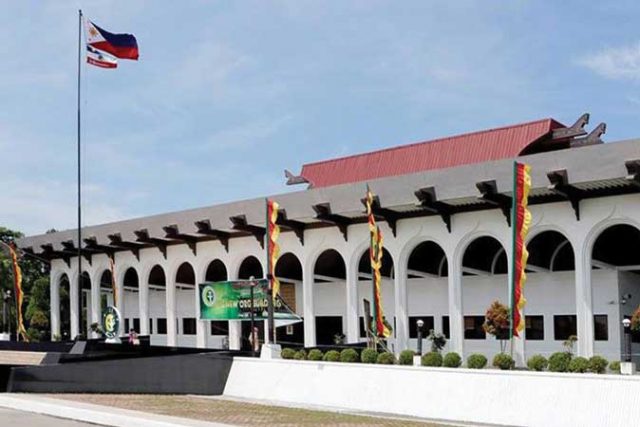
THE HEAD of the Bangsamoro region in southern Philippines promised the immediate transmission of the draft electoral code, a key legislation amid uncertainty over the scheduled election next year for the autonomous territory’s parliament members.

Bangsamoro Autonomous Region in Muslim Mindanao (BARMM) Chief Minister Ahod Ebrahim told members of the Bangsamoro Transition Authority, who currently make up the parliament, that the electoral code being drafted by the Cabinet will be transmitted “as soon as possible.”

“The electoral code which is probably one of the most sensitive legislation that this Parliament will enact must be carefully crafted to ensure that we put premium to the betterment of the electorate. We must ensure that it will pave the way for a genuine political exercise that shall serve the core of the regular Bangsamoro Government,” Mr. Ebrahim said during the opening of parliament’s third regular session on June 15.

At the same time, the BARMM leader expressed confidence that the proposal to postpone the election and extend the transition authority’s mandate by another three years will be granted by the Philippine Congress.

“Before I end this speech,” he said, “I would like to share with you that although there are bureaucratic challenges along the way — the call for the extension of the transition period has never been more resounding than now.”

“The President and the leadership of the Senate and the House of Representatives are giving us the nod that it will happen,” Mr. Ebrahim said.

He also reiterated that the call to extend the transition period “is never about power.”

“It is about ensuring the successful implementation of the Bangsamoro Peace Process.”

Apart from the electoral code, the local government and revenue codes are among the six priority regulations that must be passed by the interim government as provided under the Bangsamoro Organic Law. The three others — administrative, civil service, and education — have already been approved.

Del Pan Bridge area of Pasig River found to have high fecal coliform level

A PORTION of the Pasig River under the Del Pan Bridge in Manila has been found to have extra high amounts of fecal coliform, based on a water quality test conducted by the monitoring team from the Department of Environment and Natural Resources (DENR) and Philippine Coast Guard.

Documents from the DENR showed that the fecal coliform count in the river hit 17 million most probable number per 100 milliliters (MPN/100 mL). The DENR standard for Class C waters or those used for boating or fishing stands at only 200 MPN/100 mL.

The DENR explained that water bodies with high levels of fecal coliform or waste found in humans and animals implies improper sanitary waste disposal. It added that this indicates contamination of human or animal waste from various residential and commercial areas.

The DENR-Coast Guard joint team conducted the monitoring test to look for possible sources of water pollution.

Among the possible polluters include domestic waste from informal settlers and traditional sailing boats called batil. — Angelica Y. Yang

PHL Azkals settle for 1-1 draw with Maldives

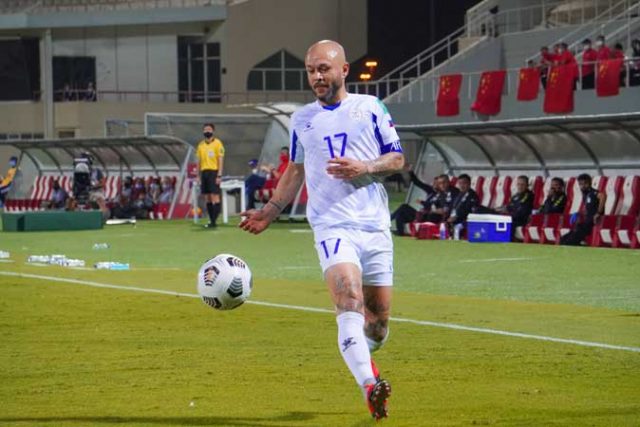
THE Philippine Azkals were held to a 1-1 draw by Maldives in their final game in the second round of the joint FIFA-AFC Qualifiers early on Wednesday morning. They, however, move on to the next face of the Asian Cup Qualifiers. — PHILIPPINE FOOTBALL FEDERATION/THE AZKALS

THE Philippine national men’s football team settled for a 1-1 draw with Maldives as it finished its campaign in the second round of the joint 2022 International Federation of Association Football (FIFA) World Cup and 2023 Asian Football Confederation (AFC) Asian Cup Qualifiers early on Wednesday morning (Manila time) in the United Arab Emirates.

Veteran Angel Guirado put the Azkals ahead 19 minutes into the match at the Sharjah Stadium but they could not maintain the lead as six minutes later Maldives pulled even, care of Ali Fasir.

The two teams tried to score the marginal goal to claim all three points the rest of the way but were not successful in it, leaving them to share the spoils and get a point each for their efforts.

After their second-round qualifiers campaign, the Azkals ended up with 11 points from a record of 3-2-3, good for solo third place in Group A.

It was not enough to book the Philippines a spot in the next round of the qualifiers for the 2022 FIFA World Cup, but the Azkals earned a trip to the next phase of that of the 2023 AFC Asian Cup to be played later this year.

Maldives (2-1-5), for its part, finished at fourth place in the group with seven points.

Syria (7-0-1) and China (6-1-1) topped Group A and are heading to the third round of the World Cup qualifiers and booked their spots in the Asian Cup. Syria progressed for winning Group A and China as one of the best runners-up.

Guam, the other team in the grouping, wound up with no wins to show for in eight matches.

PROGRESSING
Meanwhile, apart from Syria and China in Group A, also progressing in the next round of the World Cup qualifiers are Australia (Group B), Iran (Group C), Saudi Arabia (Group D), Japan (Group E) and UAE (Group F), which finished number one in their respective groups.

Korea Republic, Oman, Iraq, Vietnam and Lebanon, progressed as among the best runner-up teams.

Among the teams which have advanced, Vietnam is the lone first-timer in the third round of the World Cup qualifiers. — Michael Angelo S. Murillo

Kevin Durant’s 49-point explosion leads Brooklyn to 3-2 series edge

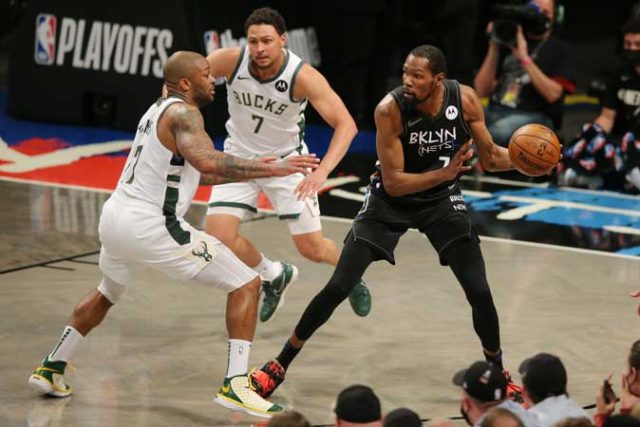
BROOKLYN Nets power forward Kevin Durant (7) controls the ball against Milwaukee Bucks power forward P.J. Tucker (17) and Bucks guard Bryn Forbes (7) at Barclays Center. — REUTERS

KEVIN Durant totaled 49 points, 17 rebounds and 10 assists as the Brooklyn Nets stormed back and beat the Milwaukee Bucks (114-108) on Tuesday night in Game 5 of the Eastern Conference semifinals in New York.

The Nets, who overcame a 17-point, third-quarter deficit, lead the best-of-seven series 3-2 thanks to one of Durant’s most impressive postseason performances. They would advance to their first Eastern Conference finals since 2003 if they can win  on Thursday night in Milwaukee. Game 7, if necessary, would be played in Brooklyn on Saturday.

Durant set a franchise record for points in a playoff game, breaking the mark of 43 set by Vince Carter in 2006. He also posted his second career postseason triple-double and joined Hall of Famers Oscar Robertson, Charles Barkley and Dallas Mavericks guard Luka Dončić as the fourth player with at least 40 points, 15 rebounds and 10 assists in a postseason game.

Durant shot 16 of 23 from the field, made four of nine 3-point attempts and hit 13 of 16 free throws. He finished one point shy of his postseason career high, set with the Golden State Warriors in Game 6 of the 2019 Western Conference finals against the Los Angeles Clippers.

On Tuesday, Durant scored 31 points in the final 18:38, when the Nets outscored Milwaukee 54-32. He scored 11 in the third to get Brooklyn within 87-81 entering the fourth and then gave the Nets a 97-96 lead on a 3-pointer with 7:54 remaining.

The Bucks tied the game at 104 on a short jumper by Jrue Holiday with 2:24 remaining, but the Nets took the lead for good on two free throws by James Harden with 87 seconds to go. Durant finished off his big game with a 3-pointer and three free throws in the final 50.5 seconds.

Brooklyn’s Jeff Green added a playoff-career-high 27 points by shooting eight of 11 and hitting seven of eight 3-point tries. Blake Griffin chipped in 17 points for the Nets, who shot 49.4 percent from the floor.

Harden went from doubtful to active but wound up with just five points on one-of-10 shooting. He missed the previous three games due to right hamstring tightness.

Giannis Antetokounmpo led Milwaukee with 34 points and 12 rebounds. Khris Middleton added 25 and Holiday chipped in 19 for the Bucks, who also shot 49.4 percent on field-goal attempts.

Antetokounmpo, Holiday and Middleton combined for 22 points as the Bucks smothered the Nets into missing 16 of 20 shots, guiding Milwaukee to a 29-15 lead after the opening quarter. The visitors held a 59-43 edge at half time. — Reuters

Antetokounmpo, Jokić, Curry, Dončić and Leonard named first-team All-NBA

LEAGUE MVP Nikola Jokić of the Denver Nuggets and unanimous selection Giannis Antetokounmpo of the Milwaukee Bucks made the All-NBA first team, announced on Tuesday.

They were joined on the first team by Golden State Warriors guard Stephen Curry, Dallas Mavericks forward Luka Dončić and Los Angeles Clippers forward Kawhi Leonard.

Despite being a finalist for the MVP award, Philadelphia 76ers Joel Embiid was only a second-team All-NBA selection due to position limitations — each team only featured one center, and Jokić beat out Embiid in votes.

Embiid was joined on the second team by Portland Trail Blazers guard Damian Lillard, Phoenix Suns guard Chris Paul, Los Angeles Lakers forward LeBron James and New York Knicks forward Julius Randle.

The five to make the third team were guards Kyrie Irving (Brooklyn) and Bradley Beal (Washington), forwards Jimmy Butler (Miami) and Paul George (Los Angeles Clippers) and center Rudy Gobert (Utah).

It marked the first career All-NBA selections for Randle and Beal. James notched his 17th All-NBA selection and Paul earned his 10th.

The next two guards receiving votes were the Wizards’ Russell Westbrook and the Nets’ James Harden, falling just behind their respective teammates, Beal and Irving. Forwards who narrowly missed the cut included the Celtics’ Jayson Tatum, the Pelicans’ Zion Williamson and the Nets’ Kevin Durant.

Harden and Tatum each earned two first-team votes despite not accumulating enough total votes for inclusion on any of the three teams.

Jokić earned 99 first-team votes and one second-team vote to fall just shy of joining Antetokounmpo as a unanimous pick. Curry earned 98 first-team votes and two second-team votes, earning his seventh career All-NBA selection.

Jokić became the first second-round draft pick in league history to be named MVP. Jokić started all 72 games for the Nuggets and averaged 26.4 points, 10.8 rebounds and 8.3 assists per game — all setting or matching career highs.

The Serbian shot 56.6 percent from the floor, including 38.8 percent from 3-point range, and added 1.3 steals and 0.7 blocks per contest.

Antetokounmpo, the league MVP in 2019 and 2020, averaged 28.1 points, 11.0 rebounds, 5.9 assists, 1.2 blocks and 1.2 steals per contest over 61 games for Milwaukee.

Curry won the NBA scoring title by leading the league with 32.0 points per game a year after suffering a broken left hand. — Reuters

NBA releases list of 69 players attending the draft combine

SOUTHERN California forward Evan Mobley and National Basketball Association (NBA) G League prospects Jalen Green and Jonathan Kuminga are among the 69 players the league expects to attend the NBA draft combine in Chicago from June 21-27.

Last year’s combine was reformatted due to the COVID-19 pandemic. Prospects had interviews via videoconference and took part in individual drills in NBA facilities around the country.

But this year’s event is back to a central location, Wintrust Arena and the Marriott Marquis in Chicago. Teams will be able to conduct interviews with prospects. Five-on-five games among prospects are set to make a return alongside shooting, strength and agility drills, all during the heart of the combine from June 22-25.

Some players attending the NBA G League Elite Camp in Chicago from June 19-21 will be selected to join the combine as well.

Two top prospects, Oklahoma State’s Cade Cunningham and Gonzaga’s Jalen Suggs, will not attend the combine. Other stars from the 2020-21 college basketball season on the list expected to attend include Davion Mitchell (Baylor), James Bouknight (UConn), Ayo Dosunmu (Illinois), Corey Kispert (Gonzaga), Johnny Juzang (UCLA) and Max Abmas (Oral Roberts). — Reuters

Hummels own goal gifts France 1-0 win over lackluster Germany

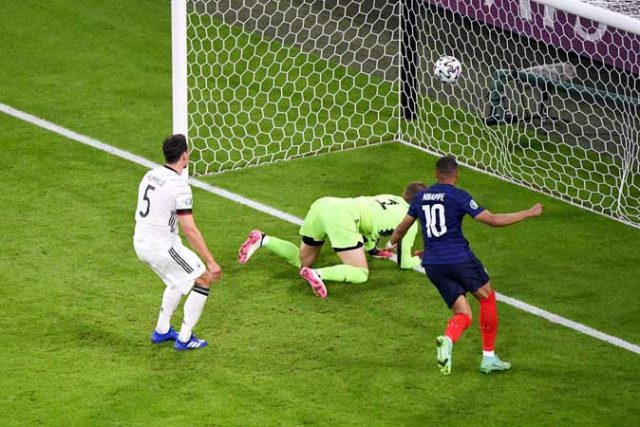
GOALKEEPER Manuel Neuer (Germany) cannot prevent the own goal by Mats Hummels (Germany, 5). — REUTERS

MUNICH, Germany — Title favourites France launched their Euro 2020 Group F campaign with a 1-0 victory over Germany on Tuesday, courtesy of an own goal by Mats Hummels, as the sluggish-looking hosts lost their opening fixture at the European Championship for the first time.

The world champions went ahead in the 20th minute when midfielder Paul Pogba’s raking pass was fired back across the goal by Lucas Hernandez and defender Hummels shanked the ball into his own net as he tried to clear it.

It was a deserved win for France, who also hit the crossbar while the Germans now have to up their game against holders Portugal on Saturday, while France plays Hungary.

“It was our first match and it was a huge game,” said France coach Didier Deschamps. “It could have been a semifinal or a final. But we have the three points that will be very important.

“They are tough to play against but we were there, on the spot. This win does a lot of good.”

Germany’s record 50th Euro match got off to a tentative start before a couple of French chances fell to Pogba and Kylian Mbappe.

The visitors’ gradual pressure paid off when Pogba launched an outstanding cross-field pass to Hernandez, who cut the ball back only for Hummels, who had been dropped more than two years ago and was recalled for the tournament, to clip it into the roof of the net past his own goalkeeper Manuel Neuer.

The Germans were desperate to impress in front of a home crowd to make amends for their shock 2018 World Cup first-round exit, but instead they rarely broke through the French rearguard.

When they did it was usually with Robin Gosens from the left, and one of his crosses found Ilkay Gundogan, whose shot veered wide of the post.

It was France who almost scored again in the 52nd when another quick break saw Adrien Rabiot cut in from the left but he hit the post with Neuer already moving in the opposite direction.

That looked to shake the hosts into action, and they carved out three consecutive chances, with Gosens again in the mix, until an injury to Benjamin Pavard around the hour mark gave the French some much-needed respite.

France gradually conceded possession but remained lethal on the break with Mbappe and Karim Benzema both putting the ball in the net but having their efforts ruled offside.

Mbappe was also denied what looked like a penalty after out-sprinting Hummels to chase down a long ball in the 78th minute, but replays showed the German got just enough boot to the ball to prevent a shot before Mbappe went to ground.

“It was a brutally intense game and we fought until the end,” Germany coach Joachim Loew said. “An own goal decided it. I cannot blame the team because we fought a lot. We maybe lacked a bit of punching power in and around the box.”

“Tomorrow, we have to process things but look ahead. We lost, we are disappointed, but we still have two games and we can fix it.”

France, unbeaten in their last 17 competitive outings, are second in Group F behind holders Portugal, who beat Hungary 3-0 earlier on Tuesday. — Reuters

DeChambeau hoping for US Open showdown with Koepka

SAN DIEGO, CA — Bryson DeChambeau made a concerted attempt on Tuesday to put a light-hearted spin on his public feud with Brooks Koepka, describing it as “great banter” and welcoming a potential on-course showdown between the pair at this week’s US Open.

Defending champion DeChambeau and 2017 and 2018 winner Koepka between them have won three of the past four US Opens, and their recent feud could hardly have come at a better time for anyone looking for a bit of acrimony in a sport with a staid public image.

Further down the track, DeChambeau and Koepka face the intriguing prospect of being American Ryder Cup team mates in September.

Their feud stems from a leaked interview Koepka recorded with Golf Channel after the PGA Championship last month. As DeChambeau walked behind the camera, Koepka rolled his eyes and made obvious his distaste for the player.

Though the video did not air on the Golf Channel, it soon popped up on social media.

DeChambeau was heckled at the Memorial tournament in Ohio two weeks ago by some rowdy spectators who yelled out Koepka’s name, and could face the prospect of similar treatment at Torrey Pines.

Koepka kept the feud alive by subsequently posting a video on social media thanking the fans who had yelled his name in Ohio, and promising free beer for their support. — Reuters

Japan’s Naomi Osaka must find ‘safe space’ to overcome issues, says Evert

LONDON — Japan’s world number two Naomi Osaka must take the time to be in a “safe space” and seek help to figure out the dilemma she finds herself in, according to American tennis great Chris Evert.

Osaka withdrew from the French Open before the second round in the wake of controversy caused by her decision to skip mandatory post-match news conferences at the tournament.

She revealed that she had been suffering bouts of anxiety and depression since bursting into the limelight by winning the US Open in 2018, the first of her four Grand Slams.

Osaka is yet to announce whether she will return to play at Wimbledon which starts on June 28.

“I have no idea, I don’t know, I’m not in her head,” Evert, an analyst for broadcaster Eurosport, told Reuters when asked whether Osaka should play at the grasscourt championships.

“You have to walk in someone’s shoes. I just hope she takes the time that she needs to get away to be in a safe place, a safe space, to have good people around her.

“She needs professionals to help her figure it out, the dilemma that she’s in.” — Reuters

Migration and financial stability: Revisiting what we know about remittances

PCH.VECTOR-FREEPIK

While we champion our OFWs for being a pillar of our economy, with the top-of-mind statistics — 10% of the population, representing 10% of the GDP — many people are unaware of how remittances are being used on a daily basis. Indeed, if remittances are increasing, the skill sets of migrants and their jobs supposedly improving abroad, then should not the second, third generations left in the Philippines by now be better off? Why is poverty still so rampant? Why is there a continuing need, and not simply desire, to follow in the footsteps of the generations before and seek a better fortune elsewhere?

Several studies in Migration and Economics have shed light on how families of migrants in the home country use the money remitted. I explained in an earlier column how in countries where migrants are predominantly female, there is a tendency to use the funds as a form of “mothering from afar.” Beyond this, studies have also shown that, 1.) Income earned abroad is significantly higher and is less volatile than other income flows, 2.) Remittances can be seen as insurance products, 3.) Usage of remittances are mainly for education, repaying debt, and savings.

Income earned abroad is significantly higher and is less volatile than other income flows. An ADB study by Ang et al. (2009) showed that the average annual income of OFW households in the Philippines is about 73% greater than the average annual income of non-OFW families who are dependent on wage and entrepreneurial income. Unsurprisingly, this is enough to justify how migration is a legitimate investment strategy. Indeed, why risk becoming an entrepreneur or slave away as an employee, with no guarantee of such returns? And speaking of risk, a World Bank study has found that the amount sent back is usually not linked to the general economic situation in the host country. Meaning: migrants continue to send the same amounts home whenever possible. They keep a stable amount, similar to giving a monthly salary, to provide stability and support to the family. This mitigates the problem of instability of income flows which keep the poor, poor. One study showed that Migrants from poor countries to rich countries can multiply their real earning potential by between three and 10 times.

Remittances can be seen as insurance products. The poor face much higher risks in terms of health and other unforeseen events (e.g., losing one’s home and job) which current savings strategies and available financial products cannot mitigate. However, they do try to do as much as they can. Yet no matter the effort made in saving, these amounts are often gone or measly compared to what is needed in times of difficulties. Because the poor are unable to pay insurance premiums at regular times, remittances can combat this wherein when there is a decline or shock in the income of the recipient household, there is a corresponding increase in remittances, operating fundamentally as an insurance policy (Yang & Choi 2007).

Usage of remittances are mainly for education, repaying debt, and savings. Based on several studies in the Philippine context, including government-wide surveys, we have clearer insight as to how migrant families use their increased incomes when they have remittances. The Bangko Sentral releases consumer expectations survey every quarter and while the numbers fluctuate, generally, more than 90% use remittances to purchase food, around 70% use the funds partly for education, 65% for medical expenses, 50% for debt repayments, and a little less than 50% used them for savings. The top three allocations were food, followed by rent, and then education. These numbers are relevant in telling us the hierarchy of what the money is being used for. Several other studies have illustrated that whereas most households used remittances for food, having additional income negatively influences the share of food consumption in total expenditure and thus allow them to spend for other things. The fact that education features so strongly is important: the poor believe in education, and yet must supplement food expenditures — illustrates how households have a long way to go in being self-sufficient.

Sixty percent reported that they were able to save and 87% kept their savings in banks. Even if they were highly indebted and continued repaying debt, they nevertheless managed to save. The OFW households also appeared to have more leisure activities, own more gadgets such as computers and laptops, and were more inclined to eat out, shop, watch movies, socialize (including drinking and attending parties), travel, and go to the mall. Some even allot a budget for charitable acts. At the end of the day, one empirical study points out that a lot depends on the treatment of remittances either as permanent income (used to augment basic consumption like food) or transitory income (used to finance purchases of durable goods, repay debts, housing and housing repairs). Finally, migrants are known to have a “home bias in investing.” That is, money is used to fund entrepreneurships and investments in the home country rather than in the host country, regardless of economic conditions abroad. That is, no matter how long they have been away, they keep looking back.

References:

Ang, A., Jha, S., & Sugiyarto, G. (2009). “Remittances and Household Behavior in the Philippines.” Asian Development Bank Economics Working Paper No. 188.

Yang, D., & Choi, H. (2007). “Are remittances insurance? Evidence from rainfall shocks in the Philippines.” The World Bank Economic Review, 21(2), 219-248.

Other References are available upon request.


Daniela “Danie” Luz Laurel is a business journalist and anchor-producer of BusinessWorld Live on One News, formerly Bloomberg TV Philippines. Prior to this, she was a permanent professor of Finance at IÉSEG School of Management in Paris and maintains teaching affiliations at IÉSEG and the Ateneo School of Government. She has also worked as an investment banker in The Netherlands. Ms. Laurel holds a Ph.D. in Management Engineering with concentrations in Finance and Accounting from the Politecnico di Milano in Italy and an MBA from the Universidad Carlos III de Madrid.

A digital mindset

VECTORJUICE-FREEPIK

So much has changed in the world in the last 18 months, particularly in the way technology has found its way in many everyday things. But, moving forward, given current trends, it may no longer be enough for one to simply know how to use technology. One may also have to start adopting a Digital Mindset.

In short, one’s attitude and behavior towards technology may also have to change. Digital Technology is no longer just a tool to get things done. It may be also viewed as a means to achieving the “impossible.” In it lies the power to foresee and appreciate potential and possibilities, and to imagine a future where current impossibilities become realities.

After the world survived the destructive force that was World War II, who would have thought that 70 years on people’s daily lives would be so influenced and affected by computers and artificial intelligence; telephones would be “mobile,” or customers would buy things without a “store,” or cars would run on electricity, or “money” would not have to be in paper or in coins.

Back in the day, if one wanted to produce and sell a book, then the author would need an editor and publisher, a book designer, a printer and a binder, a distributor, and then book stores. Reach was limited by the number of books printed, and the number of stores that sold them. And to distribute globally would be an expensive logistical nightmare.

Nowadays, however, “content producers” are no longer limited by logistical concerns. One can opt to author a book, self-publish it into digital copies, and then distribute PDF versions via e-mail and online stores. No paper, no printing, no binding, no packing, no trucking to stores, no displays on shelves, and no more people buying at bookstores and carrying around books.

The digital version of the book, or e-book, can be downloaded to one’s mobile phone. It could be bought online and paid for using e-money. No physical book or money will need to change hands. A shorter, perhaps cheaper, process that takes into account the three things that most people carry around every day: wallets, keys, and phones.

In the last 18 months, I have not had to use much cash and made only a few trips to the bank or ATMs. Many purchases were made online, and paid with e-wallets or an e-credit card. Stores purchases were made with regular credit cards, while even drive-through purchases were paid with some form of electronic money. Even tollway payments were made electronically through RFIDs. Most bills are delivered electronically, and most bills payments are done electronically as well.

Also, I used to buy a lot of pre-owned books, and a few new ones once in a while. But this has not been the case of late. I have not bought a book for over 18 months now, as I have not stepped into a bookstore since the pandemic started. Moreover, books take up a lot of shelf space in a tiny home. So, I have actually started giving away a lot of them. And I have not had to buy much printing paper as well.

I keep more files electronically now than maybe 15 years ago, when I had mountains of files laying around all over the place. I also do most of my reading on screen now. Either a laptop, a tablet, or a mobile phone is always on hand. Not a healthy habit, really. Electronic-based reading, for work or leisure, can take its toll on the eyes and hands and arms, not to mention the neck, shoulders, and back. Hours in front of the computer can be physically tiring as well.

My household has also spent a small fortune since March 2020 on better connectivity and digital systems that included laptops, tablets, mobile devices, routers, LAN cables, and a Network Attached Storage to serve as a data server at home. With parents working at home and children doing school from home, productivity and efficiency required an updated digital infrastructure.

Parents nowadays have to contend less with school books and supplies, and preparing lunches, and more with handling device failures, computer glitches, and poor internet connection. Parents also need to learn along with their children how to use new software applications that are needed for schoolwork.

With Work-From-Home and School-From-Home, and given the health protocol limits to calling service technicians into one’s home, a parent is also forced to be tech-proficient in one way or the other when trouble arises. Add to that some minor carpentry, plumbing, and electrical work in addition to regular cleaning and laundry at home. Thankfully, cooking can still be outsourced through take-out and food delivery.

As Digital Technology now find its way in most everything people do, it is pointless to resist its pervasiveness. Just a matter of time for a Digital Life to become truly a way of life for most. Computers and electronic devices were expensive luxuries in the 1970s and 1980s, as mobile phones were in the 1990s. But now, they are all everyday devices for work and leisure. Children born in the last 10 years are mostly Digital Natives.

Of course, catch-up remains an issue. The Digital Divide is wide, with the have-nots falling behind. In this line, digital technology should be made accessible to all, initially as a matter of policy. Legislation and regulation can then be calibrated to promote awareness and access. But for those with the access and the resources, no matter how few they are, it is also time to step up.

And this brings me to the point that environment, situation, and circumstance — and not just choice — can prompt people towards adopting a Digital Mindset. One must start looking beyond what digital technology currently does, and begin realizing what else it can do in the future. And this means investing time, effort, and resources to better appreciate its value and contribution to achieving unrealized potential and new possibilities. 


Marvin Tort is a former managing editor of BusinessWorld, and a former chairman of the Philippine Press Council

matort@yahoo.com

Vaccinate then stimulate

FREEPIK

After close to six years of “retirement” from sports column writing at the Philippine Star, I am back but this time in the op ed pages of this paper.

Fortunately, I am not new to writing for BusinessWorld. I have been here before as an occasional columnist for the De La Salle Graduate School of Business’ monthly column, “View from Taft.” I was Dean of the Graduate School of Business then and one of my tasks was to write a column to commemorate important national events: the anniversary of People Power 1, Independence Day, commemoration of the August 21, 1983 execution of Ninoy Aquino, recollections on the proclamation of martial law, National Heroes Day, and business and education management matters.

When I retired as dean in 2008, I still continued to teach as part time faculty. I would sometimes be called upon to write about the same important events of national interest. While writing my business column for De La Salle, I also wrote for two broadsheets’ business pages, and continued writing a sports column called “Sports for All” for the Philippine Star from February 2002 up to March 2015 when I was elected president of the Philippine Athletics Track and Field Association (PATAFA). My sports editor advised me of a potential conflict of interest between being head of the association that governs the sport of athletics track and field, the centerpiece event of any Olympics, multi-sport gathering.

That was not the first time the Star had pointed out a conflict of interest. Earlier in 1995, when President Fidel V. Ramos appointed me as chairman of the Philippine Sports Commission, my sports editor Lito Tacujan, gently invoked a policy of the Star prohibiting government officials from writing columns in the Star. Lito was a friend from way back in the early 1970s when I was asked to write about an international football tournament by the Philippine Herald. Lito and I were together at the Herald with the late Iking Gonzalez as our editor.

My weekly sports column writing actually started in 1989 when the late Betty Go-Belmonte asked me to write for the Star. I had just resigned from my post as Secretary of Agrarian Reform after paying a heavy public price for making the Comprehensive Agrarian Reform Program (CARP) the genuine social justice program that it was intended to be. There were too many powerful forces that threw roadblocks and installed land mines all over the place. People whose participation was crucial to CARP’s orderly implementation were the first ones to sabotage it.

After this brief trip down memory lane, we are here to deal with the here and now, with all the confusing issues ranging from the pandemic and how it has impacted the economy, human behavior, Government, food production and security, livelihood, banking practices and lending policies, and its other serious consequences. We shall, of course, also deal with our territorial integrity, the protection and promotion of democracy, governance and accountability issues, business trends and new ideas that will affect daily lives.

A prime topic for discussion is the Archer Talks Forum that I, together with De La Salle High School class of 1965 and college 1970 had the privilege of organizing on May 12. Archer Talks is an inclusive forum that provides an opportunity for the honest, objective, dispassionate, and respectful discussion of matters of personal and professional interest.

The bi-monthly forum had as its first speaker retired Senior Associate Justice Antonio Carpio who provided and informative and instructive update on the West Philippine Sea.

The second forum, held last Saturday, had Monetary Board member and former Secretary of Socio-economic Planning and NEDA director general, Dr. Felipe Medalla discussing the Philippine economy before, during, and after the pandemic. The main message of Medalla (who earned his doctorate in economics at Northwestern University) was “vaccinate and stimulate.” The former dean of the University of the Philippines School of Economics and cum laude graduate of Economics and Accounting at De La Salle, expressed frustration at government passing laws and implementing programs to stimulate economic activity and spending while at the same time locking down whole areas and restricting business activity.

Dr. Luis Dumlao, the forum’s second speaker, discussed economic trends over the years. At the latter part of his talk, he provided examples of successful social enterprises in agriculture.

Dr. Dumlao, who is Dean of the John Gokongwei School of Management at Ateneo, cited the late John Gokongwei for creating a conglomerate that employs thousands practically totally from borrowed funds.

At this point, readers may ask what is the meaning of the title of this column: “Earning Our Tomorrows.”

The title comes from a poem by British-born American poet Edward Albert Guest. It is entitled, “Have You Earned Your Tomorrow?”

The poem went viral some weeks ago. It was featured in a video that had motivational speaker Simerjeet Singh reciting portions of the poem which I will quote later.

For now, I will retell the thoughts of Heraclitus, the Greek philosopher: “What you choose; what you think; what you do is what you become”

Singh quotes Guest, “as you close your eyes in slumber, do you think that God would say ‘you have earned one more tomorrow by the work you did today?’…. Did you waste the day or lose it? Did you leave a trail of kindness or a scar of discontent? As you close your eyes in slumber, do you think God would say, ‘you have earned one tomorrow by the work you did today.’”

Folks, let’s earn our tomorrow.


Philip Ella Juico’s areas of interest include the protection and promotion of democracy, free markets, sustainable development, social responsibility and sports as a tool for social development. He obtained his doctorate in business at De La Salle University. Dr. Juico served as Secretary of Agrarian Reform during the Corazon C. Aquino administration.

ADVERTISEMENT
ADVERTISEMENT