Home Blog Page 7896

Ayton’s last-second dunk lifts Suns over Clippers

DEANDRE Ayton made a go-ahead alley-oop dunk off an inbound pass with 0.7 second remaining as the Phoenix Suns earned a 104-103 victory over the visiting Los Angeles Clippers on Tuesday to take a 2-0 lead in the Western Conference finals.

Cameron Payne scored a career-high 29 points for the Suns, and Ayton contributed 24 points and 14 rebounds. Devin Booker scored 20 points, playing after getting his nose bloodied late in the third quarter and having stitches.

The Suns increased their playoff winning streak to nine games.

Payne stepped up to make 12 of 24 shots from the field and had nine assists with no turnovers. He was starting at point guard for the second consecutive game with Chris Paul in health and safety protocol after he reportedly tested positive for COVID-19.

Paul George scored 26 points and Reggie Jackson added 19 for the Clippers, who fell behind 2-0 in their third consecutive series. They rallied to defeat the Dallas Mavericks in the first round and came back against the top-seeded Utah Jazz in the conference semifinals.

George missed a pair of free throws with 8.2 seconds remaining that gave the Suns a chance to win the game.

The Clippers were playing their fourth consecutive playoff game without forward Kawhi Leonard, who is out due to a sprained right knee.

Game 3 is set for Thursday night at Los Angeles, where the Clippers have won their past four after losing their first three home contests to Dallas. — Reuters

NBA mock draft: Pistons can’t pass up Cade Cunningham

THE Detroit Pistons won the NBA draft lottery Tuesday night, meaning they will select first overall for the first time since 1970.

Their chances to land the No. 1 pick were tied for the best with the Houston Rockets and Orlando Magic. Houston ended up second, while Orlando slipped to fifth.

In the spirit of immediate reactions to a draft order that is guaranteed to change via trades between now and July 29, here are our best bets for the first 14 picks on draft night.

1. Detroit Pistons: G Cade Cunningham, Oklahoma State

The Pistons need an injection of talent all over their roster, and they earned the right to land the most complete talent in this class, an enviable blend of size, playmaking skill and shooting ability.

2. Houston Rockets: G Jalen Suggs, Gonzaga

John Wall is not the long-term answer at point guard. Suggs can dish the ball to Christian Wood and whoever else is left on this roster as Houston starts over.

3. Cleveland Cavaliers: C Evan Mobley, Southern California

The Cavaliers’ backcourt of the future is set with Collin Sexton and Darius Garland, so Mobley can join a frontcourt that features an aging Kevin Love.

4. Toronto Raptors: G Jalen Green, G League

Adding Green would be especially useful to the Raptors’ offense if Kyle Lowry walks in free agency.

5. Orlando Magic: F Jonathan Kuminga, G League

A new option on the wing for a team sorely lacking them, Kuminga also would bolster an already solid rebounding team.

6. Oklahoma City Thunder: G Davion Mitchell, Baylor

So you missed out on first dibs on the Oklahoma State product. It’s a lottery, after all. A nice consolation prize at guard is this tough defender who just carried his team to the NCAA championship.

7. Golden State Warriors: G Keon Johnson, Tennessee

The Warriors made up for a down year with a nice lottery haul, as Minnesota’s No. 7 overall pick was conveyed to them. They start with a wing to help on the defensive end of the floor.

8. Orlando Magic: F Jalen Johnson, Duke

The Magic’s second pick is conveyed from Chicago. This team needs frontcourt help, too, and Johnson can move the ball around from down low.

9. Sacramento Kings: F Scottie Barnes, Florida State

Sacramento was bottom five in the NBA in both scoring defense and perimeter defense in 2020-21. Barnes is a versatile defender who can help in those departments.

10. New Orleans Pelicans: F/C Alperen Sengun, Turkey

Zion Williamson is great on his own. Pair him with this budding star from overseas, the Turkish League’s MVP at just 18 years old, and the Pelicans’ frontcourt would be one to reckon with.

11. Charlotte Hornets: F Corey Kispert, Gonzaga

One of the top shooters in the draft falls to a team that would love to pair someone up with Rookie of the Year LaMelo Ball and boost its below-average 45.5 percent team shooting rate.

12. San Antonio Spurs: F Franz Wagner, Michigan

No longer the postseason lock they used to be, the Spurs need some help just about everywhere. Wagner does a little bit of everything, from defending to facilitating to scoring.

13. Indiana Pacers: G James Bouknight, UConn

Domantas Sabonis and Malcolm Brogdon can’t do everything for the Pacers going forward. Let’s give them some added scoring from a guard who could quickly become a nice complement to a healthy Caris LeVert.

14. Golden State Warriors: F/C Isaiah Jackson, Kentucky

So last year’s second overall pick James Wiseman didn’t have the best rookie campaign. We’re not saying the Warriors should bail on him, but having more options to mix and match with an aging Draymond Green couldn’t hurt. — Reuters


England gets the job done with 1-0 win over Czechs

LONDON — England delivered an efficient but hardly scintillating display to beat Czech Republic 1-0 with an early Raheem Sterling header on Tuesday to advance to Euro 2020’s last 16 as Group D winners, with the Czechs through as one of the best third-placed teams.

Sterling scored his and England’s second goal of the tournament in the 12th minute but the initial injection of pace, intensity and crowd-pleasing excitement brought by Jack Grealish and teenage man of the match Bukayo Saka gradually dissipated as the game petered out into an utterly forgettable second half.

Neither side will mind though as they now begin to plot their assaults on the knockout phase.

England returns to Wembley on Tuesday to face the runners-up from Group E — likely to be France, Germany or Portugal — while the Czechs must wait to find out which group winner they play.

They were dislodged from second place by Croatia, who beat Scotland 3-1 and will play the Group E runners-up — Sweden, Slovakia, Spain or Poland — in Copenhagen on Monday.

On the positive side of England’s balance sheet is two wins and a draw, three clean sheets, a return to Wembley and a good number of players getting a taste of the action.

Conversely, they have scored only two goals — the lowest by any team ever to top a Euros group — were sluggish and over-cautious for long periods of all three games and the midfield combination and approach seemingly remain anything but settled. They also face a potentially daunting last 16 game next. “We are not fluent but we have moments where we look a good side,” said England coach Gareth Southgate.

“The Czechs are a really good side. They use the ball well and are really tough to break down. There is more to come from us, definitely. We have not scored from a set play yet. They are crucial in big matches and we have to get those nailed.

“All of our next opponents will be different games but there are a lot of good things we are doing.”

SHARP END
Sterling was at the sharp end of England’s early attacks as they began full of energy. He struck a post in the second minute when he lifted the ball past advancing keeper Tomas Vaclik — the third time England had hit a post of the same goal early in each match.

Ten minutes later, Sterling found the target with a close-range header from a delicious floated cross by Grealish after a driving run by Saka had splintered the Czech rearguard.

Making his first appearance of the tournament, the 19-year-old wide man showed a willingness to run with the ball that was painfully absent from England’s first two performances and, with Grealish a constant menace, the hosts looked more threatening.

Harry Kane looked sharper too and had a shot well saved late in the first half by Vaclik, but that early promise was gradually replaced by the all-too-familiar caution and England barely mustered another meaningful attempt.

The Czechs were neat and tidy without carrying a huge amount of penalty box threat, though Tomas Holes had a shot palmed clear by Jordan Pickford and Tomas Soucek fired just wide in the first half.

Substitute Jordan Henderson thought he had scored his first goal for England on his 60th appearance five minutes from time after a scramble, only to see it ruled out for offside.

Overall though, it was desperately thin gruel for most of the second half, with the loudest cheers reserved for the big screen announcements of Croatia’s goals that eliminated Scotland. — Reuters

Singapore’s millionaires count expected to surge 62% by 2025 — report

REUTERS
A VIEW of the city skyline in Singapore, Dec. 31, 2020. — REUTERS

SINGAPORE’s count of millionaires could increase by more than 60% over the five years from 2020 to 2025, according to Credit Suisse Group AG, part of a surge in millionaires expected in Asia as financial capitals emerge from the Covid-19 pandemic.

The city-state may have 437,000 millionaires by 2025 compared with 270,000 in 2020, according to the bank’s 2021 Global Wealth Report. That 62% pace would be faster than Hong Kong’s estimated 60% for the same period, but slower than the growth forecast in mainland China, India, Australia, South Korea and Taiwan.

Singapore’s millionaire density — or percentage of millionaires in the total population — was 5.5% in 2020, the second-highest in Asia after Hong Kong’s 8.3%, the report said. The island nation’s Gini coefficient — a more broad-based measure of wealth inequality — was at 78.3 in 2020, much higher than Japan’s 64.4, South Korea’s 67.6 and Taiwan’s 70.8.

The wealth share of the top 1% in Singapore was almost 34% at the end of 2020, compared with 18% for Japan, 24% for South Korea and 28% for Taiwan. In a small country like Singapore, higher wealth inequality can result from an unrepresentative cluster of very high net-worth individuals, the report said. — Bloomberg

Canada’s Trudeau hits China over proposed probe into indigenous children’s remains

GENEVA/OTTAWA — China and its allies called on Tuesday for an investigation into the discovery of the remains of indigenous children in Canada at the site of a former boarding school, prompting an angry response from Prime Minister Justin Trudeau.

The remains of 215 children, some as young as three years old, were found at the Kamloops Indian Residential School in British Columbia that closed in 1978, the Tk’emlúps te Secwépemc Nation said on May 28.

“We call for a thorough and impartial investigation into all cases where crimes were committed against the indigenous people, especially children, so as to bring those responsible to justice, and offer full remedy to victims,” Jiang Duan, a senior official at China’s mission to the United Nations in Geneva, told the Human Rights Council.

Canada, locked in a trade and diplomatic dispute with Beijing, later delivered a joint statement on behalf of more than 40 countries calling for access to China’s Xinjiang region to look into allegations of the government’s mass detention of Uyghur Muslims.

Mr. Trudeau, condemning what he called “the systemic abuse and human rights violations” in Xinjiang, said a Canadian truth and reconciliation commission had worked from 2008 to 2015 to address the mistreatment of the indigenous population.

“Where is China’s truth and reconciliation commission? Where is their truth? Where is the openness that Canada has always shown and the responsibility that Canada has taken for the terrible mistakes of the past?” Mr. Trudeau asked.

“China is not recognizing even that there is a problem … that is why Canadians and people from around the world are speaking up for people like the Uyghurs,” Trudeau told reporters in Ottawa.

Mr. Jiang read the statement out on behalf of countries such as Russia, Belarus, Iran, North Korea, Syria and Venezuela, all of which have been criticized by Western nations for human rights violations.

Canada’s residential school system, which forcibly separated indigenous children from their families, constituted “cultural genocide,” the truth and reconciliation commission said in 2015. — Reuters

Oxford University explores anti-parasitic drug ivermectin as COVID-19 treatment

REUTERS

THE UNIVERSITY of Oxford said on Wednesday it was testing anti-parasitic drug ivermectin as a possible treatment for COVID-19, as part of a British government-backed study that aims to aid recoveries in non-hospital settings.

Ivermectin resulted in a reduction of virus replication in laboratory studies, the university said, adding that a small pilot showed giving the drug early could reduce viral load and the duration of symptoms in some patients with mild COVID-19.

Dubbed PRINCIPLE, the British study in January showed that antibiotics azithromycin and doxycycline were generally ineffective against early-stage COVID-19 (coronavirus disease 2019). While the World Health Organization, and European and US regulators have recommended against using ivermectin in COVID-19 patients, it is being used to treat the illness in some countries, including India.

“By including ivermectin in a large-scale trial like PRINCIPLE, we hope to generate robust evidence to determine how effective the treatment is against COVID-19, and whether there are benefits or harms associated with its use,” co-lead investigator of the trial Chris Butler said.

People with severe liver conditions, who are on blood-thinning medication warfarin, or taking other treatments known to interact with ivermectin, will be excluded from the trial, the university added.

Ivermectin is the seventh treatment to be investigated in the trial, and is currently being evaluated alongside antiviral drug favipiravir, the university said. — Reuters

NK markets in turmoil as borders stay closed

REUTERS

SEOUL — Currency exchange rates and commodity prices appear to be wildly fluctuating in North Korea (NK) as a resumption in major trade with China hasn’t materialized, media reports and analysts say, increasing the hardship for residents facing food shortages.

After steadily rebounding in the first few months of the year, China’s exports to North Korea in May fell to $2.71 million from $28.75 million in April, quashing hopes among traders along the border that more than a year of anti-coronavirus closures could soon ease.

North Korea is highly insular and it is difficult to pinpoint the situation within the country. But reports this week that China, its biggest ally, plans to keep pandemic border restrictions in place for at least another year have cast doubt on North Korea’s prospects.

In some areas, that appears to be among the factors that sparked significant volatility in foreign exchange rates and the prices of some key goods.

“The fuel and forex price swings are likely caused by the foreign trade situation,” said Peter Ward, an expert on North Korea’s economy.

Daily NK, a Seoul-based website that has tracked such indicators in North Korea for years, reported on Tuesday that North Korea’s won had surged 15-20% against the US dollar and China’s renminbi in the space of around a week.

The swings seem driven in part by North Korean organizations and individuals selling off their dollars and yuan because the expected restart of China-North Korea trade did not materialize, the website reported, citing sources in the country.

“After years of relative stability, the wild swings in prices and internal exchange rates in recent days threaten to raise the level of popular desperation and may make reopening trade with China more difficult,” a report from the US-based 38 North program, which tracks North Korea, said this week.

Last week, North Korean leader Kim Jong Un said the country’s economy improved this year but called for measures to tackle the “tense” food situation caused by the coronavirus pandemic and last year’s typhoons.

State media reported that the government would produce and distribute more grain to the people.

Daily NK reported that corn and rice prices in some of the country’s major cities, including Pyongyang, have fallen after local residents received government rations. But some other areas have seen prices soar for basic supplies, the website said.

Earlier this year, some imported luxuries reappeared on store shelves in Pyongyang as border restrictions appeared to ease, but prices have shot back up again, one Western source with contacts in the city told Reuters.

Some shampoo has been selling for $200 per bottle and a kilogram of bananas for $45, NK News, which monitors North Korea, reported last week.

“From what we can learn through Asia Press and Daily NK, the food situation outside a few major cities is very bad,” Ward said. “If these trends continue, we will have to start to worry about hunger and even starvation amongst North Korea’s poorest.” — Reuters

As banking sector consolidates, 9,000 physical branches to disappear across SEA by 2030 — report

FREEPIK

By Patricia B. Mirasol 

Traditional banks that do not adjust to meet evolving customer habits risk being overtaken by hungrier digital startups, according to big data firm ADVANCE.AI. 

“Traditional banks and financial institutions (FIs) have the customer base and brand equity, while fintechs are nimbler and more innovative, and so can tailor customized solutions for the bigger banks,” said Aradhna Sharma, Southeast Asia digital and data solutions director of ADVANCE.AI, in an e-mail interview with BusinessWorld. “Many such banks and FIs are looking to either enhance their digital capabilities by building their own technology or setting up digital subsidiaries, or else through partnering with tech startups like ourselves to accelerate their digital transformation journey.” 

Most Southeast Asia countries will significantly reduce their bank branch footprints, and only a few less mature markets are expected to slightly increase their physical networks, according to an April 2021 report by global consulting firm Roland Berger. A net reduction of more than 9,000 bank branches across Southeast Asia is expected by 2030, with the biggest consolidations driven by Indonesia, Thailand, the Philippines, and Malaysia. 

The coronavirus pandemic has compelled banks to reimagine basic hygiene services such as account deposits and bill payments. The report stated that future bank branches in Southeast Asia will likely move away from offering simple transactions and focus on higher value-added services. With key drivers such as an increased access to technology and government digital economy policies influencing the future of retail banking branch networks, traditional banks need to reimagine how they offer services that meet evolving customer needs. 

With the focus on higher value-added services, traditional bank employees must be retrained from repetitive roles, such as bank telling, to ones that require more human decisioning and skills such as creativity, problem solving, and design thinking. 

The Bangko Sentral ng Pilipinas approved on November 2020 the recognition of digital bank as a new bank category that is separate and distinct from existing bank classifications. A digital bank is defined as a bank that offers financial products and services that are processed end-to-end through a digital platform and/or electronic channels with no physical branches. 

BENEFITING THE UNBANKED
The benefits of virtual banks also redound to the unbanked and underbanked, as they enable these segments  many of whom come from rural areas  quicker access to loans and financial services, Ms. Sharma said. 

“With virtual banking, customers can be onboarded and have access to banking services solely through their mobile phone, anywhere and anytime, without having to step into a bank branch,” she added. 

More than 70% of the population of Malaysia, Vietnam, and the Philippines have access to the internet (above the global average of 54%), the Roland Berger report said. 

“AI can be deployed in a variety of ways to facilitate customer onboarding via your smartphone,” said Ms. Sharma. “A simple video call with a customer service agent could also cut the need for a trip to the physical bank.” 

Examples of customer onboarding include digital identity verification and authentication by taking selfies or submitting photos of national identity documents such one’s Taxpayer Identification Number (TIN). With the use of AI software and optical character recognition (OCR) technology, meanwhile, an agent can verify and match the authenticity of the caller with the documents shown on the video call. Ms. Sharma added that these verification techniques will gradually phase out the reliance on cash on delivery (COD).  

Ms. Sharma told BusinessWorld that physical banks remain an important touchpoint to help consumers in the transition towards online banking. 

“You also have certain times (e.g., setting up a business, buying property, mortgage/wealth management, retirement planning) when complex discussions or high-value transactions are better done face-to-face to build trust, understanding, and relationships,” she said. “Physical banks are still instrumental in providing a human touch, but the question is, how many do you need?” 

Meralco Improves substation in Cabuyao, Laguna

Meralco recently commissioned a new 83 MVA transformer bank no. 2 in its Light Industry and Science Park (LISP) 115 kV – 34.5 kV Substation located along South Street, Cabuyao, Laguna. This additional transformer bank will provide the additional capacity needed to serve the new load requirements of locators inside the LISP, as well as the increasing power demand in the City of Cabuyao in Laguna.  This project is also expected to reduce system losses, improve system reliability and voltage regulation, and provide adequate supply of electricity to the Meralco customers in the area.  Despite the continued implementation of community quarantine measures throughout the country due to the COVID-19 pandemic, Meralco personnel and its subsidiaries are continuously working round the clock to execute major capital projects to “Keep the Lights On”, “Save Lives” and “Keep the Hopes Alive” for its customers.

China condemns latest US warship transit of Taiwan Strait

NAVY.MIL

BEIJING/TAIPEI  China condemned the United States on Wednesday as the region’s greatest security “risk creator” after a US warship again sailed through the sensitive waterway that separates Taiwan from China. 

The US Navy’s 7th Fleet said the Arleigh Burke-class guided missile destroyer USS Curtis Wilbur conducted a “routine Taiwan Strait transit” on Tuesday in accordance with international law. 

“The ship’s transit through the Taiwan Strait demonstrates the US commitment to a free and open Indo-Pacific.” 

The People’s Liberation Army’s Eastern Theater Command said their forces monitored the vessel throughout its passage and warned it. 

“The US side is intentionally playing the same old tricks and creating trouble and disrupting things in the Taiwan Strait,” it said. 

This “fully shows that the United States is the greatest creator of risks for regional security, and we are resolutely opposed to this.” 

Taiwan’s Defense Ministry said the ship had sailed in a northerly direction through the strait and the “situation was as normal.” 

The same ship transited the strait a month ago, prompting China to accuse the United States of threatening peace and stability. 

The latest mission comes around a week after Taiwan said 28 Chinese air force aircraft, including fighters and nuclear-capable bombers, entered Taiwan’s air defense identification zone (ADIZ), the largest reported incursion to date. 

That incident followed the Group of Seven leaders issuing a joint statement scolding China for a series of issues and underscoring the importance of peace and stability across the Taiwan Strait, comments China condemned as “slander.” 

The US Navy has been conducting such operations in the Taiwan Strait every month or so. 

The United States, like most countries, has no formal diplomatic ties with democratic Taiwan but is its most important international backer and a major seller of arms. 

Military tension between Taiwan and Beijing have spiked over the past year, with Taipei complaining of China repeatedly sending its air force into Taiwan’s air defense zone. — Reuters

Trial of first person charged under Hong Kong’s national security law begins

Image via Comma Papana BS200/CC BY-SA 4.0/Wikimedia Commons

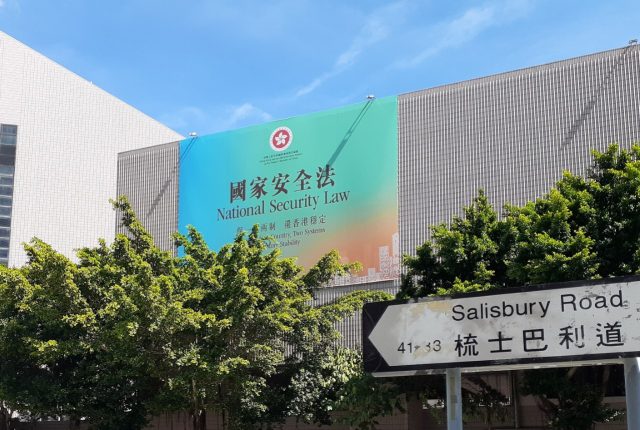
HONG KONG  The trial of the first person charged under the national security law in Hong Kong begins on Wednesday, almost a year after he was charged with driving his motorbike into officers during a rally while carrying a flag with a protest slogan. 

The case of Tong Ying-kit is seen as a departure from Hong Kong’s common law traditions, as he was denied bail and a jury, and a test of the government’s claim that the slogan “Liberate Hong Kong! Revolution of our times” is secessionist. 

Mr. Tong, 24, was arrested on July 1, 2020, hours after the enactment of the national security law, which punishes what China deems as subversion, secessionism, terrorism and collusion with foreign forces with up to life in prison. 

Mr. Tong faces charges of terrorism and inciting secession, as well as an alternative charge of dangerous driving causing grievous bodily harm, which can lead to up to seven years in prison. 

Mr. Tong has been denied bail. Hong Kong’s common law has traditionally allowed defendants to seek release unless prosecutors can show lawful grounds for their detention. Under the new law, the burden is now placed on the defendant to prove they will not break the law if released on bail. 

On Tuesday, the Court of Appeal upheld a decision to deny Mr. Tong a trial by jury, citing a threat to the personal safety of jurors and their family members. 

His trial will be held by a panel of three judges instead: Esther Toh, Anthea Pang and Wilson Chan. 

Hong Kong’s Judiciary describes trial by jury as one of the most important features of the city’s legal system, a common law tradition designed to offer defendants additional protection against the possibility of authorities overreaching their power. 

Article 46 of the security law  drafted by Beijing, where courts are controlled by the Communist Party and conviction rates are close to 100% – states three instances in which juries can be scrapped: protecting state secrets, cases involving foreign forces and protecting jurors’ safety.  Sara Cheng/Reuters 

US blocks websites linked to Iranian disinformation

Screenshot via www.almasirah.com

DUBAI — The US Justice Department said on Tuesday it seized 36 Iranian-linked websites, many of them associated with either disinformation activities or violent organizations, taking them offline for violating US sanctions.

Several of the sites were back online within hours with new domain addresses. 

“Today, pursuant to court orders, the United States seized 33 websites used by the Iranian Islamic Radio and Television Union (IRTVU) and three websites operated by Kata’ib Hizballah (KH), in violation of US sanctions,” the department said in a statement. 

Also spelled Kataib Hezbollah, KH is one of the main Iran-aligned Iraqi militia groups and has been designated a Foreign Terrorist Organization by the United States. 

The sites seized included Press TV, the Iranian government’s main English-language satellite television channel, and Al Alam, its Arabic-language equivalent. Both came back online using Iranian domain addresses Alalam.ir and Presstv.ir. 

The Justice Department said the 33 domains used by IRTVU are owned by a United States company and that IRTVU did not obtain a license from Treasury’s Office of Foreign Assets Control prior to utilizing the domain names. 

KH also did not obtain a license. 

Notices appeared earlier on Tuesday on a number of Iran-affiliated websites saying they had been seized by the United States government as part of law enforcement action. 

Iranian news agencies said the US government had seized several Iranian media websites and sites belonging to groups affiliated with Iran such as Yemen’s Houthi movement. 

The notices appeared days after a prominent hardliner and fierce critic of the West, Ebrahim Raisi, was elected as Iran’s new president and after envoys for Iran and six world powers, including Washington, adjourned high-stakes talks on reviving their tattered 2015 nuclear accord and returned to capitals for consultations. 

The website of the Arabic-language Masirah TV, which is run by the Houthis, read: 

“The domain almasirah.net has been seized by the United States Government in accordance with a seizure warrant … as part of a law enforcement action by the Bureau of Industry and Security, Office of Export Enforcement and Federal Bureau of Investigation.” 

The site quickly opened up a new, working website at www.almasirah.com. 

Iran’s Arabic language Alalam TV said on its Telegram channel: “US authorities shut down Al-Alam TV’s website.” 

Notices also appeared on the website of Lualua TV, an Arabic-language Bahraini independent channel that broadcasts from Britain. 

US prosecutors in October seized a network of web domains they said were used in a campaign by Iran’s Revolutionary Guard Corps (IRGC) to spread political disinformation around the world. 

The Justice Department said then it had taken control of 92 domains used by the IRGC to pose as independent media outlets targeting audiences in the United States, Europe, Middle East and Southeast Asia. 

The semi-official Iranian news agency YJC agency said on Tuesday the US move “demonstrates that calls for freedom of speech are lies.” — Reuters 

ADVERTISEMENT
ADVERTISEMENT