Home Blog Page 7854

Treasury bill rates to inch lower

BW FILE PHOTO

RATES OF Treasury bills (T-bills) on offer on Monday will likely move sideways or edge lower after inflation eased slightly last month and amid uncertainty on whether current quarantine measures would be tightened further.

The Bureau of the Treasury (BTr) is looking to raise P25 billion in fresh funds via its offering of T-bills on Monday, broken down into P5 billion from 91-day papers, P8 billion via 182-day debt and P12 billion in 364-day instruments.

Noel S. Reyes, first vice-president and chief investment officer at Security Bank Corp., expects T-bill yields to move sideways or lower.

“Inflation last month came out softer and oil prices are also consolidating off the highs which allowed longer dates to also ease off from their steepness,” Mr. Reyes said in a Viber message on Sunday.

A bond trader likewise said the rates of the short-term debt papers could move sideways or go down by up to 5 basis points (bps).

The trader said investors will monitor if inflation will continue to ease in the next months and move within the central bank’s 2-4% target.

“The still increasing number of COVID-19 (coronavirus disease 2019) cases also played a role and fuels speculation on whether the government will extend ECQ (enhanced community quarantine) for Metro Manila. If ECQ is extended, that would help demand for T-bills,” the trader added.

Headline inflation slowed to 4.5% in March from 4.7% in February mainly due to a slower increase in food prices, the Philippine Statistics Authority (PSA) said last week. However, the February print was still higher than the 2.5% seen in March 2020 and beyond the 2-4% annual target of the central bank.

Meanwhile, Malacañang had not announced the new quarantine measures for Metro Manila and nearby provinces as of this writing. The capital, along with Bulacan, Cavite, Laguna and Rizal, have been under the strictest form of lockdown since March 29 as coronavirus cases continued to climb.

On Saturday, the Health department reported 12,674 new COVID-19 infections to bring the total count to 853,209. The death toll hit 14,744 after 225 new deaths were recorded that day.

The Treasury fully awarded the P25 billion T-bills it offered last week from P67.49 billion in total bids.

Broken down, it raised P5 billion via the three-month papers as tenders reached P12.65 billion. The average rate for the 91-day debt papers went up to 1.295% from 1.269%.

Meanwhile, it borrowed P8 billion as planned through 182-day T-bills as demand hit P16.712 billion. The six-month papers fetched an average rate of 1.646%, up from 1.609% previously.

Lastly, the Treasury made a full P12-billion award of the one-year securities auctioned off from total bids of P38.126 billion. The average rate of the one-year debt stood at 1.912%, down from the previous week’s rate of 1.926%.

The trader added that the debt market could also react to the dovish tone of the minutes of the US Federal Reserve’s latest meeting released last week, as the central bank said it will continue to support the recovery of the world’s biggest economy.

The Treasury aims to raise P170 billion through the local bond market this month: P100 billion via weekly offerings of T-bills and P70 billion from fortnightly auctions of Treasury bonds.

The government is looking to borrow P3 trillion this year from both domestic and external sources to help fund its budget deficit, which is seen to hit 8.9% of gross domestic product. — B.M. Laforga


Breitling, Bentley release limited-edition chronograph

PHOTO FROM BENTLEY AND BREITLING

ONLY 25 examples of a limited-edition timepiece from Bentley Motors and watchmaker Breitling will be released this month. The Premier B21 Chronograph Tourbillon 42 Bentley Limited Edition also marks nearly two decades of partnership between the two companies.

The new watch is a reinterpretation of the original Breitling Premier wristwatches of the 1940s, and highlights a 42mm case in 18K red gold, rectangular chronograph pushers, a gold-brown alligator strap, and a transparent sapphire caseback revealing the movement within and its 22-karat gold oscillating weight.

The visual highlight is the special chronograph tourbillon caliber and cage seen through the distinctive green dial — reminiscent of the British racing green color associated with the other models within the Breitling and Bentley partnership. The COSC-certified tourbillon movement delivers 55 hours of reserve power. The timepiece promises 100 meters of water resistance.

Willy Breitling, the grandson of the brand’s founder Léon Breitling, was a passionate Bentley driver. In 1934, he patented the chronograph with two independent pushers at the two o’clock and four o’clock positions. “Besides being tech-savvy and bold, Willy Breitling understood the desire for the elegance and glamor from watch lovers,” said the company in a statement. With this in mind, Mr. Breitling designed the original Premier wristwatches in the 1940s.

Bentley Chairman and CEO Adrian Hallmark noted, “This striking watch embodies our joint commitment to pioneering spirit, expert craftsmanship and technological excellence.”

Added Breitling CEO Georges Kern, “We’re proud of this elegant symbol of our brands’ shared values: quality, performance, and design excellence.” In 2002, Bentley Motors commissioned Breitling to create an onboard clock for the Continental GT and the partnership continued to progress from there.

Corn farmers to receive aid in containing fall armyworm pest

PHILSTAR

THE DEPARTMENT of Agriculture (DA) said corn farmers will receive aid in containing the fall armyworm (FAW), including pheromone lures, pesticides, power sprayers, pest awareness materials, and digital equipment.

The program was authorized by Agriculture Secretary William D. Dar’s Memorandum Order No. 26, with funding from Republic Act No. 11494 or the Bayanihan to Recover as One Act.

According to Mr. Dar, corn accounted for 5.8% of gross value added in agriculture in 2020, valued at P102.5 billion at constant 2018 prices.

“Production was up to 8.12 million metric tons (MT) in an effective area of 2.55 million hectares with yields of about 4.18 MT per hectare for yellow corn and 1.89 MT per hectare for white corn,” Mr. Dar said in the memorandum.

Under the memorandum order, the project also provides for pest monitoring and surveillance in corn-growing areas.

According to Mr. Dar, the DA’s National Corn Program will oversee the implementation of the FAW management project and is charged with conducting assessments and filing regional reports and periodic updates, while the Regional Corn Program in affected provinces will lead the procurement of materials to be distributed to affected farmers.

The memorandum order also directed local government units to submit reports to the DA’s Regional Corn Program and regional crop pest management center as a condition for the release of pesticide and pheromone lures to their constituents.

FAW was first detected in June 2019 in Piat, Cagayan and has since spread to the Zamboanga Peninsula, Bicol, and Northern Mindanao. — Revin Mikhael D. Ochave

SEC to accept digitally signed financial statements from OST-enrolled corporations

THE Securities and Exchange Commission (SEC) said it will accept digitally signed audited financial statements (AFS) submitted by corporations through its online submission tool (OST) as Metro Manila and nearby provinces of Bulacan, Cavite, Laguna, and Rizal are still under the enhanced community quarantine (ECQ).

“In a notice issued on April 8, the Commission announced that electronically signed AFS for the period ended December 31, 2020 and for other fiscal years ending this year will be accepted through the OST,” the commission said in a statement on Friday.

The commission said it had received requests from professional and business organizations to allow the use of electronic signatures (e-signatures) in their AFS.

E-signatures are accepted for submissions made through the OST beginning March 29, when the ECQ was first implemented in the so-called NCR Bubble.

“Enrollment in the OST will ensure that the AFS submitted by corporations were duly signed and officially submitted to the Commission by their authorized filers,” the commission said.

However, the SEC is requiring corporations’ management and external auditors to make sure that manually-signed AFS will be available should it be collected by the commission, “pursuant to the exercise of its supervisory and investigative authority and visitorial power under the Securities Regulation Code and Revised Corporation Code of the Philippines.”

All stock corporations are required to file their AFS and other annual reports through the OST starting this year, while nonstock corporations will have until next year to enroll on the platform.

Stock corporations, including branch and representative offices, with a fiscal year ending Dec. 31 are required to enroll and file their AFS through the OST based on the last digit of their SEC registration or license number.

Corporations with registration or license numbers ending with 1 should submit reports within June 1-30; those ending with 2 within July 1-31; with 3 and 4 within Aug. 1-31; those with 5 and 6 within Sept. 1-30; those with 7 and 8 within Oct. 1-31; and those with 9 and 0 from Nov. 1 to 30.

“Those whose fiscal year ends on a date other than December 31 should file their AFS within 120 days from the end of their fiscal year, while publicly listed companies and other issuers of securities should file their AFS within 105 days after the end of their fiscal years,” the corporate regulator said.

Should corporations and their authorized filers encounter problems in OST enrollment or during the submission of reports, physical submission will be allowed provided that an appointment is secured with the SEC Express Appointment System. — Keren Concepcion G. Valmonte

Chinese ‘limited edition’ sneakers soar after Xinjiang backlash

SNEAKERBARDETROIT.COM/

BEIJING — Prices of some Chinese limited edition sneakers soared among collectors and speculators following calls for local consumers to boycott global brands that have said they don’t source products or yarn from China’s western Xinjiang region.

Nike and Adidas came under attack on Chinese social media last month over past comments.

Some researchers and foreign lawmakers say Xinjiang authorities use coercive labor programs to meet seasonal cotton picking needs, which China strongly denies.

The listed price of the “All Star” version of Li-Ning Way of Wade 4 on the Dewu App —  the country’s largest sneaker resale platform also known as “Poizon” — reached 48,889 yuan ($7,463) per pair, 31 times higher than the official price of 1,499 yuan, the state-owned Global Times reported last week.

Anta’s Doraemon-themed casual shoes on the platform were also eight times higher than the original price of 499 yuan.

Both offerings disappeared from Dewu, which deleted listings for numerous local shoe models after state media criticized speculation on sneaker prices and taking advantage of people’s patriotic feelings.

“A large number of internet users choose to support domestic brands, which is normal,” said an opinion piece on People.cn, the website of the People’s Daily, the official newspaper of China’s ruling Communist Party. “But some scalpers thought they have caught on to a business opportunity, as if they smelled blood.”

Dewu last Tuesday said that it deleted listings of 20 kinds of sneakers made by Chinese sportswear brands including Li Ning and Anta Sports after noticing abnormal price fluctuation.

Michael John, research and strategy manager at Shanghai-based consultancy AgencyChina, said he believes the frenzy for domestic sneaker brands will pass.

“First, the platform Dewu continues to facilitate exchange of limited edition Nike and Adidas sneakers,” he told Reuters. “Second, the items that were subject to speculative activity feature an American basketball star and a Japanese cartoon character.”

Chinese consumers speculating on high-end sneakers typically target foreign brands. One of the most sought-after items is the Jordan 1 sneaker, with some editions currently selling at more than 40,000 yuan per pair on Dewu. —  Reuters

Geely takes part in feeding program of charity groups

PHOTO FROM GEELY PHILIPPINES

THE STORY began when a lady from the fishing community of Paombong, Bulacan reached out to Sojitz G Auto Philippines (SGAP) or Geely Philippines. She asked if she could trade 120 kilos of tilapia in exchange for Geely’s old tarpaulin billboards which had already been taken down.

Wheng Clemente shared that the tarpaulins would be used to save the community’s fishery business. “Our location is a catch basin,” she said in Filipino. “The tarpaulins would serve to protect the shoreline from erosion — particularly when it rains. Erosion deals a blow on our businesses.”

SGAP welcomed Ms. Clemente’s proposal and donated the fish to Walang Iwanan Alliance, Kawa Pilipinas, and Heaven’s Touch Cuisine — charity groups that organize feeding programs for disadvantaged communities. These groups helped to prepare the fish and cook the meals for around 600 people in Manila and Pasay, just a day before the government has placed NCR Plus under enhanced community quarantine.

“It’s a win-win solution for everybody,” declared SGAP Marketing Manager Ryan Isana. “We get to recycle, support our local fish farmers, and at the same time give back to the community in these times.”

Geely Philippines said that since COVID-19 broke out in 2020, it has been proven that the threat won’t stop Filipinos from helping countrymen from initiating relief operations. Many companies joined forces last year to give aid to those greatly affected by the lockdown. “This Filipino bayanihan spirit has somehow made the dreadful year more bearable,” the company said in a statement.

PHL food manufacturing poised for modest expansion in 2021 — USDA

THE PHILIPPINE food manufacturing sector is expected to post flat to higher growth this year in line with growth in consumption, the United States Department of Agriculture (USDA) said in a report.

The USDA said positive growth indicators for the food manufacturing sector include the 5.3% increase in household expenditure on food and non-alcoholic beverages in the fourth quarter.

It also noted that food manufacturers have started selling online directly to consumers, although volumes were limited.

“According to industry sources, the outlook for 2021 food manufacturing performance remains relatively stagnant at 0-3% growth, which while below the long-term 6% average would be an improvement over the previous two down years,” the USDA said.

The USDA added that the retail food sector is projected to grow 10% during the year as convenience stores, supermarkets, and hypermarkets made progress with online shopping following the coronavirus disease 2019 (COVID-19) pandemic.

“An increase in purchasing power boosted warehouse clubs and awareness of imported products and have at times faced shortages due to COVID-19 related supply and demand shocks,” the USDA said.

“Stay-at-home orders continue to keep many workers and children at home, which has fueled demand for pantry items, including baked goods and mixes, canned goods, cooking oils, milk, and snack foods as well as products, larger package sizes, and products with extended shelf-life, as well as allowed consumers to redirect their discretionary spending on purchasing premium products,” it added.

Meanwhile, the USDA said it sees no current prospect of recovery for the food service sector this year, after it posted a 34% decline in 2020 due to COVID-19 related measures.

“Food service providers that still remain in operation have generally shifted to online delivery platforms and curbside pickups,” the USDA said.

In a separate report, the USDA also projected that the market for plant-based food products will grow 3-5% in 2021.

“Traders are optimistic the market will grow 3-5% in 2021 as consumers become increasingly aware of health trends and responsible consumption,” the USDA said.

“Ease of sharing information on social media is fueling demand for plant-based food products. More than 100 vegan restaurants have shifted to a cloud-kitchen model to cope with COVID-19 community quarantine restrictions,” it added. — Revin Mikhael D. Ochave

Cirtek to procure COVID-19 vaccines for over 1,900 employees

FREEPIK

LISTED Cirtek Holdings Philippines Corp. said on Thursday that it is looking to buy vaccines for 1,979 employees in an effort to inoculate its workers against the coronavirus disease 2019 (COVID-19).

“The Company has facilitated the reservation of vaccines to its 1,979… employees with a leading pharmaceutical company,” Cirtek told BusinessWorld in an e-mail.

The firm said it could not give details yet on the pharmaceutical company from which it will be buying the vaccines as it did not have consent to do so yet.

“The cost is estimated over [a] million of pesos and delivery time is estimated [in the] third quarter this year. The company is exerting maximum efforts toward the employees’ protection and benefits,” it added.

This came shortly after Cirtek told the local bourse on Wednesday that it had reserved COVID-19 vaccines by tying up with “a leading pharmaceutical company” to hasten the achievement of herd immunity against the disease and ensure the good health of its workers.

The move, which the firm said was welcomed by its employees, is part of the company’s commitment to the social responsibility aspect of its ESG (environmental, social and governance) principles.

In its earlier disclosure, Cirtek forecast that this year would see an increased growth in its semiconductor and wireless business segment driven by the shortage of semiconductor chips, the return of customer demand for various electronics parts, and “the positive outlook of the end of the crisis.”

The firm said that its telecommunications business would possibly grow in 2021 since it plans to roll out its 5G-model Quintel antennas by yearend.

Seven months ago, Cirtek said that its wholly owned unit Quintel USA, Inc. inked a master purchase agreement with a new telecommunications operator in North America. The carrier was said to launch its full commercial services for fifth-generation (5G) services from 2021.

“With this positive improvement of the business, Cirtek is hiring additional people to augment its current work force. This development thus gives assurance of continued employment as opposed to what the other business sectors are unfortunately experiencing,” Cirtek said.

Cirtek is engaged in the development of high-technology products that focus on 5G wireless communication. Shares of Cirtek in the stock exchange shed 1.09% or seven centavos to close at P6.35 apiece on Thursday. — Angelica Y. Yang

Chery Auto PHL vows no price increase in April

PHOTO FROM CHERY AUTO PHILIPPINES

CHERY AUTO Philippines announced that it is keeping the current prices of all its models throughout April.

In a release, Chery Auto Philippines President Rommel Sytin said, “In light of the difficulties of the Filipino families posed by the ongoing pandemic, we have decided to continue absorbing the safeguard tariff instead of passing it on to the consumer in the form of higher vehicle prices.”

Early in March, Chery Auto Philippines issued a statement that “it had elected to absorb the price increases from the newly implemented safeguard tariff.” Mr. Sytin added, “The use of public transportation stays as a challenge for those who essentially need to travel for work, transport items for business, or attend medical emergencies. We want to give the Filipinos more options — safe, reliable, and affordable options — through our Chery Tiggo crossovers.”

The Chery Tiggo 2, Tiggo 5x, Tiggo 7 Pro, and Tiggo 8 will retain their pre-safeguard tariff prices (as follows):

Chery Auto Philippines, through its distributor United Asia Automotive Group, Inc. (UAAGI), expressed its commitment to deliver “safe, secure, and value-packed mobility.”

In January, Chery vehicle sales demonstrated growing consumer confidence in its feature-packed, high-value products by exceeding its January sales projections. The all-new Tiggo 7 Pro was introduced just last Jan. 27 but quickly sold out its initial batch within a month. The company reported that the “number of deposits and pre-orders for the upcoming new shipments is fast-growing.”

Chery Auto Philippines boasts industry-leading warranty and PMS programs: a 10-year/one- million-km engine warranty, a five-year general warranty, a three-year free full preventive maintenance service, and three years’ worth of roadside assistance. Other factors that the company said contributed to strong sales are “easy-on-the-budget auto loan packages given support by Chery’s bank partners, the availability of Chery’s EC Mobile Home Service, and the fast-growing nationwide network of Chery dealers, which now total 18 dealerships.”

For more information, follow Chery Auto Philippines on social media — Chery Auto Philippines (Facebook) and @cheryautophilippines (Instagram) for more updates. The 24/7 Chery Auto Philippines hotline is 0917-552-4379; e-mail chery@uaagi.com.

Bargain hunting, growth prospects lift PLDT stock

JGSUMMIT.COM.PH

INVESTORS loaded up on PLDT, Inc. shares on bargain hunting and expectations of sustained growth amid the ongoing lockdown restrictions that led to an increase in demand for data services.

A total of P541-million worth of 432,340 shares were exchanged from April 5 to 8, data from the Philippine Stock Exchange showed, making it the eighth-most actively traded stock in the bourse last week.

Shares of the telco company rose 2.8% to P1,255 apiece on Thursday compared with the closing price of P1,221 on March 31. For the year, its stock price has fallen 7.9%.

Financial markets were closed last Friday in observance of the Day of Valor.

“[A]t P1,221 (per share), PLDT was trading at a price-to-earnings ratio of 10.89 times which is below its 2016 – 2020 average of 14.63 times, implying that the share is undervalued,” Philstocks Financial, Inc. Senior Research Analyst Japhet Louis O. Tantiangco said in an e-mail.

Mr. Tantiangco also noted the company’s good financial performance last year, in contrast to those of other firms amid the pandemic-induced economic recession.

“The telecommunication firm’s service revenues climbed 7.6% year on year to P173.6 billion. This comes on the back of strong data service revenues from both its wireless and fixed-line segment,” he said.

PLDT’s gross revenue rose 7% to P181 billion last year. Likewise, its telco core income and attributable net income picked up by 3.7% and 7.8%, respectively, to P28.09 billion and P24.28 billion.

“Assuming that demand for data services would be strong for the whole year, together with further improvements in PLDT’s overall cost efficiency, we may see its telco core income grow by around 8% for 2021,” Mr. Tantiangco said.

For Mercantile Securities Corp. Analyst Jeff Radley C. See, PLDT “might maintain the bottom line growth or even surpass it depending on the expansion they have for 2021,” he said in a separate e-mail.

The company is hoping to exceed its core profit guidance of P29-30 billion for this year despite the “worrisome” economic outlook, PLDT Chairman and Chief Executive Officer Manuel V. Pangilinan said at a briefing on March 4.

PLDT plans to spend between P88 billion and P92 billion this year, mainly to support the exponential rise in mobile data traffic. From 2011 to 2020, its consolidated capital expenditure investments reached P286.4 billion.

Philstocks’ Mr. Tantiangco noted that aside from rising demand for telco services, PLDT will also benefit once right-of-way (ROW) issues are solved.

“Resolving the ROW issues would allow PLDT to further expand its network infrastructure and improve its services,” he said.

In a news release last Tuesday, Aileen D. Regio, first vice-president and head of PLDT’s Regulatory and Strategic Affairs, said the company will be “relentless” in securing government issuances that “will provide a more permanent solution” to ROW issues as it will help speed up the company’s rollout and maintenance of its fiber infrastructure.

This is in line with Department Order No. 29 issued by Department of Public Works and Highways Secretary Mark A. Villar that will “facilitate the erection of infrastructure that will allow speedy expansion of telecommunication services and facilities while ensuring public safety, availability of government’s ROW, and the structural integrity of roads and bridges.”

The order will cease application three years after its launch on March 23.

Philstocks’ Mr. Tantiangco placed PLDT’s initial support and initial resistance at P1,190 and P1,300, respectively.

Mercantile Securities’ Mr. See said PLDT might move in a range between P1,200 and P1,300.

Hastings Holdings, Inc., a unit of PLDT Beneficial Trust Fund subsidiary MediaQuest Holdings, Inc., has a stake in BusinessWorld through the Philippine Star Group, which it controls. — Marissa Mae M. Ramos

Bayer, Corteva in ‘two-dog battle’ over soy market

REUTERS

CHICAGO — Bayer AG is launching a new genetically modified soybean in the United States, striking back against rival Corteva, Inc. in a bid to retain its dominant position supplying seeds to the $40 billion US soy industry.

Billions of dollars are on the table for companies producing a growing variety of seeds for soybeans, the top US export crop, as farmers expand acreage this year due to soaring crop prices.

Bayer’s new XtendFlex soybeans and Corteva’s Enlist E3 soy are shaping up to be the most popular with farmers in the coming years, according to interviews with a dozen seed makers, dealers and farmers. Each seed tolerates three chemical herbicides so farmers can destroy weeds without damaging their crops, as weeds grow increasingly resistant to the once-universal glyphosate herbicide.

XtendFlex soybeans are marketed alongside the previous top US soybean seed, Bayer’s Xtend, but offer resistance to one additional weedkiller.

Bayer bought glyphosate-developer Monsanto for $63 billion in 2018. The following year, Corteva challenged Monsanto’s two-decade-long US market dominance by launching Enlist on a small scale. For farmers, the competition is welcome after they had little choice but to accept Monsanto’s seeds for years.

“It is setting up to be a two-dog battle between XtendFlex and Enlist,” said Jim Herr, a manager for Beck’s Hybrids, a seed company that sells Bayer and Corteva brands.

Corteva, spun off in 2019 after a merger of Dow Chemical and Dupont, says Enlist will account for about 30% of US soy plantings this year, or about 26 million acres. That is up from 20% in 2020, the first year they were widely available, according to the company.

Another player, BASF SE, is distributing a new soybean brand, Xitavo, which contains Enlist technology. It will cover just a few hundred thousand acres in its first year, BASF said.

Enlist was the first soybean genetically modified to withstand sprays from two weed chemicals as well as glyphosate. Corteva expects it will eventually account for half of North America’s soybean plantings, said Susanne Wasson, president of the company’s crop protection business.

At Latham Hi-Tech Seeds, an Iowa-based company that sells seed to farmers across seven US states, total soybean seed sales are up about 20% and Enlist is the most popular, President John Latham said.

Seed sellers said some farmers have been reluctant to try XtendFlex because they are unsure of how well it will produce crops.

Dealers could not sell the seeds to farmers last year because Bayer was awaiting approval for XtendFlex from soybean importers. The final clearance did not come until September from the European Union.

In February, Bayer estimated XtendFlex soybeans will account for at least 15 million acres this spring, or about 17% of plantings. That is down from the 20 million acres the company estimated last year, likely due to the delayed approval.

“People want to see it, feel it themselves, and that just wasn’t possible this last year because of the late approval,” Latham said.

XtendFlex soybeans resist a herbicide known as dicamba that tends to drift and damage vulnerable plants, along with the weedkillers glufosinate and glyphosate. The crop appeals to some farmers who do not want to spray dicamba because of the drifting risk, but want protection if neighbors spray it.

Illinois farmer Dan Henebry said he dumped plans to plant Enlist in favor of XtendFlex after the EU approval. He wants to use dicamba to kill weeds and prevent them from emerging from his soil. He said he will turn to glufosinate if he needs to fight weeds late in the summer.

For each crop season from 2021 to 2025, the Environmental Protection Agency (EPA) has banned farmers from using dicamba after June 30 because heat can increase the risk of drifting.

Bayer’s Xtend soybeans resist dicamba and glyphosate only. The company said it expects to remain “the number one soybean system for weed control in North America” in 2021 with its Xtend and XtendFlex offerings.

Bayer declined to estimate Xtend soy plantings, which flatlined at about 50 million acres last year amid increased competition from Enlist soy.

Companies generally strike deals with farmers to produce crops for seeds ahead of the spring growing season based on expected demand. The companies then sell the seeds to other farmers to plant the following year.

Projecting demand for 2021 was trickier than usual, dealers said, after a US appeals court in California in June blocked Bayer from selling dicamba, making Xtend soybeans less attractive.

Nebraska farmer Scott Langemeier said Corteva called him in August offering to buy the Enlist soybeans he was growing, anticipating a surge in seed demand for 2021 plantings after the dicamba court verdict. He had not planned to sell his crop for seed but agreed when Corteva offered a premium.

Then, the Trump administration’s EPA in October approved dicamba use for five years, nullifying the court’s decision and dealing a blow to Corteva in the seed battle.

“Now that dicamba went through, I think they’re sitting on some beans that they didn’t need,” Langemeier said of Corteva. — Reuters

Gov’t debt yields end mixed on inflation, Fed minutes

YIELDS ON government securities (GS) ended mixed last week after the slower-than-expected March inflation print and the release of dovish minutes from the US Federal Reserve’s latest policy meeting.

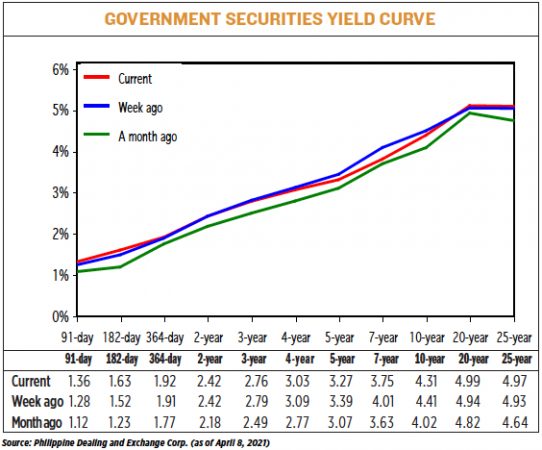
GS yields, which move opposite to prices, went down by an average of 2.7 basis points (bps) week on week, based on the PHP Bloomberg Valuation Service Reference Rates as of April 8 published on the Philippine Dealing System’s website.

Local financial markets were closed last Friday in observance of the Day of Valor.

At the secondary market on Thursday, rates at the short end of the curve rose from their March 31 finish, with the 91-, 182-, and 364-day Treasury bills increasing by 7.16 bps, 10.82 bps, and 1.64 bps, respectively, to fetch 1.3555%, 1.628%, and 1.9242%.

At the belly, the yields on the two-, three-, four-, five-, and seven-year Treasury bonds fell by 0.39 bp (to 2.4151%), 2.54 bps (2.7633%), 6 bps (3.027%), 12.91 bps (3.2656%), and 26.85 bps (3.7453%), respectively.

The long end of the yield curve ended mixed as the 10-year debt dropped by 9.89 bps to fetch 4.3096%, while the rates of the 20- and 25-year notes picked up by 4.9 bps and 4.40 bps, respectively, to finish at 4.9879% and 4.9737%.

“[Last] week, buying momentum in the local GS space was spurred by the slower-than-expected March inflation print as well as lower US Treasury yields. Overall, the GS curve ended the week flatter with yields in the belly (five- to 10-year sector) outperforming the rest of the curve,” First Metro Asset Management, Inc. (FAMI) said in an e-mail on Thursday.

“While yields are still higher month on month, the disinflation surprise led to some buying in oversold bonds across the curve,” it added.

Aside from the slower-than-expected March inflation rate, yields “were likewise pulled down by some caution ahead of the release of the US Federal Reserve policy minutes, which reiterated its dovish monetary policy stance while keeping an optimistic outlook on the US economy,” a bond trader said in an e-mail on Thursday.

The government on Tuesday reported that the March headline inflation rate settled at 4.5%. This was slower than the 4.7% seen in the previous month but faster than the 2.5% posted in March 2020.

The March print was slower than the 4.8% median in a BusinessWorld poll but was within the 4.2-5% estimate range given by the Bangko Sentral ng Pilipinas for the month.

Year to date, inflation averaged at 4.5%, still higher than the central bank’s 2-4% target for 2021 and its forecast of 4.2%.

Meanwhile, the minutes of the Fed’s March 16-17 meeting showed the US central bank remains cautious over the coronavirus pandemic and will continue to support the world’s largest economy until its recovery is more secure, Reuters reported on Wednesday.

With their own forecasts projecting the strongest run of US economic growth in nearly 40 years, “participants agreed that the economy remained far from the (Fed’s) longer-run goals and that the path ahead remained highly uncertain,” the minutes showed.

“For [this] week, we may continue to see persistent demand in the local bonds space should global bond yields continue to trade within range,” FAMI said.

“We see the lower inflation trend as well as reduced economic activity following the implementation of stricter lockdown measures to prevent the yield curve from steepening in the near term,” it added.

For the bond trader: “Local yields might track its global peers to move higher [this] week on expectations of stronger inflation reports from the US and the eurozone. Moreover, global optimism might likewise prevail amid a potentially upbeat Chinese economic growth report for the first quarter of 2021.” — Jobo E. Hernandez