Home Blog Page 7850

Shakey’s reassigns over 100 employees

Shakey’s Pizza Asia Ventures, Inc. is reassigning employees to stores closer to their homes to reduce travel time and to ensure its stores are “crisis-ready.”

The company said the move would help mitigate operation disruption during “increasingly volatile times,” with quarantine restrictions brought by the pandemic continue to affect commuters.

“The ultimate goal is for 80% of our workforce to spend no more than an hour on the road,” Shakey’s President and Chief Executive Officer Vicente L. Gregorio said in a statement on Friday.

“Plans are already in place – from fully mapped out store reassignments to new hiring directives ensuring that new employees live within a store’s vicinity,” he added.

Under “Project Nerdy: Near and Ready,” over 100 employees have been relocated to branches near their homes since June 2020.

The company said the reassignments have led to a 20% decrease in its employees’ average travel time to work. Seven out of 10 of its employees now reportedly spend 30 minutes or less commuting.

“I spend only 30 minutes on the road, sometimes less. I am even able to walk home. That’s my form of exercise. I get to spend more time with my family and rest longer,” Shakey’s Aseana Branch Store Manager Rashidi Forteza said, adding that it used to take her two hours to go to work.

Shakey’s also said community-based store employees also help build better rapport with their customers, allowing these stores to have a “sense of family” experience.

“As we seek to expand, we will always give incumbent employees the opportunity to move to even nearer stores, further reducing their travel time and helping them create work-life balance,” Mr. Gregorio said.

On Friday, shares of Shakey’s at the stock market closed unchanged at P8.40 each. — Keren Concepcion G. Valmonte

Globe says 5G users up almost 13% in May

Globe Telecom, Inc. said on Friday fifth-generation (5G) technology users have increased by 12.9% to more than 700,000 in May from April.

“The entry of affordable 5G-capable mobile devices has also made it possible for more people to use the technology,” said Joel R. Agustin, senior vice-president for Globe’s program delivery, network technical group, in an e-mailed statement.

“We will make our 5G presence more felt in Visayas and Mindanao in the coming months,” he added.

Globe said it had over 560,000 users on 5G devices in March. The number of users climbed to over 620,000 in April, then to over 700,000 in May, a 12.9% rise over the previous month.

“There was an average of 11.8% increase in device count in the last two months,” Globe noted.

Globe has said its 5G network now covers at least 88% of the National Capital Region.

Citing data from Ookla, the company behind Speedtest, Globe said its 5G network was the “most available” to users of 5G-capable devices in the first three months of the year. — Arjay L. Balinbin

Investing sustainably ensures enduring benefit for SM

Solid principles of service, fairness and progress for all have been the foundation of the SM group’s holding firm towards becoming more sustainable since it was founded by Henry Sy, Sr. about six decades ago.

“Our journey on sustainability is shown by how the group has grown and how we think about our responsibilities. It is about how we do our business by looking after all our stakeholders,” Tim Daniels, consultant and head of investor relations at SM Investments Corp., said in a recent environmental, social and governance (ESG) forum from BusinessWorld.

Since its incorporation, SM’s ecosystem has grown to consist of hundreds of thousands of employees, more than 80,000 micro, small and medium enterprises, customers in the millions, plus properties and businesses all over the country.

SM said it has aimed to create value as a responsible business for its longevity and resilience. At present, this has been tested by the COVID-19 pandemic, which forced many to seek a win-win strategy for all, it added.

“How do we create value and how do we share that value? That’s our starting point for how we think about sustainability and with that mindset under the COVID 19 experience, it made decision-making quick because it starts with our stakeholders,” Mr. Daniels said.

SM said it focused on safety, innovation and resilience as a strategy to ensure its employees and customers have a safe and sanitized environment aligned with protocols.

Adjustments have been made on how stakeholders access products and services, while meaningful support has been given to sectors that needed them most.

Mr. Daniels said the company was rewarded by investors who now understand the company and its sustainability story better.

For its sustainable growth, SM focused on providing inclusive economic opportunities through multiple partnerships; creating positive social impact;

practicing environmental responsibility and embracing good corporate governance with the objective of building an ecosystem of vibrant local economies.

“Since investors have been understanding us better, that multiple (or premium to the Philippine market) has widened, even faster than our earnings have grown. It’s because people have recognized the quality of company that we are. As it goes on, we start to look at more technical ways to engage and that for us is a positive journey,” Mr. Daniels said.

He expects greater demand for stronger sustainability practices and reporting as industries globally introduce new measurements, frameworks and metrics to cater to investors who value sustainability.

“We shouldn’t lose focus on what are the material things to our company and what it needs to do to be responsible. Thinking sustainably leads your investments into the right areas,” Mr. Daniels said.

LANDBANK agri loans hit P230 billion in five months to May

BW FILE PHOTO

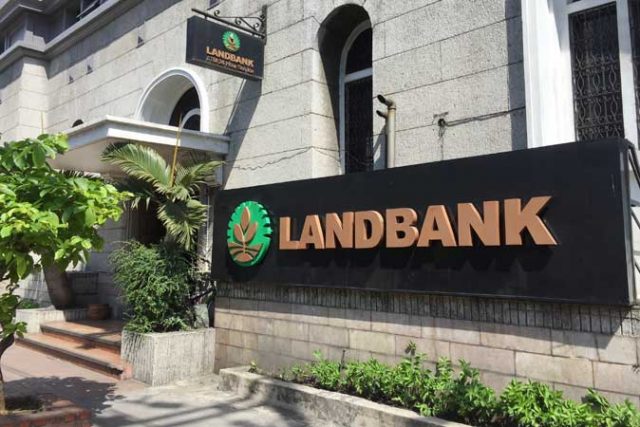
The Land Bank of the Philippines (LANDBANK) booked P230.02-billion in loans to the agriculture sector in the five months to May, with the bank expanding its support for the sector during the pandemic as the government’s funding conduit for farmers.

Citing reports from LANDBANK, the Finance department said the bank’s farm loans during the period were only slightly higher than the four-month tally of P229.29 billion.

The five-month tally accounted for 81.6% of its P281.75-billion target for the sector this year.

About P145.85 billion went to small, medium and large agribusinesses. It said P34.79 billion went to 2.73 million farmers and fisherfolk while P33.55 billion went to cooperatives and farmers’ associations.

Some P49.38 billion went to agriculture-related projects of local government units (LGUs) and state-run firms.

Loans to build cold storage facilities, irrigation systems, slaughterhouses, farm-to-market roads and other farm infrastructure projects accounted for P90.27 billion.

Funding support for agri-processing and trading activities came up to P85.13 billion. Livestock accounted for P35.46 billion, crops P17.2 billion and fisheries P2 billion.

LANDBANK provided P9.42 billion for farmer-related programs of the Agriculture department via credit lines to support the Agricultural Competitiveness Enhancement Fund, the Socialized Credit Program under the Sugarcane Industry Development Act, the Expanded Rice Credit Assistance program and the Survival and Recovery Assistance program.

To the Department of Agrarian Reform, LANDBANK extended P63 million in credit to agrarian reform beneficiaries.

LANDBANK mainly provides loans to the agriculture and fisheries sector, micro, small and medium businesses, countryside financial institutions, LGUs, and government institutions.

Republic Act 10000 or the Agri-Agra Reform Credit Act of 2009 requires banks to set aside 15% of their loanable funds to the agriculture sector and 10% for agrarian reform-related projects. – Beatrice M. Laforga

S&P flags delayed economic recovery as risk to PHL banks

S&P Global Ratings said weak economic activity and a prolonged lockdown are adding to the risks for Philippine banks

In a statement late Thursday, S&P Global credit analyst Nikita Anand said the firm expects Philippine loan portfolios to grow 3-5% this year when credit demand picks up in the second half.

S&P Global put Philippine banks in the group five category of its Banking Industry Country Risk Assessment (BICRA), along with those of other economies such as Bermuda, Italy, Malta, Panama, Peru, Hungary, Qatar, Iceland, Mexico, and the United Arab Emirates.

It said this is generally the tier for “BBB-” rated countries, the starting point for assigning an issuer credit rating for banks in that particular country.

The outlook could further be downgraded with a slower economic recovery, a resurgence in coronavirus infections and a sluggish vaccination program.

The credit rater downgraded its gross domestic product (GDP) forecast for the Philippines this year to 6% from 7.9% previously.

“The trend for economic risks faced by Philippine banks is negative, in our opinion,” it said.

“We forecast a sluggish revival in credit growth, rising non-performing loans (NPLs), a marginal decline in credit costs, and a mild recovery in profitability in 2021 as the Philippine economy recovers,” it added.

S&P Global said the sector’s NPLs could rise to 6% of total loans by year’s end from the 4.44% bad loan ratio at the end of 2020, as the pandemic’s impact on borrowers becomes more evident.

Credit costs will remain high this year at 1.7% of gross loans, but slightly lower than last year’s 2.1%.

Due to the sustained weakness in the labor market and prolonged lockdowns, banks should brace for a surge in bad loans from consumers and small businesses, it said.

Meanwhile, bigger companies have kept the quality of their credit strong so far but those in the services sector will likely struggle.

S&P Global said the solid capitalization of banks, with a Tier 1 capital ratio of around 16%, sound liquidity and sufficient loan loss provisioning could provide a buffer against these risks.

It said banks offloading their soured loans to asset management companies can provide relief as well.

Republic Act 11523 or the Financial Institutions Strategic Transfer (FIST) Law was signed in February, allowing banks to sell their non-performing assets to asset management companies. To encourage participation the law also provides tax breaks on the transfer of foreclosed assets associated with the loans.

“We view the industry risk trend as stable. We believe banks’ well-established domestic franchises will help them sustain a strong, stable, and diversified customer deposit profile. The banking sector’s institutional framework and competitive dynamics should stay stable over the next two years,” S&P said.

It said the sector could see a 1% return on assets this year, better than last year’s 0.8% return, as credit costs soften.

Bigger banks focused on enhancing their digital capacity will likely remain resilient against fresh competition from digital banks and financial technology companies, it said.

The Bankers Association of the Philippines (BAP) declined to comment when asked Friday. – Beatrice M. Laforga

Peso declines further as US unemployment signals recovery momentum

BW FILE PHOTO

The peso continued to weaken Friday after US jobs data forecasts pointed to the possibility of growing momentum for an economic recovery there. 

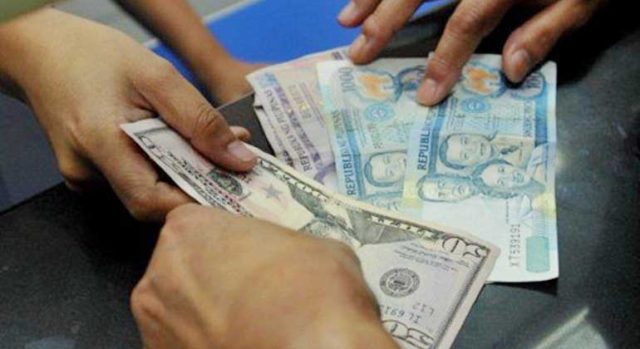
The peso closed at P49.20 against the dollar Friday, declining from its P49.11 finish Thursday, according to the Bankers Association of the Philippines website. 

The peso opened at P49.28, with the low at P49.31 and the high at P49.08.  

Dollar trading volume fell to $956 million from $1.35 billion previously. 

Week-on-week, the peso shed P1.11 from its June 15 close of P48.09. 

Friday’s finish was the weakest in more than 11 months or since July 27, 2020 when it closed at P49.25, Rizal Commercial Banking Corp. (RCBC) Chief Economist Michael L. Ricafort said.   

Mr. Ricafort attributed this to the strong expectations for US jobless claims data.

The number of US citizens filing for unemployment benefits fell last week, possibly heralding a labor market rebound, Reuters reported. 

Economists surveyed by Reuters estimated that nonfarm payrolls may have increased by 700,000 in June following the 559,000 rise in May, which will produce a decline in the jobless rate to 5.7% from 5.8% previously. 

Other positive developments in the US also helped buoy its currency, according to Mr. Ricafort, such as strong manufacturing data. 

He added that the Philippines’ own expected economic recovery is likely to increase demand for exports, raising the prospect of increased dollar outflows. – Beatrice M. Laforga  

Wilcon Depot awarded DTI Safety Seal Approval

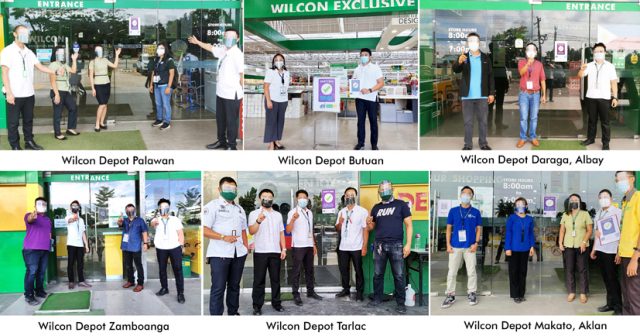
Wilcon Depot, the country’s leading home improvement and construction supply retailer, has been awarded the DTI Safety Seal in compliance with the minimum public health standards set by the government.

To ensure a safe and convenient shopping experience, Wilcon received the DTI Safety Seal certification as a fulfillment of its commitment to providing a safe environment for both valued customers and employees. Currently, Wilcon Depot stores located in Libis, Balintawak, Valenzuela, Quezon Ave., Commonwealth, Capitol-Commonwealth, I.T. Hub, Pasong Tamo,  Filinvest, Alabang, Sucat, Taytay, Antipolo, San Isidro, San Juan, Baliuag, Calumpit, Dau, Mexico, San Fernando, Tarlac, Naga, Daraga, Bacoor, Batangas, Sto. Tomas, Lipa, Palawan, Aklan, Jaro, Sta. Barbara,  Bacolod-Talisay, Mandaue, Talisay, Tacloban, Ormoc, Zamboanga, Opol, Matina, Panacan, General Santos, Butuan, and Wilcon Home Essentials stores located in Mindanao Ave., Muñoz, Pasay, and Festive Walk Mall Iloilo have already gotten their DTI Safety Seal guaranteeing safe shopping.

Along with the certification is the company’s continuous implementation of the necessary safety measures to all Wilcon stores nationwide.

For more information about Wilcon, you can log on to www.wilcon.com.ph or follow their social media accounts on Facebook and Instagram. Subscribe and connect with them on Viber Community, LinkedIn, and YouTube.


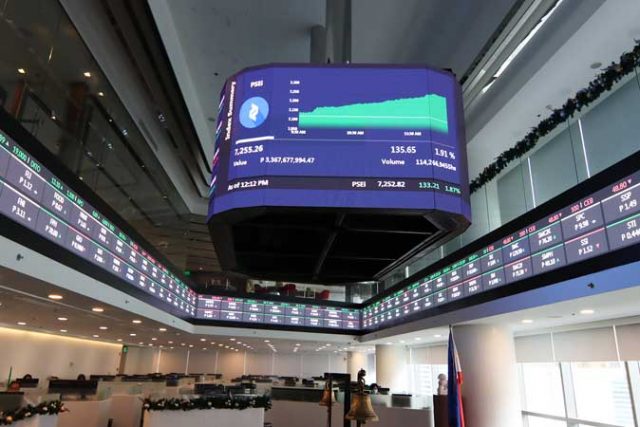
PSEi breaks past 7,000 on positive economic data

COURTESY OF PHILIPPINE STOCK EXCHANGE, INC.

Philippines shares closed the week in the green due to positive economic data, as markets in the region also got a boost with more economies reopening.

The Philippine Stock Exchange index (PSEi) gained 38.25 points or 0.54% to close at 7,002.26 on Friday, while the all shares index went up by 19.54 points or 0.45% to end at 4,294.97.

“Philippine shares touched the 7,000 mark to end the week as positive sentiment spilled over to the region, bolstered by better-than-expected economic data and as energy stocks got a boost from crude oil hitting $75 a barrel,” Regina Capital Development Corp. Head of Sales Luis A. Limlingan said in a Viber message on Friday.

On Thursday, preliminary results of the Philippine Statistics Authority’s May 2021 round of its Labor Force Survey showed that the country’s unemployment rate in May slowed to 7.7% from 8.7% in April, the second-lowest rate recorded since the year began.

The IHS Markit also reported on Thursday that manufacturing activity in the Philippines expanded in June after two months of contraction following the implementation of less stringent quarantine restrictions. The Philippine Manufacturing Purchasing Managers’ Index (PMI) went up to 50.8 in June from 49.9 in May.

“The local market closed higher together with most Asian markets, on growing investor optimism towards the progress made over the reopening of a lot of economies across the globe,” Timson Securities, Inc. trader Darren Blaine T. Pangan said in a separate Viber message.

All sectoral indices closed in the green on Friday. Services gained 23.55 points or 1.48% to 1,614.81; mining and oil climbed 102.52 points or 1.05% to finish at 9,838.56; property went up by 18.06 points or 0.53% to 3,375.14; holding firms improved by 27.19 points or 0.38% to close at 7,026.58; financials inched up by 4.36 points or 0.28% to 1,518.49; and industrials rose by 26.57 points or 0.27% to

9,701.48.

Value turnover dropped to P5.85 billion with 2.77 billion issues traded on Friday, from the P13.52 billion with 2.93 shares recorded on Thursday.

Advancers beat decliners, 108 against 100, while 36 names closed unchanged.

Foreigners turned buyers with P1.95 billion recorded in net purchases on Friday, a reversal of the P4 billion logged in net outflows the previous trading day.

For next week, Timson Securities’ Mr. Pangan expects the index to trade between 6,820 and 7,080. — Keren Concepcion G. Valmonte

S.Korea’s COVID-19 cases spike as Delta variant spreads

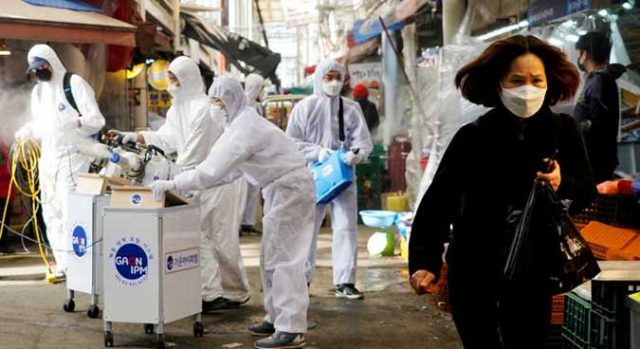
SEOUL — South Korea’s daily count of coronavirus cases topped 800 on Thursday, the highest in nearly six months, due to new cluster infections and the spread of the highly contagious Delta variant, officials said on Friday. 

The Korea Disease Control and Prevention Agency (KDCA) reported 826 cases, up from 762 a day before and the highest since Jan. 7 when the country was grappling with a third wave of coronavirus disease 2019 (COVID-19). 

Almost 81% of the 765 locally transmitted cases came from the capital Seoul and its surrounding regions, KCDA data showed. 

The government had said it would relax social distancing measures starting this month as daily new cases hovered around 500 and the vaccination drive accelerated. 

But days before the limits on movement were to be eased, case numbers shot up and authorities in Seoul and surrounding areas extended restrictions for another week to July 7. 

“More than 80% of new cases have come from the Seoul metropolitan area for a third straight day on the back of cluster infections from restaurants and private educational institutions,” Interior and Safety Minister Jeon Hae-cheol told an intra-agency COVID-19 meeting. 

“We’re extremely concerned the virus would spread further as there are clear signs of increased outside activity among the people, and a rising number of cases of the strongly transmissible Delta variant. 

Authorities have urged people to keep wearing masks indoors and refrain from unnecessary outings even as the inoculation drive makes progress. 

Authorities are particularly concerned about a new outbreak traced to an English language academy just outside the capital, with at least 242 cases including the Delta variant confirmed so far. 

“We have concerns that outbreaks could increase explosively if distancing is relaxed, as there would be more people-to-people contact through drinking or exposure at various public facilities,” KDCA director Jeong Eun-kyeong told a briefing on Thursday. 

The Delta variant first detected in India has led to spikes in cases around the globe, becoming the second-most prevalent variant in the United States and prompting Britain to delay its reopening by one month. — Hyonhee Shin/Reuters 

Serious tax charges test loyalty of longtime Trump ally

Image via Bin im Garten/CC BY-SA 3.0/Wikimedia Commons

The sweeping tax-fraud indictment unsealed on Thursday against Donald J. Trump’s longtime accountant Allen Weisselberg threatens the 73-year-old executive with years in prison and puts heavy pressure on him to implicate the former US president. 

Prosecutors allege that Mr. Weisselberg, the Trump Organization’s chief financial officer, evaded more than $900,000 in taxes by taking part of his annual pay in benefits including apartments, luxury cars, and a cash bonus at the holidays, described in financial records as “holiday entertainment.” 

Judges are often reluctant to sentence elderly defendants with no prior record to prison time, said Ethan Greenberg, a retired New York judge who is now a defense lawyer. But the indictment — detailing a deliberate scheme to avoid taxes on $1.7 million in income over 16 years — “convinces me, and should convince Weisselberg, that a substantial prison sentence is possible,” Mr. Greenberg said. 

And that’s the point: convincing Mr. Weisselberg. The case, filed by Manhattan District Attorney Cyrus Vance, will provide an acid test of Mr. Weisselberg’s loyalty to the family he has served for nearly five decades. Prosecutors moved to charge the accountant after months of failed attempts to secure his cooperation in the wide-ranging probe into possible financial fraud at the Trump Organization. Now they’ll see whether the prospect of felony charges and prison changes his mind. 

Mr. Weisselberg pleaded not guilty during an appearance in a Manhattan courtroom on Thursday. In a brief statement, his lawyers said he would fight the charges in court. 

Mr. Trump was not indicted on Thursday but prosecutors levied fraud charges against the Trump Organization, which experts say could create some headaches for Mr. Trump in dealing with banks. The indictment implicates others who were not charged, including Mr. Weisselberg’s son Barry, who worked for the Trump Organization, and an unnamed “Co-Conspirator Number 1.” 

Mr. Trump released a statement calling the case a continuation of “the political Witch Hunt by the Radical Left Democrats, with New York now taking over the assignment.” 

Mr. Vance’s office said the investigation will continue, as did the office of New York Attorney General Letitia James, which is also probing Trump’s business. 

Mr. Weisselberg has been a key figure in Mr. Trump’s empire for decades. He started working for Trump’s father, Fred, at the company’s office in Brooklyn before joining the son as Donald Trump broke into Manhattan real estate. Mr. Weisselberg served alongside Mr. Trump’s children on the board of the now-dissolved Trump family foundation and on the trust that ran his business when he became president. 

Although it’s unusual for prosecutors to bring criminal charges based on untaxed benefits, former prosecutors and other criminal law experts say the allegations are more serious than most. The indictment describes a long-running scheme by Mr. Weisselberg and the company to avoid taxes, by taking part of his $940,000 annual salary in apartments, cars and other off-the-books benefits. The untaxed compensation totaled $1.76 million, according to the indictment. 

Prosecutors allege that the Trump Organization kept internal records that made clear that all of those benefits were part of Mr. Weisselberg’s annual compensation  in essence, a separate set of records contradicting Mr. Weisselberg’s tax returns. 

The most serious of the charges against Mr. Weisselberg, second degree grand larceny, carries a sentence of up to 15 years. Criminal law experts said its unlikely Mr. Weisselberg would get a sentence that long. Daniel Alonso, Mr. Vance’s former deputy, said that a charge involving $900,000 tax fraud would more commonly lead to a sentence of one to three years, but possibly more. 

State law allows for probation in such cases, Mr. Alonso said, “but I don’t see a judge giving him probation.” 

Mr. Weisselberg faces 14 other charges, including tax fraud and conspiracy. The Trump Organization was charged with 10 counts of crimes including tax fraud and falsifying business records, which could lead to financial penalties. 

The indictment alleges that Mr. Weisselberg accepted more than $133,000 in federal and state tax refunds that he was not owed. 

“He’s also affirmatively going to the federal treasury and saying, give me money that wasn’t his. That’s called stealing,” said John Moscow, a former prosecutor in the Manhattan District Attorney’s Office. 

Dan Horwitz, a white-collar defense lawyer and former Manhattan prosecutor, said the charges ramp up the pressure on Mr. Weisselberg to provide investigators with information on Trump. 

“Is that a sufficient hammer for someone to think about cooperation? I would think so,” he said. 

The case is based in part on information provided by Jennifer Weisselberg, the ex-wife of Allen’s son, Barry. The son worked for the Trump Organization as a manager of ice-skating rinks and a carousel in Central Park, under contracts with New York City. Jennifer Weisselberg spoke multiple times with prosecutors and provided tax returns and other records that documented apartments, private school tuition and other benefits that were not reported as income. 

Any legal threat against Mr. Weisselberg’s son also could be an inducement for the father to cooperate. 

Notably, the indictment does not contain any charges related to one key focus of Mr. Vance’s investigation  whether the Trump Organization illegally manipulated values of Trump’s property holdings  inflating them to receive loans, for instance, or lowering them to avoid property taxes. 

 Mr. Weisselberg’s testimony could be crucial to a case based on those valuations. Mr. Trump was questioned in a civil case in 2007 about how he assigned values to his properties on financial statements. He said he would give his opinion  but left the final decisions on values to Mr. Weisselberg. 

Both Mr. Vance’s office and Attorney General obtained records and testimony involving some Trump properties, notably the Seven Springs estate north of New York City. Mr. Trump agreed to forego building luxury homes on part of the property, making him eligible for a $21.1 million charitable deduction. Mr. Vance subpoenaed development records for three towns and from Mr. Trump’s representatives on the deal. 

Jessica Roth, a former federal prosecutor and now a professor at the Benjamin N. Cardozo School of Law, said she was struck by the specificity of the charges  and the fact that Mr. Weisselberg was not the only person who received such benefits. 

“I think it is reasonable to expect that these will not be the last charges we see in this case,” she said.  Joseph Tanfani and Jan Wolfe/Reuters 

US calls build-up of China’s nuclear arsenal ‘concerning’

REUTERS

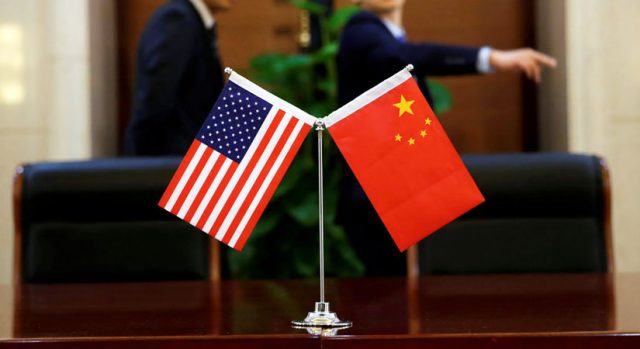
WASHINGTON  The United States said on Thursday China’s rapid build-up of its nuclear forces was concerning and called on Beijing to engage with it “on practical measures to reduce the risks of destabilizing arms races.” 

The build up had become more difficult for China to hide and it appeared it was deviating from decades of nuclear strategy based around minimal deterrence, State Department spokesperson Ned Price told a regular news briefing. 

Mr. Price was responding to a question about a report in the Washington Post that said China had begun constructing more than 100 new missile silos in a desert area in the western part of the country. 

“These reports and other developments suggest that the PRC’s nuclear arsenal will grow more quickly, and to a higher level than perhaps previously anticipated,” Mr. Price said using the acronym for the People’s Republic of China. 

“This buildup is concerning. It raises questions about the PRC’s intent. And for us, it reinforces the importance of pursuing practical measures to reduce nuclear risks,” he said. 

“We encourage Beijing to engage with us on practical measures to reduce the risks of destabilizing arms races  potentially destabilizing tensions.” 

Mr. Price added that this was why President Joseph R. Biden, Jr., had prioritized strategic stability in his engagement with Russian President Vladimir Putin, and added: “The same rationale would apply to engagement with another nuclear power, the PRC.” 

Mr. Price also said that Washington had “taken note” of remarks by Chinese leader Xi Jinping at a ceremony marking the 100th anniversary of the founding of the Chinese Communist Party on Thursday, but was “not going to comment on the specifics.” 

In his address, Mr. Xi warned that foreign forces attempting to bully China would “get their heads bashed” and pledged to build up its military. He also committed to the “reunification” of Taiwan and said social stability would be ensured in Hong Kong while protecting China’s security and sovereignty. 

The Washington Post report cited commercial satellite images and analysis from the James Martin Center for Nonproliferation Studies in Monterey, California. 

It said the 119 nearly identical construction sites contained features that mirrored existing launch facilities for China’s existing arsenal of nuclear-tipped ballistic missiles. 

In a 2020 report to Congress, the Pentagon estimated China’s nuclear warhead stockpile in “the low 200s” and said it was projected to at least double in size as Beijing expands and modernizes its forces. Analysts say the United States has around 3,800 warheads, and according to a State Department factsheet, 1,357 of those were deployed as of March 1. 

Washington has repeatedly called on China to join it and Russia in a new arms control treaty and the US disarmament ambassador said in May that Beijing was resisting this despite a “dramatic” buildup in its arsenal. 

Beijing says its arsenal is dwarfed by those of the United States and Russia and it is ready to conduct bilateral dialogues on strategic security “on the basis of equality and mutual respect.” 

Non-proliferation experts said this year China’s push to develop fuel for a new generation of nuclear power reactors will produce large amounts of materials that could be diverted to making nuclear weapons. — David Brunnstrom and Daphne Psaledakis/Reuters 

France investigates fashion retailers for concealing crimes against humanity in Xinjiang

Image of Zara in Paris, France, via inditex.com

PARIS  French prosecutors have opened an investigation into four fashion retailers suspected of concealing crimes against humanity in China’s Xinjiang region, a judicial source said on Thursday. 

The procedure is linked to accusations against China over its treatment of minority Muslim Uyghurs in the region, including the use of forced labor, the source said. 

The source told Reuters Uniqlo France, a unit of Japan’s Fast Retailing, Zara owner Inditex, France’s SMCP, and Skechers were the subject of the investigation, confirming a report by French media website Mediapart. 

“An investigation has been opened by the crimes against humanity unit within the antiterrorism prosecutor’s office following the filing of a complaint,” the source said. 

Inditex said it rejected the claims in the legal complaint, adding that it conducted rigorous traceability controls and would fully cooperate with the French investigation. 

“At Inditex, we have zero tolerance for all forms of forced labor and have established policies and procedures to ensure this practice does not take place in our supply chain,” the company said in a statement. 

SMCP said it too would cooperate with the French authorities to prove the allegations false. 

“SMCP works with suppliers located all over the world and maintains that it does not have direct suppliers in the region mentioned in the press,” SMCP said, adding that it regularly audited its suppliers. 

Uniqlo France were not immediately available to comment outside of European business hours. Skechers said it does not comment on pending litigation. It referred Reuters to a March 2021 statement in which it said it maintained a strict supplier code of conduct. 

Two nongovernmental organizations (NGOs) filed a complaint in France in early April against multinationals for concealment of forced labor and crimes against humanity. 

UN experts and rights groups estimate over a million people, mainly Uyghurs and other Muslim minorities, have been detained in recent years in a vast system of camps in China’s western Xinjiang region. 

Many former inmates have said they were subject to ideological training and abuse. Rights groups say the camps have been used as a source of low-paid and coercive labor. 

China denies all accusations of abuse. 

Several Western brands including H&M, Burberry and Nike have been hit by consumer boycotts in China after raising concerns about forced labor in Xinjiang. 

In March, the United States, the European Union, Britain and Canada imposed sanctions on Chinese officials for human rights abuses in Xinjiang. Beijing retaliated immediately with its own punitive measures. — Reuters 

ADVERTISEMENT
ADVERTISEMENT