Home Blog Page 7843

Singapore deputy PM unexpectedly steps aside as future premier, in succession setback

Singapore’s Deputy Prime Minister Heng Swee Keat will step aside as the designated successor to current premier Lee Hsien Loong, in an unexpected decision that disrupts the city-state’s succession plans.

“We need a leader who will not only rebuild Singapore post-COVID-19, but also lead the next phase of our nation-building effort,” Mr. Heng said in a letter published on Thursday.

Mr. Heng, who will turn 60 this year, is set to give up his portfolio as finance minister at the next cabinet reshuffle expected in about two weeks.
Succession in the wealthy Southeast Asian city-state—which has been governed by the People’s Action Party (PAP) since independence in 1965—is normally a carefully planned affair.

The pandemic, however, has set back a handover of power. Mr. Lee, 69, has flagged that he may delay his plan to pass the reins to a successor by the time he is 70 to see Singapore through the aftermath of the pandemic.

“As the crisis will be prolonged, I would be close to the mid-60s when the crisis is over,” Mr. Heng said, referring to the COVID-19 pandemic.
“But when I also consider the ages at which our first three Prime Ministers took on the job, I would have too short a runway should I become the next prime minister then,” he said.

Mr. Heng will continue as deputy prime minister, but will step aside as head of the ruling party’s so-called fourth-generation team of leaders.

“This unexpected turn of events is a setback for our succession planning. We recognize that Singaporeans will be concerned. We seek your support and understanding, as we choose another leader,” the 4G leaders said in a separate statement.

“The 4G team will need more time to select another leader from amongst us,” they added.
They said Mr. Lee had agreed to stay on as prime minister until a new successor is chosen by the team and is ready to take over.

The PAP was stung by its worst-ever election result last year. Heng scraped through with only 53% of the vote in his constituency, in what some analysts said could be a sign of a lack of public support for his expected future premiership.

Mr. Heng, who had steered the central bank through the global financial crisis, has doled out billions of dollars in stimulus to help the country weather its worst-ever recession caused by the pandemic.

But questions were also raised about his health after he suffered a stroke and collapsed during a cabinet meeting in 2016.

“I do see PM Lee’s successor being clear within the next 18–24 months,” said Eugene Tan, a former nominated member of parliament. “The pandemic has led to a delay but Singapore’s next PM will take over just before or after the next general election which must be held by end 2025.”

The city-state’s small and open economy was badly hit by the pandemic, but is now on a recovery path. It has brought the COVID-19 situation under control and has been ramping up vaccinations, although external demand and reopening of international borders is seen as key to growth.

“For such an announcement to be made this early, it seems that the leadership is pretty confident that the economy is in a far better shape today than a year ago and they are on top of the situation,” said Song Seng Wun, an economist at CIMB Private Banking.
“I always saw Heng as a bridge between the older and newer group of leaders.”
The Singapore dollar was steady following the announcement on Thursday, made after the close of trading in the stock market. — Aradhana Aravindan and Anshuman Daga/Reuters

Pru Life UK receives four Golden Arrows for solid corporate governance

Pru Life UK Board of Director Imelda “Ida” C. Tiongson (top right) is joined by Pru Life UK Senior Vice President and Chief Legal and Government Relations OfficerAtty. Ma. Emeren V. Vallente (lower right)as they receive the four Golden Arrow recognition during the virtual ceremony of the 2019 ASEAN Corporate Governance Scorecard (ACGS) Golden Arrow Awards.

Leading life insurer Pru Life UK was bestowed four Golden Arrows awards by the Institute of Corporate Directors (ICD), marking another milestone in the company’s history of good performance on the ASEAN Corporate Governance Scorecard (ACGS).

“In a step-up from the three Golden Arrows awards we were presented in 2018, we are very honored to receive this prestigious recognition. These distinctions serve as testimony to our unwavering effort and deep commitment to tirelessly keep elevating and strengthening our standards for all our stakeholders as we endeavor to help Filipinos get the most out of their lives,” shared Pru Life UK President and CEO Antonio De Rosas.

For four consecutive years, Pru Life UK has consistently ranked first among Insurance Commission (IC)-regulated companies based on the overall governance scores determined by the ICD.

The ICDimplemented the ACGS to raise corporate governance standards and practices and showcase well-governed ASEAN publicly listed companies. The assessment is based on publicly available information and benchmarked against international best practices to encourage listed companies to go beyond local regulatory requirements.

The ACGS was adopted by the Philippine insurance industry to enhance its competitiveness, improve public perception, and increase its penetration rate. The IC prescribed the assessment, enjoining participating companies to publicly disclose the necessary information and supporting documents on their company websites.

STADA Philippines shows resilience with triple-digit growth in 2020

Newly-established pharmaceutical player STADA Philippines showed resilience amid the coronavirus pandemic by achieving triple-digit sales growth of 478% in 2020.

Fueling the growth is the expansion of the STADA Philippines portfolio, with the banner acquisition of the FERN-C line (consisting of the established, 15-year-old vitamin c brand FERN-C, and two children’s vitamin products FERN C Kidz and Kiddimin). Total sales growth of the Fern-C portfolio in 2020 reached 100% compared to the previous year.

STADA Philippines’ revitalization of the Oilatum brand, likewise, established the company as a major player in the Philippine skin care market, with Oilatum sales growing 1,012% versus the previous year. Acquired from GSK in 2019, Oilatum is a full emollient range that generates significant sales in Europe, as well as helping to build up growth in the Asia-Pacific region.

“The acquisition of these products is in line with our strategy of strengthening our portfolio with well-established consumer healthcare brands and also expanding in selected emerging markets,” states Carsten Cron, STADA EVP for Emerging Markets.

Sharmaine Abarientos, general manager of STADA Philippines, adds: “With our successful portfolio expansion activities, we are able to offer quality medicines at reasonable prices, across all segments of healthcare; specialty, generics and consumer health.”

Carsten Cron, STADA EVP for Emerging Markets and Sharmaine Abarientos, General Manager of STADA Philippines

PHL performance mirrors STADA Worldwide’s strong growth journey

STADA’s CEO Peter Goldschmidt

STADA Philippines’ performance contributed significantly to the strong global STADA growth journey, with the Germany-based parent company posting 18% sales growth. This performance, even in the midst of a stagnating market, is testament to the agility and entrepreneurship with which STADA’s diverse global workforce acted under difficult circumstances to keep supplying medicines to patients and healthcare professionals.

“Throughout 2020, ensuring the health and safety of all employees and their families has been STADA’s utmost priority,” explains STADA’s CEO Peter Goldschmidt. “While STADA has responded with agility to the pandemic, we have continued to strengthen our supply-chain infrastructure for a sustainable future. I am proud of how STADA has worked tirelessly with hundreds of partners amid the pandemic to keep supplying medicines and deliver on our purpose of caring for people’s health as a trusted partner,” said Mr. Goldschmidt.

Synergies derived from acquisitions, as well as ongoing efficiency measures in areas such as supply chain, procurement, and sales and marketing contributed to the growth of the company.

“Our above-market sales increases reflect the extraordinary engagement and entrepreneurship of our diverse global workforce,” Mr. Goldschmidt stated. “Our strategy to position STADA as the go-to partner for consumer healthcare, specialty pharmaceuticals and generics is succeeding.”

STADA closed multiple acquisitions and in-licensing deals in 2020, building a wider base in the Philippine consumer healthcare market with such brands as FERN-C, Oilatum, Zoflora and Zerochol.

STADA’s optimistic outlook in 2021

Through a clear growth strategy that is based on a shared purpose, vision and set of values, the business expects a continuation of its growth journey in 2021. Outlining reasons for this optimistic outlook for 2021, Mr. Goldschmidt observed that STADA enjoys a well-stocked Generics pipeline, while the group’s Specialty presence is expanding through biosimilar partnerships and through launches such as the entry of a novel patented product for late-stage Parkinson’s disease. Newly-acquired Consumer Healthcare brands are gaining traction in several countries, and are set to enter the Philippine market in the near future.

With STADA continuing to evaluate further acquisitions, in-licensing and business development opportunities, the group is confident of delivering further organic and inorganic growth in 2021. “As a go-to partner for consumer healthcare, specialty pharmaceuticals and generics, STADA is broadening its portfolio and delivering on our purpose of caring for people’s health as a trusted partner,” Mr. Goldschmidt concluded.

Semirara Mining and Power Corporation announces schedule of annual stockholders’ meeting

Feb. trade gap widens as imports rise

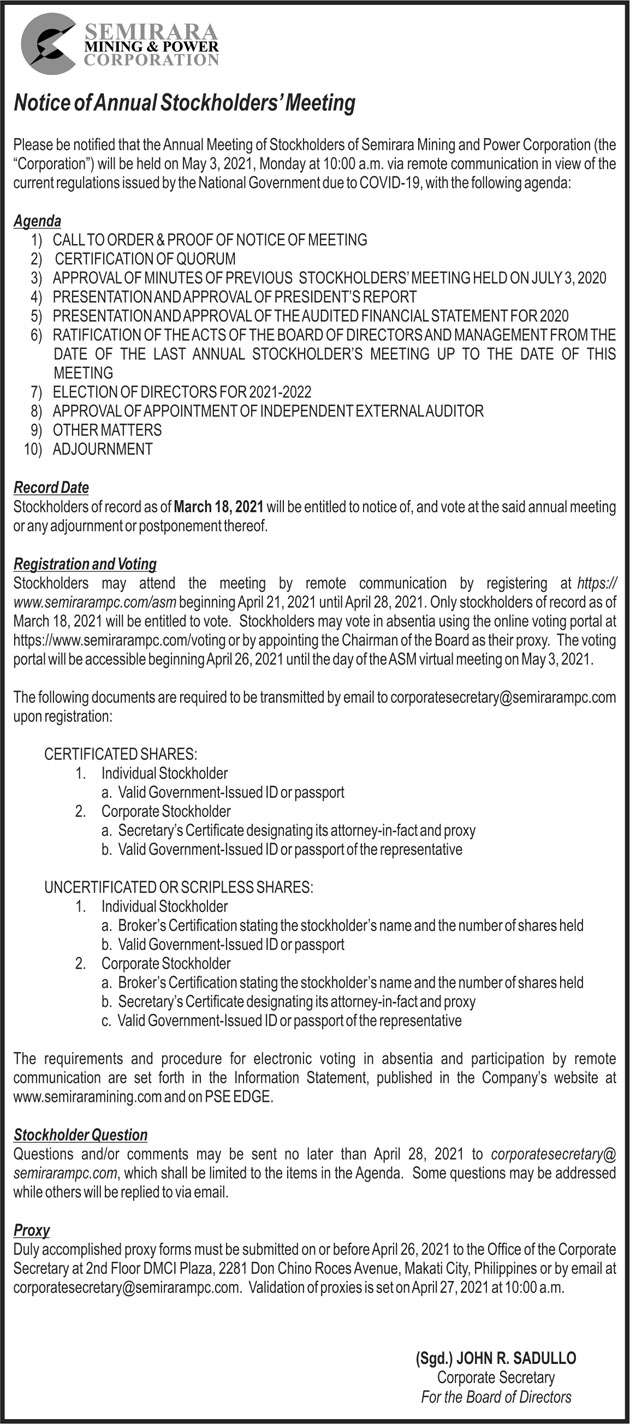
THE COUNTRY’S trade-in-goods deficit widened in February as imports grew for the first time in 22 months and exports contracted albeit at a slower pace, the government’s statistical agency reported on Thursday.

Merchandise imports rose by 2.7% to $7.60 billion in February following a 12.1% annual decline in January, preliminary data by the Philippine Statistics Authority showed.

The import tally for February was bigger than the $7.40 billion in February 2020, but smaller than the $8.40 billion in January 2021.

Philippine trade year-on-year performance (Feb. 2021)

Moreover, the value of imports for February was lowest since June 2020’s $6.96 billion.

Nevertheless, February imports marked the first expansion in 22 months or since April 2019 when it posted an annual growth of 2.9%.

“The rebound in imports… may be more a result of base effects rather than a true recovery for the sector with the economy still stuck in recession amidst an ongoing 12-month lockdown with daily COVID-19 (coronavirus disease 2019) infections spiking in March,” ING Bank N.V. Manila Senior Economist Nicholas Antonio T. Mapa said in a statement to reporters.

Meanwhile, merchandise exports declined by 2.3% in February to $5.31 billion, lower than the 4.8% contracted recorded in January.

Pantheon Macroeconomics Senior Asia Economist Miguel Chanco in a statement said the continued decline in merchandise exports was “particularly discouraging.”

This brought the trade deficit to $2.29 billion for February, bigger than the $1.97-billion gap in the same month last year.

Year to date, imports of goods fell 5.6% to $16 billion, while exports slid 3.6% to $10.83 billion.

These figures were below the Development Budget Coordination Committee’s growth targets of 8% and 5% for imports and exports this year.

That brought the year-to-date trade balance to a $5.17-billion deficit, smaller than the $5.72-billion shortfall in the same two months last year.

The country’s total trade — the sum of export and import goods — was $12.91 billion in February, up 0.6% year on year. For the first two months of the year, total trade amounted to $26.83 billion, down 4.8% from $28.19 billion a year ago.

As of last year, the imports and exports of goods made up 16.3% and 28.7% of the country’s gross domestic product, PSA’s national accounts showed.

Raw materials and intermediate goods, which account for 39% to the goods imports bill in February, jumped 6.4% to $2.97 billion year on year.

Capital and consumer goods likewise increased by 5.7% (to $2.56 billion) and by 3.9% ($1.32 billion) in February, respectively. On the other hand, imports of mineral fuels, lubricant and related materials contracted by 20.1% to $692.46 million.

On the export side, the sales of manufactured goods rose 2.6% year on year to $4.53 billion last year. These goods made up 85.3% of total goods exports in February.

Electronic products, which made up more than half of the total export sales in February, inched up 0.4% to $2.98 billion.

However, declines were seen in the sales of agro-based products (-22.3% to $336.63 million), mineral products (-26.3% to $318.03 million), and petroleum products (-97.9% to $808,090).

BRIGHT SPOTS
Mr. Chanco noted some “bright spots” in the data, particularly the turnaround in capital goods imports.

“This was more than enough to keep their recovery from last year’s lockdown broadly intact. On the other hand, though, imports of consumer goods continued to struggle, and they look set for a renewed collapse, due to the headwinds posed by the second virus wave,” he said.

“All told, the weakness in domestic demand will continue to dominate, keeping the trade deficit well above the 2018 nadir,” he added.

Security Bank Corp. Chief Economist Robert Dan J. Roces expects “renewed demand for inputs” by the time the enhanced community quarantine (ECQ) imposed in Metro Manila and the provinces of Bulacan, Cavite, Laguna, and Rizal will be lifted on April 11.

“When the ECQ is lifted, renewed demand for inputs should cause some rebound in imports of capital goods and raw materials, while a global reflation trade is possible once major economies reopen again. Thus, we still anticipate a trade rebound notably in the second half…,” Mr. Roces said.

For Mr. Mapa, imports of goods and services will continue to expand in the next few months due to base effects and with manufacturers moving to restock depleted inventories.

“Meanwhile, exports may face some challenges in the near term with global trade expected to take a hit after select countries reinstate lockdowns to deal with spiking COVID-19 cases in their areas…” he said.

UnionBank of the Philippines, Inc. Chief Economist Ruben Carlo O. Asuncion said the government’s export target of 5% this year “is modest and very much attainable.”

“However, imports may be slightly hampered and largely depends on how the government curbs the virus effectively,” Mr. Asuncion said. — Lourdes O. Pilar with inputs from Beatrice M. Laforga

No ‘drastic’ liquidity moves for now — BSP

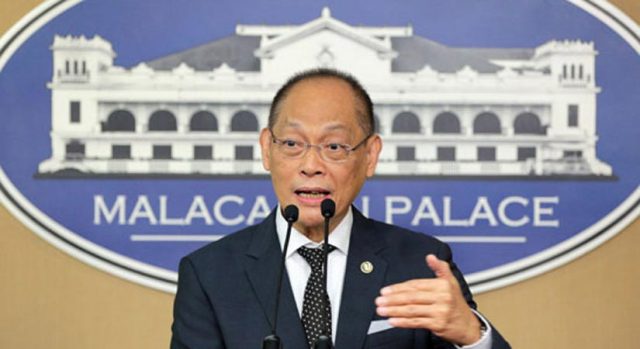
THE CENTRAL BANK is not keen on “drastic” liquidity-infusing moves as the impact of the pandemic is better addressed by fiscal measures, Bangko Sentral ng Pilipinas (BSP) Governor Benjamin E. Diokno said.

“Where we are right now is that we feel that our current monetary policy stance is still appropriate for the recovery. I don’t think there will be any drastic moves on our part to inject more liquidity into the system,” Mr. Diokno said in a Bloomberg TV interview on Wednesday, noting the impact from the measures rolled out in 2020 have yet to be fully absorbed by the financial system.

The Monetary Board maintained its key policy rate at a record low of 2% at its policy setting in March, as support for the pandemic-hit economy even as inflation surpassed the annual target range of 2-4%.

Central bank officials have assured that they will remain watchful of the inflation spike’s second-round effects such as wage and transport fare hikes.

The National Economic and Development Authority (NEDA) earlier estimated the two-week enhanced community quarantine in Metro Manila and nearby provinces could shave off around 0.8 percentage point from this year’s gross domestic product.

Mr. Diokno said the economy will likely grow by 6%-7% this year, below the official target range of 6.5%-7.5% set by economic managers.

For now, Mr. Diokno said heavier lifting should be on the fiscal side.

“I think there’s still a need for some fiscal stimulus. I think for example, we need to take care of the poor and the vulnerable who were affected by the lockdown,” he said.

Lawmakers are pushing for a third stimulus measure to support affected businesses and drive recovery. House Bill 8628 or the Bayanihan to Arise as One Act, which proposes to allocate P420 billion for a social amelioration program, wages subsidy for affected workers and the acquisition of more COVID-19 vaccines and medicine, among others.

EXTENSION
Mr. Diokno also confirmed that the BSP extended the maturity of the P540-billion loan to the National Government by three months. It was originally supposed to have been repaid in March.

National Treasurer Rosalia V. de Leon said in a Viber message that the no-interest BSP loan should be repaid by July 12.

“We are fortunate that under the revised charter of the central bank, we are really allowed to lend to the government in extraordinary times and these are extraordinary times,” Mr. Diokno said.

Finance Secretary Carlos G. Dominguez III on Tuesday said the government is looking to wind down its loans from the central bank this year or next. — Luz Wendy T. Noble with inputs from Beatrice M. Laforga

PHL factory output continues 12-month losing streak

REUTERS

THE COUNTRY’S factory output declined for a 12th straight month in February, and posted its steepest fall in five months, the government reported on Thursday.

Preliminary results of the Philippine Statistics Authority’s (PSA) Monthly Integrated Survey of Selected Industries for February showed factory output, as measured by the Volume of Production Index (VoPI), plunged by 43.6% year on year in February. This was faster than the revised 12% drop in January, and a reversal of the 0.4% growth a year earlier.

The February decline marked the steepest in five months or since the 56.7% year-on-year slump seen in September 2020.

The index has been on steady a decline since March last year, around the time when strict lockdown restrictions were implemented to contain the spread of the coronavirus disease 2019 (COVID-19).

The February result brought the slump in the first two months of the year to average 27.8% compared with the 1.4% dip in the same period last year.

The PSA noted 19 out of 22 industry divisions saw a drop in February. Of these, 14 posted double-digit annual declines led by the manufacture of coke and refined petroleum products (-85.4%); machinery and equipment, except electrical (-48.5%); textiles (-32.6%); and furniture (-30.3%).

Capacity utilization — the extent to which industry resources are used in producing goods — averaged 53.8% in February, down from 56.7% in January. This was the lowest since April 2020 when it recorded an average capacity utilization rate of 46.1%.

Of the 22 sectors, 15 averaged a capacity utilization rate of at least 50% in February.

In comparison, the IHS Markit Philippines Manufacturing Purchasing Managers’ Index (PMI), which uses a different set of parameters, posted a 52.2 reading in March, above the neutral 50 mark which separates expansion from contraction. However, this was down from the 52.5 figure recorded in February.

“The downtrend in manufacturing mirrors the weakness noted in our export figures also released where we saw outbound shipments other than semiconductors fell 5.5%. The most recent PMI report also indicated fading demand for our export products,” ING Bank N.V. Manila Senior Economist Nicholas Antonio T. Mapa said in an e-mail.

The economist also attributed the February turnout to the ongoing lockdown that continued to weigh on manufacturing activity.

The government has imposed lockdown restrictions nationwide since March of last year to curb the spread of COVID-19. Currently, Metro Manila and the provinces of Bulacan, Cavite, Laguna, and Rizal were placed under “extended community quarantine” — the country’s strictest form of lockdown until April 11.

Philippine Exporters Confederation, Inc. (Philexport) President Sergio R. Ortiz-Luis, Jr. expects manufacturing production in the coming months to continue to shrink by double-digits, albeit to a lesser degree compared with the February result due to base effects, he said in a phone interview.

A look at the PSA’s national accounts shows manufacturing to be among the top contributors to economic growth in the last few years. The same could be said for the revised 9.6% gross domestic product decline in 2020 wherein the sector chipped in -1.83 percentage point (ppt), only second to construction’s -2 ppt. — Jobo E. Hernandez

Philippines’ GDP decline in 2020 steeper than initially reported

PHILIPPINE STAR/ MICHAEL VARCAS

By Ana Olivia A. Tirona, Researcher

THE PHILIPPINE ECONOMY performed worse than previously reported in 2020, as the coronavirus pandemic continues to dampen business activity, the Philippine Statistics Authority (PSA) reported on Thursday.

Gross domestic product (GDP) — the value of all finished goods and services produced in the country at a given period — fell by record 9.6% last year, slightly faster than the 9.5% drop initially reported on Jan. 28.

Meanwhile, GDP for the fourth quarter of 2020 was unchanged at 8.3% from PSA’s preliminary estimate.

On the other hand, last year’s gross national income — the sum of the nation’s GDP and net primary income from the rest of the world — was revised to an 11.4% decline from the earlier estimate of -11.1%.

The performance in the services sector for the entire 2020 was revised downward to -9.2% from the previously reported -9.1%. Likewise, the decline in the industry sector is now estimated at -13.2% from -13.1%.

Downward revisions were noted in the following subsectors: manufacturing (-9.8% from -9.5%); wholesale and retail trade (-6% from -5.7%); accommodation and food service activities (-45.4% from -44.7%); information and communication (5% from 5.1%); financial and insurance activities (5.5% from 5.8%); and professional and business services (-10% from -9.3%).

On the expenditure side, growth in government spending was raised to 10.5% in 2020 from the preliminary 10.4%.

Trade in goods and services figures were also tweaked, with exports (-16.3% from -16.7%) and imports (-21.6% from -21.9%) both contracting less than initially reported.

Gross capital formation, or the investment component of the economy, was revised to -34.4% from -35.8%.

Bank of the Philippine Islands (BPI) Lead Economist Emilio S. Neri, Jr. said sectors that have been resilient at the outset of the coronavirus pandemic such as manufacturing, agriculture, and information and communications technology will be the main drivers for economic recovery.

“Sectors like recreation, retail trade and face-to-face services where health protocols are difficult to implement will continue to lag behind, however. This is where the public sector can give more attention to avoid a spiral of joblessness, erosion of consumer confidence and production as a good portion of our labor force work there,” he said in an e-mail.

“Capital formation may see a slightly faster recovery than household spending as many of the supply-side challenges causing inflation to spike will be addressed both by the private and the public sector’s projects, hopefully stepping up post-ECQ (enhanced community quarantine),” he added.

Meanwhile, IHS Markit Chief Economist for Asia-Pacific Rajiv Biswas said the reimposition of strict lockdown restrictions in Metro Manila and the surrounding provinces is “likely to be a key factor constraining the pace of near-term economic recovery.”

“[T]he pace of economic recovery in 2021 is likely to be less buoyant than previously expected, with renewed pandemic control measures dampening growth in the near term. Consequently, GDP growth in 2021 is expected to be in the 5% to 6% range, with stronger growth in 2022 as the pandemic is gradually constrained by widening vaccine rollout in the Philippines,” he said in a separate e-mail.

The revision comes ahead of the release of the PSA’s national accounts for Q1 2021 on May 10.

According to the PSA, revisions on the estimates are based on updated data submissions by data source agencies, in line with international standard practices.

PHL business sentiment improves, but ECQ may dampen outlook

PHILIPPINE FIRMS are more optimistic for the rest of the year, a central bank survey showed, but the surge in coronavirus infections and the reimposition of a strict lockdown in the capital region threatens to dampen sentiment.

The overall business confidence index in the first three months of the year improved to 17.4% from a reading of 10.6% in the fourth quarter of 2020, based on the Business Expectation Survey results released by the Bangko Sentral ng Pilipinas (BSP) on Thursday.

This is the highest reading since the 22.3% in the first quarter of 2020 before the pandemic’s impact became more pronounced.

Business Expectations Survey

The confidence index reading for business outlook for the second quarter also improved to 42.8% from 37.4%.

Business optimism spilled over for the rest of the year with the confidence index at 60.5%, better than the 57.7% the previous quarter and the highest since the 59.6% seen in the fourth quarter of 2019.

The improvement in business confidence could be traced to the easing of restriction measures and re-opening of businesses, as well as more people adapting to the new normal, BSP Department of Economic Statistics Senior Director Redentor Paolo M. Alegre, Jr. said in an online briefing on Thursday.

Respondents also cited the increase in volume of sales and orders, the rollout of the coronavirus disease 2019 (COVID-19) vaccines, and the development of new business strategies, as factors that contributed to business optimism.

“However…as seen from the chart there was a dip in optimism that you see by area or by period basis that with a lockdown, there can be an impact on business sentiment in the second quarter,” Mr. Alegre said.

The study was conducted among 1,512 firms around the country from Feb. 4 to March 12. Metro Manila and nearby provinces was placed under the strictest form of lockdown on March 29. The enhanced community quarantine was extended until April 11.

“So far what we have experienced is just two weeks of ECQ, it depends on the extent where restrictions are reimposed and it also depends on the direction,” BSP Deputy Governor Francisco G. Dakila, Jr. said.

He noted the vaccination rollout also contributed to the firms’ more upbeat outlook.

The BSP study also showed more firms are eyeing to expand in the next quarter (20.6% for the second quarter from 16.9% in the fourth quarter of 2020) although slightly lower for the next 12 months (27% from 28%).

Firms involved in mining, quarrying and manufacturing are planning to expand, while those in agriculture, fishery and forestry sectors were less keen on expansion in the next 12 months.

Firms cited insufficient demand resulting in low sales volume (46.7%) and stiff competition (41.6%) as major risks to their business. — Luz Wendy T. Noble

Meralco rates rise on higher spot market prices

TYPICAL households in Metro Manila are set to see an increase of around P17 in their electricity bill this month as Manila Electric Co. (Meralco) announced a rise in the overall power rate due to higher spot market prices.

In a press release on Thursday, Meralco said that its overall rate climbed by P0.0872 per kilowatt-hour (kWh) to P8.4067 per kWh from last month’s P8.3195 per kWh.

The increase will translate into a P17.44 hike in the monthly bill of typical households, or those that consume 200 kWh a month. Households consuming 300 kWh, 400 kWh, and 500 kWh will see an increase of around P26, P35 and P44, respectively.

Meralco explained that the generation charge, which it remits to power suppliers, rose this month by 3.7% or P0.1621 to P4.5370 per kWh. The surge was caused by the P2.5991-per-kWh increase in the cost of power at the wholesale electricity spot market (WESM) because of tighter supply conditions in the Luzon grid.

“Peak demand in Luzon increased by almost 1,000 MW (megawatts) in March as a result of warmer temperature, while unavailable capacity from plant outages remained above 3,400 MW. WESM share is slightly down to 11% this month,” the firm said.

However, the increase in WESM charges were mitigated by the lower costs from independent power producers (IPPs) and power supply agreements (PSAs), Meralco said.

Charges from IPPs and PSAs went down by P0.2090 and P0.1371 per kWh, respectively, due to improved average plant dispatch and the peso’s appreciation.

PSA-sourced power accounted for 50% of Meralco’s energy requirements while IPPs were responsible for 39%.

Transmission charges decreased by P0.0856 per kWh, mainly caused by lower ancillary service charges, while taxes and other charges climbed by P0.0107 per kWh.

Meralco said that the collection of the environmental component of the universal charge at P0.0025 per kWh remains suspended in line with an order from the Energy Regulatory Commission (ERC).

The power firm said its distribution supply, and metering charges have remained unchanged for 69 months, after being reduced in July 2015.

Meralco does not earn from the pass-through charges, such as generation and transmission charges.

“Payment for the generation charge goes to the power suppliers, while payment for the transmission charge goes to the NGCP (National Grid Corp. of the Philippines),” it said.

Taxes and other public policy charges like the universal charges and the feed-in tariff allowance are remitted to the government, it added.

REFUNDS
In its statement, Meralco said that the April rate includes the ERC’s approved adjustments of the firm’s pass-through charges from January 2017 to December 2019.

Four months ago, the ERC ordered Meralco to refund over-recoveries in transmission and other charges over three months, and to collect an under-recovery in the generation rate for 24 months.

“Meralco implemented the ERC-approved adjustments starting January 2021. The impact to residential customers, from the months of January to April 2021, is a net refund of around P0.1150 per kWh,” the company said.

The distribution utility added that it is also implementing its distribution rate true-up refund, which began in March. The amount represents the difference between the actual weighted average tariff and the ERC-approved interim average rate for distribution-related charges from July 2015 to November 2020.

The refund rate is at P0.2761 per kWh, and is set to appear in consumers’ bills as a line item called “Dist True-Up.”

On Thursday, shares in Meralco at the local bourse shed 1.13% or P3.2 to close at P280.60 apiece.

Meralco’s controlling stakeholder, Beacon Electric Asset Holdings, Inc., is partly owned by PLDT, Inc.

Hastings Holdings, Inc., a unit of PLDT Beneficial Trust Fund subsidiary MediaQuest Holdings, Inc., which has interest in BusinessWorld through the Philippine Star Group, which it controls. — Angelica Y. Yang

Sorkin’s Chicago 7 is Netflix’s latest shot at Oscar glory

A SCENE from the film The Trial of the Chicago 7 (2020) — IMDB.COM

AARON SORKIN has seen a lot over more than 30 years in Hollywood, but even he couldn’t have predicted how neatly a Vietnam War-era film would fit the political climate of 2020.

The Trial of the Chicago 7, the second movie directed by the famed screenwriter, follows the Vietnam War protesters who were accused of inciting riots at the 1968 Democratic Convention. The film has been nominated for six Academy Awards, including for Mr. Sorkin’s screenplay, and represents Netflix, Inc.’s latest shot at the industry’s top prize.

The movie got a boost last week by taking the best-ensemble prize at the Screen Actors Guild Awards, marking the first time a streaming service has won that recognition. The Academy Awards will be announced April 25.

Reflecting earlier on the film, which took about 14 years to make from conception to completion, Mr. Sorkin marveled at how little things have changed in the half-century since Tom Hayden, Abbie Hoffman, Bobby Seale and the others went on trial for their roles in the riots. The antiracism movement of last summer helped audiences connect with its message about the importance of protest in a democracy, he said.

“We thought the movie was plenty relevant last winter when we were making it,” Mr. Sorkin, 59, said in a phone interview from his home in Los Angeles. “We didn’t need it to get more relevant, but it did, obviously. I’ve been asked a lot if I changed the script to reflect events in the world. And I didn’t ever. The world changed to reflect the script.”

The idea for the movie came from Oscar-winning director Steven Spielberg, who has made a few of his own historical pictures, including Lincoln. He called Mr. Sorkin, the creator of the TV series The West Wing, over to his house on a Saturday morning in 2006 and said he wanted to make a movie about the Chicago Seven. Mr. Sorkin enthusiastically agreed to write it, without admitting he didn’t know what Mr. Spielberg was talking about.

“I left his house, called my father and asked who the Chicago Seven were,” Mr. Sorkin recalled.

The Chicago Seven (there were initially eight) were from different factions of the antiwar movement that rallied thousands of young people to come to Chicago in the summer of 1968 to protest the Democratic Party’s expected nomination of Vice-President Hubert Humphrey to succeed President Lyndon Johnson. They were met by 12,000 Chicago policemen, 5,600 members of the Illinois National Guard and 5,000 US Army soldiers.

The trial began more than a year later, pressed by President Richard Nixon’s Justice Department. Mr. Sorkin did some firsthand research through conversations with Mr. Hayden, a leader of Students for a Democratic Society at the University of Michigan in the 1960s. Mr. Hayden, played by Eddie Redmayne, gave Mr. Sorkin a sense of the tension between himself and Mr. Hoffman, a prominent antiwar activist who is played in the film by Sacha Baron Cohen. Mr. Hoffman took his own life in 1989. Mr. Hayden, who had a long career in California politics later and was married for 17 years to actress Jane Fonda, died in 2016 after a lengthy illness.

The drama between the two became an important part of the script, along with the police confrontation early in the film and the courtroom fireworks, after Mr. Sorkin dropped the notion of turning the story into a Broadway musical or play. He rewrote the screenplay dozens of times and the film went through numerous iterations, first with Mr. Spielberg set to direct, then with different actors including Seth Rogen and Dane Cook, before eventually going into production at ViacomCBS, Inc.’s Paramount Pictures with the current cast and Mr. Sorkin as director.

Last spring, it was clear the coronavirus was going to disrupt Paramount’s plans for a theatrical release. Market research indicated the first customers to come back to theaters would be people who thought COVID-19 was a hoax. And they might not have been sympathetic to the film’s message, studio Chairman Jim Gianopulos and the filmmakers agreed. “We didn’t have much confidence the Idaho militia was going to show up opening weekend,” said Mr. Sorkin, who won an Oscar in 2011 for adapting the Facebook story The Social Network to the big screen.

Tyler Thompson, a producer at Cross Creek Pictures who worked with Mr. Sorkin on the movie, said the transition to streaming went smoothly and may ultimately have been a good thing. The film cost about $35 million to make and would have eaten up a similar amount in marketing. Netflix bought the picture for $56 million and released it to home audiences on Oct. 16.

“It’s interesting to watch the Netflix big machine,” Thompson said. “They reach 600 million people. It’s pretty fantastic, to say the least. It was definitely a lifeboat that was an unlikely possibility, but they saw what we saw.”

Because Netflix doesn’t routinely disclose viewer numbers, it’s not clear how popular the film was. The streaming giant’s management touted its good fortune in picking up the film on an earnings call. It’s one of eight movies vying for the best-picture Oscar.

But for the producers to receive that same $56 million from a theatrical release, The Trial of the Chicago 7 would have had to generate almost $150 million in ticket sales, on par with the performance of Wonder Woman 1984.

Mr. Sorkin, who also wrote the screenplay for the hit courtroom drama A Few Good Men, said that while he thinks some aspects of moviegoing may be permanently changed because of COVID-19, he still wants his pictures shown theatrically when the pandemic is over. He just started production on a new film, Being the Ricardos, a biopic about Lucille Ball and Desi Arnaz.

“I really do think we’re going to have our cake and eat it, too,” Mr. Sorkin said. “I think that people are going to go back to the movies. I think we’re going to have the convenience of being able to watch a feature at home.” — Bloomberg

Cebu Pacific’s refunds payable hit P1.43 billion in 2020

BW FILE PHOTO

BUDGET CARRIER Cebu Pacific said its customer refunds payable reached P1.43 billion last year due to a surge in refund requests amid a public health crisis.

Cebu Air, Inc., the listed operator of the low-cost carrier, said in its annual report released on Thursday that it saw a “1,938.7% increase” in its refunds payable last year “due to a surge in refund requests with the increase in flight cancelations brought about by the COVID -19 (coronavirus disease 2019) outbreak.”

Its refunds payable last year totaled P1.43 billion, a significant increase from the previous year’s P70.17 million.

“In light of the significant increase in flight cancelations due to the COVID-19 outbreak and consequent to the grounding of the group’s commercial operations, customers were given options for their canceled flights which included, among others, conversion to a full travel fund which is a virtual wallet equivalent to the amount paid for an existing booking. A travel fund is valid for two years and can be used as payment for future bookings,” the budget carrier said.

Cebu Pacific has said processing of refunds could take up to seven months due to the high volume of requests.

It reported a net loss of P22.2 billion, owing primarily to the effect of the pandemic on its operations.

Cebu Air’s revenues for 2020 dropped 73% to P22.6 billion. Cargo business contributed P5.4 billion or 24% of the total.

The number of passengers it carried last year dropped 78% to five million, while the number of flights was 71% lower at 41,804.

It closed the year with P20.77-billion operating loss and negative EBITDAR (earnings before interest, taxes, depreciation, amortization, and restructuring or rent costs) of P932 million.

Cebu Air said it expects a slow recovery from the crisis due to the losses it has suffered.

“The group remains in a strong balance sheet and equity position at the end of the period,” it noted.

“The group is actively engaged in planning and executing various measures to mitigate the impact of the COVID-19 global pandemic on its business operations. These include negotiations with key suppliers on capital expenditure commitments and related cash flows, as well as with other suppliers and stakeholders as they impact the group’s cash flows. It is further engaged in the planning of staff rightsizing in addition to further optimization and digitalization of processes,” it added.

Cebu Air shares closed 2.06% higher at P47 apiece on Thursday. — Arjay L. Balinbin