Home Blog Page 7614

Powell’s chances at second term rise with key Yellen endorsement

JEROME POWELL’S chances for a second term as Federal Reserve chair gained momentum with Treasury Secretary Janet Yellen’s endorsement, a move that would reduce uncertainty about the path for monetary policy amid risks from inflation and the Delta variant.

Ms. Yellen has told senior White House advisers that she favors renominating Mr. Powell, whose current term ends in February, according to people familiar with the matter. President Joseph Biden hasn’t decided yet and is likely to make his choice around Labor Day, which falls on Sept. 6 this year, the people said.

Her support, reported Saturday, offers Mr. Powell an enormous boost — given both the weight of her position as Treasury chief and her personal stature having run the Fed herself for four years, capping a central banking career that spanned almost two decades.

Still, Fed governor Lael Brainard maintains some support inside the administration for the Fed chair job, according to one person familiar with the matter. The former Obama-era official, who Mr. Biden last year considered for Treasury secretary, has the support of progressive Democrats, many of who are working across the Biden team.

“One of the great benefits of keeping Powell on as chair is continuity,” said Derek Tang, economist at Monetary Policy Analytics. “That’s very reassuring in a time of such uncertainty. He is a steady hand. The markets see him that way and that’s why it helps.”

Mr. Powell’s nomination for a fresh term would need confirmation in the Senate, where there’s a 50-50 partisan split. GOP senators have in recent weeks backed the current chair, who served as a governor at the Fed from 2012 until being elevated in 2018, when then-President Donald Trump passed over Ms. Yellen for her own second term.

Ms. Yellen’s endorsement comes at an important time. Mr. Powell will deliver a much-anticipated virtual speech on Friday at the Federal Reserve Bank of Kansas City’s annual Jackson Hole symposium — possibly signaling when and how the central bank is likely to begin withdrawing some of its extraordinary support for the economy.

“This is a great opportunity for him to showcase his consensus building skills,” Mr. Tang said. Mr. Powell will have a chance to show the White House and others how he’s threading the needle within his own committee, given their different views on when to start pulling back support for the economy.

Mr. Powell and his colleagues have been applying a new policy framework — announced at Jackson Hole last year —  which alters a previous approach of raising interest rates to contain inflation based on expectations for job and economic growth rather than outcomes. Investors have been debating the appropriateness of the strategy at a time of major pandemic-triggered disruptions to supply chains and the job market. Putting a new Fed chief in place in February could heighten uncertainty in markets.

Critics, including Republicans and even some Democrats, have said the Fed is at risk of letting inflation get out of control for the first time in more than 30 years. They have urged Powell to begin pulling back on the Fed’s massive bond purchases, which help stimulate the economy by suppressing long-term borrowing costs.

“Monetary policy is at a critical juncture,” Deutsche Bank AG economists led by Peter Hooper, who previously worked at the Fed, wrote in a note to clients this month. Replacing Mr. Powell with someone more dovish “could prove counterproductive, as it could lead to an increase in perceived inflation risks, higher bond yields and weaker risk sentiment — all of which would delay the return of the economy to its pre-pandemic state.”

BRAINARD OPTION
Biden administration officials have been studying speeches and commentary by Ms. Brainard, who’s seen as a more liberal nominee who hews closer to Biden’s economic agenda and is far more of a hawk on banking regulations. Nominating Brainard would win praise from progressive Democratic senators, but it would set up a bruising confirmation fight — potentially even a 50-50 vote in the Senate with Vice-President Kamala Harris the tie-breaker.

While many senior Democrats have praised Mr. Powell, unified Democratic support isn’t a foregone conclusion. Senators Sherrod Brown and Elizabeth Warren have declined to say whether they would back him for another term, with both criticizing Mr. Powell’s handling of financial regulations on issues like bank-stock buybacks.

Several other openings are pending on the governing board, giving Mr. Biden a chance to put his stamp on the Fed and remake it after Mr. Trump’s five picks.

Besides Mr. Powell, Mr. Biden has the opportunity to replace the vice chair for supervision, who oversees bank regulations, a position now held by Randal Quarles and the vice chair post now held by Richard Clarida, along with an open seat on the Fed board.

INFLATION READINGS
Meantime, inflation — an economic phenomenon that barely registered in American politics for 40 years — represents a vulnerability in the 2022 midterm elections.

The most recent readings remain elevated: the consumer price index rose 5.4% in the 12 months through July, though it fell from the previous month for the first time since November.

The concerns revealed themselves this month when data showed that consumer sentiment fell in early August to the lowest level in almost a decade by one measure and US retail sales slid in July by more than forecast.

“Inflation-linked assets should benefit significantly” if Ms. Brainard were nominated as Fed chair, Wells Fargo & Co. analysts including Mike Schumacher, head of macro strategy, wrote this month. They predicted a widening gap in yields between inflation-linked Treasuries and regular ones following such news.

The Wells Fargo team also said, however, “To be clear, we and the online markets still expect Mr. Powell to retain his seat.” — Bloomberg

D.M. Wenceslao says projects stay ‘on track’

D.M. Wenceslao & Associates, Inc. (DMW) said its project development is still in progress, as it hopes the country may see economic recovery by the middle of next year.

“We have not slowed down our development pipeline, we’re still on track to hand over around 70,000 square meters (sq.m.) of new commercial space this year and another 70,000 sq.m. next year,” DMW Chief Executive Officer Delfin Angelo C. Wenceslao told ABS-CBN News Channel’s Market Edge on Monday.

Meanwhile, the hospital it plans to build with St. Luke’s Medical Center is still in the planning stage. The two entered into a memorandum of agreement in February last year, allowing St. Luke’s to construct its hospital in a 1.5-hectare site in the company’s flagship project, Aseana City in Parañaque.

Its mixed-use Parqal development, which is also located in Aseana City, is also scheduled for completion next year.

“I think this project is highly relevant right now,” Mr. Wenceslao said. “We predicted that there’s going to be a lot of demand for people who want to be in a campus-type development and have access to world-class public space.”

The company will not be joining the real estate investment trust bandwagon anytime soon, he said.

“From a funding standpoint, we still have actually quite a big chunk of our IPO (initial public offering) funds left, roughly 30%, and we still have a lot of untapped credit lines,” Mr. Wenceslao said.

“I think it’s something that we would probably take a look at once more of our development pipelines finish so we would want to be sure that it’s a sizable issue,” he said.

The property developer raised P8.15 billion from its initial public offering (IPO) held in 2018. Its net proceeds reached P7.6 billion, of which 49% were planned to be used to fund projects for Aseana City. It planned to use P2.9 billion for land acquisition and P1 billion for infrastructure development.

On Monday, DMW shares at the stock market inched down by 0.14% or one centavo to close at P6.98 each. — Keren Concepcion G. Valmonte

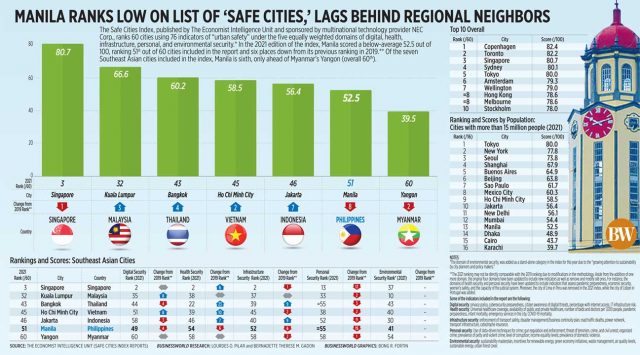
Manila ranks low on list of ‘safe cities,’ lags behind regional neighbors

MANILA is again one of the least safe cities in the world after it dropped eight spots in a biennial index released by The Economist Intelligence Unit. Read the full story.

Manila ranks low on list of ‘safe cities,’ lags behind regional neighbors

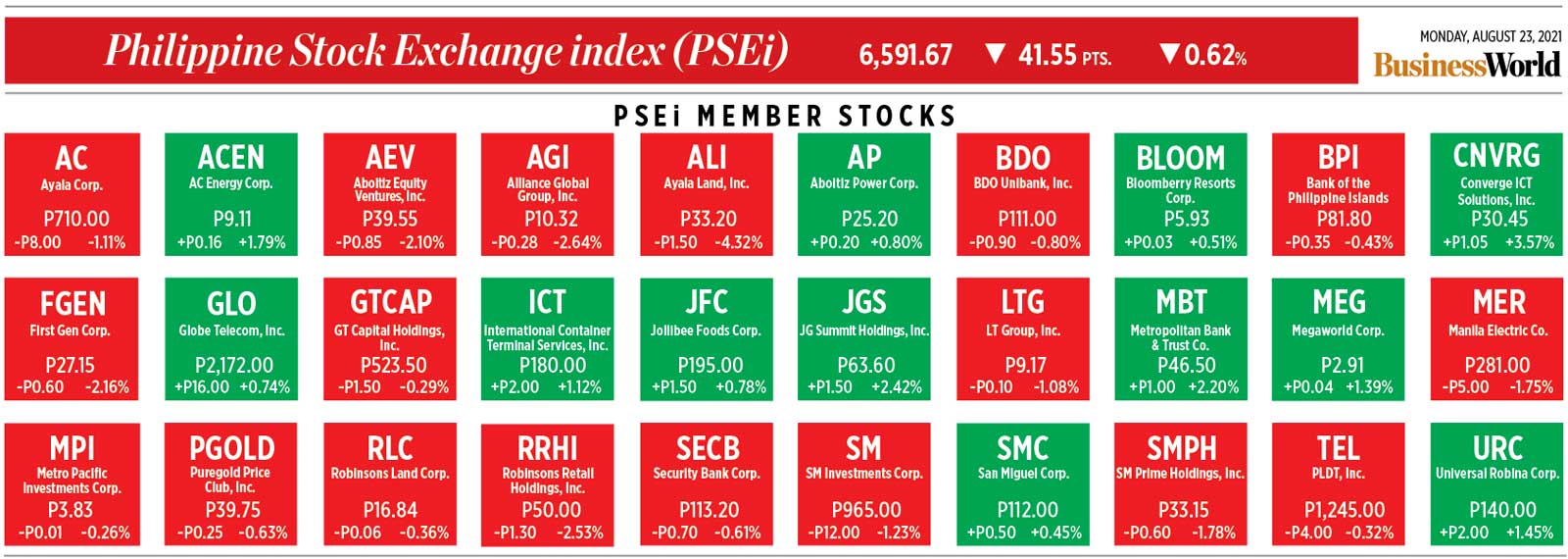
How PSEi member stocks performed — August 23, 2021

Here’s a quick glance at how PSEi stocks fared on Monday, August 23, 2021.


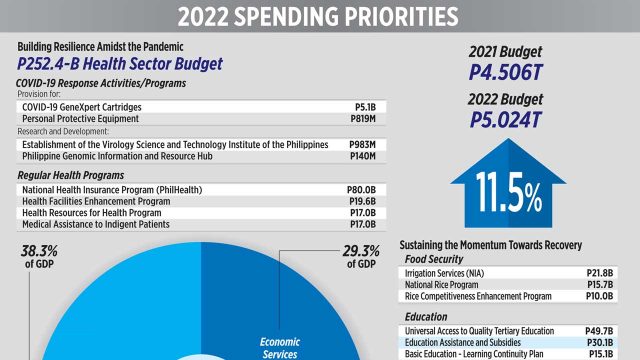
2022 Spending Priorities

THE NATIONAL GOVERNMENT is proposing to allocate P1.18 trillion for infrastructure projects in 2022, as it expects the sector to drive the economic recovery from the coronavirus pandemic. Read the full story.

2022 Spending priorities

S&P says PHL credit rating likely unaffected by rising debt load

REUTERS

S&P GLOBAL RATINGS is expecting a “modest” increase in net general government (GG) debt next year assuming the Philippines needs to deal with further waves of coronavirus disease 2019 (COVID-19), but such deterioration in debt metrics is unlikely to impact the sovereign rating.

In a note issued Monday, the ratings agency projected net GG debt at 45.4% of the overall economic output next year, higher than its baseline forecast of 44%, under a scenario of two more COVID-19 surges.

Interest expense as a percentage of GG revenue will edge up to 12.6% from the 12.2% baseline estimate.

“We do not expect the projected impact of the simulations here to affect the sovereign ratings of the Philippines. The higher debt levels in the simulation do not materially affect country’s debt assessment… The increases in government debt in the simulations are relatively modest,” YeeFarn Phua, director at S&P Global Ratings said in an e-mail responding to BusinessWorld queries.

He said the debt increase under such a scenario will pay for additional measures needed to deal with future surges, noting that debt will remain well within the S&P forecast range for the Philippines.

Mr. Phua said the ratings agency has taken into account much of the impact of the pandemic in its outlook for Philippine budget balances in 2021-2022.

S&P last week trimmed its economic growth outlook for this year to 4.3% from the 6% estimate it issued in June as quarantine measures were tightened once more due to rising COVID-19 cases. It is expecting a 7.7% expansion in 2022.

The Philippines experienced a fresh surge in COVID-19 infections early this month as the highly contagious delta variant gained traction around the country.

The Health department reported a record 18,332 fresh cases Monday, pushing the tally of active cases to 130,350.

“Despite the recent surge in COVID infections, our ratings on the Philippines remains on a stable outlook. It reflects our expectation that the Philippine economy will recover to healthy rates of growth as the COVID-19 pandemic is better contained, and that the government’s fiscal performance will materially improve,” Mr. Phua said.

S&P affirmed in May its “BBB+” rating on the Philippines, with a “stable” outlook.

S&P said in its report that sovereign ratings of most Asia-Pacific economies will likely withstand the potential damage of two more waves of COVID-19 outbreaks.

“Our two-wave simulation shows weakened credit support for some governments, but few sovereigns are likely to see lower ratings as a result. Deterioration in the fiscal metrics are most pronounced, similar to the actual impact of the pandemic since April 2020. For this period, we have lowered our fiscal performance assessments on about 50 sovereigns,”according to the report.

“For many of these sovereigns, the longer-term impact of COVID-19, and other factors, prevent governments from returning to pre-pandemic budgetary positions. In the simulations, however, we assume that new outbreaks do not damage future fiscal performances,” it added.

However, if interest rate and revenue trends turn out worse than expectated, S&P said the additional outbreaks could affect the sovereign ratings of more economies, with Malaysia, Australia, and Vietnam, being more sensitive to heavier debt burdens. — Beatrice M. Laforga

House passes tax relief bill for private schools on third reading

HOUSE LEGISLATORS approved a measure on third and final reading Monday to explicitly make private schools eligible for preferential tax rates which will allow them to recover from the crisis, after their eligibility for such relief had been questioned by the Bureau of Internal Revenue (BIR).

House Bill 9913 amends Section 27 (B) of the National Internal Revenue Code of 1997 to apply the 10% preferential tax rate to all proprietary educational institutions and nonprofit hospitals from Jan. 1, 2012 to June 30, 2020.

In effect, private schools will pay a tax rate of 1% between July 1, 2020 and June 30, 2023, as authorized by Republic Act No. 11534 or the Corporate Recovery and Tax Incentives for Enterprises (CREATE) law. Once the provision expires, the tax rate will revert to 10%.

The measure was passed by the House Ways and Means committee on Aug. 2 and was passed on second reading the next day.

The BIR had suspended provisions of Revenue Regulations No. 5-2021, which granted tax relief only to private educational institutions that are “nonprofit” ineligible schools had to pay the 25% regular corporate income tax rate.

Albay Rep. Jose Ma. Clemente S. Salceda, chairman of the House Ways and Means committee, said Monday that the measure will help private schools hire at least 12,996 teachers at the start of the next school year.

“That is the largest tax cut to any sector ever in the country’s history, and I am proud that we will do it for the sector the Constitution values the most, the education sector,” he added.

He also hopes that the Senate adopts the House-approved version to ensure that the bill is transmitted to Malacañang before the year ends.

Private school groups, led by the Coordinating Council of Private Educational Associations welcomed the bill’s passage in the House, calling on the Senate to take prompt action on the measure.

“This legislative policy intervention, once enacted, will provide the needed stability to education not only in this time of pandemic but also for generations to come, as it aligns with all existing and future initiatives to revive our battered economy,” they said in a joint statement. — Russell Louis C. Ku

ERC urged to disallow automatic pass-through fuel costs in power deals

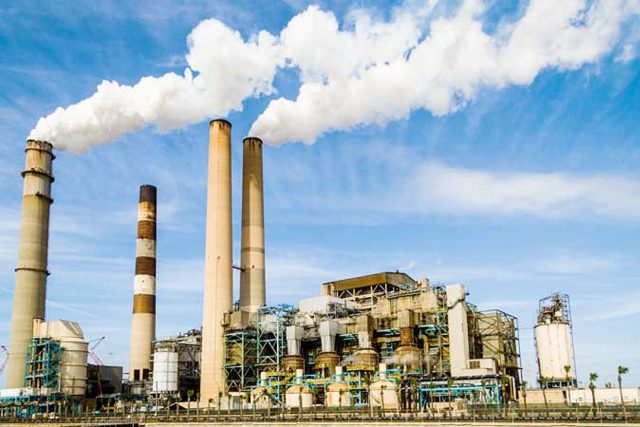
THE ENERGY Regulatory Commission (ERC) needs to remove the pass-through fuel cost provisions in power purchase agreements (PPAs) to ensure the least cost for consumers, according to a UK-funded report on the Philippines’ energy transition.

“It would be prudent for the ERC to implement mandatory fixed prices for PPAs by removing the automatic (fuel) pass-through,” according to the findings of the report, Analyzing Energy Transition Risks in the Philippine Power Sector.

“Eliminating the pass-through for imported fuel costs avoids the ups and downs of volatile commodity markets, providing valuable price stability,” it added.

A typical PPA between a distribution utility and coal power producer provides for fuel costs incurred by the latter to be automatically passed on to consumers, with pass-through charges based on the prevailing global coal price index.

The report cited the case of Panay Energy Development Corp. whose 167.4-megawatt coal-fired plant sold power at P2 per kilowatt-hour (kWh) more than the agreed PPA price set in 2016, which was P3.96 per kWh.

The pricing difference can be attributed to current market rules which contain a pass-through provision that allowed “fluctuations in fuel price and (foreign exchange) rates to be passed onto consumers and industry.”

Institute for Climate and Sustainable Cities (ICSC) Energy Transition Advisor Alberto R. Dalusung III said that coal power generation facilities must absorb fuel pass-through costs since they are in the “best” position to do so.

He said fuel costs from coal plants can account for more than 50% of the total price of generated power, describing pass-through as a process of transferring risk to end-users.

“The power plant itself (chose) coal as the fuel. They could have chosen natural gas or liquified natural gas. (But) they chose coal. Now that fuel has a cost. It’s imported, and you have to bring it to the Philippines. You (also) have to spend foreign exchange which means that there is a foreign exchange risk (or) currency risk,” he told BusinessWorld in an online interview last week.

He added that the fuel-pass through costs show up in power bills as generation charges.

The proposed removal of pass-through is also thought to deter further coal plant construction, avoiding the risk of having such plants become stranded assets when the energy transition gains momentum.

Other proposals include fast-tracking auctions to ensure new capacity; improving tariff setting to ensure least-cost and flexibility generation; implementing a permanent moratorium on new inflexible power; and improving clarity on who pays for stranded-asset risk.

The ICSC is one of the contributors to the report. Others include the Carbon Tracker Initiative and the Institute for Energy Economics and Financial Analysis. — Angelica Y. Yang

LANDBANK opens accounts for 47% of national ID applicants

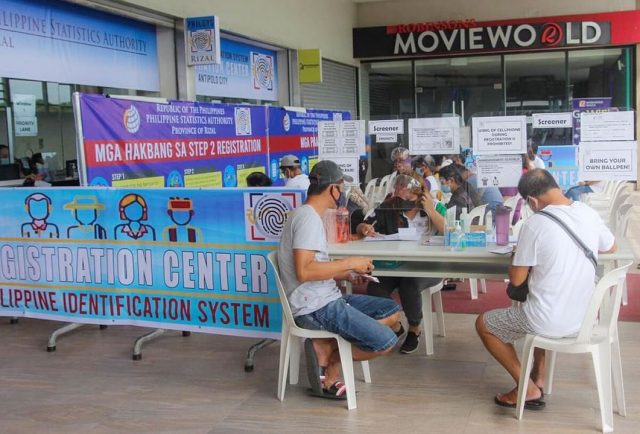
LAND BANK of the Philippines (LANDBANK) opened 4.47 million accounts for applicants who registered to receive the national ID system as of the end of June, the equivalent of 47% of the ID registration total.

The Department of Finance released the data on account openings in a statement Monday, citing a report from the bank.

Some 1.23 million had received their LANDBANK Agent Banking cards and are already using these cards for various transactions. The cards enable users to engage in branchless banking by transacting with LANDBANK partners, enabling them to withdraw money. The cards are issued for free.

The cards can also be used to transfer government subsidies electronically, and for “tap” payments in mass transport automated fare collection systems.

One of the national ID’s main goals is to expand financial inclusion by eliminating onerous ID requirements currently in place for opening bank accounts.

LANDBANK sets up booths in the registration centers of the Philippine Statistics Authority, which allow registrants to open bank accounts after their biometrics are taken for the national ID.

Meanwhile, LANDBANK said 1.67 million accounts have been opened under its Digital Onboarding System from its launch date in November 2018 until end-June. 

In June, new accounts opened rose 1.43% month on month to 68,863.

LANDBANK also saw the number of transactions coursed through its mobile bank application increase by 47% from a year earlier to 47.03 million in June.

The bank’s net earnings rose 1.67% to P5.48 billion in the first quarter. — Beatrice M. Laforga

Medical equipment distributor planning expanded product line

SIEMENS

MEDICAL EQUIPMENT company Medilines Distributors, Inc. said it plans to expand its footprint in the Philippines to increase the supply of medical devices during the pandemic.

The company has been distributing equipment that helps in the detection of coronavirus disease 2019 (COVID-19) complications, including CT scanners and x-ray machines, the company said in a statement Monday.

Medilines has also installed 126 dialysis machines and 63 portable reverse osmosis machines in intensive care units. Founded in 2002, the firm distributes Siemens, B. Braun, and Varian devices in the Philippines.

“The firm continues to equip hospitals with more dialysis machines as 30-50% of hospitalized COVID-19 patients have (developed) severe kidney injury from the infection,” the company said.

It said that it plans to expand its product portfolio, but did not elaborate.

Medical device distribution was constrained during the initial lockdown last year after transport between regions was hampered. But the company said it had since been able to  deploy medical equipment after travel rules were refined.

“As the pandemic drags on, we will remain steadfast in our commitment to make critical equipment available to primary providers of COVID-19 care wherever in the country they may be,” Medilines Chairman Virgilio Villar said. — Jenina P. Ibañez

UN ESCAP launches risk and resilience database for Asia Pacific

PHILSTAR

THE UN ECONOMIC and Social Commission for Asia and the Pacific (UN ESCAP) has announced the launch of an online portal to track various hazard hotspots as well as climate adaptation efforts across the Asia Pacific region, featuring up-to-date information from over 50 countries including the Philippines.

In a virtual briefing Monday, UN ESCAP Deputy Executive Secretary for Sustainable Development Kaveh Zahedi described the “Risk and Resilience Portal” (RRP) as a “one-stop shop” that supports risk-informed policymaking across the region.

“(It) enables member-countries to identify hazard hotspots; calculate losses on the various hazards and climate change scenarios; (and) estimate the specific costs of adaptation; and highlight potential priority adaptation (measures),” he said.

The portal also has a “decision support system” which provides an analysis of the disaster risk stories of five countries: Papua New Guinea, Pakistan, Myanmar, Mongolia and Armenia.

“(The portal) bridges the science and policy gaps that currently exist from the lack of translational science. Through the integration of data from multiple existing and validated sources, the portal is a one-stop shop to ensure that the vast array of scientific info on hazards, climate change, social, economic and health data can be analyzed in a way that can be used by policy makers, decision makers and development researchers to make efficient risk-informed decisions that span across multiple sectors,” said UN ESCAP Economic Affairs Officer Madhurima Sarkar-Swaisgood.

On the portal’s website, UN ESCAP said that the database “aims to strengthen the capacity of countries in Asia and the Pacific to mitigate the impacts of cascading risks on the achievement of the sustainable development goals.”

Other groups that worked on the RRP include the UN Institute for Training and Research and United Nations Satellite Centre.

The online portal can be accessed at https://rrp.unescap.org/.

The RRP’s launch took place on the first day of the UN ESCAP’s virtual Disaster Resilience Week which will run until Aug. 27. — Angelica Y. Yang

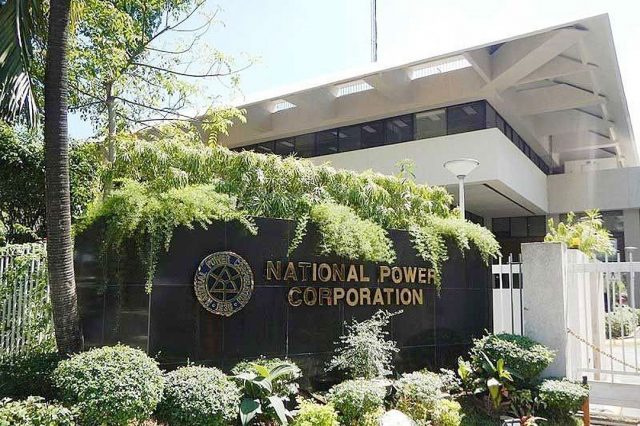
Napocor to extend power supply agreement with Mindoro electric co-op until end of 2021

PHILSTAR FILE PHOTO

THE NATIONAL Power Corp. (Napocor) said Monday that it will extend its power supply agreement (PSA) with Occidental Mindoro Electric Cooperative, Inc. (Omeco) until the end of the year, and provide funds to the power distributor as it awaits the completion of a power procurement auction.

“We will also heed their request that our leased units with a total capacity of 4 MW (megawatts) be operational at full capacity to ease their power situation,” Napocor OIC Donato D. Marcos said.

The Napocor-Omeco PSA expired on June 25, but the decision to extend came after Omeco experienced problems in contracting power.

Napocor provided no details on how much aid it is providing Omeco.

At present, Omeco is awaiting the results of a competitive selection process for power suppliers to fill the cooperative’s additional power requirements.

Napocor added that it has connected the transmission system of Oriental and Occidental Mindoro.

“Omeco can tap Oriental Mindoro Electric Cooperative’s reserve power. (But) It is yet to be evaluated by both parties,” Napocor said.

Napocor is mandated by law to provide power to remote off-grid areas via its small power utilities group plants.

It is also in charge of effectively managing the government’s remaining power assets like the 981-MW Agus and Pulangi hydroelectric power plants in Mindanao, and managing watershed areas and dams that support power generation. — Angelica Yang

ADVERTISEMENT
ADVERTISEMENT