Home Blog Page 761

Worker trapped under collapsed medieval tower in Rome dies, media says

COMMONS.WIKIMEDIA.ORG

ROME — A Romanian worker trapped for hours under rubble in Rome on Monday following the partial collapse of a medieval tower near the Colosseum has died, local media said.

The man was rescued by emergency services late on Monday and taken to hospital in a serious condition, Rome police chief Lamberto Giannini had previously said.

Parts of the 29-meter Torre dei Conti crashed to the ground on at least two occasions, videos posted on social media and Reuters video showed. The first collapse took place at around 1030 GMT, the second about 90 minutes later.

Clouds of dust came billowing out of the windows, along with the sound of collapsing masonry. The second incident took place while firefighters were working on the structure with aerial ladders.

A second worker, also Romanian, was pulled out almost immediately and hospitalized with serious but not life-threatening head injuries, while two more workers suffered minor injuries and declined hospital treatment.

None of the firefighters was injured.

Authorities have seized the construction site, Italian daily Corriere della Sera reported.

TOWER BUILT BY 13TH CENTURY POPE
The tower, which was due to be converted into a museum and conference space, is located halfway along the Via dei Fori Imperiali, the broad avenue that leads from central Piazza Venezia to the Colosseum.

The building was still standing, but showing significant internal damage.

It once hosted city hall offices but has not been in use since 2006 and was being worked on as part of a four-year renovation project due to end next year, according to Rome city authorities.

Due to the European Union-funded restoration work, the area around the tower was closed off to pedestrians.

The building was erected by Pope Innocent III for his family in the early 13th century, and was originally twice as high, but was scaled down after damage from earthquakes in the 14th and 17th centuries. — Reuters

Determining stockholder status in a corporation

STOCK PHOTO | Image by Pressfoto from Freepik

One of the common disputes within corporations is the matter of stock ownership, which is material to determine quorum, voting rights, right to dividends, right to inspect corporate records, and preemptive rights, among others.

In determining stockholder status, the stock and transfer book still remains as the primary basis. This is the pronouncement of the Supreme Court in the recent case of Lopez v. Lopez, et al. (Lopez).1

STOCK AND TRANSFER BOOK VS GENERAL INFORMATION SHEET
In Lopez, the petitioner, together with her children, filed two separate complaints for election contest before separate lower courts to nullify the convening of special stockholders’ meetings and the elections of board of directors for several corporations, for being tainted with legal infirmities.

The petitioner and her children claimed that they were excluded from participating in the meeting and elections. Further, despite the petitioner’s children being recorded as stockholders in the General Information Sheet (GIS), their proxies were prevented from attending and participating in the special stockholders’ meeting and elections of the board of directors by the respondents. The petitioner claimed that she walked out of the venue since she was not allowed to have her lawyer present during the meetings. Thus, they alleged that their exclusion resulted in the failure to reach a quorum, and thus made the resulting meeting and elections null and void.

The respondents countered that the petitioner’s children were not considered stockholders since their names were not listed in the stock and transfer book. As such, their presence and participation were not required to attain quorum.

The lower courts ruled in favor of the petitioner and held that the special stockholders’ meetings and elections for the subject corporations were null and void. The petitioner and her children are considered stockholders considering that they appeared and are listed as such in the GIS submitted to the Securities and Exchange Commission (SEC), notwithstanding the fact that their names are not listed in the stock and transfer book.

Upon appeal, however, the Court of Appeals reversed and set aside the lower courts’ rulings and upheld the validity of the meetings and the elections conducted.

When the case reached the Supreme Court, it initially reversed the Court of Appeals’ ruling through its Decision dated June 15, 20222 and held that the subject corporations should have referred to the GIS, instead of the stock and transfer book, as the latest GIS would have given a “more accurate representation of the actual stockholdings” to determine whether or not quorum was constituted during the meeting and in view of the “undisputed findings of the court a quo that the entries [in the stock and transfer book] were of doubtful veracity.”

On motion for reconsideration and after reexamination of the records and the factual backdrop of the case, the Supreme Court, through its Resolution dated April 21, 2025 reversed its 2022 Decision and ruled that the stockholders’ meetings and resultant elections of the board of directors of the subject corporations were validly conducted and must be upheld.

In reversing itself and upholding the validity of the stockholders’ meetings and resultant elections of the board of directors, the Supreme Court reiterated the rule that the stock and transfer book of a corporation is the primary basis for determining the stockholders of a corporation, as it is only when the transfer of shares has been recorded in the stock and transfer book that a corporation may rightfully regard the transferee as one of its stockholders.

Such Resolution aligns with previous pronouncements of the Supreme Court in F & S Velasco, Co., Inc. v. Madrid3 and Lao v. Lao,4 where it consistently held that the stock and transfer book should be the primary basis in determining the shareholders of a corporation. The Supreme Court likewise emphasized that between the stock and transfer book and the corporation’s GIS, the former is controlling. The mere inclusion as a shareholder in the GIS of a corporation is, by itself, insufficient proof that such a person is a shareholder.

STOCK AND TRANSFER BOOK — NOT CONCLUSIVE
In Lao, the Supreme Court notably identified other evidence that may be presented to prove that one is a stockholder of a corporation in order to overcome corporate records: a certificate of stock issued in the stockholder’s name is prima facie evidence that the holder is a stockholder of a corporation, and, in the absence thereof, other documentary evidence, such as a deed of assignment, or any similar instrument, may be presented to establish how the alleged stockholder acquired or came into ownership of the shares of stock. Hence, while courts may give strong weight to entries recorded in a corporation’s stock and transfer book, it is not conclusive and can still be overcome by parol evidence to supply omissions, explain ambiguities, or to impugn the corporate records.

In Lopez, the Supreme Court held that, unless otherwise proven to be irregular, the general rule that the stock and transfer book is considered as the primary basis to determine stock ownership, applies. In the same case, however, the petitioner’s children failed to establish their status as stockholders by mere presentation of the subject corporations’ GIS. Likewise, they did not possess any certificates of stock issued in their names, nor did they show any document to prove their ownership of shares therein. Further, they failed to explain how they came to acquire the subject shares. Accordingly, their exclusion from the special stockholders’ meetings and the resulting elections had no effect and cannot serve as a ground to nullify the same.

DUTY OF STOCKHOLDERS AND THE CORPORATION
In light of the foregoing, it is the stockholder’s burden to prove their stockholder status in a corporation.

The stockholder must ensure that (i) his ownership is recorded in the corporation’s stock and transfer book, (ii) he is in possession of supporting documents, including but not limited to: certificate of stock, transfer documents evincing proof of purchase or acquisition, and/or proof of payment of transfer taxes.

Corollarily, it is the corporation’s duty to align and update its corporate records with actual stock ownership and to safekeep supporting documents to avoid disputes involving stockholder status.

1G.R. Nos. 254957-58, April 21, 2025 (RESOLUTION).

2G.R. Nos. 254957-58, June 15, 2022.

3G.R. No. 208844, Nov. 10, 2015.

4G.R. No. 170585, Oct. 6, 2008.

The views and opinions expressed in this article are those of the author. This article is for general informational and educational purposes only and not offered as and does not constitute legal advice or opinion.


Ry Jordane V. Reyes is an associate of ACCRA Cebu.

rvreyes@accralaw.com

(032) 231-1449 / (032) 231-4223

Women startup founders face capital, gender barriers

FREEPIK

By Beatriz Marie D. Cruz, Reporter

WOMEN-LED startups in the Philippines continue to face systemic barriers to growth — from limited access to funding to persistent gender bias — despite their growing influence in the country’s innovation economy, industry representatives said.

“Filipina founders and leaders are not short on ideas or grit,” Celina Francia R. Durante, head of communications at Kickstart Ventures, said in an e-mailed reply to questions. “What needs to improve are the pathways — access to investors, mentors and networks that turn their vision into reality.”

A 2025 DealStreetAsia report found that all-women founding teams in Southeast Asia raised just $94.5 million in equity funding, equivalent to only 2.1% of the region’s total — a stark reflection of how female entrepreneurs remain underfunded.

In the Philippines, women founders have made strides in industries like financial technology, health technology, sustainability and education, and many also serve as investors and mentors themselves.

Some of the country’s most successful startups are female-led: Globe Fintech Innovations, Inc. (Mynt), the operator of GCash, is headed by Chief Executive Officer (CEO) Martha Sazon, while parenting platform Edamama was co-founded by Bela Gupta D’Souza, and HR technology firm Sprout Solutions by Alex Gentry.

However, beyond these success stories, most female founders struggle with limited financing and mentorship opportunities. Niña L. Terol, co-founder and CEO at FoundHer, a platform for Filipina-led startups, said many women face a “gender capital gap.”

“There are many factors for the gender capital gap, but one big reason is the privilege gap that exists between the ‘tech bros’ and women — whether startup founders or operators — who do not come from privileged backgrounds and who lack the network to open doors for them in the tech world,” she said in a Facebook Messenger chat.

She added that women-led startups are often missing from data tracking and investment studies, making it harder for institutions to understand and support their needs.

Jessica de Mesa Lim, founder and CEO at health startup Kindred Health, Inc., said gender bias remains a quiet but persistent force that shapes how women are perceived in boardrooms and investor meetings.

“Gender bias, whether subtle or overt, still influences how women are perceived in boardrooms and investor pitches,” she said in an e-mailed reply to questions.

To close these gaps, Ms. Durante said startups should diversify their leadership teams to reflect the markets they serve, while government and private institutions can integrate gender inclusion in policies and mentorship programs.

“When women have equal access to capital, mentorship and opportunity, it doesn’t just serve them as founders or leaders,” she said. “It also elevates the entire startup ecosystem to its potential.”

Divided Fed policymakers stake out positions ahead of December meeting

REUTERS

WASHINGTON — US Federal Reserve officials on Monday continued pressing competing views of where the economy stands and the risks facing it, a debate set to intensify ahead of the US central bank’s next policy meeting and in the absence of data suspended due to the federal government shutdown.

In her first public remarks since President Donald J. Trump launched a so-far unsuccessful attempt to remove her from her position, Fed Governor Lisa Cook portrayed a tug-of-war view of the policy debate, saying elevated risks to both the central bank’s employment and inflation mandates leave the Dec. 9-10 meeting “live” for a possible rate cut, but not a lock.

“Keeping rates too high increases the likelihood that the labor market will deteriorate sharply,” though for now the labor market is “still solid,” she said during an event at the Brookings Institution.

On the other hand, Ms. Cook said, “lowering rates too much would increase the likelihood that inflation expectations will become unanchored,” though at this juncture “it is encouraging that most long-run inflation expectations… are low and stable.”

“The dual mandate is in tension… so I’m attentive to both sets of risks,” said Ms. Cook, who is embroiled in a legal battle with Mr. Trump over his effort to remove her as a Fed governor. The US Supreme Court is due to hear arguments in the case early next year.

SHARP SPLIT, DOVISH ANXIETY
Speaking earlier in the day San Francisco Fed chief Mary Daly offered a similarly even-handed perspective, saying she viewed last week’s cut as further “insurance” against labor market weakening and has an “open mind” about the need for a similar move in December.

“It would be an unfortunate outcome, one that we would absolutely want to avoid, if we get inflation to 2% at the cost of millions of jobs,” she said. At the same time, she said, inflation remains too high and the Fed must make a decision that “balances those risks.”

The remarks, from two policymakers often aligned with the views of Fed Chair Jerome H. Powell, “give no indication the Fed is trying to socialize a planned December skip, but confirm sentiment on the Committee broadly has shifted in the direction of viewing a cut at that meeting as less clear-cut and less certain,” wrote Evercore ISI’s Krishna Guha.

The pair’s “lingering dovish labor anxiety,” he said, suggest the Fed is still about twice as likely to cut in December as not to cut. That’s about the same odds currently priced into interest-rate futures markets.

MIRAN SAYS FINANCIAL MARKET BUOYANCY NO BAR TO RATE CUTS
The 10-2 policy vote at the central bank’s Oct. 28-29 meeting to lower the benchmark interest rate by a quarter of a percentage point to the 3.75%-4% range was only the third time since 1990 that dissents were cast in favor of both tighter and looser monetary policy at the same meeting.

Mr. Powell, speaking after the decision Wednesday, indicated an even deeper divide as he noted the “strongly differing views about how to proceed” at the December meeting and said another rate cut then “is not a foregone conclusion — far from it.”

In an appearance on the Bloomberg television program, Fed Governor Stephen Miran restated the case for deep interest rate cuts that he has voted for since joining the central bank’s Board of Governors in September. He argued buoyant stock and corporate credit markets are no reasons to think monetary policy is too loose.

“Financial markets are driven by a lot of things, not just monetary policy,” said Mr. Miran, who is on leave from his job as a top economic adviser in the White House, in explaining why he dissented last week against the Fed’s decision in favor of a bigger half-percentage-point reduction.

Mr. Miran’s preference for steep rate cuts remains an outlier, though others at the central bank, including Fed Governor Christopher Waller, have similarly indicated they feel short-term borrowing costs are restraining the economy, which allows room for further rate cuts.

Rising equity prices, narrow corporate credit spreads, and other factors don’t “necessarily tell you anything about the stance of monetary policy” at a moment when interest-sensitive sectors like housing are less buoyant and some parts of the private credit market appear under stress, Mt. Miran said.

He added that he is more sanguine than his colleagues about inflation, and feels that by keeping policy too restrictive the Fed is heightening the risk of a downturn.

GOOLSBEE NERVOUS ABOUT INFLATION
Kansas City Fed President Jeffrey Schmid, who dissented last week in favor of no rate cut because inflation remains too high, had argued that high equity prices and elevated high-yield bond issuance showed policy was only modestly restrictive.

Two non-voting Fed bank presidents — Dallas Fed’s Lorie Logan and Cleveland Fed President Beth Hammack — late last week said they too had opposed the rate cut, while Atlanta Fed President Raphael Bostic indicated discomfort at the prospect of more cuts.

Chicago Fed President Austan Goolsbee, who voted for last week’s rate cut, told Yahoo Finance Monday that he was leery of further rate cuts while inflation remains significantly above the central bank’s 2% target and is expected to accelerate through the rest of 2025.

“I’m not decided going into the December meeting,” he said. “I am nervous about the inflation side of the ledger, where you’ve seen inflation above the target for four and a half years, and it’s trending the wrong way.” — Reuters

Mitsui unit buys 40% stake in Arthaland’s Makati condo project

ARTHALAND CENTURY PACIFIC TOWER — ARTHALAND.COM

ARTHALAND CORP. on Tuesday said SEAI Metro Manila One, Inc. (SEAIMMO), a wholly owned unit of Mitsui Fudosan (Asia) Pte. Ltd., is acquiring a 40% stake in Zileya Land Development Corp. for P724.83 million.

In a stock exchange disclosure, the property developer said its board approved the joint venture and investment agreement between its subsidiary Zileya and SEAIMMO.

The partnership covers the development, construction and sale of a residential condominium project along Arnaiz Avenue in Legaspi Village, Makati City.

Arthaland said the transaction is still subject to the fulfillment of closing conditions under the definitive agreement.

SEAIMMO’s parent, Mitsui Fudosan Co., Ltd., is one of Japan’s biggest real estate developers and is listed on the Tokyo Stock Exchange.

Arthaland, a boutique property developer, focuses on sustainable residential, commercial and leisure projects.

The company posted an attributable net income of P210.05 million in the first half, down 23% year on year, as gross revenue slipped 14% to P2.21 billion. — Ashley Erika O. Jose

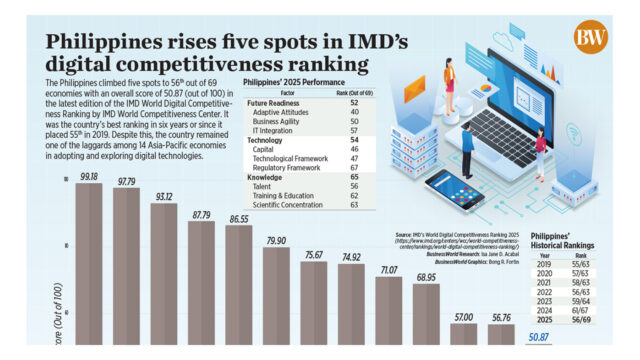
Philippines rises five spots in IMD’s digital competitiveness ranking

THE PHILIPPINES improved five spots in the World Digital Competitiveness Ranking by the International Institute for Management Development (IMD), but remained a laggard in the Asia-Pacific region. Read the full story.

Philippines rises five spots in IMD’s digital competitiveness ranking

How PSEi member stocks performed — November 4, 2025

Here’s a quick glance at how PSEi stocks fared on Tuesday, November 4, 2025.


Typhoon Tino kills at least 3 people

FACEBOOK.COM/PAGASA.DOST.GOV.PH

THE DEATH toll from Typhoon Kalmaegi, locally called Tino, continued to climb on Tuesday as disaster officials receive initial reports from affected provinces after the powerful storm unleashed heavy rains and floods across the central Philippines, submerging homes and forcing thousands to evacuate.

Three people were confirmed dead and at least one person was reported missing in the central province of Cebu, provincial information officer Ainjeliz Orong said. Two more deaths were still being verified.

“We weren’t expecting this much flooding,” Ms. Orong said by phone.

In neighboring Bohol province, one person was killed after being struck by a falling tree, disaster official Anthony Damalerio told DZMM radio.

Office of Civil Defense (OCD) spokesperson Junie B. Castillo in a phone call to reporters said that the agency has received reports that the death toll has risen to 26.

“22 were from Central Visayas, two from NIR (Negros Island Region), one from Region 6, and one from Region 8,” he said in Filipino.

Meanwhile, more than 187,000 were affected by Typhoon Kalmaegi as it continued to batter large parts of Visayas and neighboring areas, the state disaster agency reported on Tuesday.

In its 12 p.m. situational report, the National Disaster Risk Reduction and Management Council (NDRRMC) said 187,536 individuals were affected by the typhoon, with 122,519 currently staying inside evacuation centers.

Western Visayas was hit hardest by Kalmaegi where 133,554 individuals were affected, followed by Eastern Visayas (29,160), central Visayas (11,140), and Caraga region (11,110).

The agency also reported more than 2,100 affected persons in Mimaropa, and over 400 others in Negros Island Region.

Kalmaegi remained at typhoon category as it weakened on Tuesday afternoon, the Philippine Atmospheric, Geophysical and Astronomical Services Administration (PAGASA) said.

Kalmaegi has already made three landfalls, as of Tuesday morning — first in Silago, Leyte at 12 a.m., Borbon, Cebu at 5:10 a.m., and Sagay City, Negros Occidental at 6:40 a.m.

It was monitored in the vicinity of Patnongon, Antique at 4 p.m. packing 130 kilometers per hour (kph) of sustained winds and 180 kph of gustiness, according to PAGASA’s 5 p.m. bulletin. It was moving Northwestward at 15 kph.

SIGNAL NO. 4 STILL UP
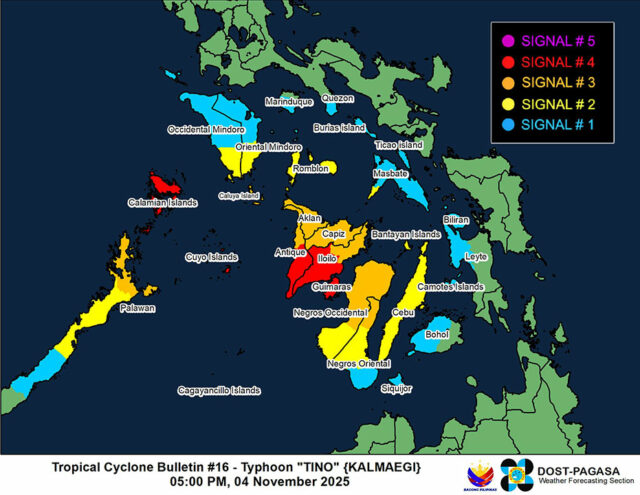
Signal No. 4, with expected typhoon-force winds, remains in effect in Calamian and Cuyo Islands in Luzon and many parts of the Visayas, including the central and southern portions of Antique, the central and southern portions of Iloilo, and Guimaras.

Signal No. 3 is up over portions of the Visayas and Luzon that may experience storm-force winds. These include the northernmost portion of mainland Palawan, the rest of Antique including Caluya Islands, Aklan, Capiz, the rest of Iloilo, the northern and central portions of Negros Occidental, and the northern portion of Negros Oriental.

Meanwhile, Signal No. 2 is in effect over areas likely to experience gale-force winds, including the southwestern portion of Masbate, the southern portions of Oriental Mindoro, Occidental Mindoro, and Romblon, the northern portion of Palawan including Cagayancillo Islands, Cebu including Bantayan Islands, the central portion of Negros Oriental, and the rest of Negros Occidental.

Signal No. 1 is hoisted over areas that may experience strong winds, such as the southern portions of Quezon and Marinduque, the rest of Oriental Mindoro and Occidental Mindoro including Lubang Island, the rest of Romblon and Masbate including Burias and Ticao Islands, and the central portion of Palawan.

Biliran, the northwestern portion of Leyte, Camotes Islands, the northern and western portions of Bohol, the rest of Negros Oriental, and Siquijor are also under Signal No. 1.

“Tino will emerge at Sulu Sea this afternoon or evening and is forecast to traverse the northern Palawan area by tomorrow (Nov. 5) early morning,” PAGASA said.

“It is expected to emerge over the West Philippine Sea tomorrow morning and may exit the Philippine Area of Responsibility by tomorrow evening or Thursday (Nov. 6) early morning.”

TYPHOON RELIEF
Meanwhile, President Ferdinand R. Marcos, Jr. has ordered key Cabinet officials to deploy aid to provinces heavily affected by Typhoon Kalmaegi as authorities rush to restore power and clear roads.

In a statement on his Facebook page, Mr. Marcos said the government is closely monitoring the storm’s effects.

The Department of Social Welfare and Development has prepositioned food packs, the Department of Energy and National Electrification Administration (NEA) are addressing power outages, and the Department of Public Works and Highways and Metropolitan Manila Development Authority have mobilized clearing teams, Mr. Marcos added.

Power supply was disrupted in several areas, with eight electric cooperatives reporting full outages and 15 partially affected, according to the NEA.

Clearing and repair operations are underway but hampered by strong winds and heavy rains, particularly in Mimaropa and the Negros Island Region.

OCD spokesperson Junie B. Castillo said the NDRRMC has activated its inter-agency coordination center to monitor the storm’s impact.

Mr. Castillo said 10,448 disaster response assets and 1,737 personnel have been deployed for debris clearing and civil works.

Around 30,000 responders from the Armed Forces of the Philippines, Bureau of Fire Protection, Philippine Coast Guard, and local DRRM offices are on standby for search and rescue operations.

He also confirmed flooding in parts of Caraga and Cebu, where some residents reportedly refused evacuation despite warnings.

Asked about available disaster funds, Mr. Castillo said the government’s Quick Response Fund (QRF) remains sufficient, with Mr. Marcos having earlier ordered its replenishment following recent earthquakes and typhoons.

Several local governments in Eastern Visayas are preparing to declare a state of calamity, Mr. Castillo added, while others await assessments pending the typhoon’s exit.

Typhoon Tino, the 20th tropical cyclone to enter the Philippine area of responsibility this year, is forecast to leave the country by Thursday, according to the state weather bureau.

Authorities are also monitoring a potential new weather disturbance forming east of the Philippines.

Mr. Marcos urged the public to remain alert and follow evacuation orders. — Edg Adrian A. Eva, Chloe Mari A. Hufana and Reuters


Philippines starts war games amid South China Sea tensions

PHOTO FROM PHILIPPINE COAST GUARD

By Kenneth Christiane L. Basilio, Reporter

THE PHILIPPINES on Tuesday kicked off its annual military drills to test its armed forces’ ability to repel invasions as if being “already at war,” its top general said amid repeated incursions within its exclusive economic zone in the South China Sea.

About 2,000 Filipino troops will take part in the nine-day high-intensity military exercise along the country’s western seaboard, near disputed maritime features that have been at the core of the Southeast Asian nation’s security anxieties, according to an armed forces handout.

Called Exercise Dagitpa — a blend of the Filipino words for sea, air and land — military units will hold a mix of beach defense, naval fire support and missile defense drills to test their joint force capabilities against invasion threats as China remains increasingly coercive in the contested waterway.

“As I have always said, we are already at war… I want us to have that mindset,” Philippine military chief General Romeo S. Brawner, Jr. said during his opening remarks.

“We are not at war with bullets and bombs, but with disinformation, with coercion, and with encroachment into our territories, into our exclusive economic zone.”

The drills are not directed at any specific country, but are designed to sharpen the armed forces’ ability to hold off an invading force for up to a month, a period during which Manila expects the US and other allies to step in.

“We must defend our country on our own first,” he told reporters in Filipino after the exercise’s opening ceremonies at the Philippine military headquarters in Manila. “We have to rely on ourselves first, that’s why our exercises continue without letup.”

The Southeast Asian nation has stepped up military activities both independently and with allies as tensions with China continue to escalate in the South China Sea, a resource-rich waterway that has been the site of repeated confrontations between Philippine and Chinese forces.

“This exercise is entirely us alone so we can assess where we stand, and the limits of our defense,” Mr. Brawner said.

He said the Philippines must be “prepared for any eventuality” to ensure its forces’ combat readiness, adding that support from allies would follow only after hostilities erupt. “If conflict breaks out, we will naturally be the first to engage in combat.”

“But we are expecting also reinforcements or help from our allies.”

Defense ties with other countries have flourished under President Ferdinand R. Marcos, Jr., whose administration has adopted a more assertive posture in the contested waters. Manila has sealed military agreements with Japan and New Zealand since he took office and is pursuing similar pacts with France and the UK.

Mr. Brawner, however, said the armed forces would not use allied equipment during the Dagitpa drills, opting instead to rely solely on Philippine military assets. “We need to understand both our capabilities and our gaps.”

“Considering the threats we are facing, we are comparing our capabilities with those of our neighboring countries,” he said, recognizing that Philippine forces lack equipment and advanced weaponry when compared to others in the region. “We have the ability to defend our country, but what I’m saying is it’s still not enough.”

“If we consider the entire archipelago, our current equipment is not enough to cover it entirely,” he added.

The Philippines has launched a sweeping P2-trillion military modernization program, aimed at bolstering its defense capabilities over the next decade, including the acquisition of warships, jets and missile systems, as it pushes back against Beijing’s military might in the South China Sea.

China has maintained sweeping control over the waters bordering several Southeast Asian nations despite a 2016 ruling by a United Nations-backed court that voided its overreaching claim.

Manila has described China’s actions in the waterway as coercive and escalatory, while Beijing insists its operations are meant to defend its sovereignty.

Also on Tuesday, Defense Secretary Gilberto C. Teodoro, Jr. underscored the need to develop cheap but effective weapons, citing the growing importance of “low-cost, asymmetrically and algorithmically designed technologies” to strengthen deterrence.

Mr. Teodoro also “underscored the importance of highly mobile production systems to minimize disruptions in defense materiel manufacturing,” Manila’s Defense department said in a separate statement.

A senior defense official last week said the Philippines is looking at widely adopting unmanned systems and drones more broadly in its armed forces, describing them as much-needed force multipliers for effective deterrence.

Philippine troops had already trained with unmanned weapon systems, including the US anti-ship Navy-Marine Expeditionary Ship Interdiction System (NMESIS) and sea drones, during a month-long joint exercise with US forces that began in April.

Remotely piloted drones have become a backbone in modern warfare due to their long-range reach and lower cost compared with other advanced weaponry, like missiles and fighter jets, and they have since seen heavy combat use since Russia’s invasion of Ukraine in 2022.

ICI recommends new case, flags P72.3-M ‘ghost’ project

THE Independent Commission for Infrastructure (ICI) submitted its interim report and recommendations to the Office of the Ombudsman for potential cases against several lawmakers and Public Works officials linked to the flood control scandal. — ICI

THE Independent Commission for Infrastructure (ICI) on Tuesday recommended the filing of cases over alleged “collusion” between former Public Works officials and contractors, involving a P72.3-million “ghost” flood control project in Bulacan.

In a statement, ICI Chairperson Andres B. Reyes, Jr. said the referral made to the Office of the Ombudsman concerns a riverbank protection structure along Bagong Silang, Plaridel, which was left undeveloped being paid in full by the Bulacan first district engineering office of the Department of Public Works and Highways (DPWH).

A report by the Commission on Audit (CoA) confirmed that the project did not exist in its intended location. Instead, a different site was indicated in the “as-built” plans, with no documentation explaining the change.

“The results of the CoA technical inspection, together with available records, establish that the project was never constructed at the designated location despite the full payment of the contract cost,” Mr. Reyes said.

The ICI found that several DPWH officials were “grossly negligent, if not remiss” in ensuring proper implementation and lawful disbursement of government funds. It also alleged collusion between the implementing officials and the contractor, resulting in undue injury to the government.

The commission recommended the filing of charges for violations of the Anti-Graft and Corrupt Practices Act, malversation, and falsification of public documents under the Revised Penal Code, as well as possible offenses under the Government Procurement Reform Act and Presidential Decree No. 1759.

The ICI also urged the Ombudsman to assess whether former DPWH Secretary Manuel M. Bonoan and former Undersecretaries Roberto R. Bernardo and Maria Catalina E. Cabral may be held administratively liable under the Code of Conduct and Ethical Standards for Public Officials and Employees.

Mr. Bonoan, who resigned last September amid a wave of corruption allegations involving flood control projects, earlier said that he had no involvement in any irregularities. Mr. Bernardo has likewise denied any wrongdoing, saying his conscience is clear.

The ICI stressed that it does not make categorical findings of guilt, adding that liability “rests with the proper authorities.” The referral, it said, forms part of its continuing effort to ensure accountability and protect the integrity of public funds.

‘DELUGE OF CASES’
During the filing, Mr. Reyes said the commission expects its work to accelerate in the coming months, noting that the ICI’s budget process is proceeding smoothly and will allow the hiring of more lawyers and investigators to handle the growing number of cases.

Ombudsman Jesus Crispin C. Remulla, who received the referral, said his office will begin fact-finding proceedings before determining if cases should proceed to preliminary investigation.

“We will go into fact-finding immediately,” Mr. Remulla said, noting that the referrals may still require additional documents to support the filing of cases for preliminary investigation.

“And because you have to inform the accused of their rights and you have to have the proper allegations brought into the mix,” he added.

Tuesday’s referral was the third case transmitted by the ICI to the Ombudsman, the commissioner said that more will follow in the coming weeks.

Mr. Remulla said a parallel investigation is being conducted by the Department of Justice’s Task Force on Infrastructure Anomalies, led by Undersecretary Jesse Hermogenes T. Andres in coordination with the National Bureau of Investigation (NBI).

The task force, according to Mr. Andres is also examining “kickback” patterns that may involve both public officials and private proponents.

Mr. Remulla further disclosed that the ICI’s findings could include recommendations to charge certain officials with gross inexcusable negligence, possibly extending to high-ranking officials, including a former Speaker of the House and other sitting lawmakers.

“It’s a novel theory. I know we’re crossing the boundary of normal legal theory. But we have to stretch it a bit,” Mr. Remulla said. “At the least, negligence should be charged against those who were responsible for their offices.”

Commissioner and former DPWH Secretary Rogelio “Babes” L. Singson, said early findings point to “total connivance” among DPWH offices, lawmakers, and contractors.

“Congress, DPWH, and even monitoring agencies were involved,” Mr. Singson said. “Without the role of DPWH officials, none of this could have happened.”

Mr. Remulla said the Ombudsman expects a “deluge of cases” extending into 2026, estimating that over 1,000 infrastructure projects nationwide are under review. Around 400 lawyers will handle these cases, he said, with additional staff to be hired.

“High-profile cases will receive more attention,” he added. “The higher position, the greater responsibility.” — Erika Mae P. Sinaking

Tino still threatens large parts of the country, to hit Palawan on Wednesday 

DOST-PAGASA FB PAGE

Typhoon Kalmaegi, locally known as Tino, is still expected to bring devastating winds and torrential rains to large parts of the country, and is expected to hit Northern Palawan by Wednesday morning, the state weather bureau said. 

The typhoon, maintaining sustained winds of 130 kilometers per hour (kph) and gusts of up to 180 kph, was last located over the vicinity of Patnongon in Antique, the Philippine Atmospheric, Geophysical and Astronomical Services Administration (PAGASA) said in a 5:00 p.m. press briefing. 

By early Wednesday morning, it is expected to reach the coastal waters of Linapacan, Palawan, and continue traversing until it exits over the West Philippine Sea. 

PAGASA raised Tropical Cyclone Wind Signal No. 4 in several areas, which are expected to experience typhoon-force winds. This includes Calamian and Cuyo Islands in Luzon, and the central and southern portions of Antique and Iloilo, as well as Guimaras in the Visayas. 

Signal No. 3, where storm-force winds are expected, is raised in the northernmost portion of mainland Palawan in Luzon, the rest of Antique, Aklan, Capiz, the northern and central portions of Negros Occidental, and the northern portion of Negros Oriental in the Visayas. 

Meanwhile, Signal No. 2, where gale-force winds are expected, is hoisted in southwestern Masbate, the southern portions of Oriental and Occidental Mindoro, southern Romblon, northern Palawan including Cagayancillo Islands, Cebu, the central portion of Negros Oriental, and the rest of Negros Occidental. 

Signal No. 1 is in effect in the southern portion of Quezon, southern Marinduque, the rest of Oriental and Occidental Mindoro, the rest of Romblon, the rest of Masbate, including Burias and Ticao Islands, central Palawan, Biliran, northwestern Leyte, Camotes Islands, northern and western Bohol, Siquijor, and the rest of Negros Oriental. 

Following its multiple landfalls, Typhoon Kalmaegi has brought destructive winds and flooding, primarily in Cebu province, with floodwaters reportedly reaching above human height in some areas. 

Several aftermath photos posted on social media show many homes swept away or dilapidated, with cars also carried off by floodwaters, some piled on top of each other. 

The national disaster agency has yet to release an official report about the estimated cost of damage caused by Kalmaegi.  

Cebu Governor Pamela S. Baricuatro said in a press briefing on Tuesday that clearing and relief operations are ongoing amid the typhoon. She also extended the suspension of work in all national and local government offices until Wednesday. 

In Sagay City, Negros Occidental, one of the typhoon’s landfall sites, nearly 4,000 individuals are set to receive family food packs and other relief. 

ANOTHER TYPHOON?
While parts of the country are still inundated by floodwaters caused by Kalmaegi, a tropical depression has developed a few hours ago outside of the Philippine Area of Responsibility (PAR), with the possibility of it intensifying into a typhoon, according to PAGASA. 

The cyclone, packing 55 kph sustained winds and 70 kph gusts, was located 1,900 kilometers east of northeastern Mindanao, moving 57 kph west-southwest. 

It is expected to enter the PAR by Saturday, and the possibility of it making landfall in parts of the country is not ruled out, PAGASA said. — Edg Adrian A. Eva  

800 Filipino scam hub victims repatriated

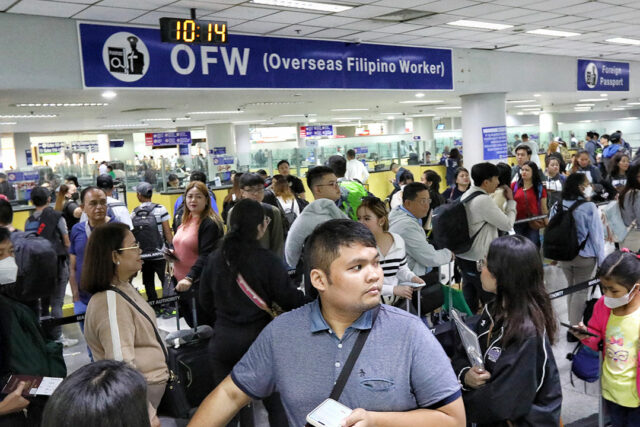
Overseas Filipino workers (OFWs) are seen at the Ninoy Aquino International Airport Terminal 3. — PHILIPPINE STAR/WALTER BOLLOZOS

THE DEPARTMENT of Migrant Workers (DMW) said it has repatriated 800 Filipinos who were recruited into illegal scam hubs across Southeast Asian countries, as it seeks to strengthen measures against illegal recruitment.

In a statement, the agency said that the repatriated Filipinos were rescued from Myanmar, Cambodia, and Laos, while more than 200 are still waiting to return home.

“Rest assured we’re cooperating with the authorities so they can return home as soon as possible,” Migrant Workers Secretary Hans Leo J. Cacdac said late Monday.

The Department of Foreign Affairs earlier reported that about 222 other overseas Filipino workers have applied for repatriation.

Mr. Cacdac said that the DMW is seeking to intensify its operations against illegal recruitment by syndicates in Myanmar, Cambodia, and other countries in Southeast Asia, targeting job-seeking Filipinos.

The DMW has arrested 20 individuals linked to illegal recruitments and the trafficking of Filipinos to foreign scam hubs, where they are forced to engage in exploitative and illegal labor.

Among those arrested were four recruiters in Rizal, Palawan, and a Taiwanese national who was apprehended at the Ninoy Aquino International Airport (NAIA).

“There were some who pretended to be repatriates, but in reality, they were the recruiters themselves,” Mr. Cacdac said following joint operations with the Presidential Anti-Organized Crime Commission, Philippine National Police, and National Bureau of Investigation.

He added that some recruiters have been luring Filipinos to work in visa-free ASEAN countries like Thailand and Malaysia without legal documents.

“Visa-free is only for tourists, it doesn’t mean they can work there,” he said.

He added that the government has also been strengthening operations against human trafficking by improving international relations.

“We are not on the side of irregular labor mobility. We stand for safe, ethical, and transparent recruitment,” Mr. Cacdac said.

He added that the DMW has been continuing to coordinate with the Overseas Workers Welfare Administration and the Philippine embassies in Myanmar, Cambodia, Laos, and Thailand in implementing the operations. — Adrian H. Halili