Home Blog Page 7559

Rich Asians jump booster shot queue amid vaccine shortages
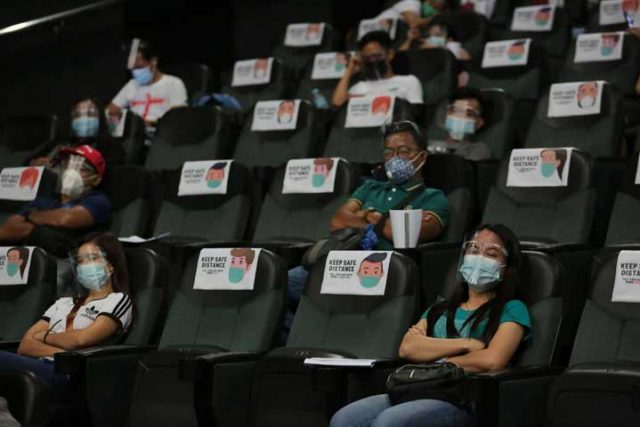
People wait for their turn to get a vaccine dose inside a cinema at a mall in Antipolo, Rizal, Aug. 24. -- Photo by Michael Varcas, The Philippine Star

In some of Asia’s COVID-19 hotspots, powerful and wealthier citizens are nabbing booster shots even as most people remain unvaccinated, undermining the inoculation strategies of nations struggling with the highly infectious delta variant. 

The growing trend in countries like Indonesia, Thailand and the Philippines is worsening inequities at a time when they are grappling with vaccine shortages.  

In Indonesia — where the health ministry has said boosters are only for health workers — members of the political elite, including the governor of a prominent region, were caught on camera discussing the boosters they received. The conversation was inadvertently broadcast in a livestream of an event on the Presidential Secretariat’s official channel. President Joko Widodo could be heard saying he hasn’t received a booster because he was waiting for Pfizer Inc.’s shot to be available. Widodo’s office and the governor didn’t respond to requests for comment at the time, and the video has since been deleted.   

Thailand is investigating a director and a doctor at two hospitals who allegedly gave Pfizer Inc. jabs meant for pregnant women and health workers to family members and aides. Ronaldo Zamora, a representative for San Juan City in the Philippines, has spoken openly at a press conference about getting four COVID shots — a round of Pfizer, adding to the Sinopharm Group Co. vaccine he received last year before it was even approved by regulators. His son, a mayor of the same city, later said it was done under doctor’s orders because Zamora was immunocompromised. 

The chase for added inoculations comes at a time when there is a growing global debate around booster shots, which have been shown to increase protection against the virus as the delta variant drives up cases worldwide. The World Health Organization has urged developed nations to hold off on boosters until supplies are available for poorer nations. Meanwhile, at the end of August, U.S. President Joe Biden said his administration was considering giving boosters five months after the second dose.  

For countries in Southeast Asia that are hamstrung by vaccine shortages, extra doses for the well-connected means fewer stockpiles for health professionals or the vulnerable. In the  Philippines, Malaysia and Thailand, daily infections are near record levels, while Indonesia’s death toll is among the world’s highest. Displacing others in the vaccine queue is “very morally questionable” and also puts the entire population at greater risk of the virus in the long run, said Voo Teck Chuan, assistant professor at the Centre for Biomedical Ethics of the National University of Singapore.  

“You might or might not make yourself safer by taking a booster shot,” Voo said. “But if you let the virus continue to transmit and mutate across your community, you will see more variants and more infections. Then, you’re not sure if your vaccine, no matter how many you’ve taken, will be enough.”  

LIMITED IMMUNITY 

In the U.S., White House chief medical adviser Anthony Fauci said Thursday that three doses of COVID-19 vaccine may become the standard regimen for most people.  

Southeast Asia is particularly emblematic of the complexities of the debate around boosters because countries like Indonesia and the Philippines relied heavily on inactivated shots made by Chinese companies, which studies have found to be less effective than the mRNA vaccines made by Moderna Inc. as well as Pfizer Inc. and its German partner BioNTech SE.  

With the exception of Singapore, which has met its goal of inoculating 80% of its population, many Southeast Asian nations are falling behind their vaccination goals. Both the Philippines and Indonesia are at 13%. Vietnam and Thailand are at 10% and 11%, respectively. The Philippines has yet to approve booster shots, unlike Thailand and Indonesia which have greenlit extra doses for priority groups. 

Often, it is money, connections or influence that help people jump the queue for vaccines. However, the rush to distribute shots as quickly and as widely as possible has also left open loopholes for many who want to take advantage. In Indonesia, instances of booster misuse were spotted in the government’s registry after complaints were raised by whistle-blowers, according to crowd-sourcing platform LaporCOVID-19. 

In the Philippines, it’s possible to register in one city as a resident and in another as an employee, with no unified database. That’s helping a privileged few with better jobs and higher salaries get added jabs.  

A project manager in metropolitan Manila, who asked not to be named discussing his inoculations, initially signed up for a jab with his company because the Philippines allows the private sector to procure and vaccinate workers. However, with little clarity on when his vaccine would arrive this year, he chose to take two shots from China’s Sinovac Biotech Ltd. through the government program when supplies became available in a nearby city.  

Still, the limited data then available on Sinovac’s effectiveness against the Delta strain weighed on his mind, he said. He didn’t report the vaccination to his company and went on to take a round of the Moderna vaccine through the firm this August.  

In Indonesia, meanwhile, the military chief, who was also seen and heard on the livestream on the Presidential Secretariat’s official channel, denied getting a vaccine booster and said he had used the term ‘booster” to refer to a stem cell treatment he had received.  

Amid shortages, some in Southeast Asia have resorted to traveling great distances or camping out at health centers just to vie for first or second shot. As governments start to ease lockdown measures for the vaccinated, crowds have swelled further, increasing the risk of infection.  

Illicit booster shots undermine the government’s surveillance abilities because if authorities don’t know how many people have been inoculated or what segments of society remain exposed, it hinders their ability to track transmission, said Leonila Dans, a clinical epidemiologist at the University of the Philippines.  

“Jumping the queue harms not just one or two people,” Dans said. “It puts the entire community at risk.” — Bloomberg  

Over 20,000 new COVID cases says Health dept.

The Philippines’ active coronavirus cases hit more than 158,000 after the country logged a record-high number of infections on Friday.

This as a group of medical professionals said that lockdowns would only work if they were enforced for a long period of time and calling instead for more permanent solutions to the ongoing pandemic.

The country recorded 20,310 new coronavirus cases, bringing the total number of cases since the pandemic started last year to 2,040,568, the Department of Health (DoH) said in its case bulletin for Sept. 3.

The country’s death toll rose to 33,873 after 193 more patients died, while recoveries increased by 7,710 to 1.85 million, the agency said.

There were 158,994 active cases, 96.5% of which were mild, 1.1% were asymptomatic, 1% were severe, 0.92% were moderate, and 0.5% were critical.

The DoH said 226 duplicates were removed from the tally, 219 of which were recoveries. It added that 84 recoveries were reclassified as deaths. Six laboratories did not submit data on Sept. 1.

The country is battling a fresh spike in coronavirus infections believed to be triggered by the highly contagious Delta variant.

NO LONG-TERM SOLUTIONS

The government has failed to implement long-term solutions to address the country’s coronavirus situation more than a year since the pandemic hit the country, a group of medical professionals said.

Aileen Espina of the Healthcare Professionals Alliance Against COVID-19 (HPAAC) told a virtual media briefing that the government’s coronavirus data conflicts with what is happening on the ground.

Ms. Espina also cited the government’s lack of political will to create new strategies to contain the evolving coronavirus.

HPAAC said the government must come up with permanent solutions to address the country’s coronavirus situation, noting that lockdowns would only work if they were enforced for a long period of time.

“We need to realize that these lockdowns are just band-aid solutions,” Maria Encarnita Limpin of the HPAAC said at the same briefing. “The effects of lockdowns are just for short-term. What we need are permanent solutions,” she said.

“We will just have a seesaw battle if we will just resort to lockdowns,” Ms. Limpin added.

The discussion on the country’s pandemic recovery should not be centered on whether or not the country needs more lockdowns, said Antonio L. Dans, the group’s spokesperson.

“The question should be centered on whether we are ready for the reopening of the economy,” the medical doctor said at the same briefing. “Did our situation improve? What are the improvements after the lockdowns?”

“We should learn how to live with the virus without getting infected,” Mr. Dans added. — Kyle Aristophere T. Atienza

Philippines approves emergency use of Moderna shot for adolescents

The country’s drug regulator has approved the emergency use for adolescents of the vaccine made by Moderna, Inc.

The decision was made two weeks after the American drugmaker applied for an amendment of its previous vaccine application.

The agency’s regulatory experts and the government’s panel of vaccine experts have allowed the two-dose Moderna vaccine to be used for children aged 12 to 17, Food and Drug Administration (FDA) Director General Enrique D. Domingo said during a televised news briefing.

“With the Delta variant affecting a lot of children, experts saw that the benefits of the vaccine outweigh the risks,” Mr. Domingo said.

Meanwhile, Vaccine Expert Panel chief Nina G. Gloriani said the government may come up with a decision on the use of booster shots next week.

“By next week, we may release a decision on that,” she told ABS-CBN Teleradyo.

“We are considering a lot of things, including the breakthrough infections among healthcare workers,” she added.

Health Undersecretary Maria Rosario S. Vergeire said separately at a virtual news briefing that the government may consider the administration of booster shots “once the vaccine supplies stabilize.”

The vaccination of children may also happen once the country secures enough vaccines for its entire adult population, she added.

Health Secretary Francisco T. Duque III earlier told a House committee hearing that the Department of Budget and Management cut the DoH’s proposed P104-billion budget for booster shots next year to just P45 billion.

The budget for the top-up shots would only be funded if the government is able to raise enough money for it, said Mr. Duque.

LOCAL SUBSTITUTE FOR COVID DRUG

Meanwhile, Ms. Vergeire said the FDA has already issued an emergency use authorization for a local drug that may be used as an alternative to immunosuppressive drug tocilizumab, which is being used to treat patients with severe coronavirus disease.

Mr. Domingo said separately that the Philippine government is in talks with Roche, the producer of tocilizumab, to secure more of the drug as the country struggles to contain a spike in coronavirus cases.

“We have already talked to the company that owns the innovator drug to ask if they can add more supply because the shortage is happening worldwide,” he said.

Ms. Vergeire of DoH earlier said the country was having a hard time sourcing the anti-inflammatory drug due to competition “across the globe.” — Kyle Aristophere Atienza

197 more OFWs repatriated from Macau

THE 22nd repatriation flight from Macau brought 197 overseas Filipinos home on Friday.

With the help of the Office of the Undersecretary for Migrant Workers’ Affairs and the Philippine Consulate General in the Macau Special Administrative Region, the Department of Foreign Affairs was able to repatriate 197 more Filipinos, bringing the total number of repatriations from Macau since the beginning of the pandemic to 4,397.

Macau Consul General Porfirio M. Mayo, Jr. renewed his call to all Filipinos in Macau who want to return to the Philippines to register with the Consulate.

All repatriation flights from Macau are coordinated with the Overseas Workers Welfare Administration Region III and Philippine Airlines. — Alyssa Nicole O. Tan

House panel gives swift nod to the P8.2B Office of the President budget

THE HOUSE appropriations committee approved the P8.182-billion budget of the Office of the President (OP) for 2022 of without any deliberation.

The 2022 budget, which is P4.05 million smaller than the office’s spending plan for this year, was approved following a motion by Pangasinan Rep. Tyrone D. Agabas to immediately terminate the proceedings.

In the approved budget, P1.12 billion would be allotted for personnel services, P6.49 billion for maintenance and other operating expenses (MOOE), and P547.97 million for capital outlays.

The motion is consistent with the tradition of the House to terminate hearings on the Office of the President budget as a way of “extending parliamentary courtesy to a co-equal branch of the government.”

Kabataan Party-list Rep. Sarah Jane I. Elago objected to the motion, but her move was rejected by Zamboanga City Rep. Manuel Jose M. Dalipe, vice-chairperson of the House Committee on Appropriations, as Ms. Elago is not a member of the panel.

Lawmakers of the progressive Makabayan bloc, including Ms. Elago, said that traditions should not be used as an excuse for the House to not to scrutinize the budget of the office at the committee level.

“There are a number of pressing issues to be brought before the Office of the President at this budget hearing… We’ve had (opportunities) in the past years to raise these significant concerns before the OP budget briefing. Why is the committee now denying this very right to the House members?,” Ms. Elago said during the hearing.

ACT Teachers Party-list Rep. France L. Castro said that the House needs to take a closer look at items that are deemed not needed by the office such as the P4.5 billion allotted for intelligence funds, comprising more than half of the OP’s total budget.

The Office of the President proposed P2.25 billion each for confidential and intelligence expenses for next year.

ACT-CIS Party-list Rep. Eric G. Yap, chairman of the House appropriations committee, said that he would take full responsibility for the early termination of the hearing.

“There would be an opportunity for House members to ask all of the questions during the plenary,” he said in Filipino. — Russell Louis C. Ku

CoA head says it can’t audit Red Cross as Duterte slams Gordon for leading probe on overpriced medical goods

The chair of the Commission on Audit (CoA) said in a House budget hearing Friday that state auditors cannot conduct an audit on the Philippine Red Cross (PRC) as it is not under their jurisdiction. This as President Rodrigo R. Duterte on Thursday night slammed Senator Richard J. Gordon — who is also the head of the Red Cross — for leading an inquiry into the government’s procurement of overpriced medical supplies, saying a Senate panel tasked to investigate state wrongdoings was being used for politicking.

President Duterte also ordered the CoA to conduct an audit on the Red Cross after he accused Senator Gordon of using the organization’s funds for his election campaigns.

“Are you really investigating in aid of legislation, or in aid of your personal political interests?” Mr. Duterte asked Mr. Gordon in a taped Cabinet meeting on Thursday night. “I heard that you want to run for vice-president next year,” he said.

The tough-talking leader said Mr. Gordon had used the PRC, a non-profit organization, to further his political career.

Ginamit mo talaga ito para sa eleksyon,” he said. “Ito yung milking cow mo ehsa totoo lang,” said Mr. Duterte. (You used [the PRC] for elections. In truth, it is your milking cow.)

There might also be a conflict of interest since the senator is also the chairman of the humanitarian organization, Mr. Duterte said.

The president’s long-time aide, Senator Christopher Lawrence T. Go, made a similar claim last week, saying Mr. Gordon should not be involved in the probe of the government’s pandemic spending since the PRC has transactions with the state health insurer, the Philippine Health Insurance Corp. (PhilHealth).

Meanwhile, CoA’s Mr. Aguinaldo said, “We do not have the jurisdiction to audit the Philippine Red Cross. The only thing we can audit is Philippine Health Insurance Corp. payments to the Philippine Red Cross.” He also said that the audited payments to Red Cross would be part of CoA’s audit of PhilHealth.

“It is an honor to be attacked for doing my job both in the Senate and at the Red Cross. I have nothing to be ashamed of,” said Mr. Gordon at the Philippine Chamber of Commerce and Industry Meeting on Friday. “I stand by the good work I and the Red Cross has done.”

“I think it is an attempt by the president to try and distract the people once again,” said Mr. Gordon in response to the president’s statements.

During the House budget hearing, the CoA proposed a P13.79 billion budget for itself next year under the 2022 National Expenditure Program, with P12.58 billion allocated for personnel services, P571.37 million for MOOE, and P643.71 million for capital outlays. Next year’s budget would be a 2.8% increase from the agency’s spending plan for this year due to salary adjustments for personnel, completion of the CoA office building, and an increase in local travel and operational costs, among others.

DUTERTE ANGRY OVER PHARMALLY

At the same Thursday cabinet meeting, Mr. Duterte also slammed other senators who have been questioning the government’s pandemic deals with Pharmally Pharmaceutical Corp., a subsidiary of Taiwan-based Pharmally International whose executives have been linked to various crimes.

Kayong lahat (all of you), do not investigate programs which are ongoing,” the President said. “You will derail it, delay it with your penchant for investigating government offices. You do not run this government alone by questioning the unspent amount,” he said.

At a Senate Blue Ribbon Committee hearing last week, Mr. Gordon, who has been an ally of Mr. Duterte through most of his presidency, played a video from state media that showed former presidential economic adviser Michael Yang introducing Pharmally International executives to Mr. Duterte in March 2017.

Some senators have said that leaders of Pharmally have active criminal cases in Taiwan for alleged stock manipulation.

Senator María Imelda Josefa “Imee” R. Marcos, another Duterte ally, earlier said Mr. Yang “appears to be the go-to powerbroker in the Philippines for Chinese politicians and businessmen looking for smooth transactions in the country.”

SENATORS REBUKE DUTERTE

On Friday, Senators rebuked President Duterte’s call to stop investigations on “ongoing programs,” saying their focus is on past affairs.

CoA was able to flag government offices because previous discrepancies were revealed during its audits, and with this, Senate President Vicente C. Sotto III said that “the Senate is investigating issues of the past, not ongoing.”

The Senate chief said that the president should let the Senate do its job.

“I cannot see how anybody, even if he is the President of our country, can influence us especially on an issue involving public funds — and most especially in the middle of a pandemic,” said Senator Panfilo M. Lacson in a statement on Friday.

Senator Ana Theresia N. Hontiveros-Baraquel said the Philippines’ state of emergency was not an excuse to stop guarding the country’s treasury.

“Because of the pandemic and many emergency purchases, we need more and better, not less and weaker mechanisms for accountability,” she said in Filipino in a statement, adding that honest workers had nothing to fear, with CoA providing them time to respond to its reports.

“There’s nothing to fear if the transactions are above board,” she said. Likewise, Mr. Sotto said that “the government offices have nothing to worry about if they are doing nothing wrong!”

RED CROSS’ COVID TESTING

The President had also criticized Mr. Gordon for ordering the PRC to halt its COVID-19 (coronavirus diseases 2019) testing services in August last year after collectibles from PhilHealth ballooned into the billions of pesos.

“Red Cross is supposed to be a humanitarian organization, but when the government was struggling to source funds, you threatened to stop testing,” the President said. “I cannot see the rationale of your statement na you threaten government with something which ought to be done by you irrespective of whether or not may pera ba (there is money),” he added.

The PRC last year said it “does not have unlimited resources to replenish the testing kits for its laboratories unless PhilHealth, its major creditor, settles its lawful obligations to PRC.” It resumed testing that same month after PhilHealth settled part of its obligations.

Mr. Gordon in June said he might run for president next year. — Kyle Aristophere Atienza, Russell Louis C. Ku, and Alyssa Nicole O. Tan

SEC issues cease-and-desist order vs R.L. Aggregates

https://www.sec.gov.ph/

The Securities and Exchange Commission (SEC) has issued a cease-and-desist order against R.L. Aggregates and Diversified Lending Group, Inc. for its “fraudulent” and “deceitful” scheme.   

R.L. Aggregates was found soliciting investments from the public using a copy of its articles of incorporation that was altered to state that “the corporation shall direct, solicit, accept or take investments/placements from the public and shall issue investment contracts.”    

“The SEC issued the order after finding that R.L. Aggregates has been enticing the public to invest in the company in exchange for guaranteed returns of 1% per day or 30% per month over a lock-in period of three months,” the regulator said in a statement on Friday.  

The entity, which is registered with the commission, also as a certificate of authority to operate as a lending company. However, it does not have the secondary license needed to solicit investments from the public.  

“Through the falsified articles of incorporation, R.L. Aggregates was able to conveniently offer and/or sell unauthorized securities from investors by means of fraud,” the commission said.   

R.L. Aggregates promotes a scheme where investors may deposit as low as P1,000 and can allegedly earn P150 every 15 days or P1,900 monthly.   

 The SEC’s Enforcement and Investor Protection Department (EIPD) also found R.L. Aggregates falsely declaring that it is a parent company of cooperative and lending groups that cater to agriculture, small businesses, and small-scale mining in Masbate.   

The commission also said the entity’s authorized capitalization amounted to only P1.5 million, making the business model unsustainable and “will likely cause grave or irreparable injury or prejudice to the investing public.”  

The SEC released an advisory against R.L. Aggregates in February this year to warn investors that the entity is not authorized to collect investments from the public. The commission said it received a number of complaints and inquiries about the entity following the publication of the advisory.  

As of March 2021, the commission said 21 complainants formally filed their complaint-affidavits with the EIPD.  

“The company, along with its operators, directors, officers, representatives, salesmen, and agents, has likewise been prohibited from transacting any business involving funds in its depository banks, and from transferring, disposing, or conveying in any manner, any related assets to ensure the preservation of the assets of the investors,” the SEC said.  

The cease-and-desist order also applies to R.L. Aggregates’ directors Roberto S. Llorente, Jennylyn M. Clemente, Patricip B. De Villa, Carlo S. Mamaril and Alvin C. Camanero.   

It also covers the entity’s operators, officers, representatives, salesmen, and agents as well as other individuals acting under R.L. Aggregates’ behalf. The SEC named Ashley Reyes, Maya Gonzalez, Randy Dela Cruz and Kenneth Daniel Papa as part of the investment scheme.   

 “The SEC further enjoined the company to cease its internet presence relating to the transactions and investment scheme covered by the order,” the regulator said. — Keren Concepcion G. Valmonte  

Alfamart to open 200 stores in Luzon this year

BW FILE PHOTO

Minimart chain Alfamart said on Friday that it is on track to have over 1,200 stores in the Philippines by yearend, after it plans to open 200 stores across Luzon this year. 

The mini-supermarket chain aims to “play a bigger role in community development” through supporting local entrepreneurs. Without disclosing specific numbers, Alfamart Philippines said it aims to add more stores in “underserved communities” this year.  

“We want every Alfamart store to benefit its local community by generating employment, providing rental income to its lessors and creating opportunities for local suppliers,” Alfamart Philippines Chief Operating Officer Harvey T. Ong said in a statement.   

Alfamart Philippines is a joint venture between the SM Group and PT Sumber Alfaria Trijaya Tbk (Alfamart Indonesia). It has over 17,000 outlets in Indonesia.  

Alfamart carries products from basic grocery items, selected SM Bonus products, fresh and frozen items, snacks, and personal care products. It is also a supplier of neighborhood eateries and mom-and-pop shops.   

Meanwhile, its bigger branches allow local entrepreneurs to set up shop within Alfamart’s vicinity, helping them gain access to its “strategic locations.”   

“A growing number of bills payment kiosks, food kiosks, and laundry shops are already partnering with us to offer their products and services to our shoppers. Partnerships are especially relevant now that everyone is reeling from the economic effects of the pandemic,” Mr. Ong said.  — Keren Concepcion G. Valmonte  

D&L says maiden bond offering nearly five times oversubscribed

D&L Industries, Inc. said its bond offering received “strong support” from fixed-income investors as total bids amounted to P13.8 billion so far, 4.6 times its base offer of P3 billion.  

The maiden bond offer has an oversubscription option of up to P2 billion.   

“We are overwhelmed with the strong support the fixed income community has shown us in our debut bond issuance. This has allowed us to price our bonds at among the lowest rates in Philippine corporate bond history,” D&L President and Chief Executive Officer Alvin D. Lao said in a statement on Friday.   

D&L’s bond offer comprises P2-billion three-year Series A bonds at a 2.7885% per annum (p.a.) rate due 2024, with an oversubscription option of up to P1 billion.  

Meanwhile, its five-year Series B bonds with 3.5962% p.a. due 2026 have a base offer of P1 billion and a P1 billion oversubscription option.  

The bonds have been rated by the Philippine Rating Services Corp. with PRS Aaa with a “stable outlook,” which means the credit rating agency sees the company has a “very strong capacity” to meet financial obligations and expects the rating to be maintained within the next twelve months.  

“This maiden offering will be a useful financial exercise for the company and will allow us to fully fund our Batangas expansion, which will be the next leg of growth for the company,” said Mr. Lao.   

The company will be using proceeds from the bond issuance to fund its Batangas plant expansion as well as to cater to its working capital requirements. Total capital expenditures for the project amount to P8 billion, and the company said it had P3.5 billion left.   

D&L said the plant will be used for its export business, particularly food and the oleochemicals segment. The company is planning to develop more coconut-based products and is keen on entering new markets abroad.   

“We are looking forward to May 2022 when commercial operations finally start,” Mr. Lao said.   

On Friday, D&L shares at the stock exchange declined by 0.24% or two centavos to close at P8.28 each.  — Keren Concepcion G. Valmonte  

Meralco wants to retire Tanza substation

Manila Electric Co. (Meralco) has asked the Energy Regulatory Commission (ERC) to approve of its petition to retire its substation in Tanza, Cavite and withdraw its equipment from the facility. 

Based on a document submitted to the ERC, the power provider said the Tanza substation has been operating for over 29 years, and runs on an odd-voltage system or one that has a voltage of other than 34.5 kiloVolts. 

Meralco is currently process of converting odd-voltage systems to standardized distribution voltage systems within its franchise area.
 

“The voltage standardization will reduce technical system loss, improve flexibility and reliability of electric service by phasing out isolated odd voltage systems, and minimize equipment inventory types,” it said. 

According to the company, there is no reason to continue running the Tanza substation since its “load can be transferred to adjacent source circuits.”
 

Meralco also proposed the retirement of power transformer banks and complete conversion of the substation’s circuit, a move that will help reduce system losses of around 54,940 KWHR (kilowatt per hour) annually. 

If ERC approves the firm’s proposal, some P3.27 million worth of equipment and machinery will be withdrawn from the Tanza facility, with some slated to be reused for distribution services. 

“There will be no impact to the customers currently being served by the Tanza substation,” Meralco said, referring to the effects of the facility’s proposed closure. 

In an initial order posted on its website this week, ERC said it will hold hearings via Microsoft Teams on Oct. 26 and Nov. 3 to discuss Meralco’s petition. 

Shares of Meralco in the local bourse improved by 2.84% or P8 to finish at P289.80 apiece on Friday. 

Meralco’s controlling stakeholder, Beacon Electric Asset Holdings, Inc., is partly owned by PLDT, Inc. Hastings Holdings, Inc., a unit of PLDT Beneficial Trust Fund subsidiary MediaQuest Holdings, Inc., which has interest in BusinessWorld through the Philippine Star Group, which it controls.  — Angelica Y. Yang 

Converge inks P3-billion loan deal

Fiber broadband provider Converge ICT Solutions, Inc. signed a P3-billion term loan agreement with the state-owned Land Bank of the Philippines (LANDBANK) to help finance its terrestrial and subsea domestic fiber backbone network expansion. 

The agreement would also support the internet service provider’s working capital requirements, Converge said in a press release on Friday. 

The total loan package will include an additional short term loan line and a facility for trade transactions amounting to up to P2 billion. 

“This loan package will provide Converge with financial flexibility as we continue to connect Filipino households to our pure fiber network nationwide,” Converge President Maria Grace Uy said. 

“We expect this financing facility to strengthen our balance sheet and help us reach our goal of covering 55% of Filipino households by 2025.” 

Converge set P20 billion in capital expenditures for 2021 to fund its nationwide expansion, connecting Visayas and Mindanao to its national fiber backbone.  

By the end of June, the Converge pure fiber network has reached over 8.2 million homes, accounting for 32% of Philippine households. 

“There is still huge pent-up demand for high-speed broadband connectivity in the country. And the need for quality internet services became even more critical when the pandemic happened. Suddenly, the home became the office, the school, entertainment center, and marketplace in one,” Converge Chief Executive Officer Dennis Anthony H. Uy said. — Jenina P. Ibañez 

Grab launches online supermarket in Philippines

Grab Philippines on Friday launched an online supermarket that offers fresh food products for next-day delivery. 

Under its on-demand goods delivery service GrabMart, GrabSupermarket Fresh will offer fresh fruits and vegetables, meat, seafood, grains, and plant-based products. 

“GrabSupermarket Fresh is a new format we are launching under GrabMart to meet the fast-growing and evolving grocery needs of Filipino online consumers,” Grab Philippines Head of Deliveries Anton Y. Bautista said. 

“As lockdowns continue to impact the flow of goods and fresh produce into Metro Manila, we believe that our latest offering will enable our users to safely and conveniently access farm-fresh produce easily through the Grab app.” 

This is Grab’s third online supermarket in the region, after those opened in Malaysia and Singapore. 

The goods come from farmers and suppliers across the country, including Pangasinan and Bukidnon. The company partnered with Teraoka Family Farm, Bukidnon Milk Company, Emerald Fresh, 28 Derby, Tender Bob’s, and Don Bangus. 

“Grab aggregates and sends all fresh produce orders for the day to partnering farmers and suppliers who will then arrange for the items to be delivered in bulk to Grab’s sorting and packing facility the next day,” the company said. 

Orders placed before 5 p.m. can be delivered the next day. 

“We will continue to expand and curate the best assortment of fresh produce and goods for our users based on in-app shopping data while prioritizing freshness and quality,” Mr. Bautista said. 

The international firm operating across Southeast Asia reported that its GrabMart gross merchandise value (GMV) in the first quarter of 2021 went up 36 times compared to the same period last year. Operating in eight countries, the service’s GMV went up 21% compared to the fourth quarter of 2020. 

Grab Holdings, Inc. posted a $652 million net loss in the first quarter, compared to $771 million a year earlier. — Jenina P. Ibañez 

ADVERTISEMENT
ADVERTISEMENT