Home Blog Page 7558

Filipino fisherman and eco-activist among 5 who got honored with Magsaysay award

A FILIPINO fisherman who pushed a sustainable marine environment to revive a dying fishing industry was among four people who got recognized this year by the Ramon Magsaysay Award Foundation.

Roberto “Ka Dodoy” Ballon, a 53-year-old fisherman from Zamboanga Sibugay in southern Philippines, was cited for his “shining example of how everyday acts of heroism can truly be extraordinary and transformative.”

The Manila-based foundation announced the awardees, who also included a Pakistani, a Bangladeshi, an American and an Indonesian documentary group, at an online news briefing on Tuesday.

“As a fisherman, I dedicate this to my family, to everyone who has helped me, institutions and the government agencies that help our association and our programs,” Mr. Ballon said in a video in Filipino.

“I dedicate this also to all fishermen, especially the small fishermen across the Philippines,” he added.

Also honored was poverty alleviation visionary Muhammad Amjad Saqib of Pakistan, affordable vaccine champion Firdausi Qadri of Bangladesh, American humanitarian and peace builder Steven Muncy and Watchdoc of Indonesia.

Mr. Muncy was recognized for his “unshakable belief in the goodness of man that inspires in others the desire to serve; his life-long dedication to humanitarian work, refugee assistance and peace building; and his unstinting pursuit of dignity, peace and harmony for people in exceptionally difficult circumstances in Asia,” the foundation said in a statement.

Ms. Qadri was awarded for her “passion and life-long devotion to the scientific profession and her vision of building the human and physical infrastructure that will benefit the coming generation of Bangladeshi scientists, women scientists in particular.”

The foundation also cited her contributions to vaccine development, advanced biotechnological therapeutics and critical research that has been saving millions of lives.

Mr. Saqib was recognized for his “intelligence and compassion that enabled him to create the largest microfinance institution in Pakistan; his inspiring belief that human goodness and solidarity will find ways to eradicate poverty; and his determination to stay with a mission that has already helped millions of Pakistani families.”

Meanwhile, Indonesia’s Watchdoc was cited for its “highly principled crusade for an independent media organization, its energetic use of investigative journalism, documentary filmmaking and digital technology in its effort to transform Indonesia’s media landscape.”

The annual Ramon Magsaysay Award, which started in 1957 to perpetuate former Philippine President Ramon F. Magsaysay, Sr.’s example of integrity in governance, resumed this year after it was canceled last year amid a global coronavirus pandemic.

The awards will be given out on Nov. 28 at the Ramon Magsaysay Center in Manila.

The awardees will be presented with a medallion embossed with a right side-facing profile of the late President, a certificate and a cash prize.

The Ramon Magsaysay Award has been given to 340 people and organizations “whose selfless service has offered their societies, Asia and the world successful solutions to some of the most intractable problems of human development,” according to its website.

Previous awardees from the Philippines include National Artist for Music Ryan Cayabyab (2019); the late President Corazon C. Aquino (1998); the late National Artist for Literature Nick Joaquin (1996); actress, volunteer and former Philippine National Red Cross member Rosa Rosal (1999); and the late BusinessWorld founder Raul L. Locsin (1999). — Michelle Anne P. Soliman


SEC sounds alarm on fuel firms’ investment offer

By Keren Concepcion G. Valmonte, Reporter

THE Securities and Exchange Commission (SEC) is warning investors about gasoline companies that offer investment programs via franchise agreements, co-franchisee agreements, partnership agreements, co-ownership contracts, among others.

“The commission has received reports that there has been a proliferation of offering and solicitation of investments for the purpose of setting up gasoline stations or investing in already existing small gasoline companies,” the regulator said in an advisory, which did not name specific entities.

It added that these programs say investors can generate profit “hassle-free.” Investors were told to just place their money in the scheme, sign the contract, and wait for the quarterly profit distribution.

The company would be handling the construction, management, and operation of the gas stations. Some companies would offer guaranteed profits, with the loss to be shouldered by them.

“The usual scheme of these small gasoline companies is to lure investors by advertising that they can co-own a gas station for a minimal amount of at least P300,000,” the SEC said.

These gasoline companies also offer subscriptions to its shares of stock, partnership agreements, where several partners can own a gas station, and co-franchisee contract, where a single gas station will be franchised and owned by several individuals.

The SEC said, “these kinds of contracts or investment schemes, no matter how they are called, would squarely fall under the definition of an ‘investment contract’ and/or subscription of ‘shares of stocks,’” which are under the regulatory jurisdiction of the commission.

“Any issuance of unregistered securities is illegal,” the commission said.

The list of registered issuers of securities with permits to offer and sell securities may be accessed via https://www.sec.gov.ph/registered-firms-individuals-and-statistics/registered-firms-and-individuals/.

“Investments not included in the list are deemed to be unregistered and therefore not authorized to be offered to the public,” the regulator said.

Meanwhile, the list of capital market institutions and individuals authorized to solicit investments is on the Capital Market Participants Registry System, http://cmprs.sec.gov.ph/.

Those who act as salesmen, brokers, dealers or agents for the unlicensed schemes offered by these entities may be prosecuted and be held liable under the Securities Regulation Code, the SEC said. They may be fined P5 million at most and/or face 21 years of imprisonment.

“The public is therefore advised to exercise caution in dealing with these gasoline companies or persons purporting to be their representatives,” the SEC said.

First Gen’s Avion unit goes offline after turbine damage

LOPEZ-LED First Gen Corp. told the local bourse on Tuesday that the second unit of its 97-megawatt (MW) Avion gas-fired plant will be offline for the time being due to damage found in its gas turbine.

Its subsidiary Prime Meridian PowerGen Corp. (PMPC) informed the listed power firm that one of the compressors of Avion Unit 2’s gas turbine was discovered in a routine inspection to have been damaged.

The Batangas-based Avion plant, which uses dual fuel aero-derivative gas turbines developed by General Electric (GE), is one of the gas facilities that source fuel from the offshore Malampaya gas field.

“The damage to Avion Unit 2, which has a capacity of approximately 48.5 MW, was found during an ongoing routine inspection. After carefully reviewing the findings, GE has advised PMPC that Avion Unit 2 cannot be operated and will require further offsite assessment at a GE service depot abroad to determine the extent of the damage and effect repairs necessary to place the gas turbine back into service,” First Gen said.

It added that Avion Unit 1 is unaffected, indicating that it will stay online.

First Gen earlier said that some 50 MW from Avion, which can operate on either natural gas or diesel, will be available for the Luzon grid during the Malampaya gas-to-power project’s temporary closure from Oct. 2 to 22. It will be operating on liquid fuel during the gas field’s shutdown.

In a separate filing on Tuesday, the company said that it had received the tender offer report from Philippines Clean Energy Holding Inc. (PCEHI), which plans to acquire by way of a secondary sale a minimum of issued and outstanding common shares representing 3%, and a maximum of 5.7% from the Lopez firm’s existing shareholders.

The shares will be priced at P33 per common share.

“The tender offer provides existing shareholders of the company the opportunity to sell their common shares and realize their investment, in cash, at a premium to the current trading price of the common shares,” the report read.

The tender offer will begin at 9:00 a.m. on Sept. 1 and end at 12:00 noon of Sept. 29. The offer period may be extended as long as it gets prior approval from the corporate regulator.

In another disclosure, First Gen requested for a one-day extension of its trading suspension, after receiving PCEHI’s 59-page tender offer in order to “give the company’s shareholders equal access to the said report.”

First Gen has 3,495 MW of installed capacity in its portfolio, which comprises of projects in natural gas, geothermal energy from steam, hydro-electric, wind, and solar power. The listed power firm is a subsidiary of First Philippine Holdings Corp. — Angelica Y. Yang

Rental fees in all CAAP airports waived for the whole year

THE Civil Aviation Authority of the Philippines (CAAP) Board has moved to waive concessionaire rental payments in all its airports for the entire year, an official from the agency said on Tuesday.

“Like MIAA (Manila International Airport Authority), CAAP Board in its ongoing Board meeting now just approved the recommendation to waive airport concession rental charges from January to December 2021,” CAAP Chief of Staff Danjun G. Lucas told BusinessWorld in a phone message.

In an e-mailed statement, CAAP, an attached agency of the Department of Transportation (DoTr), said the initiative is part of efforts “to support aviation stakeholders, specifically concessionaires renting/leasing spaces in CAAP airport terminals, who were affected by the [coronavirus] pandemic.”

“Waiving and deferment of airport concessionaire fees was first implemented by DoTr and CAAP in March 2020, following the order of the national government to place Luzon under Enhanced Community Quarantine or ECQ,” the agency added.

On Aug. 27, the DoTr announced that MIAA Board had agreed to waive the rental payments of the Manila airport’s concessionaires from July until December this year.

On Aug. 4, the Air Carriers Association of the Philippines said it would seek an extension of the waiver of airport fees because of the ongoing crisis. — Arjay L. Balinbin

Ovialand to expand housing portfolio countrywide by 2030

REAL estate developer Ovialand, Inc. on Tuesday said it aims to expand its housing portfolio throughout the country by 2030.

“Aside from our planned public listing, expanding our portfolio throughout the Philippines is core to our expansion plans,” Ovialand President Marie Leonore Fatima Olivares-Vital said in a statement.

“While we are currently focused on South Luzon, we believe it is important to have a presence in other major markets if we want to take advantage of the potential for growth in these areas,” she added.

Ovialand signed its second joint venture with the Japan-based wholly owned unit of Saibu Gas Holdings Co. Ltd., Kyushu Yaesu Co. Ltd., to develop Santevi in San Pablo, Laguna. It will be their second project together following Caliraya in Quezon’s Candelaria.

Santevi will also be the developer’s third housing development in San Pablo. It comprises 810 house and lot units, which will bring Ovialand’s total San Pablo portfolio to 2,500 units.

“We have bet big on Southern Luzon because of its accessibility and the city’s openness to modernization and change,” Ms. Olivares-Vital said.

Ovialand said its plan to boost its portfolio by 2030 across Luzon, Visayas, and Mindanao “marks the strength” of the company. It said its expansion also reflects the strong market demand for Ovialand homes despite the pandemic.

“The value for money that our clients are looking for is what Ovialand has consistently delivered, and we are looking to provide the same quality of service to other regions in this country,” Ms. Olivares-Vital said. — Keren Concepcion G. Valmonte

Globe signs loan deals with BPI, Metrobank for capex

GLOBE Telecom, Inc. announced on Tuesday that it signed term loan facilities with Bank of the Philippine Islands (BPI) and Metropolitan Bank & Trust Co. (Metrobank) for P3 billion and P10 billion, respectively.

The company will use the loans to finance its capital expenditures (capex), Globe said in a disclosure to the stock exchange.

“Globe invested a record level of capital expenditure of P43.3 billion in the first half of 2021 to improve its network infrastructure and internet connectivity, beating last year’s spending by 107%,” the company said.

“Majority or about 88% of the capex spending went to data network builds to address and elevate customer experience in this challenging time,” it added.

Globe raised its capital spending program for the year from P70 billion to P76 billion.

The telco aims to make high-speed connectivity accessible for all and usher the Philippines “closer to being a digital nation.”

It is currently upgrading its network from third generation (3G) to 4G LTE (long-term evolution)/5G.

The company also announced on Tuesday that it upgraded 265 sites in Cavite and Laguna to 4G LTE, which is the new standard of mobile data.

“These include sites in General Trias City, Dasmariñas City, Bacoor City, Naic, Cavite City, Trece Martires City, Carmona, Gen. Mariano Alvarez, Tanza and Rosario. Efforts are also underway to modernize other sites in Alfonso, Amadeo, Gen. E. Aguinaldo, Indang, Magallanes, Maragondon, Mendez, Tagaytay City, Silang, Talisay and Ternate,” it said.

“In Laguna, Globe has also modernized sites in Biñan, San Pedro and Sta. Rosa, Laguna to include one 5G tower,” the company added. — Arjay L. Balinbin

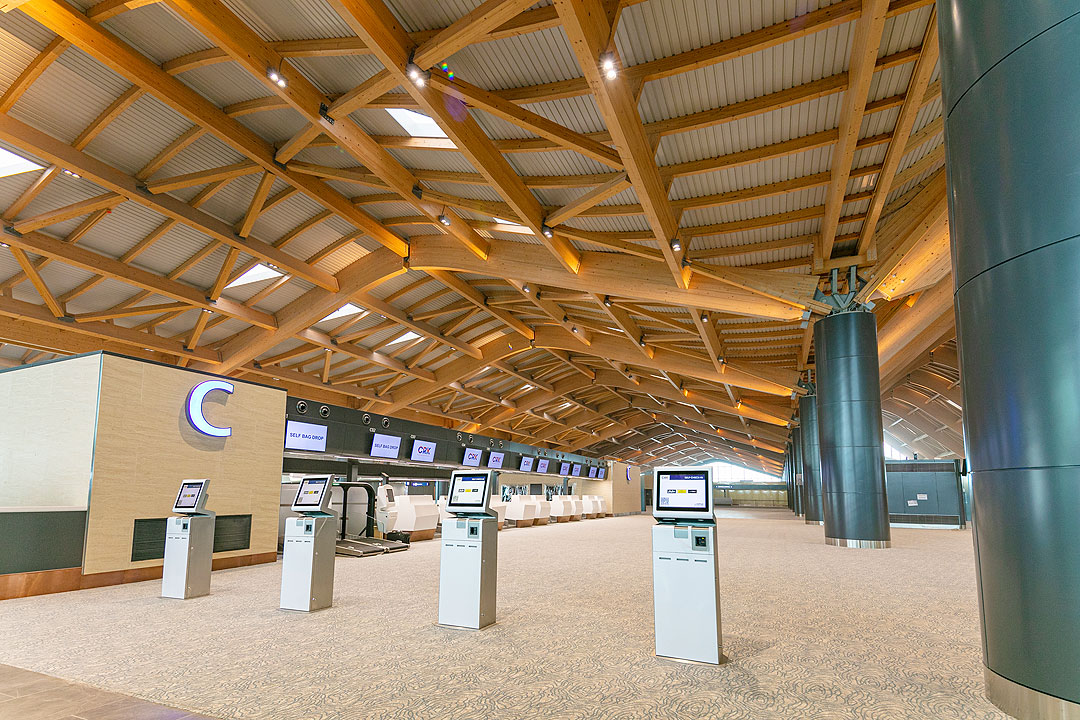
Clark International Airport is a finalist in architecture awards

THE CLARK International Airport has been named as one of the finalists in the 2021 World Selection of the Prix Versailles Architecture and Design Awards under the Airport Category.

Finalists of the Prix Versailles are chosen for their innovative design and connection to their local area’s culture and heritage.

“The World Selections pay tribute to the qualities of innovation, creativity, reflection of local, natural and cultural heritage, and ecological efficiency, as well as the values of social interaction and participation which the United Nations holds in high regard,” stated a press release in July 2021 from the Prix Versailles.

According to the Prix Versailles website, the program aims “to foster better interaction between the economy and culture” and gives attention to how “economic agents can play, in all sectors, to enhance, embellish and improve living environments.”

Luzon International Premiere Airport Development Corp. (LIPAD) is the private sector consortium in charge of the airport’s operations and maintenance which assumed operations of the facility in Aug. 2019.

“This distinction is very timely because it comes at a time when… we Filipinos are in great anticipation of better times and hopefully, the decline of the pandemic. We hope that through this new terminal building we can help uplift the mood of our countrymen, and soon when travel is relaxed, Clark International Airport will be there to delight passengers and [serve] as a fitting testament to Philippine capacities,” Bi Yong Chungunco, CEO of LIPAD, said at an online press conference on Aug. 26 via Zoom.

LIPAD worked with the international architecture and interior design firm Populous for the new terminal’s interior design.

“We brought our global expertise and quality to Clark. Populous drew inspiration for the terminal from Pampanga’s stunning natural beauty to select a material palette which reflects the local areas’ vibrancy. We have sought to avoid the neutral page palettes of many airports around the world, and instead create a strong sense of place. One that nods to the natural and cultural heritage of the area,” Populous architect Ben Dawson said.

“At the same time, we believe there is a subtlety to the design. We aim to showcase the open ceiling and the incredible views outside rather than compete against them for attention. Passenger experience was at the heart of this design, and we believe the Philippines can be proud of Clark airport as a vibrant gateway to the country,” he added.

The terminal features include a dedicated OFW (Overseas Filipino Worker) lounge, walk-through commercial spaces, gender-neutral toilets, and elevators and escalators at each boarding gate.

“We also incorporated the latest in technology. These would include automated self-bagging drops, self-checking kiosks, e-gates at the immigration areas, and generous spaces for retail and F&B (food and beverage),” Mr. Dawson said about additional key considerations to the terminal’s design.

The four-level terminal is in a 110,000 square meter area and has the capacity to accommodate eight million passengers annually.

Alongside the Clark International Airport, other international airports selected to compete in the Prix Versaille World Finale are the Berlin Brandenburg Airport Willy Brandt (Germany), the Athens International Airport (Greece), the South Wing Hazrat Sultan International Airport (Kazakhstan), the New Plymouth Airport (New Zealand), and LaGuardia Airport, Terminal B (New York).

The winners in the category will be announced at the World Awards Ceremony at the UNESCO Headquarters in Paris in late November or early December this year.  — Michelle Anne P. Soliman

AC Energy unit to list notes on Singapore Exchange

AC ENERGY Corp. said on Tuesday its executive committee had given the green light for its wholly owned subsidiary ACEN Finance Ltd. to issue senior guaranteed undated notes, which will be listed on the Singapore Exchange (SGX).

The size and terms of the securities will be set at a later date. The management also authorized AC Energy to be the guarantor of the notes.

“[The] target launch date of the notes is Aug. 31, 2021… The notes will be part of a $1.5-billion Medium-Term Note Program, which was granted an approval in principle by the SGX on Aug. 26, 2021,” it said in a regulatory filing to the local bourse on Tuesday. 

The listed power firm said the bonds qualify as an ASEAN Green Bond issuance, since they complied with the requirements listed down by the ASEAN Green Bonds Circular, citing a recent decision of the Securities and Exchange Commission.

ASEAN green bonds are securities or Sharia-compliant bonds (sukuk) whose proceeds will be used to fully or partially fund new and existing green projects, according to the ASEAN Capital Markets Forum.

AC Energy clarified that its senior notes are not and will not be registered with the corporate regulator.

“Any future offer or sale of the securities in the Philippines is subject to the registration requirements under the Philippine Securities Regulation Code, unless such offer or sale qualifies as a transaction exempt from these requirements,” it said.

It added that it does not plan to register the bonds in the United States.

Last week, AC Energy announced that it would embark on a joint venture with an affiliate of German solar firm ib vogt GmbH to develop solar projects with an initial 300 megawatts of direct current (MWdc) in the Philippines.

The Ayala group’s energy platform has an attributable capacity of around 2,600 MW in the Philippines, India, Vietnam, Indonesia, and Australia. It hopes to become the largest listed renewables platform in the region, as it targets to reach 5,000 MW of renewables capacity by 2025.

Shares in AC Energy improved by 4.24% or 39 centavos to finish at P9.59 apiece at the stock exchange on Tuesday. — Angelica Y. Yang

Ateneo Art Awards shortlist released

BRISA AMIR’s exhibit “Untitled Blankets” was held in Oct. 2019 at Artinformal Makati. — PHOTO FROM ATENEOARTGALLERY.COM/

THE SHORTLIST of artists and writers for the 17th Ateneo Art Awards has been released by the Ateneo Art Gallery (AAG).

Because of the ongoing COVID-19 pandemic, the program, which give recognition to contemporary artists and art writers, will cover a two-year period — exhibits which were shown between May 2, 2019 to May 1, 2021 — instead of the usual one year.

The AAG received over 140 nominations from museums, galleries, artists, and art educators for the Fernando Zóbel Prizes for Visual Art (FZA) category, which recognizes young and upcoming Filipino visual artists under the age of 36 whose works were exhibited within the aforementioned two-year period.

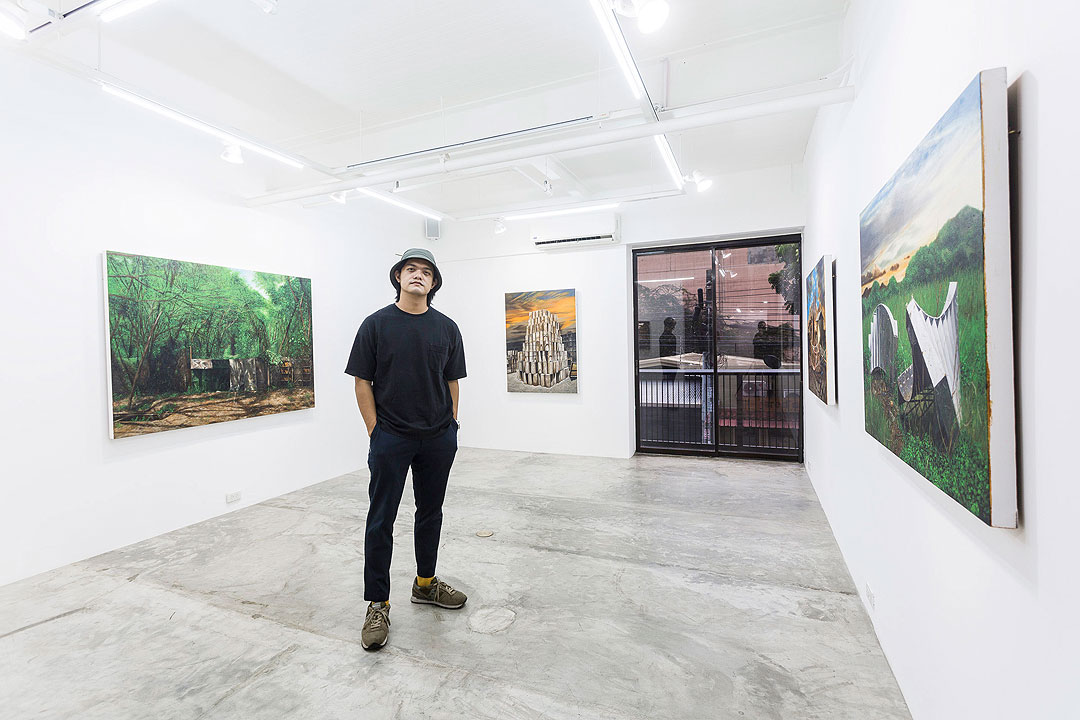
Twelve artists and exhibitions made the FZA shortlist. They are: Brisa Amir for the exhibit “Untitled Blankets” (held during October 2019 at Artinformal Makati); Renz Baluyot for “Empire” (Oct. 2020, West Gallery); Nice Buenaventura for “Fools will copy but copies will not fool” (June 2019, Artinformal Makati); Mars Bugaoan for “Appear Disappear ½ ¼” (April 2020, Kapitana Gallery, Talisay, Negros Occidental); Doktor Karayom for “Patingin” (May 2019, Blanc Gallery); Celine Lee for “The Length and Breadth of Depth” (Nov. 2020, Underground Makati); Christina Lopez for “Portraits (Proxies)” (March 2020, The Drawing Room, Makati); Henrielle Baltazar Pagkaliwangan for the work On This Site Will Rise (Part of a group exhibition “Fathom: The Monumental Art Series,” Oct. 2019, Orange Project, Bacolod); Ioannis Sicuya for “NICHE” (Nov. 2019, The Boston Gallery); Jel Suarez for “small bones, holding a mountain” (Oct. 2020, West Gallery); Jo Tanierla for “Pagburo at Pag-alsa: Natural Depictions and Illustrated Prophecies (Gelacio, 1910)” (Oct. 2020, UP Jorge B. Vargas Museum); and, Miguel Lorenzo Uy for “I am that I am” (March 2021, Underground Makati).

A jury will choose three artists from the shortlist to receive the FZA.

One artist from the 12 shortlisted will also be the recipient of the Ateneo Art Awards-Embassy of Italy Purchase Prize. The award is a partnership between AAG and the Embassy of Italy which seeks to help the Embassy compile a collection of Philippine contemporary art.

Meanwhile, six writers were identified for the shortlist of the other half of the Ateneo Art Awards, the Purita Kalaw-Ledesma Prizes in Art Criticism (PKL).

In the English Category the writers are: Allyn Canja for the essay The Internet Knows No Region: How artists from Western Visayas broke barriers during a global pandemic; Kiko del Rosario for Piercing Loss, Streaming Desire; Elizabeth Ruth Deyro for The Artist’s Social Responsibility in the Time of Crisis: On Leslie de Chavez’s I Like Art Fairs and Art Fairs Like Me; Carla T. Gamalinda for Art and the inevitable crisis of the screens; Alee Garibay for Birthing an Alternative Culture amidst a Crisis; and, Portia Placino for Forging on by the Mountainside. The shortlisted writers in the Filipino Category are: Jaffy V. Fajardo for “Nandiyan lang kultura at mga sining”; Jord Earving Gadingan for “Habang Wala Pang Matino”; and Mikka Ann Cabangon for “Ang Hikayat sa Pag-aaral ng Sining-bayan.”

Two winners will be selected from the English category. The winner of the PKL Prize for The Philippine Star will be awarded a regular column in the Arts and Culture section of the paper, to be published once a month for a year. The winner of the PKL Prize for ArtAsiaPacific will be contributing six articles to this bi-monthly publication for a year. One winner selected from the Filipino category will be awarded the PKL Prize for the Katipunan Journal and will be contributing two works to this bi-annual research publication for a year.

The three winners in the FZA category will be eligible for local residency grants funded by AAG and its new partner institutions. In addition to the opportunity to have their written work published, one of the winners from the PKL category will also be selected and offered a month-long writer’s residency at Orange Project in Bacolod.

The winners of the 2021 Ateneo Art Awards will be announced on Sept. 15 via livestream. In place of a physical exhibition, the AAG will release a series of videos about the shortlisted exhibits and essays after the online awarding.

Local airlines report high vaccination rates

STOCK PHOTO

THE Philippines’ three major airlines said they have vaccinated at least 90% of their flight crews, as they wait for tight travel restrictions to be eased.

Low-cost carrier Philippines AirAsia said in a statement on Tuesday that its flying crew is now “a hairline” towards achieving a 100% coronavirus disease 2019 (COVID-19) inoculation rate, with 98% of them vaccinated.

It said 106 out of 109, or 98%, of the airline’s pilots have been vaccinated against COVID-19.

“Meanwhile, 92% of the guest services (check-in counter and boarding gate staff) and 100% of the ramp agents have received their vaccine shots,” Philippines AirAsia added.

AirAsia Group Chief Executive Officer Anthony Francis “Tony” Fernandes said the acceleration of vaccine rollouts in all the key markets of the airline group is setting it up “for a strong return to the skies.”

Philippines AirAsia, citing its recent survey, said 91.4% of its passengers “feel more comfortable flying with fully vaccinated crew.”

Meanwhile, Cebu Pacific said on Monday that 95% of its flying crew are already vaccinated.

Cebu Pacific is “on track to completing its employee inoculation by October this year,” the budget carrier said in a statement.

“To date, 93% of [Cebu Pacific’s] total work force has been inoculated,” it added.

Flag carrier Philippine Airlines said: “As of Aug. 31, 90% of our flight crew (pilots and cabin crew) are fully vaccinated, while 91% of our ground staff are fully vaccinated.”

Philippine Airlines is hoping to complete its employee vaccination “by end-September.”

CEBU PACIFIC RESUMES HK FLIGHTS
Cebu Pacific also announced on Tuesday that it will resume its direct flights to Hong Kong from Manila starting Sept. 1.

“The carrier intends to fly six times weekly (daily except Saturdays) for the month of September,” it said in a statement.

Passengers need to present a negative COVID-19 test result conducted within 72 hours prior to the scheduled time of departure.

Cebu Pacific’s move comes after Hong Kong banned Philippine Airlines from operating passenger flights between it and Manila after three of the seven imported coronavirus cases were found to have come from Manila via the flag carrier’s flight PR300.

“There is latent travel demand, and we remain cautiously optimistic as we boost operations where it is needed most. We continue to listen to our passengers, and we do all that we can to address their needs while we remain committed to prioritize everyjuan’s health and safety,” said Xander Lao, chief commercial officer at Cebu Pacific. — Arjay L. Balinbin

Living languages

KWF’s Buwan ng Wika (or Language Month) theme for 2021 is “Filipino and native tongues in Filipino decolonization.” The theme promotes the use of native languages to better reflect Filipino perspectives. It is in line with the 2021 Quincentennial Commemorations in the Philippines (2021 QCP), which commemorates significant events over the nation’s past 500 years.

According to language resource Ethnologue, there are 183 living languages spoken in the Philippines, the majority of which are indigenous tongues. The most utilized languages — according to their order of use — are Tagalog, Cebuano, Pangasinan, Bicol, Hiligaynon, Waray, Kapampangan, Maranao, and Maguindanao, said Patrocinio V. Villafuerte, a poet, author, and retired professor, in an Aug. 12 webinar.

Republic Act No. 7104, which created the KWF, refers to Philippine languages as “the indigenous languages of the Philippines, including the national language and the regional and local languages.”

Gov’t fully awards T-bills as rates move sideways

BW FILE PHOTO

THE GOVERNMENT made a full award of the Treasury bills (T-bills) it offered on Tuesday as rates barely moved from their previous levels amid a lack of fresh leads.

The Bureau of the Treasury (BTr) raised P15 billion as planned via the T-bills it auctioned off on Tuesday as the offer was over three times oversubscribed, with tenders reaching P55.185 billion. The bids also rose from the P50.867 billion seen in the previous week’s auction.

Broken down, the BTr borrowed P5 billion as programmed from the 91-day debt papers as bids reached P15.584 billion. The average rate of the three-month T-bills was quoted at 1.077%, unchanged from last week’s level.

The Treasury also raised P5 billion as planned via the 182-day T-bills after the tenor attracted tenders worth P22.646 billion. The six-month papers fetched an average yield of 1.405%, down by 0.3 basis point (bp) from the 1.408% seen the week prior.

Lastly, the government made a full P5-billion award of the 364-day securities it offered on Tuesday from P16.955 billion in bids. The average rate of the one-year papers inched up by 0.4 bp to 1.616% from 1.612% previously.

At the secondary market prior to the auction, the 91- 182- and 364-day T-bills were quoted at 1.141%, 1.442% and 1.632%, respectively, based on the PHL Bloomberg Valuation Reference Rates published on the Philippine Dealing System’s website.

A bond trader said the movement of T-bill rates tracked the trend seen in the past auctions amid a lack of leads.

The trader said yields on short-term debts could see more movement if the central bank changes its policy stance or if there is a significant adjustment in its inflation outlook.

The central bank will keep its policy stance supportive of the economy as long as inflation remains stable, Bangko Sentral ng Pilipinas (BSP) Governor Benjamin E. Diokno said last week.

“The BSP will remain vigilant of the current inflation dynamics to ensure that the monetary policy stance will support economic recovery to the extent that the inflation outlook will allow,” Mr. Diokno said. “It will carefully scan the operating environment with a forward-looking perspective to move in a preemptive fashion to address any risks to our price stability mandate.”

The Monetary Board kept benchmark interest rates at record lows at its Aug. 12 meeting, citing the need for an accommodative policy stance due to the risks posed by the reimposition of strict lockdown measures to the ongoing economic recovery.

At that meeting, the BSP hiked its inflation forecast for the year to 4.1% from 4% previously, above the 2-4% target. It also raised its estimates for 2022 and 2023 to 3.1% from 3% previously.

Inflation stood at 4% in July, marking the first time it fell within the government’s target range since December 2020.

However, year to date, inflation averaged at 4.4%, still above the goal.

The Monetary Board will have its next policy review on Sept. 23.

On Wednesday, the BTr will offer P35 billion in reissued five-year Treasury bonds (T-bonds) with a remaining life of four years and seven months.

The Treasury is looking to raise P250 billion from the local market this month: P75 billion via weekly offers of T-bills and P175 billion from weekly auctions of T-bonds.

The government wants to borrow P3 trillion from domestic and external sources this year to help fund a budget deficit seen to hit 9.3% of gross domestic product. — B.M. Laforga