
How PSEi member stocks performed — June 22, 2021
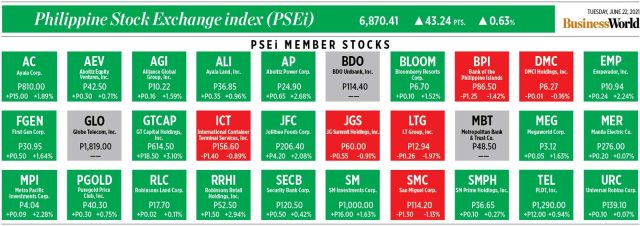
Here’s a quick glance at how PSEi stocks fared on Tuesday, June 22, 2021.
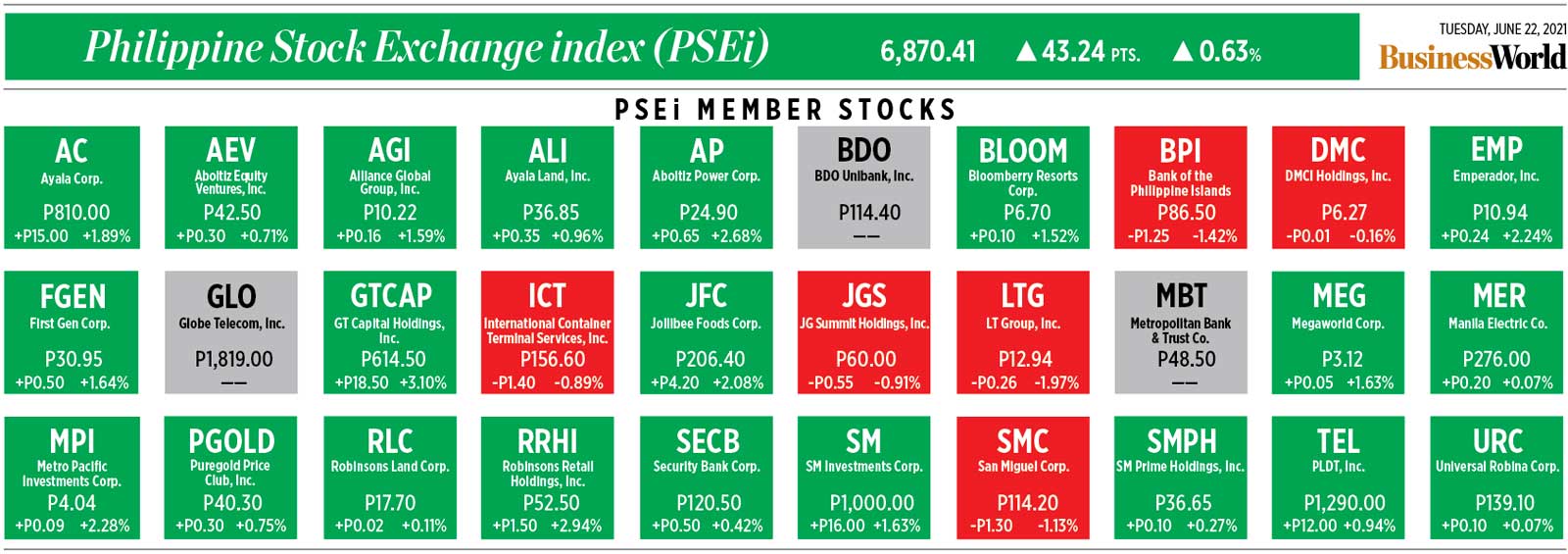

Here’s a quick glance at how PSEi stocks fared on Tuesday, June 22, 2021.
STOCKS climbed on Tuesday after the Bangko Sentral ng Pilipinas (BSP) chief on Monday said the Philippine economy can weather the adverse market impact of a tightening in the US Federal Reserve’s policy stance.
The Philippine Stock Exchange index (PSEi) gained 43.24 points or 0.63% to close at 6,870.41 on Tuesday, while the broader all shares index went up by 28.16 points or 0.67% to 4,182.90.
“Philippine shares followed the sentiment of their US counterparts after the Dow [Jones] booked its best day on a percentage basis since March after soaring by +1.76%. The S&P 500, +1.40%, likewise had its best day since May,” Regina Capital Development Corp. Head of Sales Luis A. Limlingan said in a Viber message.
“Investor sentiment also likely got a lift [on Tuesday] following pronouncements from the BSP that the Fed’s accelerated timetable for raising interest rates will be less of a threat to the Philippines vis-a-vis other emerging economies,” China Bank Securities Corp. Research Director Rastine Mackie D. Mercado said in an e-mail.
Emerging markets could experience capital flight once the US Federal Reserve lifts interest rates in 2023, BSP Governor Benjamin E. Diokno said, who believes this is less of a threat to the Philippines compared with other economies.
“We have sound fundamentals — hefty GIR (gross international reserves), low debt-to-GDP (gross domestic product) ratio, sound and resilient banking system, and we have adopted structural reforms — that a Fed rate hike in 2023 is less of a threat to the Philippine economy compared to other developing and emerging economies,” Mr. Diokno said on Monday.
The Fed hinted last week that it may need to raise benchmark interest rates twice in 2023 as the US economy’s recovery picks up pace.
All sectoral indices posted gains on Tuesday except for financials, which declined by 4.38 points or 0.29% to close at 1,486.11.
Meanwhile, holding firms improved by 75.95 points or 1.11% to 6,915.89; industrials climbed by 101.30 points or 1.08% to finish at 9,420.38; property added 19.80 points or 0.59% to 3,351.88; mining and oil went up by 54.11 points or 0.58% to end at 9,257.13; and services gained 8.80 points or 0.56% to finish at 1,560.03.
Value turnover inched down to P5.22 billion with 2.55 billion issues traded on Tuesday, from the P5.86 billion with 2.43 billion shares that switched hands the previous day.
Advancers beat decliners, 122 against 69, while 53 names closed unchanged.
Foreigners turned sellers anew and logged P101.57 million in net outflows on Tuesday from the P238.45 million in net purchases seen on Monday.
“For [Wednesday], we may see the index try to push higher and possibly retest the 7,000 resistance; however, such an attempt is likely to be met with strong selling pressure,” China Bank Securities’ Mr. Mercado said. — K.C.G. Valmonte
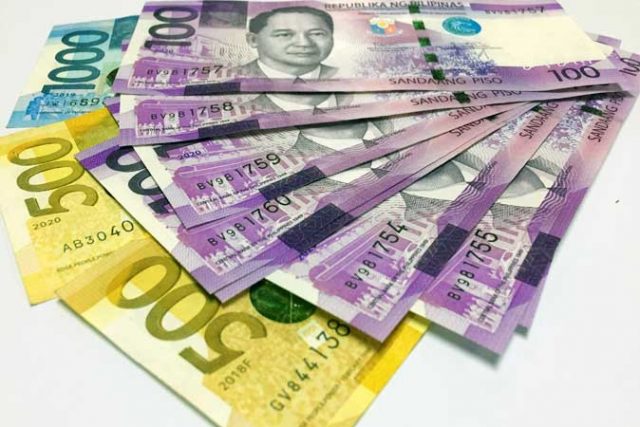
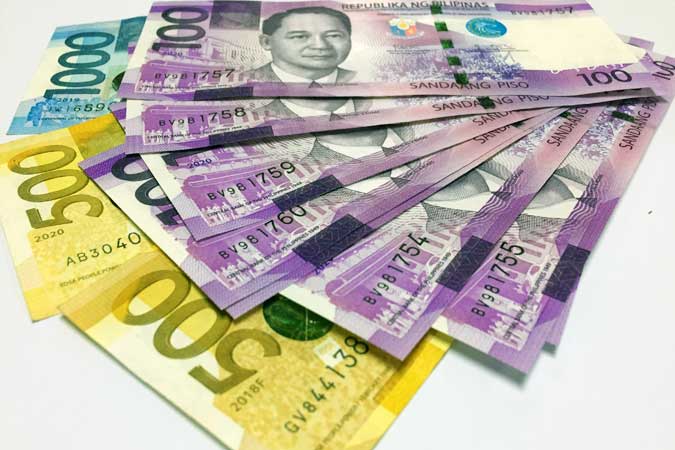
THE PESO moved sideways versus the greenback on Tuesday as the market waited for more signals from the US Federal Reserve on its policy tightening plans.
The local unit closed at P48.70 per dollar on Tuesday, barely changed from its P48.695 finish on Monday, data from the Bankers Association of the Philippines showed.
The peso started Tuesday’s trading session at P48.68 versus the dollar. Its weakest showing was at P48.76, while its intraday best was at P48.66 against the greenback.
Dollars traded declined to $1.067 billion on Tuesday from $1.338 billion on Monday.
The peso was flat as investors were waiting for remarks from the US central bank’s chief, which could contain more hints about the Fed’s planned unwinding of its easy monetary policy, a trader said.
Fed Chairman Jerome Powell was set to speak before the US House Committee on Coronavirus Crisis on Tuesday regarding their latest assessment of the economy.
In his prepared testimony released by the Fed on Monday, Mr. Powell said the economy continues to show “sustained improvement” and ongoing recovery in the job market but has seen inflation “increase notably in recent months, Reuters reported.
“We at the Fed will do everything we can to support the economy for as long as it takes to complete the recovery,” Mr. Powell said.
Meanwhile, Rizal Commercial Banking Corp. Chief Economist Michael L. Ricafort attributed the peso’s slight depreciation to the continued increase in oil prices.
Reuters reported that oil prices edged higher due to expectations of quick recovery in demand. Brent crude futures for August climbed 29 cents or 0.4% to $75.19 a barrel by 0658 GMT.
Meanwhile, US West Texas Intermediate (WTI) crude for July stood unchanged at $73.66 per barrel but rose by 13 cents to 0.2% to $73.25 a barrel for August.
For Wednesday, both Mr. Ricafort and the trader gave a forecast range of P48.60 to P48.80 versus the dollar. — LWTN with Reuters

THE ENERGY department is working with the World Bank Group to identify potential offshore sites for wind power and to help design a future market for the industry’s output.
In a statement Tuesday, the Department of Energy (DoE) said that it recently launched the Philippine Offshore Wind Road Map project which will be funded by the World Bank Group’s Energy Sector Management Assistance Program (ESMAP).
Apart from identifying suitable sites, the project also aims to establish short- and long-term offshore wind targets; come up with strategies to integrate offshore wind power into the government’s renewable energy portfolio; and propose policy measures that will make it attractive to invest in offshore wind.
Early estimates indicate that the Philippines “has over 170 gigawatts (GW) of offshore wind potential,” the bank’s Offshore Wind Development Program Co-Lead Mark Leybourne said.
The World Bank engaged the UK’s BVG Associates to study the technical, economic, environmental, social, employment, and financing aspects of establishing an offshore wind market in the Philippines.
Energy Secretary Alfonso G. Cusi described the project as a “key milestone” for the energy sector.
“As the country actively pursues the energy transition, broadening our offshore wind prospects would help fast-track meeting our goal of attaining a 35% renewable energy share in our energy mix by the year 2030,” Mr. Cusi said.
The industry roadmap is part of a series of offshore wind studies commissioned by the World Bank through the joint ESMAP-International Finance Corporation Offshore Wind Development Program.
The DoE has so far awarded five wind energy service contracts to various entities pursuing projects with a combined potential capacity of five GW from offshore wind. — Angelica Y. Yang

THE ENERGY department said its endorsement for energy efficiency (EE) projects to the Board of Investments (BoI) will depend on whether the project meets norms like a P10 million minimum investment and 15% energy savings.
In its guidelines for recommending EE projects to the BoI, the Department of Energy (DoE) said in a circular that such projects can be installations on new facilities or retrofitted equipment or modifications to older plants.
The BoI is one of the agencies empowered to grant fiscal incentives like income tax holidays (ITHs) in areas of investment that the government deems high priority.
The DoE defines the energy-savings norm of 15% or more as the “project boundary” — the degree to which the installations make their plants more energy-efficient.
Projects that can achieve annual energy savings of 15% to 20% are eligible for a 30% ITH based on the cost of the EE equipment; those with yearly savings from 20% to 25% can avail of a 40% ITH, while those with annual savings of 25% up are eligible for a 50% ITH.
EE projects with annual energy savings below 15% will not receive the ITH incentive, but their registration will not be cancelled, the DoE said.
Applications for project endorsements to the BoI must be filed with the DoE’s Records Management Division. The evaluation and issuance of endorsement certificates to the BoI must be issued within 20 working days upon receipt of the required documents, the DoE said in its circular.
Companies endorsed by the DoE are required to submit completion or commissioning reports within 30 days before the EE project’s commercial operations date; a monthly project progress report; and must allow the DoE to conduct an “independent verification” of their facilities.
Energy Secretary Alfonso G. Cusi signed the circular on May 11. The rules for EE project endorsements will take effect on July 2.
In April, Undersecretary Jesus Cristino P. Posadas said that BoI believes that a “healthy ITH must be set in place to lower the costs of capital-intensive projects that are being developed during a global economic slump.” — Angelica Y. Yang
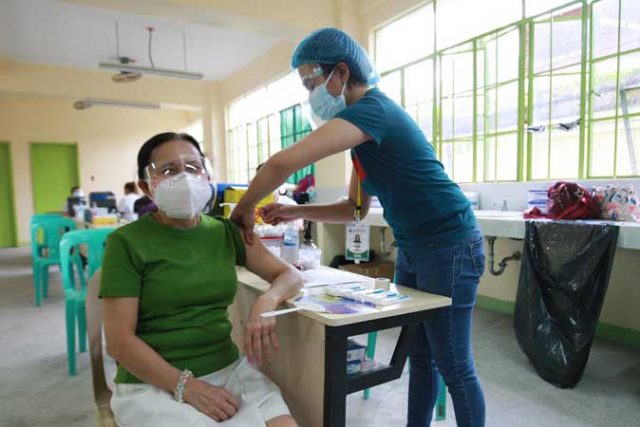
THE economic recovery remains hindered by the persistence of high infection numbers and the slow pace of vaccination relative to elsewhere in Asia, according to analysts from HSBC Ltd., who projected a 75% vaccination rate for the Philippines sometime around April 2024.
The timing of that milestone would make the Philippines the third-slowest among Asia Pacific vaccination programs ahead of only Vietnam and Bangladesh, which are expected to achieve herd immunity by the end of 2025.
“Because of the slow pace of vaccination, we continue to see the Philippine economy remaining on a slow path to post-pandemic recovery because currently, the daily infection cases in the Philippines continue to stay at relatively elevated levels as compared to the rest of Asia,” Fan Cheuk Wan, chief investment officer for Asia at HSBC Private Banking and Wealth and Management, said in a virtual briefing on Tuesday.
“We do expect the accelerated pace of vaccination amid improved vaccine supply will help to support the consumption recovery later this year,” she added.
In March, HSBC Research downgraded its growth outlook this year for the Philippines to 6.3% from the 6.5% forecast it issued in January. Both forecasts are near the low end of the government’s 6-7% growth target for the year.
Separately, ANZ Research in a note Tuesday said the country’s “constrained” policy response will also hinder its recovery efforts.
“COVID-19 can pose a key macroeconomic risk, but mainly for middle- and lower-income economies where the policy response might be more constrained. This includes Thailand, the Philippines and Malaysia,” it said.
According to the Asian Development Bank data as of May 31, the Philippines’ pandemic-related measures amounted to $30.323 billion or 8.59% of its 2019 gross domestic product (GDP). This is bigger than that of Vietnam (7.92%) but much smaller compared to measures enacted by Indonesia (11.35%), Malaysia (21.51%), Singapore (30.52%), and Thailand (19.42%).
House Bill 9411, representing the third stimulus package, known informally as Bayanihan III, hopes to allocate P401 billion for the economic recovery. It would be larger by far than the previous two packages if signed without substantial reductions. The measure remains pending at the committee level in the Senate.
The Palace has described Bayanihan III as not necessary for the moment as funds remain available from the 2021 budget and previous stimulus packages. Finance Secretary Carlos G. Dominguez, III said earlier this month that the economic team can only fund a P173-billion stimulus package this year if the fiscal deficit is not to exceed a deficit cap of 9.3% of GDP.
ANZ Research in May downgraded its growth outlook for the Philippines to 4.8% from the 7.1% estimate it gave in March.
In 2020, the economy contracted by a record 9.6% due to the impact of the pandemic, the worst performance in Southeast Asia.
Another roadblock to recovery was the fresh wave of infections earlier this year, ANZ said.
“The labor force in the region’s lower per-capita economies is suffering from weak wage growth, high unemployment or a combination of both. In the Philippines, around a quarter of the labor force is now unemployed or underemployed,” it said.
Infections surged once more in March and April, with daily new cases exceeding 10,000 at the peak. The government responded by raising the quarantine settings for Metro Manila and surrounding provinces. These restrictions were gradually eased and the so-called NCR (National Capital Region)-Plus region is now observing a more relaxed set of restrictions known as general community quarantine.
New cases totaled 5,249 Tuesday to bring the total infections to 1.364 million. Active cases were tallied at 55,847.
BSP HIKES SEEN BY 2022
HSBC’s Ms. Fan said the bank expects the first rate hike by the Bangko Sentral ng Pilipinas (BSP) by the first quarter of 2022, projecting a 75 basis-points (bps) move in policy rates next year to 2.75% by the end of 2022.
She said the central bank will continue to be “cautious” in setting policy even when it starts raising interest rates, with an eye towards inflation. The central bank’s overnight reverse repurchase rate was 4% before the 25-bps rate cut implemented as a precautionary measure as the pandemic was taking hold in February 2020.
Ms. Fan cautioned that financial markets could experience “increased volatility” in the coming months as the Fed decides the timing of its taper.
She expects the Philippines to be “more resilient” when the taper happens compared to 2013, when the Fed’s announcement that it will wind down its bond purchasing program triggered sharp outflows from emerging markets.
“This time, I think the strong reserves will provide a critical support for the Philippine economy to withstand market uncertainty. We do not expect to see significant turbulence in the Philippine market on the back of the Fed tapering,” she added. — Luz Wendy T. Noble
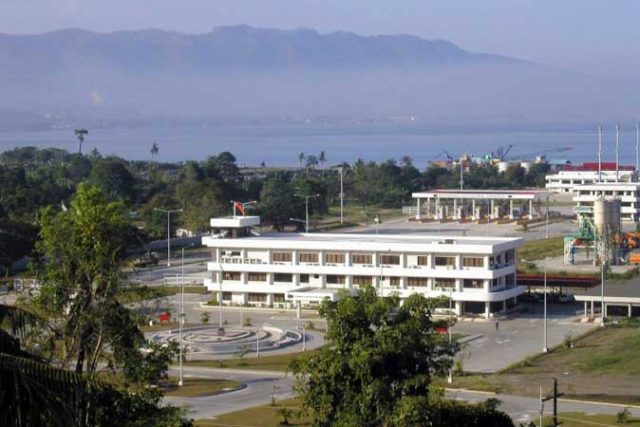
THE POWER generation unit of a Filinvest Development Corp. subsidiary is applying to double the capacity of a 405-megawatt coal-fired plant in Misamis Oriental, the Department of Environment and Natural Resources (DENR) said as it announced hearings on the matter on July 16.
The hearing will examine the proposal of FDC Misamis Power Corp., which operates the plant in Northern Mindanao’s PHIVIDEC Industrial Estate.
According to the FDC Misamis proposal posted on the Environment Management Bureau’s website, the expansion involves the construction of three circulating fluidized bed boilers and the addition of three steam turbines at a cost of between P20 billion and P30 billion.
It will take about three years to complete upon the acceptance of the engineering, procurement, and construction deal, FDC Misamis said.
“The basic rationale for the expansion project is to contribute to the sustained and robust development of Mindanao which requires electricity as a major infrastructure support,” the company said.
The hearing will take place via videoconference, part of a process that will allow the DENR to evaluate the project’s environment performance report and management plan.
Last year, Filinvest Development Corp.’s power arm FDC Utilities, Inc. said FDC Misamis has released funds as required by Energy Regulation 1-94 to provide financial assistance to its host communities.
The funds consist of cash tied to the volume of power generated on the site and are intended to aid communities where power companies operate. — Angelica Y. Yang

THE PHILIPPINES and the US should work on a standalone digital trade agreement that could serve as a model for the region, a US chamber of commerce official said.
Charles Freeman, senior vice-president for Asia of the US Chamber of Commerce, said that some issues remain unresolved for a US-Philippine free trade agreement.
“We’ve had this on again-off again conversation about whether the United States and the Philippines can enter into a free trade agreement. I think the politics of that still are unresolved,” he said.
But Mr. Freeman said at a virtual business dialogue on Tuesday that the two economies could enter a digital trade deal.
“There’s real congruency in the way that our businesses approach digital issues,” he said.
“I really think there’s an opportunity to set the stage for what would be a win not just for technology companies, but really for the people that put bread on the table every day in both the Philippines and the United States.”
The US and Japan in 2019 signed a digital trade agreement banning customs duties on electronically distributed digital products like e-books and videos and facilitating cross-border data transfer.
In the Philippines, restrictions on foreign participation have limited the country’s integration with digital trade networks in the Asia Pacific, a Philippine Institute for Development Studies study has found.
According to the report, the Philippines has a slightly restrictive policy and regulatory environment for digital trade as foreign equity limitations on electronic commerce and telecommunications dampen foreign participation. A digital infrastructure gap, the report added, also limits online transactions.
Meanwhile, Trade Undersecretary Ceferino S. Rodolfo said at the event that some US firms have been showing interest in the Philippines after a law cutting corporate income tax and reforming the tax incentives system was passed.
“We have seen strong interest coming mainly from, at this time, infrastructure-related companies,” he said, noting that there has been interest from the telecommunications, artificial intelligence, and data center sectors.
“There has been strong interest from highly innovative, labor-intensive companies in the electronics sector trying to look at the Philippines as an alternative or complementary location for their factories here in Asia,” Mr. Rodolfo added. — Jenina P. Ibañez

BOHOL has been selected as a site to trial the local takeover of services formerly carried out by the National Government in preparation for the implementation of the Supreme Court’s Mandanas ruling, which ordered an increase in local governments’ share of the National Government’s revenue starting next year.
Agriculture Secretary William D. Dar said the initial devolution of services will come in the form of Province-led Agriculture and Fisheries Extension Systems (PAFES) program, for which Bohol was chosen as a “model.”
The National Government is shedding services in response to the Mandanas ruling, and is hoping that newly cashed-up local government units (LGUs) pick up the slack.
Mr. Dar said in a statement Tuesday: “We would like to see more LGUs investing in agriculture and fishery projects that would produce traditional as well as emerging products that enjoy comparative advantage.”
The DA, citing the Department of Budget and Management, said the Internal Revenue Allotment (IRA) of LGUs, representing their share of National Government revenue, is set to increase by P234.4 billion to P1.8 trillion in 2022.
Mr. Dar also confirmed that the DA has sent Malacañang a draft executive order to institutionalize PAFES next year for all provinces.
“With the additional IRA, LGUs could implement the PAFES in partnership with the DA, to significantly boost the delivery of devolved functions and better perform their role as the country’s food security czars,” Mr. Dar said.
He said Bohol was selected because Governor Arthur C. Yap has aligned the province’s priority agriculture and fishery programs with the DA’s own plans.
“If all provinces are like Bohol, the improvement of the agriculture sector in every province would be quicker,” Mr. Dar said.
According to Mr. Yap, P588.8 million has been allotted for programs that cover rice, corn, root crops, coconut, milkfish, tilapia, seaweeds, dairy, native chicken, swine, and farm-to-market roads.
Mr. Dar said the DA will act favorably towards Mr. Yap’s request for an additional P976 million for farm and fishery projects, and P1.4 billion for farm-to-market roads.
“Agriculture is too important to be left alone with the DA. The DA must only do the steering. LGUs must do the rowing so that the provinces will be food secure. There must be a sense of partnership that must be nurtured between DA and the LGUs,” Mr. Dar said.
“Several provinces are also taking the initiative by investing much of their budgets on agriculture. These include Isabela, Ilocos Norte, Ilocos Sur, Pangasinan, Quirino, Pampanga, Bulacan, Nueva Ecija, Batangas, Cebu, and Marinduque, among others,” he added. — Revin Mikhael D. Ochave

THE US and the Philippines have finished the final phase of a five-year biological threat capacity-building program worth around, aimed mainly at addressing the Philippines’ ability to handle animal diseases.
The US Embassy in the Philippines said the US Defense Threat Reduction Agency – Biological Threat Reduction Program (DTRA-BTRP) was conducted alongside the Department of Agriculture (DA) starting September 2016 to establish or improve seven regional animal disease diagnostic laboratories in Luzon, the Visayas, and Mindanao.
“The program also included the provision for Philippine counterparts to participate in 15 bio-safety and security courses, 26 quality management courses, four table-top exercises, 27 laboratory staff workshops, and support to the Regional Institute of Tropical Medicine through equipment fielding and training,” the US embassy said in a statement.
Agriculture Undersecretary William C. Medrano said the partnership helped modernize laboratories and institutionalize quality management.
“I can safely say that the desired outcome of the bio-safety and security project was fulfilled,” Mr. Medrano said.
The US embassy said the program also helped address emerging diseases in the Philippines such as avian influenza (bird flu) and African Swine Fever.
It added that the partnership also included disease surveillance and laboratory security and safety training.
Ada A. Bacetty, head of the DTRA-BTRP, said the partnership allowed the Philippines to improve its capacity to detect, diagnose, and report dangerous pathogens.
“These labs are a central line of defense against dangerous pathogens affecting agriculture, including those with potential to affect humans. The capabilities developed through the BTRP-DA partnership strengthened the Philippines’ ability to detect and respond to emergent threats,” Ms. Bacetty said.
“Now that the Philippine government is operating these labs at full capacity, we look forward to the next opportunity to work with our critical Philippine friends, partners, and allies,” she added.
The US embassy said future partnerships between the BTRP and the Philippines will expand to include the human health sector. — Revin Mikhael D. Ochave
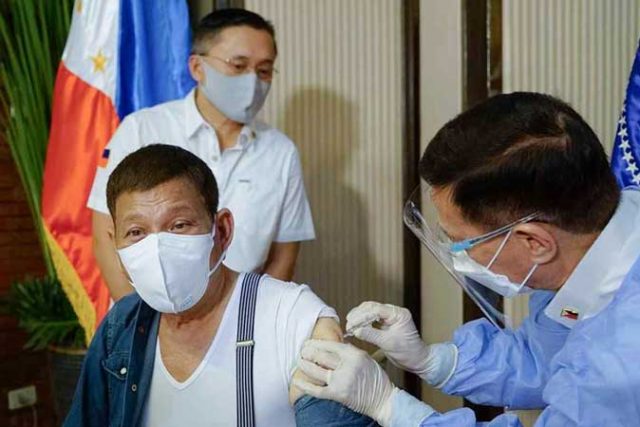
PRESIDENT Rodrigo R. Duterte’s threat to order the arrest of people who refuse to be vaccinated against the coronavirus has no legal basis, the country’s Justice chief said.
“As a lawyer, he (Mr. Duterte) knows that not getting vaccinated is a legal choice; there is no law as yet that compels vaccination against COVID-19 (coronavirus disease 2019), much less criminalizes it, as presently available vaccines are still in their trial phases,” Justice Secretary Menardo I. Guevarra told reporters on Tuesday via Viber.
“I believe that the President merely used strong words to drive home the need for us to get vaccinated and reach herd immunity as soon as possible,” he added.
He explained that not getting vaccinated and not following health protocols are “two entirely different things.”
“Getting vaccinated is not mandatory but complying with health protocols is mandatory,” he said.
Presidential Spokesperson Herminio L. Roque, Jr., however, insists that the state has the power to make COVID-19 vaccination mandatory.
Mr. Duterte, during his public address on Monday night, said he will order the arrest of those who refuse to take part in the vaccination program. He also threatened to require village officials to prepare a list of those who decline to be vaccinated.
The President also said those who do not want to be vaccinated may leave the country. “For as long as you are here and you are a human being who can carry the virus, magpa-bakuna ka (get vaccinated),” he said.
The President’s statement “emphasized what the state can do,” Mr. Roque told a televised news briefing on Tuesday.
“This is part of what we call the police power of the state,” Mr. Roque said, reiterating that the government can use police power to deter potential threats to public health.
He did acknowledge that implementing compulsory vaccination would require legal basis, either under a national law or a local government ordinance.
The spokesman said it would be easy for the executive branch to ask Congress to pass a law that would make vaccination mandatory.
LAWMAKERS
Several lawmakers, on the other hand, questioned the President’s threat.
Senator Francis N. Pangilinan said the solution to encourage Filipinos to get vaccinated is through “science-based” interventions, not by intimidation.
“Threatening or arresting are not the solutions. The solution is science-based interventions, contact tracing, testing information dissemination and an effective vaccine rollout,” he said, partly in Filipino, in an online briefing Tuesday.
Senator Risa N. Hontiveros-Baraquel, in a statement in Filipino, said there is no need to threaten Filipinos.
“There is no need to threaten the public if there is a sufficient and continuous supply of vaccines that are safe, effective, and appropriate to their conditions; credible health information and education in the communities; and an organized vaccination system,” she said.
Meanwhile, Senator Maria Lourdes Nancy S. Binay noted that vaccine hesitancy is not the problem.
“Vaccine supply is the biggest problem, so we need to arrest that. But at the same time, vaccine hesitancy is there, but for me, the urgent need right now is you need to have more supply of the vaccine,” she said in an interview with ABS-CBN News Channel.
A Social Weather Station survey released on May 20, conducted among 1,200 respondents from April 28 to May 2, found that 32% of Filipinos were willing to get vaccinated, 35% were uncertain, and 33% were unwilling to get their shots.
Around 8.4 million coronavirus vaccines doses were administered as of June 20, with around 2.15 million people who were fully vaccinated, according to the Health department.
Philippine authorities and medical experts have been urging the public to get vaccinated to reduce the number of critical cases and achieve herd immunity by the end of the year. — Bianca Angelica D. Añago, Kyle Aristophere T. Atienza, and Vann Marlo M. Villegas
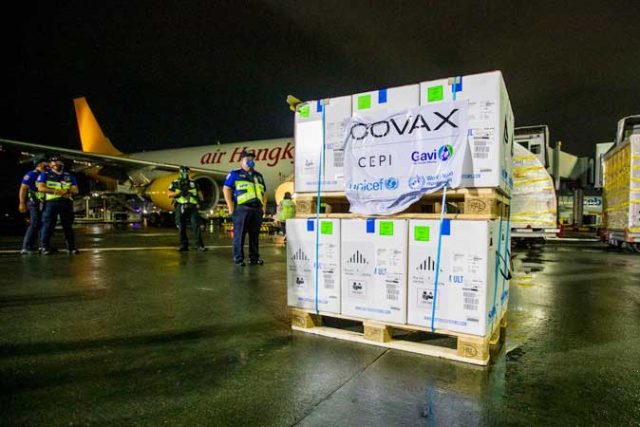
THE UNITED States is set to donate as many as one million doses of coronavirus vaccines to the Philippines, Manila’s envoy to Washington said on Thursday.
The 800,000 to one million doses are part of the 18 million vaccine vials that the US will give to various countries, Ambassador Jose Manuel D. Romualdez said at a televised interview with Palace spokesman Herminio L. Roque, Jr.
The vaccines would be either from Moderna, Inc. or AstraZeneca Plc, Mr. Romualdez said. The vaccines would probably arrive next month.
Mr. Romualdez said Manila would also get “a substantial amount of doses” from the 500 million vaccine vials donated by America “to the world.”
The US government would donate about 80 million vaccine vials globally, according to a White House statement on June 3. Of the total, at least 75% will be shared through a global initiative for equal access, which will allocate roughly seven million doses to Asian countries, including the Philippines.
The Philippines earlier negotiated for the purchase of about 20 million doses of Moderna vaccines. The first batch of which will arrive before the end of the month, Mr. Romualdez said.
The Philippines has so far received about 10.8 million doses of coronavirus vaccines. About 8.4 million doses have been administered as of June 20.
On Tuesday, the Department of Health reported 3,666 new coronavirus infections, bringing the country’s total to 1.37 million.
The death toll rose by 60 to 23,809, while recoveries increased by 6,810 to 1.29 million, it said in a bulletin.
There were 52,696 active cases, 1.4% of which were critical, 91% were mild, 4.2% did not show symptoms, 2% were severe and 1.40% were moderate.
The agency said 11 duplicates had been removed from the tally, eight of which were tagged as recoveries.
A total of 56 cases previously tagged as recoveries were reclassified as deaths. Twelve laboratories failed to submit data on June 20, the agency said.
About 13.6 million Filipinos have been tested for the coronavirus as of June 19, according to DoH’s tracker website.
The coronavirus has sickened about 179.6 million and killed 3.9 million people worldwide, according to the Worldometers website, citing various sources including data from the World Health Organization. — Kyle Aristophere T. Atienza and Vann Marlo M. Villegas
