Home Blog Page 7534

Duterte daughter says she won’t run for top post

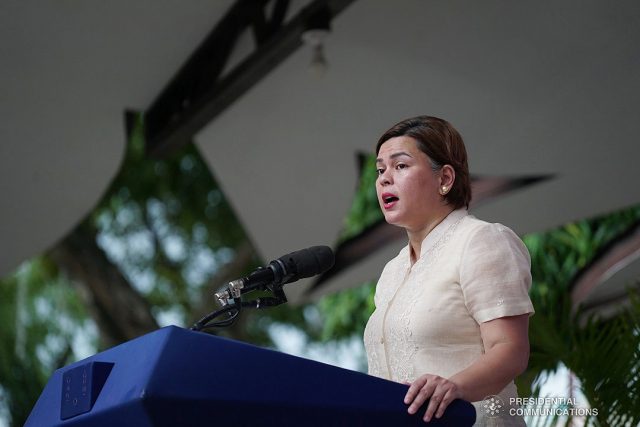
PRESIDENTIAL PHOTO/KING RODRIGUEZ

By Kyle Aristophere T. Atienza, Reporter

DAVAO CITY Mayor Sara Duterte-Carpio on Thursday said she would no longer seek the presidency in 2022 after her father President Rodrigo R. Duterte accepted the ruling party’s nomination for him to run for vice-president.

In a text message, Ms. Carpio said she was honoring an earlier agreement that only one of them would run for a national position next year.

Mr. Duterte, who is barred by law from running for reelection, on Wednesday accepted the endorsement of a PDP-Laban faction to be its vice-presidential candidate at the elections next year. Senator Christopher Lawrence “Bong” T. Go, his former aide, declined the party’s endorsement for him to be its presidential bet.

The presidential daughter said the latest move by the PDP-Laban faction led by Energy Secretary Alfonso G. Cusi was the original plan. “Plan B was for Senator Bong Go to run for VP,” she said, citing a conversation with her father.

Mr. Duterte, who had flip-flopped in his 2016 presidential run, earlier said he would reconsider his vice-presidential ambition if his daughter decides to run for President.

Ms. Carpio heads Davao-based political party Hugpong ng Pagbabago, which has entered into alliances with various traditional parties less than a year before the 2022 elections.

“We are seeing here an attempt to create a grassroots demand for her candidacy,” said Cleve V. Arguelles, a political science lecturer at De La Salle University. “We should take this announcement with a grain of salt,” he said in a Facebook Messenger chat. “She’s polling well, strong potential candidates are offering to be her VP, and different political factions are talking to her.”

On Sept. 2, Ms. Carpio said Senators Christopher Lawrence “Bong” T. Go and Sherwin T. Gatchalian had expressed their intent to run with her.

She also said a proposal to make former Defense Secretary Gilberto Eduardo Gerardo C. Teodoro her running mate “was made known through common friends.”

Certain groups also want House Majority leader Martin G. Romualdez and Senator Juan Edgardo M. Angara to be her vice-president, she said.

Ms. Carpio added that she had read reports of a possible tandem between her and the late dictator’s son, former Senator Ferdinand “Bongbong” R. Marcos, Jr.

“If there’s anything Sara learned from 2016 is that she can always decide to run after all what’s been said,” Mr. Arguelles said. “Joining the race late isn’t a disadvantage.”

The filing of certificates of candidacy will start in October.

Earlier this month, Mr. Duterte said he would run for vice-president so he could continue his campaign against insurgency, corruption and illegal drugs. The tough-talking leader had also said a successful vice-presidential run would protect him from potential lawsuits.

Former International Criminal Court (ICC) Chief Prosecutor Fatou Bensouda on June 14 asked the court’s pre-trial chamber to open a probe into Mr. Duterte’s bloody war on drugs. The court has said the Philippines’ withdrawal from the ICC would not affect its investigation.

Mr. Marcos on Wednesday said he is eyeing a national post in the 2022 elections.

The son of the late dictator Ferdinand E. Marcos who recently lost his vice-presidential election protest at the Supreme Court said he had started organizing people on the ground who could help him win.

The former senator narrowly lost the 2016 vice-presidential race to Maria Leonor “Leni” G. Robredo, whom the High Court sitting as the Presidential Electoral Tribunal favored in Mr. Marcos’s election protest.

Mr. Marcos said he could no longer run with Senator Panfilo M. Lacson and Senate President Vicente C. Sotto III since both have officially declared their tandem for the 2022 elections. He added that his campaign would focus on pandemic recovery and food security.

Mr. Lacson on Wednesday became the first politician to announce his presidential ambition, with Mr. Sotto as his running mate.

Senator Emmanuel “Manny” D. Pacquiao is also believed to be seeking the presidency, as well as Manila Mayor Francisco “Isko” M. Domagoso III, a former matinee idol. A faction of the ruling party led by the boxing champion earlier ousted Mr. Duterte as party chairman.

FDA says only 0.0017% of fully vaccinated Pinoys infected with COVID-19 

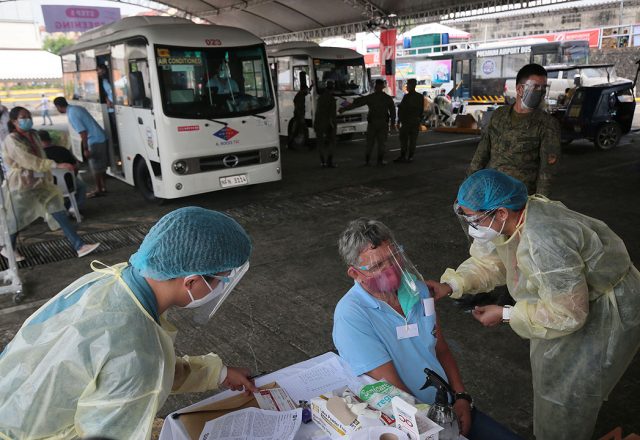
PHILIPPINE STAR/ MICHAEL VARCAS

THE FOOD and Drug Administration (FDA) on Thursday said only 243 out of 13.8 million fully vaccinated Filipinos had been infected with the coronavirus as of Aug. 29. 

That is 0.0017%, which is very low and within global standards, FDA chief Rolando Enrique D. Domingo told a televised news briefing. He added that it showed that the benefits of getting vaccinated against the coronavirus far outweigh the risks. 

At least five fully vaccinated people have died, he said. The patients were either old or were seriously ill. 

Mr. Domingo said 60,703 people had experienced adverse effects after getting a shot, 2,083 of whom had experienced serious effects. 

The FDA chief said one of 200 Filipinos who got the vaccine made by AstraZeneca Plc had experienced adverse effects, including body pains, pain on the injection site, fever and a heavy feeling. 

The Department of Health (DoH) reported record 22,820 coronavirus infections on Thursday night, bringing the total to 2.16 million. 

The death toll rose to 34,733 after more patients died, while recoveries increased by 12,337 to 1.96 mollion, it said in a bulletin. 

There were 166,672 active cases, 87% of which were mild, 8.3% did not show symptoms, 1.4% were severe, 2.65% were moderate and 0.7% were critical. 

DoH said 108 duplicates had been removed from the tally, 96 of which were tagged as recoveries, while 29 recoveries were reclassified as deaths. Five laboratories failed to submit data on Sept. 7. 

Meanwhile, Mr. Domingo said children would get vaccinated against the coronavirus once the country gets enough vaccines. 

Earlier in the day, the Quezon City government said 99 children in an orphanage had been infected with the coronavirus. 

The outbreak in Gentle Hands Orphanage in Bagumbayan village followed a visit by a positive adult who did not show symptoms, according to state media. 

The World Health Organization has been urging advanced countries to suspend a plan to give out booster shots until at least the end of the year to ensure supplies for poor countries. 

Health Secretary Francisco T. Duque III earlier told a House committee hearing the Budget department had cut the agency’s proposed P104-billion budget for booster shots next year to P45 billion. 

Meanwhile, Socioeconomic Planning Secretary Karl Kendrick T. Chua told a Senate hearing a plan to let fully vaccinated people move more freely during a lockdown might be enforced in Metro Manila. 

“Perhaps we can have it across the board, across the National Capital Region, in a gradual process,” he said. 

The government seeks to fully vaccinate 70% of the target population against the coronavirus in high-risk areas by the end of October, according to the country’s vaccine czar. 

These places include the National Capital Region, Metro Cebu, Metro Davao, Iloilo City, Cagayan de Oro City, Central Luzon and the Calabarzon region, vaccine czar Carlito G. Galvez, Jr. told lawmakers at a House of Representatives hearing on Thursday. 

“This is a very bold target,” he said, adding that its success would depend on the availability of vaccines. 

Mr. Galvez on Wednesday said the state would raise its herd immunity target to as much as 90% of the population to protect people from a more contagious Delta coronavirus variant. 

Citizens are indirectly protected from an infectious disease when more people become immune, either through vaccination or a previous infection. It makes the spread of the disease from person to person unlikely. 

Mr. Galvez also said during the House hearing the government had taken delivery of 52.79 million vaccine doses, 17.12 million doses of which were donated and 35.67 million were bought. 

He said 61.5 million more doses, including 28 million from Pfizer, Inc. and 22 million from Sinovac Biotech Ltd. would arrive as early as this month. 

Of the 25 million vaccines to be given out this month, 3.81 million doses would be allotted to Calabarzon while 3.06 million doses will be sent to Central Luzon. 

Meanwhile, at least a million doses will mostly be given to various regions in the Visayas and Mindanao. Mr. Galvez said 15.84 million Filipinos have been fully vaccinated. 

Also on Thursday, Finance Secretary Carlos G.  Dominguez said delays in vaccine deliveries are beyond their control. 

He told a Senate hearing the Finance department had paid for 195.67 million vaccine doses to cover 100 million Filipinos, including children aged 12 to 17. 

The Finance chief said the vaccination drive would depend on the arrival of the vaccines. “We have to trust that they step up to the plate,” he said of vaccine suppliers. 

“We are at the mercy of the suppliers of the vaccines,” Senator Maria Lourdes Nancy S. Binay-Angeles told a hearing attended by economic managers. — Kyle Aristophere T. Atienza, Russell Louis C. Ku and Alyssa Nicole O. Tan 


ERRATUM: An early version of this story incorrectly put the ratio in the title and lead. 

7 more reported missing in typhoon Jolina’s aftermath; Kiko intensifies as it nears land

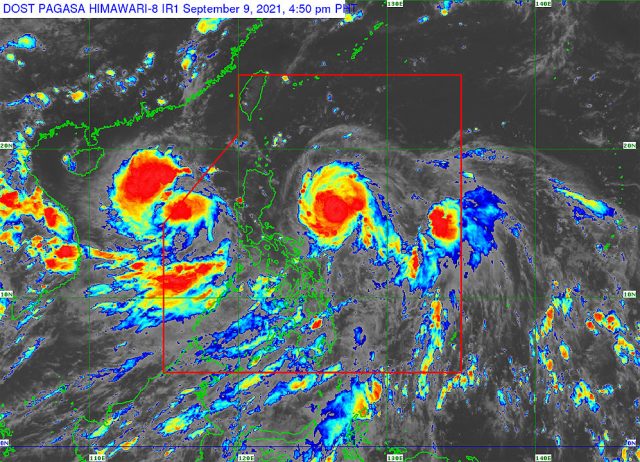
ANOTHER SEVEN people were reported missing, bringing the total to 19, and more than 79,000 were affected in the aftermath of tropical storm Jolina (international name: Conson), according to the national disaster management agency.

In its Sept. 9 report, the National Disaster Risk Reduction and Management Council (NDRRMC) said 12 fishermen from Samar and three from Biliran have been confirmed to have gone out to sea despite warnings from authorities. Four other persons from Masbate reported missing are still being verified. 

NDRMMC said 79,062 people were affected by the 10th typhoon to hit the country this year, including about 7,867 who were displaced from their homes across the regions of Central Luzon, Mimaropa, Calabarzon, Western Visayas, and Eastern Visayas. 

More than 120 road sections were rendered impassable due to landslides or damage, but most of these were already reopened as of Thursday morning. 

The Philippine Coast Guard also announced Thursday that shipping and fishing operations in all seaports have resumed.   

Damage to agriculture has reached P299.40 million compared to the previous estimate of P179.57 million, affecting 62,052 farmers, according to the Department of Agriculture (DA). 

The DA’s Disaster Risk Reduction and Management Operations Center said in a bulletin on Thursday afternoon that Jolina affected 57,649 hectares of farm areas in the regions of Calabarzon, Bicol, Western Visayas and Eastern Visayas. 

Affected commodities include rice, corn, high value crops, livestock, and fisheries totaling 16,155 metric tons.   

“These values are still subject to validation,” the DA said in the bulletin.   

Damage to fisheries amounted to P662,000 while livestock and poultry losses, consisting of 171 combined heads of goat and duck, reached P58,000.   

“The DA, through its regional field offices, is conducting further assessment and validation of damage and losses brought by Typhoon Jolina in the agri-fisheries sector,” the bulletin said.   

As of 5 p.m. Thursday, weather agency PAGASA said Jolina was already 410 kilometers (kms) west of Dagupan City and was expected to be out of the Philippine area by Friday morning. — Marifi S. Jara and Revin Mikhael D. Ochave

UPLB, SEARCA to establish halal S&T and health knowledge hub

THE UNIVERSITY of the Philippines Los Baños (UPLB) has partnered with the Southeast Asian Regional Center for Graduate Study and Research in Agriculture (SEARCA) to establish a halal and health knowledge hub for the region. 

The envisioned Halal Science and Technology (S&T) and One Health Knowledge Center will be hosted by the UPLB-School of Environmental Science and Management (SESAM).

SEARCA said in a statement that the first phase of the project is to conceptualize the “Halal Industry and One Health ecosystem” as a developing innovation for growth and development.   

“The Halal Science and Technology and One Health Knowledge Center is envisaged to be a virtual one-stop, open-access regional hub for country-to-country and cross-country government-academe-industry exchanges of knowledge and resources related to the growing Halal and One Health global ecosystems,” SEARCA said.   

According to project leader Yusuf A. Sucol, halal is a “growing and promising global market valued at $2.5 trillion in 2020, largely in the food industry.”   

Rico C. Ancog, UPLB-SESAM dean, said the initiative seeks to combine halal requirements with health concepts to develop a more sustainable way of managing livestock and ecosystems.   

SEARCA Director Glenn B. Gregorio said regional competition in Southeast Asia has “stimulated the local and global markets for halal products.” — Revin Mikhael D. Ochave 

Comelec fails to attract vote counting machine suppliers for 2022 polls 

NO COMPANY participated in the bidding for the lease of 10,000 additional units of vote counting machines for the 2022 elections, including previous supplier Smartmatic, citing an insufficient budget set by the Commission on Elections (Comelec).

The Comelec bids committee declared a “failure of bidding” during Thursday’s hearing.

The committee secretariat said only Smartmatic, which has been the Philippines’ technology provider for automated elections since 2010, bought bid documents in August but did not submit an offer for the machines with SD cards, which had an approved budget of P60,050.35 each, totaling P600.5 million.

In a letter to the committee, Smartmatic’s representative Filipinas S. Ordoño said after thoroughly studying the procurement documents, the firm has “determined that the budget is not sufficient to cover all of Comelec’s conditions stated in the TOR (terms of reference).”

Ms. Ordoño further said the coronavirus pandemic has “disrupted the global supply chain servicing the electoral sector resulting in huge backlogs in the manufacturing process.” The disruption has led to a shortage in electronic components, which has increased costs by up to 25%. There has also been a “sharp rise” in the costs of logistics by 200%, she added. 

The committee will conduct a mandatory review of the budget as required under Comelec rules.    

Comelec currently owns 97,345 vote counting machines but aims to rent 10,000 more units so it can reduce the number of voters per precinct to practice social distancing and other health protocols. — Bianca Angelica D. Añago

Top-heavy Ombudsman’s office reorganizing, eyes more investigators

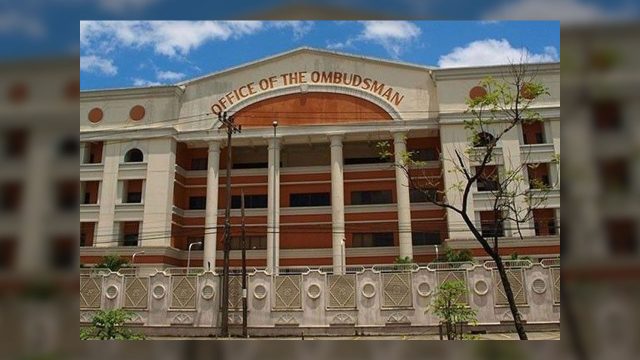
THE OFFICE of the Ombudsman is adjusting its organizational structure after the findings of the Commission on Audit in 2019 that 64% of the office’s employees are occupying high level positions.

Ombudsman Samuel R. Martires, speaking before the House Committee on Appropriations Thursday for their proposed 2022 budget, said they are also working on having more investigators and lawyers to expedite cases.   

“We are also trying to augment the number of investigators and lawyers who will be assigned to the fact-finding investigation bureau and the preliminary investigation bureau because these are the two bureaus where (a bulk) of our cases are pending,” he said.

Mr. Martires said their original proposed allocation for next year was slashed by over P700 million.

The executive department proposed a P3.97-billion spending plan for the Office of the Ombudsman for next year, 14.4% lower than this year’s P4.56 billion. The office originally proposed a P4.731-billion 2022 budget to the Department of Budget and Management (DBM).   

Several lawmakers, including Cagayan de Oro Rep. Rufus B. Rodriguez, recommended to restore the slashed budget, noting that the office’s reduced allocation would violate Republic Act 6770 or the Ombudsman Act of 1989.

According to Section 38 of the law, the appropriations for Office of the Ombudsman cannot be reduced below the amount allotted in the previous year.   

Mr. Martires said he was willing to accept the reduced budget if “there is a need to augment the budget of other agencies who are fighting (the) pandemic,” noting that their investigations were significantly affected by the coronavirus crisis. 

SALN
During the House hearing, Mr. Martires also suggested an amendment to Republic Act 6713 or the Code of Conduct and Ethical Standards for Public Officials and Employees, which would provide a jail sentence of five years to anyone who makes a comment on a government official’s statements of net worth.

Bayan Muna Party-list Rep. Carlos Isagani T. Zarate questioned the proposed amendment saying it would hamper the public from demanding accountability from government officials.

“Isn’t it dangerous to penalize our countrymen if they raise questions, because freedom of expression is guaranteed by the Constitution,” he said in Filipino.

Mr. Martires also said he would “not yield to any public opinion” on Ombudsman Memorandum Circular No. 1 which restricts public access on Statements of Assets, Liabilities and Net Worth (SALN) of government officials.

The circular, which he signed, would grant the release of SALNs only if the requester is an authorized representative of the declarant or if the request is either upon a lawful order of the court or for the purpose of a fact-finding investigation by the Ombudsman.

DOJ-COA-OMBUDSMAN DEAL
Meanwhile, the Ombudsman has signed an agreement with the Department of Justice (DoJ) and the Commission on Audit (CoA) for the deployment of prosecutors and auditors as resident ombudsmen in corruption-prone agencies.

The Justice department has yet to release a copy of the signed agreement after “finalizing some formalities,” said DoJ Assistant Secretary Neal Vincent M. Bainto in a Viber message to reporters.

With the recent controversial audit reports of the CoA on the use of various government agencies of pandemic funds, Justice Secretary Menardo I. Guevarra said in a private mobile message to BusinessWorld on Aug. 29 that “the CoA annual audit reports will indeed provide a good starting point” for the resident ombudsmen.

However, during the House of Representative’s budget hearing for the DoJ on Thursday, Mr. Guevarra said the department is monitoring the congressional probes into the questioned funds before launching its own investigations.

“If we find the need for our department to act on the matter, then it is not the DoJ but the NBI (National Bureau of Investigation) that may conduct an investigation,” Mr. Guevarra said in Filipino. 

The DoJ has proposed a P24.8-billion budget for 2022. Of this amount, P7.5 billion will be allotted to the department’s Office of the Secretary, P7.5 billion for legal services, P6.3 billion for its corrections services, and P3.6 billion for law enforcement services. — Russell Louis C. Ku and Bianca Angelica D. Añago 

Former CamSur governor Villafuerte, 86

LRAY VILLAFUERTE FB PAGE

LUIS R. Villafuerte, Sr., former Camariñes Sur governor and congressman, passed away on Wednesday at age 86.

His son, Camariñes Sur Rep. Luis Raymund “Lray” F. Villafuerte, Jr., announced in a statement released late Wednesday that his father died 12:35 am at St. Luke’s Medical Center in Taguig City. No cause of death was mentioned.

The elder Mr. Villafuerte served for over four decades as a public servant starting as an assemblyman from 1978 to 1986 and served as Minister of Trade under the late dictator Ferdinand E. Marcos from 1979 to 1981.

He also served as Secretary of Government Reorganization under the late President Corazon “Cory” C. Aquino.

He was elected five times as governor of Camariñes Sur, serving a total of 15 years. He was a member of the House of Representatives from 2004 to 2013.

Mr. Villafuerte authored 67 bills, including one that was enacted into law as Republic Act 10157, which mandates every child to go through kindergarten before entering Grade 1.

He is survived by his wife Nelly Favis Villafuerte, six children, and grandchildren. — Russell Louis C. Ku

Parlade appointed to National Security Council

RETIRED MILITARY general Antonio G. Parlade, Jr. has been appointed to the state’s top advisory body on security policies, according to the presidential palace.

Mr. Parlade’s appointment as deputy director-general of the National Security Council (NSC) was signed by President Rodrigo R. Duterte, Palace Spokesman Herminio “Harry” L. Roque, Jr. said in a statement.

Citing his service in the Armed Forces of the Philippines, Mr. Roque said Mr. Parlade would “immensely contribute in the crafting of plans and policies affecting national security.”

Mr. Parlade, who served as spokesman for the government’s anti-communist task force, became controversial for tagging civic leaders and media personalities critical of the government as communist fronts.

A number of senators had opposed Mr. Parlade’s appointment to the anti-communist task force, saying it violated a constitutional provision that bars an active military officer from holding a civilian position in the government.

Mr. Duterte chairs the NSC, a collegial body composed of Cabinet members, lawmakers, and private citizens tapped by the government. — Kyle Aristophere T. Atienza

PSEi drops as Fed says US economy ‘downshifted’

BW FILE PHOTO

PHILIPPINE shares declined on Thursday along with other markets in the region after the US Federal Reserve reported slower economic activity amid a fresh surge in coronavirus disease 2019 (COVID-19) cases due to the Delta variant.

The Philippine Stock Exchange index (PSEi) lost 25.37 points or 0.36% to close at 6,924.02 on Thursday, while the all shares index inched down by 5.50 points or 0.12% to 4,280.79.

“The market finished lower together with most Asian markets after the US Federal Reserve released a report showing that their economic activity slowed down in July and August amid the ongoing spread of the Delta variant,” Timson Securities, Inc. Trader Darren Blaine T. Pangan said in a Viber message.

“[The] Fed’s Beige Book reflected that businesses are experiencing escalating inflation because of supply shortages. These rising costs would likely be passed on to the consumers,” Regina Capital Development Corp. Head of Sales Luis A. Limlingan said in a separate Viber message.

The US economy “downshifted slightly” in August as the renewed surge of the coronavirus hit dining, travel and tourism, the Fed said on Wednesday, but the economy overall remained in the throes of a post-pandemic rush of rising prices, labor shortages and stilted hiring, Reuters reported.

“The deceleration in economic activity was largely attributable to a pullback in dining out, travel, and tourism in most Districts, reflecting safety concerns due to the rise of the Delta variant, and, in a few cases, international travel restrictions,” the Fed reported in its latest Beige Book compendium of anecdotal information about the economy.

“Back home, the UK-based think tank Pantheon Economics forecasts that inflation will accelerate further, driven by the rising global commodity prices,” Mr. Limlingan added.

Headline inflation stood at 4.9% in August, its fastest pace in 32 months, Pantheon Economics said inflation could exceed six percent by the end of the year.

Majority of sectoral indices posted gains on Thursday except for holding firms, which shed 51.61 points or 0.73% to end at 6,981.59, and services, which declined by 12.01 points or 0.66% to 1,790.20.

Meanwhile, industrials increased by 25.43 points or 0.25% to 10,154; mining and oil climbed 13.68 points or 0.14% to 9,639.79; financials went up 1.08 points or 0.07% to 1,449.61; and property rose 0.45 point or 0.01% to 3,102.93.

Value turnover dropped to P4.39 billion with 920.41 billion shares switching hands on Thursday, from the P5.87 billion with 742.74 billion shares traded the previous day.

Decliners narrowly beat advancers, 96 versus 94, while 44 names were unchanged. Net foreign selling climbed to P271.16 million yesterday from the P49.55 million logged on Wednesday.

“Friday being the last day of the trading week, we’ll have to see if the index retests its nearest resistance at 7,000, while immediate support may be drawn at the 6,780 level,” Timson Securities’ Mr. Pangan said. — K.C.G. Valmonte with Reuters

Peso rallies vs dollar on trade data 

THE PESO rallied versus the dollar on Thursday amid data showing slower growth in the country’s imports, which could mean decreased demand for the greenback. 

The local unit closed at P49.92 per dollar on Thursday, rising by 19 centavos from its P50.11 finish on Wednesday, based on data from the Bankers Association of the Philippines. 

The peso opened Thursday’s session at P50.20 versus the dollar, which was also its weakest showing. Meanwhile, its intraday best was at P49.90 against the greenback. 

Dollars exchanged increased to $1.164 billion on Thursday from $937.6 million on Wednesday. 

The peso appreciated as July trade data released yesterday showed slower growth in the country’s imports and exports, Rizal Commercial Banking Corp. Chief Economist Michael L. Ricafort said.  

The Philippine Statistics Authority reported on Thursday that the country’s trade deficit widened to $3.29 billion in July from $2.13 billion a year earlier. 

Preliminary data showed the country’s import bill increased by 24% to $9.71 billion that month, slower than the 43.4% expansion in June but a reversal of the 20.8% contraction seen in the July 2020. Exports also rose by 12.7% year on year to $6.42 billion in July, easing from the 18.8% pace in the previous month but rebounding from the 8.9% decline in the same month last year. 

Meanwhile, a trader attributed the local unit’s climb to the decline in the yield on 10-year US Treasuries. The average rate of the 10-year notes went down 3.9 basis points to 1.333% on Wednesday, Reuters reported. 

For today, Mr. Ricafort gave a forecast range of P49.80 to P50 per dollar, while the trader expects the local unit to move within P49.90 to P50.20. — LWTN with Reuters 

Hubris and May 2022

VECTORJUICE-FREEPIK

What we are seeing today is the emergence of truth.

There are initial signs of political blunders on the part of the President. We wish they could have been avoided, or reversed, for the good of our country. But his true north might have been lost.

Blunder one is pandemic management. People would recall the President called for a whole-of-nation war against the virus, ruling out easy community quarantines to put the virus out for good.

The people welcomed this move even as the virus was dismissed like a plain nuisance. But he depended entirely on the interagency task force that was virtually clueless in elevating the level and quality of testing and tracing potential for COVID-19 cases, as well as quarantining and treating actual COVID-19 patients.

In February 2020, everybody thought he was bold and decisive when he declared “the response of the people from the initial reports of coronavirus was almost hysterical when there was really no need for it actually.” That was reported together with this quip: “Kagaya ng SARS (like SARS), I assure you even without the vaccines it will just die a natural death.” Seven days later, the President cursed the virus and assured the Filipino people that the government was prepared even for the worst.

But on April 6, when both incidence and mortalities sustained their uptrend, the President changed his pronouncement and claimed he warned our people about the viral threat from the start. “Itong COVID na ito, ito talaga ’yang tunay na at the start sinabi ko na sa inyo bantay tayo, talagang yayariin tayo nitong COVID na ’to…” (This COVID, this is really the real thing that at the start I told you we should guard for, it will really hurt us this COVID…)

So far, some 2.1 million people have been infected while 34.7 thousand have died as of Sept. 8 as we swirl in the never-ending cycle of alphabet lockdown.

Blunder two is when the country’s arbitral victory against China’s claims in the West Philippine Sea was dismissed as mere scrap of paper. Worse, the President claimed it’s something that he could throw away in the trash.

We are for strengthening our diplomatic ties with all countries including Asia’s superpower, but for the President to admit he gave it the freedom to fish in Recto Bank suggests he was unmindful of the fact that it is within the Philippines’ Exclusive Economic Zone (EEZ). The arbitral tribunal actually ruled with finality that our country has jurisdiction over our own EEZ. As retired Supreme Court Justice Antonio T. Carpio argued, it is unconstitutional for the Philippine Government to allow foreigners to fish in the country’s EEZ.

It was not enough. The President himself challenged Carpio to a debate over whether the Philippines could enforce the 2016 arbitral ruling, a challenge that Carpio immediately accepted. The Philippine Bar Association offered to host the debate “to provide a balanced arena fit for two lawyers of eminent stature.” The President backed out of his own dare and instead assigned his spokesperson Harry Roque to stand in.

Blunder three is his perceived attempt to muzzle the media. First Rappler, then ABS-CBN. They have their faults; they have their inclinations. But as Pulitzer Prize-winning journalist Manny Mogato disclosed to ANC, very few believed that the President had nothing to do with the shutdown of ABS-CBN. He is very popular, his wish is everybody’s command.

As expected, Congress refused to renew the franchise of ABS-CBN on grounds of political meddling, inappropriate program content, even the alleged American citizenship of Eugenio Lopez III. Its franchise expired, the NTC issued a cease-and- desist order on May 5, 2020. Their assigned frequencies were recalled. ABS-CBN could only resume broadcasting through pay-TV and free-to-air A2Z Channel 11 starting Oct. 10, 2020.

This whole spectacle proves the increasing democratic deficit under the President. Some 11,000 employees lost their jobs in the middle of the pandemic last year. The presidential spokesperson insisted information gaps did not exist because both government and private media tried to provide news updates to the general public. Roque did not realize he did not make sense; very few believed what he was feeding the press.

If these are not the early signs of hubris, we don’t know what they are.

Only the truth is the anti-thesis of hubris. Wasn’t it St. Thomas Aquinas who asserted that truth is more powerful than the authority of a king, the influence of wine or the temptation of a woman? But as Umberto Eco explained, “truth often takes a long time to prevail, and the acceptance of truth costs blood and tears.”

What we are seeing today is the emergence of truth.

When President Duterte belatedly joined the presidential race, he cut a big bike-riding, non-traditional political figure from Mindanao. He offered to the people peace from drugs, committed to address corruption, and promised to untangle red tape in the delivery of public services. The electorate owned his agenda and 16 million voted him to Malacañang.

Truth one is that contrary to his initial promise that he would solve the drug issue in six months, the President later admitted the problem was much bigger than he thought. CNN Philippines reported government data indicating 293,841 drug suspects were arrested from July 1, 2016 until May 31, 2021. But some 6,147 were killed in the 203,715 anti-illegal drug operations. Human Rights Watch and other rights monitors, however, believe these numbers could be three times higher.

With barely 10 months remaining in the President’s term, the light at the end of this drug tunnel appears remote.

Truth two is that corruption has evolved as the single biggest issue today against the government. Key departments particularly the Department of Health (DoH) are involved. The Commission on Audit (CoA) found initial evidence that unscrupulous elements in the DoH and the Procurement Service (PS) — Department of Budget and Management leveraged on the deadly pandemic to make billions of pesos. This scandal collateralized the lives and health of our people, many of whom had to fight the pandemic with very little protection.

It was unnecessary for the President to defend his cabinet members and other officials under investigation. He could be accused of transgressing the law, preventing both CoA and the Senate from investigating and drilling down to the bottom of what has become the byword, “plundemic”: plunder in the time of the pandemic.

Truth three is that red tape is still red, meaning it’s hardly moving. The tape seems to have stopped growing but it remains long. It took a pandemic to show that even during an emergency situation, even the rate of vaccination could be subject of red tape itself. If the procedures to secure permits to operate business, or license to drive, continue to be complicated and less than transparent, there would always be a space to make money.

Hubris comes when one least expects it. But it happens.

The President has 10 months to start managing the political and economic risks today. The sudden, unexpected pullout of the GCQ (second most lenient quarantine level) and resumption of MECQ (the second toughest), betrays serious lack of strategic plan for calibrating community quarantines. The recent admission of testing czar Benjamin Magalong that we have yet to organize a centralized health database for testing and tracing puts into question how granular lockdowns can be implemented. Lives are at stake. Business noise is getting louder.

The economic situation appears no better.

Quarter on quarter, real GDP for the second quarter actually shrank, a mirror image of the prolonged health lockdown motivating economic inactivity and therefore, contraction. With more demand for COVID-19 and output-stimulating public spending, the government may find itself further sinking into more debt. We are running out of good assets to dispose of to help keep fiscal sustainability. Many corporates are losing, many banks are not lending.

The judicious design of the 2022 budget, stripped of all fat, is crucial.

Translation of the economic narrative is straightforward. While the latest unemployment rate dropped, the labor force participation rate also declined by about three million. All in, we have more people without jobs: those who lost their employment plus those who dropped out of actively seeking jobs. More families will feel they are poorer. With the latest inflation for August at almost 5%, poverty will be rising; inequality will be worse.

While truth takes time to set in, the reality of these results represents matters seen and felt by the Filipino people. They may read what the trolls write, but they will remember what happened to them during this pandemic. The momentum could be hastened.

This is not good for May 2022.


Diwa C. Guinigundo is the former Deputy Governor for the Monetary and Economics Sector, the Bangko Sentral ng Pilipinas (BSP). He served the BSP for 41 years. In 2001-2003, he was Alternate Executive Director at the International Monetary Fund in Washington, DC. He is the senior pastor of the Fullness of Christ International Ministries in Mandaluyong.


Vaccines versus COVID-19: The Great Immunity Debate

PEOPLE who don’t want to get vaccinated will grasp at any new piece of information to justify their reluctance — the latest being some pretty good data suggesting that the natural immunity left after recovering from COVID-19 is stronger over the long run than immunity generated by the Pfizer vaccine. It’s a finding that’s worth taking seriously — several scientists sent the study to me or mentioned it, and a number of others noted its importance in a news story in Science Magazine.

That’s a terrible reason to skip the vaccine — 100% of people who have “natural immunity” suffered from at least one bout of the disease, putting them at risk of severe illness, lingering symptoms, and the prospect of spreading the virus to others. The point of the vaccine, after all, is to cut back on the risk of getting sick at all and to reduce the severity of symptoms if a so-called breakthrough occurs.

But there’s still a lot to be learned, and a lot of public-health policy that should be subject to adjustment. The new data, which come out of Israel, show that the US Centers for Disease Control erred by telling people in early August that vaccine-induced immunity is better than immunity acquired from past infection. People who had two Pfizer shots were about 27 times more likely to get symptomatic COVID-19 and eight times more likely to be hospitalized than were people who’d been infected. In previous columns, I’d quoted scientists citing that earlier data, saying that vaccine-induced immunity might be better than protection from a past infection. I was wrong, and stand corrected.

While not officially published, a scientific paper announcing the new data has impressed the medical community because it’s based on a study of tens of thousands of people conducted this summer when the Delta variant was dominant, and because the researchers measured what matters most: whether people got sick or were hospitalized, not just whether their antibodies changed or some tiny amount of virus was detected in their noses.

The new findings might force a rethinking of the current US policy of recommending full vaccination to people who’ve already had a documented case of COVID-19. And, while it still makes sense to encourage anyone who hasn’t had the virus to get the shots, doctors might want to reconsider whether the Moderna version would be a better bet. Several studies, including one out of the Mayo Clinic, show it might offer more durable protection against the Delta variant.

The immunity from infection may explain, in part, why the Delta wave has leveled off or started to drop in Arkansas, Missouri, Mississippi, Louisiana, and Florida, where it had risen highest. The phenomenon also complicates the study of long-term vaccine efficacy because unvaccinated people are becoming increasingly immune as Delta spreads through them. That means the unvaccinated are becoming inadvertently inoculated, though at the high cost of putting pressure on hospitals and killing people.

That natural immunity works isn’t a surprise. In the summer of 2020, scary stories about waning post-infection immunity were dampening hopes that vaccines would work — as the persistence of immunity was taken as a sign that the same effect could occur with a vaccine.

Since last December, I’ve asked different experts how natural immunity might compare with vaccine-induced immunity, and it turns out that for some diseases, vaccines can be more protective than past infection. But not always.

The reason I kept asking was that people who’ve had COVID-19 wondered whether the risk-benefit ratio of getting the shots might be different for them. Last December, nobody knew whether vaccine-induced immunity would be better than infection-induced immunity, but it was always understood that past infection incurred some degree of protection.

The answer I got last December was that it was too important to get all the healthcare workers vaccinated quickly. There was an emergency, the risks of the shots looked minimal, and it would have been slow and cumbersome to determine who had actually had the virus. It’s also not clear whether all the so-called asymptomatic cases elicited immunity or whether the body’s first lines of defense killed the virus off before any antibodies were created. It’s also likely that at least a few people who were never tested just assume they’ve had COVID-19, and others may have had a false positive test.

But now, perhaps the sensible approach is the one taken in France, Germany, Italy and other countries — to offer people who’ve been infected a single dose of a two-shot vaccine. Data from some previous studies as well as conclusions drawn from the Israeli data show that a single shot can boost post-infection immunity to even higher levels. Other studies suggest that a previous infection combined with a single-dose vaccine will be better than vaccines alone at protecting against new variants.

The findings may or may not figure into the policy of President Joe Biden’s administration to encourage booster shots, which has already been widely criticized for not “following the science.” Most decisions about the pandemic have had to be made with only partial knowledge, so it’s only natural that policies have to change as more relevant data become available.

BLOOMBERG OPINION

ADVERTISEMENT
ADVERTISEMENT