Home Blog Page 7512

Ruling party tensions could distract focus from economic recovery
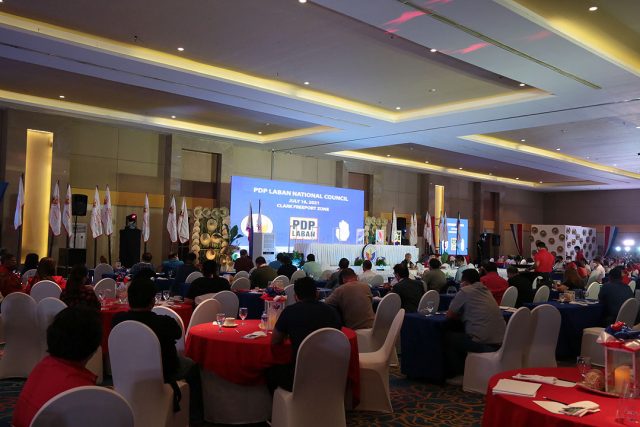
PHILIPPINE STAR/ MICHAEL VARCAS

THE internal conflict among members of ruling political party may derail the Duterte administration’s policy making and reforms in its remaining months, Fitch Solutions Country Risk and Industry Research said.

“There is a risk that policy-making processes will slow as attention is turned to political jostling rather than measures to speed up the Philippines’ economic recovery from the coronavirus disease 2019 (COVID-19) pandemic and longer-term reforms,” Fitch Solutions said in a note on Monday.

The think tank raised concern over the infighting within the Partido Demokratiko Pilipino – Lakas ng Bayan (PDP-Laban), as the ruling party prepares to field candidates for the presidential elections in May.

The two camps led by President Rodrigo R. Duterte and Senator Emmanuel “Manny” D. Pacquiao, Sr. are now preoccupied with gaining control of the political party, even as the country battles a Delta-driven surge in COVID-19 infections.

“The PDP-Laban infighting and potential switching of allegiances in the coming months could disrupt policy making at a time when the Philippine economy remains hampered by COVID-19. The confusion over the easing of containment measures in Metro Manila on Sept. 8, highlights the uncertainty facing the economy in the near term,” Fitch Solutions said.

This prompted Fitch Solutions to lower the country’s Short-Term Political Risk Index (STPRI) score to 64 from 64.9 out of 100 to reflect the higher near-term risks of political instability and its impact on policies.

“Indeed, signs of significant disruptions to policy making, such as delays to the passing of the 2022 budget, could prompt us to revise our score even lower,” it said.

Fitch Solutions noted these “political distractions” may affect efforts to support economic recovery.

“Focus will likely shift away from the need to boost the Philippines’ vaccine uptake rates and address supply issues,” it added, referring to the sluggish vaccine rollout.

The Philippines has only vaccinated less than 15% of its population, lagging behind its Southeast Asian neighbors and was only better than Vietnam’s 4.91%.

The Health department on Monday reported 20,745 new COVID-19 cases, bringing the active caseload to 180,293.

“Longer-term reforms that would benefit the next president could also stall. These include proposed reforms to ease restrictions on foreign ownership in the utilities and retail sectors, as well domestic hiring requirements, which could be key to reinvigorating investor interest in the Philippines,” it said.

Fitch Solutions also noted the squabbling among PDP-Laban members has also raised the prospects for opposition candidates winning the presidency in next year’s election.

‘LIMITED SUPPORT’
Meanwhile, Nomura Global Markets Research said the Philippine economy could face a sluggish rebound this year as fiscal support remained limited amid the new virus surge.

Nomura lowered its 2021 growth forecast for the Philippines to 4.8% from the 5.4% it previously gave. This falls within the downgraded 4-5% full-year target set by the government.

It also maintained its growth forecast of 8.7% for the Philippines in 2022, also within the 7-9% government target.

“Vaccinations have picked up, but new COVID-19 cases are rising more sharply, threatening the economic recovery amid still-limited signs of large fiscal stimulus,” Nomura Chief ASEAN economist Euben Paracuelles and analyst Rangga Cipta said in a monthly economic note on Monday.

Nomura expects the Philippines will fully vaccinate up to 45-55% of its population by end-2021, based on the 451,200 average number of doses administered per day as of end-August. This is still below the government’s target to have 70% of the population vaccinated against COVID-19 by end-2021.

“If the pace of vaccination does not pick up (i.e., the August pace is maintained), Indonesia, the Philippines and Thailand would only reach 80% full vaccination coverage by Q3 2022,” it added.

Nomura also warned that the government’s plan to implement granular lockdowns may be a “risky approach” given cases remain high.

Despite the need for support amid the new wave of infections, Nomura believes fiscal measures are likely to remain limited “given the government’s continued aversion to higher debt ratios.”

“We also think the reforms in the pipeline will be difficult to pass in the congress, as political noise will likely continue to pick up, ahead of next year’s presidential elections in May,” the report said. — Luz Wendy T. Noble

Time is a major point in TV5 drama ‘Di Na Muli

WHAT would you do if you could tell how long a person had to live just by looking at their hand? That is the premise of TV5’s drama series ‘Di Na Muli, starring Julia Baretto.

“She comes from a family of fortunetellers. And then, she discovers this gift. She has the ability to see the lifespan of a person by just holding their hand,” Ms. Baretto explained during an online press conference on Sept. 6.

“That’s what drove her to be fearful [of getting] close to people, because she doesn’t want to know until when she has time with them,” she added.

“All of us have regrets, and most of them are about things we did not do because we thought we still had a lot of time),” the show’s writer, Noreen Capili, said in Filipino.

“[Yanna] uses that gift [precognition] to help the people around her to deal with their regret,” Ms. Capili added.    

Directed by Andoy Ranay, the series is produced by Cignal and Sari-Sari Channel together with Viva Entertainment.    

The show is Ms. Baretto’s first drama series outside ABS-CBN, and her first project with VIVA Entertainment after transferring to VIVA Artists Agency in 2020.   

Ms. Baretto stars alongside Marco Gumabao who plays Mico, the man who challenges Yanna’s perspective on love. Marco Gallo stars as CJ, Yanna’s long-time friend, with whom she learns to value time with loved ones.

Also in the cast are Angelu De Leon, Bobby Andrews, and Baron Geisler.

“We hope that after watching this series, people will value time more,” Ms. Capili said.

‘Di Na Muli premieres on Sept. 18, 8 p.m., on TV5, Sari Sari on Cignal TV Ch. 3 and SatLite Ch. 30, and on Live and On-Demand via the Cignal Play app. New episodes will be released every Saturday. — MAPS

How ‘sissy men’ became the latest front in China’s campaign against big tech

ZHANG ZHEHAN of the Chinese drama Word of Honor

THE CHINESE government has recently taken action against what it calls “sissy men” — males, often celebrities, deemed too effeminate.

On Sept. 2, 2021, government regulators banned their appearance on both television and video streaming sites. Using the Chinese derogatory slur “niang pao” — literally, “girlie guns” — Chinese cultural authorities explained that they were rolling out a rule to purge “morally flawed celebrities” in order to “correct aesthetics” in “performing styles” and “wardrobes and makeups.”

Technically this is a rule, not a law. But thanks to the strong control the Chinese government exerts over industry, the tech companies that give these celebrities a platform have quickly fallen in line.

The international community may view the rule as yet another example of Chinese repression centered on LBGTQ communities.

And this could be true, to an extent.

However, as someone who studies China’s queer cultures, I’m also attuned to the way pronouncements made by the Chinese government often cloak a hidden agenda.

To me, it’s no coincidence that the ban has come during the intense national campaign against China’s domestic big tech giants, which the government increasingly sees as a threat to its ability to keep tabs on its citizens.

In the mid-2010s the Chinese government’s grip on the country’s entertainment sector began to weaken after decades of control over who could star on TV and what sort of stories could be told. TV dramas, films, and talent shows produced by private tech companies started to take off, while ratings and ad revenues of state-owned television stations tumbled.

Beginning in 2016, the government started to censor web videos with the same criteria it had been using for television. However, the restrictions seemed to only inspire more creative and subversive expressions of sexuality on video streaming sites.

For example, images of two men kissing and holding hands were banned. So, creators simply used dialogue and gestures, like intense eye contact, to convey homosexual intimacy. Furthermore, these rules didn’t regulate the physical appearance of characters.

Since 2017, shows produced by the country’s leading video streaming platforms — many of which mimic the basic format of shows like American Idol and The Voice — have launched the careers of a number of effeminate male celebrities.

These shows include The Coming One and CHUANG 2021, which appear on Tencent Video, a streaming site owned by Tencent, the Chinese technology conglomerate that also owns WeChat. Meanwhile, Idol Producer and Youth With You appear on another video service provider, iQiyi, a subsidiary of Baidu, the Chinese equivalent of Google. The male participants in these shows are often young, dress in unisex clothing, and apply orange-red eye shadow and lipstick, along with heavy makeup that whitens their skin and thickens their eyebrows.

In the past, female audiences would clamor for masculine looks or physiques in their male celebrities. Today’s young Chinese people, on the other hand, are more open to challenging gender stereotypes. Within online fan communities, femininity in male celebrities isn’t stigmatized; instead, it’s celebrated. They’ll call their female idols “brother” or “husband” and their male idols “wife” — names meant more as compliments than insults.

This shift can be traced, in large part, to the influence of K-pop, the South Korean pop music phenomenon in which many of the singers reject traditionally masculine ideals.

An easy way for male actors to achieve stardom is to appear in adaptions of “boys’ love novels,” an online fiction genre originating in Japan that features homoerotic relationships between men.

Take the actor Zhang Zhehan. For years, he played masculine characters in several TV shows. Still, he remained largely unknown until he appeared in the adaption of the boys’ love novel Word of Honor, which appeared in early 2021 on Youku, a streaming service owned by the tech giant Alibaba.

His female fans even invented a meme to describe Mr. Zhang’s rapid rise to fame: “manning up for a decade failed, but [he] succeeded as a wife overnight.”

Despite their perceived effeminate mannerisms, these male celebrities have amassed a huge following among female viewers. Typically, their shows can generate billions of views and considerable ad revenue.

Celebrities whose fame emerged out of shows like The Coming One and Idol Producer are called “traffic stars” because they’re more dependent on their massive followings than on any specific skill such as singing, acting, or dancing.

Since views, shares, and likes have become the dominant metric for a celebrity’s popularity and market value, fans will organize to actively manipulate social media features such as ranking lists and trending topics in support of their idols. This “data worship” — to use the terminology of the Chinese authorities — ultimately boosts the revenue of the big tech companies that promote and host the stars.

Therefore, the profits of tech companies and the proliferation of internet influencers, movie stars, and TV personalities have become increasingly intertwined.

For a country seeking to rein in the power of big tech companies, these effeminate idols become an obvious target.

Although it could be argued that everyday LGBTQ people aren’t the real target of the most recent policy, I believe it will almost certainly have a pernicious effect on China’s marginalized gender groups and LGBTQ communities.

In China, the government has long exploited gender and sexuality in the service of political needs. During the first three decades of the People’s Republic of China — from 1949 to 1978 — homosexuality was portrayed as the epitome of capitalist vice and was, therefore, seen as incompatible with the values of the Communist party-state.

After China’s market reforms in 1978 and the “opening up” of the country, people — especially in China’s cities — became more comfortable calling themselves gay.

In the lead-up to the 2008 Beijing Olympics, the state-run News agency even published articles championing the gay website Danlan — a precursor to Blued, the most popular gay dating app in the world — in order to portray China as an inclusive and diverse place and to deflect international criticism of China’s poor record on human rights.

Thanks to digital technology and the growth of online subcultures, China has achieved some real progress in the acceptance of gender and sexual minorities over the past decade. Young women often speak of having a “gay confidant” (“gaymi” in Chinese), while young straight men are keen to call their male friends “good gay buddies” (“hao jiyou”).

So, it’s a bit surprising to see a gender slur — “girlie guns” — being written into government policy and repeated throughout the country’s mainstream media outlets.

And it isn’t difficult to envision more anti-LGBTQ bullying, harassment and violence in schools and workplaces as a result.

After all, if the government condones a slur, who’s to say it’s wrong to use it to attack others?

Shuaishuai Wang is a Lecturer of New Media and Digital Culture, University of Amsterdam.

Int’l Film Industry Conference will feature masterclasses  

AS PART of the Philippine Film Industry Month, the 5th International Film Industry Conference (IFIC) has organized 11 free public panels and seven masterclasses from Sept. 16 to 19, featuring local and international film industry professionals from of the global film industry.      

Organized by the Film Development Council of the Philippines (FDCP), since 2017, the IFIC consists of a series of panels and masterclasses which bring together big names from the local and international film industries.    

Last year, the conference was held online because of the coronavirus disease 2019 (COVID-19) pandemic. It drew over 2,000 attendees to eight online public sessions and six online masterclasses. It featured 16 local and international partners, and 32 local and international speakers.     

This year, the conference will open with a keynote address from Asia-Pacific Region-Motion Picture Association, Communications Vice-President Stephen Jenner.   

“As we expand the annual conference to IFIC along with the eventful celebration of the very first Philippine Film Industry Month, we also elevate the sessions and masterclasses by purposefully curating the lineup of topics and bringing in exceptional filmmakers and professionals in the industry. There’s so much going on right now in the international arena and through IFIC, we are brought together to know more about the direction and future of cinema,” FDCP Chairperson and CEO Mary Liza B. Diño-Seguerra said in a statement.   

IFIC features speakers from various international programs including SEAFIC Lab and Torino Film Lab.       

The 11 public sessions are: “Nurturing Your Narratives through Film Labs”; “Essentials on Film Financing”; “Fundamentals of Dossier Making”; “Filming With the ASEAN Region: The Future of Film Funding and Grant Opportunities”; “Backstage Access: Bringing Philippine Animation to the World”; “Shaping the New Landscape of ASEAN Film Industry”; “Film Market Strategies and Trends”; “Preserving the Future with Film Archiving”; “Netflix: Bringing Filipino Stories to Audiences Everywhere”; “Behind the Scenes of International Distribution”; and, “Building Strategies Towards the Future of Film Exhibition.” The 11 public sessions will be held via Zoom for free and streamed on the FDCP Facebook and YouTube pages.   

The seven masterclasses offered in the conference are “Writing Essentials: Creating Character-Driven Stories” with film producer, consultant, and screenwriter Samantha Horley; “Unveiling Success Behind Documentary Co-Production” with film producer Alexander Nanau;  “To the Next Level: Fundamentals of Dossier Making” with film producer Armi Rae Cacanindin; “Packaging Your Films for Release” with film sales agent Kataryzna Siniarska; “Finding the Right Tune for Your Film Pitch” with script editor and producer Naomi Levari; “Forging Paths for Wider Reach: A Guide to Film Marketing” with Boris Pugnet, the CEO of French film company Tiramisu and “Reality Check: Transformations in Film Distribution” with Vincent Quek, founder of Anticipate Pictures. The masterclasses are priced at P800 to P1,000 per class; and P5,000 for premium access to all seven. The masterclasses will be held via Zoom.      

For the complete schedule and details, visit www.fdcp.ph/ific. Registration is ongoing until Sept. 15.   

Megaworld to launch three townships in Luzon

By Keren Concepcion G. Valmonte, Reporter

MEGAWORLD Corp. is preparing to launch three townships within Luzon this year, its chief strategy officer and Alliance Global Group, Inc. (AGI) chief executive told BusinessWorld at the first installment of its Crisis Insights from Business Tycoons series.

“We want to expand, we are actually looking to launch at least three townships between now and next year in various parts of the Philippines, and then we are also very bullish about tourism even though right now, the situation is quite bleak,” said Kevin Andrew L. Tan, Megaworld chief strategy officer and AGI chief executive officer.

He reported that AGI unit Traveller’s International Hotel Group, Inc. saw a “record-breaking” VIP business amid the pandemic. 

Meanwhile, Megaworld’s township concept became “ideal and quite compelling” amid the pandemic as it offered convenience to residents as well as for the office locators. Megaworld’s office buildings are located within these townships. 

For Megaworld’s expansions across the country, it is banking on expectations that the business process outsourcing (BPO) industry will create more satellite offices in different areas.

Mr. Tan believes the group’s township concept can be a catalyst for economic development in other cities. He reported that every five square meters (sq.m.) of office space that Megaworld builds is equivalent to two BPO jobs.

“There’s [a] tremendous amount of opportunities to go out outside Metro Manila to the countryside and promote economic development there and we believe that our unique brand of townships enables us to do this, to create jobs,” Mr. Tan said.

AGI is also investing to support the BPO industry. Through Megaworld, it recently launched the Dr. Andrew L. Tan Data Science Institute (ALTDSI) with De La Salle University.

ALTDSI will offer programs and courses on data science to train more BPO professionals. It will be located within Megaworld’s 50-hectare McKinley Hill township development in Taguig City.

Megaworld is planning to get back to building 100,000 sq.m. of office spaces by next year, after slowing to building only 50,000 sq.m. because of the pandemic. It aims to have two million sq.m. in office spaces by 2030.

It currently has 1.2 million sq.m. of office spaces, 16% of which are infused into the initial portfolio of its real estate investment trust (REIT), MREIT, Inc.

“As we build more office spaces, we will also continue to inject mature office buildings into the REIT and that’s why MREIT will double its size in three years’ time and [will] probably hit a million sq.m. by 2027 to 2030,” said Mr. Tan, who is also the president and chief executive officer of MREIT.

Around 80% to 90% of the properties to be added to its REIT portfolio will cater to BPOs and tech firms, while its mixed-use developments will account for around 10% of the portfolio.

MREIT
In a statement on Monday, MREIT said Megaworld will be adding 100,000 sq.m. of office assets to increase its portfolio by the end of next year to around 324,000 sq.m. from 224,431 sq.m.

“We are committed to reaching half a million square meters by 2024, and are highly confident of our ability to reach one million square meters in the near future so that we can be the largest office REIT in Southeast Asia,” Mr. Tan said.

MREIT is offering to the public 844,300,000 common shares for P16.10 each, with an overallotment option of up to 105,537,500 shares.

“This IPO (initial public offering) was priced at an attractive level to provide IPO investors a compelling entry opportunity to become long-term partners in MREIT’s goal of becoming the Philippines’ fastest-growing REIT backed by the country’s largest office landlord,” said BDO Capital & Investment Corp. President Eduardo V. Francisco.

MREIT’s offer period will run from Sept. 14 until Sept. 20, while it aims to make its debut at the Philippine Stock Exchange by Sept. 30.

Should the overallotment option be exercised, the offer may raise up to P14.7 billion along with the expected asset injection of Megaworld.

Megaworld will have a post-IPO stake of 62.1% in MREIT. It will use the proceeds to invest in 15 projects within the next 12 months.

MREIT’s initial portfolio consists of 10 office assets in its township developments.

“Our current portfolio has been carefully curated to include only Grade A PEZA-accredited buildings with mainly BPO and multinational tenants,” Mr. Tan said. 

The buildings in its portfolio include 1800 Eastwood Avenue, 1880 East Avenue, and E-commerce Plaza in Eastwood City; 8/10 Upper McKinley, 18/20 Upper McKinley, One World Square, Two World Square, and Three World Square in its McKinley Hill development in Fort Bonifacio; and One Techno Place, Richmonde Tower and Richmonde Hotel Iloilo in Iloilo Business Park.

“Throughout the years, our integrated live-work-play townships [have] proven to be successful in attracting better and stickier tenants, which in turn translates to significantly less tenant churn, consistently higher occupancy rates, and sustainable escalating rental rates,” Mr. Tan said. 

On Monday, shares of listed Megaworld at the stock exchange went down by 1.67% or five centavos to close at P2.95 each. Its parent AGI also declined by 0.37% or four centavos to finish at P10.66.

Malaya plant’s owner allots P500M for repair

BELGROVE Power Corp. is setting aside an initial P500 million to repair the 350-megawatt (MW) second unit of the Malaya Thermal Power Plant (MTPP), an official of Fort Pilar Energy, Inc. said, speaking for its subsidiary.

“We’ve already allocated P500 million for the repairs of unit 2. Next year, we’ll be completing our feasibility study on unit 1 on how much capital is needed to either replace it or rehabilitate (it),” Fort Pilar Energy Chief Executive Officer Joseph Omar A. Castillo said in a virtual briefing on Monday.

Belgrove Power recently completed the purchase of the 650-MW MTPP and its underlying land in Pililla, Rizal, according to state-run Power Sector Assets and Liabilities Management Corp. (PSALM). The firm paid around P4.19 billion for the assets and for the plant’s fuel inventory.

The plant’s unit 1 has a capacity of 300 MW, while unit 2 has 350 MW.

Mr. Castillo said Belgrove Power wants to keep unit 2 as a diesel plant, but wishes to install two new aeroderivative gas engines within the facility that can run on liquefied natural gas.

The engines will add an additional 60 MW of capacity to the plant and will be brought in by end-2021.

Mr. Castillo added that the new owner plans to restore the plant to its original rated capacity of 650 MW so it could provide power to the Luzon grid primarily as contingency reserves.

Meanwhile, Belgrove Power Chairman Sheila B. Romero said the firm envisions MTPP as a “premiere source of backup power.”

In an e-mailed press release on Monday, she confirmed initial talks with National Grid Corp. of the Philippines to secure an ancillary services procurement agreement.

Sought for comment on a possible power sales agreement with distribution utility Manila Electric Co., Ms. Romero said that she was “open to it.”

On Monday, state-run PSALM through its President and Chief Executive Officer Irene Joy J. Besido-Garcia turned over the plant’s documents, including the original transfer certificate of title, to Belgrove Power’s Ms. Romero.

“This act will relinquish in favor of Belgrove Power Corp. the rights and obligations of PSALM over that power plant… This is a clear testament to PSALM’s dedication to do our mandate,” said Ms. Besido-Garcia, referring to the entity’s role in privatizing government assets so it can settle its assumed obligations from the National Power Corp.

During the briefing, Ms. Besido-Garcia said PSALM’s financial obligations stood at P368 billion as of June 2021.

The Department of Energy earlier said that PSALM shouldered an annual expense of P1.2 billion from 2010 to 2019 for the plant’s upkeep. — Angelica Y. Yang

Justin Bieber, Lil Nas X take top prizes at Video Music Awards 

RAPPER Lil Nas X and pop star Justin Bieber won the top prizes at MTV’s annual Video Music Awards (VMA) show on Sunday, in a ceremony packed with surprise appearances, live performances and thousands of masked fans. 

Newcomer Olivia Rodrigo and K-pop band BTS were also among the big winners at the first major awards shows in New York to be held with a full audience of fans and celebrities since the coronavirus pandemic. 

Mr. Bieber, 27, returned to the VMA stage for the first time in six years and took home Moon Person statuettes for artist of the year and best pop for his single “Peaches.” 

“Music is such an amazing outlet to be able to reach people and to be able to bring us all together,” said Mr. Bieber, referring to the dark days of the pandemic. 

Last year the VMAs took place in New York without a live audience and with most performances recorded in advance because of the pandemic.  

Lil Nas X, 22, a gay black musician who had a breakout hit with “Old Town Road” two years ago, won video of the year for his gay rights anthem “Montero (Call Me By Your Name).”  

“Let’s go gay agenda!” said the musician, accepting the award. 

Alicia Keys sang “Empire State of Mind” outdoors against the backdrop of the New York City skyline, while Doja Cat, Ed Sheeran, veteran New York rapper Busta Rhymes, Camila Cabello, Shawn Mendes, and Machine Gun Kelly were among those on stage. 

Sunday’s ceremony also marked the 40th anniversary of the launch of MTV as a channel dedicated to playing music videos.  

Madonna, also celebrating her 40 years in the music business, opened the show in a surprise appearance. “They said we wouldn’t last. But we’re still here,” Madonna said.  

Jennifer Lopez and Cyndi Lauper sent fans wild with unexpected appearances, with Ms. Lauper weighing in on abortion rights saying that women want “control over our bodies.”  

Ms. Rodrigo, 18, took home three awards, including best new artist and song of the year for “Drivers License” in the fan-voted awards, capping a break-out year. 

“This is so insane. This has been the most magical year of my life,” Ms. Rodrigo said, dedicating her win to “all the other girls who write songs on their bedroom floor.” 

BTS was named group of the year and won best K-Pop for single “Butter,” and sent thanks by video from South Korea.  

Rock band Foo Fighters got the Global Icon Award recognizing their 25 years in the music industry.  

The 12 time Grammy-winning band performed a medley of hits with “Charlie R.I.P” scrawled on their drum kit in tribute to the late Rolling Stones drummer Charlie Watts.  Reuters 

SEC advisory: Be vigilant with unregistered foreign entities

THE Securities and Exchange Commission (SEC) is reminding the public to be vigilant when dealing with unregistered corporations after receiving questions on the implications of transacting with these entities online.

Entities are required under the law to register and get a primary registration with the commission to conduct business in the Philippines. 

“If an entity or an activity is unlicensed or unregistered and is based abroad, you run the risk of not getting your money back once these are transmitted outside of the Philippines,” the SEC said in its advisory on Monday.

These entities apparently allow access their online platforms to create, enroll, or register client accounts even if they lack the needed registration or license to conduct business in the country.

Some of the unregistered online platforms identified by the SEC are of foreign currency brokers and exchanges, digital asset/cryptocurrency exchanges, decentralized finance investment platforms, yield farming/staking platforms, and multi-asset or multi-security brokerage companies.

These entities also have online platforms for securities token offerings, illegal investment scheme websites, binary options trading apps, pay-to-click or captcha websites, and “play-to-earn” gaming platforms as well as cryptocurrency gambling and investment websites. 

“In some cases, Filipinos are even targeted by their aggressive online advertisements in various social media networking sites like Facebook, YouTube, or Instagram,” the SEC said.

The commission advised the public to avoid dealing with these entities.

The SEC said investors are only protected by the Philippine law if the foreign corporations or firms they invest in are duly registered with the commission to do business as a branch, regional operating or area headquarters, or as a representative office in the country.

The commission reminds investors to check with the SEC if a corporation or an entity is registered or not.

Compared to those registered with the SEC, putting money in an unregistered platform reachable in the Philippines can offer investors little to no protection in case of fraud or misconduct.

“Jurisdiction over fraud or any form of misconduct committed by these corporations falls under the jurisdiction of the foreign country where they operate,” the regulator said.

“Domestic participants would have to go to the country where these platforms are registered and where they operate to file the appropriate complaint in order to seek redress,” it added. — Keren Concepcion G. Valmonte

Regulatory support sought to boost real estate liquidity

PHILIPPINE STAR/ MICHAEL VARCAS

THE PHILIPPINE real estate space continues to be illiquid despite some real estate investment trusts (REITs) listings, UBX President and Chief Executive Officer John Januszczak said.

“There has been some movement in the REIT space, but it still represents a very small fraction of the capital markets. Real estate as an asset class remains highly illiquid,” he said at a property technology forum on Thursday.

Three REITs or companies that own income-producing properties, have listed on the Philippine Stock Exchange so far. REITs allow small and big investors to acquire ownership in big real estate projects.

RL Commercial REIT, Inc., a REIT sponsored by Robinsons Land Corp., is set to list on the stock exchange today (Sept. 14).

MREIT, Inc., the REIT sponsored by Megaworld Corp., is also expected to launch its IPO soon.

Mr. Januszczak named three main challenges facing the real estate sector: the illiquidity of assets, the cost of buying property, and the ratio of income equality.

“On top of the price of the property itself, there are associated costs on top of it,” he said. “(Property) is affordable as an investment vehicle for only a tiny fraction of the population.”

While REITs help address the nature of property assets — in which you either buy the whole asset or not at all — he also proposed converting rights of an asset to a digital token on a blockchain, although he said this idea is still at its infancy.

“The idea behind tokenized real estate is actually a hypothesis. There has been experience in other jurisdictions such as the United Kingdom… and the jury is still out on whether this will actually sell,” he said.

“You actually have to tokenize something. In many markets including the Philippines, this means you have to tokenize an intermediate vehicle. There has to be something between the title — such as a contract, a long-term leasehold, or a perhaps a single-property REIT that can actually be tokenized.”

Opening up this market, he added, would require regulatory support for tokenized asset exchanges or changing the titles themselves to reside on the blockchain as smart contracts. — Jenina P. Ibañez

Disney to debut rest of 2021 films exclusively in theaters  

LOS ANGELES  Walt Disney Co. said on Friday that it will release EternalsWest Side Story and the rest of its 2021 films exclusively in theaters before sending them to streaming, a show of confidence that moviegoing will rebound.  

The company had experimented during the pandemic with debuting some movies on the Disney+ streaming service at the same time as they ran in theaters. Cinema operators have been closely watching how Disney, which has dominated movie box offices in recent years, would handle its upcoming slate as the Delta variant slowed audiences’ return to multiplexes.   

Disney said in a statement that animated musical Encanto will play in theaters for 30 days starting Nov. 24 and head to Disney+ just before Christmas. The film tells the story of a family who live in a magical house in the mountains of Colombia. It includes music written by Hamilton creator Lin-Manuel Miranda.   

All other Disney releases, including Marvel movie Eternals in November and Steven Spielberg’s revival of West Side Story in December, will play exclusively in cinemas for at least 45 days, the company said.  

Disney’s most recent film, Marvel’s Shang-Chi and the Legend of the Ten Rings, just set a Labor Day weekend record with $94.7 million in ticket sales at US and Canadian theaters. The film, featuring a predominantly Asian cast including Simu Liu and Awkwafina, played only at cinemas.    

But moviegoing for the year remains well below pre-pandemic levels. Theater chains including AMC Entertainment, Cineworld Plc, and Cinemark Holdings, Inc. are counting on big fall and winter titles to lure customers back.  

Disney’s other 2021 films are historical drama The Last Duel and animated comedy Ron’s Gone Wrong in October, and action spy film The King’s Man in December.  Reuters  

Gov’t fully awards T-bills as rates move sideways

BW FILE PHOTO
THE GOVERNMENT made a full award of its offer of Treasury bills. — BW FILE PHOTO

THE GOVERNMENT made a full award of the Treasury bills (T-bills) it offered on Monday as rates moved sideways on strong investor demand and dovish hints from the central bank.

The Bureau of the Treasury (BTr) raised P15 billion as planned via the T-bills on Monday as the offer was more than four times oversubscribed, with total tenders reaching P63.273 billion. This was also bigger than the P56.91 billion in bids seen at last week’s auction.

Broken down, the Treasury raised P5 billion as programmed via the 91-day debt papers from P17.645 billion in bids. The three-month T-bills fetched an average rate of 1.079%, up by 0.1 basis point (bp) from 1.078% in the previous auction.

The BTr also borrowed P5 billion as planned via the 182-day T-bills as the tenor attracted tenders worth P25.312 billion. The average yield of the six-month instruments slipped 0.3 bp to 1.402% from 1.405% a week ago.

Lastly, the government made a full P5-billion award of the 364-day securities it offered on Monday as total bids reached P20.316 billion. The average rate of the one-year T-bills stood at 1.604%, dropping by 0.5 bp from 1.609%.

National Treasurer Rosalia V. de Leon said investors priced in recent comments from Bangko Sentral ng Pilipinas (BSP) Governor Benjamin E. Diokno, who said the central bank will keep rates low to help the economy recover as the coronavirus pandemic continues.

Mr. Diokno last month said the BSP will keep its policy stance supportive of the economy as long as inflation remains stable.

He also said over the weekend that the central bank is open to extending loans to the government “for as long as necessary.”

In July, the Monetary Board extended the maturity of the P540-billion short-term, no-interest loan to the National Government, which is expected to be repaid in October. This was the fourth time the BSP granted direct advances to the government since the pandemic.

Republic Act 7653 or The New Central Bank Act allows the BSP to lend 20% of its average revenue to the government, which is equivalent to P540 billion. This was increased to 30% or up to P850 billion by the Republic Act 11494 or the Bayanihan to Recover as One Act, which allowed direct provisional advances within two years since the law’s effectivity.

The central bank has been at the forefront of pandemic relief efforts. After cutting the key rate by 200 basis points in 2020, the BSP has maintained it at a record low of 2%, citing the need to support the economy’s recovery.

The Monetary Board will have a policy meeting on Sept. 23.

Meanwhile, a bond trader said rates moved sideways at Monday’s auction on strong demand from market players.

The trader said this sideways movement of T-bill rates may continue for the rest of the month as the financial system is still awash with cash and as demand for short-term safe-haven assets remains healthy.

On Tuesday, the BTr will auction off P35 billion in reissued 10-year Treasury bonds (T-bonds) with a remaining life of nine years and 10 months.

It is looking to raise P250 billion from the local market this month: P75 billion via weekly offers of T-bills and P175 billion from weekly auctions of T-bonds.

The government wants to borrow P3 trillion from domestic and external sources this year to help fund a budget deficit seen to hit 9.3% of gross domestic product. — B.M. Laforga

Mandarin Oriental goes into luxury residences in LA

MO-RESIDENCESBEVERLYHILLS.COM

WHEN Mandarin Oriental’s latest property on the West Coast opens in Beverly Hills, Calif., in mid-2022, guests will be able to show up with their luggage and have a bellman escort them up a private elevator to a penthouse with its own attended lobby and six-car garage.

On the deck of a rooftop pool lined with white-curtained cabanas, they’ll be able to enjoy some Mediterranean-inspired twist on eggs Benedict designed by chef Daniel Boulud, who’s also new to LA. And the concierge will be equally well versed in local dog grooming outfits and the best new restaurants in the area — which hasn’t seen significant real estate development like this in a decade.

Did you catch the clues to a major caveat?

The project, which is unlike anything Mandarin Oriental has done before, won’t contain a single hotel room.

Instead, the Mandarin Oriental Residences, Beverly Hills will be condos-only, with 54 apartments across a glassy new 323,000-square-foot, seven-storey structure at 9200 Wilshire that sprawls over a full city block.

The residences, which open for exclusive private previews this month and start at $3.6 million for a 1,200-square-foot, 1-bedroom, 1.5-bathroom apartment, represent the first standalone condo project for the Hong Kong-based hospitality brand.

Other hotel companies have thus far dabbled in mixed-use projects that blend both residential and transient dwellings. Mandarin has latched onto a trend in which luxury outfits, including Montage and Ritz-Carlton, have gone full tilt into residential real estate to drum up big revenue amid the high costs and thin margins of building and running hotels. The building’s two penthouses, each with their own lobby, elevator, garage, and staff, will cost up to $40 million.

“Sometimes we have to get creative with what’s available,” says Todd Ruff, director of residences for Mandarin Oriental Hotel Group. Speaking by phone from his office in Atlanta, he explains that premium real estate in key markets like LA can be so hard to come by that even a top brand can take many years to plant its flag there. “Residential propositions are a no-brainer … and a business model that we’re very bullish on.” They help companies like Mandarin scale faster, more efficiently, and with returns that are more favorable to private equity investors, he adds.

“This is one of the most highly sought-after markets that Mandarin has been trying to get into,” Ruff says of Beverly Hills, “but there were constraints we had to deal with, and while we’re still searching for a hotel in LA, this was entitled as a residential building so we went ahead with that.”

The real estate deal was negotiated by Michael Shvo, the New York-based developer, who knows a thing or two about mixing residential concepts with hotels. Among his long list of projects is the Aman New York, with 20 condos from $5.9 million, and another Mandarin Oriental Residences just blocks away at 685 Fifth Avenue (in the old Gucci headquarters on 54th Street), which like its Beverly Hills counterpart, is slated to open in mid-2022.

Shvo bought the long-vacant lot at 9200 Wilshire for $130 million with a partner in 2019 and, inspired by the premium location, decided to bring in a brand with a track record for luxury service, he says. “Mandarin is at the top of their game when it comes to that. When I travel, I know that company delivers some of the best service you can get in a hotel. Plus, the brand itself is fairly exclusive,” he continues. “They only operate around 35 hotels around the world and are extremely selective about where they go.”

Some of the units will come furnished; others can be designed in collaboration with clients, he says: “What we’re creating is a stress-free lifestyle, where you will be taken care of whether you are spending three days a month or 30.” All units can be stocked with Mandarin Oriental toothbrushes and bathrobes and will share access to a gym, small spa, and concierge team. Housekeeping services will be available on request.

“This is where the luxury world is going,” contends Shvo, who says the benefits of nixing hotel rooms from a hotel-branded condo include increased staffing efficiencies as well as privacy. “Ultimately it doesn’t matter how much money you have, it’s your headache when something goes wrong in your home,” he argues. Unless, of course, you’re not the one staffing and maintaining it.

As for the pricing, Ruff says Mandarin is used to raising the bar: “We create new pricing benchmarks for our markets. A 20% to 40% premium over the top class in the marketplace is standard for us.”

At an entry-level cost of around $3,000 per square foot, the price point is almost triple the area’s average of $1,131, according to research from Douglass Elliman. But it’s not as high as what’s being sold by Montage Hotels & Resorts, whose new Pendry-branded residences in West Hollywood broke LA sales records in August. Two of 40 condos that have begun trickling onto the market as part of its mixed hotel-condo project on the old House of Blues site sold that month for around $13 million each; at $4,848, one of them set the city’s highest price per square foot, according to the Los Angeles Times. The other wasn’t far behind, at $4,500 per square foot, far exceeding the neighborhood’s standards.

Regardless, Mandarin’s quest to push the standards of condo living won’t end in LA and New York. While the company has opened only seven properties with residential components in its almost 60-year history, that number represents the bulk of what’s to come for the brand. “Over the next four years we will triple, or at least double, our growth [in this arena],” says Ruff, pointing to new Residences projects in London’s Mayfair neighborhood, Tel Aviv, Grand Cayman, Honolulu, Boca Raton, and Barcelona.

“The list goes on and on,” he says. “We’re a strong believer in this business model — even in the next 12 to 24 months, there’s a lot in the hopper that we’re expecting to bring to fruition.” — Bloomberg

ADVERTISEMENT
ADVERTISEMENT