Home Blog Page 7486

AboitizPower approves P12-billion retail bonds

THE board of directors of Aboitiz Power Corp. has cleared the issuance of up to P12 billion worth of fixed-rate retail bonds, which the company plans to offer in the fourth quarter and listed on the bond exchange.

“Subject to market conditions, the second tranche bonds [are] expected to be offered to the general public in the fourth quarter of 2021,” the firm said in a regulatory filing on Monday, adding that these will be listed with the Philippine Dealing & Exchange Corp.

AboitizPower said that the securities form the second tranche of its P30-billion bond issuance under its shelf-registration program.

Earnings from the bonds will refinance activities, support general corporate purposes or fund future renewable energy projects.

AboitizPower said its board of directors assigned the management to finalize the issue amount, interest rate, offer price, tenors, parties involved, and other terms of the bonds.

Last week, the company announced that it had fully redeemed and paid P3.4 billion of its 12-year 2014 “Series B” Bonds earlier than their maturity, which is in 2026.

AboitizPower earlier said that it was investing P190 billion to develop 3,700 megawatts of new renewable projects by 2030 to scale up its “Cleanergy” brand, which it aims to have a bigger share or 50% of its power generation portfolio in a decade’s time.

Cleanergy is the firm’s clean and renewable energy portfolio.

AboitizPower’s second-quarter attributable net income to its parent grew by more than two-fold to P3.96 billion versus its year-on-year figure of P1.68 billion.

The company is the listed holding firm for the Aboitiz group’s investments in power generation, distribution, retail electricity and other related services. It also holds ownership interests in nine distribution utilities, which provide power to franchise areas covering 18 cities and municipalities and five economic zones across the country.

AboitizPower shares jumped 2.45% or 80 centavos to finish at P33.45 apiece on Monday. — Angelica Y. Yang

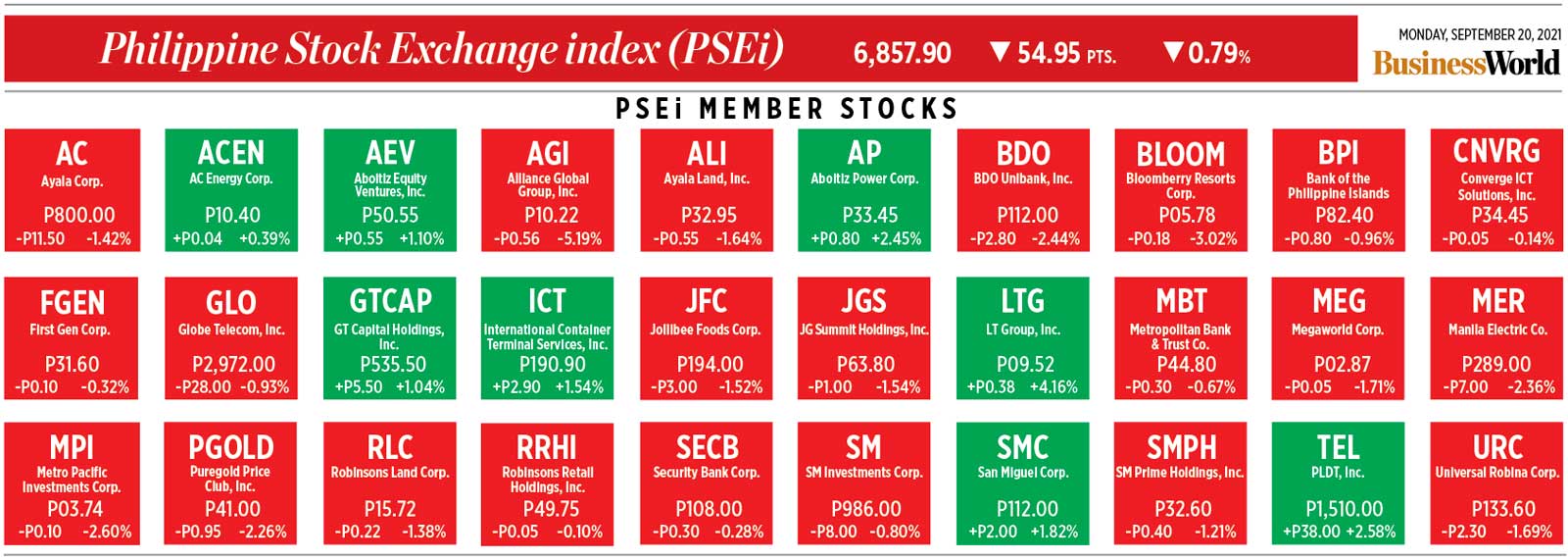
How PSEi member stocks performed — September 20, 2021

Here’s a quick glance at how PSEi stocks fared on Monday, September 20, 2021.


Minimum wages lower by at least 20% when accounting for inflation

Minimum wages lower by at least 20% when accounting for inflation

Peso sinks to P50:$1 level ahead of Fed meet 

THE PESO weakened on Monday due to safe-haven demand for the dollar ahead of the US Federal Reserve’s policy review this week. 

The peso closed at P50.24 per dollar on Monday, shedding 29 centavos from its P49.95 finish on Friday, based on data from the Bankers Association of the Philippines. 

This was the peso’s weakest close in nearly a month or since Aug. 23, when it ended trading at P50.27 per dollar. 

The peso opened Monday’s session at P50.08 per dollar. Its weakest showing was at P50.24, while its intraday best was at P50.05 versus the greenback. 

Dollars exchanged rose to $1.117 billion on Monday from $871.75 million on Friday. 

A trader said the peso weakened ahead of the Federal Open Market Committee’s policy meeting on Sept. 21-22. Markets expect Fed officials to give a clearer guidance on its plan to reduce its bond purchases. 

However, a Reuters poll found that 36 out of 49 economists expect the Fed’s taper announcement will be done in November and not this month. 

Meanwhile, Rizal Commercial Banking Corp. Chief Economist Michael L. Ricafort said external debt data released last week also caused the peso to drop. 

External debt hit $101.2 billion as of end-June, rising by 15.7% from the $101.2 billion a year earlier, based on data released by the Bangko Sentral ng Pilipinas (BSP) on Friday evening. This was the highest since at least the end of 2011, based on available BSP data. 

For today, the trader gave a forecast range of P50 to P50.25, while Mr. Ricafort expects the local unit to move within P50.10 to P50.30 per dollar. — LWTN with Reuters 

Shares drop ahead of Fed, BSP policy meetings

PHILIPPINE STAR/KRIZ JOHN ROSALES

PHILIPPINE shares opened the week in the red on cautious trading due to the lack of positive catalysts and ahead of central bank meetings here and abroad. 

The Philippine Stock Exchange index (PSEi) lost 54.95 points or 0.79% to close at 6,857.90 on Monday, while the all shares index shed 29.51 points or 0.68% to 4,266.33.

“The lack of a positive catalyst allowed selling pressures to dominate the market,” Philstocks Financial, Inc. Senior Research Analyst Japhet Louis O. Tantiangco said in a Viber message. 

“Investors have also taken a cautious stance while waiting for a clear direction on the trend of our COVID-19 (coronavirus disease 2019) cases. Trading was tepid,” he added.

Value turnover dropped to P7.23 billion with 2.29 billion shares switching hands on Monday, nearly half of the P15.22 billion with 1.81 billion issues traded on Friday.

“Philippine shares were off to a slow start this Monday as no economic data releases are on the schedule here and in the US,” Regina Capital Development Corp. Head of Sales Luis A. Limlingan said in a Viber message.

“The Federal Reserve will meet… to discuss its policies,” Mr. Limlingan said. “The investors have been anticipating this meeting as the market expects it would give more color on the timing of the Fed’s planned scaling back of its asset purchases.”

“Back home, investors are also waiting for the Monetary Board’s meeting on Sept. 23. Moreover, the August BoP (balance of payments) will be out [this week],” he added.

A BusinessWorld poll last week showed 17 of 18 analysts expect the central bank to keep its policy rate at its record low of two percent as it continues to support the economy despite rising inflation.

Meanwhile, Asian shares eased and the dollar held firm on Monday as the Fed is likely to take another step toward tapering, Reuters reported.

Early Monday, MSCI’s broadest index of Asia-Pacific shares outside Japan dipped another 0.2%, after shedding 2.5% last week.

The Fed is still expected to lay the groundwork for a tapering at its policy meeting on Tuesday and Wednesday, though the consensus is for an actual announcement to be delayed until the November or December meetings.

Majority of sectoral indices closed in the red on Monday except for services, which went up by 9.31 points or 0.50% to finish at 1,839.81.

Meanwhile, mining and oil dropped 249.34 points or 2.63% to 9,197.54; property declined by 42.97 points or 1.41% to 2,996.94; financials shaved off 20.25 points or 1.40% to 1,422.21; industrials dropped 101.40 points or 0.99% to finish at 10,070.56; and holding firms lost 57.30 points or 0.82% to end at 6,929.76.

Decliners beat advancers, 165 against 42, as 36 names closed unchanged.

Net foreign selling decreased to P30.27 million on Monday from the P812.96 million logged on Friday. — K.C.G. Valmonte with Reuters

Philippines posts 319 more Delta variant cases

PHILIPPINE STAR/ MICHAEL VARCAS
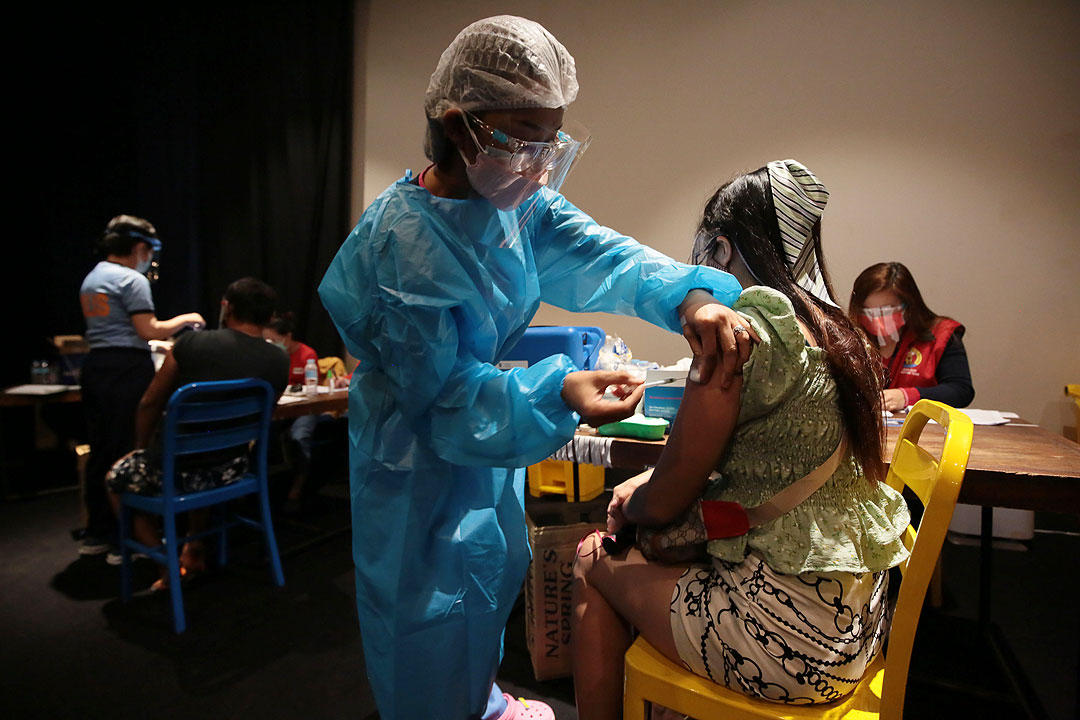
SAN JUAN outsiders got a shot of the AstraZeneca vaccine at the city’s Theater Mall on Sept. 14. — PHILIPPINE STAR/ MICHAEL VARCAS

PHILIPPINE health authorities on Monday reported 319 more infections involving a more contagious Delta coronavirus variant, bringing the total to 3,027.

Delta had become the dominant coronavirus variant in the country, overtaking the Alpha and Beta variants that triggered a fresh surge in infections months ago, Health Undersecretary Maria Rosario S. Vergeire told an online news briefing.

The World Health Organization (WHO) confirmed the Delta variant’s dominance in the Philippines as early as August.

Ms. Vergeire noted that based on the recent sequencing of 374 virus samples, 319 were Delta, 13 were Alpha, nine were Beta and five were P.3 variants. The remaining 28 samples were the original variant of the coronavirus first detected in Wuhan, China.

She added that 24% of 12,530 samples sequenced as of Sept. 18 had tested positive for the Delta variant.

The Department of Health (DoH) reported 18,937 coronavirus infections on Monday, bringing the total to 2.39 million.

The death toll rose to 36,934 after 146 more patients died, while recoveries increased by 20,171 to 2.17 million, the agency said in a bulletin.

There were 176,850 active cases, 92.7% of which were mild, 2.7% did not show symptoms, 1.4% were severe, 2.61% were moderate and 0.6% were critical.

DoH said 70 duplicates had been removed from the tally, 51 of which were reclassified as recoveries, while 53 recoveries were reclassified as deaths. Five laboratories failed to submit data on Sept. 18.

Ms. Vergeire noted that while coronavirus cases in the Philippines have fallen, the country’s healthcare capacity remained at high risk.

Cases might increase in the coming weeks due to the spread of the Delta variant and active contact tracing, she added.

Ms. Vergeire said the Philippines had a daily average of 19,963 cases from Sept. 13 to 19, 5% lower than a week earlier. Before this, the country had been posting a new peak weekly since the start of August.

The top five regions with the most coronavirus cases were the National Capital Region, Calabarzon, Central Luzon, Davao and Ilocos.

Metro Manila, which had a daily average of 5,136 cases from Sept. 6 to 12, and nearby provinces showed a steep increase in cases at the end of July, Ms. Vergeire said.

“A slight downward trend was seen in the recent week and the rest of Luzon continue to show an increase, while the Visayas and Mindanao showed a plateau,” she said.

The government on Sept. 16 started enforcing granular lockdowns with five alert levels in Metro Manila. The capital region was placed under Alert Level 4, the second highest level, until Sept. 30.

At a separate press briefing, presidential spokesman Herminio L. Roque, Jr. said the new lockdown strategy would not be implemented yet nationwide next month.

He said 77% of intensive care unit (ICU) beds in the country had been used as of Sept. 19, while 67% of isolation beds and 72% of ward beds were occupied.

Meanwhile, 77% of ICU beds in Metro Manila had been used, while 63% of isolation beds and 73% of wards beds were occupied.

The government is struggling to vaccinate its entire adult population amid a fresh spike in infections.

As of Sept. 19, 18.56 million people or 24% of the target adult population have been fully-vaccinated against the coronavirus, Mr. Roque said. The government took delivery on Sunday night of more than two million doses of the vaccine made by Pfizer, Inc., he said.

The shipment was donated by the United States through a global initiative for equal access. Mr. Roque said about 561,600 more Pfizer doses were set to arrive on Monday.

About three million doses of the vaccine made by Sinovac Biotech Ltd. also arrived on Sunday night, he said. Kyle Aristophere T. Atienza

House bill seeks to abolish Budget procurement arm

A BILL that seeks to abolish the Budget department’s Procurement Service, which the Senate is investigating for contracts that allegedly disadvantaged the government, has been filed at the House of Representatives.

Cagayan de Oro City Rep. Rufus B. Rodriguez filed House Bill 10222, which will transfer the procurement of common-use supplies to agencies.

The congressman said the Government Procurement Reform Act has made the Procurement Service “redundant and irrelevant.” Under the law, government agencies were mandated to create a procurement board and form their own bids and awards committees.

He said the Budget department’s procurement arm was created to take advantage of economies of scale by handling purchases of common-use supplies and equipment.

Senator María Imelda “Imee” Josefa R. Marcos filed a counterpart bill on Sept. 9, noting that the Budget office had become “a fertile breeding ground of graft and corruption.”

In a separate statement, Mr. Rodriguez cited the office’s “many issues and controversies.”

“The Procurement Service-Department of Budget and Management has also been hounded by allegations of improper procedure and overpriced acquisitions,” he said.

The Budget department’s Procurement Service has come under fire after it entered into P8.68 billion worth of government contracts for overpriced face masks and other medical supplies with Pharmally Pharmaceutical Corp. 

The company delivered 500,000 surgical masks to the Budget department before it won the contracts. The Health department and Procurement Service also ordered P5 billion worth of coronavirus test kits with a shelf life of six to 10 months, according to the Senate Blue Ribbon committee.

Under the House bill, the Procurement Service must make an inventory within a year of all common-use supplies to be delivered to agencies.

Unused funds transferred or advanced by agencies to the Budget office will go back to the national Treasury.

Its workers will get separation and retirement benefits under existing laws.

Pharmally officials earlier told the Senate the company had delivered half-a-million face masks even before it won the deal.

Senators investigating the deal scoffed at the idea at a hearing this month, saying officials of the company, whose capability they have questioned, were probably lying.

The company delivered 500,000 surgical masks on March 25 last year, the same day it received a request for a quote from the Budget department, Krizel Grace U. Mago, regulatory affairs head at the company, told the Senate Blue Ribbon committee.

Senator Francis “Kiko” N. Pangilinan doubted that the delivery happened on the same day, noting that Pharmally did not get a notice of award until April 6.

Former Budget Undersecretary Lloyd C. Lao told senators the company had delivered the face masks to prove it had enough capacity.

Pharmally Director Linconn Ong, whom the Senate body had arrested for failing to attend previous hearings, said the masks were bought from local supplier Tigerphil Marketing Corp. for P23 apiece. These were delivered to the Procurement Service warehouse in Paco, Manila, he added.

The government paid Pharmally P13.9 million on April 15 last year, more than the requested quote for P8 million.

Former Budget officials have said the orders from Pharmally were above board because the first stimulus law had allowed emergency orders for medical supplies amid a coronavirus pandemic. — Russell Louis C. Ku

Senators urge poll body to extend voter registration

PHILIPPINE STAR/ MICHAEL VARCAS

SENATORS on Monday adopted a concurrent resolution urging the Commission on Elections (Comelec) to extend voter registration for another month until Oct. 31.

“I don’t think one month would undermine their preparations or would risk the deadline that they have set,” said Senator Francis “Kiko” N. Pangilinan told a plenary hearing.

Many Filipino voters have yet to register for the elections next year because of the coronavirus pandemic, said Senator Juan Miguel F. Zubiri, who co-sponsored Senate Concurrent Resolution 17. “We need more time so that the registrants can be spaced out and accommodated safely and properly.”

The House of Representatives on Monday also adopted a substitute resolution urging the election body to extend the voter registration deadline to Oct. 31.

Senators also agreed to pass a bill that will extend the voter registration in case Comelec ignores their plea. Unlike a bill, a resolution does not have the force of law once approved.

Senator Franklin M. Drilon also proposed to discuss their proposed extension with elections officials this week. “If they refuse to exercise a discretion which is consistent with public interest, I think that is a valid point in denying them the appropriation of certain public funds,” he said.

Senator Risa N. Hontiveros-Baraquel, who will soon be defending the Comelec budget, said she would talk to Senator Juan Edgardo “Sonny” M. Angara, who heads the finance committee, so they could bring up the matter during budget deliberations.

The Senate last week adopted a separate resolution urging the Comelec to extend voter registration.

About 12 million voters have yet to register, Mr. Pangilinan said, citing the Comelec and the Philippine Statistics Authority.

Election officials have said the commission would not extend the deadline because this could disrupt preparations for the elections next year. — Alyssa Nicole O. Tan

CHR says ICC probe an indication of lack of confidence in PHL judicial system

THE PHILIPPINES, through the office of the prosecutor, should prove the capability of its legal system to relax international investigation on its “war on drugs,” the country’s human rights commission head said.

Jose Luis Martin C. Gascon, chair of the Commission on Human Rights (CHR), said the International Criminal Court (ICC) would unlikely proceed with its probe on alleged killings related to the Duterte government’s anti-drug campaign if it sees that the local justice system can do the job.

“A core fundamental principle of the ICC is complementarity,” said Mr. Gascon at a Senate hearing Monday. “If it believes that on its own assessment that the state itself has a workable justice system… then its approach is not to proceed.”

“The entire government should as much as possible cooperate with the office of the prosecutor,” he said.

He added that the Philippine legal system must operate consistently with national and international standards while showing its willingness and ability to properly handle the case and hold perpetrators accountable.

Senator Ronald M. dela Rosa, a close ally and former national police of President Rodrigo R. Duterte, said he would rather be tried and convicted in the Philippines than in an international court where, he noted, there is no Filipino judge.

Mr. Dela Rosa said he had no trust in a court that had no knowledge of “what was happening in the Philippines.”

“The problem is that the ICC believes too much in biased reports,” Mr. Dela Rosa told the hearing in a mix of English and Filipino.

The Hague-based ICC’s pre-trial chamber has formally opened an investigation on alleged human rights violations committed in the drug war.

Mr. Duterte reiterated last week that his government will not cooperate in any ICC probe nor allow investigators to enter the country. — Alyssa Nicole O. Tan

DoLE’s cash-for-work program in QC under probe for alleged irregularities

THE DEPARTMENT of Labor and Employment (DoLE) and the National Bureau of Investigation (NBI) are looking into alleged irregularities in the implementation of the cash-for-work program for displaced and disadvantaged workers in three districts in Quezon City.

In a news briefing on Monday, DoLE’s Bureau of Workers with Special Concerns Director Maria Karina Perida-Trayvilla said there were several seeming anomalies relating to beneficiaries as well as the amount distributed.

There were “cuts on the wages of the beneficiaries, misrepresentation in (their) identity, collection of unauthorized fees, non-implementation of the project yet the salaries were claimed, and other deviations in the project’s implementation,” she said in a mix of English and Filipino.

Ms. Trayvilla said the DoLE has yet to receive the final investigation results on the matter from its regional office, but an initial report showed that some beneficiaries were asked to pay fees for identification cards and forms for application, there were names that had no record of rendering work but claimed salaries, and some received salaries that were cut by P5,000 or more.

She added that DoLE’s Legal Service will review the implementation documents of the Tulong Panghanapbuhay sa Ating Disadvantaged/Displaced Workers (TUPAD) program to check whether there is non-compliance of the guidelines.

Ms. Trayvilla added that Labor Secretary Silvestre H. Bello III ordered a shuffling of DoLE staff in the concerned regional office while investigation is ongoing.

DoLE’s cash-for-work program has already benefited 2.7 million workers during the first semester of the year, she said.

The Labor official also stressed that TUPAD is solely a DoLE program for informal sector workers and is not related to any politician following alleged claims that some local government officials were claiming it as their own.

The program provides temporary emergency employment for displaced and disadvantaged workers for 10 days in exchange for a minimum wage worth P7,518 per beneficiary.

In a news briefing on Sept. 6, Mr. Bello announced the suspension of the program in districts 1, 2, and 5 in Quezon City after the reported allegations.

Mr. Bello also said that Quezon City Mayor Maria Josefina Tanya “Joy” G. Belmonte-Alimurung has expressed full support to the DoLE’s investigation on the matter. — Bianca Angelica D. Añago

Fishers group appeals to local governments to defy order to dismantle fishing structures in Cavite

PHILIPPINE STAR/ MICHAEL VARCAS

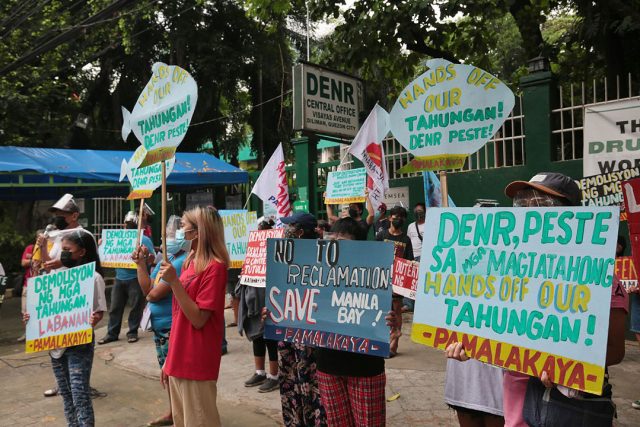
A FISHERS group appealed on Monday to local governments in Cavite to defy the dismantling of alleged illegal fishing structures in Manila Bay led by the Department of Environment and Natural Resources (DENR).

Fernando L. Hicap, chairperson of the Pambansang Lakas ng Kilusang Mamamalakaya ng Pilipinas (PAMALAKAYA), said officials of four localities in the province should “stand alongside their coastal constituents on their fight against the unjust order of the DENR,” which will dismantle illegal fishing structures as part of Manila Bay’s rehabilitation efforts.

The four areas are Cavite City, Bacoor City, Noveleta, and Kawit.

According to the group, the order will affect fishing structures, including mussel (tahong) and oyster (talaba) farms.

The dismantling of the structures was originally scheduled on Sept. 7, but was moved to Sept. 25. 

“The local executives in Cavite are morally, politically, and constitutionally obliged to protect the welfare of tens of thousands of fisherfolk who are deemed to lose their source of livelihood courtesy of the national government’s directive against fishing structures in Manila Bay,” Mr. Hicap said in a statement. 

Further, PAMALAKAYA argued that the fishing structures improve ecological productivity by tending to the food requirements of the population across Manila, whilst not contributing to pollution. Citing Section 16 of Republic Act No. 7160 or the Local Government Code of 1991, the group said the local government units are “mandated to promote the general welfare of their constituents and ensure support, among other things, the preservation and enrichment of culture and enhance the right of the people to a balanced ecology within their respective territorial jurisdiction.”

Previously, DENR Spokesperson Benny D. Antiporda said a total of 370 illegal fish pens will be demolished.

Of the total, Mr. Antiporda said 271 structures are in Cavite City, 97 in Kawit, and 2 in Noveleta. He also announced that the dismantling activities will not affect any mussel farms operating legally. 

“If you will notice, we don’t have plans of taking down even just one structure in Bacoor because of the mussel farms there,” Mr. Antiporda said.

Meanwhile, Mr. Hicap said the group will continue to voice its opposition to the planned dismantling activities.

“The DENR deserves nothing but defiance from the coastal population for using the rehabilitation program against us. We will continue to oppose this undertaking in various legal institutions such as the Supreme Court and the Philippine Congress, and through mass actions in the parliament of the streets and in the court of public opinion,” Mr. Hicap said. — Revin Mikhael D. Ochave

Pasig River polluter

DENR PHOTO RELEASE

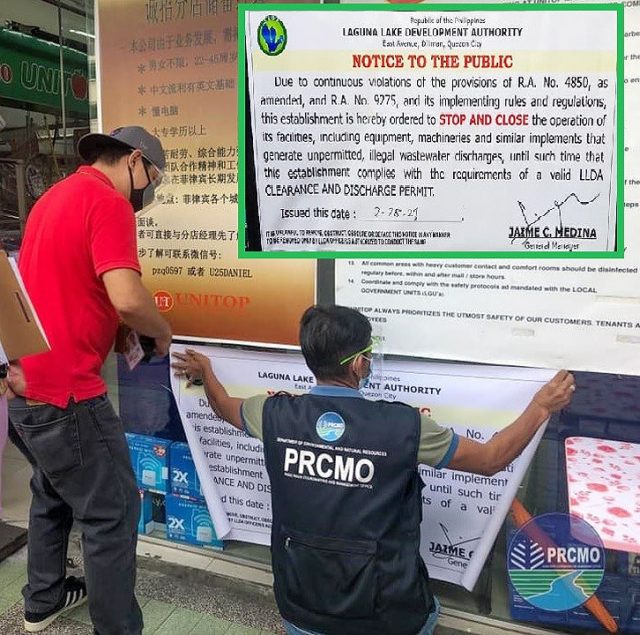
A SUPERMARKET-DEPARTMENT store was ordered closed by authorities for operating since 2012 without a wastewater clearance and discharge permit. The Laguna Lake Development Authority and Pasig River Coordinating and Management Office, following an inspection in January this year, said the establishment had been directly discharging untreated wastewater to the public drainage leading to Estero de Valencia, which leads to the Pasig River.

ADVERTISEMENT
ADVERTISEMENT