Home Blog Page 7441

Electric vehicle bill sets parking quotas, charging station mandate

REUTERS

LEGISLATORS approved on third reading late Monday a House bill promoting the adoption of electric vehicles (EVs) and laying out how they are to be regulated, setting parking quotas and providing incentives for setting up charging stations.

With a vote of 195-0 with 0 abstentions, the chamber approved House Bill 10213 or the proposed Electric Vehicle Industry Development Act.

The bill will require establishments with 20 or more designated parking slots to dedicate 5% of their space for the use of EVs and provide charging points.  

The law, if passed, also establishes tax incentives for EV manufacturers, entities maintaining charging stations, and research and development centers.

Electric vehicles, charging stations, and materials for their assembly will also be exempt from customs duties and value-added tax for five years from the effectivity of the proposed law.

The bill will establish an Electric Vehicles Advisory Board composed of officials from various government agencies, including the Department of Energy and Department of Transportation, to formulate policy encouraging the development and commercialization of EVs.

The Comprehensive Roadmap on Electric Vehicles (CREV) will become the national plan to help boost the electric vehicle industry. The CREV will be integrated with the Philippine Energy Plan and the National Transport Policy.

The measure was approved by five House committees on Sept. 14 and passed on second reading Sept. 23.

The Senate approved its counterpart measure, Senate Bill 1382, on May 31.

The Department of Energy has endorsed a P2.5-billion investment project to bring in 20,000 imported vehicles and is targeting the establishment of up to 5,000 electric vehicle charging stations within five years.

Philippine Institute for Development Studies Supervising Research Specialist Maureen D. Rosellon said in July that shortcomings in electric vehicle charging infrastructure and manufacturing technology have left the Philippines behind in the regional competition for trade and investment. — Russell Louis C. Ku


DTI says no funding for RA 11293 innovation law

THE DEPARTMENT of Trade and Industry (DTI) said Tuesday that it has received no funding for its innovation programs, which are entitled to receive a P1-billion grant annually under Republic Act (RA) 11293.

The DTI said at a Senate hearing that the Philippine Innovation Act aims to improve innovation governance and adopt long-term goals. 

“When it comes to the innovation program, it really needs to be supported. Right now, we’re not really getting the support or the budget needed,” Trade Secretary Ramon M. Lopez said during the hearing Tuesday.

“This is a great need that will help us support companies to innovate,” he added, saying that the department hopes to provide businesses with the latest equipment, “at least the integrated, functioning equipment where the mechanisms are connected to the computer.”

Mr. Lopez said that current projects for innovation rely on funds sourced elsewhere, since funding from the current national expenditure program went to training initiatives. “When you talk of the actual funding support for innovation that can help us elevate manufacturing companies, there really is no support.”

He was confident that if funding is properly provided, the department will be able to address the country’s weaknesses pointed out in the Global Innovation Index (GII).

Senator Sherwin T. Gatchalian, vice-chairman of the Senate committee on economic affairs, noted that he has been pointing out the program’s lack of funds every year, yet no change has occurred.

The Philippines ranked 51st out of the 132 economies in the 2021 GII, down one spot from a year earlier. — Alyssa Nicole O. Tan

PHL expected to benefit from profit-shifting rules

REUTERS

THE PHILIPPINES is expected to benefit modestly from international tax rules to deter profit shifting by multinationals, the ASEAN+3 Macroeconomic Research Office (AMRO) said.

In an analysis published Tuesday, AMRO said the proposed two-pillar solution under the proposed inclusive framework on base erosion and profit shifting (BEPS) can reallocate at least $100 billion worth of tax rights and generate $150 billion in additional global tax revenue each year.

The first pillar hopes to shift the right to tax a multinational company where the revenue is generated, instead of the current practice of collecting taxes where the business is incorporated. The second part of the framework aims to establish a proposed 15% global minimum tax rate for the sector.

In reallocating a portion of taxable profit to economies where the revenue is generated, AMRO said populous countries with high income and large digital economies will benefit the most.

“China and Japan will likely receive a significant portion of the reallocated residual profit. Populous middle-income economies, such as Indonesia, the Philippines, Thailand and Vietnam, are expected to gain moderately,” it said.

In an e-mail Tuesday, AMRO said the estimates were arrived at based on the potential number of consumers within a given population and income per capita. These inputs helped determine the new tax base once the framework has been rolled out.

To increase potential revenue of the country, AMRO said the Philippines needs to launch reforms that will scale down the use of tax incentives to attract investment from multinational companies.

Aside from population, AMRO said the concentration of multinational regional headquarters in certain countries will also affect government tax collection.

Foregoing revenue-based digital service taxes, as proposed under pillar one to avoid double taxation, however, would result in lower collections. The Philippines is yet to adopt taxes for digital services.

AMRO said the second pillar of the framework, which would set a floor on tax rates for multinational companies, will likely hurt regional economies with low corporate tax rates such as Cambodia, Hong Kong, South Korea and Singapore, whose rates are currently below 15%.

“These economies will be less attractive to existing multinational enterprises and potential investors as the attractiveness of their tax incentives diminishes,” it said.

The Philippines reduced its corporate income tax to 25% this year from 30% previously, and will further cut the rate by one percentage point annually until it reaches 20% in 2027. It also removed the 10% preferential tax rate for regional operating headquarters.

The framework aims to create a more “stable and fairer” global tax structure to address BEPS practices that transnational companies undertake to arbitrage tax regimes and shift profits to locations with low or zero tax rates.

Citing estimates from the Organisation for Economic Co-operation and Development, AMRO said governments are losing $100-400 billion annually in tax revenue due to these profit-shifting schemes.

“Achieving global consensus on such global tax reform is a complicated process. It would require economies with competing interests to find common ground and redefine the ways of doing cross-border business,” it said.

The Department of Finance has said that the Philippines is making progress in joining the inclusive framework, which was first established in 2015 and has 134 signatories which pledge to implement 15 action plans to address tax avoidance. — Beatrice M. Laforga

Pesticide advisory issued against smuggled vegetables

PHILSTAR

SMUGGLED Chinese vegetables have entered the market via Subic port, such as carrots and cabbage, and must be avoided because of the uncertainty regarding their pesticide content, the Department of Agriculture (DA) said.

At a virtual briefing Tuesday, Agriculture Secretary William D. Dar said that the shipments had been misdeclared as “other items.”

“The best thing we can do, meanwhile, is not to buy (the smuggled vegetables) since we do not know their content in terms of pesticide residue,” Mr. Dar said.

Mr. Dar said the Bureau of Plant Industry (BPI) did not issue import permits for the smuggled vegetables.

The BPI only issues import permits for frozen mixed vegetables and processed vegetables “intended for embassies and hotels,” he said.  

“The BPI continues to work with the Bureau of Customs (BoC). We will confiscate all smuggled vegetables,” Mr. Dar said.

Agriculture spokesman Noel O. Reyes said at a Laging Handa briefing Monday that a task force was created to check into the entry of smuggled vegetables, consisting of representatives from the DA, BoC, Department of Trade and Industry, and the Bureau of Internal Revenue.  

In a separate statement, the Kilusang Magbubukid ng Pilipinas (KMP), a farm workers’ organization, urged the House of Representatives to check into the smuggling of vegetables.

KMP Chairman Emeritus Rafael V. Mariano called on the House Committee on Agriculture and Food to arrange for the detection of imported carrots and other vegetables in markets, and to exercise its oversight powers under Republic Act No. 10845 or the Anti-Agricultural Smuggling Act.  

“This month, a large volume of allegedly smuggled fresh carrots were seen proliferating in markets nationwide, according to various vegetable trading associations and cooperatives,” the KMP said.

“In August, farmers, and traders called the attention of the DA to contraband cabbages being distributed in the Divisoria market in Metro Manila at P70 per kilogram, much lower than the price of Benguet cabbage, which sells for P115 to P125 per kilogram,” it added.

Mr. Mariano said the DA and the BoC should be held accountable for the smuggling of vegetables.

“It is within their mandate to prevent the smuggling of agricultural products. However, ‘legitimate imports’ and smuggled produce go through the same processes and mechanisms. Massive importation of agricultural products makes it easier for smugglers to do business,” Mr. Mariano said. — Revin Mikhael D. Ochave

IPOPHL ties up with film council to curb piracy

PHILSTAR

THE intellectual property office has signed a deal with the Film Development Council of the Philippines to promote copyright awareness and enforcement after piracy worsened during the pandemic.

The Intellectual Property Office of the Philippines (IPOPHL) in a statement Tuesday said the two groups will promote copyright awareness among members of the film industry and the public through a partnership signed on Sept. 23.

“The two agencies will work together to prevent and suppress all forms of piracy of Filipino films both locally and globally,” IPOPHL said.

They aim to curb a spike in piracy seen during the pandemic, IPOPHL said, adding that a 2020 slump in Metro Manila Film Festival revenue to P31 million from P955 million a year earlier was largely caused by piracy.

“As the film industry is an integral part of the Philippine creative industries, in turn, a high-value contributor to the economy, it is mission-critical to help local cinema restart and rebuild stronger,” IPOPHL Director General Rowel S. Barba said.

The film industry was among the worst-hit sectors during the pandemic, he added.

The Creative Economy Council found that creative sectors that saw the most losses during the pandemic include cinema-based film, performing arts, and heritage sites and museums.

Intellectual property rights violation reports sent to IPOPHL spiked during the lockdown last year, with a majority of complaints related to piracy and counterfeiting. Most of the violations, the agency said, are done online. — Jenina P. Ibañez

Gov’t OK’s COVID shots for children, rest of public

PHILIPPINE STAR/ MICHAEL VARCAS

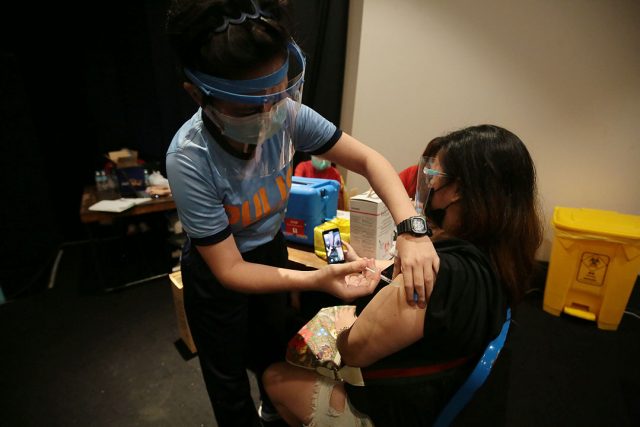
THE PHILIPPINES will start vaccinating the general population and minors against the coronavirus next month as it tries to reach herd immunity, according to the presidential palace.

President Rodrigo R. Duterte had approved the proposal by an inter-agency task force, his spokesman Herminio L. Roque, Jr. told a televised news briefing on Tuesday. He did not specify the age group for children.

The country is struggling to vaccinate its entire adult population amid a spike in infections believed to be triggered by a more contagious Delta coronavirus variant.

The first priority groups covered health workers, senior citizens, seriously ill people, essential workers and the poor. The government would continue to prioritize them for vaccines, Mr. Roque said.

Vaccine chief Carlito G. Galvez, Jr. earlier said the Philippines would have enough vaccine supply to inoculate 12 million children aged 12 to 17.

Mr. Roque urged parents to have their children registered for the vaccination.

“We have enough supply,” he said in Filipino. “We are just preparing the master list. Once we have a master list, let us wait for the announcement on who will be first.”

The Department of Health (DoH) reported 13,846 coronavirus infections on Tuesday, bringing the total to 2.52 million.

The death toll rose to 37,686 after 91 more patients died, while recoveries increased by 39,980 to 2.35 million, it said in a bulletin.

There were 132,139 active cases, 76.6% of which were mild, 16.4% did not show symptoms, 2.1% were severe, 3.99% were moderate and 0.9% were critical.

The agency said 58 duplicates had been removed from the tally, 40 of which were reclassified as recoveries and one as a death, while 37 recoveries were reclassified as deaths. Seven laboratories failed to submit data on Sept. 26.

The digital platform that the Health department uses to manage COVID-19 information had reached its maximum capacity, which led to technical glitches in the past days, said Alethea de Guzman, director of the agency’s Epidemiology bureau.

The Department of Information and Communications Technology is trying to identify fixes to expand the Health department’s server capacity, she told an online news briefing.

Mr. Roque said 44.36 million coronavirus vaccines had been given out as of Sept. 27. More than 20.58 million people or 26.68% of adult Filipinos have been fully vaccinated, he added.

Mr. Duterte on Monday night said he might force Filipinos to get vaccinated to protect public health. “The police must go in and intervene in your private life so that you cannot be a danger to society,” he said in a taped Cabinet meeting.

In June, Mr. Duterte said he would order the arrest of those who refuse to get vaccinated. He also threatened to require village officials to prepare a list of vaccine decliners.

Those who don’t want to get vaccinated may leave the country, he said.

In his taped address on Monday night, Mr. Duterte asked government workers who refuse to get vaccinated to leave public service.

“I guess the President will start requiring mandatory vaccination among those working in the government,” Mr. Roque said on Tuesday. “But this is without prejudice to Congress passing a law.”

The Philippines aims to reach population protection by vaccinating 50-60% of its population by year-end.

The government expects to take delivery of about 100 million coronavirus vaccines next month, Mr. Galvez told Mr. Duterte at the Cabinet meeting on Monday.

The government is seeking to give out 55 million COVID-19 vaccine doses next month. This could still go up depending on the capacity of local governments, he said.

The state expects to raise the number of vaccines given out to 45 million by the end of the month, Mr. Galvez said. — Kyle Aristophere T. Atienza

SC moves bar exams to next year amid COVID-19 pandemic

PHILSTAR FILE PHOTO

THE SUPREME Court (SC) has moved the bar examinations to January from November to prevent coronavirus transmissions, it said in a bulletin posted on its website on Tuesday.

The tribunal did not extend the application period for the exams.

Bar exam chairman Justice Marvic M.V.F. Leonen said magistrates reached the unanimous decision “after considering the COVID-19 situation nationally.” The court also received advice from experts.

The bar exams would now be held on Jan. 16, 23, 30 and Feb. 6. The preparation schedule for the exams would be followed, including the selection of bar applicants of their venue.

Mr. Leonen reminded bar applicants to treat the postponement as an opportunity and to “keep your momentum.”

“Remember that you study not only to pass the bar examinations but also, so that you will best serve others,” he said. “Study well, purposively and with passion.”

The High Court postponed the 2020 bar exams amid the pandemic to Nov. 7, 14, 21 and 28 this year.

It also approved a digitalized, localized and proctored mode of exams, where examinees must bring their own WiFi-enabled laptops. Handwritten exams will only be allowed for those who have a physical disability that bars them from taking the exams using a computer.

Last month, Mr. Leonen said the High Court was working with an inter-agency task force to also prioritize bar applicants for coronavirus vaccines.

Court spokesperson Brian Keith F. Hosaka said it was unlikely for the court to require testers to get vaccinated first. — Bianca Angelica D. Añago

Government urged to prioritize bill on whistleblower safety

By Kyle Aristophere T. Atienza, Reporter

HUMAN rights lawyers urged President Rodrigo R. Duterte to certify as urgent a bill that seeks to protect whistleblowers after the Senate lost contact with a potential witness in an allegedly anomalous P8-billion contract for medical supplies.

“The current witness protection program is not sufficient,” former congressman Neri J. Colmenares said by telephone. He added that the country needs whistleblowers given the extent of government corruption.

The former lawmaker, who lawyered for Rodolfo Noel I. Lozada, Jr., a key witness in a $329-million broadband deal between the government of former President Gloria Macapagal Arroyo and China’s ZTE Corp., said his client ended up facing legal charges.

The witness had tagged Ms. Arroyo’s husband Jose Miguel Arroyo and former election Commissioner Benjamin S. Abalos as masterminds of the allegedly anomalous contract, accusing them and several Cabinet officials of having received bribes from the Chinese company.

The country’s anti-graft court later dismissed graft cases against the ex-President, her husband and Mr. Abalos. “In the end, Gloria Arroyo and the rest of the gang got scot-free,” Mr. Colmenares said.

A Senate committee is investigating the government for buying overpriced medical goods from Pharmally Pharmaceutical Corp., a unit of Taiwan-based Pharmally International, at the start of the pandemic last year.

Krizle Grace Mago, Pharmally’s head for regulatory affairs, told a Senate hearing last week the company had swindled the government by selling face shields that were either damaged or expired. She also said she was only following orders from company management.

On Sunday, Senator Richard J. Gordon, who heads the blue ribbon committee, said they could no longer contact Ms. Mago.

In a taped address aired on Monday night, Mr. Duterte questioned why the expiration date of the face shields delivered to the Health department should be an issue.

He said it was hard to believe that a piece of plastic would expire, adding that senators have run out of issues to hurl against Executive officials. “I am not bothered at all,” he said.

Party-list Rep. Carlos Isagani T. Zarate said Mr. Duterte should certify the bills protecting whistleblowers as urgent if he is sincere about his anti-corruption drive. “They should walk the talk,” he said in a Facebook Messenger chat.

“Put your money where your mouth is, Mr. President,” Mr. Colmenares said. “You have so many allies in Congress, and I’m sure that even those who are not your allies will support the bill because it is a popular measure.”

Mr. Duterte in 2016 urged Congress to legislate a similar bill.

The House of Representatives bills seek to encourage more witnesses and to come forward and expose corruption.

Global corruption watchdog GraftMap earlier urged the Philippines to pass a whistleblower protection law. Whistleblowing can expose bribery of public officers, fraud in bid screening and conflict of interests in both public and private transactions, it said.

Voter registration ‘likely’ to be extended — Comelec  

PHILIPPINE STAR/ MICHAEL VARCAS

THE VOTER registration period will “likely” be extended beyond the Sept. 30 deadline, Commission on Elections (Comelec) Spokesperson James B. Jimenez said a day after Congress approved a bill setting an extension of 30 days upon enactment into law.   

Another poll official, however, confirmed to a senator on Tuesday that the commission will definitely pass a resolution to extend voter’s registration until Oct. 31.  

“After consultation with Comelec officials, and in consideration of the public clamor, it is likely that an extension of the period of voter registration will be granted,” Mr. Jimenez said in a Viber message to reporters on Tuesday.  

Mr. Jimenez reiterated a statement on Monday that the Comelec en banc will meet on Wednesday to make the final decision.  

Meanwhile, Senator Maria Imelda Josefa “Imee” R. Marcos, chair of the committee on electoral reforms and people’s participation, said Comelec Director Teopisto E. Elnas, Jr. confirmed to her in a phone conversation that “Commissioners en banc will pass a resolution tomorrow extending the registration to Oct. 31.”   

The Comelec en banc has previously denied a petition filed by several groups for an extension.   

In a news briefing on Friday, Mr. Jimenez said the commission was already open to extending the period for voter registration despite its impact on the preparation timeline for the national and local elections next year.  

He said the Comelec is “going the extra mile to find a way to solve difficulties for the good of the people.”   

In a post on social media last month, Mr. Jimenez said the Philippines already has 61.06 million registered voters as of Aug. 24, which is more than the commission’s expectation of 59 million.   

This total, however, is still low considering that there are 73.3 million qualified voters based on data from the Philippine Statistics Authority, Ms. Marcos pointed out in a Senate hearing on the bills on Sept. 22.   

There have been long lines at Comelec offices and satellite sites for voter registration in various parts of the country since last week. — Bianca Angelica D. Añago and Alyssa Nicole O. Tan 

Congress ratifies bicam report on bill prohibiting child marriage 

PHILSTAR

A BILL that would prohibit child marriage in the Philippines is set to be sent to Malacañang for the President’s signature after both chambers of Congress have ratified its bicameral conference report Monday evening.  

“We have reached another milestone in the fight against child marriage as the bill, which we have long championed and fought for many years, is now a step closer to becoming a law,” said BH Party-list Rep. Bernadette Herrera-Dy, author of the House version.  

Under the measure, people who arrange a child marriage will be jailed for up to 10 years, be fined at least P40,000, and lose parental authority if the person is an ascendant, parent, adoptive parent, stepparent, or guardian of the child.  

Those who officiate a child marriage will also be jailed for 10 years, pay a fine of at least P50,000, and be disqualified from public office if the person works in government. 

Those caught cohabiting with a child out of wedlock will also be jailed for 10 years, be fined at least P50,000, and will be disqualified from appointive or elective office.  

Meanwhile, the Senate approved Senate Bill 2332 on Monday that would increase the age of sexual consent to 16 years old from the current 12.    

The House approved its counterpart bill on Dec. 1, 2020.  

“We hope that the bicameral version will be more expansive, to include penalties for grooming and the element of lack of consent in the grounds for rape,” Gabriela Party-list Rep. Arlene D. Brosas said. — Russell Louis C. Ku 

Liberal Party names initial candidates for 2022 polls 

THE LIBERAL Party (LP), currently the dominant opposition, has named its initial candidates for the 2022 national elections during its National Executive Council meeting on Monday.   

The party nominated Senators Francis “Kiko” N. Pangilinan and Leila M. De Lima for reelection in the 2022 polls.  

Mr. Pangilinan, the party president, was senator from 2001 to 2013 and again elected to the upper chamber in 2016. He is an advocate of the agriculture sector and was instrumental in amendments to Republic Act 10068 or the Organic Agriculture Act of 2010.  

He also authored Republic Act 11524 or the Coconut Farmers and Industry Trust Fund Act.  

Ms. De Lima, one of the most vocal critics of President Rodrigo R. Duterte, is currently detained over alleged drug charges.    

The Liberal Party also nominated former Senator Paolo “Bam” A. Aquino IV for a senatorial return in 2022.  

Mr. Aquino, who has yet to announce his 2022 plan, ran under the Otso Diretso tandem in the 2019 mid-term elections, where he lost after placing 14th

The party also backed the reelection run of Senator Ana Theresia “Risa” N. Hontiveros-Baraquel from Akbayan Party. They also endorsed human rights lawyer Jose Manuel “Chel” I. Diokno’s second run for the Senate.  

Mr. Diokno declared his intent to run for the Senate on Sept. 15. He was part of the Otso Diretso tandem in 2019. 

The Liberal Party also expressed their support for Vice President Maria Leonor “Leni” G. Robredo’s efforts to unite the opposition “while respecting her preference on the elective position she may decide to run” for the 2022 polls. 

Ms. Robredo said that she will continue to pursue unification efforts despite the announced presidential runs of Senator Emmanuel ”Manny” D. Pacquiao and Manila Mayor Francisco “Isko” Domagoso.  

The filing of certificates of candidacy is set Oct. 1-8. — Russell Louis C. Ku 

Labor leader Ka Leody to run for president in 2022  

KA LEODY FB PAGE

LABOR LEADER Leodegario “Ka Leody” de Guzman has accepted the nomination of a socialist political party for him to run for president next year.   

Tinatanggap ko ang hamon niyo (I accept your challenge),” Mr. de Guzman said during the national convention of Partido Lakas ng Masa (PLM) on Tuesday.   

The labor activist vowed that should he win, he will introduce a style of leadership different from that of President Rodrigo R. Duterte as well as change the current political system in the country.   

Mr. de Guzman ran for senator in the 2019 midterm election but lost. His candidacy was backed by a coalition of labor groups, which also supported the 2019 senatorial run of former party-list representative Neri J. Colmenares and veteran unionists Jose Sonny G. Matula, Ernesto Arellano, and Allan Montano.  

In a phone interview with BusinessWorld, PLM Chairman Sonny Melencio said the presidential run of Mr. de Guzman is backed by major labor groups that are calling for an end to contractualization in the Philippines. 

“All of the candidates who declared a presidential run do not represent the true opposition fighting for an end to Duterte’s regime,” Mr. Melencio said in Filipino. 

“Even if we are starting with low resources, we know that this is an opportune time to present our program,” he said.  

“This is an opportunity because there is a vacuum in the opposition leadership. We want to get in that vacuum and present our cause.”  

Mr. Melencio also said that the camp of Mr. de Guzman is still open to having talks with Vice President Maria Leonor “Leni” G. Robredo, who he said “did not really stand as an opposition icon.” 

“We want someone to really present an alternative program to this Dutertismo,” the PLM official said.  

“If she runs, we are still open to talking with her. But we need to know her platform first. We need to know what she really wants to do. That is the main question until now,” he said. — Kyle Aristophere T. Atienza 

ADVERTISEMENT
ADVERTISEMENT