Home Blog Page 7356

NBA throws support to Smart’s flagship education program

The National Basketball Association and Smart Communications, Inc. have partnered for the latter’s flagship program, School-in-a-Bag.

The National Basketball Association and Smart Communications, Inc. have partnered for the latter’s flagship program, School-in-a-Bag.

The partnership was announced on Friday and has the groups pushing for the program, which is designed to provide digital tools and content to support distance learning in public schools and communities across the Philippines.

Through NBA Cares, the league’s global social responsibility program, the NBA and Smart will assemble and distribute School-in-a-Bag packages to 20 schools across 16 cities and provinces in Luzon (Batanes, Benguet, Bulacan, Ifugao, Mountain Province, Nueva Ecija, Palawan, Pampanga, Pangasinan and Romblon), Visayas (Biliran and Siquijor) and Mindanao (Agusan del Norte, Misamis Occidental, Surigao del Norte and Zamboanga del Norte).

The National Basketball Association and Smart Communications, Inc. have partnered for the latter’s flagship program, School-in-a-Bag.

Each package will include a Smart LTE Pocket WiFi, laptop and tablets, both of which will have preinstalled educational content including Smart’s proprietary #LearnSmart apps, featuring alphabet and number exercises, short stories, and games in native languages and dialects. The bags will also feature NBA-branded baller bands and notebooks.

“Education in the Philippines has changed dramatically as schools across the country continue engaging with students remotely,” said NBA Asia Managing Director Scott Levy at the partnership’s announcement. “Through NBA Cares, we’re proud to support our valued partner Smart and their School-in-a-Bag program, which delivers an innovative and sustainable approach to enhancing the distance learning experience for Filipino youth.”

“The Smart School-in-a-Bag is our way to provide students and teachers access to the wealth of knowledge through digital learning tools, so that no learner is left behind,” said Alfredo S. Panlilio, President and CEO of Smart. “Our collaboration with the NBA allows us to give more children in remote communities more opportunities to pursue their passion and purpose, and a fighting chance for a better future.”

The program is also in line with Smart and its partners’ commitment to the United Nations’ 17 Sustainable Development Goals, particularly providing access to quality education in the country.

The collaboration builds on Smart and the NBA’s existing partnership in the Philippines to operate NBA.com/Philippines (the official online NBA destination in the Philippines), distribute NBA League Pass (the league’s premium live game subscription service), and livestream NBA TV Philippines (a localized version of NBA TV – the league’s dedicated 24/7 channel) through its newly launched video streaming app, GigaPlay.

San Miguel forces TnT to a rubber match

The San Miguel Beermen forced the TnT Tropang Giga to a rubber match in their best-of-seven PBA Philippine Cup semifinal series after taking Game Six, 103-90, on Friday. -- PBA Images

The best-of-seven PBA Philippine Cup semifinal series between the San Miguel Beermen and TnT Tropang Giga is going the full route after the former levelled the count at three games a piece with a 103-90 win in Game Six on Friday at the Don Honorio Ventura State University Gym in Bacolor, Pampanga.

San Miguel used a strong run in the middle quarters, where it outscored TnT, 59-41, to create a considerable distance which the Tropang Giga just could not overhaul.

TnT made a spirited fight-back in the fourth period, trimming its deficit to just 10 points, 98-88, with 2:44 to go in the game but could not come closer beyond that as San Miguel went for the closeout after.

Mo Tautuaa led the way for the Beermen in the win, finishing with 24 points, followed by Marcio Lassiter and Terrence Romeo, who had 19 and 16 points, respectively.

Arwind Santos and June Mar Fajardo each had a double-double, with Mr. Santos tallying 13 points and 10 rebounds while Mr. Fajardo had 11 and 14.

For TnT, it was veteran Jayson Castro who top-scored with 16 points. Roger Pogoy struggled anew in the series, ending up with just six points on 2-of-10 shooting.

Heading into the rubber match, which is set for Sunday, the Beermen said they like their chances owing to their experience in such matches.

“I think we have the experience in playing Game Sevens. But we have to build on the momentum that we got here because TnT is a strong team,” Mr. Lassiter said in the post-game press conference.

The winner of the San Miguel-TnT series takes on the victor in the other semifinal bracket between the Magnolia Pambansang Manok Hotshots and Meralco Bolts.

Magnolia, which was leading the series, 3-2, was looking to go for the knockout in Game Six of the series later on Friday while Meralco was angling for a sudden-death match for the series. — Michael Angelo S. Murillo

BSP fully awards 28-day bills

BW FILE PHOTO

THE BANGKO SENTRAL ng Pilipinas (BSP) made a full award of the short-term securities it offered Friday its average rate dipped on the back of the peso’s climb.

The central bank awarded P100 billion in 28-day bills out of P139.05 billion in bids. However, this was lower than the P147.84 billion in tenders seen a week earlier.

Banks asked for yields between 1.7425% and 1.8%, a narrower range compared to last week’s 1.74% and 1.825%. This brought the average rate of the one-month securities to 1.77642%, lower than 1.7832% previously.

The BSP bills and the term deposit facility are used by the central bank to mop up excess liquidity in the financial system and guide market rates.

“The auction results continue to reflect stable market conditions as liquidity in the financial system remain ample. Moving ahead, the BSP’s monetary operations will remain guided by its latest assessment of the liquidity conditions and market developments,” BSP Deputy Governor Francisco G. Dakila, Jr. said in a statement.

Rizal Commercial Banking Corp. Chief Economist Michael L. Ricafort said in a Viber message that the BSP securities’ average yield was slightly lower on the back of the peso’s strength versus the dollar.

“BSP 28-day securities auction yield also eased on improved market sentiment after NCR’s (National Capital Region) Alert Level was eased to 3 (from 4) and some businesses were allowed to resume operations or operate at higher capacity, thereby further reopening the economy,” he said.

The peso appreciated on Thursday after the government relaxed mobility restrictions in the capital. The local unit closed at P50.605 per dollar, appreciating by five centavos its P50.655 finish on Wednesday.

Mr. Ricafort also noted a downward correction in the US and global interest rates after US President Joe Biden on Thursday signed a bill raising the country’s debt limit to $28.9 trillion. This delayed the risk of default until early December, Reuters reported. — J.P. Ibañez with Reuters

Central bank’s net income up 143% as of August

BW FILE PHOTO

THE BANGKO SENTRAL ng Pilipinas’ (BSP) net income went up 143% to P52.95 billion in the first eight months as revenues more than doubled on the back of strong interest and trading income.

Revenues went up 69% to P120.98 billion at the end of August from P71.56 billion in the same eight-month period last year.

Interest income also rose 42.45% to P77.25 billion in the period from P54.23 billion the previous year.

Miscellaneous income, which include trading gains, fees, penalties, and other operating earnings, went up 152.25% to P43.74 billion from P17.34 billion a year earlier.

The central bank posted a net foreign exchange gain of P3.43 billion, reversing a P2.94 billion loss seen the previous year. Gains had only been at P50 million as of the first half and P800 million as of July.

Meanwhile, the central bank’s overall expenses climbed 53% to P71.47 billion in the first eight months from P46.7 billion in the same period in 2020.

Interest expense went up 37.47% to P39.77 billion from P28.93 billion a year earlier. — J.P. Ibañez

Peso weakens as strong US jobs data fuels Fed taper bets

THE PESO depreciated versus the greenback on Friday as better US jobs data fueled expectations that the Federal Reserve would reduce its monthly asset purchases by next month.

The local unit closed at P50.711 per dollar on Friday, depreciating by 10.6 centavos from its P50.605 finish on Thursday, data from the Bankers Association of the Philippines showed.

The peso opened Friday’s session at P50.68 per dollar. Its weakest showing was at P50.61, while its intraday best was at P50.79 versus the greenback.

Dollars traded rose to $957.74 million on Friday from $936.65 million a day earlier.

“The peso weakened today as market expectations of a November Fed taper solidified from the better-than-expected US initial jobless claims report overnight,” a trader said in an email on Friday.

US weekly jobless claims fell below 300,000 for the first time in 19 months, Reuters reported on Thursday.

The US Federal Reserve last month said it could start reducing its monthly bond purchases as soon as November and signaled interest rate increases may follow more quickly than expected.

The local unit closed weaker versus the dollar as global oil prices lingered at seven-year highs, Rizal Commercial Banking Corp. Chief Economist Michael L. Ricafort said in a Viber message.

Reuters reported Friday that oil prices rose amid signs of strong demand and tighter supplies as industries switch to oil in response to higher gas and coal prices.

The peso was also slightly weaker Friday due to the easing of Metro Manila lockdown levels to Alert Level 3 starting on Oct. 16, allowing more businesses to increase activity and some pick up in imports, Mr. Ricafort said.

“However, the peso nevertheless is still among the strongest in three weeks or since Sept. 24, 2021,” he said. “Offsetting positive factors for the peso include the latest gains in the local stock market at new eight-month highs, with net foreign buying of $5.4 million today, after yesterday’s $3.8 million.” — Jenina P. Ibañez

PHL shares climb on lower alert level, positive data

BW FILE PHOTO

STOCKS closed in the green on Friday on the back of eased restrictions in Metro Manila and positive data.

The Philippine Stock Exchange index (PSEi) went up by 30.355 points or 0.42% on Friday to close at 7,213.46, while the broader all shares index rose 4.86 points or 0.10% to finish at 4,448.81.

“The index finished the week on a strong note as sentiment remained positive amid the easing of movement restrictions in the capital region,” Darren Blaine T. Pangan, trader at Timson Securities, Inc., said in a Viber message.

Regina Capital Development Corp. Head of Sales Luis A. Limlingan said sentiment also got a boost after the independent OCTA Research group said National Capital Region (NCR) is at moderate risk for coronavirus disease 2019 (COVID-19).

“Philippine shares climbed once again, buoyed by upbeat third quarter earnings from major firms, a retreat in Treasury yields, and hints of improvement in the job market,” Mr. Limlingan said in a Viber message. “A softer uptick in September PPI (producer price index) of +0.5% also pushed the market up.”

All sectoral indices closed the week in the green except for holding firms, which lost 2.19 points or 0.03% to 7,081.06.

Meanwhile, mining and oil climbed 218.13 points or 2.07% to 10,727.93; services went up by 20.16 points or 1.07% to 1,903; financials gained 10.59 points or 0.67% to 1,573.87; property added nine points or 0.27% to end at 3,330.18; and industrials rose 8.10 points or 0.07% to 10,612.62.

Value turnover inched up to P10.56 billion with 1.22 billion issues traded on Friday from the P10.28 billion with 1.01 billion shares the previous day.

Advancers beat decliners, 113 against 84, while 45 names closed unchanged.

Net foreign buying climbed to P274.53 million from P191.09 million on Thursday.

“Support for the market may be placed at 6,940, while immediate resistance lies at the 7,320 level,” said Timson Securities’ Mr. Pangan. — K.C.G. Valmonte

Singapore electricity providers hit by global power crunch quit market

Adi Wahyu/Flickr/CC BY 2.0

SINGAPORE — Two energy providers in Singapore, including one of the largest independent electricity retailers, are exiting the market and according to company sources at least three others have stopped accepting new clients amid rocketing wholesale energy prices.  

iSwitch Energy, one of Singapore’s largest independent electricity retailers, said on its website that it will be ceasing electricity retail operations on Nov. 11, due to “current electricity market conditions.” The company declined to comment further.  

SilverCloud Energy, which supplies power to commercial, industrial and residential buildings, told Reuters it will also exit the market soon and is notifying customers to switch to other providers or transfer back to state-owned SP Group.  

Global wholesale gas prices have surged in recent months as production and transit problems have lowered supply just as demand took off in a post-pandemic economic recovery.  

Asian spot LNG prices <LNG-AS> have risen by more than 500% from a year ago to over $30 per million British thermal units (mmBtu) this month while Brent crude oil prices, the basis for pricing most of Singapore’s long-term gas contracts, rose to multi-year highs.  

Company sources told Reuters that Diamond Electric, Best Electricity Supply and Ohm Energy had stopped accepting new customers, with Diamond Electric in the process of handing over existing term contracts to another utility provider. The three firms did not respond to an emailed request for comment.  

“Not only are retailers unable to sell to retail customers at a level that is economic because the set quarterly tariff implies a price that is well below where futures are trading, they are also getting hit on the front-end because spot prices have gone ballistic,” said James Whistler, global head of energy at Simpson Spence Young.  

“Add the failure of the once well-designed market-making scheme and things become untenable for many.”  

Open Electricity Market, a website that lets Singapore residents choose an energy supplier, shows only 8 out of the 12 existing retailers offering plans for consumers.  

With the spike in energy prices, “several Singapore retailers are now potentially closing their doors,” said a senior industry participant who declined to be identified due to the sensitivity of the matter.  

Singapore’s retail electricity market opened to competition for business consumers in 2001 and to residential households in 2018, according to the Energy Market Authority (EMA) website.  

EMA did not reply to a request for comment.  

Surging gas prices, which rose to record highs in Europe and in Asia this month, have also hit utility providers in Britain, where a number of energy companies have collapsed, forcing about 1.7 million customers so far to switch providers.  

China and India are being hit with power shortages and blackouts.  

In Singapore, electricity tariffs are calculated using fuel costs and non-fuel costs.  

The fuel cost component for each quarter is calculated using the average of daily natural gas prices in the first two-and-a-half month period in the preceding quarter while the non fuel-cost is calculated based on the cost of generating and delivering electricity to homes.  

Singapore LNG Corp is currently scouting for LNG cargoes and exploring options to increase inventory of LNG at its terminal, given the tight global LNG supply.  

Commercial load power prices have risen by 50% from last year and are set to go higher, Whistler said.  

“This is a pretty big difference for a country that has been relatively used to reasonably priced power now moving into a less competitive market and essentially being subject to global commodities prices as well.” — Roslan Khasawneh and Jessica Jaganathan/Reuters  

England eases COVID-19 testing rules for most incoming passengers from Oct. 24

REUTERS

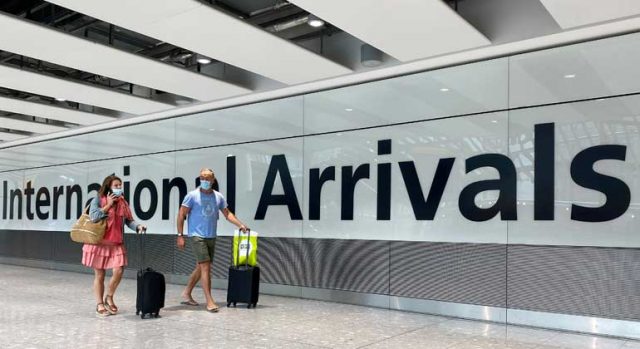
LONDON — Fully vaccinated passengers arriving in England from low-risk countries from Oct. 24 will no longer have to take expensive coronavirus disease 2019 (COVID-19) tests, the British government said on Thursday.  

Last month the government simplified the rules for international travel to England in a boost to the tourism industry, which has blamed the testing and complicated rules for the slowness of a recovery in air travel over the summer.  

The government said that from Oct. 24, the start of school half-term holidays across much of England, fully vaccinated passengers and most under 18s arriving from countries not on the red list could take a lateral flow test on or before day two of their arrival, rather than a PCR lab test.  

Lateral flow tests are cheaper and provide a faster result.  

“Taking away expensive mandatory PCR testing will boost the travel industry and is a major step forward in normalizing international travel and encouraging people to book holidays with confidence,” Secretary of State for Transport Grant Shapps said in a statement.  

The government said passengers must use lateral flow tests purchased from a private provider listed on the government’s website, rather than free ones available as part of the government Test and Trace scheme, and passengers must upload a photo of their test and booking reference to verify the result.  

Anyone with a positive lateral flow test will be provided with a free confirmatory PCR test through the National Health Service. — Reuters 

IMF panel urges central banks to closely monitor inflation, ‘act appropriately’

WASHINGTON — The International Monetary Fund’s steering committee on Thursday urged global policy makers to monitor pricing dynamics closely, but to “look through” inflationary pressures that are transitory and will fade as economies normalize.  

The International Monetary and Financial Committee (IMFC), made up of 24 finance ministers and central bank governors from IMF member countries, said in a final communique that governments should “carefully calibrate” domestic policies to an evolving pandemic.  

“We will continue to prioritize health spending and protecting the most vulnerable, while shifting focus, as appropriate, from crisis response to promoting growth and preserving long-term fiscal sustainability,” they said.  

Inflation concerns, stoked by pent-up demand, supply chain bottlenecks, higher energy and commodity prices and weather events have been a hot debate topic at IMF and World Bank annual meetings this week, and contributed to the Fund trimming its global growth outlook on Tuesday.  

“Central banks are monitoring price dynamics closely and can look through inflation pressures that are transitory. They will act appropriately if risks of inflation expectations de-anchoring become concrete,” the IMFC said, a reference to the banks using monetary policy tools to control inflation.  

The language was toned down from an earlier draft that called for central banks to be ready to take “decisive actions to maintain price stability.”  

TRANSITORY OR DURABLE?  

Policy makers are wrestling with the inflation question as wealthy countries move beyond the pandemic to recovery, while developing economies struggle with coronavirus disease 2019 (COVID-19) variants, low vaccine access and a lack of resources. An abrupt tightening of monetary policy in the United States or Europe could prompt devastating fund outflows from developing countries, the IMF has warned.  

“The key question is to know whether this is a transitory inflation or not. Nobody has a response to that key question,” French Finance Minister Bruno Le Maire told reporters on Thursday, adding that he’s been discussing it this week with US Federal Reserve Chairman Jerome Powell, US Treasury Secretary Janet Yellen and European Central Bank President Christine Lagarde.  

Magdalena Andersson, the Swedish finance minister who chairs the IMFC panel, told a news conference that more initiatives were needed to ease global shortages of key goods, adding: “It’s important that we get the global value chains working better than they are today.”  

The IMFC also called for clear communications by policy makers to limit negative cross-country spillovers and to use macroprudential tools to limit financial vulnerabilities.  

The statement noted the growing divergences between rich and poor countries in economic recovery and access to vaccines, noting that recovery risks are tilted to the downside.  

RESERVES LENDING  

The IMFC said it welcomed the IMF’s efforts to establish a new Resilience and Sustainability Trust (RST) to help channel a $650 billion allocation of reserve assets to provide affordable long-term financing to poor and middle-income countries undertaking structural reforms and working to maintain balance-of-payments stability.  

“The RST should preserve the reserve asset characteristics of the SDRs,” the IMFC said. “We call upon the IMF to develop and implement the RST and collaborate closely with the World Bank in this process, and to provide technical support in exploring viable options for channeling SDRs through multilateral development banks.”  

G20 finance ministers backed plans for the new trust on Wednesday. — David Lawder and Andrea Shalal/Reuters 

PHL is top target of banking malware in Asia-Pacific, Kaspersky says

Screenshot via Kaspersky

The Philippines had the highest number of users attacked by banking Trojans — a type of malicious software — in the Asia-Pacific (APAC). According to cybersecurity firm Kaspersky, the country accounts for 22.26% of all banking Trojans discovered in the region in 2021. 

The rise of digital payments in the region paired with insufficient protective measures in personal devices have led to banking Trojans counting among the most impactful malware for online consumers. 

Other vulnerable countries include Bangladesh (12.91%) and Cambodia (7.16%), according to data presented at Kaspersky’s Cybersecurity Weekend virtual media forum on Thursday.  

“APAC has always been one of the leaders in digital payment adoption, driven by developed countries like China, Japan, South Korea, and even India. This pandemic extended the use of this technology significantly further — particularly in still-emerging economies in Southeast Asia and South Asia,” said Vitaly Kamluk, research director of Kaspersky-APAC, at the forum.  

He shared that Kaspersky Security Network’s (KSN) historical data showed a certain form of financial attacks paralleling the rise of cashless payments: “After analyzing the figures we have on financial threats, we learned that there was an outbreak that started in early 2019 in APAC — banking Trojans.”  

Banking Trojans are a dangerous type of malware that steals money from users’ bank accounts, either by obtaining credentials for access or one-time passwords to online bank accounts.  

“We see that it will continue to pose a significant threat to both financial organizations and individuals here as we continue to see more users and startups dipping their feet into the digital payments field,” Mr. Kamluk added.  

SECURING THE DIGITAL ECONOMY  

Kaspersky’s latest study, titled “Mapping a secure path for the future of digital payments in APAC,” showed that 37% of respondents in the Philippines said they started using digital payments during the pandemic — the highest in the region — followed by India at 23% and Australia at 15%.  

“Businesses are now digitalizing their operations to capture additional revenue through digital payments, while consumers are heavily reliant on it due to the ease and convenience it offers,” said Chris Connell, Kaspersky-APAC managing director.   

However, given the threats that come with it, a great number remain skeptical: first-time users admitted being afraid of losing money online (48% of respondents), being afraid of storing their financial data online (41%), and finding the whole process of coming up with passwords and security questions too troublesome (26%).  

Though digital payments are convenient and safe in an era of social distancing, all sectors must secure the digital economy moving forward, added Mr. Connell.  

Mr. Kamluk shared reminders to protect against cybercrime:  

For individuals:  

  • Update your software regularly.  
  • Pay attention to security software alerts.  
  • Be more suspicious in communication.  
  • Use complex passwords and two-factor authentication (2FA).  
  • Use hardware digital wallets and diligently follow its security protocols.  
  • Install a reliable security solution for your devices, including mobile phones.  

For businesses and financial organizations:  

  • Defend your perimeter with reliable vendor.  
  • Run cybersecurity drills.  
  • Verify your supply chain software.  
  • Monitor the latest trends and attacks 
  • Motivate staff to report suspicious findings and contacts.  

 Brontë H. Lacsamana 

Mark Villar: Building the Filipino dream, one block at a time

In the last four years under the leadership of Secretary Mark Villar, the Department of Public Works and Highways (DPWH) has already provided over six million jobs to Filipinos.

In 2021 alone, it has so far generated over 700,000 jobs — from January to Aug. 31, 2021, a total of 768,062 jobs were already listed under the government-backed infrastructure program.

With the aim to employ 1.6 million more workers as the present administration pushed to a close, the DPWH has launched last August its “Bigay Trabaho” online job fair that offers job opportunities from various job contractors in the country.

These job descriptions range from welders to laborers, materials and civil engineers, technicians, scaffolders, foremen, equipment operators, and carpenters, among the like. So far, it has already employed more than a thousand workers across the country.

With these numbers, the DPWH have already achieved some major infrastructure completions, thanks to the laborers working under them — a major feat for the everyday Filipino’s dream to provide for their families, while at the same time being part of the country’s nation-building.

ACCESS POINTS FOR TOURISM AND LOCAL INFRASTRUCTURES

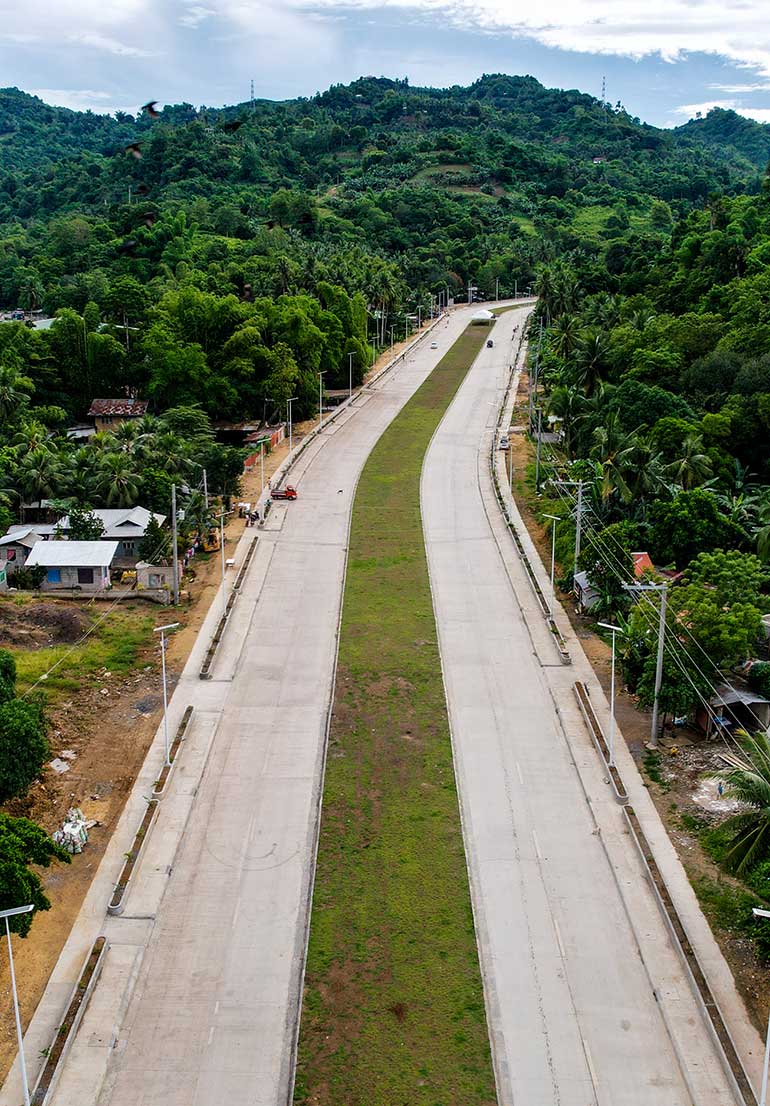
For the Tourism Road Infrastructure Program (TRIP), a total of P121 million was allocated from 2016 to 2021 for the construction, improvement, and upgrading of 4,268 km of roads, with 2,436 km of tourism roads completed.

Under the Roads Leveraging Linkages for Industry and Trade (RoLL-IT) Program, a budget of P42 billion for about 1,519 km of roads leading to industries and trade corridors across the country were appropriated, with 704 km of it already completed.

For the KAlsada TUngo sa PAliparan, Riles at daungAN (KATUPARAN) Project, from 2016 to 2021, a total of P29 billion has already been allocated, for the upgrading and improvement of 906 km of access roads to airports, railway stations and seaports, with 443 km of it already completed.

For the current situation of the country with the ongoing health crisis, regional evacuation centers were also utilized as health/quarantine facilities to provide health monitoring and treatment.

Farm-to-mill roads under the Agri-Infrastructure Support Programs are also under way, with 2,025 km of farm-to-market roads already completed, and 95 km of farm-to-mill roads completed.

The Tatag ng Imprastraktura Para sa Kapayapaan at Seguridad (TIKAS) Project, on the other hand, focuses on the 616 military/police projects, with 133 of them already completed. The Basic Education Facilities Fund Program has already built and constructed 150,149 classrooms, while 2,064 school workshop buildings and other school facilities were constructed, rehabilitated, and improved.

For the current situation of the country with the ongoing health crisis, regional evacuation centers were also utilized as health/quarantine facilities to provide health monitoring and treatment — there are now 230 completed evacuation centers, with 105 of them currently under construction, rehabilitation and improvement.

Mega community quarantine facilities, dormitories and modular hospitals are also part of the DPWH’s current projects, in response to the ongoing pandemic — there are now a total of 819 quarantine facilities, off-site dorms, and modular hospitals totaling to 29,776 bed capacity.

JULY 2016 TO MAY 2021

IN NUMBERS

To rectify the flood situation of the country every typhoon season, there have already been 11,340 completed flood control projects, with 4,155 currently under construction.

These include the Kabasalan River Flood Control Structure in Zamboanga Sibugay, the Estero De Sunog Apog Pumping Station, the flood risk management project in Cagayan River and the Tagaloan River.

5,950 bridges were also completed during these 5 years, with 1,859 of them under construction. These include the BGC-Ortigas Center Link Road Project, the Estrella Pantalleon Bridge, and the Binondo-Intramuros Bridge.

On the works are the Panguil Bay Bridge that will connect the City of Tangub in Misamis Occidental to the Municipality of Tubod in Lanao del Norte. The Panay-Guimaras-Negros Link Bridge is another major connecting project, with the 32.47-km, two-sea-crossing bridge connecting the three islands. The Bataan-Cavite Interlink Bridge, also under development, is a 32.15-km link starting from Brgy. Alas-asin in Mariveles, Bataan, crossing Manila Bay towards Brgy. Timalan, Naic, Cavite.

The DPWH also completed numerous road widening, construction and improvements from July 2016 to May 2021, with 29,264 of them already completed, and 15,134 ongoing ones. These include the Tarlac-Pangasinan-La Union Expressway (TPLEX), TPLEX Extension, Central Luzon Link Expressway, the NLEX Harbor Link Segment 10 and the C3-R10 Section, the NLEX-SLEX Connector Road, the Metro Manila Skyway Stage 3, the NAIAX Phase II, the Alabang-Sucat Skyway Connection and Ramp Extension, and the Cavite-Laguna Expressway, among many others.


Spotlight is BusinessWorld’s sponsored section that allows advertisers to amplify their brand and connect with BusinessWorld’s audience by enabling them to publish their stories directly on the BusinessWorld Web site. For more information, send an email to online@bworldonline.com.

Join us on Viber to get more updates from BusinessWorld: https://bit.ly/3hv6bLA.

 

US port’s supply chain fix challenge: selling 24/7 shifts 

IMAGE VIA THE PORT OF LOS ANGELES

LOS ANGELES — The Port of Los Angeles is beginning the hard work of convincing terminal operators, importers, warehouses owners and trucking firms to embrace moving more cargo at night.  

“It’s not a single lever we can pull today to open up all the gates,” Executive Director Gene Seroka said on Thursday.  

On Wednesday, the White House gathered stakeholders including retailers Walmart and Home Depot, logistics firms United Parcel Service and FedEx, and electronics supplier Samsung. The companies pledged to use more overnight workers to ease the backups at the Los Angeles and Long Beach port complex that is the No. 1 gateway for trade with China.  

We’re “trying to squeeze every minute, every hour of efficiency out of this port that we can,” said Mr. Seroka. Most work is currently done during the day, although some parts of the operation already run 24/7. The White House said adding more overnight shifts could double available time to move cargo and union leaders are onboard.  

COVID-19 (coronavirus disease 2019) fueled demand for consumer goods while at the same time closing factories and ports. A shortfall of workers ranging from truckers to warehouse staff are driving up the cost of goods, contributing to product shortages, and raising alarms about a worsening global supply-chain crisis.  

The global supply chain “was creaking along before the pandemic,” said John Porcari, port envoy for the White House Supply Chain Disruptions Task Force.  

The health crisis laid bare weaknesses in a brittle global supply chain built for predictable, just-in-time cargo flows, he said. In many cases, it is “your grandfather’s infrastructure that we’re working with.”  

STRESS AT EVERY LINK  

The ports of Los Angeles and Long Beach significantly lag Chinese rivals when it comes to port efficiency, according to a ranking prepared by the World Bank and IHS Markit.  

Port terminals in China usually operate 24/7, many tasks are automated and labor slowdowns are rare, US-based shipping industry consultant Jon Monroe said.  

Messrs. Seroka and Porcari stressed that US supply chain improvements will not come at the flip of a switch. Changes are needed at every link to ease the impact of unintended consequences, they said.  

The White House efforts announced Wednesday are expected to account for just 3,500 additional containers per week being moved at night — a tiny fraction of the 120,000 containers already moving each week.  

Meanwhile, there are 62 container ships waiting to unload some 500,000 containers at Los Angeles/Long Beach — and another 25 are scheduled to arrive in the next three days.  

Those vessels are carrying parts and components for US manufacturers as well as seasonal goods for retailers racing stock up for the Nov. 26 kickoff of the make-or-break holiday selling season, Mr. Seroka said.  

Extended hours at Los Angeles/Long Beach could benefit Honda Motor Co, hit hard by the automotive chip shortage, and Mattel, which is under pressure to get holiday toys to stores, according to Panjiva, the supply chain research unit of S&P Global Market Intelligence.  

And the effort raises the question of where to put all the stuff.  

The Greater Los Angeles area logged a record low vacancy rate of 1% for warehouses and other industrial space during the third quarter, according to CBRE Group, a commercial real estate services firm.  

“If we increase the capacity at the port, then we still have to find space to temporarily store goods in warehouses,” said Douglas Kent, an executive vice president at the Association for Supply Chain Management. — Lisa Baertlein/Reuters  

ADVERTISEMENT
ADVERTISEMENT