Home Blog Page 7266

DoF says peso more volatile in the first half

PHILSTAR

THE PHILIPPINE PESO was among the Asian currencies that showed high volatility versus the dollar in the first half, the latest economic bulletin by the Department of Finance (DoF) showed.

The volatility of the peso-dollar exchange rate, measured through the coefficient of variation (CV), picked up to 1.13 in the first half from 0.92 at the end of 2020, DoF Undersecretary and Chief Economist Gil S. Beltran said on Sunday.

This was the second-highest among Asian currencies in the report next to Vietnamese dong’s CV of 1.84 as of June, easing from 4.01 in 2020.

The bulletin covered 11 Asian currencies: the Philippine peso, the Brunei dollar, Chinese yuan, Indian rupee, Indonesian rupiah, Japanese yen, Korean won, Malaysian ringgit, Singapore dollar, Thai baht, and Vietnamese dong.

The peso last year ended at P48.036 per dollar and was among the most stable Asian currencies with a CV of 0.92, the second lowest after the Thai baht, even with markets taking a hit due to the coronavirus pandemic.

However, the peso’s CV picked up to 1.17 in the first quarter and 1.03 in the second quarter, while the volatility of currencies in other economies eased. The peso-dollar CV went up to 0.94 in June alone from 0.82 in May.

The local unit closed at P48.544 against the dollar at end-June, depreciating by 1.05% from the end-2020 level. It has been trading at the P50-per-dollar level in the past days.

“This increase in volatility may be traced to the Fed’s indication to start ‘talking about talking’ about a taper, that is, reducing its purchase of government bonds and mortgage-backed securities,” Mr. Beltran said.

The US Federal Reserve in June said they may gradually reduce their bond purchases soon and start increasing interest rates in 2023 as the US economy shows more signs of recovery.

“Strong fundamentals support the relative stability of the peso. As of end-May, for instance, the country’s reserves of $107.25 billion could cover more than a year’s worth of imports. Furthermore, the country’s exposure to external debt, measured in percent to gross domestic product, is the lowest among major Southeast Asian economies,” Mr. Beltran added.

Economic managers expect the peso to range from P48 to P53 versus the dollar this year. — B.M. Laforga

2021 Old Manila wine dinner series continues

THE 2021 OLD Manila Wine Dinner Series continues, featuring a five-course degustation menu, created by Old Manila Chef de Cuisine Allan Briones, paired with wines from Spottswoode Estate Vineyard & Winery. The wine dinner is set for July 20, 6:30 p.m., at The Peninsula Manila’s signature fine dining restaurant Old Manila. Price per person is P12,000, inclusive of taxes. This is the second time this year that Mr. Briones is collaborating with an award-winning vineyard and winery, and creating a dinner around the wine. During the five-course dinner, select fine wines and Champagnes will be paired with each course. Guests will also have the opportunity to “meet” Spottwoode Estate President and CEO Beth Novak Milliken who will be streaming live from Napa Valley, as well as Mr. Briones and his team and ask questions about the wines and dishes they will be enjoying. The menu includes dishes such as a Goats Cheese and Crab Tart which uses artisanal goats cheese crafted in Butuan and crabs harvested from the waters off Sulu. Also on the menu are a Primavera Truffle Risotto, Mediterranean Dry-aged Lamb Burger on a Rosemary Brioche, Wagyu Parmentier with Potato Textures, and Dark Chocolate and Orange Crémeux. Pre-paid reservations are required for the dinner as there is very limited seating. For inquiries and orders, call 8887-2888 (trunk line) or through PenChat, The Peninsula Manila’s 24-hour e-concierge by using this link: https://bit.ly/PenChatFacebook.

Germany detects first ASF outbreak in farmed pigs near Polish border

REUTERS

HAMBURG — The first cases of African Swine Fever (ASF) have been confirmed in farm pigs in Germany, the country’s federal agriculture ministry said on Friday.

The disease was confirmed in pigs on two farms in the eastern German state of Brandenburg.

Previous cases have only been found in wild animals, with 1,267 ASF cases so far in wild boar in the Brandenburg area. Brandenburg is on the border with Poland, where the disease is widespread.

China and other pork buyers banned imports of German pork in September 2020 after the first case was confirmed in wild animals. Import bans by China and major Asian importers remain in place.

Germany’s Friedrich-Loeffler scientific institute had confirmed the farm animals had ASF, the agriculture ministry said.

The disease was found in pigs on one organic farm with 200 animals and on a smallholding with only two pigs, the Brandenburg health ministry said. All have been slaughtered.

“For almost a year we have been fighting against the enormous pressure of the disease from Poland,” said Brandenburg state health minister Ursula Nonnemacher.

Fencing has been built along the Polish border to prevent wild boars entering Germany and six zones were established with intensified hunting of wild boars, she said.

“I very much regret the first cases in farm pigs, but sadly this possibility could never be fully ruled out,” Nonnemacher said.

The import bans on German pork imposed last year have led to trade displacement, with EU producers including Spain raising exports to Asia while Germany increased sales inside the EU.

The agriculture ministry said the regionalization concept means Germany’s pork exports inside the EU will continue.

The regionalization concept means stopping pork imports from the region of a country where African swine fever has been found but not a blanket ban on sales from the whole country. — Reuters

Jaguar Philippines presents new XF, F-Pace

PHOTO FROM JAGUAR PHILIPPINES

JAGUAR PHILIPPINES last week presented to media the 2021 model year Jaguar XF and Jaguar F-Pace.

The Jaguar XF 2.0 S boasts a refreshed exterior and all-new interior “incorporating luxurious new materials, and seamlessly integrated, connected and future-proof technologies.” Under the hood is a choice between a next-generation, 2.0-liter four-cylinder Ingenium turbocharged diesel engine and the latest 2.0-liter four-cylinder Ingenium petrol mill.

The new XF receives a front bumper with enlarged, lower air intakes to accentuate the car’s width, also helped along with a wider front grille featuring a mesh design detail inspired by Jaguar’s heritage logo. Flanking it are super slim all-LED quad headlights with double-J daytime running lights (DRLs). The side fender vents get the Leaper emblem. At the rear are a wider bumper and body-colored rear upper valance, which visually lowers the car.

“The new cockpit design is bolder, more dynamic and with greater focus on the driver. A new sporty center console, faster in profile, (and) sweeps up to the dashboard incorporating a wireless device charger,” reported Jaguar Philippines in a release. “In the middle… is a seamlessly integrated centrally mounted 11.4-inch curved-glass HD touchscreen, which controls the new Pivi Pro infotainment system.”

A new Drive Selector features an upper section finished with a “cricket-ball” stitching, with the lower part made of precision-engineered metal for improved tactility. A 12.3-inch HD Interactive Driver Display boasts enhanced graphics and a configurable layout features for full-screen navigation mapping with turn-by-turn instructions, digital dials, media, contact list or infotainment details. A new head-up display makes it even easier for drivers to access key pieces of information. Apple CarPlay and Android Auto come standard.

Meanwhile, segment-first Active Road Noise Cancellation technology “constantly monitors vibrations from the road surface and calculates the opposite phase sound wave needed to remove the noise heard by the occupants.” This results in a quieter cabin — ultimately leading to reduced fatigue, which is a usual by-product of prolonged exposure to low-frequency noise. The XF monitors cabin occupancy, then optimizes performance.

A full 3D surround camera system provides drivers an enhanced 3D and 360-degree view around the car through the vehicle’s touchscreen, in aid of parking and maneuvering. The system can display several views simultaneously on the screen — including 3D perspectives, junction view, and ClearSight Plan View with dynamic Parking Aid overlays. An updated Meridian sound system now gets two additional center channel speakers for total of 12 speakers plus a 400W subwoofer.

The Jaguar F-Pace heralds an all-new interior, greater connectivity, and increased refinement. The cockpit design, said Jaguar, puts more emphasis on the driver. A new center console boasts a “faster” profile and “sweeps up to the instrument panel, and incorporates a wireless charger and greater console stowage.”

The F-Pace gets an integrated, centrally mounted 11.4-inch curved-glass HD touchscreen, which controls the new Pivi Pro infotainment system. “Authentic finishes, including wood veneers and aluminum, (are featured) in beautifully formed shapes such as the upper door insert and full-width ‘piano lid’ that is formed across the width of the instrument panel. Laser-etched mid-line speaker frets and the metallic rotary dial of the Jaguar Drive Control epitomize the attention-to-detail.”

The new F-Pace is powered by the company’s latest four-cylinder in-line diesel mild hybrid electric vehicle (MHEV) technology Ingenium engine. The 2.0-liter turbo mill has 199ps on tap, and is mated to an eight-speed automatic which drives all the wheels. The powertrain also boasts a belt integrated starter generator (BISG) “to harvest energy usually lost when slowing and braking. This energy is then stored in a separate 48V lithium-ion battery before being intelligently redeployed to assist the engine when accelerating away, as well as delivering a more refined stop/start system.”

As in the XF, the F-Pace gets a segment-first Active Road Noise Cancellation technology.

Jaguar equips it with its latest 3D surround camera technology to deliver more detail and a choice of real-time viewing when maneuvering the vehicle. The company said it commits to creating strong and lightweight vehicles, with aluminum-intensive architecture that employs recycled aluminum from closed-loop manufacturing for greater sustainability and is an important contribution towards Jaguar’s journey to Destination Zero, a world of zero emissions, zero accidents and zero congestion.

For more information, visit https://www.jaguar.ph/jaguar-range-xf and https://www.jaguar.ph/jaguar-range-f-pace.

Negative market sentiment drags down newbie DITO’s stock price

DITO Telecommunity Corp. saw its stock price go down on a week-on-week basis as negative market sentiment due to the persisting coronavirus pandemic offset any positive development from the telecommunications firm.

DITO’s stock price settled at P8.21 per share to end the trading week last Friday, down 7.3% from its stock price of P8.86 per share last July 9, Philippine Stock Exchange (PSE) data showed.

For the year, the company’s share price has gone down by 36.9%.

“[DITO] was mainly dragged down by the cautious sentiment on the overall market,” AAA Southeast Equities, Inc. Research Head Christopher John J. Mangun said in an e-mail.

Mr. Mangun said the news on the company’s expansion “was already factored into the price.” He also noted the company’s strategy on building its infrastructure in the provinces where there is not much demand for mobile data services, but said its transition to compete with incumbent telco players in Metro Manila and other major cities “will determine its long-term success.”

Mercantile Securities Corp. Analyst Jeff Radley C. See shared the same assessment on DITO building up market share, but nevertheless described the stock’s price movement last week as bearish.

“Volume traded grew but price is going down. It entails market sentiment,” Mr. See said in a Viber message.

A total of 33.80 million shares worth P290.47 million exchanged hands between July 12 and 16. The stock’s value and volume turnover figures last week were higher by 18.1% and 23.2% compared with those the week prior.

In a statement last week, the telecommunications firm announced its mobile services are now available “starting July 15” in 18 more areas, bringing the number to 158 cities and municipalities nationwide. DITO is targeting to complete 4,500 cell towers by December as part of its nationwide expansion. It has built over 3,000 towers as of July 1.

On the other hand, the same week saw the Philippine government announced a travel ban on Indonesia from July 16 to 31 after the latter overtook India in daily infections.

Meanwhile, the Philippines has extended its travel ban on India and six other countries, where a coronavirus variant has caused a surge in infections, until July 30. Also covered by the ban that was supposed to end on July 15 was Pakistan, Sri Lanka, Bangladesh, Nepal, Oman and the United Arab Emirates.

Last Friday, the Health department reported 16 new coronavirus cases of the more transmissible Delta variant. Of these, 11 were detected in Mindanao, Metro Manila, Central Luzon, and the Visayas while the remaining five are in Filipinos who returned from Qatar, the United Arab Emirates, and the United Kingdom.

Last Thursday, the presidential palace announced Manila and nearby cities would remain under a general lockdown until July 31 after some cities in the capital region experienced a spike in coronavirus infections. Other areas saw their respective quarantine levels extended during the same period.

“The market is waiting for earnings and good network to compete with the other two telcos,” Mercantile Securities’ Mr. See said, referring to the two incumbent firms PLDT, Inc. and Globe Telecom, Inc.

“There would not be much of a fundamental side for now since they are just expanding and building everything,” he added.

Mr. See placed the stock’s support levels at P8.15 and P7.00 per share, and resistance levels at P8.75 and P9.30 apiece.

For AAA Southeast Equities’ Mr. Mangun, DITO may “bottom out” and hold support between P7.50-7.80 and major resistance between P10-10.20. — Ana Olivia A. Tirona

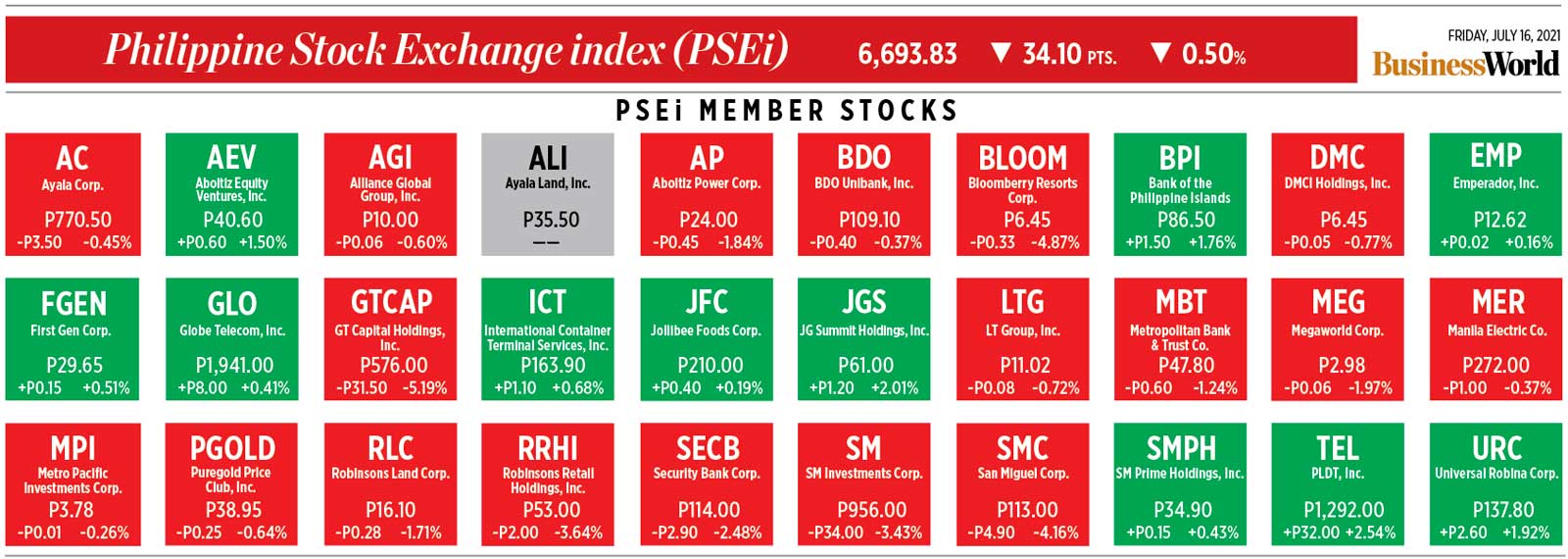
How PSEi member stocks performed — July 16, 2021

Here’s a quick glance at how PSEi stocks fared on Friday, July 16, 2021.


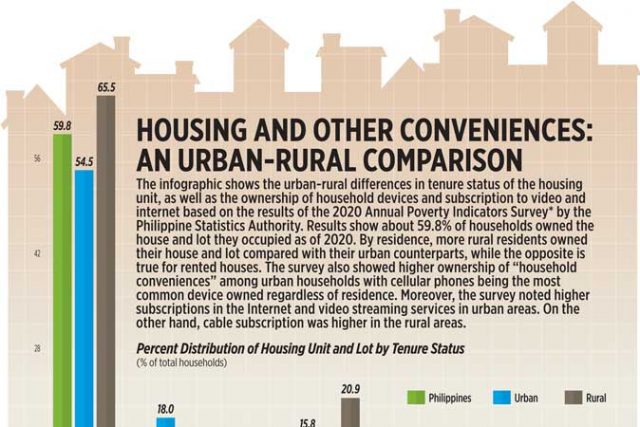
Housing and other conveniences: An urban-rural comparison

Housing and other conveniences: An urban-rural comparison

Market to stay cautious as Delta variant cases rise

REUTERS

INVESTORS in the Philippine stock market will likely remain cautious this week after the country logged more cases of the coronavirus disease 2019 (COVID-19) Delta variant and as they wait for the release of economic data and corporate earnings reports.

The bellwether Philippine Stock Exchange index (PSEi) went down by 34.10 points or 0.5% to close at 6,693.83 on Friday, while the broader all shares index lost 45.08 points or 1.07% to 4,137.94.

Week on week, the benchmark index dropped by 141.09 points from its 6,834.92 finish on July 9.

“The downgrade in the Philippines’ outlook from stable to negative by Fitch Ratings raised economic worries which in turn weighed on sentiment,” Philstocks Financial, Inc. Senior Research Analyst Japhet Louis O. Tantiangco said in a Viber message on Friday.

“The detection of COVID-19 cases with a locally transmitted Delta variant also added fuel to the pessimism,” Mr. Tantiangco added.

Fitch last week revised its outlook for the Philippines but kept its investment grade “BBB” rating for the country. A “negative” outlook means the country could get a rating downgrade within the next 12 to 18 months.

Meanwhile, the Health department reported 16 new cases of the Delta variant of COVID-19 on Friday, 11 of which were local infections in Mindanao, Metro Manila, Central Luzon, and the Visayas. Five cases were returning Filipinos abroad.

“Market is getting impatient with extended quarantine measures and slow vaccination and is thus pricing a low growth scenario,” First Metro Investment Corp. (FMIC) Head of Research Cristina S. Ulang said in a Viber message on Friday.

Diversified Securities, Inc. Equity Trader Aniceto K. Pangan said he expects the negative sentiment brought by the increase in Delta variant cases in the country to be sustained this week.

“Another factor which may negatively affect the market is the weakening peso as it is seen to discourage foreign investors from parking their funds in the local market,” Philstocks Financial’s Mr. Tantiangco said in a text message.

“If the peso declines further [this] week, then we may see more foreign fund outflows from the market,” he added.

Mr. Tantiangco forecasts tepid trading this week as investors are expected to remain cautious while awaiting the second quarter results of listed companies.

“Upcoming economic data specifically second quarter GDP (gross domestic product) growth, inflation in July, and corporate earnings will help improve sentiment,” FMIC’s Ms. Ulang added.

“In the coming days, we’ll have to monitor how the COVID-19 situation in the country progresses, weighing it against the ongoing vaccination program of the government,” Timson Securities, Inc. Trader Darren Blaine T. Pangan said in a Viber message on Saturday. He said expects the index to trade between 6,600 to 7,065 this week. — Keren Concepcion G. Valmonte

Peso may drop vs dollar on virus fears, budget data

THE PESO may continue to depreciate versus the greenback this week on rising concerns due to the local transmission of the Delta variant of the coronavirus disease 2019 (COVID-19) and ahead of the release of latest budget balance data.

The local unit closed at P50.235 per dollar on Friday, slipping by 1.5 centavos from its P50.22 finish on Thursday, based on data from the Bankers Association of the Philippines.

It also retreated by 15.5 centavos from its close of P50.08 per dollar on July 9.

The peso weakened due to risk-off sentiment after the Health department reported the local transmission of the more infectious Delta variant of COVID-19, Rizal Commercial Banking Corp. (RCBC) Chief Economist Michael L. Ricafort said.

Health Undersecretary Maria Rosario S. Vergeire on Friday said there were 16 new patients that were sick with the Delta variant. Among them, 11 were locally transmitted cases, with six detected in Mindanao.

Authorities have imposed stricter restriction measures in Cagayan de Oro and Misamis Oriental to prevent further spread of the highly infectious variant.

Another factor that caused the peso to weaken last week was Fitch Ratings’ revision of its outlook for the Philippines to “negative” from “stable,” UnionBank of the Philippines, Inc. Chief Economist Ruben Carlo O. Asuncion said.

Fitch last week revised its outlook for the Philippines but kept its investment grade “BBB” rating for the country. A “negative” outlook means the country could get a rating downgrade within the next 12 to 18 months.

For this week, the exchange rate could be affected by the upcoming budget deficit data, RCBC’s Mr. Ricafort said.

The Bureau of the Treasury will release its June cash operations report on Friday, July 23.

In May, the government’s budget deficit narrowed to P200.3 billion from the P202.1-billion shortfall a year earlier. However, it widened by nearly five times from the P44-billion fiscal gap in April.

For the first five months, the fiscal deficit increased by 0.7% to P566.2 billion.

Meanwhile, UnionBank’s Mr. Asuncion said rising concerns over the spread of the Delta variant in the country may continue to affect the peso.

For this week, Mr. Ricafort gave a forecast range of P49.90 to P50.40, while Mr. Asuncion expects the peso to move within a tighter band of P50 to P50.40 per dollar. — L.W.T. Noble

Ports authority seeking bidders for 2 port expansion projects

THE PHILIPPINE Ports Authority (PPA) is seeking bidders for the expansion of Abra de Ilog Port in Occidental Mindoro and San Andres Port in Quezon.

The Abra de Ilog Port Expansion Project has an approved budget of P523.06 million, according to PPA’s invitation to bid.

The PPA wants the project completed within 660 days from the receipt by the successful bidder of the notice to proceed.

The agency said the auction format will be open competitive bidding using non-discretionary “pass/fail” criteria.

The PPA’s bids and awards committee will conduct a pre-bid conference on July 21.

It said the committee secretariat must receive the bids on or before Aug. 3 at 1 p.m.

Meanwhile, the San Andres Port Expansion Project has an approved budget of P183.25 million. It is targeted for completion within 450 calendar days from the receipt by the successful bidder of the notice to proceed.

The format will also be open competitive bidding using a non-discretionary “pass/fail” criteria.

A pre-bid conference will be conducted on July 21.

The PPA’s bids and awards secretariat must receive the bids on or before Aug. 3 at 9 a.m.

The PPA completed 27 port projects last year, accelerating infrastructure projects during the pandemic.

The PPA expects passenger volume of around 25 million-27 million between 2021 and 2023, way below the pre-pandemic traffic levels of nearly 84 million passengers annually. — Arjay L. Balinbin

RE generators say industry competitive, market abuse unlikely

ACENERGY.COM.PH

RENEWABLE ENERGY (RE) developers said there is sufficient competition in the industry to make market abuse unlikely, noting that any pricing issues that have emerged are due largely to capacity constraints.

The Developers of Renewable Energy for AdvanceMent, Inc. (DREAM) industry association made the remarks at a forum organized by the competition regulator.

“We have enough players in the industry to avoid market abuse,” DREAM President Jose M. Layug said Saturday at a Philippine Competition Commission (PCC) event.

“Particularly during times where there’s a lot of supply, market concentration is limited. In other words, there is inability on the part of the generators to control the market.”

Although there are market leaders, the entry of small players has widened ownership in power generation, he said. The Herfindahl–Hirschman Index, which measures market concentration, indicates that the industry has a sufficient number of entrants to avoid such abuse, he added.

The PCC is conducting an investigation into the industry following recent power outages on the Luzon Grid and whether they were the result of collusion. The PCC is working with the Energy Regulatory Commission (ERC), which ordered generation companies to explain the interruptions. 

Energy Secretary Alfonso G. Cusi said his department is also looking into claims of sabotage.

The grid was placed on red alert after a series of unscheduled power plant outages, causing a spike in market prices.

Mr. Layug, who is a former Energy undersecretary, said that the country needs to build more transmission and distribution lines, along with more power plants, noting the increase in prices when supply is down.

“That’s why we’ve been pushing government to make power plant construction and development more efficient,” he said.

PCC Chairman Arsenio M. Balisacan said more work needs to be done in defining the roles of the PCC and ERC in regulating competition in the energy sector.

“I think that there… are places that are available for better coordination between the two regulators. In fact, we have signed a tripartite memorandum of agreement (MoA) — DoE, ERC, and PCC — toward improved coordination and exchange of information,” he said.

“So far with respect to the brownout case that was brought up to the commission by the Office of the President, we’re using that MoA… to get that sharing of information.” — Jenina P. Ibañez

Co-ops: Supply issues caused higher power prices

BW FILE PHOTO

THE PHILIPPINE Rural Electric Cooperatives Association, Inc. (Philreca) said that electricity rates rose in June due to supply issues and not the failure of electric cooperatives (ECs) to procure power through competitive bidding.

“The sudden spike in electricity prices last month is not because there is a failure for ECs to conduct CSPs (competitive selection processes). This is more of a supply concern… We only conduct CSPs and enter to power supply agreements depending on our long-term projected needs — and not more than that,” Philreca told BusinessWorld in an e-mail last week.

“We cannot just purchase or enter into contracts that will result to more than what we need so as to avoid purchasing from the market because this would result in higher prices for electricity,” it added.

Advocacy group Laban Konsyumer, Inc. (LKI) called on ECs to enter into power supply agreements with generation companies (gencos) through CSPs following the recent surge in wholesale electricity spot market (WESM) prices.

In a July 11 statement, LKI President Victorio Mario A. Dimagiba said that high spot market prices “greatly affected” ECs that bought more from the WESM, which in turn burdened consumers in the form of higher electricity rates.

“Batelec II, the largest EC in the Philippines, implemented an increase of P1.87 per kilowatt-hour (kWh). Penelco, the EC of Bataan, implemented an increase of P1.54/kWh. In PELCO II (located in) Pampanga, the rate hike was P2.50/kWh. What’s surprising is the extent of the WESM exposure of all these electric cooperatives,” he said.

“Considering the examples of ECs in Bataan, Batangas, and Pampanga that bought more than 30% of their power from the WESM, this meant that uncontracted capacities are available. ECs should conduct tender offer(s) and invite gencos to enter into power supply agreements via the CSP,” Mr. Dimagiba added.

The Independent Electricity Market Operator of the Philippines estimated the average spot market price at P6.53 per kilowatt hour in June, down from P7.66 in May.

Philreca, whose members number 121 ECs, said entering into contracts through CSPs is a long-term commitment of up to 20 years.

“What happened in the last months is not really because we lacked the initiative to conduct CSPs — this is really because there was a lack of supply, and we were forced to buy from the market temporarily,” the organization said.

Philreca said procuring power via CSPs can result in stable electricity prices as long as the contracted generation companies provide the committed amounts, and that they do not undergo unplanned outages or maintenance work.

Between May 31 and June 2, the Luzon grid was placed under a series of yellow and red alerts following forced plant outages, thinning reserves, and as demand rose due to high temperatures.

The system operator declares a yellow alert if reserves fall below ideal levels. The yellow alert shifts to a red alert if the supply-demand balance worsens, triggering rotating brownouts. — Angelica Y. Yang