Home Blog Page 7227

More small firms now eligible for 13th month pay loan program

THE COVERAGE of a loan program aimed at helping small businesses give the 13th month pay of their employees has been expanded to include more firms, the Department of Trade and Industry (DTI) said.

Trade Secretary and Small Business Corp. (SB Corp.) Chairman Ramon M. Lopez said during the virtual ceremonial launch of the 13th month pay loan facility on Friday that the initiative now covers micro and small businesses with a maximum of 40 employees from 20 previously.

“We are increasing the facility to a maximum of 40 employees per company since for every employee, there is a budget of P12,000 to be allotted,” Mr. Lopez said.

“The facility is an assistance. However, the company will have to shoulder the other part of the 13th month pay. If there are 40 employees, the maximum amount that can borrowed by interested small businesses is about P480,000,” he added.

Robert Bastillo, SB Corp. spokesman, said the coverage of the program was expanded to give assistance to more employees and small businesses.

“When we first announced this program, the target is only 20 employees. After that, we increased the loan fund from P200 million to P500 million to accommodate more, and we also increased the maximum number of employees that can be covered from 20 to 40. We hope that by making those little adjustments, we could help more,” Mr. Bastillo said.

SB Corp., which is offering the loan facility, said it has already received 77 applications as of Nov. 12. Applications will be accepted from Nov. 2 to Dec. 7.

Of the total applications, 25 have been approved. Total loans approved have reached P5.05 million.

The loan facility has a budget of P500 million and offers loans with zero interest payable within 12 months.

Around 8,000 micro and small firms listed under the Labor department’s database of small businesses that availed of flexible working arrangements from March 16, 2020 to Oct. 15, 2021 are eligible for the loan facility. — R.M.D. Ochave

Former NEDA chiefs call on gov’t to address inequalities caused by the pandemic

THE GOVERNMENT should push for more targeted assistance to address inequalities that affect vulnerable groups, two former socio-economic planning chiefs said. 

“This big issue about increasing inequality, and a big part of that is coming from this digital divide access to schools, access to health, access to employment, access to almost everything now depends so much on access to the Internet, access to good, quality telecom facilities,” Philippine Competition Commission Chairman Arsenio M. Balisacan, who is also a former secretary of the National Economic and Development Authority, said at an online forum of the Philippine Economic Society on Friday. 

He said there should be targeted internet allowance for students that are much in need of access for virtual learning.  

Mr. Balisacan added grants to small businesses as well as focused wage subsides for contact-intensive sectors could also be looked into. 

Emmanuel F. Esguerra, another former NEDA chief who is now a professor at the Development Academy of the Philippines, recommended a national survey on Filipinos’ sentiment regarding the new normal, especially its impact on their work life. 

He noted adopting work-from-home arrangements in the long-term will impact the work-life balance of employees. 

“It (work from home) is therefore bound to cast a spotlight on existing labor laws as it already has in relation to gig economy, especially on the question of who is an employee and who deserves protection under the labor laws,” Mr. Esguerra said. — LWTN 

PNB net income down in Q3

BW FILE PHOTO

PHILIPPINE National Bank (PNB) recorded a lower net income in the third quarter as it set aside higher credit provisions. 

The bank’s net profit dropped 12.9% to $2.182 billion year on year in the third quarter of 2021 from $2.506 billion, based on its financial report published on Friday. 

“Our performance this quarter shows that PNB continues to be profitable despite the negative impact of the pandemic on some of our customers and the overall economy,” PNB President and Chief Executive Officer Jose Arnulfo “Wick” A. Veloso said in a statement. 

“With the recent reduction in COVID-19 cases, we are seeing a better-moving economy as the government is allowing more mobility. We continue to serve our customers and work together with the government with the goal of supporting the Philippine economy in the road to recovery,” Mr. Veloso said.  

In the first nine months of the year, PNB’s net income surged by more than six times (524%) to P24.312 billion from P3.896 billion in the same period of 2020. 

In May, the bank recognized a one-off gain of P33.6 billion from the transfer of prime real estate properties in exchange for shares of PNB Holdings Corp. 

PNB’s return on equity and assets as of end-September were at 14% and 1.8%, respectively. 

The lender’s net interest income in the third quarter rose 2.79% year on year to P8.901 billion from P8.659 billion. This was backed by higher interest earnings as interest expense declined.  

PNB’s net interest margin as of end-September was at 3.3%, slightly down from 3.6% a year earlier. 

Meanwhile, net income from service fees and commissions rose 65.7% to P1.414 billion in the July to September period from P853.146 million a year ago. 

Other income also improved 14% to P1.005 billion in the three months to September from P878.446 million in the same period of 2020. 

“[This] is mainly due to the recognition of P800-million gain on sale of certain loans,” the bank said. It was partially offset by losses from foreign exchange and lower equity in net earnings of an associate, PNB added. 

For the third quarter, PNB’s operating expenses rose 10% to P7.851 billion year on year from P7.128 billion. 

The bank’s provision for impairment losses surged 142% to P1.423 billion in the quarter from P587.426 million a year earlier. This brought PNB’s provisions for the first nine months to P20.445 billion, up 126% from P9.02 billion in the same period of 2020. 

The bank’s loans and receivables stood at P600.07 billion as of end-September. Gross non-performing loan (NPL) ratio reached 10.8%, while NPL coverage ratio was at 63.6%. 

The bank’s consolidated total assets increased 11% from year-ago levels to P1.1 trillion backed by higher loans and treasury assets.  

On the funding side, PNB’s deposit liabilities rose 16% year on year to P854.738 billion as of end-September. The expansion was mainly backed by current account, savings account deposits. 

As of end-September, PNB’s capital adequacy ratio stood at 14.3%, while common equity Tier 1 ratio was at 13.5%. Both are above minimum regulatory requirements. 

PNB closed at P20.95 on Friday, down by 45 centavos from its previous finish. — Luz Wendy T. Noble 

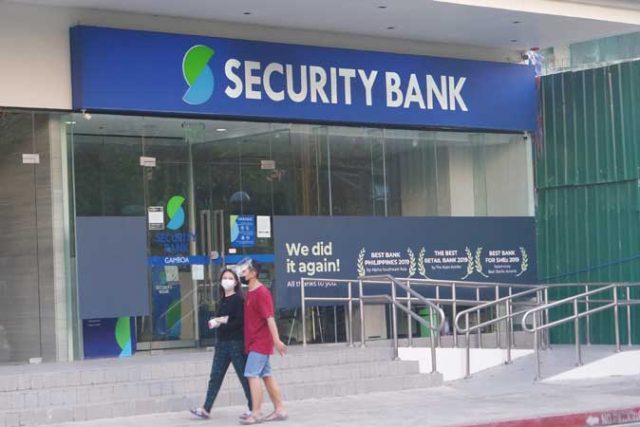
Security Bank profit up 71% in third quarter

BW FILE PHOTO

Security Bank Corp. posted higher net profit in the third quarter, even as its operating income dropped, as it significantly reduced its loan loss provisions and expenses. 

The lender’s net income rose 71% year on year to P1.715 billion in the July to September period from P1.002 billion, based on its quarterly report released on Friday. 

For the first nine months, its net income was at P4.8 billion, down from P6.7 billion last year. Return on assets and equity were at 0.95% and 5.2% at end-September, respectively. 

“We are optimistic on the improvements in the economic and health data over the past few weeks and the subsequent steps taken to open the economy,” Security Bank President & Chief Executive Officer Sanjiv Vohra said in a statement. 

“The bank is well positioned to support our clients as they recover from the pandemic impact,” Mr. Vohra said. 

Security Bank’s net interest income dropped 8.4% year on year to P6.915 billion in the third quarter from P7.55 billion. 

The lender’s other income also declined 67% to P2.214 billion in the third quarter from P6.814 billion a year earlier. This was mainly due to trading losses, which offset its higher fee income. 

This brought Security Bank’s total operating income to P9.129 billion in the third quarter, down by 36.4% year on year from P14.365 billion.  

Meanwhile, the bank’s total operating expenses in the third quarter dropped 53.8% year on year to P7.043 billion from P15.249 billion. 

Security Bank’s provisions for credit losses decreased 83.6% to P1.649 billion from P10.075 billion a year ago. For the first nine months of 2021, it set aside P4.089 billion, down by 80.5% from the P21.059 billion a year earlier. 

Gross loans slipped 1% year on year to P449 billion as of end-September. This was mainly due to the 12% decline in retail loans, which was partially offset by the 3% increase in wholesale borrowings.  

The bank’s gross non-performing loan (NPL) ratio stood at 4.15% as of end-September, while NPL reserve cover was at 91%.  

Meanwhile, total deposits inched up 20% year on year to P522 billion as of end-September, backed by the growth in low-cost savings and demand-deposit which rose by 24%, as well as the 24% rise in high-cost deposits. 

Security Bank’s capital adequacy ratio and common equity Tier 1 ratio improved to 20.1% and 19.5% as of September from 19.9% and 19%, respectively. 

Total assets stood at P699 billion as of end-September.  

The bank’s shares closed at P122 apiece on Friday, up by 50 centavos or by 0.41%. — L.W.T. Noble 

BSP eyeing cross-border payment deals with Thailand, Malaysia

BW FILE PHOTO

THE BANGKO SENTRAL ng Pilipinas (BSP) is also looking into forging cross-border payment agreements with Thailand and Malaysia, officials said. 

“There’s a constant communication with ASEAN (Association of Southeast Asian Nations) neighbors to also enter cross-border agreements,” Raymond O. Estioko, director of the Payment System Oversight Department of the BSP, said at the virtual Digital Pilipinas – World Fintech Festival Stage held on Friday. 

Earlier this week, the BSP and the Monetary Authority of Singapore (MAS) signed an enhanced FinTech Cooperation Agreement to facilitate payments between the Philippines and Singapore. In 2017, the central banks had an initial agreement to broaden the scope of collaboration and partnership between the BSP and MAS.  

“The upgrade of the agreement dovetails really well with the goal of ASEAN leaders to facilitate payments integration in the region, that would usher further ASEAN economic integration,” BSP Assistant Governor Edna C. Villa said. 

The new agreement signals the start of formal dialogue between BSP and MAS to link their retail electronic fund transfer systems — InstaPay for the Philippines and PayNow for Singapore. 

Mr. Estioko said they are looking into inking similar agreements with Malaysia and Thailand due to their economic transactions with the Philippines. 

“Singapore was just the first because of our strong economic relationship with them. They have that bilateral and multilateral experience as far as payments connectivity is concerned, which we can learn from,” he said. 

Ms. Villa said cross-border payment links can boost the regional economy. She added the region has also seen increasing visitor arrivals.  

“Given these, ASEAN member states have agreed to prioritize the establishment of interoperable cross-border real time payment systems which can support the increasing globalization of trade and investments as well as growing tourism and manpower mobility in the region,” she said. — LWTN 

Central bank fully awards one-month securities

BW FILE PHOTO

THE CENTRAL BANK raised P110 billion as planned via its one-month bills even as its average rate inched up following elevated US consumer inflation. 

The Bangko Sentral ng Pilipinas (BSP) fully awarded its 28-day bills on Friday, with the offer oversubscribed as tenders hit P110.25 billion. However, the demand was lower than the P148.69 billion seen in the previous auction. 

Accepted rates for the one-month papers ranged from 1.7475% to 2%, wider than the 1.75% to 1.7799% margin seen a week earlier. This caused the average rate of the 28-day securities to increase by 3.43 basis points to 1.7934% from 1.7591% previously. 

The BSP bills and the term deposit facility are used to mop up excess liquidity in the financial system and guide market rates. 

The average rate of the central bank’s short-term bills rose week on week after the multi-year high rise in the US consumer price index, Rizal Commercial Banking Corp. Chief Economist Michael L. Ricafort said in a Viber message. 

The US Labor department on Wednesday reported the consumer price index rose 0.9% last month, Reuters reported. This brought the annual increase in the consumer price index to 6.2%, which was the biggest since November 1990. 

The continued uptick in global oil prices also affected rates, Mr. Ricafort added. — L.W.T. Noble 

Peso rises to P49:$1 level on GIR, oil prices

PHILSTAR FILE PHOTO

THE PESO rebounded to close at the P49-per-dollar level on Friday amid a decline in oil prices and the increase in the country’s foreign exchange buffers. 

The local unit ended trading at P49.85 per dollar on Friday, rising by 31.5 centavos from its P50.165 close on Thursday, data from the Bankers Association of the Philippines showed. 

Week on week, the peso also strengthened by 48 centavos versus its close of P50.33 per dollar on Nov. 5.   

Friday’s finish is the peso’s strongest in nearly two months or since it closed at P49.79 per dollar on Sept. 15, Rizal Commercial Banking Corp. Chief Economist Michael L. Ricafort said in a Viber message. 

The peso opened Friday’s session stronger at P50.08 per dollar. Its weakest showing was at P50.105, while its intraday best was its finish of P49.85 versus the greenback. 

The peso strengthened on Friday on lower oil prices and the country’s higher gross international reserves (GIR), a trader said in an email. 

Reuters reported Friday that global pump prices dropped to wipe out gains from the previous session. 

US West Texas Intermediate crude futures dropped 0.8% or 61 cents to $80.98 a barrel at 0749 GMT on Friday, rolling back Thursday’s 25-cent gain. Meanwhile, Brent crude futures dropped 65 cents or 0.8% to $82.22 a barrel. 

Back home, the Bangko Sentral ng Pilipinas reported that GIR as of end-October rose 1.3% to $107.946 billion from $106.596 billion a month earlier. It likewise gained 4% from the $103.802 billion a year earlier. 

At its end-October level, the dollar buffers are enough to cover 7.8 times the country’s short-term external debt based on original maturity and 5.4 times based on residual maturity. It is also equivalent to 10.8 months’ worth of imports of goods and payments of services and primary income. 

Mr. Ricafort said the market was also anticipating the seasonal increase in remittances ahead of the Christmas season. — L.W.T. Noble 

2021 MMFF to be held in cinemas, official entries announced

There are eight official entries in the upcoming Metro Manila Film Festival (MMFF) it was announced on Friday. And unlike last year’s festival which was held online because of the coronavirus (COVID-19) pandemic, this year’s festival will return to the cinemas from Dec. 25 to Jan. 8, 2022. 

Out 19 submissions, this year’s lineup returns to eight titles compared to last year’s roster of 10 films, it was announced today at a press conference held at the Novotel Manila in Quezon City’s Araneta City.   

The eight films are Lawrence Fajardo’s action drama A Hard Day, starring Dingdong Dantes and John Arcilla; Jun Robles Lana’s comedy Big Night, starring Christian Bables and John Arcilla; Louie Ignacio’s romance comedy Huling Ulan Sa Tag-Araw, starring Rita Daniela and Ken Chan; Adolf Alix, Jr.’s horror film Huwag Kang Lalabas, starring Kim Chiu, Jameson Blake, Beauty Gonzalez, and Aiko Melendez; Carlo Francisco Manatad’s drama Kun Maupay Man It Panahon (Whether the Weather is Fine), starring Charo Santos-Concio and Daniel Padilla; Cathy Garcia-Molina’s romance comedy Love at First Stream, starring Kaori Oinuma, Jeremiah Lisbo, Daniella Stranner, and Anthony Jennings; Lester Dimaranan’s suspense drama Nelia, starring Wynwyn Marquez and Raymond Bagatsing; and Fifth Solomon’s comedy horror The Exorsis, starring Toni and Alex Gonzaga.  “Let us assume na Alert Level 2 pa rin (during the film festival), gagawa kami ng paraan na ating parada and even the awards night ay gawin nating parang normal [setup] (Let us assume that it will still be Alert Level 2, we will find a way to have the parade and even the awards night similar to a normal setup),” said Benjamin Abalos, Jr., Chairperson of the Metropolitan Manila Development Authority (MMDA), referring to the MMFF Parade of Stars and MMFF Gabi ng Parangal.  The MMDA runs the festival, which is now on its 47th year. 

“The purpose of this parade and awards is to grow interest again for people to go out and watch in the cinema. Whatever would really be for the best of the industry,” he said.  

Tignan natin kung pwede natin i-extend nang kaunti. (We will see if we can make extend the run a little). We will look at the legality and feasibility,” Mr. Abalos said regarding the possibility of extending the screening dates due to the limited seating capacity in cinemas.   

After being closed for 20 months because of the pandemic, selected cinemas in the country opened on Nov. 10 in accordance with health and safety protocols.    

For more information on the festival, visit https://www.facebook.com/watch/mmffofficial/.  Michelle Anne P. Soliman 

Stocks rise on lower COVID-19 cases, positive corporate results

BW FILE PHOTO

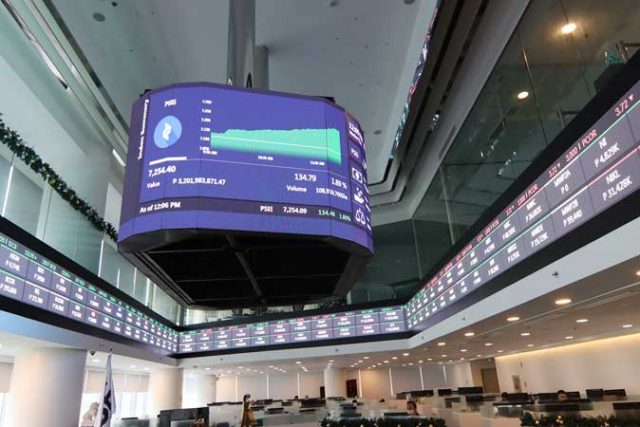
PHILIPPINE shares closed higher on Friday on positive sentiment due to the ongoing economic recovery and strong third quarter corporate earnings.

The bellwether Philippine Stock Exchange index (PSEi) increased 51.19 points or 0.69% to end at 7,382.84, while the broader all shares index rose 11.78 points or 0.29% to close at 3,964.68.

Japhet Louis O. Tantiangco, Philstocks Financial, Inc. senior research and engagement supervisor, said in a mobile phone message that the local bourse ended higher on the back of the ongoing economic recovery and positive third quarter corporate results.

“The local market bounced back this Friday as investors took opportunities out of its preceding two-day decline. Sentiment has been positive due to the robust third quarter corporate earnings, and improving economic prospects amid the easing of restrictions,” Mr. Tantiangco said.

“GT Capital Holdings, Inc. was the top index gainer, climbing 3.39% to P580.00. Bloomberry Resorts Corp. was at the tail end, falling 3.03% to P7.68,” he added.

The government placed the National Capital Region (NCR) under Alert Level 2 from Nov. 5 to Nov. 21, amid declining coronavirus disease 2019 (COVID-19) cases. The said alert level allows more businesses to operate at higher capacity.

Health Secretary Francisco T. Duque III earlier said NCR may be downgraded to Alert Level 1 if COVID-19 cases go below 1,000 or 500 per day.

Darren Blaine T. Pangan, trader at Timson Securities, Inc., said in a mobile phone message that the local market increased amid investor optimism.

“The market ended higher amid investors feeling optimistic over the global economic outlook, and also due to the positive corporate earnings results that continue to be released in the country,” Mr. Pangan said.

The market’s sectoral indices were mixed at the end of Friday’s trading. Property improved 64.34 points or 1.94% to 3,377.08; holding firms climbed 52.16 points or 0.73% to 7,106.63; and financials gained 6.03 points or 0.37% to 1,613.72.

Meanwhile, mining and oil declined 164.93 points or 1.67% to 9,683.87; industrials fell 32.79 points or 0.30% to 10,825.88; and services retreated 1.59 points or 0.07% to 2,004.12.

Value turnover on Friday reached P10.42 billion with 1.55 billion shares switching hands, an improvement compared to P7.25 billion with 1.02 billion issues recorded during the prior trading day.

Net foreign selling amounted to P306.23 million, lower than the P755.58 million in outflows reported on Thursday.

Decliners bested advancers, 109 against 81, while 50 names ended unchanged.

“Support seems to be around the 7,060 area, while resistance may be pegged at 7,454.50,” Mr. Pangan said. — Revin Mikhael D. Ochave

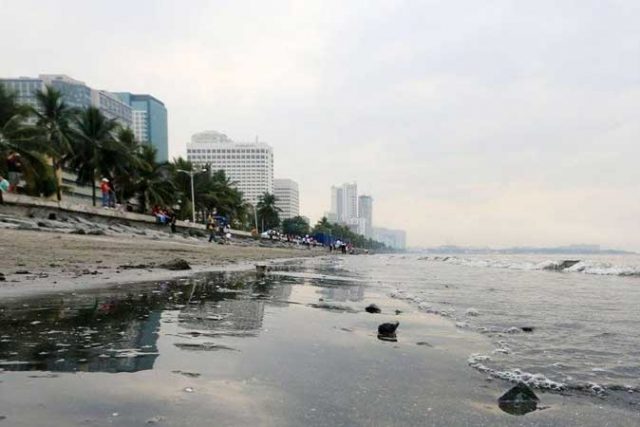
Complete rehabilitation of Manila Bay could take 40 years — scientists

The water quality of Manila Bay is improving but scientists aren’t ready to declare it swimmable just yet.  

“There’s a long way to go,” said Gil S. Jacinto, an oceanographer and retired professor from the University of the Philippines (UP) Marine Science Institute, on Manila Bay meeting Class SB status — a designation that means a body of water can be used for ecotourism and recreational activities.  

“Manila Bay” here refers to the larger Manila Bay that extends into southwestern Luzon. It covers eight provinces and 178 local government units in three regions of the country: National Capital Region (NCR), Region III, and Region IV-A. Of the eight provinces, four are coastal (Bataan, Bulacan, Cavite and Pampanga); four are non-coastal (Laguna, Nueva Ecija, Rizal and Tarlac).  

The DENR has been conducting cleanup drives since Environment Secretary Roy A. Cimatu launched “The Battle for Manila Bay” in 2019. 

This August, DENR noted that the fecal coliform level in Dolomite Beach dropped to 7,000 most probable number (mpn)/100ml from 523,000 mpn/100 ml in February, prompting Mr. Cimatu to say that water along Manila’s Baywalk could soon meet the 100 mpn/100ml standard for accommodating recreational activities.   

Aside from fecal coliforms (which indicates bacterial contamination from humans and warm-blooded animals), DENR criteria for assessing water quality include color, oil or grease.  

“While [the improvement] can be a direct result of DENR’s interventions, it could also be a result of the pandemic anthropause [the slowdown of human activity],” said Benjamin M. Vallejo, Jr., a professor at the UP Institute of Environmental Science and Meteorology.  

SATELLITE DATA 

Assessing the health of a body of water is a complex and broad topic that needs contextualization, according to Mark Jayson B. Felix, a researcher of STAMINA4Space’s GRASPED (Ground Receiving, Archiving, Science Product Development and Distribution) project.  

GRASPED undertakes the systematic operations, and subsequent data processing, of the country’s Diwata microsatellites.  

The Philippine Space Agency (PhilSA)’s Space Data Dashboard — which provides public access to various space data pertaining the country’s air quality, water quality, night lights, and land cover — shows that Manila Bay has improved on other fronts, such chlorophyll-a levels and turbidity. 

Chlorophyll-a, Mr. Felix explained, is a pigment inherent in microalgae called phytoplankton found in the ocean, which in turn account for 50 to 85% of oxygen in the atmosphere. In a balanced ecosystem, phytoplankton provide food for sea creatures. When too many nutrients are available, however, phytoplankton may form blooms — known as red tide — that harm fish, mammals, and people.   

Turbidity, meanwhile, is the measure of relative clarity of a liquid. Water that is high in particulate matter affects its clarity, and can also provide a place for pollutants to attach.  

“Those parameters are just a few of the many variables that can be used to study the health and status of our oceans,” said Mr. Felix. 

The dashboard, updated every quarter, showed a decrease in chlorophyll-a and turbidity levels in the Dolomite Beach area (or the portion of Manila Bay adjacent to Metro Manila) as of Nov. 3, compared to data captured between March 13–28, 2020. 

The cities and regions surrounding the bay are co-responsible for keeping its waters clean, said Mr. Felix.  

“Based on ground and satellite monitoring, there’s indeed a connection between Manila Bay’s rehabilitation and Cavite’s [garbage problem],” he said.  

Citing other satellite images, Mr. Jacinto added that discharge into the bay from Pasig River, as well as tributaries south of the river, reach and impact the Dolomite Beach.   

“We need proper waste disposal, [which is] made difficult by the continued presence of informal settlements along waterways and adjacent to the bay,” Mr. Jacinto also pointed out.  

The NCR has a 100% sewerage coverage plan that’s targeted for completion in 2037. Section 8.4 of the Clean Water Act of 2004’s implementing rules and regulations calls for water concessionaires to connect sewer lines to all households and commercial establishments in the capital by the said year 

BETWEEN 25 AND 40 YEARS 

Mr. Vallejo, who is part of a team that has been monitoring biofouling indicators in the Manila Port district and the South and North Harbors since 2009, added that the bay is improving based on the decreasing levels of the unwanted buildup of small animals, plants, or microorganisms on surfaces of submerged structures.  

As far as Mr. Vallejo knows, Sisiman Cove in Bataan is the only area in Manila Bay that has already met the DENR standards for swimmability.

If comparable studies in Singapore are considered, the complete positive outcome from Manila Bay’s cleanup could take between 25 and 40 years, he told BusinessWorld 

“Please recall that the Port of Singapore has an area of 600 hectares [6 square kilometers]. The Port of Manila, including the berthing areas for ships calling into port, has an estimated aggregate area of 100 square kilometers,” he added.  

Biden, Xi to address Asia-Pacific leaders on trade, COVID recovery

WELLINGTON – U.S. President Joe Biden and Chinese leader Xi Jinping are expected to address leaders of the Pacific Rim late on Friday amid heightened regional trade and geopolitical tensions.

China set the tone for the 21 member Asia Pacific Economic Cooperation (APEC) meeting this week, with Xi warning in a video recording on Thursday that the region must not return to the tensions of the Cold War era.

The comment was seen as a reference to efforts by the United States and its regional allies to blunt what they see as China’s growing coercive economic and military influence.

Biden is expected to address the gathering that begins midnight New Zealand time, the White House confirmed in a statement, adding he will discuss ongoing efforts to address the COVID-19 pandemic and support global economic recovery.

“The President’s participation demonstrates U.S. commitment to the Indo-Pacific region and to multilateral cooperation,” the statement said.

Chinese foreign ministry has also confirmed that Xi will speak at the meeting via video link.

Xi will take the virtual podium a day after China’s ruling Communist Party approved a rare resolution that amplified his status and authority, bolstering the likelihood of securing an unprecedented third leadership term next year.

The APEC gathering comes ahead of a much-anticipated online summit between Biden and Xi on Monday, as the super powers look to prevent growing tensions between the world’s two biggest economies from spiralling toward conflict.

APEC is the last multi-lateral meeting of the year and comes after a flurry of gatherings including the high-profile G20 summit in Rome and the COP26 climate meeting in Glasgow, Scotland.

APEC in 2021 was hosted entirely online due to host New Zealand’s hardline pandemic control measures and saw political and business leaders emphasize the need to fight COVID-19, decarbonise economies and grow sustainably.

During a session on Friday, German chancellor Angela Merkel reiterated the importance of vaccinations in the fight against the pandemic. New Zealand Prime Minister Jacinda Ardern then paid tribute to the outgoing chancellor.

The APEC summit will be held in Thailand next year.

The United States has offered to host the 2023 round of APEC meetings for the first time in over a decade, although a consensus has not been reached on this proposal, officials have said.

Russia’s President Vladimir Putin and Canadian President Justin Trudeau are also expected to speak at the meeting. – Reuters

Tesla dips after Musk sheds $5 billion in shares

Tesla‘s stock declined slightly on Thursday after filings revealed Chief Executive Elon Musk sold about $5 billion worth of his shares this week following his much-hyped Twitter poll.

The electric-car maker’s stock ended the session down 0.4% at $1,063.51 after tumbling earlier in the week.

Musk‘s share sale was his first since 2016 and comes after his weekend poll of Twitter users about offloading 10% of his Tesla stake, which comprises most of his estimated $281 billion fortune.

“I don’t think investors are reading in to the news negatively,” said Oliver Pursche, senior vice president and adviser at Wealthspire Advisors in New York. “If you believe in the Tesla story, this should not impact you or change your mind.”

Tesla‘s stock is in portfolios utilized by Wealthspire, Pursche said.

Filings showed Musk‘s trust sold nearly 3.6 million shares of Tesla, worth around $4 billion, while he also sold another 934,000 shares for $1.1 billion to cover tax obligations after exercising options to acquire nearly 2.2 million shares.

The sale equates to about 3% of Musk‘s total holdings. The options-related part of the sale was put in place in September, well before his Twitter poll.

Before the sale, Musk owned a 23% stake in Tesla, including stock options. He also owns other companies including SpaceX.

Musk‘s move to sell his Tesla shares comes as U.S. Senate Democrats propose taxing the stock holdings of billionaires to help finance President Joe Biden’s social spending plan.

“Elon Musk doesn’t take a salary, he’s paid in big chunks of stock. At some point in time you have to take some of that concentration down,” said Art Hogan, chief market strategist at National Securities in New York.

“This is not novel. It just gets more attention because it’s such a high market-cap type, attention-grabbing kind of company.”

With nearly 800,000 options, or about 12% of Tesla‘s open contracts, set to expire at the close of trading on Friday, some analysts have pointed to the potential for additional near-term volatility as investors and options dealers make adjustments to account for expiring positions.

Tesla did not respond to a request for comment.


EV MANIA

Tesla this week has lost $157 billion in stock market value, more than the combined market capitalizations of Ford Motor Co and General Motors Co. At the same time, demand for shares of electric vehicle makers has heated up.

Shares of Rivian Automotive Inc jumped 22% a day after a stellar market debut that sent the company’s valuation over $100 billion. Lucid Group surged 10%.

Underscoring retail investors’ thirst for EV stocks, Rivian, Tesla and Lucid made up three of the four most-traded stocks on Fidelity’s brokerage website on Thursday, with buy orders outnumbering sell orders.

Wall Street’s biggest institutional investors, including T. Rowe Price and BlackRock Inc, are betting on Rivian to be the next big player in a sector dominated by Tesla, amid mounting pressure on automakers in China and Europe to eliminate vehicle emissions.

“Rivian’s valuation makes it a legitimate option for institutional investors who have previously only had Tesla to play the electric vehicle space,” wrote Nicholas Colas, co-founder of DataTrek Research, in a recent note.

Four former and current Tesla board members, including Musk‘s brother, Kimbal Musk, have filed to sell nearly $1 billion worth of shares since Tesla‘s market value surpassed $1 trillion late last month, according to filings and market data.

Tesla‘s share price has made staggering gains over recent years and has epitomized the ebullient mood in U.S. markets and the optimism of small-time traders who have helped drive it up 51% this year and 1,300% from 2020 lows. – Reuters

ADVERTISEMENT
ADVERTISEMENT