Home Blog Page 7224

Gov’t adviser seeks further lockdown easing in capital

PHILIPPINE STAR/ MICHAEL VARCAS
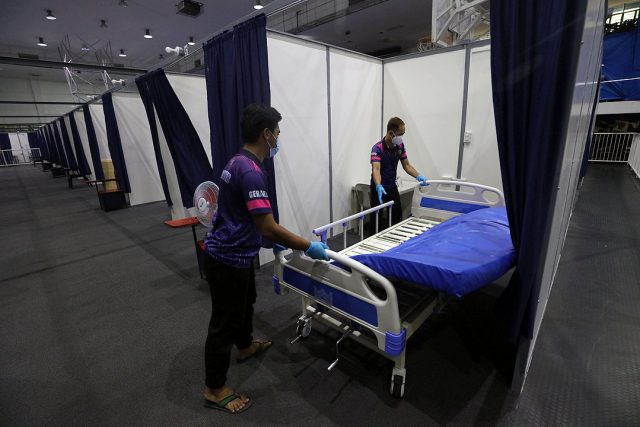
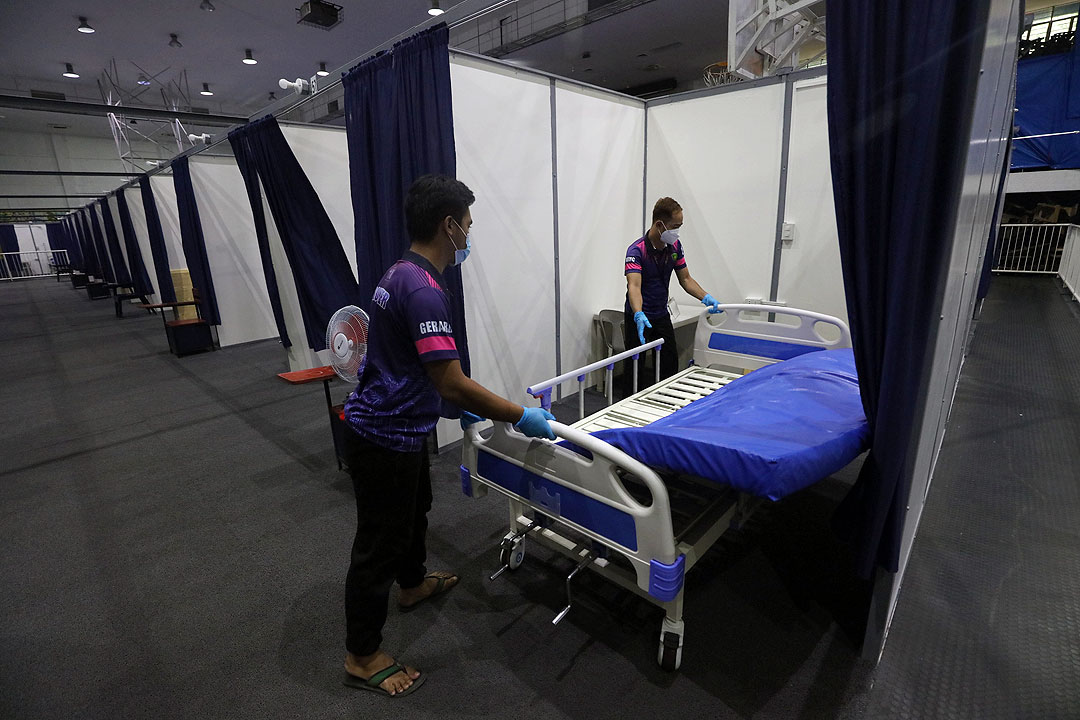
MAINTENANCE workers from the Pasig local government disinfected an isolation booth of a quarantine facility at the Caruncho stadium before it got dismantled on Nov. 11. — PHILIPPINE STAR/ MICHAEL VARCAS

THE LOCKDOWN level in Metro Manila could be eased further to Alert Level 1 next month, as long as its more than 13 million residents remain cautious to prevent another surge in coronavirus infections, according to the country’s entrepreneurship adviser.

“We can do it,” presidential adviser for entrepreneurship Jose Maria A. Concepcion III told ABS-CBN’s TeleRadyo in Filipino on Sunday. “While we continue to go down in cases, and we’re recommending Alert Level 1, vigilance is important.”

An area may be put under the first alert level if virus transmission is low, cases are decreasing, and hospital bed and intensive care unit use is low, according to an inter-agency task force.

Under this quarantine level, movement is allowed regardless of age and illness. All types of businesses may operate and venues may be used at full capacity subject to minimum public health standards.

“I think the relaxed policies this fourth quarter will continue until 2022,” Mr. Concepcion said. “We already found the solution — local governments vaccinating at least 80% of their constituents.”

The Department of Health (DoH) reported 1,926 coronavirus infections on Sunday, bringing the total to 2.82 million.

The death toll rose to 45,581 after 309 more patients died, while recoveries increased by 3,140 to 2.74 million, it said in a bulletin.

There were 28,102 active cases, 62.3% of which were mild, 5.8% were asymptomatic, 10.5% were severe, 16.94% were moderate and 4.5% were critical.

The agency said 26 duplicates had been removed from the tally, 24 of which were tagged as recoveries, while 245 recoveries were relisted as deaths. Two laboratories failed to submit data on Nov. 12.

DoH said 34% of intensive care units in the Philippines were occupied, while the rate for Metro Manila was 31%.

The government aims to vaccinate at least 50% of its adult population by yearend.

Metro Manila is now under Alert Level 2. Mr. Concepcion cited the need for people to get vaccinated against the coronavirus and always wear masks.

“We all need to get vaccinated,” he said. “This is for the national interest and common good. Our economy depends on it.”

Mr. Concepcion said there is now enough vaccine supply, and local governments should counter fake news against vaccination.

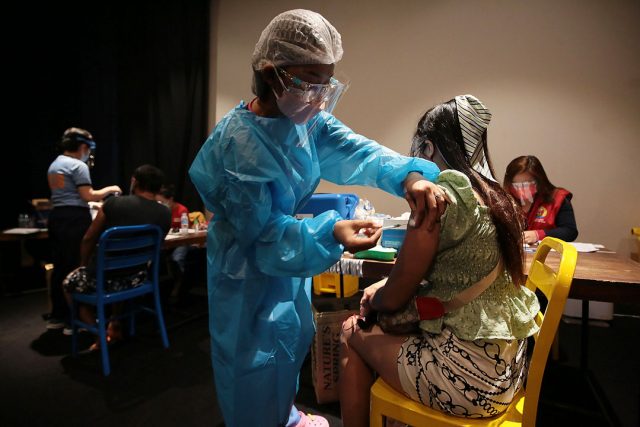
The Philippines has received almost 122 million COVID-19 vaccine doses, 67.7 million of which had been given out.

About 30.8 million Filipinos had been fully vaccinated against the coronavirus as of Nov. 11. Almost 37 million more have received their first dose.

President Rodrigo R. Duterte has approved a plan to use for the entire country a coronavirus alert level system first tested in the Philippine capital and nearby cities.

The nationwide enforcement of the quarantine strategy will be in four phases, according to Executive Order 151 released on Thursday.

The government on Sept. 16 started enforcing granular lockdowns with five alert levels in Metro Manila, weeks after the government struggled to contain a fresh surge coronavirus infections triggered by a more contagious Delta variant.

Coronavirus cases in the capital region might soon plateau as the infection rate dropped to 3%, the OCTA Research Group from the University of the Philippines said last week. — K.A.T. Atienza

Local governments should lead disposal plan for face shields  

PHILIPPINE STAR/ MICHAEL VARCAS

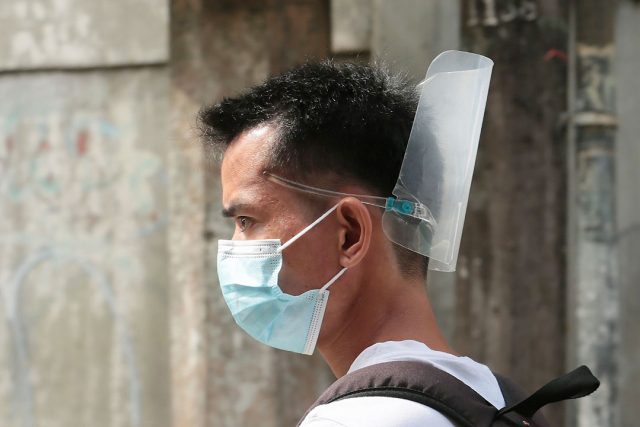
A PROPER disposal plan should be drafted and strictly implemented, environmental experts said, as government mulls ending the use of face shields for the general public, the only country in the world to do so in response to the coronavirus pandemic.  

“The mass stoppage of using face shields will definitely add to our plastic problems in the country, and that’s a big strain on our waste management systems,” Zero Waste campaigner Marian Frances Ledesma of Greenpeace Philippines told BusinessWorld via Viber call. 

Ms. Ledesma, along with Plastic Flamingo (Plaf) Communications and Marketing Associate Allison Audrey Tan, said local governments, particularly the barangay level, should be at the forefront of the disposal plan while receiving both technical support and financial assistance from the national government.  

It is important for the government to issue ordinances or regulations around how each barangay should be collecting and properly disposing of these face shields, said Ms. Ledesma.   

“What LGUs (local government units) need right now is guidance on how to get disposed face shields to the right facilities, and how to safely collect them from households to make sure the waste pickers are properly protected during that collection and disposal process,” she added. 

Under Republic Act 9003 or the Ecological Solid Waste Management Act of 2001, LGUs are supposed to lead the implementation of proper waste disposal with policies on segregation, recycling, and reuse.   

Many LGUs, however, have yet to fully comply with the 20-year-old law, including the establishment of barangay-level material recovery facilities.   

Ms. Tan said LGUs must provide a consolidated list of recycling centers to inform people how to properly dispose of the face shields.  

“It’s not an overnight thing, we have to slowly implement that and make it a behavior or a lifestyle,” she told BusinessWorld in a separate Viber call.  

Environment Undersecretary Benny D. Antiporda did not immediately reply to inquiries on the government’s face shield disposal plan.  

The government should consider recycling face shields more than dumping them in landfills or bodies of water, said Ms. Ledesma.  

Ms. Tan cited a study by Ocean Cleanup indicating that 1,600 rivers worldwide are accountable for at least 80% of marine pollution, of which 30% come from Philippine rivers.  

The environmental experts further warned that any recycling methods that involve incineration and burning should be avoided since they will release toxic emissions that lead to cancer, respiratory issues, and developmental side effects for pregnant women and young children. 

Ms. Tan suggested plastic extrusion, which is already being done by Plaf’s recycling facility. It is the process in which plastics are melted then molded to different materials such as eco lumber to build homes, furniture, and other products.   

SINGLE-USE PLASTIC
Meanwhile, Health Care Without Harm Asia Executive Director Ramon San Pascual told BusinessWorld that there is no longer any way to create value to plastic waste.  

“That is the reason why the call is to ban single-use plastic.”  

There is nothing that can be done but to cope and learn to avoid or refuse the use of unnecessary materials, he added, noting that a disposal plan should have been considered by the government prior to implementation.  

“Most of it is a knee-jerk kind of response, without long-term planning and a cohesive holistic attempt to address effectively the pandemic,” said Mr. Pascual.   

Similarly, Oceana Philippines Vice President Gloria Estenzo Ramos said plastics are not recyclable. “It is not degradable; it only turns into microplastics.”  

This is why manufacturing should be stopped from the source, she added, noting that legislation to ban single-use plastics at a national level was needed.  

The Philippines’ current medical waste is beyond the existing capacity for treatment, storage, and disposal, the Department of Environment and Natural Resources said in Sept.  

It said the country produces about 15,383 metric tons of medical waste per day, and over 5.6 million metric tons per year.   

“The generated health care waste, as of June 20, 2021, approximately increased (by) 11.30% of the total capacity of the existing TSD facilities nationwide,” Environmental Management Bureau Assistant Director Visminda A. Osorio said in an earlier Senate hearing.  

The task force handling the coronavirus response has already forwarded its recommendation on face shield use to President Rodrigo R. Duterte, who is expected to decide soon on policy adjustments.    

Several cities — including Manila, Muntinlupa, Cebu, Iloilo, and Davao — have already scrapped the use of face shields except in medical facilities.  

“Face shield becomes a cover-up for the inadequacy of the government in terms of the holistic, effective response to the pandemic,” Mr. San Pascual said. — Alyssa Nicole O. Tan 

Solon says hike in teachers’ election duty allowance not enough 

PHILIPPINE STAR/ MIGUEL DE GUZMAN

A LAWMAKER from the progressive Makabayan bloc said that a recent resolution by the Commission on Elections (Comelec) that would increase the allowances of public school teachers serving election duty are not enough.    

ACT Teachers Party-list Rep. France L. Castro said that the resolution only provides “minimal increase” in honoraria.  

“We cannot accept what was released through Comelec Resolution 10727. It is lacking to the call of teachers who make up majority of election service volunteers,” she said in a statement.  

Comelec Resolution 10727 would provide P7,000 to the electoral board chair, P6,000 for electoral board members, P5,000 for the supervising official from the Department of Education, P3,000 for support staff and medical personnel. 

It would also provide an anti-pandemic allowance worth P500 along with at least five days of service credit if poll workers are in government service.  

The resolution also provides different rates for travel and communication allowances.  

Rates under the law are currently set at P6,000 for electoral board chair, P5,000 for members, P2,000 for support staff, and P1,000 for additional travel allowance.    

Ms. Castro said that a higher compensation is needed for poll workers in consideration of longer voting hours in next year’s elections and to ensure their safety and wellness.  

Comelec Commissioner Marlon S. Casquejo said during a House hearing that voting period for the 2022 elections will run from 6 a.m. to 7 p.m.   

ACT-Teachers recommended that benefits mandated by Republic Act 10756 or the Election Service Reform Act be increased to P10,000 for chairpersons of electoral boards, P9,000 for electoral board members, P7,000 for support staff, P3,000 to P5,000 for travel allowance, and P2,500 for food allowance, among others. — Russell Louis C. Ku 

Senator, labor leader say addressing vaccine hesitancy should be scientific, not coercive 

PHILIPPINE STAR/ MICHAEL VARCAS

THE GOVERNMENT should focus on information-based methods to address vaccine hesitancy, a senator said, rather than imposing coercive regulations.  

“Since day one, the government’s so-called solution on issues surrounding vaccine hesitancy among Filipinos has been dependent on fear and coercion instead of concrete and scientific solutions,” opposition Senator Leila M. De Lima said in a statement Sunday.  

She suggested an intensified information drive to educate people on the benefits of inoculation along with a campaign that would help build public trust on vaccines.  

Presidential Spokesperson Herminio L. Roque, Jr. said Friday that beginning Dec. 1, employees from both public and private institutions in areas with enough vaccine supply will be required to get vaccinated against the coronavirus disease 2019 (COVID-19).  

“They should not pass the responsibility to the workers,” national labour centre SENTRO Secretary-General Josua Mata told BusinessWorld via Viber call. 

“It is their responsibility to explain, convince the people and provide the right vaccine. They have no right to impose yet again punitive measures to the workers that don’t want to accept the kind of vaccines they are providing,” he added in a mix of English and Filipino.  

According to an OCTA Research survey cited by Ms. De Lima, 65% of 1,200 adult respondents are uncertain over COVID-19 vaccine safety while 14% are unsure of its effectivity.  

Other reasons for vaccine hesitancy include pre-existing medical conditions, belief that it is not needed, fear of death, and fear of injections.  

“I’ve said this before, if the government had given more attention to increasing the understanding and trust of the people to vaccines, it’s likely that the number of people rejecting vaccines would not have risen,” Ms. De Lima said in Filipino.  

The attempts of the government to “simplify the solution” will not solve the problem, said Mr. Mata.   

He added that vaccination in itself is not the means to ending the pandemic, since it is still necessary to observe other containment measures such as mass testing, effective contact tracing, isolation, and treatment.  

“The best way to go about this is to patiently explain to people why it is important, the science of it,” he said.    

Mr. Roque also said that “eligible employees who remain to be unvaccinated may not be terminated, but they shall be required to undergo regular RT-PCR testing, or antigen tests, at their own expense.”  

For more than a year, workers have endured the loss of income and jobs, said Mr. Mata. Now, the government is making them vulnerable, yet again, to losing their jobs by requiring additional costs to their already limited earnings.  

The policy is “inhumane” because minimum wage earners cannot afford the pricey costs of testing and will be forced to either lose their earnings or quit their jobs, he said.  

Unemployment rose to 8.9% in September as bad weather left nearly 900,000 without work in the farm sector and strict lockdowns claimed over 340,000 factory jobs, based on data from the Philippine Statistics Authority.  

This translated to 4.25 million unemployed Filipinos in September, up from 3.88 million in August. — Alyssa Nicole O. Tan 

Cooperative for tech services eyed in Mindanao 

COOPERATIVES in southern and central Philippines are moving along the digital path with plans to set up a specialized technology service enterprise in Mindanao, while small and micro co-ops in Central Visayas have started looking into the adaption of automated platforms.  

The Cooperative Development Authority (CDA) recently met with Mindanao-based farmer co-ops to discuss their plan to set up a secondary unit that will be named Technology Service Cooperative to focus on the sector’s digital transformation.  

“The organized cooperatives are expected to pool their resources so as to introduce technological innovations, particularly in supporting cooperatives across the country through e-commerce, portals and innovative ways of bridging the gap in market access,” Assistant Secretary Myrla B. Paradillo, CDA acting administrator and board member, said during the meeting.   

The tech service cooperative, which will be composed of at least 15 existing ones, will comply with financial regulation requirements, particularly those from the central bank. 

“One of the dreams of Philippine cooperatives is to be part of the national payment management system,” said Assistant Secretary Vidal Villanueva III, head of the CDA’s financial cluster.  

While some cooperatives, particularly the bigger ones, have already started their own digital systems, there is still room to improve their smaller counterparts’ access to online services, he added.   

CENTRAL VISAYAS
In Cebu City, 15 cooperatives from across the Central Visayas region met in end-October to discuss the digital shift, especially for small and micro cooperatives.  

“Top cooperatives worldwide make use of technology to engage their members in governance and decision-making,” said Ann J. Cuisia, chair of Traxion Cooperative, which provides the DigiCOOP platform to Mindanao-based First Community Credit Cooperative, Inc. 

“Unfortunately, technological adoption in the local setting is still considered low,” she added.  

DigiCOOP has recently set up business centers in Cebu City and Antique in partnership with existing local cooperatives to expand into the Visayas area.   

“Digitalization is a natural progression for cooperative members that are part of the huge, (asset-rich) cooperatives. But how about the small and micro cooperatives? That is still the challenge for our country,” said CDA Central Visayas Regional Director Doreen C. Ancheta.   

She noted that 54% of cooperatives in the Philippines are classified as micro. These account for 2% of all cooperatives’ assets. — MSJ 

How may the Tampakan copper project leave a smaller mining footprint?

PIXABAY

The Provincial Government of South Cotabato has a delicate balancing act to do. Nearly 10 years ago, it banned open pit mining in its territory. Xstrata, an Anglo-Swiss multinational mining company, was ready to invest about $5-5.9 billion to construct the copper mines in Tampakan, South Cotabato and operate it. The firm was locally registered as Sagittarius Mines, Inc. (SMI). Unfortunately, it was unable to operate. It continued to work for the lifting of the ban, unsuccessfully.

The late former President Benigno “Pnoy” Aquino imposed a moratorium to new mining projects while Congress was deliberating on mining tax reforms.

The mining industry’s challenges turned worse when the current government of President Rodrigo Duterte echoed the same concern of its predecessor on revenue sharing. The late Environmental Secretary Gina Lopez, who was fiercely anti-mining, then imposed a nation-wide ban on open pit mining and added to the list of concerns against large scale mining, namely the alleged huge mining footprint and alienation of host communities. Then the COVID-19 pandemic hit the world and triggered a relatively prolonged slump of the global economy.

While all these setbacks unfolded, Xstrata merged with Glencore, another multi-national in 2013. The Filipino partners of Glencore purchased their partners’ share in the company in 2015.

THE TAMPAKAN COPPER PROJECT
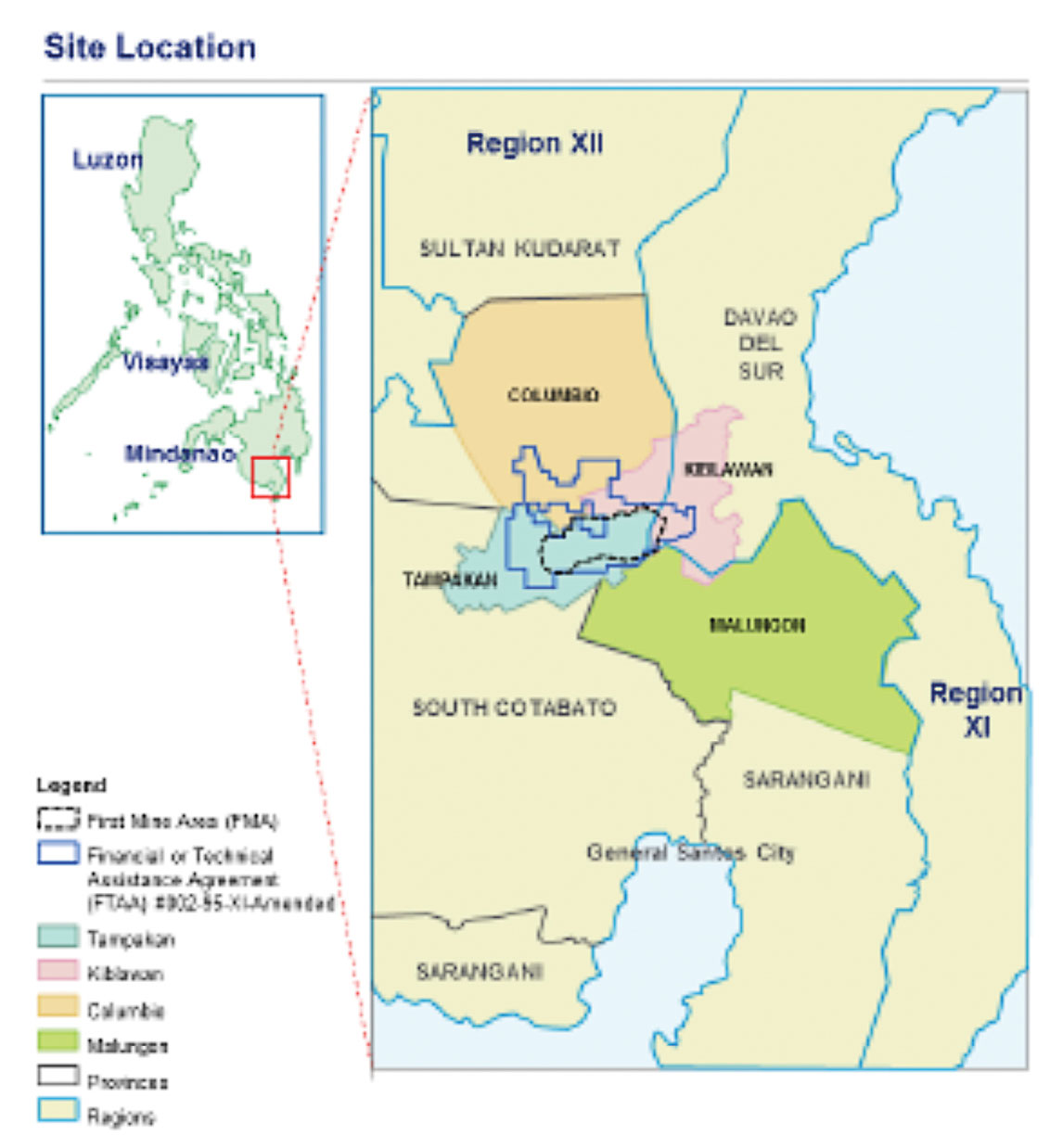
Once operational, the Tampakan copper project in South Cotabato would put the Philippines on the global map. The site is one of the largest undeveloped copper deposits in the world. The site offers 15 million tons of copper and 17.9 million ounces of gold at a 0.2% copper cut-off grade.

SMI reported that since 1995, when the company secured a financial and technical assistance agreement (FTAA) with the Philippine government to develop the copper mine, and eventually to construct and operate it, nearly P30 billion had already been invested. From these investments, the national and local governments earned P2.7 billion in taxes and fees, while the host communities obtained P1.2 billion of benefits in the form of schools constructed or assisted, college scholarships, health access, infrastructure, and forest programs.

Under new ownership since 2015, SMI decided to construct and operate the Tampakan copper project in three phases. Under the first phase, SMI would start at a reduced production rate; in 10 years, it would calibrate its operation to attain its production objective with a reduced mining footprint and expanded benefits to host communities. The company is committed to let stakeholders assess the company’s performance against its stated production, environmental protection plans, and social development goals.

BENEFITS FROM THE COPPER MINE
The national and local governments would receive billions of pesos from its commercial operation under Phase 1 or the first 10 years of its operation. Indigenous peoples and the host communities also expect to receive billions of pesos in royalty payments and social development and management programs.

Mining investments like this one have tremendous development impact on the regional economy. The opportunity could not have come at a better time than now, when the country is just recovering from the recession due to COVID-19. People are looking for jobs and income opportunities. Small and medium enterprises need to be back in business.

SMI would directly employ 1,000 workers during construction and 500 during operations. To get this mine operating, SMI would need supplies and would have to engage local businesses, contractors, and service providers. The core investment of SMI to construct and operate the Tampakan copper project would have significant ripple effects of stimulating the provincial economy and those of its neighboring provinces and cities.

The project would have beneficial effects as well for the national economy, aside from the tax revenues going to the national government. Over the life of the project, SMI is projecting net exports from copper worth billions of US dollars. With the country being a net exporter of copper, it is in a position of stimulating downstream industries dependent on copper. Those in turn will generate new jobs and incomes.
BAN ON OPEN PIT MINING
The holdouts to getting this copper project constructed and operating are the Department of Environment and Natural Resources (DENR) and the Provincial Government. The late former Environmental Secretary Gina Lopez imposed a nationwide ban on open-pit mining. This not only prevents the operation of the Tampakan copper projects but also those of two other large-scale mines. Both located in Mindanao, these are the Silangan Project of Philex and the King-king Project of NADECOR.

There appears to be hope that the DENR will lift the nationwide ban on open pit mining, according to a report by Catherine Talavera, which appeared in the Philippine Star yesterday.

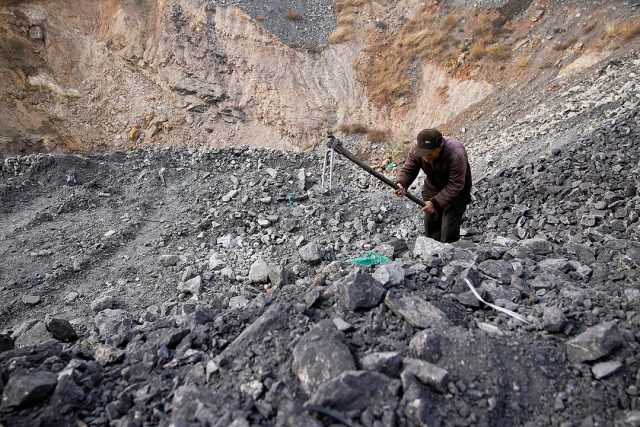
As for the provincial ban on open pit mining in South Cotabato, this continues to be a challenge to SMI. Based on the pattern of copper deposits in the area, the company has to operate the project as a surface mine. However, it cannot proceed without the Sangguniang Panlalawigan of South Cotabato lifting the ban. Opponents of mining in the province say that South Cotabato will be left with an abandoned mine, one with a gaping hole.

ABANDONED MINES
While there appears to be a basis for this concern, the matter of abandoned and inactive mines reflects the problem of either a lack of rules and regulations and weak enforcement of rules as the following show. Let us look into a few of the abandoned and inactive mines.

According to the Mines and Geosciences Bureau (MGB) of the DENR, in its report to the National Economic and Development Authority’s Philippine Council for Sustainable Development several years ago, there are five abandoned mines and 18 inactive mines in the country.

Abandoned mines are those without any legal owner and where the rehabilitation and closure are either not done or incomplete. Inactive mines are temporarily not operating for a variety of reasons including waiting for the approval of their respective applications to explore or operate, or being temporarily suspended due to the lack of integrity of the overall mine.

The Bagacay mine in Western Samar was abandoned in 1992. Its previous owner apparently encountered high recovery cost of pyrite concentrates, and had a dispute with the local union. The MGB is presently rehabilitating the area using Philippine government funds and official development assistance.

The abandonment occurred before the 1995 Mining Act. It was only in 1995 that the rules and obligations of mining companies with respect to protecting the environment were set.

This point applies as well to the Privatization Management Office (PMO), which took over the mine in consideration of the unpaid loan that its previous owner incurred. The PMO is unfamiliar, in the first place, with mining operations, including as owner its obligation under the law to rehabilitate the mine. Many of the abandoned mines got sequestered like the Bagacay mine, and were abandoned for a long period of time.

Another case of abandonment before the rules were set in 1995 is the Palawan Quicksilver Mines, Inc. The mine started operating in 1955 and its owner abandoned it in 1976.

The third case is different. The mine suspended operations because of a tailings spill and problems with the integrity of the mine’s structure. The Marcopper incident happened in 1996 in Marinduque, but again before the rules and regulations of the 1995 Mining Act were issued. The suspension of operations followed the tailing spill incident in 1996.

All three cases illustrate the importance of rules and regulations that would need to be crafted and issued in order to elicit proper behavior by mining companies towards conserving the environment.

The fourth case is entirely different as it occurred after the 1995 Mining Act. The abandonment occurred in 2010 and therefore this is a case of lack or weak enforcement of regulations. Black Mountain, Inc. abandoned its operation in 2010 due to bankruptcy.

The MGB is slow in carrying out its mandate to rehabilitate abandoned/inactive mines. Under the 1995 Mining Act, funds are set aside by the company and deposited with the MGB, earmarked for the rehabilitation/closure of mines. For example, the Bagacay mine was abandoned in 1992 and it was only several years later that the MGB rehabilitated the mining site.

CONSIDER OUTSOURCING THE REHABILITATION OF MINES
The government may consider outsourcing the rehabilitation of a mine to the private sector. The MGB calls for proposals to rehabilitate the mine and selects the best. The best may even propose to convert the mine into another asset that can be operated by the private company, such as housing, parks, farming, fishing, and other assets suitable to the area of the mine to be closed.

Presently, the mining company comes up with its proposal to close the mine, or the final mine decommissioning plan, before it is even allowed to operate. But the more detailed decommissioning and rehabilitation plan is finalized five years before closure, and the MGB approves it. The MGB may improve on this plan by procuring private sector services for this purpose.

The benefit of outsourcing the rehabilitation of the mine is that better ideas of transforming the previous mine to other assets can come out. The present protocol is such that the company initiates the planning for the rehabilitation. Expectedly, it has very little interest in coming up with better ideas of rehabilitation. Definitely, the host LGU should partner with the MGB in selecting the best proposal.


Ramon L. Clarete is a professor at the University of the Philippines School of Economics.

Rising teen pregnancy and the ‘cycle of misinformation’

PIXABAY
PIXABAY

Rising teenage pregnancy in the Philippines is now a national social emergency. The 2017 National Demographic and Health Survey showed that one out of 10 women between the ages 15 and 19 was childbearing. Similarly, 200,000 teenage girls in the Philippines give birth every year.

This essay explores an alternative perspective at examining and maneuvering around the current constraints on minors’ access to contraceptives.

The lack of access to sexual and reproductive health (SRH) commodities is a contributing factor to the teenage pregnancy problem. Minors can only avail themselves of these commodities upon presenting the written consent of their parents or guardians. Hence, as different stakeholders work on the long and arduous process of amending this existing provision of the Reproductive Health (RH) law, in the interim, highlighting the responsibility of parents and legal guardians to ensure the access of minors to SRH services and commodities serves as an alternative path to increasing the protection of teenagers from unplanned pregnancies.

Not only is there lack of access to reproductive health services and information, violence, and abuse and the persisting negative social norms towards young people’s sexuality contribute significantly to teenage pregnancy.

The lack of access stems from the non-implementation of comprehensive sexuality education. Similarly, a comprehensive communications plan for the RH law is missing. Further, adolescent-friendly spaces in local health units to assure the confidentiality and privacy of young people are wanting.

The result is that young people get their sexual and reproductive health information from informal and inaccurate sources, which in turn contribute to the cycle of misinformation.

Unfortunately, the RH law prevents young people from having complete access to reproductive health commodities and services. The RH law requires written consent from a parent or a guardian before minors can access modern forms of reproductive health commodities.

Thus, adolescents have the largest unmet needs. Teens are left with abstinence and the “pull-out” method as the only options that they can choose and practice. Both are the least effective in preventing unplanned pregnancies.

Violence and abuse also contribute to the rising incidence of teen pregnancy. The age of consent in the Philippines is one of the lowest in the world. The current age of consent is 12 years old. A low age of consent means that adolescents are more vulnerable to sexual abuse.

According to the United Nations Children’s Fund (UNICEF), adults may lure young adolescents into sexual activity in exchange for goods and favors. Those from disadvantaged settings and poor backgrounds, particularly, at risk of unwanted or early pregnancy.

The law’s barrier is hinged on the prevailing beliefs and attitude on young people’s sexuality and agency that discussing sexual and reproductive rights to young people would encourage them to engage in risky behaviors. Also, young people who engage in pre-marital sex are deemed immoral.

There is a perception that parents should decide on the family planning of young people. There is also a belief that only health workers can initiate discussion on sexuality. However, the biased attitudes and behaviors of service providers towards teen clients deter young people from approaching them.

Nevertheless, women’s rights organizations, other civil society groups and stakeholders are addressing the lack of access to information and the transformation of the existing social norms. The problem of access to contraceptives is the main bottleneck, especially the provision on parental consent.

Amending the RH law, specifically the clause on the mandatory written parental or legal guardian consent, is the main reform to remove the bottleneck on young people’s access to SRH services and commodities.

This is a long-term agenda, but its feasibility at present is remote. With the legislators being fixated on the 2022 national elections, the reform advocates have a short and narrow timeframe for legislative reform.

That said, the best possible outcome of the advocacy is directed towards efforts to incorporate the prevention of teen pregnancy in the electoral agenda. This initiative will also directly challenge the existing norms that govern young people’s sexuality and agency over their bodies — a reform battle that might be reminiscent of the long and arduous journey of the RH law.

So, what can be done given the current circumstances, including the hard-wired beliefs and attitudes on young people’s sexuality? What can serve as a bridge between the formal barriers and the existing social norms?

In the interim, highlighting the responsibility of parents and legal guardians to ensure the access of minors to SRH services and commodities can serve as an alternative path to increasing the protection of teenagers from unplanned pregnancies. This can serve as the focal point to refocus the discussion on why and how minors should have access to sexual and reproductive health information and services.

Responsible parenthood, as defined by the RH law, refers to the will and ability of a parent to respond to the needs and aspirations of the family and children. Looking at this term from a new perspective, we can reinterpret this to emphasize the duty of parents and legal guardians to ensure that their children will be able to reach their full potential in terms of health, social development, and economic potentials.

Parents and guardians obviously play a crucial role in promoting positive sexual health outcomes, influencing the sexual behaviors of their children, and aiding them in accessing the health interventions that are provided in the community. All parents and legal guardians aspire for the good health and development of their children. Along with school and health professionals, they share the responsibility of ensuring that children can attain sexual health and general wellbeing. Conversing about the body, consent, and touching helps parents be supportive agents in the health decision-making of their children.

Young people’s ability to control, decide, and plan about their bodies has been associated with the capability to complete their education, achieve their career goals, increase their chances of breaking out of the cycle of poverty, and have higher levels of satisfaction in their relationships. It also leads to positive mental health outcomes.

Research suggests that teenagers who engage in healthy conversations on sexual and reproductive health with their parents may help reduce the chances of engaging in risky sexual behaviors that can lead to unintended pregnancies. Teens who also have high levels of communication with their parents are more likely to discuss pregnancy, sexually transmitted infection prevention, and use contraception. Teenagers also echo that open and honest conversations with parents about sex and sexuality can help them avoid unintended pregnancy.

For parents and guardians to fulfil this role and responsibility, they need support and assistance. Civil society organizations can actively develop initiatives and innovative tools that are targeted towards parents and guardians. These can be in the form of giving educational sessions on sexual and reproductive health, conducting communication skills-building workshops, connecting them to websites or platforms where they can access age-appropriate sex education materials, and linking them to support groups where they can learn from other people.

While the legal barrier and policy landscape on sexual and reproductive health and rights remain challenging, civil society can enable parents and guardians to become active collaborators and first-line responders in addressing the teenage pregnancy problem in the Philippines.

Their active participation and intervention can then be the alternative interim channel for young people to exercise their informed choice over their sexual health. Hopefully, this will lead to greater opportunities to realize the youth’s full potential and aspirations.


Iverly Viar has handled projects on human rights, sexual and reproductive health and rights, and women, peace, and security. She previously worked with Oxfam Pilipinas as project officer for the Sexual Health and Empowerment Project. She was also part of the first cohort of the Development Entrepreneurship Mentoring Program of the Coalitions for Change.

Inflation and high pork prices

PHILIPPINE STAR/ MICHAEL VARCAS

The national inflation rate is too high for comfort. It stood at 4.9% and 4.8% in August and September, respectively, and eased to 4.6% in October. The Economic Intelligence Units of BDO and ADB both forecast that year-end inflation will hover at around 4.5%. This is a cause for concern since gross domestic product (GDP) is projected to grow by only 5% this year. This means spending power will likely remain static despite the growth in the economy.

One of the principal reasons for the high inflation rate is the high price of fresh pork resulting from a shortage in supply. It will be recalled that the African Swine Fever (ASF) entered our shores in 2019 through smuggled swill feed imported from China. Swill feed is composed of food scraps and/or food waste that may contain or may have come into contact with meats infected with viruses and other pathogens. In theory, the use of swill feed is illegal, but it is still widely used in the hog raising industry.

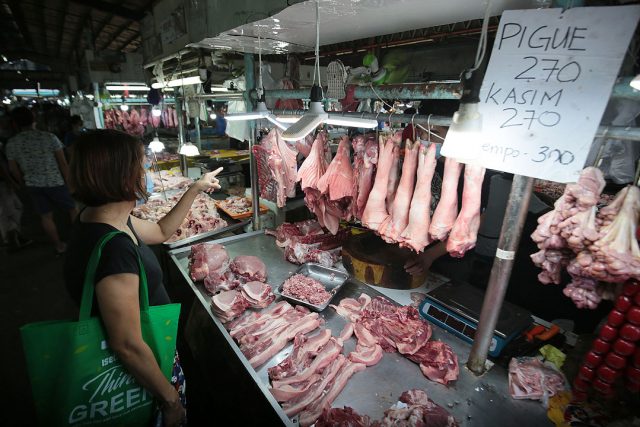
The ASF virus decimated hog supplies in the last two years, especially in National Capital Region. The national inventory of hogs dropped from 13 million heads in 2019 to just 8 million heads today. Consequently, price of pork increased from P220 per kilo to about P335 per kilo.

To augment pork supplies and to address high retail prices, the Office of the President handed-down Executive Order (EO) 128 on April 7. The EO effectively lowered the tariff rates for imported pork from 30% to 5% for imports within the import quota and from 40% to 15% for imports outside the import quota until July 7. From July 8, 2021 to April 6, 2022, tariff rates were slightly adjusted to 10% for imports within the import quota and 20% for imports outside the import quota. Further, import quotas were also increased from 54,000 tons to 404,000 tons.

The liberalization of pork importation should have driven pork prices down. Why hasn’t it worked?

Two reasons. First, only traders (wholesalers and retailers) were initially allowed to import pork. Processed meat manufacturers were not allowed to do the same.

As we all know, a large portion of the national pork supply is used by food processors to produce hotdogs, sausages, luncheon meats and the like. Unlike other Asian nations, Filipinos derive their protein not from milk and soy, but from processed meats and fish. Filipinos consume more hotdogs, on a per capita basis, than the Americans themselves.

The prohibition for meat processors to use imported pork left them no choice but to use local alternatives at high prices. This is why the liberalization of pork had no effect in arresting the continued rise in prices for canned and frozen meats products during the second and third quarter of the year. It was only last month that the Department of Agriculture (DA) issued Memorandum Circular 23 which allowed food processors to utilize imported meats. Thus, we can only expect prices of processed meats to roll back by January.

The second reason is due to the DA’s decision not to allow the sale of imported meats at room temperature. The meat can only be sold if it is stored and displayed in freezers and kept at a temperature of -18 degrees Celsius.

As we are well aware, vendors in our public markets do not operate with freezers — they do not have the financial bandwidth to purchase them. Meats are displayed at room temperature or on ice, at best. The frozen temperature requirement of the DA has impeded the entry of imported meats in public markets. Even today, public markets vendors still make do with the limited local pork supply which is why prices have remained above P300+ per kilo.

The main beneficiaries of the DA’s temperature requirement are the supermarkets. But instead of rolling back prices, supermarkets maintained their prices at sky high levels since public markets are unable to offer price competition. For those who are unaware, the landed cost of imported pork belly is only P220 per kilo. Instead selling this at P265 per kilo (adding on a decent 20% profit margin), supermarkets are selling them at P335 per kilo, the same price as local pork in public markets. This has allowed supermarkets to enjoy a windfall profit of 52% for every kilo of pork sold.

The high cost of pork has made the meat inaccessible for the majority of Filipinos. This has caused demand to drop. Importers and traders are now stuck with high levels of inventory. Millions of kilos of imported pork are tied up in cold storages which, according to DA, totaled 80 million kilos or about three times more than the normal pre-pandemic monthly inventory.

Of total pork volume in cold storage, 25 million kilos are in Metro Manila; 21 million kilos in Calabarzon, another 21 million kilos in Central Luzon, and 12 million in Cebu.

What makes the DA’s temperature requirement for imported pork contentious is that local pork is still allowed to be sold in public markets without refrigeration. This does not make sense. The chemistry of pork is the same, regardless of whether it is imported or locally raised. Why require one to be sold frozen and disallow the other? If the DA’s intention is to avoid bacterial contamination, it should impose the freezer requirement on local pork too. To impose it only on imported pork defeats the purpose.

Besides, Filipinos customarily consume their pork well done. In almost no instance is it consumed raw or rare. Bacteria dies at 62.8 degrees Celsius, which is normally exceeded in the cooking process.

The DA’s imposition of the stiff temperature requirement is the reason why millions of kilos of imported pork cannot be sold in public markets and why it is unable to reach the masses. It is the reason why prices have not rolled back despite liberalizing importations.

The only way to solve the situation is for the DA to relieve the temperature requirement in the sale of imported pork. Only then will we see the price of pork decrease. Only then will it have an impact on the national inflation rate.


Andrew J. Masigan is an economist

andrew_rs6@yahoo.com

Facebook@AndrewJ. Masigan

Twitter @aj_masigan

Forget the words of this COP26 deal, follow the money

PEXELS-PIXABAY

FOR ALL THE WEEKS of negotiation and hard-headed diplomacy that go into the text of an international agreement, the words that result in the end aren’t a magic spell.

Whether the communique resulting from the Glasgow climate conference promises to “accelerate the phasing out of coal and subsidies for fossil fuels” (as initial drafts proposed) or instead to escalate “efforts towards phase-down of unabated coal power and phase-out of inefficient fossil fuel subsidies” (in the softened language of the final agreement), it will barely change what the world’s big emitters do over the coming years.

At the same time, the governments that sign such agreements clearly do believe that words have a power of enchantment. Why else has it taken 26 meetings for a passage singling out fossil fuels to make it into the wording of a climate agreement? Language crystallizes the more important reality that’s emerging away from the conference halls in power stations, industrial facilities, and government offices around the world. In its modest way, it also helps edge that process along.

The most important of all those softening phrases is almost certainly “inefficient fossil fuel subsidies.” Although nearly every kilowatt of fossil energy on the planet is by definition inefficient (because it doesn’t pay the cost externalities that its pollution levies on human health and the global climate), that hoary formula is so broad that it gives a political excuse for almost any support.

There’s a great deal that can be justified in the name of efficiency. The difference between a country with a stable and secure supply of energy and one without it is the difference between China and sub-Saharan Africa, or Glasgow in the 18th century versus the 21st century. Even the minor energy crises we’ve seen in China, India, and Europe’s coal and gas markets in recent months are an indicator of the vast social value of a functioning energy system. An efficient subsidy goes about providing it in the cheapest possible way, however — and that calculation has changed drastically.

At the time of the Paris climate conference in 2015, renewables were the most affordable way of providing new power generation in only a handful of European countries, and weren’t competitive with existing fossil power anywhere. Now, they’re undercutting even generators that are already connected — one reason we’ve seen the likes of Indonesia, Vietnam, Poland, and South Korea sign up to end the coal-fired electricity that they’ve been dependent on.

The same is true with transport. BloombergNEF, one of the more bullish forecasters for electric vehicles, estimated in 2016 that global sales would grow to 2 million in 2020. In practice, the figure was 3.1 million, and is forecast to rise to 5.6 million this year. The cost of owning an EV in many major markets is already lower than the equivalent petroleum-powered car, and sales as a share of the total this year have already hit 12.8% in China and 17% in Europe.

Other areas will follow in the years ahead. Green steel, regarded as little better than science fiction a few years ago, ought to be competitive with the conventional product at the sort of carbon prices now prevailing in the European Union. Green hydrogen, until recently another pie-in-the-sky notion, is already seeing 213.5 gigawatts of planned projects, roughly equivalent to the power generation capacity of Germany. In industry after industry, the emerging reality is that fossil fuels are no longer as necessary to modern life as we thought they were. The cheapest and most efficient route to energy security is zero-carbon.

Some things, however, remain the same. Technological change means swathes of India and China’s coal-fired power stations are already uneconomic — but the wind and solar plants to replace them must first get built, which will require financial and political change as well. Coal India Ltd., the world’s largest miner of solid fuel, in some ways resembles a state within a state, operating hospitals, schools and colleges and employing more than 250,000 people. Indian Railways, the vast state-owned rail operator, can only provide cheap transport for passengers because it levies a hefty charge on coal transport.

To talk about this only in terms of subsidies in some ways understates just how deeply fossil fuels are integrated into the structure of their most avid producers and consumers. These are not simply outgrowths, but arteries of the economy through which finance, jobs, politics, and influence flow. The surgery necessary to remove them won’t be straightforward.

The $8.5-billion package announced in Glasgow to speed South Africa’s transition away from coal provides one model for how this could be done — but it’s far from certain whether it will succeed, and that one country accounts for less than 3% of the emerging world’s solid fuel consumption. India has already put a $1-trillion price tag on the funds it needs this decade to accelerate its energy transition.

Something must be done, though. The costs of subsidizing fossil fuels go up with each passing year, making it harder to abandon them even as their damage accumulates. In a world where annual energy investment runs to $1.9 trillion or so a year, the problem isn’t that funds are lacking, but that they’re going to the wrong places.

With developing nations missing out on zero-carbon power for a lack of investment capital, even as they’re buffeted more and more by the shocks of climate change itself, the greatest inefficiency isn’t in the subsidies that undergird our energy systems. It’s the loss of human potential that we will suffer if we fail to provide the planet with the clean, cheap energy that’s now within our grasp.

BLOOMBERG OPINION

UN climate agreement clinched after late drama over coal use

REUTERS

GLASGOW — United Nations (U.N.) climate talks ended Saturday with a deal that for the first time targeted fossil fuels as the key driver of global warming, even as coal-reliant countries lobbed last-minute objections.

While the agreement won applause for keeping alive the hope of capping global warming at 1.5 degrees Celsius, many of the nearly 200 national delegations wished they’d come away with more.

“If it’s a good negotiation, all the parties are uncomfortable,” US climate envoy John Kerry said in the final meeting to approve the Glasgow Climate Pact. “And this has been, I think, a good negotiation.”

The two-week conference in Scotland delivered a major win in resolving the rules around carbon markets, but it did little to assuage vulnerable countries’ concerns about long-promised climate financing from rich nations.

The British COP26 president, Alok Sharma, was visibly emotional before banging down his gavel to signal there were no vetoes to the pact, after the talks had extended overtime — and overnight — into Saturday.

There was last-minute drama as India, backed by China and other coal-dependent developing nations, rejected a clause calling for the “phase out” of coal-fired power. After a huddle between the envoys from China, India, the United States and European Union, the clause was hurriedly amended to ask countries to “phase down” their coal use.

India’s environment and climate minister, Bhupender Yadav, said the revision reflected the “national circumstances of emerging economies.”

“We are becoming the voice of the developing countries,” he told Reuters, saying the pact had “singled out” coal but kept quiet about oil and natural gas.

“We made our effort to make a consensus that is reasonable for developing countries and reasonable for climate justice,” he said, alluding to the fact that rich nations historically have emitted the largest share of greenhouse gases.

The single-word change was met with dismay by both rich countries in Europe and small island nations along with others still developing.

“We believe we have been side-lined in a non-transparent and non-inclusive process,” Mexico’s envoy Camila Isabel Zepeda Lizama said. “We all have remaining concerns but were told we could not reopen the text … while others can still ask to water down their promises.”

But Mexico and others said they would let the revised agreement stand.

“The approved texts are a compromise,” said U.N. Secretary-General Antonio Guterres. “They reflect the interests, the conditions, the contradictions and the state of political will in the world today.”

CARBON MARKET BREAKTHROUGH
Reaching a deal was always a matter of balancing the demands of climate-vulnerable nations, big industrial powers, and those like India and China depending on fossil fuels to lift their economies and populations out of poverty.

Mr. Sharma’s voice broke with emotion in response to vulnerable nations’ expressing anger over the last-minute changes.

“I apologize for the way this process has unfolded,” he told the assembly. “I am deeply sorry.”

The overarching aim he had set for the conference was one that climate campaigners and vulnerable countries said was too modest — to “keep alive” the 2015 Paris Agreement’s target to keep global temperatures from rising beyond 1.5°C above pre-industrial levels. Scientists say warming beyond this point could unleash irreversible and uncontrollable climate impacts.

In asking nations to set tougher targets by next year for cutting climate-warming emissions, the agreement effectively acknowledged that commitments were still inadequate. National pledges currently have the world on track for about 2.4°C.

The talks also led to a breakthrough in resolving rules for covering government-led markets for carbon offsets. Companies and countries with vast forest cover had pushed hard for a deal, in hopes also of legitimizing the fast-growing global voluntary offset markets.

The deal allows countries to partially meet their climate targets by buying offset credits representing emission cuts by others, potentially unlocks trillions of dollars for protecting forests, expanding renewable energy and other projects to combat climate change.

‘THE ERA OF COAL IS ENDING’
Jennifer Morgan, executive director of the campaign group Greenpeace, saw the glass as half-full.

“They changed a word but they can’t change the signal coming out of this COP, that the era of coal is ending,” she said. “If you’re a coal company executive, this COP saw a bad outcome.”

Developing countries argue rich nations, whose historical emissions are largely responsible for warming the planet, must finance their efforts both to transition away from fossil fuels and to adapt to increasingly severe climate impacts.

The deal offered a promise to double adaptation finance by 2025 from 2019, but again no guarantees. A U.N. committee will report next year on progress towards delivering the $100 billion per year in promised climate funding, after rich nations failed to deliver on a 2020 deadline for the funds. Finance will then be discussed again 2024 and 2026.

But the deal left many vulnerable nations despondent in offering no funding for climate-linked losses and damages, a promise made in the original pact called the U.N. Framework Convention on Climate Change in 1992.

Rich nations once again resisted acknowledging financial liability for their years of emissions that drove climate change as they rose to economic prosperity.

While Glasgow agreement laid out a pathway for addressing the issue by establishing a new secretariat dedicated to the issue, vulnerable countries said that represented a bare minimum of acceptability.

“This package is not perfect. The coal change and a weak outcome on loss and damage are blows,” said Tina Stee, climate envoy from the Marshall Islands. Still, “elements of the Glasgow Package are a lifeline for my country. We must not discount the crucial wins covered in this package.” — Reuters

US military hid airstrikes that killed dozens of civilians in Syria — NYT

WASHINGTON — The US military covered up 2019 airstrikes in Syria that killed up to 64 women and children, a possible war crime, during the battle against Islamic State, the New York Times reported on Saturday.

The two back-to-back airstrikes near the town of Baghuz were ordered by a classified American special operations unit tasked with ground operations in Syria, according to the report.

The newspaper said that US Central Command, which oversaw US air operations in Syria, acknowledged the strikes for the first time this week and said they were justified.

In a statement on Saturday, Central Command reiterated the account it gave the newspaper that 80 people were killed in the strikes including 16 Islamic State fighters and four civilians. The military said it was unclear if the other 60 people were civilians, partly because women and children could have been combatants.

In Saturday’s statement, the military said the strikes were “legitimate self-defense,” proportional and that “appropriate steps were taken to rule out the presence of civilians.”

“We abhor the loss of innocent life and take all possible measures to prevent them. In this case, we self-reported and investigated the strike according to our own evidence and take full responsibility for the unintended loss of life,” Central Command said.

The number of civilians among the 60 fatalities could not be determined because “multiple armed women and at least one armed child was observed” in video of the events, it said, adding that the majority of the 60 were likely combatants.

Central Command said the strikes took place while Syrian Democratic Forces (SDF) were under heavy fire and in danger of being overrun and the SDF had reported the area clear of civilians.

The Defense Department’s inspector general launched an inquiry into the March 18, 2019, incident, but its report was ultimately “stripped” of any mention of the bombing and a thorough, independent probe never took place, according to the Times. The newspaper said its report was based on confidential documents and descriptions of classified reports, as well as interviews with personnel directly involved.

An Air Force lawyer present in the operations center at the time believed the strikes were possible war crimes and later alerted the Defense Department’s inspector general and the Senate Armed Services Committee when no action was taken, the Times said. — Reuters

Hackers compromise FBI’s external e-mail system

HACKERS compromised the Federal Bureau of Investigation’s (FBI) external email system on Saturday.

The hackers sent out tens of thousands of emails from an FBI email account warning about a possible cyberattack, according to the Spamhaus Project, which tracks spam and related cyber threats. The FBI said it, along with the Cybersecurity and Infrastructure Security Agency, is “aware of the incident this morning involving fake emails from an @ic.fbi.gov email account.”

“This is an ongoing situation and we are not able to provide any additional information at this time,” the FBI said in a statement.

The FBI has multiple email systems, and the one that appears to have been hacked on Saturday is a public-facing one that agents and employees can use to email with the public, according to Austin Berglas, head of professional services at the cybersecurity company BlueVoyant. There’s separate email system agents are required to use when transmitting classified information, he said.

“This is not the classified system that was compromised,” said Berglas, who is also a former assistant special agent in charge of the FBI’s New York office cyber branch. “This is an externally facing account that is used to share and communicate unclassified information.”

The attacks started at midnight Saturday in New York with a subsequent campaign beginning at 2 a.m., according to Spamhaus. The nonprofit said it estimates the spam messages ultimately reached at least 100,000 mailboxes.

The emails came with the subject line: “Urgent: threat actor in systems.” The message was signed by the US Department of Homeland Security and warned recipients that the threat actor appeared to be cybersecurity expert Vinny Troia, who last year penned an investigation of the hacking group The Dark Overlord.

There was no malware attached to the emails, according to Spamhaus. The group speculated that the hackers could have been attempting to smear Troia or were staging a nuisance attack to flood the FBI with calls.

Troia didn’t respond to a request for comment. The FBI urged consumers to be cautious and report any suspicious activity. — Bloomberg

ADVERTISEMENT
ADVERTISEMENT