Home Blog Page 7217

Should I be taxed for showing political support?

And so it begins. The last day for the substitution of candidates for elections was set yesterday, Nov. 15, and we now have a better idea of what the ballot will look like for the May 9, 2022 national elections.

A rise in election campaign spending is anticipated, albeit in more creative ways as we are still coping with the COVID-19 pandemic. According to the Philippine Center for Investigative Journalism (PCIJ), some P5.8 billion was spent during the 2016 polls, with major spending on ad placement in various media platforms — and that is assuming that there were no misstatements in the Statement of Contributions and Expenses submitted by the political candidates to the Commission on Elections (Comelec).

Nevertheless, beyond the tumult of election campaigning and controversies, one thing that is consistent regardless of the season is taxes. Over the years, many discussions have taken place on election contributions; as such, it is equally important to discuss the taxability of election contributions as much as the election itself. Let’s take a glimpse at the history of the tax treatment of campaign funds over the years.

In the case of Abello et al. vs. Commissioner of Internal Revenue (G.R. No. 120721, February 23, 2005), the Supreme Court held that the contributions made by Abello et al. in 1987 for the political campaign of then Senator Edgardo Angara were subject to gift or donor’s tax. While the petitioners asserted that the Bureau of Internal Revenue (BIR) had never attempted to impose donor’s taxes on political contributions since the 1939 Tax Code, the Supreme Court further held that the BIR is not precluded from making a new interpretation of the law, especially when the old interpretation is flawed. Besides, the contribution falls within the purview of donations as per the New Civil Code. It is to be noted, however, that at that time, there was no regulation exempting political contributions from donor’s tax.

The high court ruling may be discouraging to political supporters. Why even bother donating to a cause if the donor is taxed? Fortunately, legislative action has addressed some concerns. For one, the 1997 Tax Code deferred to the Omnibus Election Code and Republic Act (RA) No. 7166 on the tax treatment of campaign contributions and funding. Under Section 13 of RA No. 7166, any contribution in cash or in kind to any candidate, political party, or coalition of parties for campaign purposes, duly reported to the Comelec, shall not be subject to any gift tax.

The BIR further strengthened that provision by issuing Revenue Memorandum Circular Nos. 38-2018 and 31-2019. As clarified, campaign contributions are exempt from donor’s tax only during the exclusive period for campaigning as scheduled by the Comelec. According to the Comelec calendar of activities for the 2022 polls, the campaign period runs from Feb. 8, 2022 to May 7, 2022, with prohibitions on campaigning in force on April 14 and 15 or during the Holy Week break. Therefore, pending further clarification by the BIR, only donations made between Feb. 8, 2022 and May 7, 2022 are exempt from donor’s tax. Donations extended before this period are subject to a donor’s tax of 6% in excess of the P250,000 exempt gift threshold and which are not deductible as donation on the part of the donor.

Furthermore, until 2018, domestic and foreign corporations were prohibited by the 1980 Corporation Code to give donations in aid of any political party or candidate. The Securities and Exchange Commission (SEC) penalizes erring corporations a fine of P1,000 to P30,000 and imprisonment of between 30 days and five years, or both. One may recall that during the 2016 polls, at least two corporate donors were alleged to have funded political campaigns, according to the PCIJ.

With the enactment of the Revised Corporation Code in 2019, only foreign corporations are prohibited from giving such donations. It appears therefore, that a domestic corporation is now allowed to fund political campaigns so long as it is not a prohibited entity under the Omnibus Election Code. These prohibited contributors include those engaged as public or private financial institutions, those engaged in public utilities, those who hold contract or sub-contracts to supply the government, those who were granted franchises, incentives, allocations, or concessions by the government, and entities provided with government loans in excess of P100,000.

For income tax purposes, on the other hand, the eligible campaign contributions may be deducted from the donor’s gross income, subject to a cap of 10% for individual donors and 5% for corporations, based on their computed taxable income before the donations. These may not be deducted in full as these are not donations given to the government or accredited non-government organizations, or to selected foreign organizations.

So, should one be taxed for showing political support? Our election laws say no tax should be imposed on donations, as long as these are within the bounds of and within the timelines provided by law. After all, they say the most tangible way to support your candidate — aside, of course, from actually casting your vote — is to donate tax-free.

Let’s Talk Tax is a weekly newspaper column of P&A Grant Thornton that aims to keep the public informed of various developments in taxation. This article is not intended to be a substitute for competent professional advice.


Joen Jacob G. Ramas is a senior-in-charge of the Tax Advisory & Compliance division at the Cebu office of P&A Grant Thornton, the Philippine member firm of Grant Thornton International Ltd.
pagrantthornton@ph.gt.com

President Duterte to run for senator next year

PCOO

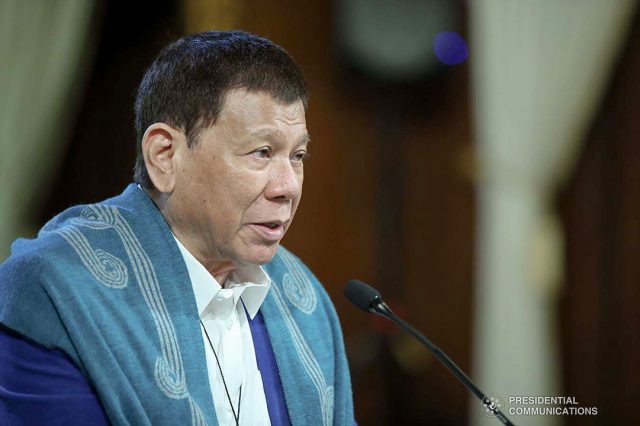
PHILIPPINE President Rodrigo R. Duterte on Monday filed his candidacy for senator, two days after his daughter announced her vice-presidential ambition for the elections next year.

Mr. Duterte, 76, will run under a party founded by a political supporter in 2018, according to copies of his filing documents tweeted by state media. He substituted for a relatively unknown member of the party.

His former aide Senator Christopher Lawrence T. Go filed his candidacy for president under the same party.

Mr. Duterte, who claimed last month he was retiring from politics next year, on Sunday said he could not support the presidential bid of the late dictator’s son Ferdinand “Bongbong” R. Marcos, Jr., accusing him of being a communist sympathizer.

The tough-talking leader, who is barred by law from running for reelection, said at the weekend he was backing Mr. Go.

His former aide dropped his vice-presidential bid after Davao City Mayor and presidential daughter Sara Duterte-Carpio decided to run for the same post, in tandem with Mr. Marcos.

Ms. Carpio on Sunday said her vice-presidential run was an opportunity to meet halfway her supporters, who wanted her to run for president.

The Davao mayor, who had rejected calls for her to run for a national post, is running under the political party of ex-President Gloria M. Arroyo, a known powerbroker in Philippine politics.

Mr. Marcos’ Partido Federal ng Pilipinas adopted her as its vice-presidential bet on the day she filed her candidacy.

Mr. Marcos registered his presidential candidacy in October, angering activists and victims of his late father’s 14 year-long martial rule.

His family was forced to flee the country in 1986 after a people power uprising supported by military generals toppled his father’s regime. He was among the first members of the family to return to the Philippines from exile in the United States in 1991.

Political observers have said Mr. Duterte could not afford to lose support from the Marcoses because their loyal backers supported his presidential bid in 2016.

Mr. Duterte’s senatorial ambition is yet another attempt to evade accountability from the International Criminal Court (ICC), Karapatan Secretary General Cristina Palabay said in a Facebook Messenger chat.

“It is as sinister, opportunist and underhanded as the attempts of his daughter, his aide and allies to run in the 2022 elections,” she said.

Political observers and critics have said the ruling camp might be doing everything to remain in power to protect Mr. Duterte from potential lawsuits.

The ICC has ordered an investigation of Mr. Duterte’s crackdown on illegal drugs that has killed thousands, saying crimes against humanity might have been committed.

The court will also probe vigilante-style killings in Davao City when Mr. Duterte was still its vice mayor and mayor.

Mr. Duterte earlier planned to run for vice-president, but promised to drop out of the race if his daughter runs for president.

But the President said he took note of the “overwhelming sentiment” of Filipinos that running for vice president would “circumvent” the law.

On Oct. 2, he said he was retiring from politics after finishing his six-year term in 2022.

“The overwhelming sentiment of Filipinos is that I am not qualified and it would be a violation of the Constitution to circumvent the law, the spirit of the Constitution,” he said of his vice-presidential ambition at that time.

He was referring to a Social Weather Stations poll that showed six of 10 Filipinos thought his plan to run for vice-president was illegal.

“In obedience to the will of the people, who after all placed me in the presidency many years ago, I now say to my countrymen ‘I will do what you want,’” Mr. Duterte said last month. “And today, I announce my retirement from politics.”

It wasn’t his first time to talk about retirement.

In 2015, Mr. Duterte said he would “retire from public life for good.” He ran for president the following year under PDP-Laban via substitution. — Kyle Aristophere T. Atienza and Norman P. Aquino

Late dictator’s son top bet for president based on SWS poll

FERDINAND “BONGBONG” R. MARCOS, JR. -- REUTERS

THE SON and namesake of the late dictator Ferdinand E. Marcos was the most preferred candidate for president, according to a poll by the Social Weather Stations (SWS).

The poll, commissioned by think tank Stratbase ADR Institute, Inc. showed that 47% of Filipinos would vote for former Senator Ferdinand “Bongbong” R. Marcos, Jr. if the elections were held today, the think tank posted on Facebook on Monday.

Vice-President Maria Leonor “Leni” G. Robredo was far behind him with 18%. Manila Mayor Francisco M. Domagoso came in third with 13%, followed by boxing champion and Senator Emmanuel “Manny” D. Pacquiao with 9%, it said.

Senators Panfilo M. Lacson and Ronald M. Dela Rosa were tied in fifth place with 5% each.

Meanwhile, Senate President Vicente C. Sotto III was the top pick for vice-president, with 44% of Filipinos backing his candidacy. He was followed by Davao City Mayor Sara Duterte-Carpio with 25%.

Senator Francis “Kiko” N. Pangilinan and cardiologist Willie T. Ong were tied at No. 3 with 13% each, followed by Party-list Rep. Jose Livioko “Lito” Atienza, Jr. (3%).

Stratbase did not say how many Filipinos were interviewed for the Oct. 20-23 poll. It also did not say what the error margin was. — Kyle Aristophere T. Atienza

DoH adds 630 Delta cases, 128 deaths from coronavirus

PHILIPPINE STAR/ MICHAEL VARCAS

THE DEPARTMENT of Health (DoH) reported 630 coronavirus infections involving a more contagious Delta variant on Monday, bringing the total to 6,612.

The new cases accounted for 95% of 666 samples collected in March, September, October and November and sequenced on Nov. 12, Health Undersecretary Maria Rosario S. Vergeire told an online news briefing.

There were now 3,129 cases of the Alpha variant first detected in the United Kingdom and 3,577 cases of the Beta variant first found in South Africa, she said.

DoH reported 1,547 coronavirus infections on Monday, bringing the total to 2.82 million.

The death toll rose to 45,709 after 128 more patients died, while recoveries increased by 2,601 to 2.75 million, it said in a bulletin.

There were 27,025 active cases, 61% of which were mild, 5.9% did not show symptoms, 10.8% were severe, 17.59% were moderate and 4.6% were critical.

The agency said 16 duplicates had been removed from the tally, 12 of which were tagged as recoveries, while 109 recoveries were relisted as deaths. Three laboratories failed to submit data on Nov. 13.

It said 35% of intensive care units in the Philippines were occupied, while the rate for Metro Manila was 30%.

Ms. Vergeire said the capital region might soon be placed under Alert Level 1 from the second alert level now.

At least half of residents must have been fully vaccinated against the coronavirus for an area to be placed under the lowest alert level. At least 70% of senior citizens must have been fully vaccinated as well.

The government on Sept. 16 started enforcing granular lockdowns with five alert levels in Metro Manila, weeks after the government struggled to contain a fresh surge in infections triggered by the more contagious Delta variant.

Metro Manila, which had an average of 404 daily cases from Nov. 1 to 7, was at low risk from the coronavirus. It has also reached the ideal vaccination rate among seniors and the target population.

The vaccination rate for seriously ill people in the capital region had not reached 70%, Ms. Vergeire said. The Philippines aims to vaccinate at least 50% of its adult population by yearend. — Kyle Aristophere T. Atienza

Allied strike groups hold war games in Philippine Sea

US NAVY carrier strike groups led by the USS Carl Vinson joined Japanese and British forces for military exercises in the Philippine Sea last month, according to the Philippine presidential palace.

USS Carl Vinson and ships and submarines from US, Britain and Japan held the exercises on Oct. 3 to 4, presidential spokesman Herminio L. Roque, Jr. told a televised news briefing on Monday.

The American flagship also held military exercises with the Japan Maritime Self-Defense Force in the South China Sea on Oct. 29 to Nov. 3, he said, citing reports from the National Security Council.

The sea operations brought together more than 15,000 sailors across six nations and “demonstrates the US Navy’s ability to work closely with its unmatched network of alliances and partnerships in support of a free and open Indo-Pacific,” according to the US Navy website.

The Philippines, China, Vietnam, Malaysia, Brunei and Taiwan claim parts of the South China Sea.

The US, which is not a claimant, has accused China of flexing its military muscle and restricting freedom of navigation in the disputed water. It has pledged to provide security support to its Asian allies.

Last month, Foreign Affairs Secretary Teodoro L. Locsin, Jr. said the Philippines was backing a defense pact that allows Australia to build nuclear-powered submarines using technology that the United States had only previously shared with Britain, saying it could keep the balance of power in the Indo-Pacific region.

BBC News last month reported that a US nuclear submarine had hit a mystery object in the sea.

Tan Kefei, a spokesman for China’s defense ministry, has demanded a clear explanation of the incident, the South China Morning Post reported.

The South China Sea, which is important for the regional ambitions of China, is a source of tension in the Indo-Pacific as the US and other Western countries continue to assert freedom of navigation.

President Rodrigo R. Duterte led a foreign policy pivot to China away from the US when he took office in 2016. Less than a year before he steps down, Mr. Duterte has changed his tone toward the US.

He has thanked US President Joseph R. Biden, Jr. for donating coronavirus vaccines to the Philippines. He also restored a visiting forces agreement after suspending it for months.

The two nations are set to hold more than 300 joint defense activities next year. — Kyle Aristophere T. Atienza

UN agencies, WHO cheer Philippine schools’ reopening 

DEPED

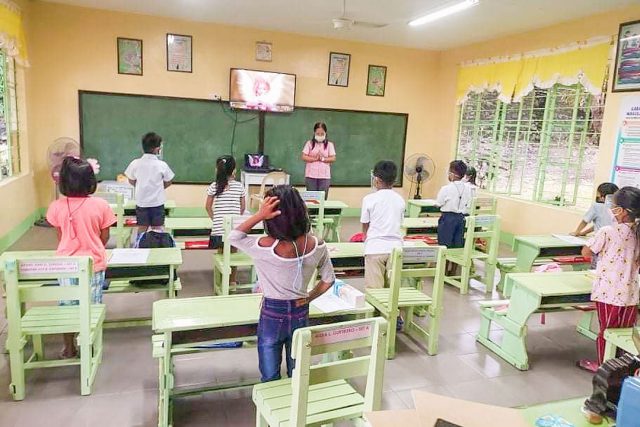
UNITED NATIONS (UN) agencies and the World Health Organization (WHO) cheered and expressed support to the Philippines’ limited reopening of primary schools on Monday, the last country in the world to resume in-person classes since the start of the coronavirus pandemic.   

“The pilot in-person schooling is a positive step which provides an opportunity to learn how to manage and minimize the risk of infections in school settings,” the organizations said in a joint statement Monday.  

The initiative highlights the importance of social development and continued learning in a child’s growth, it said.   

The organizations — including the UNICEF and UNESCO — also noted the negative impact of prolonged school closures on the physical and mental health of the younger generation.  

“We acknowledge that implementing in-person schooling in the context of the COVID-19 (coronavirus disease 2019) pandemic poses many challenges and is not without risk. However, in the context of learning to live with endemic COVID-19, available evidence confirms that starting in-person classes as soon as possible brings greater benefits than risks,” they said.  

The statement also underscored that the most vulnerable children, and those who are unable to access remote learning, are disproportionately impacted and are at risk of never returning to the classroom. 

The Education department approved the reopening of an initial 100 public elementary schools across the country out of over 3,500, mostly those in more remote and low-risk areas. — Alyssa Nicole O. Tan 

Parlade joins presidential race; Duterte spokesman, ex-police chief file for Senate run 

A FORMER official of the government’s anti-communist task force on Monday filed his candidacy for president.  

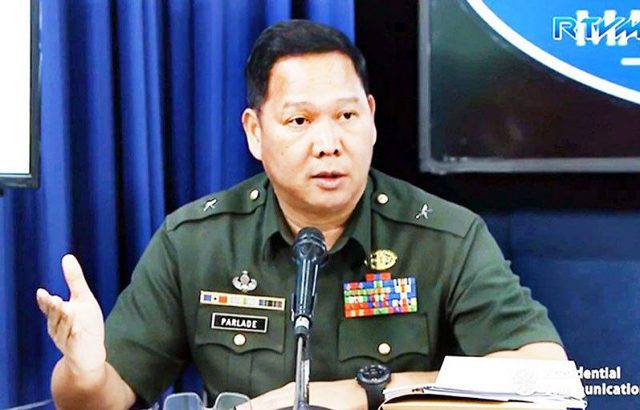
Retired military officer Antonio G. Parlade, Jr. filed his candidacy for president under the Katipunan ng Demokratikong Pilipino (KDP). He substituted for a party member.  

“Let me clarify I am not a politician, I am a soldier,” Mr. Parlade told reporters. “With this circus that’s happening now, wala akong nakikita na may magandang pag-asa ang bayan (I do not see a bright hope for the country).”  

Mr. Parlade, who served as spokesman for the government’s anti-communist task force, became controversial for tagging civic leaders and media personalities critical of the government as communist fronts.  

A number of senators had opposed his appointment to the controversial task force, saying it violated a constitutional provision that bars an active military officer from holding a civilian position in the government.  

Meanwhile, Mr. Parlade criticized Sen. Christopher Lawrence “Bong” T. Go for supposedly controlling President Rodrigo R. Duterte and called him one of the country’s “problems.”   

“I cannot align with SBG, I’m sorry,” Mr. Paralde said of the President’s long-time aide. “I just don’t like the way he does things, including controlling the decisions of the President.”  

In September, Mr. Parlade was appointed to the state’s top advisory body on security policies.  

SENATORIAL ASPIRANTS
Also on Monday, Mr. Duterte’s spokesman and one of his former police chiefs registered their respective candidacies for senator.   

Presidential Spokesman Herminio “Harry” L. Roque, Jr. will run under the political party founded by the late Sen. Miriam Defensor-Santiago. He substituted for a partymate.   

Mr. Roque did not submit his candidacy papers for senator in the filing period in early October, saying he would only run if Mr. Duterte’s daughter decides to run for president.   

Meanwhile, Guillermo Lorenzo T. Eleazar, who just stepped down as Philippine National Police chief on Nov. 13 upon reaching the mandatory retirement age of 56, filed his certificate of candidacy under Partido Reporma, the party of presidential candidate and Senator Panfilo M. Lacson, Sr. 

Mr. Eleazar replaced Paolo Capino, an advocate for persons with disability, who said he was withdrawing as his chances of winning are “slim to none.”  

Mr. Eleazar, in a short statement posted late Sunday, said he hopes to replicate the service he delivered as police chief.  

Poll watchdog Kontra Daya denounced the mockery of election rules, particularly the withdrawal and substitution for the country’s two highest positions.  

“The disastrous political spectacle these past few weeks could have been avoided if the Commission on Elections (Comelec) declared as nuisance candidates those who were clearly placeholders based on the public statements either by themselves or by the officials of political parties they represent,” it said in a statement.   

“Had Comelec decided swiftly and decisively, substitution would not have been allowed, sparing the public from the political maneuverings of the rich and powerful,” it added.   

Kontra Daya called on the poll body to “redeem itself by unilaterally declaring these placeholders as nuisance candidates, effectively voiding the substitutions.” — Kyle Aristophere T. Atienza and Russell Louis C. Ku 

LRTA administrator Berroya, 74 

LRTA.GOV.PH

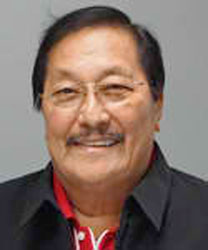
REYNALDO I. Berroya, a retired police general who became administrator of the Light Rail Transport Authority (LRTA), has passed away. He was 74. 

“It is with profound sadness and sorrow that we bid adieu to one of the most courageous and dedicated public servant and defender of the Republic, Gen. Reynaldo Berroya, administrator of the Light Rail Transport Authority,” Transportation Secretary Arthur P. Tugade said in a statement on Monday.  

Mr. Berroya, who was elected as LRTA administrator in 2017, previously held positions in the Department of Transportation and Communications, Land Transportation Office, Civil Security Group, Anti-Drugs Task Force, and the Presidential Anti-Crime Commission, among others. 

Mr. Tugade described him as having an “exceptional leadership.” 

“As Administrator, he was one of those who was instrumental in lifting and revitalizing the image of the country’s transport system, particularly the railways sector,” he also said. — Arjay L. Balinbin 

Dargani siblings in pandemic supply controversy caught in Davao 

OFFICE OF SENATE SGT OF ARMS

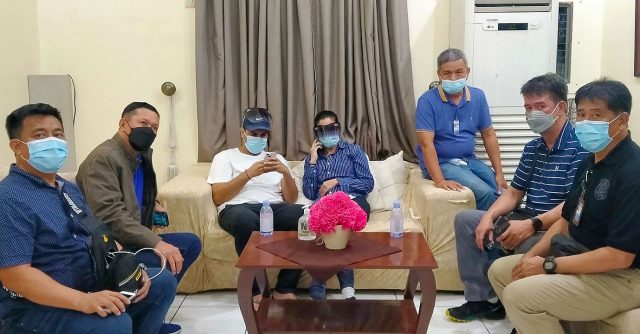
TWO OFFICIALS of a company being investigated for allegedly anomalous contracts for pandemic supplies are now under Senate custody after they were caught Sunday afternoon at the Davao International Airport, where they were supposed to take a private flight to Malaysia.  

Pharmally Pharmaceuticals Corp. President Twinkle Dargani and her brother, Pharmally Corporate Secretary Mohit Dargani, are now detained at the Senate following their arrest by members of the Office of the Senate Sergeant-At-Arms (OSAA) while already on board a private plane bound for Kuala Lumpur.   

Senator Ana Theresia “Risa” N. Hontiveros-Baraquel said at the Pandesal forum Monday that she expects the Darganis to be more forthright in their testimonies now that they are under Senate custody.   

“In the past few weeks, the Senate has been scouring possible hideouts of the Darganis after they were cited in contempt and ordered to be arrested for refusing to submit documents the Senate needed in its investigation,” Senator Richard J. Gordon, Sr. who chairs the blue ribbon committee, said in a statement Monday.  

“We knew they were hatching their grand escape via the back door,” he added.  

Mr. Gordon on Monday also sent a letter to Globan Aviation Corp. to request details and copies of the flight contracts showing the price, contractor, payer, and signatory of the documents related to the Darganis’ supposed flight to Malaysia.  

Ms. Hontiveros also said during the forum that the final committee report will likely include recommendations to sue former budget procurement executive Lloyd C. Lao, former Presidential economic adviser Michael Yang, and other Pharmally officials.  

“The foreign officials of Pharmally, the elder and younger Huang, are already subject to standing warrants of arrest in Singapore and will probably be recommended for charges here in the Philippines with regards in particular to violations of the new procurement law and the tax code,” she added. — Alyssa Nicole O. Tan 

PAL introduces exclusive flights for fully vaccinated in Manila-Bacolod route 

NEGROS OCCIDENTAL PROVINCIAL GOV'T

PHILIPPINE Airlines, Inc. (PAL) is offering flights exclusively for those fully-vaccinated in its Manila-Bacolod route starting this month.   

PAL Bacolod branch head Rene G. Aviles, in a letter to industry partners, announced a “special flight for fully vaccinated passengers only” from Manila, twice a week on Monday and Fridays in November and December.   

“You might want to take that flight if you want to travel more safely,” Bacolod City Administrator Em Legaspi-Ang said in a Facebook post where she shared the PAL advisory. 

The flag-carrier is also maintaining a daily Manila-Bacolod-Manila service.  

The Bacolod-Silay International Airport is the main gateway to Negros Occidental.  

Bacolod is currently under Alert Level 2, the second most relaxed quarantine level under the new system.   

The city has eased rules for inbound travelers, including the lifting of the negative RT-PCR test result and S-pass requirements for fully-vaccinated individuals.  

The city has seen a decline in coronavirus disease 2019 (COVID-19) cases and positivity rate over the last four weeks.  

As of Nov. 14, Department of Health data show Bacolod had 757 active COVID-19 cases out of the 3,456 recorded since the start of the pandemic. There were 22,093 recoveries and 603 deaths.  

Bacolod has fully vaccinated 42% of its target population while over 45% have been given a first dose, based on data as of Nov. 8. — MSJ 

House panel approves bill protecting human rights defenders 

PHILSTAR

A COMMITTEE in the House of Representatives approved a bill on Monday that seeks to protect human right defenders from harassment and intimidation.  

In a hearing, the House Committee on Human Rights approved a substitute bill to House Bills 15, 161, and 240, subject to amendments.   

The measure would mandate the government to respect the rights of defenders such as forming organizations. It will also prohibit state authorities from freezing or seizing their bank accounts, among others.  

State authorities will also be directed to refrain from using “derogatory” labels, or tagging human rights defenders as “red,” “communists,” “terrorists,” or “enemies of the state.”    

It would also create a Human Rights Defenders Committee, with the chair and members to be selected by the Commission on Human Rights along with representatives from the Philippine Alliance of Human Rights Advocates, Karapatan, Free Legal Assistance Group, and the National Union of People’s Lawyers. 

House Deputy Speaker Bienvenido M. Abante, Jr. suggested the inclusion of government officials, such as representatives from the Department of National Defense and Department of Justice, in the committee.   

Meanwhile, Kabataan Party-list Rep. Sarah Jane I. Elago welcomed the approval of the bill saying as it can help enable the youth to actively contribute to nation-building. 

“It is imperative to give the highest priority to the implementation of legislative enactments, executive issuances and judicial decisions that guarantee respect, protection, promotion and fulfillment of human rights and fundamental freedoms, to provide access to legal remedies and reparative measures to human rights violations victims,” she said in a statement.  

A counterpart bill is pending at the committee level in the Senate. — Russell Louis C. Ku 

Spain’s Morata grabs late winner to seal World Cup spot

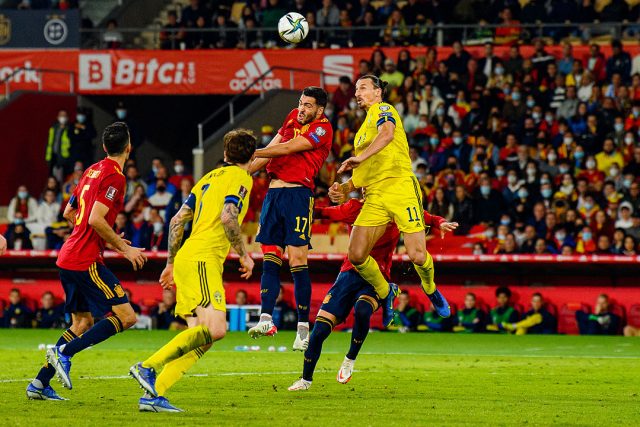
MIKEL MERINO of Spain and Zlatan Ibrahimovic of Sweden during the FIFA World Cup Qualifier football match between Spain and Sweden on Nov. 14 in Seville. — REUTERS

SEVILLE, Spain — Spain’s Álvaro Morata came off the bench to strike a late winner as they qualified for next year’s World Cup finals in Qatar by beating stubborn visitors Sweden (1-0) in a tense clash on Sunday.

Morata struck in the 86th minute when he cleverly lifted the ball over Sweden’s Robin Olsen after Dani Olmo’s fierce drive was pushed onto the post by the keeper and fell into his path.

Spain, who won the 2010 World Cup in South Africa, finished top of Group B with 19 points, four ahead of the second-placed Swedes who could still qualify through the playoffs in March.

“I felt more pressure now then in the Euros,” said Spain manager Luis Enrique, whose side lost to eventual winner Italy on penalties in this year’s European Championship semifinals.

“We tried to work a lot on the mental side, always trying to keep it positive and the players responded well. I’m so proud of them and how they responded.”

Spain, playing in front of 52,000 fans in the sold-out La Cartuja stadium, had never lost a home game in World Cup qualifiers and kept their record intact in Seville.

They had only ever lost four of 52 games in the city.

“We knew it was a life and death situation and we wanted to qualify at any cost. Nobody said it was going to be easy and I’m happy for our people,” Sergio Busquets told reporters.

It was a nervous occasion and although Spain dominated play, the Swedes created the best opportunities through the dangerous Emil Forsberg and Alexander Isak on the counterattack.

Forsberg almost scored twice in the first half. First, he shot just past the upright and then he was left unmarked at the far post to meet Ludwig Augustinsson’s cross with a volley that licked Unai Simón’s right-hand post before going wide.

“It feels sour. I think we played a good first half and created chances, but the ball did not want to go in. It was not our day.” Forsberg told reporters.

After playing the full 90 minutes in Sweden’s 2-0 loss to Georgia on Thursday, Zlatan Ibrahimović started on the bench and made little impact when he came on for the last 20 minutes.

The game was heading for a draw, which would have been enough take Spain to the finals, when Olsen tipped Olmo’s strike against the woodwork before it fell to substitute Morata, who was winning his 50th cap, and he calmly put the ball in net.

It will be Spain’s 16th appearance, and 12th in a row, in 22 World Cups. The last time they failed to qualify was in 1974. — Reuters

ADVERTISEMENT
ADVERTISEMENT