Home Blog Page 7176

COVID injury

Aaron Rodgers was businesslike in his virtual press conference following the Packers’ loss to the host Vikings over the weekend. Needless to say, much of the talk in the post-mortem focused on his injured left pinky toe, and not simply because it was aggravated by incidental contact in the first half of the close contest. He left early to have it treated, and whatever was done in the locker room must have helped tremendously; he was close to perfect in the final two quarters, going for touchdown passes in each of four drives covering at least 74 yards.

So good was Rodgers that the outcome of the set-to could well have been different were the timing more favorable; his last push knotted the score at 31 heading into the two-minute warning, with only a game-ending field goal by the Vikings clipping the rally short. In any case, he was prepared for inquiries from scribes on the state of his toe. In large measure, he anticipated the interest after he himself referred to it in an appearance on The Pat McAfee Show the pre-vious week as a “COVID injury.” And he was ready with his reply.

Interestingly, Rodgers moved to quash speculation borne of his statement uttered in a light-hearted moment by showing his left foot on camera. He went about proving that it did not suffer from the discoloration said to be a symptom of “COVID toes.” Why it would be significant for him to go through such lengths to disabuse fans of news he fueled is subject to debate. He even sought an apology from The Wall Street Journal for previously reporting on it, never mind that he made a mistake as to who crafted the article; he called out former The Athletic scribe Molly Knight and not actual writer Andrew Beaton.

That said, any information on Rodgers, and especially when it comes to the virus, will continue to be media fodder. And, bottom line, the reigning league Most Valuable Player need just look in the mirror to find who to blame. After all, he misled the public with his declaration that he is “immunized” from COVID-19 despite being unvaccinated. Is his intent to keep deliberately fudging the facts, if for no other reason than to give all and sundry the finger? Who knows? Meanwhile, there’s no question on his impact on the field, COVID toes or no.


ANTHONY L. CUAYCONG has been writing Courtside since BusinessWorld introduced a Sports section in 1994. He is a consultant on strategic planning, operations and Human Resources management, corporate communications, and business development

Withering away of democracy?

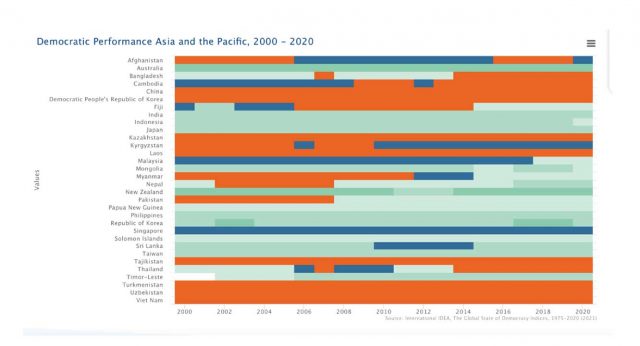
Source: International IDEA, Global State of Democracy Report 2021

It was quite common back then to hear some Marxists assert that when a classless society has been achieved and the State as a coercive institution, interfering in social relations, ceases to be necessary, the State simply withers away. It dies out.

It did not happen in Russia, or anywhere else. It has not happened today. What used to be the Soviet Union disintegrated into independent republics after 69 years from its foundation in 1922. Totalitarian dictatorship was repu-diated; the hammer-and-sickle flag yielded to the pre-revolutionary white-blue-red flag.

Ironically, the trend that is most evident today, as reported by the International Institute for Democracy and Electoral Assistance (International IDEA), is that “a greater number of countries are sliding toward authoritarianism, while the number of established democracies under threat has never been so high.”

Are we seeing the withering away of democracies?

International IDEA is an intergovernmental organization formed to “promote and advance democracy worldwide.” It aims to see democracy flourishing, rather than dying out. It is driven by its vision to see a world in which democratic processes, actors and institutions are inclusive and accountable.

Three impact areas are the focus of International IDEA: electoral processes, constitution-building processes, and political participation and representation. Based in Stockholm with regional and country offices in Africa, the Asia-Pacific region, Europe, Latin America, and the Caribbean, it has gravitas. International IDEA is a permanent observer at the United Nations and is accredited by the European Commission and the European Parliament.

There has been a sea change in democratic space across the world over time.

Source: International IDEA, Global State of Democracy Report 2021

In its retrospective report 2012-2017 entitled “Supporting Democracy Worldwide,” International IDEA documented the implementation of its “Strategy” in the time of citizens-led uprisings across the Middle East and North Africa, culminating in the downfall of autocratic regimes of long standing. In more established democracies, populism held ground due to the failure of democracies and the ruling class to deliver fair access to opportunities, employment, and education. Great advances in information and communication technology helped in the cause of demanding accountability from policy makers. What was essential was championing the centrality of the citi-zenry in a democracy.

It was correct for International IDEA to shift the public debate away from the “perception that democracy can be built by occupying a central space like Cairo’s Tahrir Square or protesting on Wall Street.” Instead, democracy thrives when citizens are mobilized into institutions and processes that can influence real policy action. By sharing country experiences globally in upholding democracy, International IDEA has contributed to increasing democ-racy’s capacity, legitimacy, and credibility.

Of late, 33 countries have signed up with International IDEA including Asia-Pacific countries, namely Australia, India, Indonesia, and the Philippines which joined in 2013. Japan participates as an official observer.

But in the last few years, International IDEA recently observed that “the world is becoming more authoritarian as autocratic regimes become even more brazen in their repression. Many democratic governments are back-sliding and are adopting authoritarian tactics by restricting free speech and weakening the rule of law, a trend exacerbated by the COVID-19 pandemic.”

This is the key message of International IDEA last Monday with the release of its latest assessment, “The Global State of Democracy 2021 (Building Resilience in a Pandemic Era).” The Report was released three weeks before US President Joe Biden’s Summit for Democracy on Dec. 9-10. About 100 countries will gather to discuss the challenges of keeping democracy alive.

International IDEA’s report is indeed an alarm bell.

Authoritarianism has been observed to be rising in every part of the world. Universal values of democracy are under threat. Backsliding now seems to be the norm as it has doubled in the last 10 years, covering about a quar-ter of the world’s population. The US is the prime example of a backslider as well as some European member states like Hungary, Poland, and Slovenia. What happened in the US Capitol after the Trump defeat was everything that a democracy should not be.

The democracy organization noted that there were more countries in 2020 that moved to more authoritarianism than to more democracy. We are not surprised that as shown previously by press reports, four democracies were lost to fraudulent electoral exercise or military coups. Using various indices, the Report disclosed an increase in state repression, the worst in years.

Not all the democratic losses were due to political factors. The health pandemic has actually entrenched the trend of democratic descent. As of August 2021, around 64 countries “have taken an action deemed to be dispro-portionate, unnecessary or illegal to curb the pandemic.”

What drive democracies to swing to the other side are slippages in political processes and, in International IDEA’s words, social fault lines unmasked by the pandemic. We are all witnesses to how the Philippines’ pandemic response was shaped. Easy-to-implement policies were resorted to like lockdowns and prohibitions of personal mobility. Establishing a more sophisticated, science-based centralized and digital database system was more chal-lenging but that could have enabled the granular community quarantine with a manageable hit on economic growth. Blanket tagging of individuals as insurgents on mere suspicion was even enacted into law.

In addition, as Dindo Manhit of the Stratbase Group recently wrote, “another pandemic threatens to destroy our way of life. Disinformation is an insidious instrument that deprives people of their right to credible information. It dispossesses them and diverts their attention from pressing public issues.” This is anti-democracy. It happened in Myanmar, Peru, and even in the United States.

The only good news is that there are newly observed contrary movements. Some democracies proved to be more resilient despite all the odds. They introduced or broadened democratic innovations and adaptability of their practices and institutions.

It is good civic activism that continues to strengthen, defying state repression especially in Belarus, Cuba, and Myanmar. In addition, issues of global sustainability like climate change and racial justice have creeped into public debates. The democracy organization also reported that over 80 countries went through various forms of protests and mass actions during the pandemic despite repressive state actions.

For democracy to continue to thrive, International IDEA recommends “embracing more equitable and sustainable social contracts, reforming existing political institutions, and shoring up defenses against democratic backslid-ing and authoritarianism.”

What does the Report have to say about the Philippines and the rest of the Asia-Pacific region?

In the press release issued on Nov. 22, International IDEA noted that “democratic erosion is also widespread, including in India, the Philippines, and Sri Lanka with many of them suffering from rising internationalism and the militarization of politics.” The Philippines has remained as a mid-range (green) performing democracy compared to either weak (light green), high-performing (dark green), hybrid (blue) and authoritarian (orange). The chart accompanying this piece shows in no uncertain terms the growing dominance of orange, pointing towards authoritarianism.

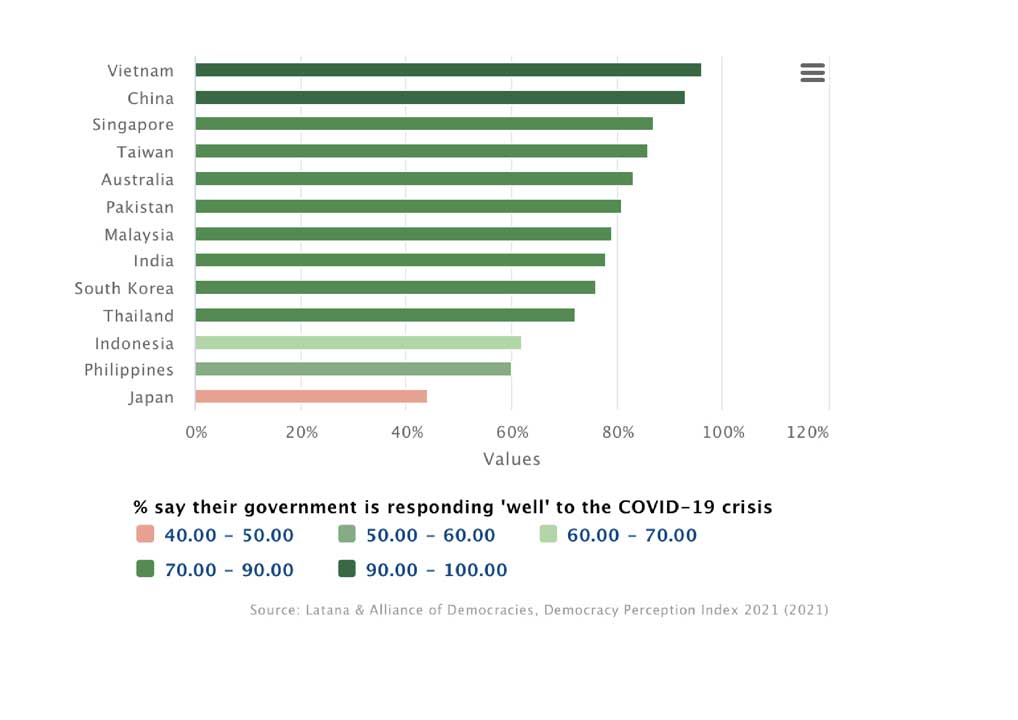
One interesting finding of International IDEA is that Vietnam’s authoritarian regime did not prevent it from getting popular support and people’s trust in, for instance, pandemic management. It delivered, and delivered well. China, Singapore, and Taiwan also received good feedback despite their democratic performance. Singapore has a hybrid regime while Taiwan, like the Philippines, is a mid-range performing democracy.

The clear challenge for the next President of the Republic is to ensure democracy work well especially in the areas of electoral reforms, fighting corruption, upholding the rule of law, defense of our sovereignty, strengthening of our public health system, restructuring of the Philippine economy and mainstreaming of marginalized sector, ensuring universal education, promoting social justice, and building resilient communities.

We cannot afford to see democracy wither away.

Diwa C. Guinigundo is the former deputy governor for the Monetary and Economics Sector, the Bangko Sentral ng Pilipinas (BSP). He served the BSP for 41 years. In 2001-2003, he was alternate executive director at the International Monetary Fund in Washington, DC. He is the senior pastor of the Fullness of Christ International Ministries in Mandaluyong.

Reporting the circus

With only a year before the most crucial Philippine elections in decades, nearly 40 media organizations and 300 journalists and media workers signed on June 17 a pledge to do a better job in reporting the campaign for President, Vice-President, and other national as well as local posts.

The pledge declared that every election “is a reckoning for democracy,” hence the duty of journalists “to provide accurate, reliable and essential information that will empower voters and encourage public discussion and debate.”

The signatories vowed to “put voters and the integrity of the electoral process at the center of (their) reporting” — to depart from the usual media focus on personalities, concentrate on the issues that matter to the citizenry, and make sure that the elections are clean and fair.

As part of the commitment to issue-focused reporting, they also pledged to look into and report on the track records of candidates, check and challenge false information and hate speech, provide the context of whatever events and issues may arise, monitor the independence of the State and other agencies involved in the elections, and encourage and support best practice in journalism.

The pledge basically reiterated the need for journalists to observe in the critical months ahead the professional and ethical standards that enable journalists to discharge the essential duty of truth-telling in behalf of the making of an informed electorate capable of making intelligent choices during elections.

Five months since, however, compliance with the pledge in much of the reporting on the politics of the campaign has been spotty at best. While some media organizations and practitioners have done a yeoman’s job of re-porting the political circus, their work in the context of the huge amounts of airtime and space that have been spent on the coverage of the prelude to the official campaign period in February 2022 has been the exception ra-ther than the rule.

Much of media coverage of what transpired as the Nov. 15 deadline for candidate substitutions came and went was no different from that of past election campaigns.

Glaring enough was the focus on personalities — on Sara Duterte, Ferdinand Marcos, Jr., Rodrigo Duterte, Christopher “Bong” Go, etc. — as that much awaited date passed.

The media closely covered what those worthies said and did without pointing out that, as they jumped from this or that “political party” and became their candidates, it had become quite obvious that keeping power and getting it are all that drive this country’s officialdom and pretenders to the Presidential throne.

It took political scientists to point this out and the truth that the groups that call themselves “political parties” have neither program nor principle and are mere vehicles of convenience for the realization of these and other power-seekers’ ambitions.

Neither was any context provided by much of the media reports on the disqualification complaints against Marcos Junior. Instead, they covered the usual caravans and parades, and quoted him and his lawyers as the Commission on Elections (Comelec) granted his appeal for an extension of the period within which he has to answer the complaints.

Only in the social media pages of some commentators were there any attempts at analysis, as it became evident that the Duterte-Marcos Axis has collapsed, and that Marcos’ disqualification in the context of growing doubts over Comelec inde-pendence would be advantageous to the Dutertes’ drive to remain in power at all cost.

Again, only some of the media provided contextual information on the suggestion that because Marcos and Sara Duterte are supposedly leading among the voters’ preferred candidates for President, they could enter into a term-sharing agreement. It could mean Sara Duterte’s completing the last three years of Marcos’s six-year term should they both win in 2022.

A handful of reports said it would be unconstitutional, and cited the provisions of the Constitution mandating separate six-year terms for the President and Vice-President as well as the rules of succession which say that a Vice-President can succeed a President only if he or she can no longer perform the duties of that office.

The rest reported it without that context, which could have led their audiences to mistakenly conclude that once in power, government officials can do whatever they please, including violate the Constitution. The exceptions stood out for the rarity of their dedication to providing the information voters need to prevent their again electing into office the bogus leaders that have made this country the development basket case of Asia.

The three dozen-plus media organizations and 300 journalists and media practitioners that signed the June 17 pledge seem like a lot, but they are not. There are thousands more that did not sign for a number of reasons, among them the different and often conflicting political and economic interests of corporate media that have long prevented the making of a community of shared values; the vast differences in the training of practitioners in the professional and ethical principles of journalism practice; the corruption and patron-client relations between some practitioners and their sources; and the fear factor engendered by the continuing harassment and killing of journalists.

The last has been even more of a media concern during the Duterte regime. Mr. Duterte himself aggravated it. After justifying the killing of journalists in 2016, he proceeded to insult reporters for asking questions about his health, persecuted media organizations and independent journalists for their supposed bias, accused individual journalists and media organizations of conspiring to bring down his regime, and orchestrated the shutdown of the free TV and radio services of ABS-CBN network.

His spokespersons have denied the “chilling effect” on the media of these acts and threats. But among their consequences is a decline in critical reporting, and the resulting dominance of the regime narrative on such issues as the extrajudicial killings and human rights violations that characterize its rule.

All the above factors contribute to the failure of the media to go beyond “he-said-she-said” reporting. So few are the exceptions that they escape the attention of much of the mass audience. There is also the uncritical ac-ceptance of such precepts as “objectivity” and non-interpretation that have been drummed into the heads of many practitioners by the journalism schools. The result is a fetish in reporting without analysis, critical discernment or context of the claims, no matter how outrageous, absurd, tasteless and dangerous they are, of this or that prominent, usually government source about an issue or event.

Meanwhile, the conflicting loyalties and interests of corrupt practitioners leads to many journalists’ being no more analytical than their cameras and sound recorders. The subservience of corrupt practitioners to this or that source also contributes to mass disinformation.

The result of the dominance in much of the media of the fear of provoking State retaliation for a critical report and of corrupt and business-as-usual practices is an information crisis — and multiple crises in Philippine governance and what little remains of Philippine democracy.

The failure of the mass of the electorate to vote wisely is among the lethal by-products of the media inability and/or unwillingness to provide their audiences not only with information on what happened, but, even more importantly, why— and what it means to them. Unless things change in the way the media report the circus that politics in this country has become, the consequences to the democratization process and the way this country is governed will condemn many more to needless suffering and even death.


LUIS V. TEODORO is on Facebook and Twitter (@luisteodoro). www.luisteodoro.com

Killing Roe vs. Wade

Next year may just be the year that Roe vs. Wade is finally overturned by the US Supreme Court. And in doing so, correct a grievous constitutional error that resulted in the deaths of 62 million babies.

That’s 62 million. One study tracked it at a million aborted babies a year from 1975 to 2012. That’s far more than the 775,000 alleged COVID deaths in the US. Or the 5.16 million alleged COVID deaths worldwide.

Because what the US Supreme Court did in 1973 was to rule that a pregnant woman has the right to have an abortion without government interference. In essence, authorizing abortion on demand. And with its companion case Doe vs. Bolton, as well as 1992’s Planned Parenthood vs. Casey, was crafted a judicially legislated national abortion regime where:

• “States may not prohibit abortion before viability, or when an unborn child is ‘potentially able to live outside the mother’s womb,’ which occurs at approximately 24 weeks of pregnancy.

• “States may not restrict or regulate abortion before viability with ‘the purpose or effect of placing a substantial obstacle in the path of a woman seeking an abortion of a nonviable fetus.’

• “States may prohibit abortion after viability ‘except when it is necessary, in appropriate medical judgment, for the preservation of the life or health of the mother.’

• “The ‘health’ exception encompasses ‘all factors — physical, emotional, psychological, familial, and the woman’s age — relevant to the well-being of the patient.’”

The US Supreme Court “thus created one of the most permissive abortion regimes in the world; the United States, for example, is one of only seven nations allowing elective abortions after 20 weeks of pregnancy.” (“Dobbs v. Jackson Women’s Health Organization: An Opportunity to Correct a Grave Error.” The Heritage Foundation, 2021)

The US Supreme Court did this through the mistaken theory of the “living constitution,” where the Constitution’s words can be flexibly interpreted to take a meaning not rooted in the actual text for the purpose of achieving a certain policy objective. In the case of Roe, the “right” to abortion was created out of nowhere, under a supposed constitutional right to “privacy.” Never mind that the words “abortion” and “privacy” never even appear in the US Constitution.

This was done by building on previous rulings within the confused idea of “substantive due process,” most infamously by upholding a so-called “right” to contraceptives (never mind again that the word “contraceptives” does not appear in the US Constitution), flimsily reasoned out, as Justice William Douglas did in Griswold vs. Connecticut, that “specific guarantees in the Bill of Rights have penumbras, formed by emanations from those guarantees that help give them life and substance.”

The ruling in Roe was so egregious, so mistaken, so wrong, that even a liberal legal academic, Stanford Law Dean John Hart Ely, was famously moved to write about it being completely untethered to the text, structure, and understanding of the US Constitution. That it was “not constitutional law and gives almost no sense of an obligation to try to be” (“The wages of crying wolf,” 1973).

But now comes Dobbs vs. Jackson Women’s Health Organization, which arose from a 2018 Mississippi law entitled the Gestational Age Act. This law bans any abortion operation after the first 15 weeks of pregnancy (with an exception carved out for medical emergencies or severe fetal abnormality).

Relatedly, this was on the heels of Georgia’s House Bill 481 in 2019, which banned abortions after six weeks, and the 2021 Texas Heartbeat Act, which made illegal abortions done after the sign of fetal heartbeat (usually six weeks after pregnancy).

What makes the Dobbs case additionally interesting is the monumental shift in the make-up of the US Supreme Court, what with the appointment of Chief Justice John Roberts, Clarence Thomas, Samuel Alito, Neil Gorsuch, Brett Kavanaugh, and Amy Coney Barrett. All (to varying degrees) conservative judges. All Catholics. And with the exception of Roberts, all “originalists” or “textualists,” which means that they interpret the US Constitution as written. As it should be.

Of course, their presence does not guarantee a proper ruling. Casey is a good example of that. Two decades after Roe, the US Supreme Court had a great opportunity to overturn it (or at least pave the way for its eventual demise) with the 1982 Pennsylvania Abortion Control Act. Instead, that law, which provides among others requirements of a waiting period, spousal notice, and (for minors) parental consent before an abortion could be had, was rendered unconstitutional by a vote of 5-4. Even more painfully, three of those justices were nominated by conservatives: Sandra Day O’Connor, Anthony Kennedy (who’d go on to later pen the equally erroneously ruled Obergefell v. Hodges), and David Souter. Under the most callow of reasons: stare decisis and judicial legitimacy.

Hopefully next year the US Supreme Court will finally do the right thing: protect the rights of the unborn child.


JEMY GATDULA is a senior fellow of the Philippine Council for Foreign Relations and a Philippine Judicial Academy law lecturer for constitutional philosophy and jurisprudence https://www.facebook.com/jigatdula/

Twitter @jemygatdula

Cultivating resilience

The ongoing Ako Para Sa Bata (APSB) conference webinars have presented many facets about child protection.

Among them is “Resilience, the ability to thrive amidst difficult situations. It is the buffer between stressors and one’s mental health. People tend to rely on others. Going through failure and hardship in life tends to strengthen resilience.”

The objective is to see the factors that affect individual resiliency and how organizations survive and thrive amidst adversity and turbulence.

Ma. Regina Hechanova-Alampay PhD, RPsy, (professor at Ateneo de Manila University, Chief of Party, USAID RenewHealth project) highlighted a chart that reveals COVID-19 Mental Health Concerns of Filipinos which showed the youth (age 25 and below) and women are at risk.

Those suffering from severe to extreme stress came up to 55% of those studied, with 70% suffering from anxiety and 55% from depression. The stressors included health exposure to COVID, and illness. Occupational Stressors in-cluded increased responsibilities, while Social Stressors were lack of social support, discord in the family, and COVID news, and Governance Stressors were access to basic needs, and loss of income.

Coping behaviors matter. How people cope affects how resilient they feel. Spiritual behavior (looking at thing in a different way) lead to diminished depression and anxiety especially among the mature population. Resilience is both “Nature and Nurture: innate and developed.”

“While there are individual resources which contribute to resilience, communities and societies also provide resources which are key to facilitating resilience.”

She focused on workers in companies and organizations. There was a decline, she noted, in problem solving, perspective taking, and spirituality. There was an increase in distraction, denial and substance use. Organizations can help employees become resilient by providing the basic needs: safety, medical service, self-care information, and education on self-care. For Employee Care they can embark on Wellness programs and benefits, psychological first aid, training supervision, the prevention of stigma and discrimination, mental health stress management programs, counseling and coaching, psychological debriefing, and peer support group. Specialized services include the referral to mental health professionals and coverage of mental health service.

Among the programs is Katatagan — a psychoeducational intervention of the future; a way of finding strength to develop resilience skills for those with mild or moderate distress. It is composed of: Making the future; Finding and cultivating strengths; Managing physical reactions; Managing thoughts and emotions; Positive activities; and, Seeking solutions and support. It is delivered though synchronous small groups meeting virtually for three to six weeks; asynchronous facilitated online classes wherein participants go through modules on their own time; and the innovative Lusog Isip (Mental Health) App that allows one to monitor mood, coping mechanism and stress levels.

The Johns Hopkins Model has three phases with organization strategies that would enable organizational resilience in the Philippines. These are:

1.) Resistance has communication system, formation and training of response teams, business continuity plans, database of employees and monitoring system;

2.) Resilience has impact assessment on employees and organization, psychological first aid, provision of materials and financial resources to affected employees;

3.) Recovery has access to resilience programs, counseling, review of protocol, and, restoration of facilities.

Dr. Bernadette J Madrid, executive director of the Child Protection Network Foundation, head of the PGH Child Protection Unit, and a pediatrician, talked about Organizational Resiliency as “the ability of an organization to anticipate, prepare for, respond, and adapt to incremental change and sudden disruptions in order to survive and prosper. Resilience, being prepared, proactive and flexible are guides against failure, she said.

She said that “Successful organizations have well-established routines. Work is predictable.” She said that they have simple rules or heuristics — “rules of thumb that help you speed up decision making and prioritize the use of resources in less-predictable contexts.” And, improvisation —“spontaneous and creative efforts to address an opportunity or a problem.”

“The ease with which teams refashion how specific tasks get done — whatever the level of turbulence — is the defining capability of a resilient organization,” she said.

Managing Risk and Resilience were discussed by Fernando F. Suarez and Juan S. Montes in the Harvard Business Review (November/December 2020). Dr. Madrid explained, “No one was really prepared for a pandemic. It’s world-wide. It’s deadly! It affects everybody from all sectors. Existing problems become worse…. We don’t know when it will end. It’s unpredictable. It’s not in our control. You can be unemployed. Your whole family can be affected.”

The University of the Philippines (UP) Philippine General Hospital (PGH) Child Protection Unit charts the reported cases of Violence against Children. It showed a high in January 2020, a decline that April, and an increase in December. However, not all cases are reported because some resources shifted to responding to COVID-19, and social workers were busy. No home visits were allowed. Schools were closed. No transportation was available during the strictest quarantine. People were afraid to go to the hospital. The perpetrators were at home with the victims, preventing them from seeking help. These exacerbated the crisis.

The response of UP-PGH COVID 19 Operations center was the expansion of the hotline to include child abuse. Around the country, the Women and Children Protection Units Helpline was active from Batanes at the tip of Luzon, through the Visayas, and down to Mindanao. In partnership with the UNFPA (United Nations Population Fund), the virtual access, Child Protection Network (CPN) web-based database collected date for processing and analysis. With UNICEF, there is digitalization of services, telemedicine consults, there are video-visits or cellphone follow-ups.

Case conferences are virtual. Online court hearings are being done.

Parenting tip sheets — “Masayang Pamilya Parenting Program” in Filipino and seven other Philippine languages (with information from Ateneo, Oxford University, the CPN, and UNICEF) — were prepared and are being dis-tributed.

Child maltreatment is being addressed despite the limitations and restrictions of the pandemic lockdown.

In partnership with the ICTSI Foundation, the more complex cases are being handled.

In partnership with UNICEF, CPU has multidisciplinary teleconsultation with 55 barangays in 13 cities. The barangays and cities have TeleCPU and Child Helpline.

The challenges of CPU are staff burnout, the need for increased resources to help staff and patients, and mental health support.

The open forum was very lively with Kara Patricia David —GMA TV host, assistant professor at the UP College of Mass Communications, and Founder of the Malasakit Foundation — interacting with panelists and partici-pants.

Dr. Madrid and Dr. Hechanova-Alampay assessed staff burnout and exhaustion. “Feeling there is nothing left to give. The lack of empathy comes from exhaustion… When you stop loving the work you do, it becomes some-thing you dread.”

It was noted that hyper-independent people do not ask for help because there is hiya or shame. The message should be: “It is okay to ask for help.”

The strongest predictor of meaningful work is feedback from clients, bosses, or peers. Leaders should be more expressive of their praise of others. “One strategy is the sandwich method — the affirmations of the work, the feedback itself, then closing with encouragement.”

The discussion led to the possible triggers of suicidal thoughts. Parents should be educated about the principle of trauma-informed care and prevention. Thoughts are not innate — they could be traced to trauma.

Dr. Madrid recommends the book The Body Knows and asserts that every experience is absorbed by the body and can have symptoms.

At the end, the panelists said, “Together, we can stop violence against children.”

The APSB conference ends on Nov. 25 with the 8th and final webinar: “Violence for, by and with the Children and Youth.”

It has been an enlightening experience for more than 10,000 participants.

Our warm congratulations and thanks to Child Protection Network Foundation, UNICEF, the partner-sponsors, and the efficient organizers and team who have presented the broader view and deeper insights on the Child.


MARIA VICTORIA RUFINO is an artist, writer and businesswoman. She is president and executive producer of Maverick Productions. mavrufino@gmail.com


Singapore to avoid a Europe-style COVID resurgence, official says

REUTERS

One of the highest vaccination rates in the world and growing natural immunity could protect Singapore from a Covid-19 resurgence like those currently engulfing Europe and the US, even if another wave hits as expected, Health Minister Ong Ye Kung said.

Singapore’s immunized population is half as likely to die of Covid than influenza, while those who aren’t vaccinated are five times more likely to succumb to the infection, Mr. Ong said in an interview with Bloomberg News on Wednesday at the Asia Summit on Global Health in Hong Kong. That shows that the virus can be endemic, provided enough people are immunized, he said.

About 85% of Singaporeans are fully vaccinated, and the city state is the third-most inoculated place in the world, according to Bloomberg’s Vaccine Tracker. Some 94% of those eligible for Covid shots have gotten them, according to the health ministry, and nearly one-in-four people have already received a booster shot, Mr. Ong said.

Ong Ye Kung, Singapore’s health minister, speaks during the Asia Summit on Global Health in Hong Kong, China, on Wednesday, Nov. 24, 2021. The inaugural event discusses public healthcare challenges during the pandemic and the future direction of public health policies.

“Can we keep ICU cases and deaths as low as possible, to the extent that it’s no different from an influenza wave?” he asked. “I think it’s possible,” he said. “Even when it’s a wave you can withstand it. There are casualties but you are able to work through it with society still functioning very normally.”

The number of people infected in Europe and many parts of the US is rising again, with some places reporting record increases and imposing new restrictions. While shots protect against severe disease, deaths are also climbing, particularly among the unvaccinated, and some hospitals are starting to ration care for the first time since the pandemic began nearly two years ago. The virus’s cyclical nature has policy makers in other parts of the world trying to anticipate when they may get hit again, and if so how hard, with vaccines altering the outlook.

Singapore has slowly been pivoting away from a COVID Zero strategy of walling out the virus, gradually allowing more cases and opening its border to different countries. The relaxation of mitigation measures means the virus will continue to spread, but vaccinations, boosters and other steps like mask-wearing and social distancing will keep the number and severity of infections down, Mr. Ong said.

CRUCIAL WEEKS

The next two weeks will be critical for Singapore, he said.

Officials won’t decide whether to ease pandemic restrictions further, or to hit pause on the reopening, until it’s clear where the outbreak is headed, he said. The country, which has been seeing around 1,500 new cases a day — up from double digits at the start of the year, but down from the peak above 4,500 last month — recently allowed five people from different households to dine together in a restaurant, up from two.

“Cases ought to go up,” he said. “On the other hand, we are also boostering at a fairly decent pace. We are also seeing more people recovering safely, and there will be natural immunity. With all three measures in place, it applied brakes on the natural rise of infections. We will have to monitor closely for the next two weeks, and then we will know.”

Singapore recorded 2,030 cases in the community on Wednesday, more than 1,000 fewer than on the same day last week and the lowest Wednesday total since September. The city-state’s week-over-week infection ratio dropped to 0.75, the lowest number logged since officials began releasing it.

One of the next relaxation moves will be to ease work from home requirements, Mr. Ong said, without giving a timeline for when or how that may occur.

Singapore reopened dining-in in August, and just weeks later began battling a new wave of cases, prompting its leaders to pull back and reimpose some virus measures. Prime Minister Lee Hsien Loong said last week the country is taking a “step-by-step” approach to reopening. It has also taken a tough line on inoculation, saying those who choose not to take the shots will have to pay for any hospital treatment if they get Covid.

While easing restrictions has triggered rising case rates, severe disease and deaths have remained a fraction of what occurred in other countries. Mr. Ong said he expects the virus to return and hit Singapore again even after this wave is contained, since that’s its normal cycle.

The city, he hoped, will be able to withstand the onslaught.

“The direction is clear, we want to progressively open up more and move toward a stage where it becomes an endemic disease,” he said. — Bloomberg

Thailand sees slow tourism recovery after reopening

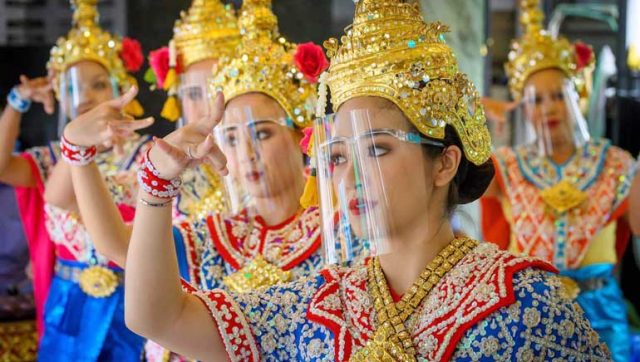
BANGKOK — Thailand was among the first countries in Asia to reopen for foreign arrivals, and it is seeing a slow recovery, including new hotels touting longer stays for individual travelers.

In the first 10 months of 2021, Thailand saw 106,117 foreign tourists, a drop from 6.7 million in 2020. Before the pandemic, Thailand saw about 40 million visitors a year.

Hospitality firms like Asset World Corporation Pcl, which opened its 19th property this month, saw the majority of its bookings come from Western countries and the Middle East.

“About 70% of total bookings came from Europe, including Germany, UK, Scandinavian countries, followed by the US, Middle East, and Asia,” chief executive Wallapa Traisorat told Reuters, adding that domestic travel helped. “For November, we should see 30% occupancy, and in the fourth quarter we hope to see better momentum from the reopening.”

Thailand, one of the region’s most popular destinations, is heavily dependent on tourism. In 2019, 40 million arrivals spent 1.91 trillion baht ($57.3 billion).

Centara Hotels and Resorts is moving ahead with plans to open a 1.1-billion-baht hotel on the island of Samui in December.

Initially the property expects most guests to be locals on longer stays, said Centara Hotels chief financial officer Gun Srisompong.

“Demand patterns have changed. Individual travelers on longer stays and ‘workations’ need more personalization,” Mr. Srisompong said.

Thailand expects only 200,000 foreign tourists this year, and 5 million in 2022. Thinner crowds and discounts made for a more pleasant experience, said German tourist Markus Klarer.

“It’s a good time to come back to Thailand again,” Mr. Klarer said.

Despite the reopening, some businesses said COVID rules still made some things hard.

“Tourists are not fully confident and still confused with government regulations,” said Chitchai Senwong, a restaurant manager in Bangkok, citing a government rule that prohibits alcohol consumption after 9 p.m. — Reuters

Death of S. Korean dictator leaves brutal legacy unresolved

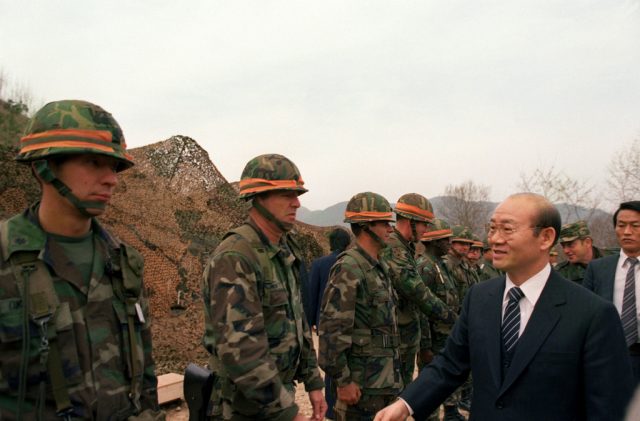
An archival photo shows South Korean dictator Chun Doo-hwan meeting with staff officers of the US 25th Infantry Division at their field headquarters in 1983. Image via US National Archives.

SEOUL — The death this week of South Korea’s last military dictator, Chun Doo-hwan, marks the end of a divisive chapter in the country’s modern history but leaves survivors of his regime’s violence no closer to reconciliation or resolution.  

Chun died on Tuesday at the age of 90.  

Hundreds of people are estimated to have died or gone missing when the South Korean government violently put down the Gwangju uprising by pro-democracy protesters in May 1980, when Chun was the de facto leader of the country after leading a military coup.  

Years after the massacre, many details remain unconfirmed, including who gave the orders for troops to open fire on protesters. Many victims remain unidentified.  

A lack of contrition and cooperation by former members of the regime, including Chun, has hampered efforts to find the full truth, victims said.  

“I’m very worried that a lot of truth will be hidden with Chun Doo-hwan’s death,” said 57-year-old Kim Young-man, who still carries a scar on his head from where a police officer struck him with a baton.  

Mr. Kim holds out hope that former members of the regime will come forward to shine light on the bloody crackdown, but like many other victims, was disheartened that Chun died without showing significant remorse.  

Months after leaving office in 1988 amid growing calls for democracy, Chun offered a formal apology for abuses during his leadership, including Gwangju.  

But later he appeared to walk back some of that contrition, prompting victims to doubt the sincerity of that apology as he embraced a defiant and defensive stance to the end.  

“Chun Doo-hwan was not the type of person to apologize,” Mr. Kim said. “Yet if he had apologized, I think there would have been a possibility that Gwangju citizens who have been heartbroken for 41 years feel a little better.”  

In 1996 Chun was sentenced to death on charges of corruption and treason, but the sentence was reduced to life in prison and later commuted.  

More recently he was involved in other legal disputes, including being found guilty in 2020 of defaming a priest who claimed to have witnessed the Gwangju crackdown.  

On Wednesday, a day after Chun’s death, a group of 70 Gwangju survivors, including Mr. Kim, filed a lawsuit against the government seeking compensation for emotional damage.  

Some victims have received compensation for their loss of work, but other claims for compensation for emotional and psychological trauma faced legal barriers until a Supreme Court ruling in September, said Lee Ki-bong, an official at the May 18 Memorial Foundation who works with the families.  

A group of victims rallied on Thursday outside the hospital where Chun’s body was taken, holding signs telling him to “go to hell.” They condemned some of Chun’s former aides who call the uprising a plot inspired by North Korean communists.  

In November the main conservative party’s presidential nominee, Yoon Suk-yeol, traveled to Gwangju to apologize after appearing to excuse or praise Chun by saying many people thought the former president “was really good at politics aside from the coup and the events of May 1980.”  

Chun will not be given a state funeral, and officials said his treason conviction made him ineligible to be buried in a national cemetery.  

“Upon Chun Doo-hwan’s death, South Korean news appear to be pure emotion, disbelief at how he never apologized,” tweeted Korean-American author Suki Kim.  

“It’s an odd thing to want an apology from a ruthless dictator, decades later, as though expecting justice by [a] universe which had allowed that dictator.” —  Hyonhee Shin and Yeni Seo/Reuters

Australia introduces contentious religious anti-discrimination legislation

UNSPLASH

SYDNEY — Australia on Thursday introduced contentious religious anti-discrimination legislation to parliament that if approved would allow faith-based organizations to prioritize the hiring and enrolment of people from their faith.  

Religious freedom has been in the spotlight in Australia for years amid concern from some that the likes of churches, schools, and workplaces are unable to express their religious beliefs.  

In a move seen as targeting religious voters with an election just months away, Prime Minister Scott Morrison said the legislation would protect people who express their religious faith outside of the workplace as long as it did not cause financial damage to their employer.  

“People should not be canceled or persecuted or vilified because their beliefs are different from someone else’s,” said Mr. Morrison, a devout Pentecostal Christian, while introducing the bill in the parliament’s lower house.  

Mr. Morrison said the legislation would also protect Australians who make “statements of belief” from discrimination laws, but only if those statements do not “threaten, intimidate, harass or vilify a person or group.”  

Australia’s existing Sex Discrimination Act allows schools to expel students or sack teachers for being gay. Mr. Morrison pledged in 2018 to reform the legislation.  

LGBT groups support reforming the Act but have criticized the new bill saying it would enable discrimination against gay students and teachers as it permits prioritizing the hiring and enrolment of people based on faith.  

It will wind back hard-fought protections for women, people with disability, LGBTIQ+ people, and even people of faith, said Anna Brown, Chief Executive of the representative body, Equality Australia.

The bill has also divided the parliament, with some conservative government lawmakers threatening to vote against the legislation until Mr. Morrison moves to abolish state mandates requiring coronavirus disease 2019 (COVID-19) vaccines.  

The legislation is expected to be put to a vote next week in the lower house, but it is far from guaranteed to pass into law. The bill is expected to be reviewed before being voted on in the upper house Senate sometime in 2022–23.  

Australia’s parliament is in its last sitting fortnight for the year and Mr. Morrison could call an election before it resumes in 2022. Mr. Morrison must return to the polls by May 2022. — Renju Jose and Colin Packham/Reuters

World’s biggest Ikea opens in Philippines as part of global push

Ikea opened its biggest store in the world in the Philippines, with the new 730,000 square foot facility in Manila a cornerstone of the home-furnishings giant’s expansion plans in Asia.

Thursday’s opening was feted with an event held at the store’s cafeteria attended by Philippine trade secretary Ramon Lopez and foreign minister Teodoro Locsin, where Ikea’s cult-favorite Swedish meatballs were served to some attendees. They were accompanied for the big day by a special Philippine twist — adobo sauce.

Ikea is sticking to COVID-19 protocols after the store’s opening was delayed amid the pandemic, with an online booking system that’s full for the next two weeks, according to store manager Georg Platzer. Customers have to wear masks and observe distancing.

The spread houses a two-level 270,000 square foot store, dining area and showroom; warehouses; an e-commerce facility; and a call center. It’s on property leased out by SM Prime Holdings Inc.’s Mall of Asia.

Its opening comes as Ikea has expanded its e-commerce presence — which proved timely during the pandemic — with online orders now accounting for 26% of its global sales. The company, which has more than 460 physical stores in about 60 markets, is planning to add nearly 60 more locations in the current financial year. And it’s not just looking toward Asia: It will take its first step into South America this spring, opening a branch in Santiago, Chile.

Platzer said the Philippines had “been the right spot on our map for the longest time.”

“It was always a plan to come to the Philippines,” he said. “It’s a very good growing economy, growing middle class and domestic environment that’s good for us as a home furnishing retailer. I think it’s about time to open it, finally.”

Household spending fueled the Philippine economy’s recovery last quarter, with consumption expected to grow further in the fourth quarter as virus curbs are eased in time for the holidays. However, output isn’t expected to return to pre-pandemic level until the latter half of 2022.

The Manila store was initially scheduled to open in 2020, but faced delays due to COVID-induced movement restrictions and the disruption of construction material supplies. It’s part of a move to expand in Asia, with the brand recently unveiling its second store in India.

The Philippine debut comes despite Ikea forecasting a more difficult year ahead in 2022, due to logistics logjams and price spikes of raw materials brought about by the pandemic.

Local government officials and employees during the ribbon cutting ceremony.

Despite the supply crunch and challenges keeping stores and warehouses stocked, the company managed to report record sales last year. Chief Executive Officer Jon Abrahamsson Ring of Inter Ikea, the brand’s worldwide franchiser, told Bloomberg in October that his vision was to make Ikea “even more affordable” by shifting a larger share of new products to a lower price segment. — Bloomberg

Seoul, Barbados check into metaverse as governments eye virtual presence  

PIXABAY

The metaverse will soon be a place to not just buy virtual goods and meet avatars, but to also get essential public services, as governments prepare to enter the rapidly expanding digital world despite concerns about privacy and other rights.  

The city of Seoul and the island nation of Barbados earlier this month said they will enter the metaverse to provide administrative and consular services, respectively.  

Other cities and countries may follow suit if the technology becomes more mainstream, analysts say.  

The statements came amid a flurry of announcements from companies including Facebook — now named Meta — saying they would invest in the metaverse, an online realm that uses augmented and virtual reality (VR) to help users interact.  

“It is in the best interest of governments to know about this universe intimately because the virtual world will replicate life and business,” said Keith Carter, an associate professor at the National University of Singapore’s School of Computing.  

Metaverse — a term first coined in science fiction — is a combination of the prefix “meta,” meaning beyond, and “universe.” 

It has been used to describe a range of shared worlds accessed via the internet, from fully-immersive VR spaces to augmented reality accessed through devices such as smart glasses.  

The global metaverse market is expected to reach about $6 billion this year and nearly $42 billion by 2026, according to research firm Strategy Analytics, helped by increased interest in virtual spaces for work and leisure during the pandemic.  

There will be new roles for governments in this space where jurisdiction isn’t as clearly defined, said Steve Benford, a professor of computer science at the University of Nottingham.  

“Cybersecurity, freedom and protection of information, and online safety are issues that governments are already interested in, and this list can be expected to grow if and when the metaverse becomes an everyday experience for people,” he said.  

“Governments are already shaping policies that will impact the metaverse, so arguably they have a duty to be visibly present in it for reasons of accountability,” said Mr. Benford, who co-founded the Mixed Reality Laboratory at the university, which studies and creates interactive technologies for daily life.  

CIVIL COMPLAINTS  

Seoul is the first major city to announce its entry into the metaverse, with the Seoul Metropolitan Government (SMG) building a “metaverse ecosystem for all administrative services regarding the economy, culture, tourism, education and civil complaints.”  

Metaverse Seoul, a platform for public services, is scheduled to be complete by the end of next year. A virtual city hall, where citizens can meet avatars of public officials and file complaints, will be set up in 2023, it said in a statement.  

Barbados will open what it says will be the world’s first metaverse embassy in the virtual reality platform Decentraland, with embassies on other platforms also planned.  

“We are a small island nation — this gives us a way to expand our diplomatic footprint without adding dozens of physical embassies, which is not feasible for us,” said Gabriel Abed, who is leading the Caribbean nation’s metaverse strategy.  

“It gives us diplomatic parity with larger nations, and a fully immersive way to showcase our culture and business opportunities, while being fully in control of our environment,” said Mr. Abed, who is also ambassador to the United Arab Emirates.  

Smaller nations have a lot to gain in the metaverse, he said, noting that Barbados was also quick to embrace a digital currency, like other small nations including Malta, the Bahamas, and El Salvador.  

“COVID really shook up the world. Who knows when the next pandemic or lockdown will come — we cannot afford to not try out new technologies that can help us overcome these limitations,” he told the Thomson Reuters Foundation.  

LIMITED OPPORTUNITIES  

While it is unclear whether a full replication of real life is possible in the metaverse, or even how long it will take to build, tech and legal experts are divided on who will wield control, and how much cities and national governments can gain.  

Users are pushing for an open, decentralized universe, and it is possible that the metaverse might “eventually become its own constituency or jurisdiction, with its own representatives and civil service,” said Mr. Benford.  

But governments will have a presence, too, he added.  

“Where else will the citizens of the metaverse stage a future protest?”  

Governments may also make the metaverse more inclusive, with Seoul saying it will have “numerous services for the vulnerable, including the disabled,” for their safety and convenience. It is also training older citizens to help navigate the virtual world.  

But the current technology is not good enough, or cheap enough, so cities “face big costs and no guarantee on returns,” said Tony Matthews, a senior lecturer in urban and environmental planning at Australia’s Griffith University.  

“I doubt many cities will be rushing to set up in the metaverse … the opportunities right now are limited and very expensive,” he said, noting that people have been quite resistant to VR since it became mainstream a few years ago.  

When the technology gets good enough to encourage widespread uptake, however, major, permanent virtual cities may emerge with their own economies and markets, he said.  

In some years, “we might all be as familiar with the cities of the metaverse as London, Paris and Tokyo. That could truly be transformative for real-world cities and their virtual siblings.” — Rina Chandran/Thomson Reuters Foundation

US economy eyes strong 2021 finish as labor market tightens, spending accelerates

UNSPLASH

WASHINGTON — The number of Americans filing new claims for unemployment benefits dropped to a 52-year low last week, suggesting economic activity was accelerating as a year ravaged by shortages, high inflation and an unrelenting pandemic draws to a close.  

The plunge in claims reported by the Labor Department on Wednesday was, however, exaggerated by difficulties adjusting the data for seasonal fluctuations this time of the year. Still, the labor market is tightening, with jobless rolls shrinking in mid-November to the smallest since March 2020 when the economy was in the grips of the first wave of coronavirus disease 2019 (COVID-19) infections.  

The economy’s strengthening tone was confirmed by other data showing strong consumer spending in October as well as business orders for equipment, excluding transportation. The goods trade deficit narrowed sharply last month as exports surged.  

But prices remained stubbornly high, with annual inflation jumping by the most in nearly 31 years. The raft of solid reports ahead of Thursday’s Thanksgiving holiday prompted economists to boost their fourth-quarter growth estimates to as high as an 8.6% annualized rate.  

“There might be some seasonal adjustment problems, but the handwriting is on the wall and all the anecdotal reports on how companies cannot find the help they need are true,” said Christopher Rupkey, chief economist at FWDBONDS in New York.  

“The economy will finish the year with a bang, there is lots to give thanks for.”  

Initial claims for state unemployment benefits tumbled 71,000 to a seasonally adjusted 199,000 for the week ended Nov. 20, the lowest level since mid-November 1969.  

Economists polled by Reuters had forecast 260,000 applications for the latest week.  

Unadjusted claims rose 18,187 to 258,622 last week amid a surge in Virginia, which offset declines in California, Kentucky and Missouri. More volatility is likely over the holiday season.  

“The claims series can be noisy and especially choppy around holidays like Thanksgiving when the seasonal factors anticipate large swings in the underlying data,” said Daniel Silver, an economist at JPMorgan in New York. “But even so, initial claims fell by more than a half million over the year through Nov. 20, both before and after seasonal adjustment.”  

Claims have declined from a record high of 6.149 million in early April 2020, and are now viewed as consistent with a healthy labor market, though an acute shortage of workers caused by the pandemic is hindering faster job growth.  

But there is hope for an expansion of the labor pool. The number of people continuing to receive benefits after an initial week of aid dropped 60,000 to 2.049 million in the week ended Nov. 13, a 20-month low, the claims report showed.  

There were 10.4 million job openings as of the end of September. The workforce is down 3 million people from its pre-pandemic level, even as generous federal government-funded benefits have expired, schools have reopened for in-person learning and companies are raising wages.  

Stocks on Wall Street fell. The dollar gained versus a basket of currencies. US Treasury prices rose.  

BRIGHTENING PICTURE  

Signs the economy was regaining momentum after hitting a speed bump in the July–September quarter as coronavirus cases flared up over summer and shortages became more widespread could result in the Federal Reserve quickly winding up its bond-buying program.  

Indeed, minutes of the US central bank’s Nov. 2–3 policy meeting published on Wednesday showed some Fed officials would be open to doing so.  

“We see the Fed accelerating tapering in January to clear the runway for a September rate liftoff,” said Lydia Boussour, lead US economist at Oxford Economics in New York.  

A separate report from the Commerce Department on Wednesday showed gross domestic product rose at a 2.1% rate in the third quarter. That was a slight upward revision from the 2.0% pace estimated in October, but was still the slowest in more than a year. The economy grew at a 6.7% rate in the second quarter.  

But that is all in the rear-view mirror. A third report from the Commerce Department showed consumer spending, which accounts for more than two-thirds of US economic activity, jumped 1.3% in October after rising 0.6% in September.  

Consumers, buoyed by rising wages and massive savings, bought motor vehicles and traveled, showing no signs yet of holding back because of high inflation.  

Global economies’ simultaneous recovery from the pandemic, fueled by trillions of dollars in relief money from governments, has strained supply chains, unleashing inflation.  

President Joseph R. Biden. Jr., announced on Tuesday that the United States would release 50 million barrels of crude from the US Strategic Petroleum Reserve to help cool oil prices, in coordination with China, India, South Korea, Japan and Britain.  

The personal consumption expenditures (PCE) price index, excluding the volatile food and energy components, increased 0.4% last month after gaining 0.2% in September. In the 12 months through October, the so-called core PCE price index accelerated 4.1%. That was the largest gain since January 1991 and followed a 3.7% year-on-year advance in September.  

The core PCE price index is the Fed’s preferred inflation measure for its flexible 2% target.  

Adjusted for inflation, consumer spending rose a solid 0.7%.  

In another boost to the economy, orders for non-defense capital goods excluding aircraft, a closely watched proxy for business spending plans, rose 0.6% last month, the Commerce Department said in a fourth report.  

With corporate profits hitting a record high last quarter, businesses are likely to keep spending.  

More goods were exported in October, sharply narrowing the goods trade deficit by 14.6% to $82.9 billion. If the trend holds, trade could contribute to GDP growth this quarter.  

Wholesalers continued to rebuild inventories last month though motor vehicle shortages stymied progress by retailers, a fifth report showed.  

Inventory accumulation, the key driver of GDP growth last quarter, will likely continue to support the economy. The strong data flow led the Atlanta Fed to raise its fourth-quarter GDP growth estimate to an 8.6% rate from an 8.2% pace. JPMorgan boosted its forecast to a 7.0% pace from a 5.0% rate. — Lucia Mutikani/Reuters  

ADVERTISEMENT
ADVERTISEMENT