Home Blog Page 7129

Kill coal is kill growth agenda
When the “phase out” of coal power became “phase down” at the recent United Nations Climate Change Conference in Glasgow (COP26), the climate alarmism movement took it as the defeat of their “last chance to save the planet” narrative. Their next move was to target individual countries.

HOUSE RESOLUTION 2361
In the Philippines, House Resolution No. 2361 was introduced on Nov. 16 by Pampanga Rep. Juan Miguel “Mikey” M. Macapagal Arroyo hastening the “Philippines’ transition to 50% renewable energy [RE] sources by 2030.” The existing target under the National Renewable Energy Program (NREP) 2020–2040 is 35% RE in the power generation mix by 2030 and 50% by 2040. So Mr. Arroyo and the kill-coal lobbyists want to hasten the transition by 10 years.

This and related proposals like the Asian Development Bank’s acquire-retire-coal scheme to be replaced by RE, especially intermittent solar and wind, are impractical and based on emotion, not reason. Below are four quantitative reasons why.

HIGH COAL GENERATION, LOW SOLAR + WIND GENERATION
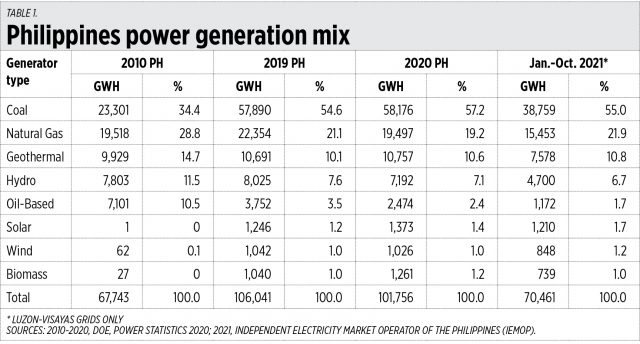
One, coal provided up to 57% of total power generation in the country as of 2020, solar + wind provided only 2.4%. In the first 10 months of 2021 in the Luzon-Visayas grids, coal provided 55% while solar + wind generated only 2.9% share. If we persist in having more intermittent unstable and weather-dependent energy, we will have daily Earth Hours soon.

Two, generation capacities of other indigenous energy are limited. From 2010 to 2020, natural gas generation was flat at 19,500 gigawatt-hours (GWH); geothermal, flat at 10,000 GWH; and hydro, flat at 7,000+ GWH. The main reason the Blackout Economics agenda of the RE lobby did not happen is because coal generation has expanded big time, from 23,300 GWH in 2010 to 58,200 GWH in 2020 (see table 1).
MORE COAL, MORE GROWTH
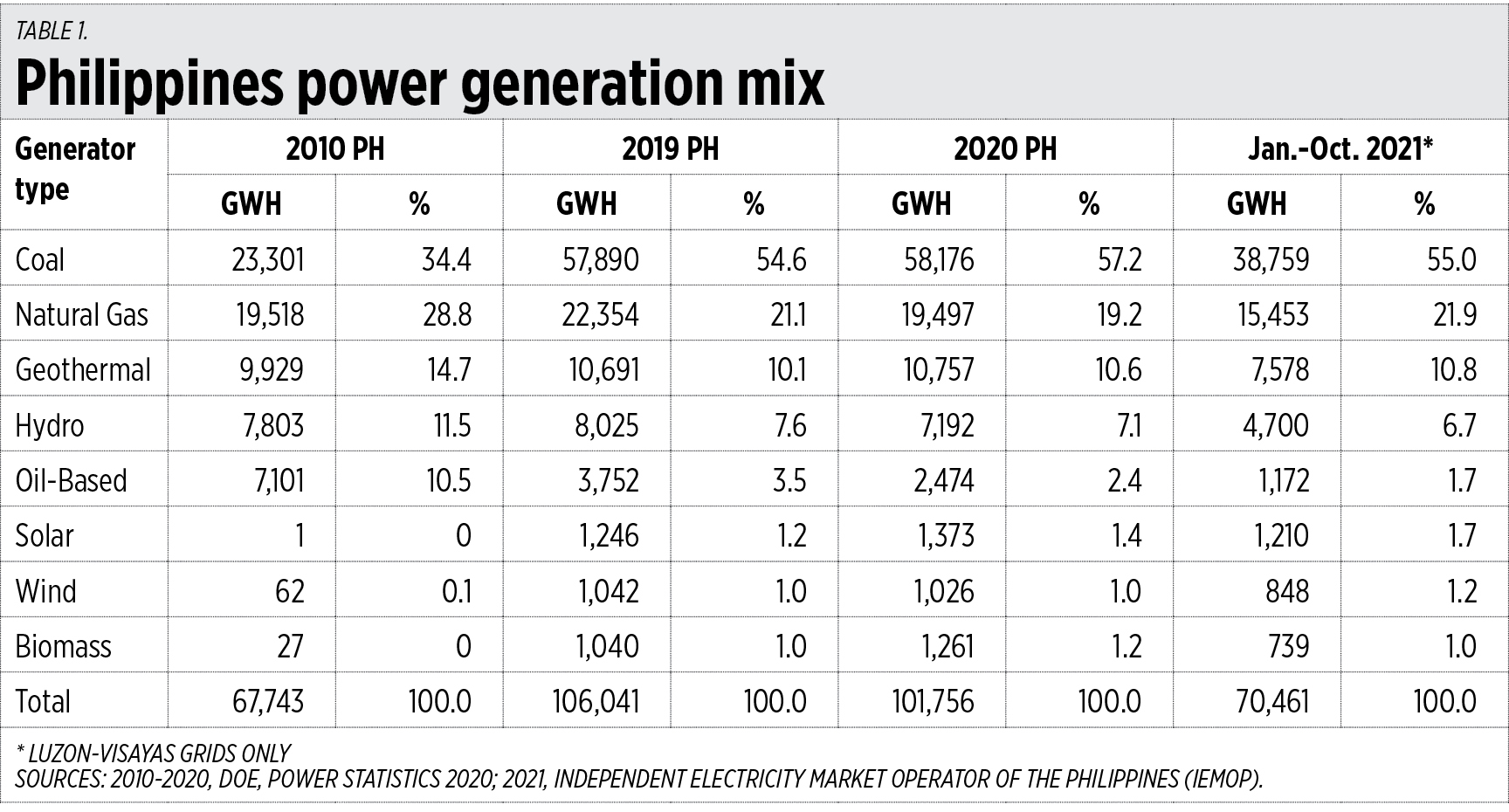
In the next table below, I computed the decadal averages of energy consumption in Petajoules (1 PJ = 277.78 GWH) and GDP growth of selected countries.

Three, countries that expanded their coal consumption and did not significantly raise their solar + wind share have fast or high GDP growth. Examples are China, India, S. Korea, Indonesia, Taiwan, Vietnam, Malaysia, Thailand, and Philippines. Japan is the exception for some reason/s.

Four, countries that shrank their coal consumption and significantly raised their solar + wind share have slow and anemic GDP growth. Examples are the US, Germany, UK, Italy, Spain, France, and the Netherlands. Exceptions in Europe and have relatively fast growth are Kazakhstan and Turkey, they expanded their coal use instead. Russia and Poland have shrunk their coal use but they did not significantly increase their solar + wind share, they experienced modest growth (see table 2).
Of course, there are other factors that contribute to fast or slow growth of countries but for this paper, we want to see if the desire of the RE lobby will be useful or not for developing countries like the Philippines. The above numbers show that the answer is no. The RE lobby is useless in pushing the Philippines and other developing countries in their desire to have sustained growth and uplift millions of their people from poverty.

TRANSMISSION WOES IN NEGROS AND NGCP MONOPOLY
My Nov. 15 column discussed the high power prices in Negros provinces after the National Grid Corp. of the Philippines (NGCP) Negros-Cebu submarine cable was damaged this June by Department of Public Works and Highways (DPWH) dredging and re-channeling activities in Amlan, Negros Oriental. Transmission was cut by half to only 90 MW and market prices in the alternative transmission Negros-Panay shot up to P7.70/kwh in the July billing; P7.55/kwh in August; down to P3.42/kwh in September, when the submarine cable was fixed.

Both NGCP and DPWH assumed zero liability for the higher cost of electricity for two months in Negros Occidental and Oriental. All congestion costs were passed on to consumers and generation companies (gencos). The DPWH or its contractor should have liability insurance to handle these cases but the NGCP went chummy friendly with DPWH. And the Energy Regulatory Commission (ERC) did not penalize NGCP for not going after DPWH and its contractor. ERC went chummy with NGCP. Shame.

COMPETITION UNDER EPIRA IS WORKING
Updated data show that the Electric Power Industry Reform Act (EPIRA) of 2001 or RA 9136 is working for the consumers via more competition, more choices. The registered electricity players in the Luzon-Visayas grids alone as of Nov. 26, data from IEMOP:

The Wholesale Electricity Spot Market (WESM) now has 281 members: 143 gencos, 71 electric cooperatives (ECs), 47 directly connected customers, and 20 private distribution utilities (DUs) and local government utilities.

The Retail Competition and Open Access (RCOA) program has 1,970 participants: 1,834 contestable customers, 59 retail metering service providers, 37 national retail electricity suppliers (RES), 25 suppliers of last resort (SOLR), 15 local RES.

Medium to large customers can choose whether to stay with their ECs or DUs, or become contestable customers and choose their own RES with customized power supply, services and pricing.

GREEN OPTION IS AVAILABLE
Instead of pushing for mandatory transition to RE by restricting and later killing coal plants, RE advocates and lobbyists can walk the talk by joining the Green Energy Option Program (GEOP) under the Renewable Energy Act of 2008. Consumers enter into supply contracts with RE suppliers (i.e., only RE will be supplied, no fossil fuels) which are registered with the Central Registration Body (CRB). The CRB processes the GEOP switch request by the consumers and RE gencos will supply the needs of the customers.

Registration of RE suppliers started on Dec. 3 and the switch to GEOP will start by Jan. 3, 2022. More GEOP customers and participants, more RE will be supplied, less demand for fossil fuels. People walk their talk, no need for legislated RE mandates and political noise and drama.


Bienvenido S. Oplas, Jr. is the president of Minimal Government Thinkers.

minimalgovernment@gmail.com

In aid of legislation

“Public office is a public trust” is enshrined in the 1987 Philippine Constitution. Congress plays a crucial role in upholding accountability and the system of checks and balances in both executive and judicial branches of the government.

An investigation in aid of legislation is indeed necessary to avoid any possible tax evasion, smuggling, graft and corruption or money laundering, especially in government procurement or spending of taxpayer’s money during a pandemic.

The Senate Committee on Accountability of Public Officers and Investigations (Blue Ribbon) presided by Senator Richard “Dick” J. Gordon conducted its 15th public hearing on Friday, Nov. 26, on the 2020 Commission on Audit (CoA) Report and other issues related to budget utilization of the Department of Health (DoH), especially its expenditures related to the fight against the coronavirus disease 2019 (COVID-19).

While the investigation is far from over, the Senate Blue Ribbon already released an initial report and filed cases against those who are responsible for the procurement of the alleged overpriced face masks, face shields, and other medical supplies.

In the last 14 hearings, due diligence has been underscored as mandatory and indispensable for any government agency and/or officials in spending public funds even during a state of emergency. While the Bayanihan to Heal as One Law (Bayanihan I) allows an “expeditious” manner of procurement, the Government Procurement Reform Act or Republic Act (RA) 9184 must not be totally disregarded in the exercise of due diligence.

Unfortunately, the Data Privacy Act (RA 10173) and the Bank Secrecy Law (RA 1405) have been invoked by the officers of Pharmally Pharmaceutical Corporation to evade providing information to verify the facts and uncover the truth. Although the National Privacy Commission has already issued an official statement clarifying that the Data Privacy Act cannot be invoked in refusing to submit subpoenaed documents, the Senate Blue Ribbon has yet to secure required financial documents to expedite the investigation.

The Philippines is among the three countries in the world that have ultra-strict bank secrecy laws. The other two countries are Lebanon and North Korea. This has to be repealed or lifted especially during fraud investigations whether on tax evasion or graft and corruption cases to prosecute violators particularly corrupt public officials who have been inadvertently benefiting from the bank secrecy.

But will Congress repeal the Bank Secrecy Law which might expose alleged ill-gotten wealth?

As the investigation continues, several deficiencies, material misstatements and undisclosed information were cited. These would have been prevented if concerned government agencies were more strenuous and tax information was required to check the veracity of financial documents submitted without compromising ease of doing business.

In incorporating a company, the Securities and Exchange Commission (SEC) must require a Tax Identification Number instead of passport number, latest income tax return, and bank statement as proof of financial capacity of incorporators/shareholders. Further, basic due diligence must be done before approving articles of incorporation particularly on affiliate companies with the same directors, foreign investors or dummy incorporators and use of offshore accounts or illegal sources of capital.

Mandatory audit and investigations of government contractors and suppliers must also be conducted before issuing tax clearance, which is required to join government bidding.

Evidently, the role of Certified Public Accountants (CPAs) has been highlighted once again like in previous cases involving tax evasion, graft and corruption, and other fraudulent activities. Needless to say, the accountants and auditors are equally responsible for filing fraudulent tax returns or audited financial statements with material misstatements.

Section 253 of the tax code provides automatic revocation or cancellation of a certified public accountant (CPA) license upon conviction of tax evasion. However, this does not apply to accountants and auditors working for individuals or companies violating the tax code.

The Bureau of Internal Revenue must include both accountants and auditors who prepared and audited the financial statements and fraudulent tax returns, in filing tax evasion case/s against offenders. This will send a strong message to everyone, especially CPAs, that violating the tax code is a serious civil and criminal offense.

Further, Section 253 of the tax code includes that, “if the offender is a public officer or employee, the maximum penalty prescribed for the offense shall be imposed and, in addition, he shall be dismissed from the public service and perpetually disqualified from holding any public office, to vote and to participate in any election.”

For foreigners doing business in the Philippines, they shall be deported immediately after serving the sentence without further proceedings for deportation if found guilty of tax evasion.

In spite of these, tax evaders and offenders seem fearless and heartless, while others even aspire for higher government positions.

The Senate Blue Ribbon has an immense responsibility to shed light on all these allegations by continuing the investigation in aid of legislation and enact laws which will uphold the constitution, i.e., “PUBLIC OFFICE IS A PUBLIC TRUST.”

This article reflects the personal opinion of the author and does not reflect the official stand of the Management Association of the Philippines or MAP.


Raymond “Mon” A. Abrea is member of the MAP Ease of Doing Business Committee, Founding chair and senior tax advisor of Asian Consulting Group and co-chair of Paying Taxes – EODB Task Force. He is trustee of Center for Strategic Reforms of the Philippines — the advocacy partner of the BIR, Department of Trade and Industry (DTI), and Anti-Red Tape Authority (ARTA) on ease of doing business and tax reform.

map@map.org.ph

mon@acg.ph

Myanmar’s ousted leader Suu Kyi sentenced to four years in prison

AUNG SAN SUU KYI — REUTERS

MYANMAR’s deposed leader Aung San Suu Kyi was sentenced to four years in jail on Monday on charges of incitement and breaching coronavirus restrictions, a source familiar with the proceedings said, in a case critics dismissed as a farce.

President Win Myint was also sentenced to four years in prison, the source, who spoke on condition of anonymity, said, as the court delivered its first verdicts against civilian leaders detained in a Feb. 1 military coup.

Myanmar has been in turmoil since the coup against Ms. Suu Kyi’s democratically elected government sparked widespread protests and raised international concern about the halt to tentative political reforms following decades of military rule.

Nobel peace prize winner Ms. Suu Kyi, 76, has been detained since the coup along with most senior leaders of her National League for Democracy (NLD) party. Others are abroad or in hiding and no party spokesperson was available for comment.

Rights group Amnesty International said the charges against Ms. Suu Kyi were bogus and described the jail sentence as the latest example of the military’s determination to eliminate all opposition and suffocate freedoms.

“The court’s farcical and corrupt decision is part of a devastating pattern of arbitrary punishment that has seen more than 1,300 people killed and thousands arrested since the military coup,” the group’s deputy regional director for Campaigns, Ming Yu Hah, said in a statement.

The military has not given details of where Ms. Suu Kyi has been detained and it was not immediately clear if the sentencing would mean any immediate change in her circumstances.

The trial in the capital, Naypyitaw, has been closed to the media and the junta’s public information outlets have not mentioned the proceedings. Ms. Suu Kyi’s lawyers have been barred from communicating with the media and public.

Ms. Suu Kyi faces a dozen cases that include multiple corruption charges plus violations of a state secrets act, a telecoms law and COVID-19 regulations, which carry combined maximum sentences of more than a century in prison.

Ms. Suu Kyi and co-defendant Mr. Win Myint received jail terms of two years for incitement and the same term for breaches of coronavirus protocols. They had denied the charges. 

‘ILLEGAL POWER GRAB’
Ms. Suu Kyi’s supporters say the cases are baseless and designed to end her political career and tie her up in legal proceedings while the military consolidates power.

Her jailing had been widely expected.

“I don’t expect anything out of this broken justice system,” said Maw Htun Aung, a deputy minister in an opposition parallel government, told Reuters.

The junta says Ms. Suu Kyi is being given due process by an independent court led by a judge appointed by her own administration.

Ms. Suu Kyi, the daughter of the hero of Myanmar’s independence from British colonial rule, spent years under house arrest for her opposition to military rule but was freed in 2010 and led her NLD to landslide victory in a 2015 election.

Her party won again in November last year but the military said the vote was rigged and seized power weeks later. The election commission at the time dismissed the military’s complaints of vote fraud.

The international community has condemned the violence in Myanmar since the coup, and Western states have demanded Ms. Suu Kyi’s release.

Matthew Smith, chief executive of the Fortify Rights group, said the sentencing was “part of a widespread and systematic attack on the civilian population” and called for the immediate release of Ms. Suu Kyi and other political prisoners.

The group ASEAN Parliamentarians for Human Rights said no-one was fooled by the outcome of the trial.

“Since the day of the coup, it’s been clear that the charges against Aung San Suu Kyi and the dozens of other detained MPs, have been nothing more than an excuse by the junta to justify their illegal power grab,” it said in a statement. — Reuters

Bad weather hampers rescue efforts at Indonesian volcano

SUMBERWULUH, Indonesia — Indonesia’s Mt. Semeru volcano continued to spew hot clouds of ash on Monday, days after a powerful eruption killed 15 people and left dozens more missing.

The tallest mountain on the island of Java erupted dramatically on Saturday, shooting a towering column of ash into the sky that blanketed surrounding villages.

Aerial footage of the affected areas showed roofs jutting out of an ashen landscape, while on the ground, military officers, police and residents dug through mud with their hands to extricate victims.

The death toll rose to 15 by Monday, while 27 people remain missing, Indonesia’s disaster mitigation agency said in a statement.

The volcano erupted again on Monday morning, Indonesia’s Center for Volcanology and Geological Hazard Mitigation (PVMBG) confirmed via its Twitter account, warning of continued seismic activity.

“Semeru is one of the most active volcanoes in Indonesia. Before and after the Dec. 4 eruption, it will continue to be active,” Liswanto, the head of the Semeru Volcano Observatory told Reuters.

As some anxious residents returned to their homes to check on belongings and livestock, Liswanto urged people to keep a safe distance.

“People need to be more vigilant because the potential threat is still there,” he added.

In the Sumberwuluh area, rescue teams battled poor weather to retrieve victims from the rubble.

“We were looking for nine people reported missing in this village and thank God we found [the bodies of] three victims,” said Estianto Hendriantono, chief of the local search and rescue effort. “The challenge for the evacuation was that they were trapped under logs and rocks, and the soil was still hot.”

On Facebook, people have posted photos of their missing relatives, with public pleas for any information about their whereabouts.

Complicating logistics and rescue efforts, lava flows from Saturday’s eruption destroyed a bridge connecting two areas in the nearby district of Lumajang with the city of Malang.

Public kitchens and health facilities have been set up for more than 1,700 people who have been displaced.

A trauma healing team to work with children affected by the eruption has been dispatched, CNN Indonesia reported, while hundreds of aid packages, including rice, blankets and clothes and other basic necessities have been sent to the area.

Semeru is one of more than 100 active volcanoes in Indonesia, a country that straddles the Pacific Ring of Fire, an area of high seismic activity that rests atop multiple tectonic plates. — Reuters

COVID shots are finally arriving, but Africa can’t get them all into people’s arms

FREEPIK

SEKENANI, Kenya — When a group arrived at the Sekenani health clinic in rural Kenya for their COVID-19 vaccines recently, staff told them there were no doses left and that they should come back soon.

For some, it meant a long wasted journey on foot and a day away from their cattle herds.

Yet Narok county, where the clinic is located, was not short of vaccines; nearly 14,000 doses were sitting in a fridge in the nearest town, 115 km away. A mix-up with county officials meant Sekenani did not get enough, two health workers said.

“We had to say sorry. It’s not a good feeling, when somebody comes and they want the vaccine, and we don’t have it,” clinician Mike Nalakiti, 27, told Reuters.

The small failure in a village 270 km southwest of the capital Nairobi is an illustration of the challenges African nations now face as they battle COVID-19: Even though vaccine supplies are finally ramping up, getting needles into arms is proving the hard part.

Successful vaccination campaigns in Africa are vital to ending the pandemic globally, health experts say. The continent’s low inoculation rates encourage viral mutations like the new Omicron variant spreading across South Africa, which has prompted another spate of international travel bans.

Only 102 million people, or 7.5% of the continent’s population, are fully vaccinated, according to the World Health Organization, which warned vaccine inequity will prolong the pandemic.

African governments have been crying out for higher vaccine deliveries this year, but production constraints and hoarding by richer countries severely limited supplies until recently.

Shortages of funds, medical staff and equipment, as well as vaccine hesitancy, were already hobbling inoculation campaigns in some parts of Africa. The anticipated surge, comprising millions of jabs in the coming weeks, could expose those weaknesses further, experts warn.

About 40% of vaccines that have arrived so far on the continent have not been used, according to data from the Tony Blair Institute for Global Change, a policy think-tank.

The rate of vaccine use will have to rise four-fold to keep up with expected supply in coming months, the institute says.

“We are all, like you, very concerned that countries are not picking up the vaccines. The uptake is not as we would have loved to see,” head of the Africa Centers for Disease Control and Prevention John Nkengasong said.

FRIDGES AND MOTORBIKES
Vaccination rates vary widely across Africa, a continent of well over a billion people, and some health systems in relatively small nations and in North Africa are having more success.

Cape Verde, an archipelago nation off West Africa with a population of about 600,000, has vaccinated nearly 65% of adults, rivaling some European countries.

In Democratic Republic of Congo, a restive country in Central Africa with a population of nearly 90 million, the number is 0.1%.

In some ways, Kenya is doing relatively well. East Africa’s largest economy has received nearly 5 million doses in the past two weeks after months of slow supplies.

On Dec. 1, it vaccinated a record 110,000 people and aims to maintain that rate for the next 30 days, said Willis Akhwale, head of the government’s COVID-19 vaccine task force. That would bring the total vaccinated to 10 million out of a population of 47 million, he said.

Yet in the rural Sekenani clinic at the edge of the famous Maasai Mara Game Reserve, where elephants and lions roam, challenges abound.

The clinic started offering COVID-19 vaccinations four weeks ago. It keeps running out of doses and has only one reliable fridge, which is also used for routine immunizations, said clinical officer Gerald Yiaile.

Staff need motorbikes to take vaccines to the community, semi-nomadic livestock herders from the Maasai ethnic group who struggle to afford transport for healthcare, he said.

He applied to local authorities for funds for mobile vaccination and has not heard back.

“We have been forced to ask the community to come to us instead of us going to them,” Mr. Yiaile said.

NOT ENOUGH MONEY
African nations scrambled to ready their health systems earlier this year as global vaccine-sharing scheme COVAX began delivering doses in small quantities months after wealthy countries began inoculations.

Cash-strapped countries were short of cotton wool, fridges, face masks and trucks.

COVAX deliveries were then disrupted after COVAX’s major supplier India halted vaccine exports. The pause gave countries time to improve vaccination rollout without being inundated. They did so to differing degrees.

The GAVI vaccine alliance, a co-leader of COVAX, initially did not prioritize investing in the ultra-cold chain equipment needed for mRNA shots like Pfizer’s because it expected the bulk of doses to be the cheaper and easier-to-administer AstraZeneca shots produced in India, Reuters reported in September.

As vaccine deliveries to Africa soar, absorption of large volumes is expected to represent a major challenge for many poor countries, particularly because a substantial volume will be from Pfizer, GAVI said in internal documents prepared for its board meeting last week and seen by Reuters.

Even Kenya, which has the ultra-cold chain capacity to store 3 million Pfizer doses, is worried its cold chain will get constrained by the influx, threatening its routine immunization program, Mr. Akhwale said.

Cameroon in Central Africa had 244 vaccination centers at the start of its vaccine rollout in April, and now has 1,000, said Njoh Andreas Ateke, deputy head of the immunization program.

But health workers and officials say that power outages and lack of staff have compromised vaccines.

The country has one refrigerated truck suitable to transport vaccines, said Leonard Kouadio, UNICEF’S health section head in Cameroon. It needs at least 2,500 more fridge temperature gauges and more trucks to increase distribution, he added.

Mali, one of Africa’s largest and poorest countries, has two refrigerated trucks to carry vaccines long distances. Some health workers fled their posts in the north because of insecurity caused by an Islamist insurgency, said UNICEF health program manager in Mali, Abdoul Gadiry Fadiga.

The country expects to receive about 3.5 million doses between now and the end of March, more than double the number it has received since inoculations began, Fadiga said.

Mali has enough cold chain capacity to deal with the initial rush of doses until March, Fadiga added, but it still needs 288 fridges and freezers for its full rollout, only 10 freezers of which had arrived.

Funds have been slow to materialize. The World Bank has approved $9.8 billion for emergency health responses, including for vaccine deployment, in developing countries globally, but so far only $4.4 billion has been disbursed.

Mali and Cameroon await support.

A World Bank official said disbursements were happening “very fast.”

REACHING OUT
Even when help arrives it can backfire. Donors have sometimes sent African nations vaccine batches nearing expiration, in some cases rendering them unusable.

Countries desperate for vaccines, including South Sudan and Congo, had to send some back because they could not distribute them in time. Namibia warned last month it may have to destroy thousands of out-of-date doses.

South Africa asked Johnson & Johnson and Pfizer to delay delivery of vaccines because it had too much stock.

A key difficulty in administering vaccines is community skepticism, sometimes driven by religious belief and mistrust of Western drug companies and their own governments. Insufficient education about COVID-19 vaccines enables rumors to spread.

That can be the result of local staff and budget shortages, health workers from across the continent told Reuters.

Ethiopia is worried that vaccines might expire before they are used due to low demand, and is trying to overcome vaccine hesitancy through outreach to communities via local religious and civil society groups, said Muluken Yohannes, a senior adviser to Ethiopia’s health ministry.

“Currently, developed countries … have satisfied their vaccine needs. As a result, they are pushing leftover vaccines … to developing countries. However, the golden period to absorb these vaccines has already passed,” he said.

Kenya has ramped up its vaccine rollout with social media and television and radio ads promoting vaccines. Posts on the health ministry Twitter feed urge pregnant and breastfeeding mothers to get vaccinated.

Not everyone gets the message. Nicky Theron, 20, who works at a clothing shop in the town of Talek, is five months pregnant and scared of the jab. She doesn’t follow any government Twitter accounts.

“I have never heard of anybody who is pregnant receiving the vaccine,” she said.

Some feel they could be persuaded if someone came to explain in person.

Julius Tuyioto, who herds livestock on arid plains in southern Kenya, hears the government warn of the dangers of COVID-19 on the radio. But the disease hasn’t hit his community; he says it doesn’t feel real.

“There is no civic education on why we should be vaccinated. No one is telling us,” Mr. Tuyioto told Reuters outside his mud brick home in Narok County, to the chime of goat bells.

Last month, the government sent vaccines by motorbike to the nearest primary school, five kilometers away, he said. But he did not hear about it until the third and final day, when it was too late for him to go. — Reuters

Hamilton wins crazy Saudi GP to level with Verstappen

LEWIS HAMILTON won a crazy, twice-halted Saudi Arabian Grand Prix (GP) for Mercedes on Sunday to go level on points with Red Bull rival Max Verstappen and set up a winner-takes-all title showdown.

On a chaotic night in Jeddah, the first race in the Gulf kingdom took almost as many twists and turns as an already astonishing and enthralling roller-coaster season — and also left a bitter aftertaste.

There were crashes and collisions, safety cars, red flags, and claims of dirty driving after seven-times world champion Hamilton hit the back of Verstappen’s suddenly slowing car on the super-fast Corniche street circuit.

Extraordinary, at times angry, radio exchanges between the race director Michael Masi and the top two teams filled the airwaves.

With a bonus point for fastest lap, Hamilton moved alongside Verstappen at the top of the standings with 369.5 points after 21 races.

Verstappen, who finished second with Valtteri Bottas third for Mercedes, leads 9-8 on wins, however — meaning that the 24-year-old Dutch will be champion if neither he nor Hamilton scores another point.

Mercedes extended their lead in the constructors’ championship to 28 points and a record eighth successive title looking likely.

The final race is in Abu Dhabi next weekend.

BRAKE-TEST
Hamilton had started on pole but twice lost out to Verstappen, who began the day eight points ahead, at the standing restarts.

The Dutch driver was ordered to hand back the lead, for going wide as Hamilton tried to pass on lap 37, but when he slowed, Hamilton ran into the back of him.

“He just brake-tested me. I’ve just hit him, man. My wing’s broken,” exclaimed the Briton. “That was dangerous driving, dude.”

Stewards summoned both drivers after the race and found Verstappen predominantly to blame, handing him a 10-second penalty that changed nothing.

The Dutchman did hand back the lead on lap 42 but took it back immediately.

Stewards then gave him a five-second time penalty for leaving the track and gaining a lasting advantage, but Verstappen again let Hamilton through.

“We didn’t need to do that, Max,” said his race engineer.

Mercedes told Masi they had not been given sufficient time to inform Hamilton that Verstappen would give back the place, and the Red Bull driver was also furious.

“What happened today is unbelievable and this sport is more about penalties than racing. For me, this is not Formula One,” he fumed after being told he had been voted “Driver of the Day.”

RED FLAGS
The red flags first came out on lap 14 after a safety car period triggered by Mick Schumacher crashing his Haas.

That played into the hands of Verstappen, who stayed out while Hamilton pitted from the lead for fresh tires to take advantage of the safety car deployment.

The advantage disappeared, however, when the standing restart triggered more chaos.

Hamilton made the better getaway but Verstappen went off track to keep the lead, with Alpine’s Esteban Ocon — who finished fourth after being pipped by Bottas at the end — forcing his way into second place.

“I had to avoid a collision there,” exclaimed Hamilton. “He (Verstappen) cut across the whole kerb. He just overtook me outside the white line.”

The race was halted a lap later when Haas’s Russian rookie Nikita Mazepin and Williams’s George Russell collided while Verstappen’s team mate Sergio Perez was tagged by Ferrari’s Charles Leclerc and spun.

Masi offered Red Bull the “opportunity” to line up on the grid for the third standing start behind Hamilton, with Ocon in the lead.

“You’d be back behind Lewis,” said the Australian. “That is my offer.”

“We accept that,” came the reply from Red Bull’s team manager Jonathan Wheatley.

Verstappen seized the lead again, with Hamilton passing Ocon, and the battle was on — punctuated by more virtual safety car periods.

“Get in there, Lewis!” Hamilton’s race engineer shouted at the chequered flag. “That has got to be the craziest race I can remember, the cool heads won that out.”

Australian Daniel Ricciardo finished fifth for McLaren, ahead of AlphaTauri’s Pierre Gasly and Leclerc. Ferrari’s Carlos Sainz was eighth, with Antonio Giovinazzi ninth for Alfa Romeo and Lando Norris 10th for McLaren. — Reuters

Chelsea thumps Arsenal to win FA Cup and seal domestic treble

LONDON — Chelsea thrashed Arsenal (3-0) to win the 2020-21 Women’s FA Cup at Wembley Stadium on Sunday, completing the English treble for the first time after winning the League Cup and Women’s Super League title earlier this year.

Fran Kirby scored the opening goal after only two minutes and Sam Kerr netted a second-half brace, the latter a delightful chipped finish, to seal a third FA Cup for Emma Hayes’s side and a third trophy of 2021.

Last season’s FA Cup was interrupted, then postponed to this campaign due to the coronavirus disease 2019 (COVID-19) pandemic.

Chelsea began the game second to Arsenal in the league standings, having lost to them on the opening day of the season.

However, they got off to the best possible start when Kirby pounced on a defensive lapse by the Gunners defense, who failed to clear their lines, and hit the ball into the bottom corner.

Chelsea dominated the first half in front of almost 41,000 fans while Arsenal looked a shadow of the side who were so far unbeaten in all competitions this campaign. They were not helped by the absence of England defender Leah Williamson through injury.

The Blues were incredibly wasteful in front of goal, though, with Kirby having efforts saved by goalkeeper Manuela Zinsberger and Australia striker Kerr hitting the bar when clear through one on one.

Kerr made up for that miss shortly after half time, however, when she ran on to a long ball and cut inside the penalty area, toying with defender Lotte Wubben-Moy before firing a low shot inside the near post.

Jonas Eidevall, in his first season as Arsenal manager, urged his side forward but they were always crowded out by the Chelsea defense who expertly marked key Dutch striker Vivianne Miedema out of the game. Arsenal failed to have a shot on target.

The result was sealed for Chelsea in the 77th minute when player of the match Kerr chipped the ball over Zinsberger from the right-hand side of the penalty area.

After making up for her misses in the first half, Kerr became the second Australian to lift the FA Cup after former Matilda Taryn Rockall who won it with Arsenal in 1999.

“It wouldn’t go in in the first half — it could have been 4-0 or 5-0 but they defended well. We knew that if we kept pushing at some point they would go in and they did,” Kerr told the BBC.

“I’m paid to score goals but our defense was amazing and it was a team effort — I can’t wait to party!”

The match was played on the 100th anniversary of the English FA banning professional women’s football in 1921. The ban lasted nearly 50 years until it was rescinded in January 1970. — Reuters

Manchester United and Spurs continue revivals with wins

MANCHESTER, England — Manchester United and Tottenham Hotspur continued their recoveries from poor starts to the season with victories in the Premier League on Sunday.

United, with German manager Ralf Rangnick in charge for the first time, beat Crystal Palace (1-0) at Old Trafford thanks to a late goal from Brazilian midfielder Fred.

The Reds have not lost in the three league games since Norwegian Ole Gunnar Solskjær was dismissed following the 4-1 defeat at Watford.

Antonio Conte’s Tottenham enjoyed a comfortable 3-0 win at home to bottom club Norwich City, the North London club’s third straight win under the Italian manager.

Manchester City led the Premier League on 35 points with second-placed Liverpool on 34 points and Chelsea, who suffered a 3-2 defeat at fourth-place West Ham on Saturday, in third place on 33 points.

Spurs are fifth on 25 points with United one place and a point behind.

United had struggled to create clear chances against Patrick Vieira’s well-organized Palace side but the frequently maligned Fred beat Vincente Guaita with a wonderful strike from the edge of the box in the 77th minute after being set up by substitute Mason Greenwood.

Palace should have gone ahead minutes earlier but Jordan Ayew missed from point-blank range at the back post after James Tomkins had headed down a corner.

United held firm against some late Palace pressure, leaving Rangnick pleased with what he saw from his debut on the bench at Old Trafford.

“We need to keep clean sheets. With just the one training session, I was really impressed. We did much better than expected,” he said.

An early goal from Lucas Moura and two after half time from Davinson Sanchez and Son Heung-min ensured the three points for Spurs.

Moura gave the home side a 10th-minute lead with a shot from outside the penalty area that proved as impressive a finish as the slick buildup that led to it.

Sanchez thrashed home a loose ball from close range from Son’s corner to double the lead after 67 minutes and effectively snuff out some enterprising passages of play from struggling Norwich.

Ten minutes later, Son held off the visiting defense to work himself into position and smash the ball past Tim Krul in the Norwich goal.

Patrick Bamford struck in added time as Leeds United snatched a 2-2 Premier League draw against Brentford.

Sergi Canos and Shandon Baptiste had put the Bees (2-1) up at Elland Road.

In Sunday’s late kickoff, central defender Ezri Konsa scored twice as Aston Villa came back from a goal down to beat Leicester City (2-1), giving new Villa boss Steven Gerrard his third win in four league games.

Everton hosts Arsenal in the final game of the round on Monday. — Reuters

Medvedev leads Russia to third Davis Cup title

MADRID — Russia took an unassailable 2-0 lead over Croatia in the Davis Cup final in Madrid on Sunday to secure their third title and first in 15 years, as Daniil Medvedev outlasted Croatian Marin Čilić (7-6(7), 6-2).

Reigning US Open champion Medvedev had to produce his best tennis to survive a tense first set as a confident Čilić sent across nine forehand winners and won nearly three-quarters of his service points.

The awed crowd inside Madrid Arena was reduced to pin-drop silence as the 1.98-meter titans went into a tie-break, where Medvedev relied on his backhand to prevail despite an ill-timed double fault.

Čilić showed signs of fatigue in the second set as the world number two broke his serve in the fourth game before running away with the momentum, dropping just one of his first-serve points.

“I’m happier for the team than for myself,” Medvedev said. “I’m just happy to be part of this team and be able to bring the points.”

Medvedev got a standing ovation from the crowd and made peace with the Spanish fans following a week of animosity after Russia eliminated Spain in the group stage of the Davis Finals.

“I loved the atmosphere. It was a really amazing two weeks because it’s never easy to come here in the end of the season and compete. For sure, it was the best two weeks of my career,” Medvedev said.

Earlier, world number five Andrey Rublev beat Borna Gojo (6-4, 7-6(5)) to give the Russian Federation a 1-0 lead.

Russia’s third title equals the Czech Republic and Germany in seventh place on the all-time list of Davis Cup winners.

World number 279 Gojo entered the match as the big surprise of the tournament and a favorite of the Spanish crowd.

He was unbeaten in the finals with three victories over world number 61 Alexei Popyrin of Australia, number 27 Lorenzo Sonego of Italy, and 33rd-ranked Serbian Dušan Lajović.

But Rublev played a near-flawless match, overpowering Gojo with strong serving to keep the Croatian on the back foot.

Gojo battled hard but Rublev broke his serve at the fourth attempt before taking the opening set in 35 minutes.

Gojo fired down 11 aces, and the second set went to 6-6 before Rublev edged the tie-breaker to clinch victory.

“It was super tough and I felt a lot of pressure, but it’s good to put my country in the lead,” Rublev told reporters.

Russia is the fourth nation to win both Davis Cup and Billie Jean King Cup titles, after the women’s team won that event in Prague last month with a 2-0 victory over Switzerland in the final. — Reuters

Donovan Mitchell goes for 35 as Jazz hold off Cavs

DONOVAN Mitchell scored 35 points to lead the Utah Jazz to a 109-108 victory over the Cleveland Cavaliers in Cleveland on Sunday.

Rudy Gobert tallied 20 rebounds and five blocks for the Jazz. Bojan Bogdanović added 16 points while Rudy Gay chipped in 15 points and eight rebounds.

Utah made 20 3-pointers and shot 41.7% from long distance.

Darius Garland scored 31 points to lead the Cavaliers. Jarrett Allen added 17 points and 11 rebounds while Evan Mobley chipped in 14 points and 12 rebounds.

The Jazz took the lead for good when Mike Conley buried a 3-pointer and Gobert drove for a dunk to put them up 109-106 with 1:42 left. Garland made a jumper to make it a one-point game going into the final minute. He missed a potential game-winning 3-pointer in the final seconds.

Mitchell gave Utah a huge lift on offense in the first quarter. He scored 15 points on 6-of-8 shooting — including three 3-pointers — and helped the Jazz build a 32-29 lead by the end of the quarter.

The Jazz led by seven points four times in the second quarter — the fourth time when Mitchell made three free throws to put Utah up 60-53.

Cleveland cut the deficit to 60-57 early in the third quarter on a floater from Garland. Mitchell went to work to widen the gap again. He made back-to-back baskets to cap a 10-2 run and give Utah its first double-digit lead at 70-59.

The Jazz extended their lead to 97-82 early in the fourth quarter on back-to-back 3-pointers from Jordan Clarkson and Conley. Then, Cleveland stormed back. Cedi Osman scored or assisted on three straight baskets to fuel an 18-2 run. Garland finished it off with a go-ahead step-back 3-pointer that gave the Cavaliers a 100-99 lead. — Reuters

Peso weakens vs dollar on improved US labor market data

BW FILE PHOTO

THE PESO weakened versus the greenback on Monday following better US jobs data, which could cause the Federal Reserve to quicken the reduction of its bond purchases.

The local unit ended trading at P50.41 per dollar on Monday, shedding five centavos from its P50.36 close on Friday, based on data from the Bankers Association of the Philippines.

The peso opened Monday’s session weaker from Friday’s close at P50.43 against the dollar. Its worst showing was at P50.44, while its intraday best was at P50.32 versus the greenback.

Dollars exchanged declined to $690.84 million on Monday from $959.85 million on Friday.

A trader said in a Viber message that the peso weakened due the upbeat US labor market data released on Friday, as this could make the Fed increase the pace of the tapering of its asset purchases.

US employment growth slowed considerably in November amid job losses at retailers and in local government education, but the unemployment rate plunged to a 21-month low of 4.2%, suggesting the labor market was rapidly tightening, Reuters reported.

The four-tenths-of-a-percentage-point drop in the jobless rate from October reported by the US Labor department in its closely watched employment report on Friday occurred even as 594,000 people entered the labor force, the most in 13 months. Workers put in more hours, boosting aggregate wages, which should help to underpin consumer spending.

The survey of businesses showed nonfarm payrolls increased by 210,000 jobs, the fewest since last December. But the economy created 82,000 more jobs than initially reported in September and October, a sign of strength. That left employment 3.9 million jobs below the peak in February 2020.

Despite November’s slowdown in hiring, which also reflected a small gain in the leisure and hospitality industry, 6.1 million jobs have been added this year. The unemployment rate has declined by a whopping 2.1 percentage points since January.

Economists say the economy is very close to maximum employment, making an early interest rate increase from the US Federal Reserve possible.

Fed Chair Jerome H. Powell told lawmakers last week that the US central bank should consider speeding up the winding down of its massive bond purchases at its Dec. 14-15 policy meeting.

Employment growth was held back by a decline of 20,400 jobs in the retail sector. State and local government education employment fell by 12,600 jobs. That led to a drop of 25,000 in overall government jobs, the fourth straight monthly decrease.

Pandemic-related staffing fluctuations have distorted normal seasonal patterns in state and local government education.

November’s modest job growth did little to temper expectations that the economy was poised for stronger growth this quarter after hitting a speed bump in the third quarter.

The peso also depreciated on safe-haven demand as US stocks declined, Rizal Commercial Banking Corp. Chief Economist Michael L. Ricafort said in a Viber message.

The Dow Jones Industrial Average closed down 0.17% on Friday, while the S&P 500 and the Nasdaq Composite shed 0.84% and 1.92% on Friday, Reuters reported.

For Tuesday, Mr. Ricafort gave a forecast range of P50.33 to P50.53, while the trader expects the local unit to move within P50.33 to P50.53. — L.W.T. Noble with Reuters

Shares climb as fears over new variant subside

BW FILE PHOTO

PHILIPPINE shares picked up on Monday as Omicron fears subsided and on expectations that inflation slowed last month.

The Philippine Stock Exchange index (PSEi) rose 75.55 points or 1.07% on Monday to close at 7,130.74, while the broader all shares index went up by 21.89 points or 0.57% to 3,812.09.

“Market took cue from health experts views’ that early indications of the gravity of the Omicron variant are a bit encouraging,” Papa Securities Corp. Equities Strategist Manny P. Cruz said in a Viber message.

“Outside the country, investors are assessing the impact of Omicron variant on their open positions,” Regina Capital Development Corp. Head of Sales Luis A. Limlingan said in a Viber message.

Initial data from South Africa, the epicenter of the outbreak of the Omicron variant, don’t show a resulting surge of hospitalizations, Bloomberg reported.

“PSEi [went] up on hopes for lower interest rates due to easing inflation, spurring market confidence for sustained corporate earnings recovery into 2022,” First Metro Investment Corp. Head of Research Cristina S. Ulang said in a Viber message.

Headline inflation likely eased in November amid a slower rise in food prices and a drop in pump prices, analysts said.

A BusinessWorld poll of 18 analysts yielded a median estimate of 4% for the November inflation, which is near the upper end of the 3.3% to 4.1% estimate given by the Bangko Sentral ng Pilipinas (BSP).

If realized, last month’s consumer price index will be within the 2-4% target of the BSP and slower than the 4.6% in October but quicker than the 3.7% logged a year earlier.

The Philippine Statistics Authority will release the November inflation report on Tuesday, Dec. 7.

The BSP has kept benchmark rates at record lows since 2020 to support the economy’s recovery, and is expected to remain accommodative at least until the end of the year.

Most sectoral indices rose except for mining and oil, which fell 123.06 points or 1.31% to finish at 9,238.97.

On the other hand, services climbed 38.24 points or 1.97% to 1,976.76; financials increased 26.64 points or 1.70% to 1,585.13; property jumped 36.12 points or 1.12% to 3,252.83; industrials improved by 76.18 points or 0.73% to 10,383.23; and holding firms gained 18.26 points or 0.26% to end at 6,814.65.

Value turnover decreased to P6.55 billion with 1.32 billion shares traded on Monday from the P6.97 billion with 1.30 billion issues switching hands on Friday.

Advancers narrowly beat decliners, 94 against 93, while 52 names closed unchanged.

Net foreign selling increased to P269.52 million on Monday from the P181.60 million logged on Friday.

Timson Securities, Inc. Trader Darren Blaine T. Pangan said investors will look to the listing of Medilines Distributors, Inc. on the PSE on Tuesday for leads.

“Meanwhile, we’ll have to see if support at 6,800 holds, while 7,454.50 seems to be the closest resistance area,” Mr. Pangan said in a Viber message. — M.C. Lucenio with Bloomberg

ADVERTISEMENT
ADVERTISEMENT