Home Blog Page 7122

COVID shots are finally arriving, but Africa can’t get them all into people’s arms
FREEPIK

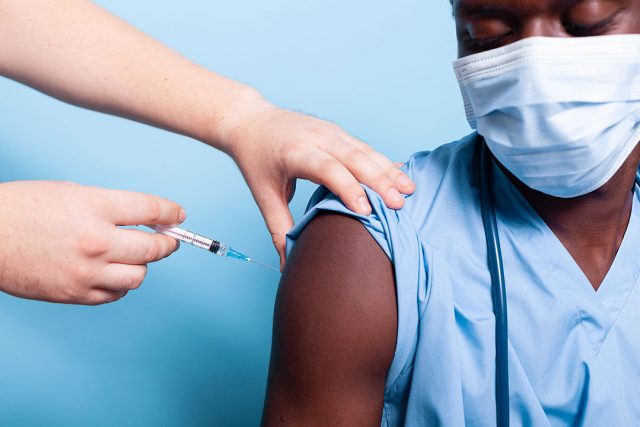
SEKENANI, Kenya — When a group arrived at the Sekenani health clinic in rural Kenya for their COVID-19 vaccines recently, staff told them there were no doses left and that they should come back soon.

For some, it meant a long wasted journey on foot and a day away from their cattle herds.

Yet Narok county, where the clinic is located, was not short of vaccines; nearly 14,000 doses were sitting in a fridge in the nearest town, 115 km away. A mix-up with county officials meant Sekenani did not get enough, two health workers said.

“We had to say sorry. It’s not a good feeling, when somebody comes and they want the vaccine, and we don’t have it,” clinician Mike Nalakiti, 27, told Reuters.

The small failure in a village 270 km southwest of the capital Nairobi is an illustration of the challenges African nations now face as they battle COVID-19: Even though vaccine supplies are finally ramping up, getting needles into arms is proving the hard part.

Successful vaccination campaigns in Africa are vital to ending the pandemic globally, health experts say. The continent’s low inoculation rates encourage viral mutations like the new Omicron variant spreading across South Africa, which has prompted another spate of international travel bans.

Only 102 million people, or 7.5% of the continent’s population, are fully vaccinated, according to the World Health Organization, which warned vaccine inequity will prolong the pandemic.

African governments have been crying out for higher vaccine deliveries this year, but production constraints and hoarding by richer countries severely limited supplies until recently.

Shortages of funds, medical staff and equipment, as well as vaccine hesitancy, were already hobbling inoculation campaigns in some parts of Africa. The anticipated surge, comprising millions of jabs in the coming weeks, could expose those weaknesses further, experts warn.

About 40% of vaccines that have arrived so far on the continent have not been used, according to data from the Tony Blair Institute for Global Change, a policy think-tank.

The rate of vaccine use will have to rise four-fold to keep up with expected supply in coming months, the institute says.

“We are all, like you, very concerned that countries are not picking up the vaccines. The uptake is not as we would have loved to see,” head of the Africa Centers for Disease Control and Prevention John Nkengasong said.

FRIDGES AND MOTORBIKES
Vaccination rates vary widely across Africa, a continent of well over a billion people, and some health systems in relatively small nations and in North Africa are having more success.

Cape Verde, an archipelago nation off West Africa with a population of about 600,000, has vaccinated nearly 65% of adults, rivaling some European countries.

In Democratic Republic of Congo, a restive country in Central Africa with a population of nearly 90 million, the number is 0.1%.

In some ways, Kenya is doing relatively well. East Africa’s largest economy has received nearly 5 million doses in the past two weeks after months of slow supplies.

On Dec. 1, it vaccinated a record 110,000 people and aims to maintain that rate for the next 30 days, said Willis Akhwale, head of the government’s COVID-19 vaccine task force. That would bring the total vaccinated to 10 million out of a population of 47 million, he said.

Yet in the rural Sekenani clinic at the edge of the famous Maasai Mara Game Reserve, where elephants and lions roam, challenges abound.

The clinic started offering COVID-19 vaccinations four weeks ago. It keeps running out of doses and has only one reliable fridge, which is also used for routine immunizations, said clinical officer Gerald Yiaile.

Staff need motorbikes to take vaccines to the community, semi-nomadic livestock herders from the Maasai ethnic group who struggle to afford transport for healthcare, he said.

He applied to local authorities for funds for mobile vaccination and has not heard back.

“We have been forced to ask the community to come to us instead of us going to them,” Mr. Yiaile said.

NOT ENOUGH MONEY
African nations scrambled to ready their health systems earlier this year as global vaccine-sharing scheme COVAX began delivering doses in small quantities months after wealthy countries began inoculations.

Cash-strapped countries were short of cotton wool, fridges, face masks and trucks.

COVAX deliveries were then disrupted after COVAX’s major supplier India halted vaccine exports. The pause gave countries time to improve vaccination rollout without being inundated. They did so to differing degrees.

The GAVI vaccine alliance, a co-leader of COVAX, initially did not prioritize investing in the ultra-cold chain equipment needed for mRNA shots like Pfizer’s because it expected the bulk of doses to be the cheaper and easier-to-administer AstraZeneca shots produced in India, Reuters reported in September.

As vaccine deliveries to Africa soar, absorption of large volumes is expected to represent a major challenge for many poor countries, particularly because a substantial volume will be from Pfizer, GAVI said in internal documents prepared for its board meeting last week and seen by Reuters.

Even Kenya, which has the ultra-cold chain capacity to store 3 million Pfizer doses, is worried its cold chain will get constrained by the influx, threatening its routine immunization program, Mr. Akhwale said.

Cameroon in Central Africa had 244 vaccination centers at the start of its vaccine rollout in April, and now has 1,000, said Njoh Andreas Ateke, deputy head of the immunization program.

But health workers and officials say that power outages and lack of staff have compromised vaccines.

The country has one refrigerated truck suitable to transport vaccines, said Leonard Kouadio, UNICEF’S health section head in Cameroon. It needs at least 2,500 more fridge temperature gauges and more trucks to increase distribution, he added.

Mali, one of Africa’s largest and poorest countries, has two refrigerated trucks to carry vaccines long distances. Some health workers fled their posts in the north because of insecurity caused by an Islamist insurgency, said UNICEF health program manager in Mali, Abdoul Gadiry Fadiga.

The country expects to receive about 3.5 million doses between now and the end of March, more than double the number it has received since inoculations began, Fadiga said.

Mali has enough cold chain capacity to deal with the initial rush of doses until March, Fadiga added, but it still needs 288 fridges and freezers for its full rollout, only 10 freezers of which had arrived.

Funds have been slow to materialize. The World Bank has approved $9.8 billion for emergency health responses, including for vaccine deployment, in developing countries globally, but so far only $4.4 billion has been disbursed.

Mali and Cameroon await support.

A World Bank official said disbursements were happening “very fast.”

REACHING OUT
Even when help arrives it can backfire. Donors have sometimes sent African nations vaccine batches nearing expiration, in some cases rendering them unusable.

Countries desperate for vaccines, including South Sudan and Congo, had to send some back because they could not distribute them in time. Namibia warned last month it may have to destroy thousands of out-of-date doses.

South Africa asked Johnson & Johnson and Pfizer to delay delivery of vaccines because it had too much stock.

A key difficulty in administering vaccines is community skepticism, sometimes driven by religious belief and mistrust of Western drug companies and their own governments. Insufficient education about COVID-19 vaccines enables rumors to spread.

That can be the result of local staff and budget shortages, health workers from across the continent told Reuters.

Ethiopia is worried that vaccines might expire before they are used due to low demand, and is trying to overcome vaccine hesitancy through outreach to communities via local religious and civil society groups, said Muluken Yohannes, a senior adviser to Ethiopia’s health ministry.

“Currently, developed countries … have satisfied their vaccine needs. As a result, they are pushing leftover vaccines … to developing countries. However, the golden period to absorb these vaccines has already passed,” he said.

Kenya has ramped up its vaccine rollout with social media and television and radio ads promoting vaccines. Posts on the health ministry Twitter feed urge pregnant and breastfeeding mothers to get vaccinated.

Not everyone gets the message. Nicky Theron, 20, who works at a clothing shop in the town of Talek, is five months pregnant and scared of the jab. She doesn’t follow any government Twitter accounts.

“I have never heard of anybody who is pregnant receiving the vaccine,” she said.

Some feel they could be persuaded if someone came to explain in person.

Julius Tuyioto, who herds livestock on arid plains in southern Kenya, hears the government warn of the dangers of COVID-19 on the radio. But the disease hasn’t hit his community; he says it doesn’t feel real.

“There is no civic education on why we should be vaccinated. No one is telling us,” Mr. Tuyioto told Reuters outside his mud brick home in Narok County, to the chime of goat bells.

Last month, the government sent vaccines by motorbike to the nearest primary school, five kilometers away, he said. But he did not hear about it until the third and final day, when it was too late for him to go. — Reuters


Hamilton wins crazy Saudi GP to level with Verstappen

LEWIS HAMILTON won a crazy, twice-halted Saudi Arabian Grand Prix (GP) for Mercedes on Sunday to go level on points with Red Bull rival Max Verstappen and set up a winner-takes-all title showdown.

On a chaotic night in Jeddah, the first race in the Gulf kingdom took almost as many twists and turns as an already astonishing and enthralling roller-coaster season — and also left a bitter aftertaste.

There were crashes and collisions, safety cars, red flags, and claims of dirty driving after seven-times world champion Hamilton hit the back of Verstappen’s suddenly slowing car on the super-fast Corniche street circuit.

Extraordinary, at times angry, radio exchanges between the race director Michael Masi and the top two teams filled the airwaves.

With a bonus point for fastest lap, Hamilton moved alongside Verstappen at the top of the standings with 369.5 points after 21 races.

Verstappen, who finished second with Valtteri Bottas third for Mercedes, leads 9-8 on wins, however — meaning that the 24-year-old Dutch will be champion if neither he nor Hamilton scores another point.

Mercedes extended their lead in the constructors’ championship to 28 points and a record eighth successive title looking likely.

The final race is in Abu Dhabi next weekend.

BRAKE-TEST
Hamilton had started on pole but twice lost out to Verstappen, who began the day eight points ahead, at the standing restarts.

The Dutch driver was ordered to hand back the lead, for going wide as Hamilton tried to pass on lap 37, but when he slowed, Hamilton ran into the back of him.

“He just brake-tested me. I’ve just hit him, man. My wing’s broken,” exclaimed the Briton. “That was dangerous driving, dude.”

Stewards summoned both drivers after the race and found Verstappen predominantly to blame, handing him a 10-second penalty that changed nothing.

The Dutchman did hand back the lead on lap 42 but took it back immediately.

Stewards then gave him a five-second time penalty for leaving the track and gaining a lasting advantage, but Verstappen again let Hamilton through.

“We didn’t need to do that, Max,” said his race engineer.

Mercedes told Masi they had not been given sufficient time to inform Hamilton that Verstappen would give back the place, and the Red Bull driver was also furious.

“What happened today is unbelievable and this sport is more about penalties than racing. For me, this is not Formula One,” he fumed after being told he had been voted “Driver of the Day.”

RED FLAGS
The red flags first came out on lap 14 after a safety car period triggered by Mick Schumacher crashing his Haas.

That played into the hands of Verstappen, who stayed out while Hamilton pitted from the lead for fresh tires to take advantage of the safety car deployment.

The advantage disappeared, however, when the standing restart triggered more chaos.

Hamilton made the better getaway but Verstappen went off track to keep the lead, with Alpine’s Esteban Ocon — who finished fourth after being pipped by Bottas at the end — forcing his way into second place.

“I had to avoid a collision there,” exclaimed Hamilton. “He (Verstappen) cut across the whole kerb. He just overtook me outside the white line.”

The race was halted a lap later when Haas’s Russian rookie Nikita Mazepin and Williams’s George Russell collided while Verstappen’s team mate Sergio Perez was tagged by Ferrari’s Charles Leclerc and spun.

Masi offered Red Bull the “opportunity” to line up on the grid for the third standing start behind Hamilton, with Ocon in the lead.

“You’d be back behind Lewis,” said the Australian. “That is my offer.”

“We accept that,” came the reply from Red Bull’s team manager Jonathan Wheatley.

Verstappen seized the lead again, with Hamilton passing Ocon, and the battle was on — punctuated by more virtual safety car periods.

“Get in there, Lewis!” Hamilton’s race engineer shouted at the chequered flag. “That has got to be the craziest race I can remember, the cool heads won that out.”

Australian Daniel Ricciardo finished fifth for McLaren, ahead of AlphaTauri’s Pierre Gasly and Leclerc. Ferrari’s Carlos Sainz was eighth, with Antonio Giovinazzi ninth for Alfa Romeo and Lando Norris 10th for McLaren. — Reuters

Chelsea thumps Arsenal to win FA Cup and seal domestic treble

LONDON — Chelsea thrashed Arsenal (3-0) to win the 2020-21 Women’s FA Cup at Wembley Stadium on Sunday, completing the English treble for the first time after winning the League Cup and Women’s Super League title earlier this year.

Fran Kirby scored the opening goal after only two minutes and Sam Kerr netted a second-half brace, the latter a delightful chipped finish, to seal a third FA Cup for Emma Hayes’s side and a third trophy of 2021.

Last season’s FA Cup was interrupted, then postponed to this campaign due to the coronavirus disease 2019 (COVID-19) pandemic.

Chelsea began the game second to Arsenal in the league standings, having lost to them on the opening day of the season.

However, they got off to the best possible start when Kirby pounced on a defensive lapse by the Gunners defense, who failed to clear their lines, and hit the ball into the bottom corner.

Chelsea dominated the first half in front of almost 41,000 fans while Arsenal looked a shadow of the side who were so far unbeaten in all competitions this campaign. They were not helped by the absence of England defender Leah Williamson through injury.

The Blues were incredibly wasteful in front of goal, though, with Kirby having efforts saved by goalkeeper Manuela Zinsberger and Australia striker Kerr hitting the bar when clear through one on one.

Kerr made up for that miss shortly after half time, however, when she ran on to a long ball and cut inside the penalty area, toying with defender Lotte Wubben-Moy before firing a low shot inside the near post.

Jonas Eidevall, in his first season as Arsenal manager, urged his side forward but they were always crowded out by the Chelsea defense who expertly marked key Dutch striker Vivianne Miedema out of the game. Arsenal failed to have a shot on target.

The result was sealed for Chelsea in the 77th minute when player of the match Kerr chipped the ball over Zinsberger from the right-hand side of the penalty area.

After making up for her misses in the first half, Kerr became the second Australian to lift the FA Cup after former Matilda Taryn Rockall who won it with Arsenal in 1999.

“It wouldn’t go in in the first half — it could have been 4-0 or 5-0 but they defended well. We knew that if we kept pushing at some point they would go in and they did,” Kerr told the BBC.

“I’m paid to score goals but our defense was amazing and it was a team effort — I can’t wait to party!”

The match was played on the 100th anniversary of the English FA banning professional women’s football in 1921. The ban lasted nearly 50 years until it was rescinded in January 1970. — Reuters

Manchester United and Spurs continue revivals with wins

MANCHESTER, England — Manchester United and Tottenham Hotspur continued their recoveries from poor starts to the season with victories in the Premier League on Sunday.

United, with German manager Ralf Rangnick in charge for the first time, beat Crystal Palace (1-0) at Old Trafford thanks to a late goal from Brazilian midfielder Fred.

The Reds have not lost in the three league games since Norwegian Ole Gunnar Solskjær was dismissed following the 4-1 defeat at Watford.

Antonio Conte’s Tottenham enjoyed a comfortable 3-0 win at home to bottom club Norwich City, the North London club’s third straight win under the Italian manager.

Manchester City led the Premier League on 35 points with second-placed Liverpool on 34 points and Chelsea, who suffered a 3-2 defeat at fourth-place West Ham on Saturday, in third place on 33 points.

Spurs are fifth on 25 points with United one place and a point behind.

United had struggled to create clear chances against Patrick Vieira’s well-organized Palace side but the frequently maligned Fred beat Vincente Guaita with a wonderful strike from the edge of the box in the 77th minute after being set up by substitute Mason Greenwood.

Palace should have gone ahead minutes earlier but Jordan Ayew missed from point-blank range at the back post after James Tomkins had headed down a corner.

United held firm against some late Palace pressure, leaving Rangnick pleased with what he saw from his debut on the bench at Old Trafford.

“We need to keep clean sheets. With just the one training session, I was really impressed. We did much better than expected,” he said.

An early goal from Lucas Moura and two after half time from Davinson Sanchez and Son Heung-min ensured the three points for Spurs.

Moura gave the home side a 10th-minute lead with a shot from outside the penalty area that proved as impressive a finish as the slick buildup that led to it.

Sanchez thrashed home a loose ball from close range from Son’s corner to double the lead after 67 minutes and effectively snuff out some enterprising passages of play from struggling Norwich.

Ten minutes later, Son held off the visiting defense to work himself into position and smash the ball past Tim Krul in the Norwich goal.

Patrick Bamford struck in added time as Leeds United snatched a 2-2 Premier League draw against Brentford.

Sergi Canos and Shandon Baptiste had put the Bees (2-1) up at Elland Road.

In Sunday’s late kickoff, central defender Ezri Konsa scored twice as Aston Villa came back from a goal down to beat Leicester City (2-1), giving new Villa boss Steven Gerrard his third win in four league games.

Everton hosts Arsenal in the final game of the round on Monday. — Reuters

Medvedev leads Russia to third Davis Cup title

MADRID — Russia took an unassailable 2-0 lead over Croatia in the Davis Cup final in Madrid on Sunday to secure their third title and first in 15 years, as Daniil Medvedev outlasted Croatian Marin Čilić (7-6(7), 6-2).

Reigning US Open champion Medvedev had to produce his best tennis to survive a tense first set as a confident Čilić sent across nine forehand winners and won nearly three-quarters of his service points.

The awed crowd inside Madrid Arena was reduced to pin-drop silence as the 1.98-meter titans went into a tie-break, where Medvedev relied on his backhand to prevail despite an ill-timed double fault.

Čilić showed signs of fatigue in the second set as the world number two broke his serve in the fourth game before running away with the momentum, dropping just one of his first-serve points.

“I’m happier for the team than for myself,” Medvedev said. “I’m just happy to be part of this team and be able to bring the points.”

Medvedev got a standing ovation from the crowd and made peace with the Spanish fans following a week of animosity after Russia eliminated Spain in the group stage of the Davis Finals.

“I loved the atmosphere. It was a really amazing two weeks because it’s never easy to come here in the end of the season and compete. For sure, it was the best two weeks of my career,” Medvedev said.

Earlier, world number five Andrey Rublev beat Borna Gojo (6-4, 7-6(5)) to give the Russian Federation a 1-0 lead.

Russia’s third title equals the Czech Republic and Germany in seventh place on the all-time list of Davis Cup winners.

World number 279 Gojo entered the match as the big surprise of the tournament and a favorite of the Spanish crowd.

He was unbeaten in the finals with three victories over world number 61 Alexei Popyrin of Australia, number 27 Lorenzo Sonego of Italy, and 33rd-ranked Serbian Dušan Lajović.

But Rublev played a near-flawless match, overpowering Gojo with strong serving to keep the Croatian on the back foot.

Gojo battled hard but Rublev broke his serve at the fourth attempt before taking the opening set in 35 minutes.

Gojo fired down 11 aces, and the second set went to 6-6 before Rublev edged the tie-breaker to clinch victory.

“It was super tough and I felt a lot of pressure, but it’s good to put my country in the lead,” Rublev told reporters.

Russia is the fourth nation to win both Davis Cup and Billie Jean King Cup titles, after the women’s team won that event in Prague last month with a 2-0 victory over Switzerland in the final. — Reuters

Donovan Mitchell goes for 35 as Jazz hold off Cavs

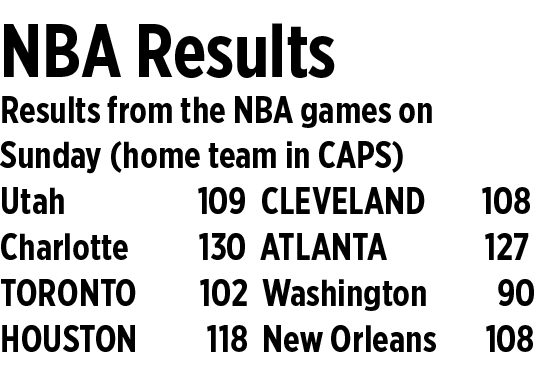
DONOVAN Mitchell scored 35 points to lead the Utah Jazz to a 109-108 victory over the Cleveland Cavaliers in Cleveland on Sunday.

Rudy Gobert tallied 20 rebounds and five blocks for the Jazz. Bojan Bogdanović added 16 points while Rudy Gay chipped in 15 points and eight rebounds.

Utah made 20 3-pointers and shot 41.7% from long distance.

Darius Garland scored 31 points to lead the Cavaliers. Jarrett Allen added 17 points and 11 rebounds while Evan Mobley chipped in 14 points and 12 rebounds.


The Jazz took the lead for good when Mike Conley buried a 3-pointer and Gobert drove for a dunk to put them up 109-106 with 1:42 left. Garland made a jumper to make it a one-point game going into the final minute. He missed a potential game-winning 3-pointer in the final seconds.

Mitchell gave Utah a huge lift on offense in the first quarter. He scored 15 points on 6-of-8 shooting — including three 3-pointers — and helped the Jazz build a 32-29 lead by the end of the quarter.

The Jazz led by seven points four times in the second quarter — the fourth time when Mitchell made three free throws to put Utah up 60-53.

Cleveland cut the deficit to 60-57 early in the third quarter on a floater from Garland. Mitchell went to work to widen the gap again. He made back-to-back baskets to cap a 10-2 run and give Utah its first double-digit lead at 70-59.

The Jazz extended their lead to 97-82 early in the fourth quarter on back-to-back 3-pointers from Jordan Clarkson and Conley. Then, Cleveland stormed back. Cedi Osman scored or assisted on three straight baskets to fuel an 18-2 run. Garland finished it off with a go-ahead step-back 3-pointer that gave the Cavaliers a 100-99 lead. — Reuters

Peso weakens vs dollar on improved US labor market data

BW FILE PHOTO

THE PESO weakened versus the greenback on Monday following better US jobs data, which could cause the Federal Reserve to quicken the reduction of its bond purchases.

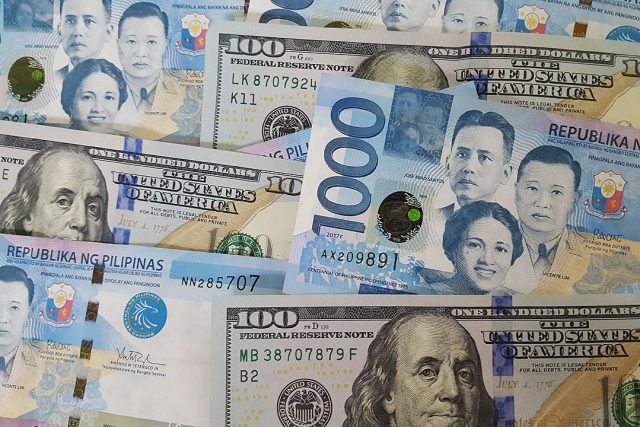
The local unit ended trading at P50.41 per dollar on Monday, shedding five centavos from its P50.36 close on Friday, based on data from the Bankers Association of the Philippines.

The peso opened Monday’s session weaker from Friday’s close at P50.43 against the dollar. Its worst showing was at P50.44, while its intraday best was at P50.32 versus the greenback.

Dollars exchanged declined to $690.84 million on Monday from $959.85 million on Friday.

A trader said in a Viber message that the peso weakened due the upbeat US labor market data released on Friday, as this could make the Fed increase the pace of the tapering of its asset purchases.

US employment growth slowed considerably in November amid job losses at retailers and in local government education, but the unemployment rate plunged to a 21-month low of 4.2%, suggesting the labor market was rapidly tightening, Reuters reported.

The four-tenths-of-a-percentage-point drop in the jobless rate from October reported by the US Labor department in its closely watched employment report on Friday occurred even as 594,000 people entered the labor force, the most in 13 months. Workers put in more hours, boosting aggregate wages, which should help to underpin consumer spending.

The survey of businesses showed nonfarm payrolls increased by 210,000 jobs, the fewest since last December. But the economy created 82,000 more jobs than initially reported in September and October, a sign of strength. That left employment 3.9 million jobs below the peak in February 2020.

Despite November’s slowdown in hiring, which also reflected a small gain in the leisure and hospitality industry, 6.1 million jobs have been added this year. The unemployment rate has declined by a whopping 2.1 percentage points since January.

Economists say the economy is very close to maximum employment, making an early interest rate increase from the US Federal Reserve possible.

Fed Chair Jerome H. Powell told lawmakers last week that the US central bank should consider speeding up the winding down of its massive bond purchases at its Dec. 14-15 policy meeting.

Employment growth was held back by a decline of 20,400 jobs in the retail sector. State and local government education employment fell by 12,600 jobs. That led to a drop of 25,000 in overall government jobs, the fourth straight monthly decrease.

Pandemic-related staffing fluctuations have distorted normal seasonal patterns in state and local government education.

November’s modest job growth did little to temper expectations that the economy was poised for stronger growth this quarter after hitting a speed bump in the third quarter.

The peso also depreciated on safe-haven demand as US stocks declined, Rizal Commercial Banking Corp. Chief Economist Michael L. Ricafort said in a Viber message.

The Dow Jones Industrial Average closed down 0.17% on Friday, while the S&P 500 and the Nasdaq Composite shed 0.84% and 1.92% on Friday, Reuters reported.

For Tuesday, Mr. Ricafort gave a forecast range of P50.33 to P50.53, while the trader expects the local unit to move within P50.33 to P50.53. — L.W.T. Noble with Reuters

Shares climb as fears over new variant subside

BW FILE PHOTO

PHILIPPINE shares picked up on Monday as Omicron fears subsided and on expectations that inflation slowed last month.

The Philippine Stock Exchange index (PSEi) rose 75.55 points or 1.07% on Monday to close at 7,130.74, while the broader all shares index went up by 21.89 points or 0.57% to 3,812.09.

“Market took cue from health experts views’ that early indications of the gravity of the Omicron variant are a bit encouraging,” Papa Securities Corp. Equities Strategist Manny P. Cruz said in a Viber message.

“Outside the country, investors are assessing the impact of Omicron variant on their open positions,” Regina Capital Development Corp. Head of Sales Luis A. Limlingan said in a Viber message.

Initial data from South Africa, the epicenter of the outbreak of the Omicron variant, don’t show a resulting surge of hospitalizations, Bloomberg reported.

“PSEi [went] up on hopes for lower interest rates due to easing inflation, spurring market confidence for sustained corporate earnings recovery into 2022,” First Metro Investment Corp. Head of Research Cristina S. Ulang said in a Viber message.

Headline inflation likely eased in November amid a slower rise in food prices and a drop in pump prices, analysts said.

A BusinessWorld poll of 18 analysts yielded a median estimate of 4% for the November inflation, which is near the upper end of the 3.3% to 4.1% estimate given by the Bangko Sentral ng Pilipinas (BSP).

If realized, last month’s consumer price index will be within the 2-4% target of the BSP and slower than the 4.6% in October but quicker than the 3.7% logged a year earlier.

The Philippine Statistics Authority will release the November inflation report on Tuesday, Dec. 7.

The BSP has kept benchmark rates at record lows since 2020 to support the economy’s recovery, and is expected to remain accommodative at least until the end of the year.

Most sectoral indices rose except for mining and oil, which fell 123.06 points or 1.31% to finish at 9,238.97.

On the other hand, services climbed 38.24 points or 1.97% to 1,976.76; financials increased 26.64 points or 1.70% to 1,585.13; property jumped 36.12 points or 1.12% to 3,252.83; industrials improved by 76.18 points or 0.73% to 10,383.23; and holding firms gained 18.26 points or 0.26% to end at 6,814.65.

Value turnover decreased to P6.55 billion with 1.32 billion shares traded on Monday from the P6.97 billion with 1.30 billion issues switching hands on Friday.

Advancers narrowly beat decliners, 94 against 93, while 52 names closed unchanged.

Net foreign selling increased to P269.52 million on Monday from the P181.60 million logged on Friday.

Timson Securities, Inc. Trader Darren Blaine T. Pangan said investors will look to the listing of Medilines Distributors, Inc. on the PSE on Tuesday for leads.

“Meanwhile, we’ll have to see if support at 6,800 holds, while 7,454.50 seems to be the closest resistance area,” Mr. Pangan said in a Viber message. — M.C. Lucenio with Bloomberg

BW Insights: Creating a Culture of Innovation Towards an Effective Digital Journey

Digital transformation and innovation, while they may not mean the same thing, essentially blend in paving the digital journeys of organizations. It can be safely said that innovation inspires digital transformation.

How valuable is culture of innovation among organizations in bringing successful digital shifts? Where should businesses begin in developing digital and innovation cultures among their workforces and leadership?

Rewatch the discussion themed “Creating a Culture of Innovation Towards an Effective Digital Journey” presented by Tata Consultancy Services – Philippines in partnership with BusinessWorld Insights.

This session of #BUSINESSWORLDINSIGHTS is supported by Bank Marketing Association of the Philippines, British Chamber of Commerce of the Philippines, Management Association of the Philippines, Philippine Chamber of Commerce and Industry and The Philippine STAR.

MoonXBT offers a fair trading environment for cryptocurrency investors, traders

According to a survey, 42% of Gen Z said they would like to take investment advice from influencers on social media. Discussions about investing in cryptocurrencies are commonplace these days. However, it’s not common to find an independent trading platform, as well as an active community discussing the industry.

As one of the leading social cryptocurrency operators, MoonXBT combines socializing and trading by creating a blockchain neighborhood for the crypto world. On an individual scale, MoonXBT solves problems traders face due to lack of communication and rising costs of learning the necessary tools to navigate the industry. While on a global scale, MoonXBT provides contract trading, social interaction and one-click copy trading services for global traders, giving them an engaging trading experience.

A leading entrepreneur in the social trading space has to provide a fair trading environment that guarantees asset security and high liquidity. They also need fully-functional tools for social interaction.

Price spikes can “leverage out” a market, which removes many leveraged positions. The spike force triggers stop losses or may even liquidate positions. When this happens, the entire margin left in your account, or part of it, is taken by the exchange.

Compared with other trading exchanges, MoonXBT provides two types of K-lines. Traders can switch between the ASK or BID K-lines on their monitors. This type of K-line is the product of the average weighted price of the top spot market exchanges.

In terms of security, MoonXBT has onboarded many former bank-level executives and a world-class research and development team. Its safety procedure is triple-protected with wallet, transaction, and system securities. They also have also put cold/hot wallet storage in place, just in case the servers, trading engines, and databases get attacked. All fund transfers from cold storage to hot wallets are processed manually and require multiple authorizations. They also use AWS Shield to reduce potential DDoS attacks and simultaneously prevent large-scale complex attacks and in-depth perspective attacks. Lastly, they designed the MoonXBT trading engine to meet the highest industry standards for online trading. All systems use unique codes to minimize delays and increase order execution speed. This is the reason why at MoonXBT, your order executes within an average of 32 milliseconds!

MoonXBT’s elite team of traders will assist you in executing your trades with the Copy Trading system at the click of a button. Everything is taken care of by simply following the trader you selected, a straightforward way to profit, the same way your chosen trader does. In addition, by copying the trades, followers can also “steal” the successful trading strategies of the traders and turn them into their own.

With a comfortable UI design, trouble-free trading experience and a user-friendly trading system, MoonXBT is growing exceptionally fast among cryptocurrency users within the six months since its launch. At present, its daily trading volume is up to 100 million.

In addition, liquidity is the best standard to measure an exchange. The liquidity of a platform is measured by how quickly transactions fill without any slippage. In other words, the higher the trading volume is, and the faster the trading speed becomes, the greater liquidity the platform has.

One example of this was when MoonXBT ran a test at the beginning of August. They invited some top-tier copy traders and many of their loyal followers to experience our Copy Trading feature. One of the traders opened a position with 5,000 USDT and 150x leverage. With the help of MoonXBT’s additional promotion, almost 100 users followed the order, which meant the transaction reached 75,000,000 USDT.

There is no “slippage” when you Copy Trade at MoonXBT. You open and close orders with your traders in real-time at the same price. If you are interested in Copy Trading and would like to be a MoonXBT trader. You can register at their official site or contact them by telegram, @MNGloria.

If you’re a new trader, MoonXBT has Welcome Campaign Rewards for you, a trading bonus of 35 USDT. Get full cashback on your first order. For instance, after registering at MoonXBT, top-up 100 USDT and make your first trade. Then, when the transaction is over, they will refund you with a 100 USDT Trading Bonus. You can trade with both Trading Bonus and USDT.  

The event is by invitation only. Please register through the invitation link below to participate. The event is limited to the first 500 new users from the Philippines on a first-come-first-served basis.

Register on MoonXBT: https://www.moonxbt.com/user/register?invite_code=mo46zg

One BTC is back and up for grabs. Participate to get a FREE 5 USDT trading bonus and an opportunity to share 1 BTC.

It only takes 1 USDT to open a position. Copy Trading leverage can be as high as 150x, with only 1 USDT needed to start following your favorite trader on MoonXBT.

If you are popular with lots of followers, then MoonXBT’s KOL program is made for you. A commission of up to 50%! More transactions mean more USDT for you.

On top of commission, when you are a MoonXBT partner, you can also participate in exclusive events customized for partners where you get top-notch support and first-class service.

Register on MoonXBT: https://www.moonxbt.com/user/register?invite_code=mo46zg

Join MoonXBT’s Telegram group: @MoonXBTGlobal and participate in more campaigns.


Spotlight is BusinessWorld’s sponsored section that allows advertisers to amplify their brand and connect with BusinessWorld’s audience by enabling them to publish their stories directly on the BusinessWorld Web site. For more information, send an email to online@bworldonline.com.

Join us on Viber to get more updates from BusinessWorld: https://bit.ly/3hv6bLA.

‘Digital empathy’ needed to combat rising cyberthreats

PIXABAY

The challenges of Attack as a Service (AaaS) and other cyberthreats are so broad that no one company can address them in isolation, according to Microsoft’s 2021 Digital Defense Report. 

“With the increasing sophistication of threat actors, cyber resilience is the key,” said Aanchal Gupta, vice president of Azure Security for Microsoft, in a Dec. 3 virtual briefer. “Focusing on mindset, cloud, and [cyber] hygiene are critical areas.”  

Among the actions that support these critical areas are assuming breaches at the onset to increase the cost for the attacker, building plans for rapid response and recovery, and utilizing the scale of cloud technology to process cyberthreats much faster.   

THE CYBERCRIME ECONOMY 
Ms. Gupta, who also leads the Microsoft Security Response Center, cited figures that gave a snapshot of the cyberthreat landscape:  

  • $4 million is the average cost of a data breach in 2020;  
  • $8 trillion is the estimated cost of cybercrime to the world economy by 2022; and  
  • 57 days is the median number of days between infiltration and detection.  

“Eight trillion dollars is higher than the Gross Domestic Product of all but 20 countries in the world,” she said. 

AaaS is cheap, moreover. Ransomware (or malware that holds a victim’s information at ransom) is priced at either $66 upfront, or 30% of the profit in an affiliate model.  

Spear phishing (a social engineering scam that tricks individuals to share sensitive data) is priced $100–1000 for every successful account takeover. Meanwhile, compromised accounts are $150 per 400 million, or an average of $0.97 per 1,000 accounts.  

“It’s a thriving economy of its own and a lot of people are getting driven to it,” added Ms. Gupta.  

FIVE PARADIGM SHIFTS 
Operational resilience is cyber resilience, noted Ann Johnson, Microsoft’s corporate vice president for security, compliance, and identity, in the report.  

To support the evolution of work, in which people work securely and from a variety of non-traditional locations and devices, Microsoft listed five paradigm shifts in cybersecurity that focus on the inclusivity of people and data:  

  1. Digital empathy – involves thinking about the ways ordinary people engage with technology, and ensures that security fits into their working practices rather than those of a cybersecurity professional.   
  2. Zero trust – involves an “assume breach” security posture that treats each request for access as a risk to be verified.   
  3. Data diversity – involves utilizing the power and scale of the cloud to make sense of data points and identify threats before they reach customers.  
  4. Operational resilience – involves a strategic approach tied to cyber resilience, which in turn applies cloud technology’s scale to prepare for various contingencies.  
  5. Integrated security – involves adopting tools that are integrated to provide end-to-end visibility across an organization’s network, apps, and users.  

Microsoft deals with 24 trillion security signals a day and uses artificial intelligence and machine learning to correlate these, said Ms. Gupta.  

“Even if it looks like a successful authentication, we put a tracking on it if it’s not our customer’s usual IP address, and if the [account is not accessed] at the usual time…” she said. “At the end of the day, we want to take care of our customers.” — Patricia B. Mirasol


‘Extreme’ vaccine discrimination risks leaving Africa behind — report

Image via UNICEF Ethiopia/Nahom Tesfaye

LONDON — Africa has little chance of overcoming the coronavirus disease 2019 (COVID-19) pandemic unless 70% of its population is vaccinated by end-2022, yet “extreme vaccine discrimination” is leaving the continent behind, a report published on Monday said.  

The discovery of the Omicron variant in southern Africa has heightened claims that low inoculation rates can encourage viral mutations, which can then spread to countries where rates are much higher.  

Yet only five of Africa’s 54 countries are on track to reach a World Health Organization target of fully vaccinating 40% of the population by end-2021, the Mo Ibrahim Foundation said in a report on COVID-19 in Africa.  

One in 15 Africans has been fully vaccinated, against nearly 70% in the G7 group of richer nations, according to data from the foundation, which was set up by the Sudanese telecoms billionaire to promote better governance and economic development in Africa.  

“From early in this crisis, our Foundation and other African voices have been warning that an unvaccinated Africa could become a perfect incubator for variants,” its chair Mo Ibrahim said in a statement.  

“The emergence of Omicron reminds us that COVID-19 remains a global threat, and that vaccinating the whole world is the only way forward,” he added. “Yet we continue to live with extreme vaccine discrimination, and Africa in particular is being left behind.”  

Vaccines have been in short supply in Africa after developed countries secured initial orders from pharmaceutical companies and the global vaccine-sharing programme, COVAX, got off to a slow start.  

Deliveries of vaccines to Africa have picked up in recent months, but weak healthcare systems and limited infrastructure are holding back rollouts once they arrive, the report said.  

There has also been confusion over short expiry dates on donated vaccines, which has led to the destruction of some.  

Monday’s report said the pandemic had exposed the weakness of African civil registration capacities, with just 10% of African deaths officially registered. Weak systems raised the possibility that vaccination rates were even lower than official statistics showed.  

The foundation also said threadbare social safety nets must be strengthened to protect the vulnerable — the average spend in Africa on COVID-19 response measured as a share of GDP excluding healthcare was 2.4%, less than half the global average. — Tommy Wilkes/Reuters