Home Blog Page 7102

CNPF, partners plant 300,000 coconut trees

VERONICA REVERSE/UNSPLASH

THE tree planting program under the collaboration of listed food company Century Pacific Food, Inc. (CNPF), mobile wallet GCash, and impact organization HOPE has reached 300,000 trees as of November.

CNPF said in a stock exchange disclosure on Thursday that the tree planting program covered an equivalent of 3,000 hectares of land with new coconut seedlings since it began its initiative.

In August, CNPF partnered with GCash and HOPE to plant 1 million coconut trees via GForest, which seeks to support small-holder coconut farmers in South Cotabato and Sarangani.

GForest is a feature on the GCash application that allows its users to help in environmental protection.

“By reducing their carbon footprint and doing cashless services like sending money, paying bills and buying prepaid load in GCash, users are awarded green energy points in GForest, which they can use to claim a virtual tree. CNPF, GCash, and HOPE then convert these virtual trees into real coconut trees,” the listed firm said.

Noel M. Tempongko, Jr., CNPF vice-president and coconut division general manager, said more than 2,300 farmers have already benefitted from the program.

“We are very pleased with the progress that we’re making. Through GForest, we have a platform that enables us to spread awareness and involve consumers in our journey,” Mr. Tempongko said.

GCash Chief Customer Officer Winsley Bangit said the partnership empowers its users to help the environment.

“The partnership empowers our users to become ‘green heroes’ in their own right and ensures that we help promote a ‘green lifestyle’ for future generations to come,” Mr. Bangit said.

According to CNPF, the initiative of planting a million coconut trees is an integral part of its sustainability program.

“With the help of GForest and HOPE, the company’s coconut division will effectively reach net zero carbon emissions by 2028. It will help secure the Company’s long-term supply of raw materials for its fast-growing coconut business,” CNPF said.

On Thursday, shares of CNPF at the local bourse rose 1.89% or 50 centavos to end at P27 apiece. — Revin Mikhael D. Ochave


SpaceX links up with Filipino partners

Elon Musk’s Space Exploration Technologies Corp. (SpaceX) is set to roll out its high-speed satellite internet services in the Philippines next year. According to the Speedtest Global Index, our country currently ranks 64th in the world for fixed broadband speed and 72nd in terms of mobile internet speed.

Bloomberg recently reported that Starlink, a unit of SpaceX, is in talks with two Philippine Stock Exchange (PSE)-listed telecommunication companies to launch its ultra-fast satellite broadband in an archipelago beset by slow speeds and poor connectivity. It identified these two telcos to be Transpacific Broadband Group International, Inc. and Converge ICT Solutions, Inc.

DFNN, Inc., another PSE-listed firm, was mentioned earlier this year in connection with Starlink’s entry into the country. Bilyonaryo.com said DFNN Chairman Ramon C. Garcia, Jr. “is serving as SpaceX’s go-between with the Senate, which is finalizing its amendments to the Public Service Act.”

Starlink uses advanced satellites in a low orbit of 550 kilometers to enable streaming, video calls, online gaming, and other high data rate activities that historically have not been possible with satellite internet. Its potential users can expect to experience download speeds between 100 Mbps and 200 Mbps, with latency as low as 200 milliseconds in most locations.

Rural communities that have gone unserved by the traditional internet service providers will finally gain access to essential online services and resources through Starlink, including virtual doctor visits and remote learning. Fine examples of Starlink’s deployments are the Pikangikum First Nation, an indigenous community in Canada; the Hoh Tribe in Washington, USA; and the Wise County Public Schools in Virginia, USA.

During disasters, the Starlink team can easily be deployed in a matter of minutes to support emergency responders, especially in areas where connectivity has been unreliable, too expensive, or completely unavailable. Starlink’s satellites are also on the leading edge of on-orbit debris mitigation. At end of life, these satellites will utilize their on-board propulstion system to de-orbit over the course of a few months.

In the unlikely event that the propulsion system becomes inoperable, the satellites will burn up in earth’s atmosphere within one to five years — significantly less than the hundreds or thousands of years at higher altitudes.

Considered as the world’s most advanced broadband system, Starlink is presently available in more than 20 countries. Its parent firm, SpaceX, is the only satellite operator with the capability to launch its own satellites as needed.

If only the Philippine Congress could fast-track the passage of amendments to the Public Service Act of 1936, which would hasten the advent of ultra-fast internet services in our benighted land.


J. Albert Gamboa is the chief finance officer of Asian Center for Legal Excellence and co-chairman of the FINEX Week Committee. The opinion expressed herein does not necessarily reflect the views of these institutions and BusinessWorld.

How to establish an employee suggestion program

A candidate had just finished what he felt was a stirring campaign speech in an online forum. He asked the audience: “Are there any questions?” A voice boomed from out of nowhere: “I have one question: Barring the result of surveys, who do you think is your biggest competitor in this election?”

We learn from experience that we all get excited when we talk about ourselves while ignoring the strengths of other competitors and stakeholder. That’s how politicians think. They often magnify their strengths and ignore their weaknesses. This is a one-sided approach.

The same thing is happening in the workplace. Managers don’t want to admit they are part of the problem. This happens all the time when they can’t maintain a work environment that encourages workers to contribute ideas. More often than not, they would simply ask workers to do this and that, without realizing what’s missing.

Taiichi Ohno (1912-1990), one of Japan’s leading industrial engineers and co-creator of the Toyota Production System, was right when he said: “Having no problems is the biggest problem of all.”

You were asking me what is wrong with your organization, except that I haven’t looked closely at your management policies and procedures. So, how can I help you? I can only give you some basics on how Toyota and other dynamic organizations carry out their time-tested employee suggestion program (ESP).

BASIC FORMULA

If organizations want to benefit from ESP or any derivative scheme, they need to do a better job of studying best practices and adjust accordingly to the company’s needs. You don’t have to reinvent the wheel, but to come up with a better platform appropriate for your company’s culture and specific needs. Here are the basic steps:

One, create or revise the company’s mission, vision, and value statements. Without a guiding light, you’ll be constantly in the dark. Many of these are motherhood statements but that happens only because management often forgets about it. For example, how do you intend to operationalize customer satisfaction, excellence in service, or quality orientation, in real, absolute terms?

Two, establish or review the company’s quality management system. QMS is the focal point, secretariat, internal expert, and repository of all tools and techniques related to quality and productivity improvement. It’s like having another job function in a department or division to ensure continuity. To ensure unhampered operations, it could be a part of human resources, quality assurance or the operations department, regardless of the nature of the business.

Three, make the employee suggestion program part of QMS. This requires the creation of a system that allows employees to process their ideas with the help of an ad hoc team in the form of a quality circle, productivity team or kaizen team. This is to ensure that their ideas are processed with the help of other workers through a consensual decision-making process.

Four, have a QMS steering committee to supervise such program. It must have an organizational structure with four levels composed of the Chief Operating Officer or General Manager as the Chairperson. The next level is composed of department managers, while the line supervisors must personally carry out the coaching and screen all employee ideas. The fourth level is composed of all employees acting like an army of problem-solvers.

Five, create a training program or similar platform to promote QMS. Make it easy for all workers to create and process their ideas. This means teaching them tools and techniques to generate ideas using problem-solving tools and decision-making approaches. You can’t simply leave the workers to contribute their ideas without a coherent policy or specific tools to process their ideas.

Last, reward and recognize people with a good number of ideas. It does not have to be cash. Some companies follow the lead of credit card companies. The earned points can be redeemed in exchange for home appliances, devices, and accessories. This is acceptable to most workers as it offers a tax-free situation for both the workers and their organization.

My experience tells me that money is often the most expensive way to motivate people. But if you treat your workers right, they will reciprocate in more ways than you can imagine.


Have a chat with Rey Elbo via Facebook, LinkedIn or Twitter or send your workplace questions to elbonomics@gmail.com or via https://reyelbo.consulting

Stuff to do (12/10/21)

Deals in Lazada 12.12 sale

HAPPENING from Dec. 12 to 14 is Lazada’s 12.12 sale, with Lazada Bonus vouchers offering P60 off for every P600 spend, and cash back offers with 10% of the purchase amount added automatically to the buyer’s Lazada Wallet upon item delivery. Customers can now send a gift card directly to the gift recipients. To do so, tap on the Lazada Gift Card icon on the app or search for Lazada Gift Card on the search bar of the Lazada app and choose an amount ranging from P100 up to P5,000, enter the mobile number, e-mail address, and the name of recipient, customize and input a message, and click on the Buy Now button to proceed to checkout. Recipients will be notified of the gift card via SMS or e-mail. Upon activation of Lazada Wallet, gift card recipients can redeem the amount with the voucher codes they receive, and use it to purchase from over 85 million products available on the platform. For P500 and below, gift cards are valid up to a year. Gift cards with a value of P1,000 and above have no expiry. Lazada also backs accessible and convenient donating campaigns for both Lazada donors and partner organizations such as Spring Rain Global, Virlanie Foundation, UNICEF, Save the Children Foundation, World Vision, UNCHR, Caritas Manila, ABS-CBN Foundation, and GMA Foundation. To access direct donations to LazadaForGood, click on this link to access the page: https://lzd.co/LazadaForGood, then select an advocacy partner and Add to Cart to donate. Lastly, Lazada’s loan providers such as TendoPay will offer 0% interest on purchases until Dec. 15. Plentina will offer the same from Dec. 10 to 14, while Billease and Cashalo will offer 0% interest on purchases until yearend. Ahead of 12.12, customers can apply for monthly installment plans from these financing partners, allowing holiday shoppers to bag the best shopping deals and pay later, with no interest. Visit Lazada for more details.

RC race tracks open at Robinsons Galleria

ROBINSONS Galleria opened RC Tracks, a racetrack for remote control cars. Visitors can bring their RC cars and race at Robinsons Galleria every Saturday and Sunday. The tracks are specially designed to accommodate RC Touring Cars (normal four-wheel-drive cars) and the drifters (drifting). “Developing new areas within Robinsons Galleria is our way of welcoming back the public after being cooped up at home due to the COVID-19 pandemic protocols,” Romina C. Domingo, Robinsons Malls Operations Director, said in a statement.

Christmas at Filinvest City

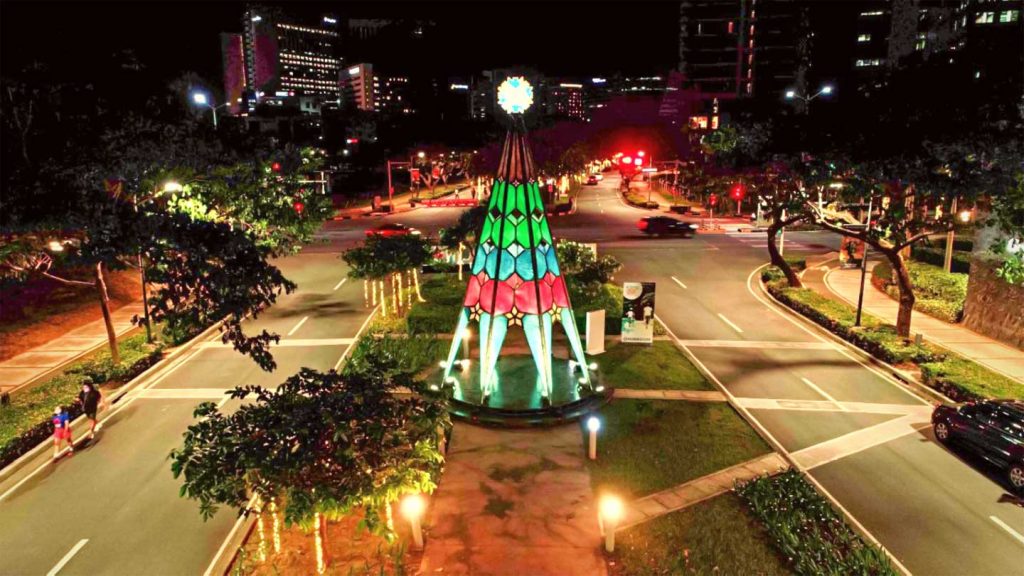
FILINVEST City makes the Yuletide season bright and merry with Share the Sparkle, a lineup of activities and holiday installations and decorations throughout the area. More lights have been set up on major streets. Spectrum Mid-way is the hub of this year’s festivities, where a 32-foot Christmas tree holds pride of place. It is complemented by a walkthrough tunnel of lights and life-sized nativity scene which is open daily and lighted at night starting 6 p.m. for the community to visit and explore. Several activities have been lined up including a short-form Video-making Contest that aims to highlight the sparkle experienced in the community’s open parks: the Spectrum Linear Park, the Festival Mall River Park, the Festival Mall Water Garden, and the Filinvest Axis Park. The competition ends by Dec. 31 and the three top winners, who will each receive P5,000, will be announced on Jan. 15, 2022, together with the most viewed entry which will receive P3,000. Enjoy a bit of shopping and food hopping at the Spectrum Market. On market days — Dec. 10, 11, 17, and 18 — Filinvest City will close a portion of the road of Spectrum Midway to provide additional open space from 4 to 9 p.m. The market will offer a variety of food, holiday gifts and products, live performances, a fireworks display, and other forms of entertainment. For more information about these Christ-mas activities, visit Filinvest City’s official Facebook Page @FilinvestCityOFFICIAL.

Seven Corners and Xin Tian Di hold 12.12 voucher sale

CROWNE Plaza Manila’s restaurants, Seven Corners and Xin Tian Di, are holding a special voucher sale from Dec. 12-14. Seven Corners Lunch or Dinner Buffet Voucher are available for P1,588 (add P58 for a signature drink) and Xin Tian Di Dim Sum Buffet Vouchers are available for P988 (add P58 for a signature drink). Avail these deals through https://crowneplazamanila.com/collections/voucher-sales. For inquiries, call 8790-310.

Shopee holds 12.12 K-Pop concert, sale  

Shopee, the leading e-commerce platform in Southeast Asia and Taiwan, will be holding a night of giveaways and performances at the 12.12 Big Christmas Sale TV Special on Dec. 12, 10:30 p.m. to 12:30 a.m. on GMA-7 and Shopee Live. Viewers can win over ₱12 million worth of prizes, including motorcycles and a brand-new car, and enjoy special numbers from rising K-Pop act Tomorrow X Together. Meanwhile, shoppers can save on their holiday purchases with free shipping with no minimum spend, ₱1 Deals, and 10% off daily at the 12.12 Big Christmas Sale. Among the evening’s highlights: two Shopee Shake players will win ₱300,000 and three Honda Click 150i motorcycles each, while two more will get ₱300,000 and three Honda Supra GTR150 motorcycles each; during the fifth Shopee Shake session, several players will share a ₱1 million coin pool, and one player will also get a brand-new MG 5 Core from Morris Garages Philippines; one Shopee Milyonaryo winner gets to take home ₱1 million in cash.Aside from the performance by Tomorrow X Together, there will be local celebrities and performers including Jessy Mendiola, Ysabel Ortega, Kate Valdez, Rayver Cruz, Julie Anne San Jose, Bianca Umali, Michael V, Ben & Ben, Ariella Arida, Max Collins, Arra San Agustin, Derrick Monasterio, Bugoy Drilon, Kris Lawrence, and Michael Pangilinan. Local artist geiko will also perform her new single, “Oh no I’m on Shopee again.” Shopee brand ambassadors Dingdong Dantes and Jose Mari Chan, together with TV Special host and fellow ambassador Willie Revillame, will be there as well. For more information, visit https://shopee.ph/m/christmas-sale. 

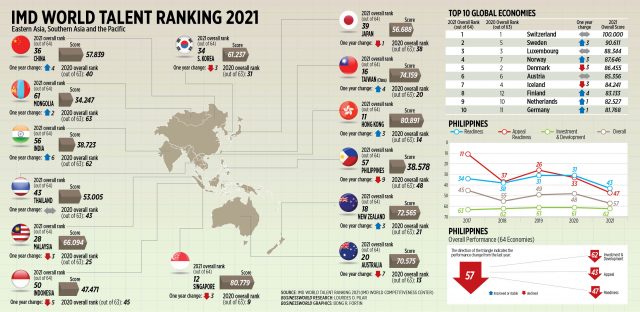
IMD WORLD TALENT RANKING 2021

THE Philippines dropped nine spots in an annual global ranking of countries’ ability to attract and retain a skilled workforce, as the coronavirus pandemic disrupted the education of millions of young Filipinos. Read the full story.

IMD world talent ranking 2021

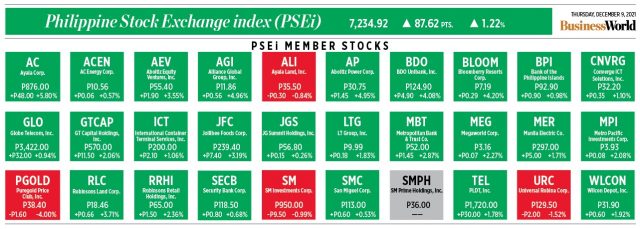
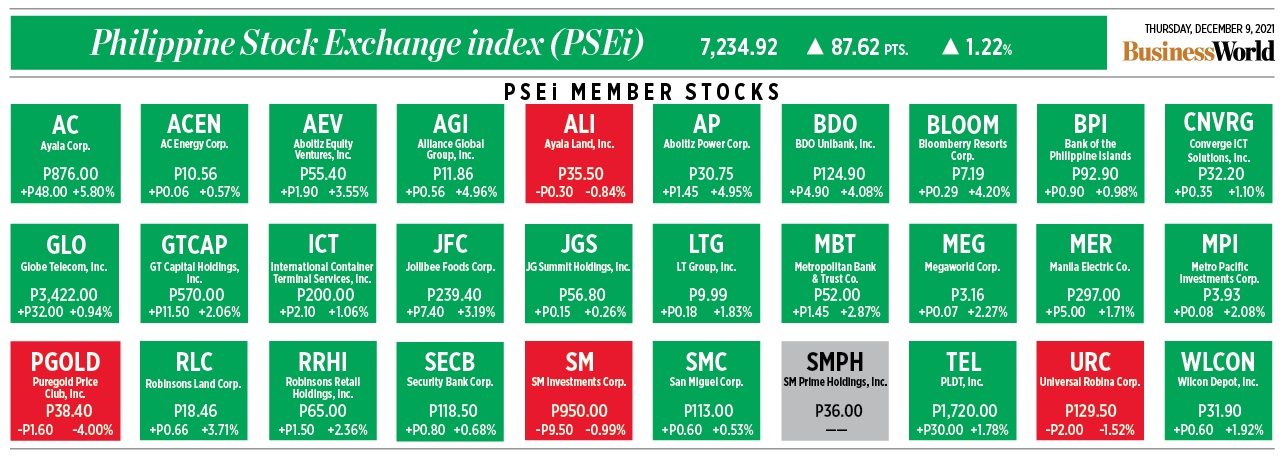
How PSEi member stocks performed — December 9, 2021

Here’s a quick glance at how PSEi stocks fared on TuesdayDecember 9, 2021.


RE projects with 16,000 MW capacity make DoE initial cut

RENEWABLE ENERGY (RE) projects accounted for 55% of the 93 proposals evaluated for grid integration as of November, with only one coal-fired facility obtaining similar clearance, the Department of Energy (DoE) said.

The DoE said in a document posted to its website that the renewable projects accounted for about 16,000 megawatts (MW) in capacity.

The sole coal-fired power plant to pass evaluation during the period was Reliance Energy Development, Inc.’s 300-MW coal-fired power plant in San Carlos in Negros.

Wind projects accounted for 10,935 MW, while solar power capacity was 4,251.233 MW. Some projects on the document were not identified with no capacity details listed.

The DoE has committed to a target of 50% RE capacity by 2040 as outlined in the 2040 Philippine Energy Plan.

Energy Undersecretary Felix William B. Fuentebella, during the Energy Investment forum on Dec. 3, said the Philippines needs an additional 92,320 MW of installed capacity by 2040 under what it calls the clean energy scenario.

Of the projects listed on the document, gas-fired power plants accounted for a significant proportion by capacity.

San Miguel Electric Corp.’s 6,492-MW Navotas liquefied natural gas Power Plant was the single biggest project endorsed by the DoE to the National Grid Corp. of the Philippines (NGCP).

The clearance does not entitle developers to start their projects, but rather to begin conducting a system impact study with the NGCP to identify whether the grid can accommodate the power sourced from such projects and the cost and adjustments needed to accommodate them.

The Energy department published an estimate on Dec. 7 indicating the issuance of permits to 13 new power ventures in November with total capacity of 5,255.258 MW.

Among these projects are Gigawind5, Inc.’s 1,248-MW Manila Bay Wind Power Project in waters off Bataan, Cavite, and Batangas, and Giga Ace 7, Inc.’s 1,024-MW Calatagan Offshore Wind Power Project in Batangas. — Marielle C. Lucenio

DoE soliciting comment on policy paper governing WTE biomass industry

THE Department of Energy (DoE) said it is circulating for comment a final draft of a circular laying down its policies for developing waste-to-energy (WTE) facilities using biomass as feedstock.

The proposed circular outlines its support measures for developers, including priority treatment in approving eligible plants as authorized by Department Circular No. 2015-03-0001.

Electric companies will also be granted a Renewable Energy Certificate (REC) for every megawatt hour of electricity generated from eligible facilities.

REC is an incentive issued by the Renewable Energy Registrar which can be traded on the Renewable Energy Market.

The policy will encourage eligible facilities to sign 20-year contracts with Distribution Utilities (DUs).

Eligible facilities are also exempt from conducting a competitive selection process when signing agreements with DUs if they are endorsed by a local government unit (LGU).

“The proposed circular aims to promote Biomass Waste-to-Energy as baseload renewable energy, provide classification and conditions for eligible Biomass WTE facilities, and prescribe policies and programs to enhance the electric power industry in the development of Biomass WTE facilities,” the DoE said in documents sent via Viber.

The DoE said it anticipates LGUs to be challenged in developing biomass waste-to-energy projects with the approach of the 2022 elections.

The department said it will address expected challenges through “intensive and massive information, education and communication (IEC) campaign and promotion activities, to increase public awareness and appreciation of this Department Circular and the renewable energy industry as a whole.”

The period for submitting comments expires on Dec. 13.

The finalized circular will be endorsed to DoE Secretary Alfonso G. Cusi for consideration and approval.

The development of waste-to-energy facilities under the new rules is expected to start by the first quarter of 2022. — Marielle C. Lucenio

Phoenix rallies to grab a thrilling 103-100 victory over Terrafirma

PBA media bureau

By Olmin Leyba

GAMES TODAY
(Ynares Sports Arena, Pasig)
3 p.m. – NorthPort vs. NLEX
6 p.m. – San Miguel Beer vs. Alaska

PHOENIX 103 – Harris 24, Perkins 18, Banchero 18, Wright 17, Jazul 9, Muyang 6, Manganti 4, Garcia 3, Pascual 2, Chua 2, Melecio 0, Tamsi 0, Rios 0.

TERRAFIRMA 100 – Hester 28, Tiongson 20, Cabagnot 12, Ramos 9, Cahilig 8, Adams 6, Rosser 5, Celda 5, Gabayni 3, Camson 2, Pascual 2, Batiller 0, Balagasay 0.

Quarterscores: 30-25, 42-52, 67-77, 103-100.

PHOENIX Super LPG unleashed a strong finishing kick to steal a thrilling 103-100 victory over a fading Terrafirma side for a 1-0 start in the 46th Philippine Basketball Association (PBA) Governors’ Cup yesterday at the Ynares Sports Arena.

Nearly counted out after trailing by as many as 17 points, the Fuel Masters rose from the ashes and turned things around with a 36-23 exchange in the final 12 minutes.

Phoenix’ second unit Larry Muyang, RJ Jazul and RR Garcia first provided the spark for the gutsy fightback then Matthew Wright and import Paul Harris took over for the coup de grace.

Mr. Wright fired 13 of his 17 points in the fourth quarter, including a triple that knotted the count at 91-91, plus 10 assists. He had a big steal and assist that led to Chris Banchero’s transition basket that gave Phoenix a 100-94 lead with 2:14 left.

Mr. Harris made three free throws in the homestretch to keep the Dyip at bay and finished with 24 markers and 15 rebounds.

Jason Perkins and Mr. Banchero also contributed heavily on offense with 18 apiece.

“Coach Topex (Robinson) just kept telling us to battle through it (despite facing a double-digit deficit at the start of the fourth),” said Mr. Wright.

“Terrafirma is a good team. They came out and surprised us a little bit but we’re able to lock down defensively, play defense and that’s it,” he added.

The Fuel Masters’ stifling defense forced Terrafirma to eight turnovers in the final canto, which they converted to 15 points. Phoenix also dominated the boards in the final 12 minutes, 16-9, en route to 13 second-chance points.

Mr. Wright and his teammates spoiled the Terrafirma debut of former San Miguel Beer star Alex Cabagnot, who had 12 points, seven rebounds and five assists, and import Antonio Hester who had 28-16-4.

Mr. Cabagnot earlier joined forces with Mr. Hester and Juami Tiongson as the Dyip took command in the second period after outscoring the Fuel Masters, 27-12.

The trio combined for 18 markers in that period, where Terrafirma led by as many as 14 after choking Phoenix to a 25% shooting (4-of-16) and scoring 15 points off the opponent’s 11 turnovers. The Dyip widened the gap to 67-50 in the third and held a 77-67 lead to start the fourth.

Meanwhile, NLEX and Alaska shoot for their second consecutive victories today against separate opponents.

The Road Warriors, who stunned San Miguel Beer in Wednesday’s opener, 114-102, seek a follow-up against NorthPort (0-1) at 3 p.m.

For their part, the Aces, 87-85 victor over the Batang Pier, aim to make it back-to-back versus the Beermen (0-1) at 6 p.m.

South Korea accredits two PHL poultry exporters

TWO Philippine companies have been accredited to export chicken meat, the Department of Agriculture (DA) said.

The DA was citing a memorandum from Seoul-based Agriculture Attaché Maria Alilia G. Maghirang dated Nov. 24, identifying the Philippine companies as Carino and Sons Agri-Development, Inc. (CASADI) and LDP Farms Food Corp.

CASADI is based in San Jose, Batangas while LDP Farms has its operations in Rosario, La Union. The products for exported are chilled or frozen meat, bone, fat, skin, and tendon.

“CASADI and LDP Farms may commence their exports of chicken meat to Korea, effective Nov. 23, 2021,” Ms. Maghirang said.

According to Ms. Maghirang, the two companies were inspected remotely by the South Korea Ministry of Food, Agriculture, and Rural Affairs Animal and Plant Quarantine Agency (APQA).

The Philippines won approval from Seoul to resume shipments after a temporary prohibition on chicken meat and pet bird imports imposed in August.

In March 2020, the South Korean ministry banned imports of Philippine chicken meat and pet birds with the issue of notices known as “Import Sanitary Condition of Philippine chicken” and “Import Sanitary Condition of birds except poultry” following the detection of the H5 avian influenza outbreak in the Philippines last year.

Ms. Maghirang said the Philippine Agriculture Office in Seoul is ready to facilitate the accreditation of other exporters once they indicate their intent to be inspected and submit complete documents for the renewal of their accreditation to export chicken meat.

“To ensure food safety, APQA is encouraging the Philippines to observe strict compliance with Korean regulations for imported food, particularly chicken meat,” Ms. Maghirang said. — Revin Mikhael D. Ochave

Tech to identify quality mango planting materials on display

ONE of mango farming’s most urgent challenges is identifying the best-quality planting materials emerging from nurseries, to ensure that inferior specimens of the leading variety, the carabao mango, do not propagate on new land, a leading academic said.

Visayas State University President Edgardo E. Tulin, speaking at a forum on the mango industry organized by the Science and Technology department, said: “We must ensure the quality of the true-to-type carabao mango that must be planted in new plantations.”

Mr. Tulin was speaking at Department of Science and Technology (DoST) virtual gathering known as the Farms and Industry Encounters through the S&T Agenda (FIESTA) conference on Mango, in which industry stakeholders exchanged ideas on innovative practices in mango cultivation.

He said the quality-control problem is complicated by the prevalence of smallholder farms, which account for about 73% of the total area planted to mango.

The industry consists of about 2.5 million farmers.

One of the presenters at the conference, Education Program Specialist Mary Grace S. Balbuena of the University of Southern Mindanao Agricultural Research and Development Center, said her team has tested a simple sequence repeat (SSR) marker kit and found that some mango nurseries are mislabeling the planting materials they distribute.

“There is a need to address the problem of mislabeling of mango seedlings produced in the nursery before they are commercially distributed,” Ms. Balbuena said. Mislabeled seedlings, she added, lead to waste and lost production.

The SSR kit works by determining the degree of relatedness of various types of mango. The kit returns results in a day or two and costs around P500-600.

Another product, a diagnostic kit known as the “dipstick,” validates and verifies mislabeled mango cultivars. The dipstick is targeted at nursery operators who must be trained in using the kit. The cost of one dipstick is P160.

In the three months to June, mango production declined by 0.2% year on year to 556.82 thousand metric tons (MT), according to the Philippine Statistics Authority.

The carabao mango accounted for 80.9% of the total crop, or 450.48 thousand MT.

Due to the numerous mango varieties, the inability to identify the correct species has been a longstanding problem. While morphological characteristics, such as color or texture, are still useful for identification, Mr. Tulin said that these are not reliable.

Technology is needed to “ensure the authenticity of the preferred mango variety as planting material for dispersal, and to ensure quality raw materials for processing required in the export market,” he added.

“We know that the Philippines is one of the leading global exporters of mango, with $91 million in exports, and we account for about 4% of the global market,” Mr. Tulin said. “Eighty-five percent of this is actually in the form of dried mango, to export destinations like the US, Hong Kong, South Korea, and Japan, among others.”

An agricultural engineering professor, Roger C. Montepio of the University of Southeastern Philippines (USeP), said technology must also help farmers adjust to the impact of climate change.

“At present, climate change has affected the fruiting season, and made the wet and dry season unpredictable. Hence, new technologies must be sustainable and aims toward lessening the impact of farming and processing towards the environment,” he said.

USeP has developed a suite of technologies known as MangoFiTek, which is a package of tools helps improve mango production across the pre-to-post harvest stages.

Other innovations highlighted at the conference were the Power Y-Sprayer Nozzle, which minimizes the loss of spray solution and the volume of solution contaminating operators, as well as the V-Sigpao mechanical fruit picker that minimizes mechanical bruising, ensuring that more fruit enter the market unblemished, commanding a higher price.

FIESTA will run from Dec. 9, and 16-17. — Luisa Maria Jacinta C. Jocson

PWD financial inclusion seen expanding due to digital transactions

PHILSTAR FILE PHOTO

THE Bangko Sentral ng Pilipinas (BSP) is betting that digital transactions will help persons with disabilities (PWDs) better meet their banking needs.

“Through digital financial inclusion, persons with disabilities will be in a position not only to overcome restrictions brought about by the pandemic, but also prepare them to take full advantage of opportunities in the post-COVID economy,” BSP Governor Benjamin E. Diokno said in an online briefing.

The central bank is in discussions with the PWD sector to promote the benefits of digital transactions, according to Cesar Augusto E. Villanueva, Jr., acting deputy director of the BSP’s Financial Inclusion Office. He added the office is still fine-tuning its data reflecting PWDs’ access to accounts and credit.

“(Online transactions) can overcome traditional challenges encountered by the sector such as time, distance, cost and effort that conventional channels would require when PWDs conduct their financial transactions,” Mr. Villanueva said.

PWD-related concerns received by the BSP consisted only of 0.1% of all complaints received as of the third quarter of 2021, Mr. Diokno said.

In the first half of 2021, the central bank received 14 PWD-related concerns, up from the four received in 2020. Mr. Diokno said the bank did not field any PWD-related complaints in 2019.

“These complaints do not necessarily pertain to discriminatory practices against persons with disabilities, but are similar in nature to the complaints received from other consumers, which include issues on interest charges and undispensed amounts and unprocessed bill payments,” Mr. Diokno said.

In July, the BSP through Memorandum No. M-2021-040 instructed financial institutions to be more inclusive in extending services to PWDs, including those with learning difficulties, people who are deaf or have hearing difficulties, and the visually impaired, the central bank said.

The directive put banks on notice to avoid discriminatory practices such as non-acceptance of the PWD identification card to open accounts and other financial transactions; turning away visually impaired persons from opening bank accounts, and requiring visually impaired customers to open only joint accounts.

The memorandum also reminded institutions to provide access ramps and Braille systems at their premises and automated teller machines, as well as express lanes for PWDs.

Last year, the central bank incorporated additional tactile marks to banknotes for easier identification of the various denominations by the visually impaired. — Luz Wendy T. Noble

ADVERTISEMENT
ADVERTISEMENT