Home Blog Page 7000

Farm group estimates volume of smuggled rice at 300M kg in 2020

REUTERS

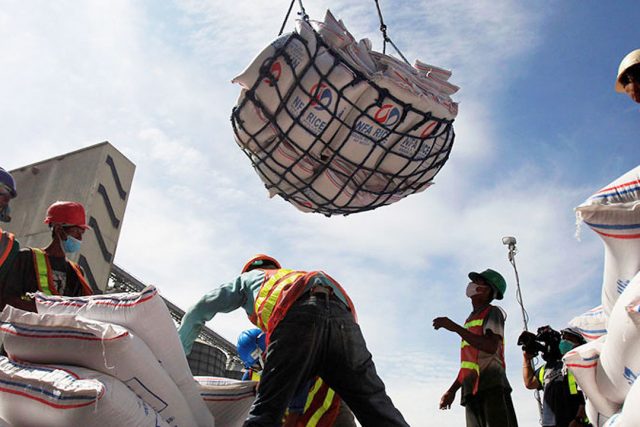
THE Samahang Industriya ng Agrikultura (SINAG) estimated the volume of smuggled rice in 2020 at 300 million kilograms (kg), making it by far the most smuggled food commodity.

SINAG’s estimate for smuggled chicken is 76 million kg, pork 45.5 million kg, onion 23.04 million kg, and assorted vegetables 12 million kg.

The estimates were arrived at using international trade estimates from the United Nations Comtrade database, which contains official totals from exporting countries. These export volumes may then be compared with official Philippine imports data, with any resulting variance assumed to represent smuggling.

“These figures are just mind boggling, eclipsing all previous smuggling numbers. May kumita at patuloy na kumikita talaga sa gitna ng pandemya (Some people continue to make money during the pandemic), to the detriment of the local producers, food safety and public health concerns and foregone revenue for the government,” SINAG Chairman Rosendo O. So said in a statement.

 “We remain the only country that is not applying the global standard of quarantine inspection at the port of first entry of imported food, food products and agricultural commodities that would ensure food safety and public health during the COVID-19 pandemic (to deter) the unrestrained smuggling of agri-food products,” Mr. So added.

SINAG also reported that “not a single smuggler has been put to jail despite all the highly publicized anti-smuggling operations.”

SINAG said its proposals to curb smuggling include making public the list of all accredited importers, the weekly publication of prices, and a more rigorous acceptance process for importers.

In the third quarter of 2021, agricultural trade was in deficit by $2.4 billion, with the growth of imports at 15.8% to $4.16 billion.

Agricultural imports accounted for 13.5% of overall imports.

SINAG said it opposed the government’s recent policy of allowing more imports of food in recent years.

“This government is brutally unique for having an Agriculture department that architected the wanton increase of imports across all agricultural commodities and arbitrarily reduced the tariff of staples,” it said in a statement.

“There is nothing more tragic for the agriculture sector than to have a government agency mandated to protect local producers doing the exact opposite. Nothing is left for local producers, backyard raisers and small agri-entrepreneurs,” SINAG added. “Future generations will only thrive if protection and support are given to the producers of our agriculture and food systems; there is no other way around it.” — Luisa Maria Jacinta C. Jocson

DTI says ‘some’ paracetamol brands may be in short supply; ample stocks from other makers

FREEPIK

THE Department of Trade and Industry (DTI) said some brands of paracetamol may be experiencing shortages, but added the overall supply is adequate.

“Tight supply for some brands… is due to timing of deliveries to replenish the stocks in the branches of these drugstores,” Trade Secretary Ramon M. Lopez said in a Viber message on Tuesday.

“In particular, popular brands (like) Biogesic or Decolgen, which are (the) paracetamol and analgesics of United Laboratories, Inc. (Unilab), may be having temporary out of stock situations. Their manufacturer had a delivery cut off last December but deliveries started coming this week,” he added.  

Mr. Lopez said the supply of other brands and generics is ample.

“Rhea Generics products aren’t affected as much, also because their lines are supplied by major companies. There are other brands of paracetamol in the market so there is no shortage. There are also a lot of generic products in the market,” Mr. Lopez said.

Mr. Lopez said he will ask drugstores to limit per-person quantities for sale to discourage panic-buying.

He also asked consumers to file report profiteers trying to take advantage of the tight supply.

“We will charge them. We also advise consumers (that) they buy from reputable drugstores to ensure fair prices according to the suggested retail price and not from sari-sari stores,” Mr. Lopez said.

In a separate statement on Tuesday, the Department of Health (DoH) also said it does not consider the supply situation for paracetamol and other drugs for flu-like symports to be a shortage.

“(We) would like to assure the public that there is no ongoing shortage in the Philippines. Paracetamol has many generic alternatives in the market, which are available in many drug stores nationwide,” the DoH said. 

“We would like to appeal to consumers however to refrain from hoarding, panic-buying, or unnecessary purchases of such medications when not clinically warranted,” it added.

Separately, the DTI’s Mr. Lopez also encouraged self-testing for people going to gatherings.  

“If one is not feeling anything or is asymptomatic, one would not have done anyway the reverse transcription-polymerase chain reaction (RT-PCR) test for that day. But an antigen test can detect if one is infectious or not for that day and can be preventive,” Mr. Lopez said.  

“This is better than no test at all for asymptomatics. We should allow this in drugstores so that people can have voluntary home tests at lower cost. This is on top of the required vaccination,” he added. — Revin Mikhael D. Ochave

Presidential adviser ‘extremely bullish’ on 2022 economic performance

PHILSTAR FILE PHOTO

A PRESIDENTIAL adviser said he is “extremely bullish” on the performance of the economy in 2022 as vaccination against coronavirus disease 2019 (COVID-19) gains momentum.

Palace Adviser for Entrepreneurship Jose Maria A. Concepcion III said at a Laging Handa briefing on Tuesday: “I am extremely bullish that 2022 will be definitely a much better year than 2021… We have the vaccines… We have the ammunition.”

“We want to end the pandemic this year (in order for businesses to) improve so that they can help the government by paying their taxes, and the government can continue to fund the vaccines,” Mr. Concepcion said.

Mr. Concepcion said the government cannot sustain buying vaccines for the population indefinitely.

“Eventually, this will have to go back to the private sector — us buying the vaccines. So, we (need) to have a vibrant economy to be able to afford buying these vaccines,” Mr. Concepcion said.

Mr. Concepcion said Metro Manila’s change to a stricter Alert Level 3 quarantine restriction poses no problems for businesses.

“This first quarter, there will be a decline in mobility since people spent all their money (on) Christmas spending. Normally, the first quarter is the slowest. There is no issue with the timing. What we saved was the most important quarter, the last quarter of last year,” Mr. Concepcion said.

“We have to restrict the movement of the unvaccinated. This cannot be the pandemic of the unvaccinated. We are trying to move from a pandemic state to an endemic state,” he added. — Revin Mikhael D. Ochave  

Alert level up in 3 provinces around Metro Manila

PHILIPPINE STAR/ MICHAEL VARCAS

THE PHILIPPINE government on Tuesday raised the coronavirus alert in three provinces adjacent to the capital region as the country confronts threats from the more transmissible Omicron variant.

Bulacan, Rizal, and Cavite, which are part of the so-called greater Manila area, would be placed under Alert Level 3 from Jan. 5 to 15 “due to a sharp increase of COVID-19 cases in the particular localities,” the presidential palace said, citing a resolution passed by an inter-agency task force.

The level 3 alert, up from level 2, means more mobility restrictions and lower operating capacity for some commercial establishments, among other limitations.

The recommendation was made by the pandemic task force’s data analytics group, it said.

Rizal and Cavite are part of the Calabarzon region in the southern and eastern sides of the National Capital Region, while Bulacan is on the northern border.

On Monday, the Calabarzon region posted more than 570 coronavirus infections, bringing its total to 500,173 with 5,815 deaths. The region, which produced 14.3% of the country’s 2020 gross domestic product, had 3,696 active cases as of Jan. 3.

Of the region’s total infections, 163,524 were from Cavite, which reported 270 cases on Monday. Rizal, meanwhile, logged 149 infections on Jan. 3, bringing its total to 105,560.

Bulacan in the Central Luzon region posted 185 cases on Monday, bringing its total to 105,524. The total number of cases in Central Luzon, which contributed 10.4% of the country’s economic output last year, hit 282,971 after it posted 275 infections on Jan. 3.

The country is battling a fresh surge in infections, which experts said could exhaust the country’s health system.

Authorities must focus on community-based interventions and proven virus containment measures to arrest the new wave of infections, the Coalition for People’s Right to Health (CPRH) said in a statement.

“With the pandemic entering its third year in the Philippines and across the world, those handling the response should have learned from the evidence in mitigating the spread of the virus,” it said in a statement.

FREE TESTING
The rights-based group composed of health advocates said that amid the spike in infections potentially spurred by the Omicron variant, “testing must finally be made free and accessible to all.”

It noted that the price ceiling for coronavirus tests remains expensive at P2,800 for public and P3,360 for private.

“Given that majority of testing laboratories are private, this further drives up the cost,” the CPRH said. “To make matters worse, in Dec. 2021, the Philippine Health Insurance Corporation reduced its coverage or subsidy for testing, with the benefit package for PCR testing reduced to P 800-2,800 from the former P901-3,409.”

“With 28 provinces still without a testing lab and an additional 3 without a public facility, the integral aspect of testing is still neither free nor accessible to all Filipinos,” it added.

Aksyon Demokratiko senatorial candidate Carl E. Balita, a registered nurse-midwife, said healthcare professionals in the Philippines continue to suffer from lack of job security and proper benefits.

“If not for the Omicron surge looming, many nurses faced non-renewal of their contracts,” he said at the Pandesal forum.

“There was an average of 30,000 nurses registered a year for the past 20 years, and there is no reason for the country to have scarcity of nurses, if only we give our Filipino nurses reasons to stay in the country,” he said.

The government should provide medical sector workers with free testing, Rizal District Representative Juan Fidel F. Nograles said, stressing that these frontliners should not be burdened with such added cost.   

“It is just right for us to ensure that our modern-day heroes, our frontliners, do not have to worry about the expenses of being tested and even managing the disease in case they are infected,” he said in a statement on Tuesday.

He said the free testing should cover all workers in medical institutions, quarantine facilities, and pharmacists.

The Department of Budget and Management (DBM) said it has allocated funds for mass testing, recognizing that it is crucial for the country’s recovery.

“We have allotted P7.921 billion for COVID-19 Laboratory Work which includes the purchase of kits, and other equipment, transportation and trainings necessary for mass testing,” DBM Director U. Rolando Toledo told BusinessWorld in a Viber message.

He added that the Department of Interior and Local Government has a P250 million budget for contact tracing.

The CPRH also said that while vaccination is key to deterring the pandemic, “testing remains essential to detecting breakthrough infections.”

VACCINATION
It urged the government to empower communities with accessible health information and services to address vaccine hesitancy and the infectious disease’s social determinants.

Senators on Tuesday called for increased vaccination capacity, enhanced information drive, and stricter protocol implementation to support economic revival despite increasing COVID-19 cases.

“We should all be responsible enough to do our part in defeating the virus and saving the lives of our people, especially now that our economy continues to suffer a beating,” said Senator Panfilo M. Lacson, Sr., a presidential candidate, in a Viber message.

Senator Ana Theresia “Risa” Hontiveros-Baraquel, meanwhile, called on the Health department to increase vaccination capacity. “Let us not wait for the situation to worsen before we find a way to hasten our inoculation measures.”

She also noted the need to ramp up the information drive for booster doses and increase free testing.

Metro mayors on Tuesday signed a resolution for the passage of local laws that will restrict the movement of unvaccinated residents.

The resolution made by the capital region’s development authority is not legally effective if Metro mayors would not pass local ordinances, the Justice department said in a Viber message to reporters.

Justice Secretary Menardo I. Guevara said local legislative councils exercise police power delegated unto them by the local government code, which was enacted by Congress. “This delegated police power authorizes them to pass such ordinances as they shall deem to be for the welfare of their constituents.”

He said it is for the courts to determine whether the measure is oppressive and could violate the country’s charter. “Unless judicially restrained, however, these public health measures may actually be executed and enforced.”

The government is aiming to inject more coronavirus vaccines amid the threat of the Omicron variant, which has been driving surges worldwide.

The government earlier failed to reach its goal of fully vaccinating 54 million people by the end of 2021.

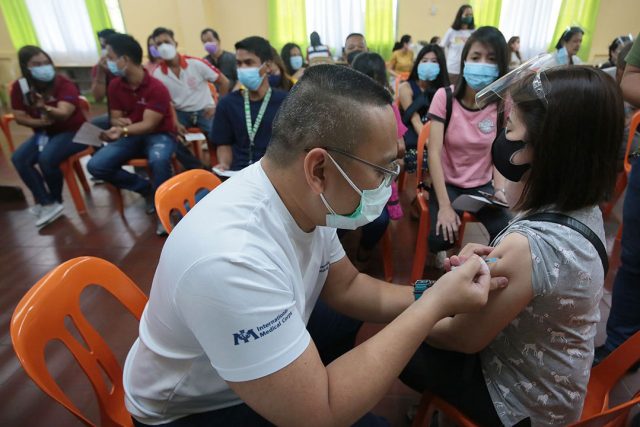
About 50.16 million people have been fully vaccinated against the coronavirus as of Jan. 3, data from the Health department showed. Almost two million booster shots have been injected.

A pandemic official earlier expressed confidence that the goal made last year would be achieved as early as this week. — Kyle Aristophere T. Atienza,Alyssa Nicole O. Tan, and Jaspearl Emerald G. Tan


PHL’s positivity rate hits 26.5% with 5,434 new COVID-19 cases

PHILIPPINE STAR/ MICHAEL VARCAS
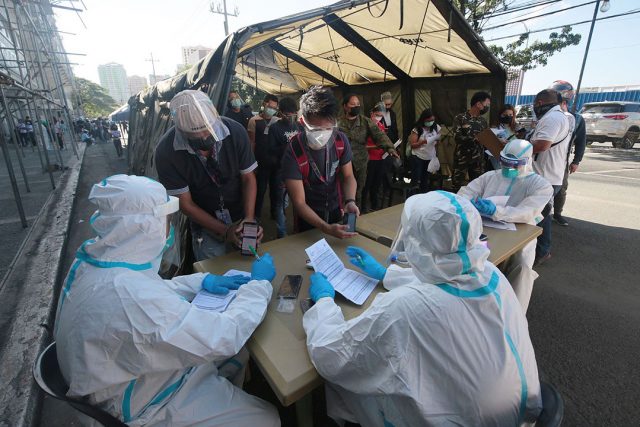
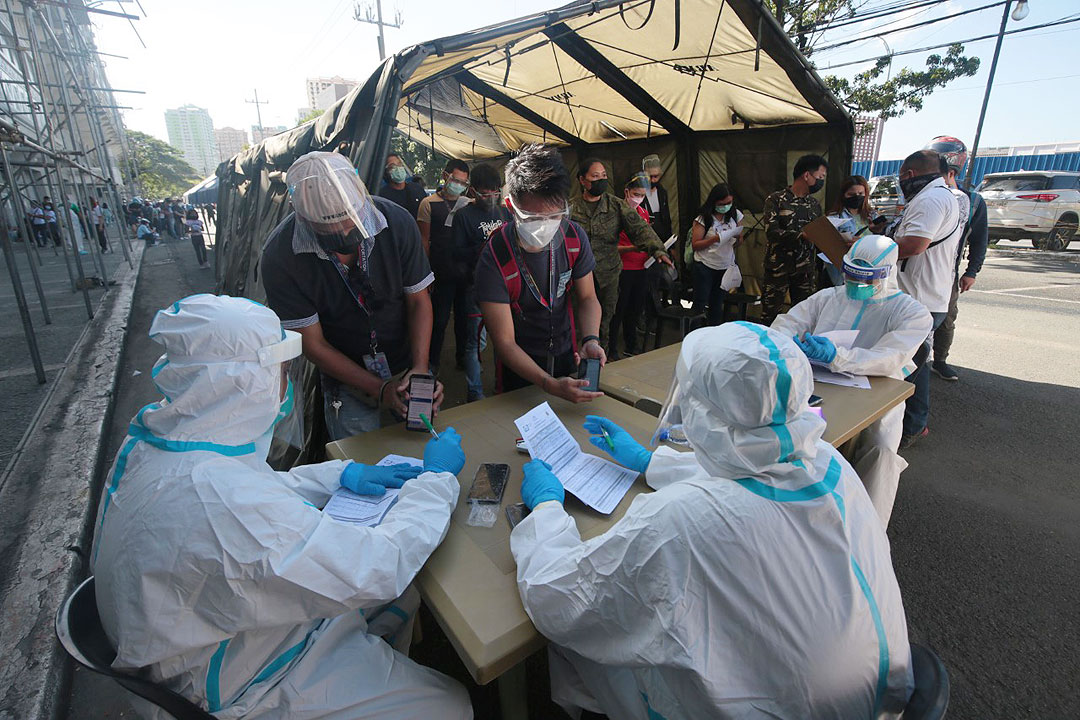
HEALTH workers process the requirements of people who will undergo RT-PCR testing at the Rizal Memorial Stadium in Manila on Jan. 4. — PHILIPPINE STAR/ MICHAEL VARCAS

THE PHILIPPINES posted 5,434 new coronavirus infections on Tuesday, bringing the total to 2.86 million.

The Health department said 26.5% of 25,704 samples on Jan. 2 tested positive for coronavirus disease 2019 (COVID-19), way above the 5% benchmark set by the World Health Organization.

All 310 licensed laboratories operated on Jan. 2, the department said. However, 16 labs did not submit data.

“Based on data in the last 14 days, the 16 labs contribute, on average, 2.1% of samples tested and 1.8% of positive individuals.”

The country’s death toll from the coronavirus hit 51,604 after 18 more patients died, while recoveries increased by 611 to 2.78 million, the Department of Health (DoH) said in a bulletin.

There were 29,809 active cases, 889 of which did not show symptoms, 24,026 were mild, 3,020 were moderate, 1,546 were severe, and 328 were critical.

The agency said 99% of the reported cases occurred from Dec. 22 to Jan. 4.

The top regions with new cases in the recent two weeks were Metro Manila with 3,826 cases, Calabarzon with 864, and Central Luzon with 333.

DoH said 11% of the reported deaths occurred in Jan. 2022, 44% in Dec. 2021, 11% in Nov. 2021, 17% in Oct. 2021, 6% in Aug. 2021, and 11% in July 2021.

The agency said 13 duplicates, logged as recoveries, were removed from the Friday tally.

It said 121 patients had tested negative and were removed from the tally. Of these, 119 were recoveries. It added that 14 recoveries were relisted as deaths.

BED OCCUPANCY
On healthcare capacity, the department said 26% of intensive care units in the Philippines were occupied, while the rate for Metro Manila was 35%.

The hospital bed occupancy in the capital region, which accounted for 31.9% of the country’s economic output last year, increased to 29% from 17% in seven days or from Dec. 26 to Jan. 2, according to local research group OCTA.

During the same period, the occupancy rate for intensive care units for COVID-19 patients in Metro Manila increased to 29% from 21%.

“Hospital bed occupancy seems to be increasing at a faster rate compared to ICU occupancy,” OCTA said. “Both hospital bed occupancy and ICU occupancy are still at very low level at this time.”

The government raised the virus alert in Metro Manila to level 3 from Jan. 3 to 15. — Kyle Aristophere T. Atienza

Pro-admin lawyer suspended for expletives vs journalist 

PHILSTAR FILE PHOTO

THE PHILIPPINE Supreme Court has suspended a pro-administration lawyer who has used foul words against government critics and journalists on several occasions. 

The suspension stemmed from lawyer Lorenzo “Larry” G. Gadon’s video hurling expletives at journalist Raisa Robles. 

The Court, in a press release on Tuesday, said it also issued a show cause order to Mr. Gadon to explain in 10 days “why he should not be meted with the ultimate penalty of disbarment in connection with his viral video uttering profanities” against Ms. Robles. 

The high tribunal said its en banc motu propio treated the case in a Jan. 4 resolution as a formal administrative complaint for disbarment, citing the most recent controversy and “the numerous prior controversies leading to the disbarment cases” against him. 

“Gadon had, on previous instances, publicly displayed the same kind of behavior, for which he is currently facing disbarment complaints before the Court and the IBP (Integrated Bar of the Philippines),” it said. 

The tribunal said that it had previously penalized the lawyer with a three-month suspension in a disbarment case in 2019. “Gadon was already warned that a repetition of the same or similar act shall be dealt with more severely,” it said.  

In another development, the Supreme Court has reduced the coverage and shortened the duration of the 2020 and 2021 bar examinations, considering the destruction brought about by the recent typhoon and the country’s coronavirus situation. 

The Court said in a press release Tuesday that the examinations would only be held on Jan. 23 and Jan. 25. The tribunal previously moved the Nov. 2021 bar exams to Jan. 16, 23, 30, and Feb. 6.  

The court said examinees — who are advised to self-quarantine starting Jan. 9 or at least two weeks before the exams — will take four sets of examinations, encompassing eight subjects. — Kyle Aristophere T. Atienza 

Poll watchdog to name ‘bogus’ party-list groups

ABOUT HALF of the more than 160 party-list groups accredited by the elections commission are “bogus,” a representative of an election watchdog said on Monday. 

“So far, we have identified quite a lot (of bogus party-lists),” Kontra Daya Lead Convener Danilo A. Arao said in an interview Tuesday over ABS-CBN News Channel.

“We just need to come up with a more exact percentage,” he said. “Later on, this month or the next month, we will be ready to come up with our list.” 

Kontra Daya is a non-profit organization that advocates for a more relevant party-list system as envisioned in Republic Act 7941 or the Party List System Act passed in 1995, intended to promote representation of marginalized sectors in Congress. 

“(S)uffice it to say that as early as now, it’s not much different from the 2019 study conducted. We’re close to 50% that would be classified as part of political clans, part of big business or have dubious advocacies,” Mr. Arao said.

“We cannot allow the hijacking of the party-list system,” he said. “The definition of marginalized itself would be, for lack of better term, bastardized and prostituted.”

The Commission on Elections (Comelec) conducted a raffle on Dec. 14 to determine the order of the qualified party-list groups on the ballot, which changes the traditional practice in previous elections of listing them in alphabetical order. 

More than 100 party-list groups had their registrations rejected by the Comelec. However, the Supreme Court issued temporary restraining orders against the commission based on petitions filed by seven party-list groups whose accreditations were denied. 

The poll body was also directed by the High Court to respond to the petitions filed by the party-list groups within 10 days.

Comelec has said that the names of the party-lists with pending Supreme Court appeals will be added to the bottom of the ballot list, and there will be no re-raffle of sequence. 

Meanwhile, a full assessment of the mock elections conducted on Dec. 29 will be available next week, Comelec Spokesperson James B. Jimenez said on Tuesday. 

“A full evaluation will be made available to us by Jan. 10 by the Office of the Deputy Executive of Operations,” he said in a press briefing.

Mr. Jimenez also confirmed that a hearing for disqualification cases against presidential candidate Ferdinand “Bongbong” R. Marcos on Friday will be streamed live on the official Comelec Facebook page as well as that of Commissioner Ma. Rowena V. Guanzon. — Jaspearl Emerald G. Tan

Chinese envoy still optimistic China-funded Samal-Davao bridge to ground break this year 

PH.CHINA-EMBASSY.ORG

A CHINESE diplomat in the Philippines remains optimistic that the long-planned bridge that will connect Samal to mainland Mindanao through Davao City will break ground this year with “progress” in the negotiations for the loan from China. 

Davao City-based Chinese Consul General Li Lin said Beijing has already authorized the loan even as discussions are still ongoing with the Philippine government.

“NEDA (National Economic and Development Authority) is right to say that it’s still undergoing negotiation but there is progress and one of the significant progresses is that last September or October, the Chinese government has already approved the loan request and already notified the Philippine government,” he told BusinessWorld. 

“All these procedures or formalities have already been finished on the part of China… The loan agreement is still ongoing but already made concrete progress,” he added. 

NEDA’s Davao regional official reported in October last year that construction for the Samal-Davao bridge was still uncertain as loan negotiations were still ongoing and right-of-way acquisition was still in the assessment stage.

Maria Lourdes D. Lim, NEDA regional director, said the Department of Finance submitted an updated loan application in April 2021, reflecting a revised financing ratio of 90% loan and 10% local fund.

The application was submitted to the China International Development Cooperation Agency (CIDCA) and China Eximbank. 

In January last year, the Department of Public Works and Highways signed a P19.32-billion contract with a Chinese firm for the design and construction of the 3.98-kilometer bridge. 

“I was a little bit too optimistic for a period hoping that the groundbreaking could start last year, but maybe let’s keep our fingers crossed for (groundbreaking) early this year,” the Chinese envoy said. — Maya M. Padillo

Bacolod gov’t allays fears after returning overseas worker reported as 1st Omicron case

NEGROS OCCIDENTAL PROVINCIAL GOV'T

BACOLOD officials assured residents that protocols are being implemented to avoid another coronavirus surge in the city after a returning overseas worker was reported on Monday as the first Omicron variant case in the Western Visayas region.

Mayor Evelio R. Leonardia and the local task force handling the pandemic response, in a statement released by the city information office, said the Omicron patient was already medically certified as having recovered from the virus before arriving in Bacolod.

“There is no cause for panic as the 38-year-old returning overseas Filipino, a cruise ship crew member who planed in from the United States, has already completed the mandatory isolation and quarantine requirement in Manila and had a negative RT-PCR result before being allowed to board a flight for the Bacolod-Silay Airport,” the city government said. 

“This is an imported one based on the accounts made by the DoH (Department of Health) and other experts. It so happened that his genome sequencing result came out late. But just the same, we have to take precautions,” Mr. Leonardia said.

He also assured that border controls at all ports are being strengthened amid the threat of the more transmissible Omicron variant.

The local government reported that its monitoring team recently caught a resident of Hinigaran town in Negros Occidental who presented an outdated RT-PCR test result upon arrival at the Bredco seaport.

“The holder of the fake RT-PCR was not allowed by authorities to board the roll-on, roll-off vessel bound for Iloilo,” it said.

A strategic plan for the Philippine economy

VECTORJUICE-FREEPIK

(Part 2)

In my experience in the formulation of the Vision of an enterprise or organization, already found latent in the words of the Vision are some directives for strategy formulation. This is clear in the subsequent elaboration of the AmBisyon Natin 2040 found in the National Economic and Development Authority (NEDA) document. Under the heading of “Realizing the AmBisyon,” it clearly states that all sectors of society, whether public or private, should direct their efforts towards creating opportunities for Filipinos to enjoy a “matatag, maginhawa, at panatag na buhay” (a strongly rooted, comfortable, and secure life).

There is already a clear reference to a strategic move to reach the vision through a specific form of governance, which we can call the social market economy. The Government is given a specific role, which has to do with the use of “fiscal, monetary and regulatory policies” in attaining the AmBisyon. All sectors of society, however, are enjoined to also be actively involved in achieving the goals of development in all its dimensions: economic, human and physical capital, social and cultural. There is no question of proposing a completely free market or untrammeled free enterprise system.

Economic growth itself is not the priority. Economic growth must be relevant, inclusive, and sustainable. This echoes the Mission statement that we recommended above (in Part 1). More specifically, it states that over the next 18 years (until 2040) per capita income must increase by at least three-fold. This can be attained if GDP can increase at an average of 6 to 7% during this period. More than the increase in income, economic growth must progressively improve the quality of life of the majority of Filipinos. In fact, I would even go to the extent of saying that economic growth must improve the quality of life of each and every Filipino citizen. The common good is not the greater good for the greater number. That is an erroneous pragmatic principle of some so-called democratic societies under which an erroneous majority can tyrannize a minority. To avoid this, the common good should be defined as a social or juridical order which enables every single person in a given society to attain her or his fullest integral human development.

There are already clear guidelines on a specific regulatory role the Government should play, starting with implementing a more effective competition policy. It is stated that AmBisyon can be partly achieved by having competitive enterprises that offer quality goods and services at affordable prices. A way of achieving this, for example, is to allow more foreign investments in telecommunications and transport services, especially railways, in which existing monopolies have led to inefficiencies and high prices of service to the consumers. Government must encourage investment in key sectors by improving market linkages (for example, by sustaining the Build, Build, Build program); simplifying government procedures (for example, by digitalizing government services); appropriate human capital development, science, technology and innovation (for example, increasing the public budget for education to 6% of GDP from its present 3%). Except for the increase in the education budget, all the suggested strategic moves above have actually already been adopted by the Duterte Administration. What the next Government has to do is to build on the accomplishments of the previous one and go further down the road. For example, the next Government must make sure that the law opening up telecom and transport infrastructures is not only passed but implemented as aggressively as possible, despite some continuing objections from the so-called “nationalists.”

AmBisyon Natin 2040 identifies the sectors that we can call strategic, those that are most crucial in attaining the Vision articulated by the representatives of the Filipino people. These sectors are as follows:

1.) Housing and urban development, which comprise construction, construction-related manufacturing (such as steel), house development-related manufacturing, and utilities (electricity, gas, water);

2.) Manufacturing (food processing, housing-related (e.g., furniture), construction-related (e.g., cement), transport manufacturing (e.g., motorcycles), and other manufacturing (e.g., semiconductor components);

3.) Connectivity (roads and bridges, ports, airports, vehicles, transport systems, and communication);

4.) Education services (formal, non-formal and informal education);

5.) Tourism and allied services (resort, rest-recreation hotels; accommodation, travel and tour services, cultural shows, heritage and pilgrimage sites, etc.;

6.) Agriculture (farming and fisheries, commercial and industrial crops, biotechnology, etc.);

7.) Health and wellness services (primary, secondary and tertiary care, pharmaceuticals, wellness facilities, sports and fitness facilities, etc.); and,

8.) Financial services (consumer financing, enterprise financing and insurance savings mobilization).

In keeping with the Mission statement that growth must be both sustainable and inclusive, the Vision articulated in AmBisyon Natin 2040 stipulates that economic growth should be broad-based across sectors and regions. The attainment of the highest per capita income possible should be subordinated to a more equitable distribution of income and wealth. We should learn from what is now happening in China. Despite the phenomenal per capita income growth rates (double digit in the 1980s and 1990s), and the significant reduction in poverty incidence (now almost close to zero), there exists a tremendous gap between the rich and the poor which is threatening social stability in China today. The Chinese leaders, led by Xi Jing Ping, are trying their best to narrow the extreme gap between the rich and the poor among the population. Using the technical language of economists, even if the poverty incidence is close to zero (i.e., extreme poverty has been eradicated), the GINI co-efficient (which measures how unequal the distribution of income is at any given time) can still be very high (close to 1.0). A GINI co-efficient closer to zero means a more equitable distribution of income.

The bad news for those who will be at the helm of the Philippine Government starting the second half of 2022 is that the poverty rate rose to 23.7 % in the first half of 2021 from 16.2 % in 2019. I would surmise that after Typhoon Odette destroyed property and lives in the ending weeks of 2021, poverty incidence could have risen even higher by the end of 2021. Obviously, as NEDA Director General Karl Chua observed, as more economic sectors reopen and rebound with less stringent restrictions on movement of people and goods as population immunity to COVID-19 increases, lower poverty rates can be achieved during the last weeks of 2021 and the first quarter of 2022. In addition to allowing market forces to energize the national and regional economies, however, there should be direct strategic interventions of the Government to address poverty, which in the coming months should be focused on rural and agricultural development.

Those who are running for elective positions in May 2022 would do well to read a recent document issued by Dr. Jesus Estanislao, former Secretary of Finance and Founder of the University of Asia and the Pacific. In a paper entitled “A Perspective on Dream PH: Philippines 2040s, Let Us Get There,” Dr. Estanislao reminds all Filipinos that in the decade of the 2040s, we shall be celebrating the centennial of Philippine democracy in 2046. Today would be the proper time to take stock of where we shall be with respect to the Philippines we have been dreaming about since 1946, and even during previous decades before we gained our independence. During the election period leading up to May 2022, we shall have many opportunities to evaluate our past, our current challenges, and the immediate, practical issues we urgently need to address as a result of the crisis in which we find ourselves. As we become more deeply aware of the radical changes (we cannot aspire to just return to what was normal before the pandemic) we need to pursue, we should ask ourselves: how do we get those radical changes undertaken and delivered? The political debates engendered by the election campaigns should help us to do a lot of soul-searching on what type of transformation we need to go through as a people so we can build the Philippines we all want for all Filipinos.

(To be continued.)


Bernardo M. Villegas has a Ph.D. in Economics from Harvard, is professor emeritus at the University of Asia and the Pacific, and a visiting professor at the IESE Business School in Barcelona, Spain. He was a member of the 1986 Constitutional Commission.

bernardo.villegas@uap.asia

Sustainable revitalization of an economic pillar

VECTORJUICE-FREEPIK

There will always be nuances in the risks and opportunities involved in mining. The Philippines is no exception when it comes to this. Many stakeholders worry about the risks and challenges frequently associated with mining. They fear that the industry’s growth, especially with the lifting of the four-year ban on the open-pit method, will be detrimental to the environment, and to the safety of host communities.

These misgivings, however, are unfounded. In fact, the ban on open-pit mining only caused the industry to lose momentum on its way to again becoming a major economic engine that generates jobs, business linkages, and government revenues. These revenues could have been used by the national and local governments to improve public services, infrastructure, and COVID-19 responses. The ban repelled much-needed investments and the arrival of technology that could have been useful for productivity and for the management of environmental risks.

Open-pit mining has long been a globally accepted industry practice. After a long series of diligent consultations with the Chamber of Mines of the Philippines (CoMP), industry experts, and stakeholders; and a thorough understanding of the science, the manageable risks, and huge economic benefits, the Philippine government has lifted the ban. The industry, in turn, must strengthen its commitment to meet society’s expectations – to be sustainable and stewards of the environment while meeting the global metal and mineral demands of a modern and greener society.

Despite recurring criticism from anti-mining groups, the Stratbase ADR Institute’s commissioned survey, conducted by Social Weather Stations in October 2021, revealed that the majority of nationwide respondents (63%) say that it is possible to have responsible mining.

In reality, the Philippine mining industry, led by CoMP, has been going beyond its mandated responsibility to sustainably manage its environmental footprint, as well as the key role it plays as an economic engine of the underdeveloped areas of the country and in the global mineral value chain.

These realities, together with the recent policy development, mean mining companies must integrate sustainability in their operations. They must live up to the open-pit method’s history of generating significant economic and social benefits for the local communities. And these companies, to their credit, have quickly and decisively acted. They have already shifted substantial capital funds to tangible, measurable initiatives toward this end.

Legitimate mining firms have already been incorporating responsible practices in their operations. They are proactively addressing their environmental impact, and have been investing in new methods suitable to the geology, geography, and ore type of their projects for environmental and economic feasibility.

For a long time now, mining firms have been on the right track toward sustainability.

With the increasing demand for minerals globally, members of CoMP are readying their capacity and reinforcing sustainability by adopting the Towards Sustainable Mining (TSM) scheme. Its members are investing in environmental management systems to help them address environmental risks onsite and in their host and neighboring communities. They closely engage communities and obtain feedback on how they can improve their operations.

These mining companies also undertake revegetation of mined-out areas as part of their progressive rehabilitation initiatives, with the end in view of restoring and developing a more economically viable operation. No less than the Department of Environment and Natural Resources has acknowledged that the reforestations programs of CoMP members are the biggest contributors to the country’s National Greening Program. The strict compliance with environmental regulations by these legitimate mining companies sets them apart from unregulated and illegal operators.

With the lifting of the ban on open-pit mining, the Philippines has opened the opportunity to be a major player in the global economy’s fast-evolving digital transformation agenda and green infrastructural development boom.

According to the World Bank (WB), over 3 billion tons of minerals and metals will be needed to deploy wind, solar, and geothermal power, as well as energy storage, required for achieving a below 2°C future. Similarly, as countries boost their post-pandemic commitments, technological innovations and development in the digital and health spectrum will further boost the demand for most minerals.

Our mining industry must be enabled to harness the country’s untapped mineral resources and seize this huge opportunity to create a thriving industry that will spark multiple centers of prosperity, especially in remote and undeveloped areas. To illustrate the magnitude of the country’s untapped mineral potential, mining occupies only 2.55% of the 30 million hectares of identified mineral lands in the country.

Now that the open-pit mining ban has been lifted, several local big-ticket mineral projects such as Sagittarius Mines’ $5.9-billion Tampakan copper-gold mine project in South Cotabato, Philex Mining Corp.’s $2-billion Silangan copper-gold mine project in Surigao del Norte, and Nadecor’s $2-billion King-King copper-gold mine project in Davao del Norte, can now move forward. Other mine projects with a potential of approximately $11 billion in total investments that were previously affected by the ban could now be encouraged to resume development plans.

The Philippine mining industry can now progress from its long-repressed potential into a revitalized strategic economic pillar empowered with conducive regulatory stability. An enabling policy regime will boost the industry’s global competitiveness. The mining industry must reciprocate by delivering on its environmental stewardship responsibilities as we move towards a more sustainable post-pandemic environment.


Felix Jose M. Vitangcol, an engineer, is the secretary general, of Philippine Business for Environmental Stewardship (PBEST).

The Second Drone Age is here and it’s a free-for-all

VECTORJUICE-FREEPIK

THE PANDEMIC has already given the future a distinctly dystopian look. And then there’s this: the burgeoning of the “second drone age.”

That’s how experts are describing the international drone market — which ranges from tiny startups selling $1,000-to-$2,000 off-the-shelf technology that can be easily weaponized by terrorist groups like the Taliban, to high-tech unmanned vehicles that can carry laser-guided munitions and Hellfire missiles. It’s an even more highly autonomized proliferation of the first age of drones, which has been dominated by the US since its first attack using a remotely piloted craft in 2001. Now, it’s an ungoverned, unregulated space with billions of dollars to be made and thousands of lives at stake.

The deadly shortcomings of this high-tech violence were placed squarely in the public eye with the US drone strike in Kabul on Aug. 29 that targeted terrorists but instead killed 10 Afghan civilians, including seven children. It was a failure of military intelligence and, like so many other civilian fatalities of the US air wars, including those featured in a New York Times investigation published in December, there was no finding of wrongdoing against those involved.

The transformation of defense operations has been far-reaching: 102 countries now run active military drone programs. It’s replaced thousands of troops on the ground with controllers behind computers located in bases far away from the air strikes they are launching. In the US, fewer troop deaths mean less pressure at the ballot box and less congressional oversight. It allows leaders of many countries and the proxies that support them to get away with what amounts to murder, often of their own citizens, as we’ve seen in the conflicts in Syria and Yemen.

All of this is happening without any overarching regulatory regime to protect civilian populations and uphold humanitarian laws, or to examine the operational and tactical ramifications of this remote-control warfare.

That’s what worries experts like Paul Lushenko, a US Army lieutenant colonel and a Ph.D. scholar at Cornell University. Drones are not just a form of war but a tool of unregulated intra-state political violence, Lushenko told me, representing a “dystopian view of what’s developing right now.”

Lushenko, who co-edited the newly released Drones and Global Order: Implications of Remote Warfare for International Society with Srinjoy Bose, a senior lecturer in international relations at the University of New South Wales, and William Maley, an emeritus professor at the Australian National University, is just one of many advocating for better regulation and more public scrutiny of drone operations. The US withdrawal from Afghanistan in August provides an ideal moment for that post-mortem, he notes.

There has been some attempt at oversight. The Missile Technology Control Regime, an informal political understanding among 35 members, seeks to limit the proliferation of and trade in missiles and missile technology — which arguably covers attack drones. But there’s no enforcement mechanism, Lushenko says. It’s certainly not equipped to regulate armed and networked drones, which can take as many as 200 people to operate, including those controlling them from the US, as well as launching them from bases abroad.

Drones are a gateway technology, Agnes Callamard noted in June as she marked the end of her five years as the United Nations special rapporteur on extrajudicial, summary, or arbitrary executions. They’ve opened the door to weaponized artificial intelligence, algorithmic and robotic warfare, and loosened human control over the deployment of lethal force. Today’s armed drones, she wrote, are tomorrow’s killer robots. She says the absence of a control mechanism for a new generation of weapons of mass destruction represents a significant threat.

Callamard, now the secretary general of Amnesty International, has called for a specific “Drone Technology Control Regime” and says nations should establish a multilateral process to develop standards for the design, export, and use of drones as well as stricter controls on the transfer of military technologies. Sales agreements, she says, should include civilian protection and adherence to international human rights and humanitarian law.

This gaping hole in international oversight has allowed major powers like the US to flout global norms (like the US drone strike that killed the commander of Iran’s Islamic Revolutionary Guard Corps’ elite Quds force, Qassem Soleimani, in Iraq in January 2020). Large-scale manufacturers now negotiate sales directly with prospective buyers who have clear military and security uses in mind. It’s seen Turkey emerge as a drone superpower in the sector, which market intelligence firm BIS Research estimated was worth $28.5 billion in 2021.

The US has already expressed its concerns over Turkey’s sale of weaponized drones to Ethiopia, where the government of Prime Minister Abiy Ahmed Ali is suspected of using them against rebel forces in the Tigray region in a civil war that’s killed thousands of civilians and forced more than 2 million people to flee their homes. The conflict between Armenia and Azerbaijan over the disputed Nagorno-Karabakh region saw Azerbaijan emerge as the clear victor using Russian, Turkish, Israeli, and indigenous drones to overpower its neighbor’s less sophisticated military.

All this illustrates the size of the logistical challenges facing the Biden administration and its plans for an “over-the-horizon” strategy in Afghanistan. The policy depends on other countries agreeing to house US bases to enable Washington to continue its counterterrorism efforts, including the use of armed drones. But without regulation and oversight, the only certainty here is that the technology will continue to advance everywhere. There will be more civilian casualties — and no one will be held accountable.

BLOOMBERG OPINION

ADVERTISEMENT
ADVERTISEMENT