Home Blog Page 6915

Pacquiao asks space company to build Mindanao launchpad

SENATOR MANNY PACQUIAO FB PAGE

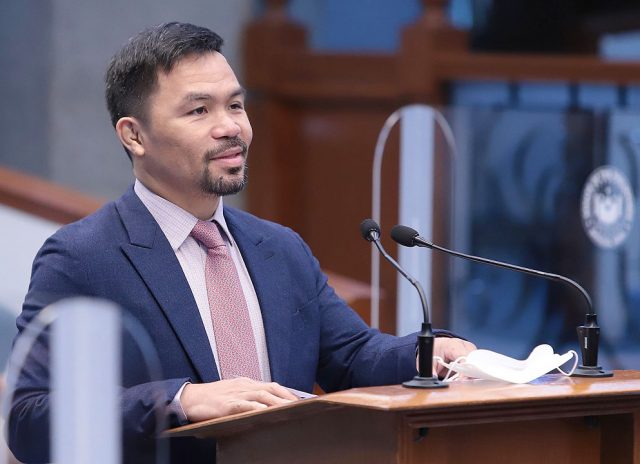
SENATOR Emmanuel “Manny” D. Pacquiao, Sr. has asked a US-based exploration company to build a launchpad on Mindanao island in southern Philippines.

This would put the country on the map of space exploration and generate thousands of jobs for Filipino scientists, engineers, and laborers, he said in a statement on Monday after meeting with top executives of US-based Space Exploration Technologies Corp. at the weekend.

The launchpad would not only cater to their Asian clients but also allow the Philippines to launch its own satellites that can be used for communications, weather monitoring, topography mapping, environment protection and research, said the boxing champion, who is running for president this year.

Senator Aquilino Martin “Koko” Pimentel III, a political ally, said Mindanao is an ideal location for a spaceship launchpad because it is near the equator.

“The involvement of SpaceX in our country will not only bring in investments and jobs but will also put us at the forefront of space science,” Mr. Pacquiao said.

He also cited the need for the Philippines to have its own communication satellite, especially now that Filipinos rely heavily on the internet amid a coronavirus pandemic.

“This technology provides various uses such as advancing online learning, e-government services and disaster relief and coordination, as well as linking our overseas Filipino workers to their loved ones,” he said. “Our future needs this technology.”

He also vowed to build an extensive subway system in major urban areas in the Philippines if he becomes president. He also promised to modernize the country’s jeepneys by using Tesla batteries in electric cars.

The subway system can be made a reality with the help of the Boring Co., Mr. Pacquiao said, decongesting the streets of Metro Manila and other urban cities. He said he met with company officials at the weekend. — Alyssa Nicole O. Tan

House OK’s bigger senior discounts

PHILSTAR

THE HOUSE of Representatives on Monday approved on final reading a bill that seeks to exempt senior citizens from the value-added tax and increase their discounts on monthly electricity and water bills.  

House Bill 10568 or the proposed Expanded Senior Citizens’ Act of 2010 limits the utility discount to a monthly consumption that does not exceed 150 kilowatt-hours and 30 cubic meters of water.  

It will be applied per household regardless of the number of senior residents. A Senate counterpart bill is pending at the committee level. — JEGT

Typhoon-hit cities of Mandaue, Lapu-Lapu offer free shared workspace for WFH employees

MAYOR JUNARD CHAN

THE CITY governments of Mandaue and Lapu-Lapu in Cebu have set up free coworking spaces for residents whose work from home (WFH) have been affected by damaged power and telecommunication facilities due to last month’s typhoon.

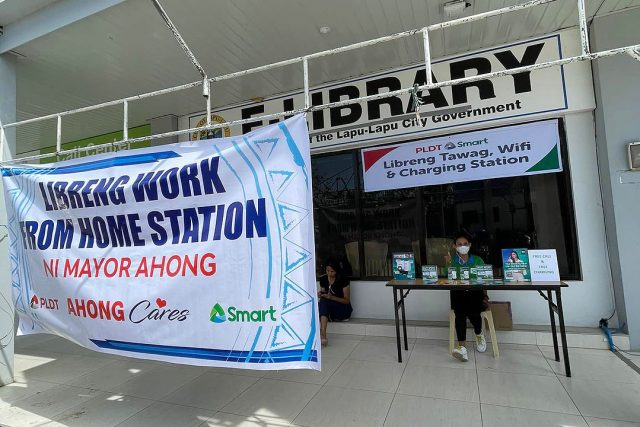
Lapu-Lapu City has set up two facilities, one at the local government’s e-library with internet service provided by PLDT, Inc. and its wireless arm Smart Communications, Inc., and the other at the TCHAC Building near the city hall with Converge ICT Solutions, Inc. as provider. 

“We are still setting up another location that can accommodate another 100 more individuals. We are doing this while we are still waiting for the power lines and internet to be restored to the houses,” Lapu-Lapu Mayor Junard Q. Chang said in a post on his Facebook page last Friday. 

“Rest assured that we have already warned companies to speed up their operations because I know it is very different when you are just in your home,” he added.

In Mandaue City, the temporary shared workspace located at the Mandaue City College opened on Monday, with Globe Telecom, Inc. as provider. 

“This is open 24 hours for those under a work-from-home (WHF) setup with free internet and coffee,” the city information office said. 

Typhoon Odette, internationally known as Rai, swept through central and southern parts of the Philippines on Dec. 16-17 with winds moving at up to 195 kilometers per hour, toppling trees and damaging houses and other structures. 

As of Jan. 17, power service has been restored in 76% of affected areas while telecommunication restoration was at 70%, according to the national disaster management agency’s report. — MSJ

Senate approves creation of Metro Davao authority on final reading

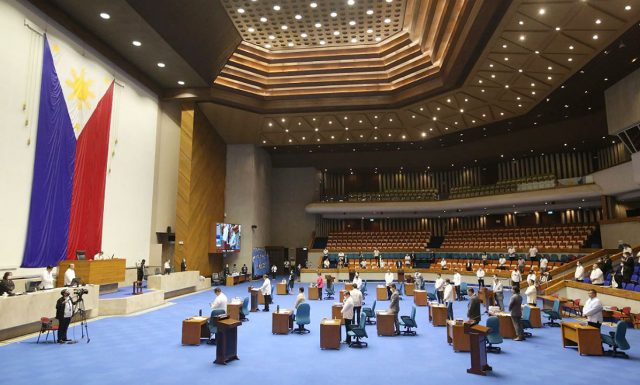
THE SENATE on Monday passed on third and final reading a proposed law that will create a Metropolitan Davao Development Authority (MDDA), which will synchronize plans for a wider urban area in the Davao region.

“The establishment of the MDDA will institutionalize the rapid urbanization in the Davao Region through strategic and viable reforms directed primarily towards regional cooperation and economic growth,” said Senator Francis N. Tolentino, primary sponsor of the bill, during the plenary session.

House Bill 8930 was passed unanimously by the Senate, with amendments in consideration of counterpart bills filed in the upper chamber.

“By agglomerating the major cities and municipalities in the Region, the MDDA will further liberalize local government units within its jurisdiction from their dependence upon the national government and promote a sustained and all-inclusive decentralization in the Region,” Mr. Tolentino said.

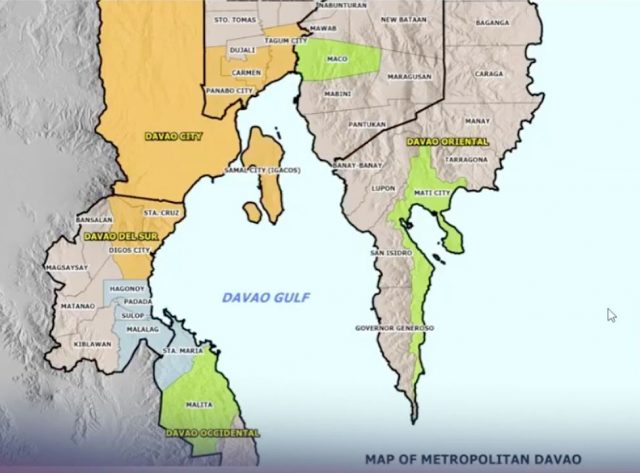
Under the Senate’s version of the bill, 15 towns and cities will be covered by the Metro Davao area. 

These are: Davao City; cities of Panabo, Tagum, and the Island Garden City of Samal in Davao del Norte; Digos City in Davao del Sur; Mati City in Davao Oriental; and the municipalities of Sta. Cruz, Hagonoy, Padada, Malalag, and Sulop in Davao del Sur; Carmen in Davao del Norte; Maco in Davao de Oro; and Malita and Sta. Maria in Davao Occidental.

“The uniform decision-making made by metropolitan councils makes more sense given the geographical contiguity of LGUs (local government units) and the state of urban mobility in the country,” said Mr. Tolentino.

The Metro Davao agency will coordinate plans on traffic management, solid waste disposal, and security, among others. — Alyssa Nicole O. Tan 

Consular affairs offices, off-site passport centers to resume operations Jan. 21

DFA.GOV.PH

CONSULAR AFFAIRS offices and off-site passport service centers that were temporarily closed due to coronavirus cases will resume operations on Jan. 21 to 26, the Department of Foreign Affairs (DFA) announced on Monday.

This includes consular offices in the National Capital Region, Antipolo, Angeles, Baguio, Dasmariñas, Iloilo, Lucena, Malolos, and San Pablo, and the DFA Office of Consular Affairs in Aseana Business Park, Parañaque City. 

Off-site passport centers that will reopen are those located in Newport Mall; Robinsons Las Piñas, Novaliches, San Pedro Laguna, and Robinsons Place Magnolia; SM Aura, Manila, Mall of Asia, and North Edsa. 

Consular offices in Dumaguete, Legazpi, Puerto Princesa, and Tacloban will begin operations on Jan. 24.

Passport applicants affected by the closures will receive details of their new appointment via email. Urgent and emergency cases may be addressed to relevant offices posted on the DFA’s website. — Alyssa Nicole O. Tan 

Delivery riders must be given social protection, says Pangilinan

DAVAO CIO

DELIVERY riders should be given proper social protection and government benefits, especially during a pandemic when they face extra health risks, a senator said on Monday.

“Their everyday travel in the streets is life-threatening,” Senator Francis “Kiko” N. Pangilinan, who is running for vice president, said in Filipino in a statement. 

“They are exposed to different kinds of sicknesses so they need protection. Riders should have PhilHealth, SSS (Social Security System), Pag-IBIG (Home Development Mutual Fund).” 

The senator said these service providers make an important contribution to the economy but have no labor protection, and get minimal benefits and small income. 

Mr. Pangilinan and Vice President Maria Leonor “Leni” G. Robredo, his standard-bearer, is backing the recommendation of the International Labor Organization to extend social protection coverage to workers in the informal sector, especially during the pandemic.

“We will use the legal means to look into this set-up and hiring practices, and see how we can strike a balance between keeping businesses sustainable and at the same time, giving the riders the benefit and protection due them,” he said. 

Having no employee-employer relationship, the Department of Labor and Employment had previously said that motorcycle riders do not enjoy job security as they are engaged in contracts of service.   

PROTECTION
Meanwhile, a bill providing protective measures to individuals engaged in food, grocery, and pharmacy delivery services was passed unanimously on third and final reading by the Senate on Monday. 

Senate Bill 2302 — which seeks to prohibit any food, grocery, and pharmacy delivery service provider to require riders or drivers to advance any monetary amount for the fulfillment of orders — was passed with 23 affirmative votes. 

In case of cancellation of confirmed orders, the service provider will still have to pay the delivery rider or driver the service fee due as if the transaction was successful. 

The service providers will be responsible for pursuing claims from customers who cancel. 

Under the proposed measure, service providers must also require their customers, prior to registration, to submit a valid proof of identity and residential address. Procedures for identity verification must also be implemented in accordance with Republic Act 10173 or the Data Privacy Act of 2012.

Companies that violate the proposed law’s provisions will be penalized with a maximum fine of P100,000 and revocation of license. — Alyssa Nicole O. Tan 

House approves 3 education bills on third and final reading

PHILSTAR

THE HOUSE of Representatives approved three measures relating to education on third and final reading on Monday, including one that aims to expand access to tertiary education. 

House Bill 10560 or the Universal Access to Tertiary Education seeks to expand the coverage of college and university subsidies to give more underprivileged students the opportunity to pursue higher studies.

Another proposed law that hurdled the lower chamber was House Bill 10555, the Free College Entrance Examinations Act, which would allow underprivileged high school graduates who are at the top of their class to take college entrance exams without paying the required fees.

House Bill 10561, the Enterprise-Based Education and Training Program Act, was approved with 203 votes. 

The measure seeks to establish a program focused on “practical work-related or workplace-related” skills, backed by theoretical instructions. 

It could be implemented by various institutions, including technical-vocational schools, private companies, industry organizations, and government agencies, among others. — Jaspearl Emerald G. Tan

Davao Oriental provincial gov’t says stoppage order issued to mining operation

THE MINING operations that is suspected to have caused siltation and discoloration in a river in Banaybanay town has been ordered to temporarily stop, the Davao Oriental provincial government announced Monday. 

“The Mines and Geosciences Bureau (MGB) has ordered the immediate stoppage to a mining company’s operation that allegedly caused the recent siltation incident along the Pintatagan River and Maputi River in the municipality of Banaybanay, Davao Oriental,” the provincial government said in a statement.

It said Governor Nelson L. Dayanghirang received confirmation of the order from MGB Undersecretary Wilfredo G. Moncano early Monday. 

Quoting Mr. Moncano, the provincial government said the MGB central office has already “given instruction to its regional office to issue the Stoppage Order to the company to give way to a joint detailed investigation to find out the causes and the means to mitigate the damages.” 

The Davao regional offices of the MGB and the Department of Environment and Natural Resources did not immediately respond to a request for a separate confirmation.

Several residents used social media last Jan. 14 to raise alarm over the heavy siltation and discoloration along the Pintatagan and Maputi portions of the Mapagba River. 

Mr. Dayanghirang gave assurance that the government, while recognizing the economic contribution of mining, will not “allow these mining companies to operate recklessly and destroy the environment.” 

“Irresponsible mining is unacceptable.” — MSJ 

2 inmates escape from national penitentiary’s maximum security facility

PHILSTAR

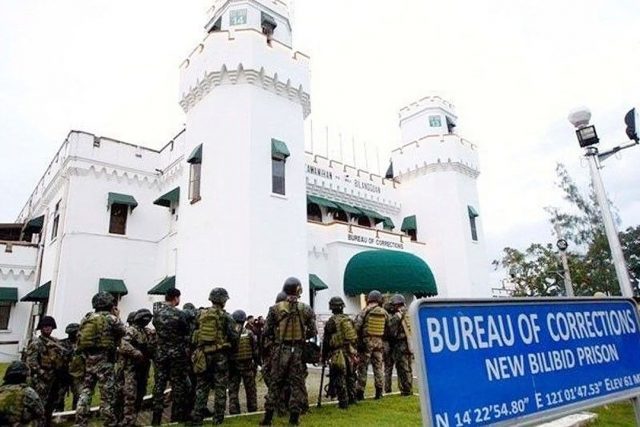
AUTHORITIES are now tracking the two inmates who escaped early Monday morning from the national penitentiary’s maximum-security compound, with the Bureau of Corrections (BuCor) describing the fugitives as “armed and dangerous” in a public advisory. 

The escapees, identified as Arwin Villeza and Drakilou Yosores Falcon, are convicted of murder and homicide, according to BuCor.

Another prisoner who attempted escape, Pacifico V. Adlawan, 49, was caught after a firefight with the Muntinlupa Police squad. 

Three jail guards also suffered gunshot wounds and have been brought to a hospital for treatment. 

Justice Secretary Menardo I. Guevarra, in a Viber message to reporters, said he has directed the National Bureau of Investigation to probe the incident along with recent riots at the penitentiary known as New Bilibid Prison. 

“I will also recommend to the office of the president that disciplinary action be taken against BuCor officials who may be found guilty of gross neglect of duty,” Mr. Gueverra said. — John Victor D. Ordonez

Push for change: Towards a better future for all

FREEPIK

Let us take a quick look at our country’s current situation. We are still facing severe and multiple crises, including a health crisis, an economic crisis, an education crisis, an environmental crisis, and a social justice crisis. Given that 2022 is a critical election year for the country, we hope that “political and constitutional crisis” is not added to this already long list.

On the national election, I must say that whatever the outcome may be, we are prepared to work with the duly elected new administration and contribute to its development program for our people.

As we enter the third year of the ongoing pandemic, nearly 3 million COVID cases have been reported, with over 52,000 deaths. To date, only 48% of our population has been fully vaccinated, falling short of the 70% goal set for 2021. The current surge in infection rates is unfortunate, and it threatens to set back our country’s recovery. Any increase in mobility restrictions can cause undue hardship once more for the business sector and the workers who could lose their jobs.

As we all know, COVID infection concerns of customers and workers alike have affected businesses adversely, and many companies have closed down and gone bankrupt. The unemployment rate in 2022 is expected to range between 7% to 9% or roughly three times the pre-pandemic 2.2% in 2019.

The digital divide is keeping the poor out of the emerging digital economy. Children from low-income families have limited access to online education, further exacerbating the education crisis.

With a poverty rate of 17.5% in 2021, there could be up to 19 million poor Filipinos among us. At the same time, millions of Filipinos are still suffering from the devastation caused by Typhoon Odette, and these typhoon victims can attest to our current environmental crisis.

What do we do now? It is time for us not only to do more but also to be more. To be better. We should not be thinking of just going back to the pre-pandemic state of affairs in 2019. In fact, why should we return to the old normal? The pandemic has proved to be an excellent mirror for humanity, and us, highlighting the social and economic inequalities and systemic weaknesses that afflict our people. What we should be striving for right now is a new normal that is genuinely sustainable, resilient, equitable, inclusive, and beneficial for all.

MAP THEME FOR 2022
Based on these observations, our 2022 MAP (Management Association of the Philippines) Board has decided to adopt the theme, “Push for change: Towards a better future for all.”

Last year we did the “Great reset: Leading for the common good.” Building on our past gains, we move forward to push for change.

Our Board will, as is customary, collaborate closely with the various MAP committees, which constitute the lifeblood of our organization. We have made some adjustments to our committee configuration to be more effective. Certain related committees have been consolidated to achieve a more coordinated approach to multifaceted challenges and avoid fragmented solutions.

As a result, we now have just 22 committees, down from 26 last year. But this does not mean a reduction in committee leaders, as we have appointed additional co-chairs and vice-chairs to committees with broader mandates.

3 MAIN THRUSTS FOR 2022
In line with our MAP Theme for 2022, we are pursuing three major thrusts:

The first thrust: policy reform for economic dynamism

We will put together an agenda of policy imperatives and push for their adoption for sustained recovery and continuing progress, whether through executive or legislative action. In addition, we will advocate for good governance and the rule of law in the operation of and policy implementation by relevant public offices.

In the wake of the pandemic, the need for a conducive enabling environment for investment, foreign and domestic, becomes even more pressing. We must address the country’s energy security, resolve foreign ownership restrictions in critical industries, and improve the ease of doing business, to name just a few imperatives.

In addition, we must unleash private sector participation in infrastructure development to benefit from private sector capital, expertise, and efficiency. More broadly, I cannot overemphasize the need to have the private sector on board as an active and dynamic participant in our nation’s quest for sustained development and growth.

During the coming election campaign period, we in MAP will organize and participate in forums featuring the presidential, vice-presidential, and senatorial candidates. These forums will serve as a platform for raising our policy and governance concerns.

By mid-2022, we will invite newly elected and appointed national officials for policy dialogues as they take their positions following the national election. If possible, we will resume our practice of having in-person breakfast conversations with policymakers. Otherwise, we’ll meet virtually.

We shall take a proactive stance on national issues that directly and substantially impact business and/or other sectors of society. Of particular interest to us are management excellence and good governance concerns. We intend to issue public statements on our own as MAP or in collaboration with other like-minded business groups. For greater influence and leverage, concerted action is sometimes, if not often, required.

We have grouped the sector committees that constitute the cluster on Policy Reform for Economic Dynamism, the first of our three thematic thrusts. These committees are: Agribusiness; Diversity and Inclusion; Ease of Doing Business; Energy; Health; ICT; Tax; Trade, Investment, and Tourism; and, Infrastructure and Urban Development. The National Issues Committee will be part of and serve as the lead committee of this cluster. Please note that the new Infrastructure and Urban Development Committee consolidates three previously separate committees: Transportation, Water Security, and Urban Development.

We anticipate that the committees will stay vigilant and monitor developments in their respective sectors while conducting studies on policy agendas they intend to pursue with their counterparts in the government.

The second thrust: human development and well-being

Our workforce has been rendered uncompetitive for decades due to a persistent and pervasive education crisis. Apart from skills training, we need an education system that will produce critically thinking and socially responsible citizens. I’m sure you agree that responsible citizenship is necessary for a well-functioning democracy.

While the issue affects all levels of education in the country, I believe MAP should focus on the higher education sector, where academe-industry collaboration has been found effective, albeit not widely practiced. Such partnerships can improve curricula, augment faculty, provide apprenticeships for students, and facilitate collaborative research and innovation.

However, we are prepared to cooperate with other organizations to address the challenges in our basic education sector.

We intend to push for programs that will generate more graduates from STEM courses (science, technology, engineering, and math) and are ready for work, particularly in data analytics.

Let me tell you about the Agri-Aqua Innovation Challenge project, which we plan to support. The project is a 10-month national competition for startups and students. Its goal is to help students turn their technological ideas into actual products and services that will benefit farmers, fisherfolk, and the rest of our population. For this project, we will join the Department of Science and Technology and the Asian Institute of Management in a government-academe-industry partnership. MAP members will serve as mentors and sponsors to the competing teams.

We are also considering collaborations with educational and other institutions to implement strategic programs with long-term national impact. We are particularly interested in programs that address critical business and social concerns, such as cybersecurity, health, and responsible social media.

One other educational issue we intend to look into pertains to the training of our seafarers. While Filipinos dominate ship crewing globally, very few become captains and senior merchant marine officers, high-paying positions that can benefit their families and the country more.

The third thrust: shared prosperity and sustainability

In November 2020, MAP led a group of 26 business organizations in signing a Covenant for Shared Prosperity. This Covenant, in my view, has the potential to catalyze inclusive and sustainable development. We will assess the Covenant’s progress and consider renewing the signatories’ commitments. We will also make an effort to bring these commitments to a broader range of companies, including MSMEs, in addition to large corporations.

We will look into how Environmental, Social, and Governance metrics (ESG for short) can support the Covenant’s implementation. In this regard, we are discussing possible collaboration on an ESG Reporting project with the De La Salle University’s Animo Labs.

A new ESG Committee will lead our programs and projects under this third thrust. The Committee results from amalgamating three previously separate committees: Corporate Governance, Climate Crisis, and Social Justice.

The three thematic thrusts I have just discussed respond directly to the major concerns that our members expressed through an indicative survey conducted in November last year.

CONCLUSION
We have all witnessed how the ongoing pandemic has accelerated the implementation of technology solutions, like digital transformation. Changes that formerly took years and decades to materialize now happen in a matter of weeks. Indeed, every major crisis presents an opportunity. The larger and more disruptive a crisis, the more opportunities it offers, as New York University Professor of Marketing Scott Galloway highlights in his 2020 book Post Corona.

It appears that the timing could not be better for us to pursue policy reforms to improve the lives and well-being of Filipinos. It is also time to push for changing mindsets towards a more productive workforce and a more robust business commitment to environmental sustainability, social justice, and good governance.

I believe that each of us can contribute to the desired changes. The work may not be easy, but I assure you that end result will be well worth it.

This article is part of the Inaugural Speech of Alfredo “Fred” E. Pascual as the president of the Management Association of the Philippines or MAP for 2022.


Alfredo “Fred” E. Pascual is lead independent director of SM Investments Corp. and former president of the University of the Philippines.

map@map.org.ph

fred.pascual@map.org.ph

How power-to-X technology could help decarbonize Indonesia’s industrial sector

VECTORJUICE-FREEPIK

As one of the world’s leading economies, Indonesia has announced an ambitious plan to build a green industrial park in North Kalimantan.

Located in the northern part of Indonesian Borneo, the 30,000-hectare industrial area will focus on manufacturing environment-friendly products using low-emission processes and green energy sources.

This plan could provide the momentum needed to boost development of eco-friendly synthetic fuel and chemical industries through what’s called “power-to-X” (P2X) technology.

In Indonesia, the utilization of renewable energy has only focused on decarbonizing electricity generation. Through P2X technology, we can also use renewable energy to tackle challenges in high-emission sectors such as chemical industries and synthetic fuel development.

P2X is a technology to produce synthetic fuel and chemicals using renewable energy. The primary process of P2X is electrolysis: converting raw materials into products using electricity generated from renewable energy.

This process can include:

• water electrolysis to produce hydrogen

• carbon dioxide electrolysis to produce synthetic gas (syngas) and hydrocarbons (compounds that are typically derived from petroleum oil and gas)

• electrolysis of nitrogen from air into ammonia (raw material for batteries and fertilizer)

• electrolysis of oxygen from the air into hydrogen peroxide disinfectants.

Hydrogen production is among the core P2X processes. Hydrogen can be used as an alternative source of clean energy and industrial feedstock for fertilizer manufacturing.

Through P2X, “green hydrogen” could also help reduce our reliance on “black hydrogen” — which is produced from fossil fuels. We can suppress carbon emissions from black hydrogen production by 830 million tons of carbon dioxide per year.

P2X could also accelerate a green transition in heavy industries that still rely on fossil energy (for example, cement manufacturers) through carbon capture technology. Captured carbon dioxide can be transformed into synthetic gas, formic acid (for the rubber industry), methanol and ethanol (alternative fuels) via electrolysis.

The government’s plan to build a hydropower plant in the Kayan River will be an important stepping stone for P2X technology in the North Kalimantan industrial park. Construction has just started in December 2021 and the plant is expected to be operating in 2025.

But such plants generally require enormous areas of land. Thus, their construction has significant impacts on the environment and local communities. Several parties are raising concerns about possible negative impacts on the forest and river ecosystems as well as the people living in the region.

To address the environmental risks, conventional hydropower technology can be replaced with pumped storage hydropower technology — which requires a smaller area than conventional hydropower. Floating solar panels can also be installed along the surface of the river to diversify energy sources.

Based on a recent study, for instance, Kalimantan has vast solar energy potential.

Another factor to be considered is what types of industries are suited for development in the North Kalimantan region.

Due to its high water flow rate (about 1,700 m3/s), the Kayan River is an enormous water source. It can be used to generate vast amounts of green hydrogen — a feedstock to produce ammonia.

Potential buyers are in place, including PT Pupuk Kalimantan Timur in Bontang, East Kalimantan — located around 354 km from Tarakan, the capital of North Kalimantan.

Furthermore, synthetic natural gas and methanol production using hydrogen is ideal for providing “green fuels” for the state-owned oil refinery in Balikpapan, East Kalimantan province.

To prove its commitment to developing a green industrial park, the government should consider the following points.

First, the government must formulate strategies for decarbonizing the industrial sector through P2X.

Establishing a clear roadmap can build trust with domestic and foreign investors. This roadmap can become a cornerstone for developing other green industrial parks.

Indonesia can also learn from Germany and Japan, which have produced green hydrogen with P2X technology.

Second, the government should support research in electrolysis technology to increase the economic viability of P2X. Other essential support includes funding from international partners or financial institutions.


Denny Gunawan is a PhD candidate, Particles and Catalysis Research Laboratory, UNSW. He is also affiliated with Energy Commission, Directorate of Research and Studies, Overseas Indonesian Students’ Association Alliance (OISAA).

The transportation sector and the motorcycle taxi

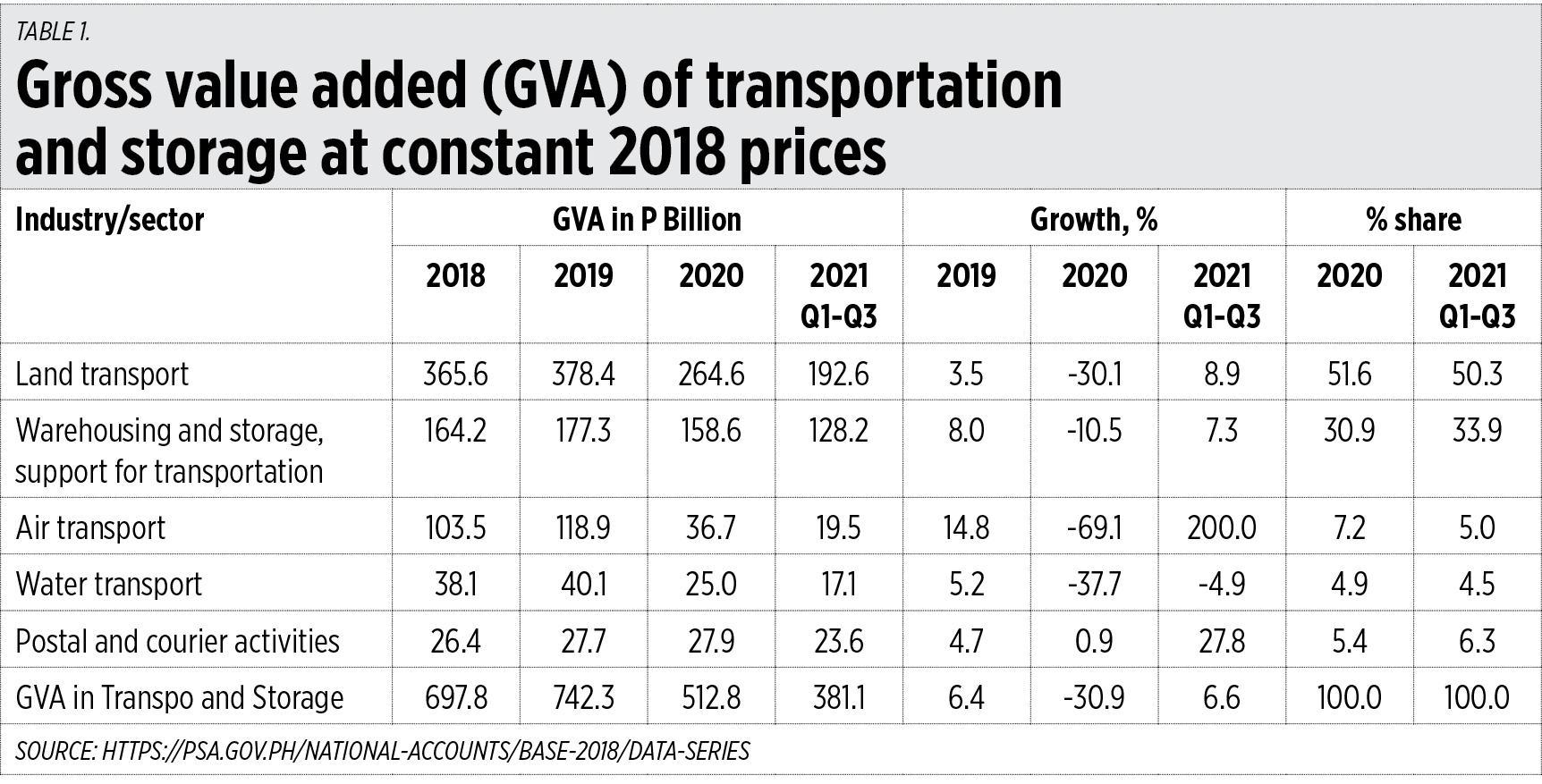
The transportation sector — air, water, and land — is among the sectors which have been most adversely affected by the pandemic scare and government lockdowns. While overall GDP in 2020 contracted -9.6%, the transportation and storage industry contracted -31%.

In the first three quarters of 2021, while overall GDP grew 5.1%, the transportation and storage sector grew 6.6% and land transport in particular grew 8.9%, and it comprised 50% of total production of services of the sector (Table 1).

LAND TRANSPORTATION IN TOP 1,000 CORPORATIONS
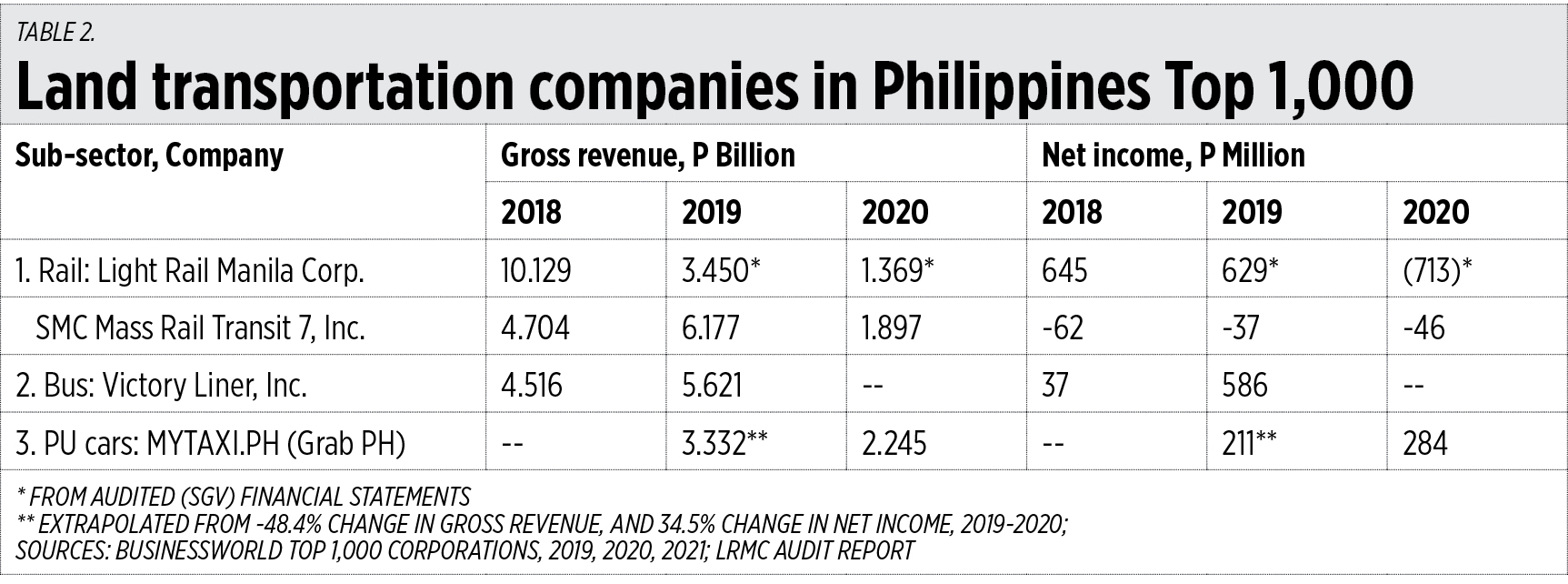
I checked the performance of land transport companies that belong to the BusinessWorld Top 1,000 corporations, and saw that the numbers are interesting.

First, only one bus company, only one provider of public utility (PU) cars, and two rail companies managed to land in the Top 1,000. And second, trains that move big number of passengers suffered a big decline in gross revenue and net income in 2020. The same could be said of the bus company due to the prolonged lockdown, while the PU car company Grab Philippines managed to grow in net income (Table 2).

This implies that during the pandemic and lockdown, people have avoided mass transportation trains and buses and have used more private vehicles, or have ridden PU cars and motorcycles. The mandatory social distancing and fear of being physically close to strangers in public transport while keeping their cost of mobility low means that demand for private, cheaper transport will stay or increase. Motorcycle taxis would be the fastest and cheapest mode of transportation for poor people who do not have private vehicles, or, even if they can afford to buy a motorcycle, are scared to drive one.

MOTORCYCLE TAXI DUOPOLY
Currently, a motorcycle taxi (MCT) duopoly — comprised of Joyride and Angkas — was appointed and authorized by the government via the MCT Technical Working Group (MCT TWG) composed of the Department of Transportation, the Land Transportation Office, the Land Transportation Franchising and Regulatory Board, the Metropolitan Manila Development Authority, the Philippine National Police, and the Inter-Agency Council for Traffic or I-ACT. There is no law from Congress yet that authorizes MCT so these agencies in the Executive branch arrogated legislative power upon themselves.

Technically there are three players (Joyride, Angkas, and Move It) authorized by the TWG which also excluded a fourth player, Grab, for no clear reason, in the pilot project to study MCT. But Move It is too small so it partnered with Grab which has millions of subscribers, potential drivers, and passengers. Since the TWG has killed the Move It-Grab partnership and Move It is back to being an insignificant player, it is a de facto duopoly.

The supply of MCT is not enough so a fourth black-market MCT — “habal-habal” or unregistered MCT — appeared to fill the supply gap, and there are thousands of them nationwide especially in Davao City and the rest of Mindanao. See these reports in BusinessWorld:

1. “Panel admits two more firms for extended motorcycle taxi trials” (Dec. 20, 2019)

2. “Grab ‘seriously considering’ motorcycle taxi business anew” (Oct. 29, 2020)

3. “Davao City to legalize, regulate motorcycle taxis” (May 9, 2021)

4. “Grab PHL, MOVE IT partner for motorcycle taxi hailing services” (Sept. 23, 2021).

The Move It-Grab partnership was allowed by the TWG to operate on Sept. 23 last year, then disallowed by Oct. 1. Perhaps that one week proved to be too successful and popular with many new drivers and passengers.

By Dec. 10, the TWG officially and permanently terminated the Grab-Move It collaboration. It recognized that the partnership had generated jobs and served the public, but still decided to stop the partnership. The TWG added that new players can come in only if the bill in Congress legalizing MCT becomes a law.

As of November 2020, the duopoly has 10,400 riders (6,400 from Angkas, 4,000 from Joyride) even if the TWG has authorized 46,713 MCT in February 2020. This means tens of thousands of units have been filled up by illegal MCT while the TWG has restricted and continues to restrict new legal MCT players. See this column’s article, https://www.bworldonline.com/tax-pressure-and-motorcycle-taxis/ (Dec. 13, 2021).

HOUSE COMMITTEE REPORT (CR) NO. 1364
On Dec. 6, 2021, the House of Representatives Committee on Transportation reported out CR No. 1364 and filed as House Bill (HB) 10571, “An Act Regulating the Operation of Motorcycles-for-hire,” substituting dozens of earlier bills allowing and regulating MCT. The bill has about 50 legislator-authors and was submitted by Congressman Edgar Mary S. Sarmiento, Chairperson of the House Committee on Transportation.

The new bill has many good provisions. It recognizes Motorcycles-For-Hire as Common Carriers via a transportation network company (TNC) or Online E-Commerce platform provider (OEPP) under Section 5; it sets the Standards and Specifications of Motorcycles (Section 7) and Qualifications of Drivers (Section 10); it allows their franchising and set the franchise requirements (Sections 8 and 9). It also sets Accreditation Requirements of TNCs and OEPPs (Section 11) and so on.

In short, the new HB 10571 sets the formal and permanent recognition of MCTs, regardless of the number of players, in very transparent ways, unlike the non-transparency of the TWG that anointed only a duopoly.

MORE BIG PLAYERS NEEDED
Many agencies in government have the habit of scuttling new and big but transparent players and keep certain sectors of the economy to be served by a few small but bureaucracy-favored players.

Consider the following lists:

• In the Financial Times story “Asia-Pacific High-Growth Companies 2021,” it said many companies from Singapore (Carro, SCI Commerce,…), Indonesia (Kioson, Dana Brata), Malaysia (Carsome, SupplyCart), Thailand (SkillLane) were in the Top 100, there were none from the Philippines.

• In the UN Conference on Trade and Development report “Top 100 non-financial multinational enterprises (MNEs) from developing and transition economies 2019,” several companies from Malaysia (Petronas, Genting) and Singapore (Trafigura, Wilmar) made the list, while there were none from the Philippines.

The Deloitte report “Technology Fast 500 Asia Pacific 2020 Ranking” was dominated by companies from China, India, Japan, Australia, and South Korea, with eight companies from the ASEAN making it to the list like Malaysia’s ARB Berhad, Indonesia’s PT Tokopedia, Singapore’s Blue Wireless PTE. Not one came from the Philippines.

MORE COMPETITION NEEDED
The TWG is wrong and acted against public interest in anointing a duopoly, Joyride and Angkas, to operate without legislation while waiting for the final legislation. It deprived thousands of aspiring MCT drivers from joining legal players with the right to earn income. It deprived thousands of passengers additional choice and options.

The TWG can correct these pitfalls by allowing more players while waiting for Congress to pass HB 10571 into a law since there is already a counterpart Senate bill.

Congress should hasten the legislation of MCT, allow more players and more competition. It is campaign season already, the current legislators can expect more votes from tens of thousands of potential new drivers, and perhaps millions of potential passengers if they are given more choices in getting cheap and fast public mobility.


Bienvenido S. Oplas, Jr. is the president of Minimal Government Thinkers.

minimalgovernment@gmail.com