Home Blog Page 6894

PLDT group: 87% of Cavite cities, towns now on Smart 5G

PLDT group announced on Thursday that it fired up additional fifth-generation (5G) base stations in Cavite province, with the service now available in 87% of its cities and towns.

The new 5G base stations are in the cities of Trece Martires, General Trias, Dasmariñas, Tagaytay, Cavite, and Imus, PLDT Inc. and its wireless arm Smart Communications, Inc. said in an e-mailed statement.

“Smart LTE (long-term evolution) is also available across Cavite, enabling high-speed mobile data service for customers with LTE handsets,” the group noted.

“Underpinning these LTE, 5G, and Wi-Fi services is PLDT’s fiber infrastructure, the country’s most extensive at over 715,000 kilometers as of end-November,” it added.

Cavite Governor Juanito Victor “Jonvic” C. Remulla said the goal is to make the province “the most technologically advanced and the least stressful province to live in in the country.”

Smart, according to the PLDT group, has the most mobile users in the country, with 40 million.

The group announced in July last year that it had partnered with the Cavite local government through its business arm PLDT Enterprise and Smart for the rollout of a fiber network for the province’s digital roadmap towards becoming a “Smart City.”

The provincial government of Cavite and the PLDT group would activate the Cavite Managed Broadband Network Service, an end-to-end solution that would enable internet to the province’s 23 cities and municipalities, PLDT group said.

The project includes the provision of a fully underground fiber optic cable backbone. It would provide free internet access to more than 23 cities and municipalities, 129 public elementary and secondary schools, and 42 public places.

Hastings Holdings, Inc., a unit of PLDT Beneficial Trust Fund subsidiary MediaQuest Holdings, Inc., has a majority stake in BusinessWorld through the Philippine Star Group, which it controls. — Arjay L. Balinbin

Japan B.League All-Star goes online today

FILIPINO basketball stalwarts in Japan get a chance to still strut their stuff as the B.League goes online for its canceled All-Star festivities starting today in Okinawa.

Kiefer Ravena of the Shiga Lakestars lead the cast of local aces to be featured in a virtual show at 6 p.m. (Manila time) in place of the actual All-Star Game and side events at the Okinawa Arena.

Included in the two-day event is a meet-and-greet via Zoom with Filipino and other fans from Indonesia, South Korea, China and Chinese Taipei.

Joining Kiefer in the alternative All-Star event are Thirdy Ravena (San-en), Ray Parks, Jr. (Nagoya), Dwight Ramos (Toyama), Kobe Paras (Niigata), Kemark Cariño (Aomori Wat’s), Javi (Ibaraki) and Juan Gomez de Liaño (Earthfriends Tokyo Z).

They were supposed to banner the B.League Asia All-Star along with other Asian imports led by Indonesian Brandon Jawato (Utsunomiya), Korean Yang Jae-min (Shinshu) and Jin Liu of China (Nishinomiya).

All players are under the Asian Player Quota as part of B.League’s new program aimed at raising the level of play in Japan and the Asian region.

The Asia All-Star were scheduled to play the Rising Stars made up of promising locals including Matthew Aquino (Shinshu), who is not considered as an import due to his Japanese heritage.

The B.League last week called off the All-Star Game slated for this weekend in Okinawa along with other regular season games last week following a spike in coronavirus disease 2019 (COVID-19) cases among the players. — John Bryan Ulanday

DBP partners with inventors’ group to improve access to funding for projects

COURTESY OF DBP FACEBOOK PAGE

DEVELOPMENT Bank of the Philippines (DBP) has partnered with an inventors’ group to help improve scientists’ access to funding for commercial projects.

The state-owned bank partnered with the Filipino Inventors Society, Inc. to create programs that will support inventors’ financial and operational management.

DBP President and Chief Executive Officer Emmanuel G. Herbosa said this will help improve inventors’ access to funding opportunities for commercial production.

“Since market potential and commercial viability are very important considerations, we hope to consequently provide the necessary funding support to shepherd the projects of Filipino inventors from the drawing board to actual implementation and even production,” he said in a press release on Thursday.

The bank is creating a program that would support inventors, scientists and entrepreneurs to speed up the development of their ideas, he said.

“We will continue to encourage the development of relevant technologies and meaningful solutions to local problems, in support of the Philippine Development Plan and the country’s Sustainable Development Goals,” he added.

The Filipino Inventors Society is nongovernment organization run by individuals who hold patents locally and overseas.

Members include professionals and entrepreneurs who support the development of local technology.

Intellectual property filings declined in 2020 as inventors and creatives delayed applications amid the lockdown declared to contain the coronavirus disease 2019.

Filings increased by 20% in the first half of last year after relatively eased lockdown restrictions at the time supported economic recovery, the Intellectual Property Office of the Philippines said.

Intellectual property applications stood at 22,919, driven by a 23% increase in trademark filings. — J.P. Ibañez

New law grants benefits to prosecutors’ survivors

PHILSTAR

PRESIDENT Rodrigo R. Duterte has signed into law a measure granting survivorship benefits to relatives of deceased retired prosecutors.

Republic Act (RA) No. 11643, which was signed by Mr. Duterte on Jan. 11, grants benefits to the legitimate spouse and dependent children of deceased members of the National Prosecution Services (NPS).

“The benefits provided in the law are also available to the qualified heirs of prosecutors who are already eligible to retire optionally at the time of their death,” the NPS said in a statement.

The NPS said the law provides for a retroactive application for prosecutors who died one year prior to its effectivity “to allow the widest and most meaningful application of the law for the intended beneficiaries.”

The law includes all prosecutors under the Office of the Secretary of Justice, the Regional Prosecution Offices, and the offices of the Provincial and City Prosecutors.

It defines the term “dependent” as a legitimate, illegitimate or legally-adopted child who is chiefly dependent on the deceased retired prosecutor and not more than 21 years old, unmarried, and not employed.

The law allows a dependent to avail of the benefits regardless of age as long as he or she is incapable of self-support because of mental or physical defects or conditions.

“The surviving legitimate spouse shall continue to receive during his or her lifetime said retirement benefits until such spouse remarries; Provided, that the surviving spouse and dependent children shall each equally share the retirement benefits,” according to RA No. 11643. — Alyssa Nicole O. Tan

What to See this Week (01/14/22)

The Matrix Resurrections

The Matrix Resurrections

THE FILM is set 60 years after the events of Matrix Revolutions. A group of rebels free Neo from a new version of the Matrix and fight a new enemy that holds Trinity captive. But what Neo doesn’t yet know is that the Matrix is stronger, more secure, and far more dangerous than ever before. Directed by Lana Wachowski, the film stars Keanu Reeves, Carrie-Anne Moss, Jada Pinkett Smith, Lambert Wilson, Daniel Bernhardt, and Yahya Abdul-Mateen II. The Verge’s Adi Robertson writes, “The original film was obviously also a product of its time, riffing on tropes about corporate cubicle workers, virtual reality utopianism, and 20th-century ennui. But it used these specifics as the building blocks for a world that was self-contained and compelling even after the underlying cultural moment passed. In The Matrix Resurrections, these elements are tangential commentary that never anchors itself in a larger plot — particularly because when that larger plot does barge in, it’s flat at best and vicariously embarrassing at worst.” Rotten Tomatoes’ Tomatometer gives the film a score of 64%, while its audience score is 63%.

MTRCB Rating: PG

Scream

TWENTY-FIVE years after a streak of brutal murders shocked the quiet town of Woodsboro in California, a new killer dons the Ghostface mask and begins targeting a group of teenagers to resurrect secrets from the town’s deadly past. Directed by Matt Bettinelli-Olpin and Tyler Gillett, this newest film in the franchise stars Courteney Cox, David Arquette, and Neve Campbell.

MTRCB Rating: R-16

Petro Gazz Angels upgrade roster, ink Fil-Am MJ Philips

FIL-AM MJ Philips — MJ PHILIPS FB

PETRO Gazz Angels revamped its roster with an aim of acquiring players with more experience and power.

They got what they asked for and more.

The Angels picked up a power-hitting Fil-American in MJ Philips and grizzled veterans Aiza Maizo-Pontillas and Bang Pineda that should beef their roster after letting go nine of their players from last season.

All three came from Sta. Lucia Realty, which took a leave early this month.

“Established names in the industry, all gassed up to give us exciting games ahead,” said the team in its social media account.

Ms. Philips, 26, should provide more scoring after emerging as one of the league’s best scorers in last year’s bubble in Bacarra, Ilocos Norte, while Ms. Maizo-Pontillas, an opposite hitter, and Ms. Pineda, a libero, should provide stability and leadership to a team seeking to improve on a third place finish a year back.

Petro Gazz also signed Nicole Tiamzon, Cienne Cruz, Djanel Cheng, Jonah Sabete and Yeye Gabarda the past week.

They will join the crisp-spiking troika of Myla Pablo, Gretchel Soltones and Remy Palma. — Joey Villar

A reset on hybrid work

LATE last year, organizations all over the word were ready and gearing up for a smooth rollout of hybrid work in 2022. Companies already crafted policies and procedures on who should report physically in the office and who will work remotely, the frequency of remote work, monitoring and reporting structures, and others. Human resource (HR) leaders were expecting a certain degree of stability in 2022, where employees just need to get vaccinated, follow health protocols, and go on with their daily lives amid the pandemic.

News about the new COVID-19 variant Omicron broke in November, but we all knew little about it. People considered it as another deadly Delta-like variant that the current vaccines can ward off. Economies and businesses continued opening in December, taking advantage of the merriment and spending sprees of the holiday season. People were intoxicated with the prospect of living normal lives in coexistence with the virus.

Then in January, news sites and the internet were littered with how the Omicron cases had been doubling every day. In the US, hospitalizations break record cases as Omicron surges. The Philippines broke the 30,000 mark on daily cases just recently. The infectivity rate of the new variant is unprecedented, acting more infectious than the common flu.

While the severity of the symptoms brought about by Omicron is not as grave, people infected were rendered bed ridden. HR leaders had to rethink and even reset their hybrid work plans.

In France, the Ministry of Labour updated its guidelines imposing on all companies operating in France “to ensure that each employee (whose role allows for remote working) works remotely at least 3 days per week, and up to 4 days per week whenever compatible with the organization of work and the employee’s situation for a three-week period starting on 03-01-2022 (i.e., until 24-01-2022).”

South Korea, the Netherlands, Germany, and Ireland were among countries to reimpose partial or full lockdowns, or other social distancing measures in recent days, impacting the implementation of hybrid work.

BBC News reported that “finding a ‘new normal’ in the workplace as impossible” and that “amid constantly shifting circumstances, it’s hard to pin down where we might find ourselves in 12 months’ time.” Further to the report, “a call for shorter workweeks and condensed hours has been gaining traction around the globe, with companies and entire governments alike already exploring this alternative.”

Another report from Forbes wrote that “there is increased speculation that some work may be shifting more permanently from offices to the home.”  Furthermore, “a large permanent shift would have major implications in many spheres, including the future of office work and downtown Central Business Districts (CBDs).”

The changing circumstance of the pandemic is now compelling business leaders to revisit, and even reset their hybrid work policies.

Luxury toilet maker Lixil Corp.’s chief people officer, Jin Montesano said that the company has deviated from Japan’s rigid work structure by dumping core working hours and morning meetings, and rethinking what the office should be, as reported by Reuters. “It’s no longer the place to work … wherever you get work done is where you work,” said Montesano as reported by Reuters. “What we want to do is reimagine the office.”

When some workers finally do return to the office in 2022 or down the road, many will find the layout and function to be completely different. Nicholas Bloom, a professor of economics at Stanford University, US, told BBC News that “companies will reconfigure spaces this year to meet the needs of a newly hybrid workforce, and accounting for how people actually want to work when they’re together in person: collaboratively.”

So how will hybrid work look like in this year and the years to come? There are many prognostications from experts. In the end, we don’t know what we don’t know. The virus may show other mutations that have differently.

But one thing is certain — the pre-pandemic office doesn’t work the way employees in 2022 need it to. Business and HR leaders need to configure the work set up with enough flexibility. Companies will need to implement a distributed enterprise strategy that mimics the central office operations to the homes and locations of workers. Constant adjustment is key.


Reynaldo C. Lugtu, Jr. is the founder and CEO of Hungry Workhorse, a digital and culture transformation consulting firm. He is the chairman of the Information and Communication Technology Committee of the Financial Executives Institute of the Philippines (FINEX). He is a fellow at the US-based Institute for Digital Transformation. He teaches strategic management in the MBA Program of De La Salle University. The author may be e-mailed at rey.lugtu@hungryworkhorse.com

HR’s role in reconciling different management styles

Some managers are friendly and empower and engage their people, while others are deeply attached to their dictatorial ways and are hated for their toxic behavior. What kind of intervention must human resources (HR) perform to keep workers from making comparisons of the two types? — Red Rose.

A motivational speaker was asked to speak by a charity institution. After the speech, the program director handed him his professional fee. “I’m sorry, I can’t accept this,” the speaker said. “I appreciate the honor of being asked to speak before your group. I suggest you use the money to support your programs.”

The director replied if he would mind if the money went to the institution’s special fund.

The speaker replied. “Of course not. But what’s the special fund for?”

The director replied: “It adds to our funding so we can get a better speaker next time.”

At times, we can’t help but compare people and what they can and cannot do. This happens all the time. Recall your first experience with a new boss early in your employment. Was it a good learning experience? Why or why not? If it was nightmare, then what made it a nightmare?

Whatever the answer, you may have endured the remaining months or years of your tenure feeling the pain until an opportunity knocked, allowing you to transfer elsewhere within the organization or move to another job, where your boss seemed a lot more friendly.

After a few months of working for the new boss, did you start getting a sense of déjà vu? Did your new boss transform into something like your former boss?

HR INTERVENTIONS
Consult your HR department and compare its ideas with what other companies are doing. Assuming that your HR department is led by professionals, they should be performing the following interventions, in a calibrated and objective manner:

One, conduct an annual employee morale survey. Also called as a climate survey, such an approach is advisable for any organization wishing to understand how the workers perceive the management style of all line supervisors and managers. It can also pinpoint a particular unit, section, or department where changes must be prioritized.

Two, explore using an established set of survey questions. Some organizations use the Gallup’s Employee Engagement Survey. This includes questions about how employees are being treated at work, how they’re recognized and rewarded, how they’re being coached on career development and how their opinions are solicited.

Three, identify the low-scoring units, sections or departments. There’s no need to identify the problem managers by name. It is enough that they must know how their style is perceived by workers, regardless of whether the perception is true or not. What is important is how they change their ways to correct the perception.

Four, consider whether the findings line up with the attrition rate. There’s no better way to validate the workers’ perceptions with the rate of voluntary resignation. If the rate has become alarming in a particular unit, one possible solution is to allow the line executive to reform, with a transfer in extreme cases.

Last, offer a leadership program for all line executives. This could take the form of a deep-dive workshop, as an indirect signal to the supervisor and manager roster to improve their poor management skills. The module may include reviewing their motivational levels and identifying their styles, for correction if necessary. 

WIN-WIN SOLUTION
If these recommendations are not feasible for whatever reason, as your problem supervisors and managers might claim, there could be another solution to consider: Turn the negative approach into positive. Learn from “The Adventures of Tom Sawyer,” which illustrates that even a bothersome task like painting a fence can be gainfully passed on to other people.

Likewise, challenge the toxic managers to make supervising their workers an enjoyable experience, day in and day out. It may involve rewarding model line executives for their management styles.

It could be a radical idea to some people and not easy to imagine, even for model executives who may be reluctant to offer their styles as a solution for management colleagues. Unless you try it, the result could be to bear the consequences of having a good number of demotivated and unproductive workers.


Have a chat with Rey Elbo via Facebook, LinkedIn or Twitter or send your workplace questions to elbonomics@gmail.com or via https://reyelbo.consulting.


AllHome opens 56th and 57th stores in Mandaluyong, Las Piñas

AllHome Corp., the home improvement store of the Villar group, announced on Thursday the launch of its 56th and 57th stores in Mandaluyong and Las Piñas, respectively.

In a press release, AllHome Chairman Manuel B. Villar, Jr. said the group is “excited” to continue pursuing its strategy of store expansion, especially in Metro Manila.

“We continue to anticipate the country’s return to normal, and all economic signs point to the brisk recovery of the retail industry. We believe that Mandaluyong City, especially our current location along Shaw is a prime location. This location is a prime example of a market ready for ‘revenge shopping’ and they are the people who stand to gain from our full-line home center offering, range of products, services and exceptional shopping experience,” he said.

The 56th store is in Worldwide Corporate Center along Shaw Boulevard, Mandaluyong.

“Our latest AllHome store in our Worldwide Corporate Center is part of our initiative to close 2021 on a strong note — one that expands AllHome presence in Metro Manila and takes advantage of the reopening economy and the increasing comfort level of shoppers to reexperience in-store shopping,” AllHome said.

“Mandaluyong shoppers will learn firsthand about our commitment to providing premium and affordably priced choices as well as unique value-added services when it comes to building and furnishing homes — in-store or online,” it added.

AllHome’s 57th store is located in Evia Lifestyle Center, Las Piñas and is positioned as a “niche specialty store for hardware products, catering to specific home needs.”

The home improvement company said its foot traffic improved, with November 2021 foot traffic showing an increase of 22% from October 2021.

At the stock exchange on Thursday, AllHome shares rose by seven centavos or 0.79% to close at P8.95 each. — Luisa Maria Jacinta C. Jocson

How PSEi member stocks performed — January 13, 2022

Here’s a quick glance at how PSEi stocks fared on Thursday, January 13, 2022.


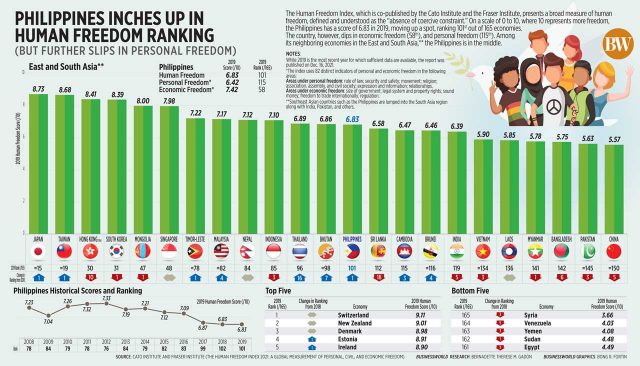
Philippines inches up in human freedom ranking

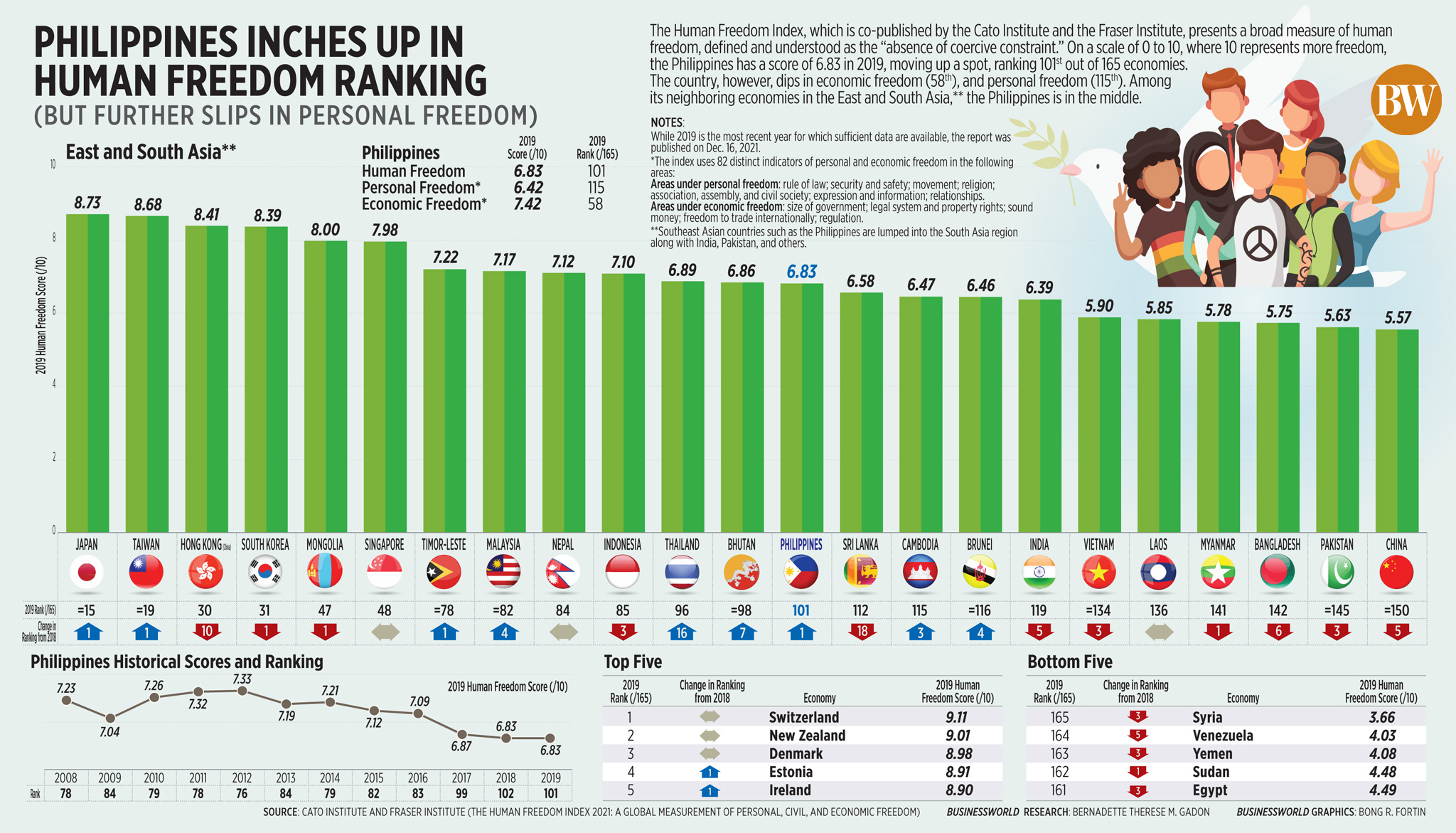
Philippines inches up in human freedom ranking

DoF blames pork for inflation blowout, backs more imports

PHILSTAR FILE PHOTO

THE Department of Finance (DoF) said meat prices pushed inflation beyond the government target range in 2021, and pressed for more pork imports and a drawdown of the pork inventory held in cold storage.

“The 16.8% meat price inflation last year accounted for 1.1 percentage points (of) the 4.4% overall inflation,” Finance Undersecretary Gil S. Beltran said in an economic bulletin on Thursday.

“Had meat price inflation been half as high, the upper level of the 2-4% inflation target range would not have been breached.”

Inflation in 2021 averaged 4.5%, against the 2.6% reading in 2020 and exceeding the central bank’s target band.

Mr. Beltran said meat price inflation in 2021 was the highest of any major food item since 2012.

The lingering effects of African Swine Fever (ASF) have drastically cut the hog population, pressuring pork prices higher, he said.

“The Department of Agriculture confirmed the outbreak of ASF in the country in the middle of 2019 but it was in 2021 that the country felt more fully the debilitating effects of the hog infection.”

Mr. Beltran said the Philippines will need to continue importing pork to meet demand and compensate for the supply shortfall.

Other interventions may include the regular release of pork held in cold storage and their continuous replenishment from local or imported supply, he said.

Finance Secretary Carlos G. Dominguez III supports the proposal by the National Economic and Development Authority to extend the validity of an executive order increasing import volumes until the end of 2022.

Executive Order No. 133 in May last year temporarily raised the pork import quota, known as the minimum access volume, to 254,210 metric tons from 54,210 to address increasing pork prices.

The hog and meat industry had opposed the proposed extension, asking the government to instead support local producers to improve supply. — Jenina P. Ibañez