Home Blog Page 6866

6-hour work day under a Ka Leody presidency

Labor leader and presidential hopeful Leodegario de Guzman (L) and the non-partisan Pandesal Forum’s moderator Wilson Lee Flores (R).

LABOR LEADER Leodegario de Guzman said on Friday that if he is elected president, he would reduce the maximum number of work hours in a day to six from the current eight hours. This, he said, will open opportunities for others to work.

“Despite the working hours being less, the worker’s wage and benefits will not decrease and will remain the same,” the labor activist said in Filipino during the Pandesal Forum.

This, he noted, will not be immediately implemented after he win, but it will be pushed once the economy recovers.

He said that for every two to three hours that will be taken from one worker, that time would be given to another worker. In this way, more jobs will be opened and created.

“What we are fighting for is ‘labor first’ not ‘labor only.’ The next-in-line beneficiary of substantial wage hikes and regularization will be the micro, small, and medium enterprises (MSMEs) sector because Filipinos will have more purchasing power to buy from local businesses” he said.

“The demand for their goods and services will correspondingly increase. To counter the tendency to increase prices with higher demand, the other pressing concerns of small businesses have to be addressed through government intervention, regulation, and control of power rates and fuel prices,” he added.

Another one of his plans to increase employment is to focus on exporting agricultural produce. To do so, he plans to double the current funds of the agricultural and fisheries sector which he calls “too small” despite its “feeding the whole nation.”

Mr. De Guzman also said that he seeks to develop the post-harvest system by increasing cold storage facilities to ensure that vegetables remain fresh. This will serve as a backup plan to control prices from sudden changes.

He also set out his plan to institute a People’s Sovereign Wealth Fund to finance local industrialization through investing in MSMEs where importation is highest. He plans to initially finance this with $50 billion (P2.57 trillion) from the Central Bank’s Gross International Reserves which has already reached $107.9 billion (P5.55 trillion) as of October 2021, due to a decade’s worth of overseas Filipino workers remittance inflow.

“Let us view the country’s Gross International Reserves as a fund for our workers. After all, it was pooled from the collective sweat and blood of OFWs. Utilize the fund to create opportunities for decent lives and decent jobs, which forces our fellow Filipinos to seek for them abroad,” Mr. De said.

“Let us invest in ‘working class enterprises,’ rather than use our dollar reserves to protect the foreign exchange rates and the interests of big importers,” he added.

Among the presidential aspirants’ other proposals are the imposition of a one-time 20% wealth tax on the country’s top 500 families to finance his P1 trillion Philippine economic recovery plan. This recovery plan shall focus on ₱475 billion for public jobs generation program, ₱400 billion for health stimulus and ₱125 billion to be provided as assistance for MSMEs. He also advocates progressive taxation — taxing the rich more and lessening regressive taxes on ordinary workers like the VAT. He also proposes to nationalize basic and strategic public utilities like water and power services.

MANDATORY MILITARY SERVICE

At the forum, the presidential aspirant also called out Davao City Mayor Sara Duterte-Carpio, who is running for vice-president, on her plan to push for mandatory military service for Filipinos 18 years and above.

“The country has a lot of problems that it needs to face,” he said. “Why is she focusing on obligating the youth to have military training?”

The labor activist noted that there are several other problems that need to be given priority instead of her suggested military training, noting concerns regarding health, the pandemic, unemployment, rising commercial prices, and contractual workers, among others.

“They should answer what the people need instead of inventing over and over again programs that the people are not asking for or are not perceived as a problem by the people,” Mr. De Guzman said.

His running mate, former party-list lawmaker Walden Flores Bello, had also called Ms. Duterte’s plan a revelation of her being a “dictator-in-waiting.”

“Like father, like daughter. Duterte’s legacy was to arm people and tell them to kill. Now his daughter wants to do it to the youth as well,” Mr. Bello said in a tweet.

In response, the Davao mayor said in a statement that “only the likes of Mr. Bello would think of mandatory military service for its citizens as arming them and telling them to kill — instead of looking at it as something that inspires patriotism in the youth.

“If only Mr. Bello did not stop at what he has been so stuck in over the past many years — dictatorship in the Philippines, something that we know is a lie in the present time — he would have a better understanding of what I truly stand for,” she added. — Alyssa Nicole O. Tan

PDP-Laban’s Cusi bloc adopts Sara Duterte as VP bet

DAVAO City Mayor Sara Duterte-Carpio

THE PARTIDO Demokratiko Pilipino-Lakas ng Bayan (PDP-Laban) bloc led by Energy Secretary Alfonso G. Cusi on Friday said they will adopt Davao City Mayor Sara Duterte-Carpio as their vice-presidential bet for the upcoming May elections.

PDP-Laban is finalizing the terms of its alliance agreement with Lakas-Christian Muslim Democrats (Lakas-CMD), which is currently chaired by Ms. Duterte.

“The decision to adopt Mayor Sara has been made by the PDP-Laban National Executive Committee based on her credentials, advocacies, and vision for our Nation,” the group said in a statement.

“Based on these, the PDP-Laban has decided that the quality of her advocacies and vision are strongly aligned with that of the party,” they added.

The group also commended her quality of leadership and track record which made her the “most qualified for the position.”

“The party believes that Mayor Sara’s election to the vice-presidency will help ensure the continuity of the vital programs of the current administration which now constitute the legacy to our Nation of PDP-Laban Chairman, President Rodrigo Duterte,” they said.

Lakas-CMD Co-Chairman and Senator Ramon Bautista “Bong” Revilla, Jr. welcomed PDP-Laban’s decision.

“The two most dominant political parties coming together is a very welcome development in ensuring a better and brighter future for the country and our fellowmen,” he said in a mix of English and Filipino in a statement released on Friday.

Meanwhile, the other PDP-Laban bloc – the political party currently has two separate groups which claim that they are the “true” party and leadership – released a statement on the adoption of Ms. Duterte as the party’s candidate for Vice-President.

“This announcement of the PDP Laban usurpers that they are adopting Mayor Sara Duterte’s Vice-Presidential candidacy shows their desperation to hold to power,” the statement, released by Lutgardo Barbo, said. “Mayor Duterte has rejected them many times and has even made pronouncements throwing insults to the party which used to be chaired by her father, President Duterte.”

The statement continues by saying, “As far as the real and genuine PDP-Laban is concerned, our Vice-presidential candidate is former Manila Mayor and now Congressman Lito Atienza and our Presidential candidate [is] Senator Manny Pacquiao. Matagal nang Pacquiao-Atienza ang PDP Laban sa simula pa lang (the PDP-Laban party has long been backing Pacquiao-Ateinza since the start) ) because we are a disciplined party with a clear vision and program of government.” — Alyssa Nicole O. Tan

Bayan Muna files resolution to probe IATF orders against the unvaccinated

PHILIPPINE STAR/ MICHAEL VARCAS

A party list group filed a House resolution on Thursday seeking to investigate whether orders given by the government task force that manages infectious diseases goes against human rights.

Bayan Muna filed House Resolution 2460 which calls on the House of Representatives’ Committee of Human Rights to look into the policies issued by the Inter-Agency Task Force for the Management of Emerging Infectious Diseases (IATF-EID) that limit the movement of unvaccinated individuals and prevent them from leaving their homes. The orders are part of the IATF-EID efforts to contain the surge of COVID-19 cases.

The resolution was introduced by Bayan Muna Representatives Ferdinand R. Gaite, Carlos Isagani T. Zarate, and Eufemia C. Cullamat, ACT Teachers Representative France L. Castro, Gabriela Women’s Party Representatives Arlene D. Brosas, and Kabataan Representatives Sarah Jane I. Elago.

In the resolution, the solons condemned several orders by the government agency targeting unvaccinated Filipinos, including ordering them to stay home except for when they need to buy essential goods, not allowing them to eat at restaurants, prohibiting them from using public transportation, and not allowing them to get a job.

They also noted in the resolution that President Rodrigo R. Duterte had directed officials to arrest unvaccinated people who disobey the IATF policies. They said that the government was using a “militaristic approach” in implementing health and safety protocols.

The lawmakers said that instead of using threats and police violence to enforce COVID-19 rules, the government should follow the advice of Coalition for People’s Right to Health (CRPH) spokesperson Joshua L. San Pedro, who said that rather than monitoring and restricting the unvaccinated, the government should address the reasons for their vaccine hesitancy and review the effectivity and reach of the Department of Health’s and other agencies’ vaccine information campaigns.

“While vaccinating the people could be important in the pandemic, Congress should take the side of the people against policies that curtail constitutional rights, [are] discriminatory and [are an] unnecessary burden [on] the workers and other poor people, especially in this time of pandemic and severe hardship,” the lawmakers said in their resolution. — Jaspearl Emerald G. Tan

Solon pushes for bill granting benefits to health workers

IMAGE COURTESY OF ST. LUKE’S MEDICAL CENTER.

A lawmaker has called on the House of Representatives to approve measures for the benefit of health workers who have been fighting against COVID-19.

Congressman Luis Raymund F. Villafuerte, representative of the 2nd District of Camarines Sur, is urging the chamber to okay a consolidated bill, of which he is a principal author, that seeks to grant medical frontliners additional benefits including insurance coverage, an increase in overtime pay, and a provision for a daily allowance.

“The Congress can go one step further by passing the bill institutionalizing this allowance and other benefits for our medical frontliners,” Mr. Villafuerte said in a statement released on Thursday.

The consolidated bill includes House Bill (HB) 10365, which Mr. Villafuerte authored, which would provide more benefits to both public and private health workers during the state of national calamity caused by the pandemic.

Meanwhile, HB 9670, another bill authored by Mr. Villafuerte, aims to amend the Magna Carta of Public Workers Health Workers by increasing the rates of their overtime pay and other incentives.

Under the bill, medical workers will receive a daily allowance of P300 and a P10,000 monthly allowance. Health workers who are required to wear uniforms will also be granted a higher monthly laundry allowance of P500 or more.

The bill states that the Health Secretary may increase the amounts of the allowances as they see fit.

The proposed measure, which is a combination of several bills that aim to address additional needs of health workers, is currently pending in the House at the committee level. — Jaspearl Emerald G. Tan

Ayala Corp, ALI forge property-for-share swap deal

Ayala Corp. (AC) and its top stockholder, Mermac, Inc., will transfer P17.5-billion worth of properties into Ayala Land, Inc. (ALI) in exchange for additional shares.  

The boards of AC and ALI, in separate meetings, approved the property-for-share swap deal on Jan. 20.  

In a disclosure on Friday, AC said the company and Mermac will transfer five assets to ALI in exchange for 311,580,000 primary common shares valued at P55.80 each. 

AC will subscribe to 309,597,711 primary common shares for assets valued at P17.27 billion. Mermac, on the other hand, will subscribe to 1,982,289 primary common shares for assets worth P110.61 million. 

The biggest asset is AC’s 50% ownership in Ayala Hotels, Inc. worth P13.2 billion.  AHI owns the Manila Peninsula property and is ALI’s partner in the Park Central Towers project. 

Other assets include a P1.72-billion property in Darong, Sta. Cruz, Davao del Sur, and office units and parking lots in Tower One, Makati City worth P1.39 billion.  

Also included are AC’s P993-million Honda Pasig property along C-5, and a P78 million property in Calauan, Laguna.  

ALI in a separate disclosure said the primary common shares to be issued to AC and Mermac will come from the unissued shares in the 1-Billion Common Shares Carve Out, which was approved by its shareholders in 2014. The shares are not subject to pre-emptive rights and do not require stockholders’ approval. 

“We are delighted about this transaction. We view ALI as the natural owner of these properties and is in the best position to optimize their value. In addition, this deal is consistent with Ayala’s initiative to increase its ownership of ALI, similar to the block purchases of ALI shares we have done over the past year,” said Fernando Zobel de Ayala, who is president and CEO of AC, as well as chairman of ALI. 

ALI President and CEO Bernard Vincent O. Dy said the properties will further expand the company’s landbank and commercial assets.  

“We are confident that the inclusion of these assets will further create value for our stakeholders,” he added. 

AC, ALI, and Mermac aim to complete the requirements within the year.  

Once the deal is approved, AC will increase its ownership in ALI to 47.2%, from the current 46.07%.  

On Friday, shares in ALI rose 1.61% to close at P34.65 each, while AC shares jumped 2.72% to end the session at P868 apiece. 

Co-founder Nolledo to infuse P100 million into Xurpas

Xurpas, Inc. co-founder and chairman Nico Jose S. Nolledo is infusing P100 million in fresh capital into the troubled listed firm.  

In a disclosure to the stock exchange, Xurpas said the company approved the issuance of common shares to Mr. Nolledo. 

The subscription price will be based on Xurpas shares’ 30-day weighted average price, and subject to a 5% premium and a floor price of P0.55 each share.  

“The fresh capital infusion amounting to P100 million will primarily be used for the expansion of Xurpas’ core enterprise business, specifically the IT staff augmentation business,” the company said. 

Xurpas said the funds will also be used for employee benefits, research and development, and equipment upgrade. 

“The past two years have been quite challenging, all the more so due to the ongoing pandemic. But there have also been opportunities for growth, as many companies try to accelerate their digital transformation and other IT initiatives. We have made meaningful progress in rebuilding our revenue base by focusing on staff augmentation,” Xurpas President Alexander D. Corpuz was quoted as saying. 

“Mr. Nolledo’s continued support through this infusion will go a long way towards allowing us to further grow the business, while strengthening our balance sheet,” Mr. Corpuz added. 

The agreement was signed on Jan. 20. Mr. Nolledo will pay the total subscription price within 30 days. 

On Friday, Xurpas shares surged 34.18% to close at P0.53 apiece. — Luisa Maria Jacinta C. Jocson 

Smart, Oppo team up for 5G standalone trial

Smart Telecommunications, Inc. on Friday said it partnered with smartphone brand Oppo to develop 5G Standalone (5G-SA) use cases in the Philippines.  

In a statement, Smart said it has been testing Oppo’s 5G smartphones’ compatibility with its commercial 5G-SA sites in Makati.  

“By maximizing its ultra-reliable and low latency capabilities, 5G-SA paves the way for new innovation and opportunities for enterprises and consumers alike,” PLDT and Smart Head of Technology Mario G. Tamayo said in a statement. 

5G-SA technology allows super-fast response times and quicker access to higher data rates required by cloud gaming or immersive media. Integrating such feature in Smart’s 5G network can lead to new consumer and business services beyond mobile phone screens.  

“Oppo is proud to partner with Smart in its pursuit of being at the forefront of the 5G evolution. We are committed to continuously provide Filipino consumers with reliable 5G enabled smartphones ranging from entry level to flagship offerings that will enable our consumers to move bigger and do more,” Ele Yu, Oppo Philippines marketing director, said. 

Smart has over 6,400 5G base stations across the country. 

Hastings Holdings, Inc., a unit of PLDT Beneficial Trust Fund subsidiary MediaQuest Holdings, Inc., has a majority stake in BusinessWorld through the Philippine Star Group, which it controls. — M.C.Lucenio  

Globe launches first Eco-SIM in Asia

The Eco-SIM cards are made from 100% recycled polystyrene that were recovered from discarded refrigerators. -- Courtesy of Globe Telecom, Inc.

Globe Telecom, Inc. on Friday launched the first Eco-SIM card in Asia for its postpaid mobile customers. 

The environment-friendly SIM cards are made from 100% recycled polystyrene that came from discarded refrigerator interiors. 

With its partner Thales, Globe has deployed Eco-SIM cards starting November 2021. Thales first developed the Eco-SIM card in 2020 in partnership with Veolia.  

“The Eco-SIM card is small, but it has a big impact on plastic and polymer waste and is another example of how we innovate to drive change. We are excited to partner with Globe on this pioneering initiative in the Philippines with a goal to roll it out throughout Asia,” Thales Digital Identity and Security Head of Mobile Connectivity Solutions for Asia Jon Cahilig said in the same statement.  

Around 4.5 billion SIM cards are manufactured every year. At 4 grams each, the total weight of these SIM cards reach an estimated 20,000 tons of plastic and other polymers. 

““In order for us to truly move the needle in the fight against climate change, we all must take on the responsibility to act sustainably. This partnership with the Thales Group not only enables us to come up with a solution for our telecommunications business, but it also gives our customers the opportunity to step up and choose to live more sustainably,” Globe Chief Sustainability Officer and Senior Vice President for Corporate Communications Maria Yolanda C. Crisanto said in a statement. 

Thales is also partnering with Globe to achieve its goals to reduce e-waste and its carbon footprint. 

Globe shares dropped 1.25% on Friday, closing at P3,318 apiece. — M.C.Lucenio 

Shell boosts sustainability initiatives

Pilipinas Shell’s new office in The Finance Center in Taguig earned the Green Building Silver rating by the Leadership in Energy and Environmental Design (LEED) under the Interior Design and Construction: Commercial Interiors Category. -- Company handout

Pilipinas Shell Petroleum Corp. on Friday said it will be adopting the recommendations from the Task Force on Climate-related Financial Disclosures (TCFD) to report climate-related risks and opportunities in its business activities.

“Pilipinas Shell is supporting the TCFD recommendations as part of its efforts to promote transparency in its sustainability efforts, as supported by the existing climate-related information that we provide via our annual and sustainability reports,” Shell President and Chief Executive Officer (CEO) Lorelie Q. Osial said in a statement.

“By adopting these recommendations, we communicate how financial risks and opportunities related to climate change are part of our risk management and strategic planning processes, leading to smarter, more efficient allocation of capital, and helping smooth the transition to a more sustainable, low-carbon economy,” she added.

Pilipinas Shell will be the first energy company in the Philippines to adopt the task force recommendations, as urged by the international Financial Sustainability Board (FSB).

Meanwhile, Pilipinas Shell said its head office in Taguig was given a silver rating under a green building rating system, the Leadership in Energy and Environmental Design (LEED).

Pilipinas Shell said its business operations in Manila are using 100% green-tech energy to produce electricity for its offices.

The company is also working on other sustainability initiatives, such as integrating solar panels and rain catchers to mobility sites and using eco-bricks from upcycled plastics for building walls.

“Pilipinas Shell remains committed to promote sustainability, providing cleaner energy solutions in a responsible way that balances short and long-term interests, and integrating economic, environmental and social considerations into decision-making,” Ms. Osial said.

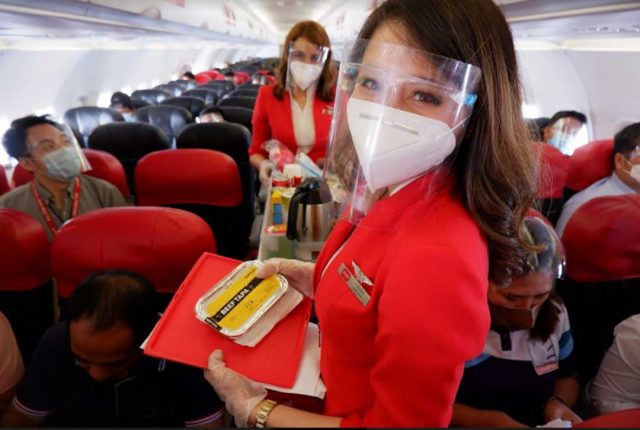
Half of travelers make add-on purchases during flights – AirAsia survey

Low-cost carrier Philippines AirAsia, Inc said that five out of ten Filipinos make add-on purchases while traveling on planes, citing a recent survey.

Additional baggage allowance and in-flight meals top the list of most purchased ancillary products, followed by travel insurance and seat assurance.

This will offer a “major additional revenue stream for air carriers this year as the industry gradually recovers from the pandemic,” Philippines AirAsia said in a media release.

Based on the survey, 46% of the participants said they would buy additional baggage allowance. Of which, 42% of respondents said they would bring baggage with a load of 20 to 25 kilograms (kgs) and 12% with a load of 30 to 40 kgs.

Meanwhile, 32% said they would purchase in-flight meals or snacks, with sandwiches and drinks as the most popular items.

“Even though flight bookings continue to be our major revenue channel, we at AirAsia also give priority to other offers such as ancillary, and we are glad that our array of products is warmly received by our guests. What’s great about being a global air travel brand is we get to bring the best practices and products from our international counterparts here in the Philippines,” said AirAsia Philippines Chief Executive Officer (CEO) Ricardo P. Isla. — Luisa Maria Jacinta C. Jocson

There’s a four-year wait list for Toyota Land Cruisers in Japan

REUTERS

Would-be buyers of Toyota Motor Corp.’s new Land Cruiser model in Japan may have to wait around four years before taking delivery, as the automaker struggles to keep up with demand for the iconic sports utility vehicle amid supply-chain disruptions.

Waiting times were already stretching out to two years after the vehicle was revamped in 2021 for the first time in 14 years. The company is seeking to give customers a more specific time frame, said Shiori Hashimoto, a spokeswoman for Toyota.

Global automakers are facing supply-chain disruptions, including a shortage of semiconductors, with the omicron variant now hitting suppliers and assembly lines in China, Japan and other parts of Asia. Even Toyota, long considered resilient to parts-related production issues, has been forced to idle operations at some plants. The carmaker said this week it was unlikely to reach its goal of making 9 million vehicles for the fiscal year ending March.

“Delivery time of four to five years is odd, and would normally prompt increased production, but currently without the parts, it can’t be helped,” said Bloomberg Intelligence analyst Tatsuo Yoshida.

The rugged Land Cruiser, already popular in the U.S. and Middle East for its off-road capabilities, is also benefiting from an outdoor camping boom in Japan amid the pandemic.

Car dealerships are asking buyers to sign pledges saying they aren’t purchasing the SUV for resale purposes, according to Hashimoto. Japanese used-car website Carsensor.net had previously shown the new Land Cruiser model being sold for around 15 million yen ($132,000), compared with the manufacturer’s suggested retail price of around 5 million to 8 million yen, including tax. — Bloomberg

Groups urge Senate to ratify PHL RCEP membership

THE Financial Executives Institute of the Philippines (FINEX), Makati Business Club (MBC), Management Association of the Philippines (MAP) and the Philippine Council for Foreign Relations (PCFR) urged the Senate to ratify the country’s membership in the Regional Comprehensive Economic Partnership (RCEP) in a joint statement on Friday. 

“Like any free trade agreement, RCEP provides wide economic opportunities for our country, along with certain threats to uncompetitive industries, and individual producers and their workers. And like in the other free trade agreements the country has joined (of which our country has the least, compared to Indonesia, Malaysia, Thailand and Vietnam), the overall economic gains in terms of net job creation, economic growth and price stabilization will well outweigh the costs,” the industry groups said. 

The RCEP currently has 15 members, consisting of ten ASEAN member economies along with Australia, New Zealand, China, Japan and South Korea. It is considered to be the largest trade bloc in the world, representing 30% of global gross domestic product. 

The trade agreement took effect on Jan. 1, although the Senate was unable to ratify the RCEP before 2021 ended. 

“RCEP will help MSMEs expand market access, especially with more liberal rules of origin on traded products to qualify for trade concessions. It will also provide broader and cheaper alternative sources for inputs and reduce costs of doing business through improved trade facilitation, especially customs and trade clearance procedures,” they said in the joint statement. 

They said exclusion from the RCEP would be “immensely costly to our economy and our people. 

“We can anticipate a significant decline in our exports to RCEP countries, which now account for nearly two-thirds (64%) of our total exports, as trade with us will logically be diverted to fellow members. It would also make us even more unattractive to job-creating investments than we already are, as these would best locate in RCEP member countries to take advantage of free access to its vast market,” they added. 

“For the same reason, our membership could attract more foreign investments into the country from firms wishing to produce and sell to the large RCEP market,” they said. 

The groups noted tariff elimination will take up to 20 years, giving enough time to enhance production and improve competitiveness. 

“RCEP skeptics should find comfort in the fact that little will immediately change in the country’s trade relations, since RCEP only reaffirms existing trade concessions we already have with all RCEP members via the ASEAN Trade in Goods Agreement (ATIGA) among ASEAN members and the ASEAN-Plus Free Trade Agreements with the rest,” they added. — L.M.J.C. Jocson