THE DEPARTMENT of Labor and Employment (DoLE) has generated more than half of its job generation goals under the National Employment Recovery Strategy (NERS).
“As of August 2021, we have already generated 780,111 jobs and most of these are under the construction sector, as reported by DPWH,” said Assistant Secretary Dominique R. Tutay during a Monday finance hearing.
“The other jobs generated are more on public administration services and IT-related, like small enterprises upgrading programs,” he added.
The NERS program seeks to generate 1 million jobs from the private sector and 200,000 jobs from the government sector.
He noted that the 780,111 jobs were from both the public and private sectors. The public administration increase was for government intervention, while the information technology was for the new entrepreneurs under startup businesses.
The committee asked for a report of the breakdown of jobs generated, as well as its status, whether contractual or regular.
The NERS program started its operations in May, in an effort to precipitate the recovery of the labor market by creating a policy environment that encourages generation of and improved access to employment, livelihood, and training opportunities; improvement of employability, wellness, and productivity of workers; and provision of support to existing and emerging businesses.
The strategy will be implemented until 2022 in response to the effects of the coronavirus disease 2019 (COVID-19) pandemic. — Alyssa Nicole O. Tan
DUTIES AND TAXES collected from marked fuel products have totaled P299.27 billion as of Oct. 7, counting back to the launch of the program in 2019, the Department of Finance (DoF) said.
The volume of fuel on which the taxes were collected was 30.54 billion liters over the period between Sept. 4, 2019 and Oct. 8, 2021.
The type of revenue generated includes P269.49 billion in Customs duties and P29.78 billion in tax since launch.
Around 73.22% of the marked-fuel volume was in Luzon, 21.32% in Mindanao, and 5.47% in the Visayas.
Diesel accounted for 60.98% and gasoline represented 38.49%, while the rest was from kerosene.
The program aims to deter fuel smuggling by injecting a special dye into the products to signify tax compliance. Absence of the dye is seen as evidence that the fuel was smuggled.
The government in September last year began collecting a fuel marking fee of P0.06884 per liter, inclusive of value-added tax on all manufactured, refined or imported petroleum products.
Revenue foregone due to fuel smuggling was between P20 billion and P40 billion a year, the DoF said. — Jenina P. Ibañez
THE ASIAN Development Bank (ADB) said it has funded $31.5 billion worth of climate mitigation projects since 2011, accounting for 78% of its climate-related financing.
“Mitigation finance is dominated by the energy sector (60%), although there has been a recent significant upward trend in the transport sector,” the bank’s Independent Evaluation Board said in a review posted on its website Monday.
Funding for adaptation projects, on the other hand, hit $8.7 billion 22%.
The bank’s evaluation covered 688 projects approved between 2011 and 2020.
Mitigation and adaptation projects accounted for 12% of the amount the ADB lent to its members over the period, which totaled $348.8 billion.
“(Our) climate investments have resulted in mitigation efforts with demonstrable reductions in greenhouse gas emissions and associated co-benefits. Results were more limited for adaptation and related financial targets have not been met,” ADB said in a separate statement.
The bank was able to meet its annual mitigation finance targets in 2017, 2019 and 2020. But it has yet to hit its $2 billion yearly adaptation finance target, which hit a high of $1.5 billion in 2019.
“Going forward given the current depth of the climate change crisis, a sense of urgency and commitment is demanded. ADB’s corporate ambitions should rise,” ADB Director General for Independent Evaluation Marvin Taylor-Dormond said.
The ADB’s evaluation team also noted that the bank has yet to play a “strong leadership” role on climate action efforts in Asia and the Pacific, noting that some key strategic and operational gaps remain.
In May, the ADB’s former Chief of the Energy Sector Group Yongping Zhai said the bank is looking to provide $80 billion worth of climate financing by 2030 in a bid to help its members access clean and reliable power. — Angelica Y. Yang
THE PRACTICE of closing fishing grounds to allow fisheries to recover has had a disproportionate impact on small fishermen by depriving them of livelihoods while driving up consumer food costs, according to a fishermen’s organization, the Pambansang Lakas ng Kilusang Mamamalakaya ng Pilipinas (PAMALAKAYA).
PAMALAKAYA National Chairman Fernando L. Hicap said in a statement Monday that closed fishing seasons are “unjust, undemocratic, and harmful to the industry.”
“The closed fishing season affects both the fisherfolk and the Filipino consumers because it simultaneously leads to shortages and inflation,” Mr. Hicap said.
“Small fishers who are directly affected by fishing bans are never consulted on this policy that adversely affects their living,” he said.
The Department of Agriculture has authorized the issuance of certificates of necessity to import covering 60,000 metric tons (MT) of fish to augment supply in preparation for the closed fishing season.
Fish species to be imported include small pelagic species such as round scad (galunggong), mackerel, and bonito.
Fish imports for sale in wet markets are governed by guidelines set by Fisheries Administrative Order No. 259.
Mr. Hicap said allowing imported fish does not solve the issue of unstable fish supply and prices.
“The government should refrain from placing our productive and major fishing grounds under closed season, which leads to shortages, and subsequently allow the entry of imported fish in our markets,” Mr. Hicap said.
“Imports harm the livelihood of fisherfolk because farmgate prices of galunggong and other fishery products are being pulled down with the entry of imported fish,” he added.
In a virtual briefing Monday, Agriculture Secretary William D. Dar said nearly 20,000 MT worth of fish imports have signed import clearances.
“Depending on the transport and logistics, some (fish imports) can arrive in two to three weeks, while the rest… MT is to arrive over the last quarter of the year,” Mr. Dar said.
Bureau of Fisheries and Aquatic Resources National Director Eduardo B. Gongona said on television Monday that fish imports will not kill the domestic industry as the volumes have been carefully calibrated to address actual demand.
Mr. Gongona said fish imports will come from Vietnam or China. — Revin Mikhael D. Ochave
THE Department of Agriculture (DA) rejected claims that farmgate prices of palay, or unmilled rice, have fallen as low as P10 per kilogram (/kg), saying that actual prices are significantly higher.
Agriculture Secretary William D. Dar said in a virtual briefing Monday that the national average farmgate price of fresh palay is P14.30/kg while the average farmgate price for dry palay is P17.81/kg.
“Under the present circumstance, the prices are okay,” Mr. Dar said.
Some farmers have claimed that they are unable to recover their costs at prices on offer.
Mr. Dar confirmed that there is a place where the average farmgate price is P10/kg, but called it a limited area.
“The price of P10/kg is very extreme. It is only recorded in a small area. If people are saying that farmers are losing income, I don’t think that is what we are receiving from the field. We have the data to show it,” Mr. Dar said.
Mr. Dar said there is “no significant increase” in the prices of rice in wet markets.
Based on the DA’s price monitoring report on Monday, the prices of imported and domestic well-milled rice in selected Metro Manila wet markets were flat at P43/kg and P40/kg, respectively.
Farmers’ group Samahang Industriya ng Agrikultura has claimed that palay farmgate prices range from P10/kg to P13/kg, which is below the P15/kg estimated production cost.
Mr. Dar said also that African Swine Fever (ASF) is present in five regions, eleven provinces, 31 municipalities, and 71 barangays. He did not identify the areas with ongoing ASF cases.
“Compared to previous quarters and years, the cases have significantly dropped,” Mr. Dar said.
Mr. Dar said new ASF cases continue to be detected in the sale of infected pork.
“We are alarmed because as long as the virus is still there, we continue to work with local government units, hog raisers, and traders so they do not sell the infected meat,” Mr. Dar said.
ASF was first detected in the Philippines in 2019. The disease has depleted the hog inventory, causing pork prices to rise. — Revin Mikhael D. Ochave
The pandemic supercharged the growth of the digital economy; the implementation of community quarantines forced us to stay at home and encouraged the use of online platforms to obtain our basic needs. Many continue to heavily rely on the internet and digital services for education, work, and entertainment. There’s no denying that online transactions quickly became part of our new normal. And while these offer advantages to us as consumers, it allows foreign online retailers to penetrate the Philippine market without having to invest or employ Filipinos. Thus, to ensure fair competition between traditional and digital businesses, and further generate funding for the pandemic recover effort, legislators were swift to propose a tax on these digital businesses.
After a year, House Bill 7425, imposing a 12% value-added tax (VAT) on digital transactions, has now been approved on third and final reading. The bill amends Section 105 of the National Internal Revenue Code (NIRC) to impose VAT on goods and property, including those digital or electronic in nature and services including those rendered electronically. This bill will be transmitted to the Senate for further deliberation and approval.
The bill expands the coverage of persons liable to VAT under Section 105 A to include non-resident digital service providers. A digital service provider (DSP), as described under the House Bill, is a 1) third-party seller of goods and services who, through information-based technology or the internet, sells multiple products for its own account, or who acts as an intermediary between a supplier and buyer of goods and services collecting or receiving payment from a buyer on behalf of the supplier and receives a commission thereon, 2) platform provider for promotion using the internet to deliver marketing messages, 3) host of online auctions through the internet, 4) supplier of digital services for a regular subscription fee, and 5) supplier of electronic and online services delivered through an information technology (IT) infrastructure, such as the internet. These non-resident DSPs will be required to register for VAT if their gross sales or receipts for the past year exceed P3 million.
The bill also defines a digital service as “any service delivered or subscribed over the internet or other electronic network (that) can’t be obtained without the use of IT.” Digital services include online licensing of software, updates and add-ons; website filters and firewalls; mobile applications, video games, and online games; webcast and webinars; and the provision of digital content such as music, files, images, text, and information. In addition, online advertising space; electronic marketplaces; search engine services; social networks; internet-based telecommunication, database and hosting; and online training, publication subscriptions, and even payment processing services are also on the list.
The bill would exempt from VAT books and other printed material that are sold electronically or online. However, payments to nonresidents for digital services rendered in the Philippines are subject to 12% withholding tax at the time of payment.
The small-time online sellers with gross receipts or sales of not more than P3 million would still be exempted from VAT; thus, the cost of VAT will not be passed on to the buyers. But the online buyers from big digital businesses with sales or receipts of more than P3 million will have to shoulder the passed-on VAT from the purchased digital services and subscriptions. We can just hope that the bill can be further refined through its implementing rules and regulations, especially on the exemptions, monitoring, compliance, and penalties to be imposed to properly realize the objectives of the bill.
The bill will still take a few months to become law, so for now, you might as well add to cart the best “tita-finds” and binge-watch all trending shows before accepting the reality that tax is now keeping up with the digital economy.
Let’s Talk Tax is a weekly newspaper column of P&A Grant Thornton that aims to keep the public informed of various developments in taxation. This article is not intended to be a substitute for competent professional advice.
Kristel Hope Avenido is a senior-in-charge of the Tax Advisory & Compliance division at the Davao office of P&A Grant Thornton, the Philippine member firm of Grant Thornton International Ltd.
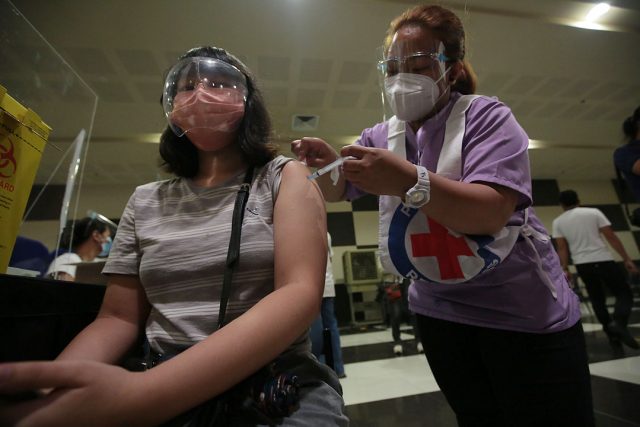
A RESIDENT of Novaliches gets inoculated with a second dose of Coronavac. — PHILIPPINE STAR/ MICHAEL VARCAS
PHILIPPINE health authorities on Monday reported 411 more cases of the highly contagious Delta coronavirus variant, bringing the total to 3,798.
New Delta infections accounted for 55% of 747 samples tested up until last month, Health Undersecretary Maria Rosario S. Vergeire told an online news briefing.
She also said 88 more people had been infected with the Alpha coronavirus variant first detected in the United Kingdom, bringing the total to 2,935.
The country now has 3,307 cases of the Beta variant after 78 more Filipinos got infected with the strain first detected in South Africa.
The Department of Health (DoH) reported 8,292 coronavirus infections on Monday, bringing the total to 2.67 million.
The death toll rose to 39,660 after 36 more patients died, while recoveries increased by 302 to 2.54 million, it said in a bulletin.
There were 98,894 active cases, 74.4% of which were mild, 15.0% did not show symptoms, 3.2% were severe, 6.14% were moderate and 1.3% were critical.
The agency said 40 duplicates had been removed from the tally, 32 of which were reclassified as recoveries, while 21 recoveries were reclassified as deaths. Two laboratories failed to submit data on Oct. 9.
Ms. Vergeire said coronavirus infections in Metro Manila might further fall by the end of the month if the region remains under Alert Level 4.
Daily cases in the capital region could decrease to 1,731 if the second-highest alert level with a four-day detection-to-isolation time is enforced until Oct. 31, she said.
The daily tally could hit 3,605 under alert Level 3 with a similar detection-to-isolation period, Ms. Vergeire said.
Daily cases would be higher at 2,195 under Alert Level 4 if the detection-to-isolation period is six days, and as many as 4,557 under Alert Level 3, she added.
“This further supports our call to focus on reducing the time between detection and isolation and to not only rely on measures that restrict mobility,” Ms. Vergeire said.
While the coronavirus situation in Metro Manila has improved, the Cordillera Administrative Region, Cagayan Valley and Zamboanga Peninsula remained at high risk classification, with health care capacities at high to critical risk.
“While we see improvement in our case trends, this is not the time to be complacent,” she said.
Last week, Ms. Vergeire said there had been fewer swab tests for the coronavirus in 14 regions including Metro Manila.
The biggest decline in RT-PCR tests was in the capital region, where the positivity rate fell to 16.4% in the past week from 19.3% a week earlier, she said.
Swab tests in the metro fell by 37,383 or 14.1% to 266,042, leading to fewer people who tested positive for the virus, she added.
Manila, the Philippine capital and nearby cities might become at low risk from the coronavirus by the end of October amid decreasing infections, the OCTA Research Group said on Sunday.
Virus cases in the capital region have peaked at a seven-day average of 2,000, Octa fellow Fredegusto P. David told ABS-CBN’s Teleradyo.
Hospital occupancy in Metro Manila was also expected to decline, he said, adding that the national daily average could fall to less than 10,000 in the coming weeks from 11,000 now.
The capital region now had a COVID-19 reproduction number of 0.6, or the number of people infected by a single virus patient, while the positivity rate was 13%, Mr. David said.
He traced declining infections to herd immunity. At least half of the capital region’s adult population has been fully vaccinated against the coronavirus.
The Philippines last week recorded daily virus cases of fewer than 10,000 for two straight days.
The Health department earlier cited a downtrend in virus cases in Metro Manila, even as cases increased in the Bicol, Mimaropa and Zamboanga Peninsula regions. — Kyle Aristophere T. Atienza
THE PRESIDENTIAL palace on Monday said Philippine press freedom is not under attack, even as it commended a journalist critical of President Rodrigo R. Duterte for winning the Nobel Peace Prize.
“Philippine press is alive and well not because of Maria Ressa,” presidential spokesman Herminio L. Roque, Jr. told an online news briefing.
The Norwegian Nobel Committee last week awarded the prize to Ms. Ressa, who founded news website Rappler, along with Russian journalist Dmitry Muratov “for their efforts to safeguard freedom of expression, which is a precondition of democracy and lasting peace.”
Mr. Roque said the award was not a “slap on the government.” “There is no slap there because as everyone knows, no one has ever been censored in the Philippines.”
Mr. Duterte has called Rappler a “fake news outlet.” Ms. Ressa is facing cyber-libel and tax evasion cases that she said were politically motivated.
Rappler has published reports critical of Mr. Duterte’s policies, including his deadly drug war that has killed thousands.
Aside from banning Rappler from covering presidential events, Mr. Duterte has been attacking media critical of his administration. His allies in Congress last year rejected the franchise application of ABS-CBN Corp., which aired news stories about his alleged secret bank accounts.
Mr. Roque insists Mr. Duterte did not have anything to do with the rejection of ABS-CBN’s franchise.
The Philippines this year slipped two notches in the World Press Freedom Index by Reporters Without Borders, ranking 138th among 180 countries. It was the fourth consecutive year that the country fell in the Paris-based organization’s ranking. — Kyle Aristophere T. Atienza
THE RULING party’s presidential bet on Monday said he was picked two hours before the filing deadline last week.
Senator Ronald M. de la Rosa said he was the second choice for president after Senator Christopher Lawrence T. Go, who later filed his certificate of candidacy for vice-president.
The lawmaker said he would continue President Rodrigo R. Duterte’s war on drugs if he wins the race. He was the tough-talking leader’s former police chief who enforced the anti-illegal drug campaign.
“Of course, that will continue” he said. “We will listen to the suggestions, recommendations on how to make it work well,” he added in Filipino.
At the weekend, Mr. Dela Rosa said he would give way to Davao City Mayor and presidential daughter Sara Duterte-Carpio if she runs for president.
“He is the one who is available,” Melvin Matibag, secretary general of the PDP-Laban faction supported by Mr. Duterte, told the ABS-CBN News Channel. “We’re not saying he is the best because originally we were pushing for Senator Bong Go.”
Under the law, Ms. Carpio may be substituted for Mr. de la Rosa as long as she becomes a member of the party. The substitute period is allowed until mid-November.
“The period for the filing of candidacy has ended, but there are more sinister plots that may definitely play out in the coming days and months,” human rights group Karapatan said in a statement.
Karapatan added that Mr. de la Rosa would not only continue Mr. Duterte’s drug war but also try to shield himself and others from accountability.
The International Criminal Court (ICC) has ordered an investigation of Mr. Duterte’s crackdown on illegal drugs, as it found “reasonable basis” that crimes against humanity might have been committed.
The court will also probe vigilante-style killings in Davao City when Mr. Duterte was still its vice mayor and mayor.
There were 1,424 vigilante-style killings in Davao City from 1998 to Dec. 2015, including 162 when Mr. de la Rosa was its police chief from 2012 to 2013, according to local watchdog Coalition Against Summary Execution. — Kyle Aristophere T. Atienza
A SENATOR has filed a resolution seeking an investigation of smuggled carrots from China.
The smuggling threatens the income and livelihood of local farmers, particularly those in Benguet province, Senator Leila M. de Lima said in Senate Resolution 924.
In a statement, she also cited the need to make local farmers more efficient in production. “It is also necessary to strengthen trade laws and agreements, protect local producers and consumers and stabilize the price of agricultural products in the local market.”
A large volume of smuggled carrots continues to flood local markets every time prices in Benguet rose, Ms. De Lima said, citing a local cooperative. The price of smuggled carrots from China was P25 a kilo compared with the P50 wholesale price in Benguet, she added.
“Such illegal practice hampers not just the livelihoods of the workers in the food and agricultural sectors, but of every Filipino in the long-run,” she said. “It cripples our efforts towards self-sufficiency in local food supplies.” — Alyssa Nicole O. Tan
FORMER HEALTH secretaries have joined the call of more than 40 medical groups urging President Rodrigo R. Duterte to allow his Cabinet members to participate in the ongoing Senate investigation into the government’s questionable deals on pandemic supplies.
In a petition led by the Philippine College of Physicians (PCP), medical groups called on Mr. Duterte to “not obstruct testimony of material witnesses to any investigation” of alleged anomalies in the Department of Health’s procurement of overpriced medical goods.
“We call on all government officials to support the call for truth, ensure that the wheels of justice grind swiftly and surely, and provide testimony when sought,” they said in the letter addressed to the government.
In a virtual news briefing, former Department of Health secretary Esperanza I. Cabral said that she and three other former health chiefs have signed the petition.
A separate letter released by the PCP after the briefing — which supported the Senate’s investigation of alleged corrupt state activities — was signed by Paulyn Ubial, Mr. Duterte’s first Health secretary, and former Health chiefs Carmencita Reodica, Manuel M. Dayrit, and Enrique T. Ona.
Ex-health undersecretaries Suzy Pineda, Juan Pablo Nañagas, and Madeleine de Rosas-Valera were also signatories to the strongly-worded statement.
Last week, Mr. Duterte signed a memorandum directing Health Secretary Francisco T. Duque III and other members of the Cabinet to ignore summons of the Senate Blue Ribbon Committee, which is chaired by Richard J. Gordon.
He said that the Senate panel’s investigation hampers the government’s pandemic response since officials will have to participate in hearings that usually last for hours.
The tough-talking leader warned senators that he will send them to jail if they cite Cabinet members in contempt.
“We demand transparency, exigency, and accountability,” PCP President Maricar Limpin said in Filipino.
The medical groups also urged the Department of Justice to conduct an “immediate impartial and thorough” investigation. They also called on the Office of the Ombudsman to file appropriate charges to those responsible.
Meanwhile, the Office of the Solicitor General asserted that Mr. Duterte’s directive is valid.
In a statement sent to reporters Sunday night, it said the hearings “are not in aid of legislation” as there is no “clear and specific piece of legislation that the investigation seeks to aid.”
The SolGen’s office said further that the alleged irregularities in question already have existing penalties in the law, but that prosecution and conviction for such “are within the domain of the Executive and Judiciary, not province of the Senate” as stated in the Philippine Constitution. — Kyle Aristophere T. Atienza and Bianca Angelica D. Añago
A LAWMAKER from the progressive Makabayan bloc is proposing that the national government buy back Petron Corp. to help control the continuous hike in oil prices, which has been prompted by increasing global crude oil prices.
“Petron Corporation which used to be state-owned and controlled, is currently the largest and the only publicly listed oil refining and marketing company in the Philippines and it would have a significant effect in mitigating oil price hikes,” said Bayan Muna Rep. Carlos Isagani T. Zarate in a statement.
Mr. Zarate pushed for congressional consideration and approval of House Bill 244 or the proposed Petron Renationalization Act.
Under the bill, the Philippine National Oil Company (PNOC) should acquire a majority stake or 51% of subscribed stocks of Petron upon the first year of its effectivity, if signed into law.
The PNOC should reacquire 100% full ownership of the company within a period of four years. This will mean that Petron would have to delist from the stock exchange once the government takes full stake of the company.
Reacquisition funds will be sourced from annual budget appropriations. Secondary funding can also come from the earnings of the PNOC from its increasing stake of Petron during its reacquisition.
In the first year of the law’s effectivity, P4 billion would be appropriated for the initial repurchase of Petron stocks by the government.
Following the proposed takeover, Petron should adopt a pricing policy to keep its crude oil and petroleum products sold to consumers as “socially and economically viable as possible” and to raise and promote the local capacity for exploration and development of petroleum, among others.
Petron was initially privatized in 1994 through a deal with PNOC and the Saudi Arabian Oil Company through a stock purchase agreement which gave a 40% stake of the company to the oil producer.
The industry was deregulated through Republic Act 8479 or the Downstream Oil Industry Deregulation Act of 1998 in a bid to stabilize and provide reasonable oil prices and encourage competition and investment in firms, among others.
Local fuel prices will increase on Tuesday for the seventh consecutive week.
Domestic diesel prices had a total increase of P15.00 per liter year-to-date while gasoline also hiked by P16.55 per liter, according to data from the Department of Energy.
BusinessWorld has reached out to Petron for comment on the proposal but has yet to receive a response as of posting time.
Shares in Petron went up by 4.72% or 16 centavos to finish at P3.55 per share on Monday. — Russell Louis C. Ku