Home Blog Page 6834

The digital rupee needs more thought, less haste

STARLINE-FREEPIK

INDIA has surprised the payments world by announcing that its central bank will issue a digital currency as early as the coming financial year, a crucial decision that most other major economies are refusing to make in a hurry. According to Finance Minister Nirmala Sitharaman, an electronic representation of India’s legal tender will give a big boost to its digital economy. How valid is that claim, and how risky is a hasty transition to a central bank digital currency, or CBDC?

A digital rupee will be like banknotes, but minus the ATMs. Users will be able to transfer purchasing power from their deposit accounts into their smartphone wallets in the form of online tokens, which will be a direct liability of the Reserve Bank of India — just like cash.

Retail access to the central bank’s IOUs may not be a big deal in countries with well-capitalized financial systems. But this is a major benefit in India. As researcher Bhargavi Zaveri observes in the blog IndiaCorpLaw, depositors at 21 Indian lenders have been restricted from withdrawing their funds due to bank distress in the last few years. “A CBDC, which is a liability of the RBI, will mitigate the risk of losses that Indian depositors face when dealing with commercial banks,” she says.

Consumers may find the digital rupee to be a safer alternative to bank deposits, which underpin 76 trillion rupees ($1 trillion) in annual real-time payments via apps such as Walmart, Inc.’s PhonePe, Alphabet, Inc.’s Google Pay, and the homegrown Paytm.

But therein lies the risk as well. If electronic cash becomes popular, and the RBI places no limit on the amount that can be stored in mobile wallets, weaker banks may struggle to retain sticky, low-cost deposits. And even as they lose that cushion, lenders may be reluctant to shed their loan assets and sacrifice profits. Their less-liquid balance sheets could leave them vulnerable to bank runs.

All economies are mindful of this threat to financial stability. Yet, advanced nations also worry about the dwindling use of banknotes, especially after the pandemic. As more purchases go online, the basis of trust in demand deposits — that they convert to cash at face value — might get reduced to a theoretical construct. A digital currency as a public utility could keep the notion of convertibility grounded in daily reality.

In India, though, there’s no such urgency because cash is far from dying. Banknotes account for about 15% of money supply, compared with 1% in Sweden. Yet, the Riksbank is in no hurry to embrace CBDCs. After five years of weighing different architectures and running pilots, the Swedish monetary authority is still to take a final decision on whether to issue an e-krona.

The US Federal Reserve is seeking the public’s views on whether to provide an official tender to compete against private stablecoins riding on the dollar as the world’s most popular unit of account. The digital euro is in a 24-month investigation phase. If all goes well, the European Central Bank may offer it by 2025. Japan may delay a call to 2026. After judging the risks and rewards, Singapore has taken a pass on CBDCs for now.

India’s rushed deadline seems to be at least partly a response to the growing popularity of cryptocurrencies, though it’s hard to see how an unremunerated means of payment can wean the public off the get-rich-quick lure of a speculative asset class.

The other reason for hurry may be a desire to head off China, which is showcasing the digital yuan at the Beijing Winter Olympics. By early November some 140 million individuals had signed up for the e-CNY. But even in the People’s Republic, there is no national rollout date, and Alipay and WeChat Pay retain their stranglehold on electronic payments. Besides, Beijing’s intention to promote a rival to the dollar in cross-border trade and finance — which is presumably what worries New Delhi — will only become clear after the digital yuan makes its appearance in Hong Kong, perhaps via the wealth connect plan for the so-called Greater Bay Area.

Any role for a digital rupee in India’s fast-growing online economy is fuzzy. Unlike perfectly anonymous cash, most CBDCs will be designed so central banks will have the power to trace spending to check money-laundering. However, transactions conducted with them may not be visible to payment apps. The fintech industry may lose access to some of the data that it is currently mining with artificial intelligence to make cheap loans available to those who do not possess collateral or business and tax registrations, such as mom-and-pop stores.

There will also be gains, though they won’t be immediate. Once international corridors are in place for exchanging one CBDC into another, there won’t be any need for an expensive network of correspondent banks to settle cross-border payments. For Indians working abroad, sending money home will become simpler and cheaper, leading to substantial savings for the world’s No. 1 recipient of foreign remittances. However, some of those benefits are possible even without a digital rupee, via a global network of bank-based online payment systems. One such proposal is Bank for International Settlements’ Nexus project.

A digital rupee may well be a boon. For one thing, it may not be a bad idea for the monetary authority to use technology to put bank managements on notice: They need to stop taking depositors for granted. Still, that lesson is probably best administered after lenders have put the pandemic-related stress on their balance sheets behind them.

Besides, the RBI needs to do its homework. The technology, blockchain or otherwise, will need to balance the often-conflicting goals of speed, scalability, auditability, security, and privacy, something the Fed is attempting to do as part of its Project Hamilton initiative. Given India’s still-vast digital divide, a protocol for offline use has to be worked out. Rushing the implementation of what should ideally be a multiyear project may be fraught with unnecessary risks.

BLOOMBERG OPINION
Net-zero plans of global companies do not add up to net zero — report

REUTERS

WHAT do Unilever Plc, Alphabet Inc.’s Google and Amazon.com, Inc. have in common? Their net-zero promises do not add up to net zero, a new report says.

It’s not just these three companies, either. The report, published by the New Climate Institute and Carbon Market Watch, finds that 25 of the world’s most valuable companies, which together accrued $3.2 trillion in revenues in 2020 and accounted for 5% of global greenhouse-gas emissions in 2019, have climate plans that are weaker than how they’ve been marketed so far.

The report says that nearly half of the 25 businesses, including Nestle SA and JBS SA, don’t have specific commitments to reduce emissions by their target net-zero year. The remaining 13 plan to cut emissions across the value chain by 40% on average, rather than fully axe them as their pledges suggest. A.P. Moller-Maersk A/S, Vodafone Group Plc and Deutsche Telekom AG are the only ones on track to near-complete decarbonization, the authors find.

“Ambitious-sounding headline claims all too often lack real substance, which can mislead both consumers and the regulators,” said the New Climate Institute’s Thomas Day, a lead author of the study, in a statement. “We were quite shocked about the extent of creativity that some companies apply to claim a credible path to net zero, and the amount of effort that it takes to reveal that.”

It can be easy for companies to hide half-hearted efforts behind net-zero pledges because third-party analysts don’t know where to look. There’s no blueprint for how companies should disclose their climate ambitions and action plans. That makes it hard for outside eyes to grasp the true extent of corporate commitments.

Carrefour SA doesn’t count the emissions from its branded shops or upstream and downstream emissions, the report says, which make up almost all of its carbon footprint. Nestle and Unilever don’t offset their own emissions but they back individual consumer brands in their portfolio to do so. And JBS states its facilities will be powered exclusively by renewable energy by 2040, but the report says it doesn’t give information about its current and planned renewable energy supply.

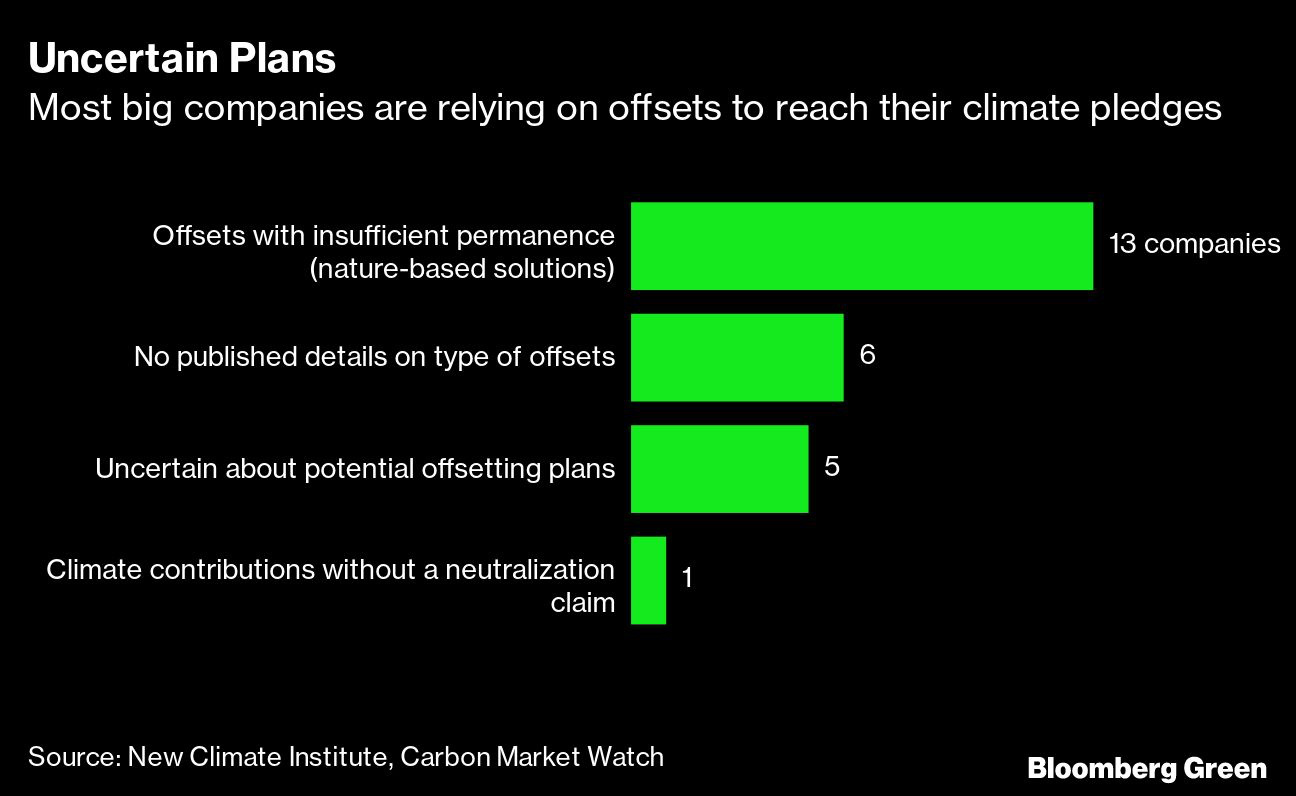
The researchers find that the companies’ plans to offset their emissions are  particularly misleading. Two thirds of the businesses are banking on CO₂ reductions from forests and other nature-based solutions to erase their effect of their future emissions. If those forests are destroyed, the logic behind their plans would also fall.

In statements emailed to Bloomberg, Amazon, Google, JBS, Nestle, Unilever and Carrefour stood by their climate plans.

Google said it clearly defines the scope of its climate commitments, acknowledging that “100% renewable energy match and high-quality offsetting is only a step” toward its net-zero goal. JBS called the report’s methodology “misleading” and said that it had “established important milestones” to net zero. Unilever welcomed “external analysis of our progress” and said it had begun working on ways to evolve its approach, while Carrefour said it is “engaged across the full scope of its indirect emissions” and had been “working for a long time to make progress” on cuts.

UNCERTAIN PLANS
Among the companies to earn good marks was Maersk, which is investing in nature-based solutions to remove around 5 million metric tons of CO₂ every year until 2030, without claiming that this will neutralize its emissions. Likewise, Apple, Inc. already sources almost all of its energy from long-term agreements with renewable developers and its own installations, and it also backs the creation of energy storage systems.

Most of the 25 companies are working with the Science-Based Targets initiative, an arbiter of corporate climate plans. “Unfortunately, we find that these standard setting initiatives can end up lending some companies more credibility than they deserve,” Day said. “In the worst case, this can legitimize business-as-usual.” (Bloomberg LP, owner of Bloomberg News, is also working with SBTi. Bloomberg Philanthropies is an SBTi funder.) 

While many companies said that they had their plans approved by SBTi, Managing Director Alberto Carrillo Pineda said that only one company — CVS Health Corp. — has had its net-zero plan validated by the initiative. The confusion arises because SBTi has approved different plans over the years. Unilever’s climate plan has an SBTi stamp for near-term targets (typically until 2030) aligned with keeping warming below 1.5° Celsius, but it is yet to get approval for its full net-zero plan. Carrefour’s plan is SBTi approved for keeping warming below 2°C, which is a much less ambitious goal. JBS has committed to a net-zero target, but its climate plan has yet to receive any approval from SBTi.

“Scrutiny helps us to create stronger methods for assessing and validating corporate climate targets,” Pineda said. “The report also exposes important gaps in the level of transparency and integrity of corporate net-zero targets.” — Bloomberg

Vegetable shortage adds to Hong Kong’s COVID woes

REUTERS

HONG KONG  — Supplies of vegetables were running low in Hong Kong on Tuesday, with shoppers scrambling to buy whatever they could find, as the government blamed a resurgence of COVID-19 for a drop in deliveries of fresh produce from the mainland.

Leader Carrie Lam was due to announce further COVID restrictions later in the day after the city reported a record of more than 600 new cases on Monday. Broadcaster TVB said there were at least 380 confirmed infections on Tuesday with 400 preliminary positive tests.

Addressing a weekly news briefing, Ms. Lam said vegetable deliveries from across the border were down as a result of truck drivers testing positive for the virus, but she did not offer any specific solutions to solve the shortage.

Shelves stocking vegetables were bare across many supermarkets in the city while crowds surged into fresh markets to snap up the limited produce available. Other food remained available.

At a market in the city’s downtown Wan Chai market on Tuesday morning, a staff member from Qiandama vegetable store, shouted to crowds not to enter.

“No more veggies inside…It’s like the battlefield,” she said as people tried to charge in.

Some vegetable and fruit stalls selling mainland Chinese produce were shuttered while others were selling produce at double their usual prices.

For now, Ms. Lam said, the best option was to adhere to the “dynamic zero” strategy employed by mainland China to suppress all coronavirus outbreaks as soon as possible.

The official Chinese Communist Party newspaper, the People’s Daily, had encouraged Hong Kong to follow China’s approach to containing the virus in an editorial on Monday.

“We should contain the spread of the virus as much and as fast as possible,” Lam said.

ISOLATED
Hong Kong’s stringent coronavirus policies have turned the once top global travel and business hub into one of the world’s most isolated major cities.

The economic and psychological toll from the hardline approach are rapidly rising, with measures becoming more draconian than those first implemented at the start of the pandemic in 2020.

Flights are down around 90%, schools, playgrounds, gyms as well as most other venues are shut. Restaurants close at 6 p.m. (1000 GMT), while most people, including the majority of civil servants, are working from home. Government quarantine facilities are also nearing their maximum as authorities struggle to keep up with their rigid contact tracing scheme.

Many health experts have said the current strategy of shutting itself off as the rest of the world shifts to living with coronavirus, is unsustainable.

Doctors say mental health is suffering, particularly in families where people are earning less, or children cannot go to school due to the restrictions. — Reuters

S.Korea’s president prioritizes tackling inflation, rising household debt

REUTERS

SEOUL — South Korea’s economic policies should focus on stabilizing consumer inflation and managing household debt as higher interest rates have made repayments more onerous, President Moon Jae-said on Tuesday, with just a few months left in office.

Presiding a cabinet meeting, Mr. Moon said consumer price pressures are building which could hurt household finances at a time when interest payments for households are also higher following the Bank of Korea’s back-to-back policy rate hikes.

“Our utmost priority should be on stabilizing prices for staple goods for our citizens, and I ask for timely deployment of various policies to stabilize prices,” Mr. Moon said.

South Korea’s consumer inflation hovered near a decade high in January and remained above the central bank’s 2% target for a 10th straight month, as surging food and energy prices pushed prices higher.

A presidential election is set for March 9, and Mr. Moon will leave office on May 9, having served the single term permitted under South Korea’s constitution. — Reuters

11-member Japanese family shows allure of frugality, limits of stimulus

REUTERS

TOKYO  — When Japan handed Tokyo bus driver Keiki Nambu and his wife, Takako, $870 for each of their nine children, they spent it exactly as the government had feared: paying down a mortgage instead of going shopping.

That kind of financial prudence has helped Japanese households amass a staggering $17 trillion in assets over the years, with more than half of that parked in savings. But it also represents a headache for policymakers, who struggle to kick-start consumption and boost a moribund economy.

Prime Minister Fumio Kishida’s government has paid nearly $17 billion in cash stimulus to families. But unlike US stimulus that lifted consumer spending, the impact is seen as limited in Japan, where households are more likely to save the money or repay debt like the Nambus.

It highlights a consistent problem in the world’s No. 3 economy, where public debt is already more than twice the size of the gross domestic product (GDP).

“If dad’s salary remains the same but prices keep going up, all we can do is ask him to do his best and work as much as he can,” said 39-year-old Takako.

Her husband makes about $44,000 a year, including the discretionary “bonus” paid twice yearly by Japanese companies but cut when times are lean, as happened during the pandemic. In the end, the stimulus money is just helping to make up for that shortfall, Mr. Keiki said.

The Nambus’ children range in age from less than a year to 17. Kids only get water and milk to drink, although the family consumes about five liters of milk a day. Mr. Keiki makes sure the kids take quick showers to keep the water bill down.

In terms of size, the Nambus are hardly typical — the average Japanese household has shrunk to 2.21 people as of late 2020 from 2.82 in 1995, according to census data. Tokyo’s average was even smaller, at 1.92.

Their frugality is common, however.

BIG SAVERS
Private consumption accounts for more than half of Japan’s GDP.

But households may be spending just 10% of the stimulus cash and saving the rest, said Koya Miyamae, senior economist at SMBC Nikko Securities. Economic insecurity keeps consumption flat, Miyamae added, and a recent surge in Omicron infections has also made people hesitant to spend.

Another economist, Hideo Kumano of Dai-ichi Life Research Institute, reckons that about 75% of the handouts will end up as savings, although he cautions that number could be higher if parents decide to set aside more for their children’s education.

Concern that the money would end up in savings prompted some municipalities to pay half of the stimulus as vouchers. Tokyo wasn’t one of them.

Separate cash payments to all residents of Japan earlier in the pandemic saw about 27% of the money spent, according to a July 2020 survey by Mitsubishi Research Institute.

The Nambus received around $8,700 in total from this round of stimulus — 100,000 yen ($870) yen per child and another one-off payment from the government.

They initially flirted with the idea of an overnight family trip to a hotel run by their city ward. In the end, frugality won out, although they did spend about $210 on sushi and ice cream.

They will also use some of the money to buy a school bag and gym clothes for Keifu, 6, who is starting primary school in April.

The hand-me-down gym clothes were too threadbare after being worn by six of his older siblings. — Reuters

Freestyle skier Gu lands Big Air gold; China moves to top of medals table

BEIJING — China’s Eileen Gu got her maiden Olympics off to a dream start as the US born teenager landed a tricky jump to become the first freeski Big Air champion at the Beijing Games, taking the host country to the top of the medals table on Tuesday.

With the Shougang steel mill in the backdrop, Gu landed in the final run a 1620, a trick only Tess Ledeux had achieved in competition before. The Frenchwoman settled for silver.

Ledeux was leading after two runs but pressure got to the Big Air World Cup leader and she struggled on her final jump, ending up in tears while the crowds erupted in cheers for Gu.

Swiss Mathilde Gremaud took the bronze, unable to turn things around in the final run as she crashed.

“I’ve never done the 16 before, I haven’t really prepared for it that much either,” the 18-year-old Gu said.

“I think I did two days on the airbag but I’ve spent a lot of hours visualizing it if that counts. Generally, I’ve visualized for about an hour and a half before bed every day.

“Tess inspired me a lot with this jump. So even if she may be sad, this gold medal also belongs to her.”

Chinese tennis player Peng Shuai, wearing a black knit hat with the Olympic rings on them, watched and waved from the stands as Gu won the Big Air gold.

It first appeared that Gu, a fashion model and incoming Stanford University student, still had a lot to learn when “Air France”Ledeux landed her double cork 1620 in the first run.

The 20-year-old Frenchwoman, a three-time Winter X Games winner in Big Air, had a combined best of 187.50 after the first two runs. Gremaud was second on 182.50 and Gu was third on 182.25.

Already assured of a podium finish, Gu went for Ledeux’s double cork 1620 and achieved it, holding her head in disbelief in the finish area under the eyes of her mother.

“So my mum called me before my last jump and she told me not to do the 16. She told me to do the right 14 again and to see if I could do it better. But I kind of was adamant that I wanted to do the left 16,” said Gu, whose phone screen saver has been a gold medal for months.

Despite an imperfect landing, she scored 94.50 — Ledeux’s score in the first run, which took Gu’s tally up to 188.25 and earned her a 0.75 final advantage over the Frenchwoman.

“She has been skiing for a long time but she is new on the big stage. What she’s been doing is incredible,” said Gremaud.

Ledeux said Gu “killed the game today.” “It’s competitive sport. I’m stoked with my silver medal.”

Gu, who has nearly two million followers on China’s Twitter-like Weibo, will have more opportunities to increase her popularity as she participates in the slopestyle and halfpipe events in Beijing.

Minutes after Gu won Big Air gold, eight of the top 10 searches on Weibo were related to her.

China have so far won three gold and two silver medals at the Winter Games, leading the medals tally, while Sweden is at second place with three golds. — Reuters

Bengals QB Burrow undaunted by grandeur of Super Bowl stage

CINCINNATI Bengals quarterback (QB) Joe Burrow, whose talent is matched by an ice-cold demeanour, said on Monday he is calmer ahead of his first Super Bowl appearance than he was prior to playing in his high school state championship.

There is no shortage of players who have been overwhelmed by playing on the National Football League’s (NFL) biggest stage but the 25-year-old Burrow feels no added jitters ahead of the Bengals’ Sunday showdown against the hometown Los Angeles Rams.

“Obviously, the players get better and the schemes get better and everything, but at the end of the day, your mindset stays the same,” Burrow said during a virtual news conference.

“When I played in the state championship in high school, it feels the same as playing in the Super Bowl does now.

“Just at that moment in my life, that was the biggest game that I had ever played in and everything kind of feels the same. I’ve just had more reps in those situations so I am probably even a little calmer.”

Under the direction of Burrow, a confident quarterback who has displayed a precocious ability to thrive under pressure, the Bengals have become just the third team to reach the Super Bowl two years after finishing with the NFL’s worst record.

Given Burrow’s ability to quickly adapt to the complexities of NFL defenses, some might expect him and the Bengals to enjoy multiple trips to the Super Bowl but the Ohio native is not taking anything for granted.

“You see guys who go entire careers without ever even getting to a Super Bowl, so when you do get there you do really have to hunker down and take advantage of those opportunities,” said Burrow, who is scheduled to arrive in Los Angeles with his team on Tuesday.

“We have a team that’s capable of doing that… we are doing a great job of eliminating the distractions that come with a Super Bowl and it’s going to get heavier when we get to LA, but I think we have the guys that are capable of doing it.”

Burrow has enjoyed a meteoric rise since being selected by a long-suffering Bengals franchise with the first overall pick of the 2020 NFL Draft.

The quarterback with pinpoint accuracy said his confidence starts with a strong locker room culture where every player on the team has the utmost belief in each other.

“I am not afraid to make mistakes because I know our defense is going to pick us up if we do, so that allows me to go out and play freely and not be scared to throw an interception or miss a throw,” said Burrow.

“And our defense plays the same way knowing that the offence is going to pick them up if they are down, and so I think we just play great team football together and that starts with the culture in the locker room.” — Reuters

Super Bowl a game changer for local LA businesses — officials

LOS ANGELES — This Sunday’s Super Bowl at SoFi Stadium in Inglewood will bring in half a billion dollars for local business in the Los Angeles region, city officials said on Monday.

At a press conference kicking off Super Bowl week, Inglewood Mayor James Butts said his city looked forward to reaping the economic benefits while hosting a “world-class event.”

“The Super Bowl means millions of dollars in economic benefits for the city, bringing thousands of out-of-town visitors — and their credit cards and cash — to our local hotels, restaurants, entertainment venues and retail businesses,” Butts said.

“The entire region is expected to reap about $500 million in business they would otherwise not have had.”

The championship game at the new $5.5-billion stadium marks the dawn of an exciting new era for Inglewood, Butts said.

The state-of-the-art stadium is set to host College Football Playoffs next year, will likely host World Cup soccer matches in 2026, and the Olympics opening ceremony in 2028.

“The benefits for the city will compound with each subsequent event, and that starts this week,” Butts said.

“We cannot wait to support an unforgettable event.”

LA Mayor Eric Garcetti said the NFL Fan Experience, an interactive exhibit at the LA Convention Center that celebrates the league’s history, broke attendance records over the weekend with 40,000 fans passing through.

“Whether you’re visiting from out of town or live two blocks away, this is your convention center and this NFL Experience is great,” Garcetti said.

Peter O’Reilly, executive vice-president of league events at the NFL, said the league is firmly committed to Inglewood, having established its west coast headquarters there.

“We’re so proud of our partnership with Inglewood, with the community, with your school district. And that’s not just during the Super Bowl, that’s year round,” he said.

The Los Angeles Rams take on the Cincinnati Bengals for the Lombardi Trophy on Sunday. — Reuters

Devin Booker drops 38 as Suns hold off Bulls

DEVIN Booker scored 38 points while Chris Paul and Jae Crowder both registered double-doubles as the visiting Phoenix Suns topped the Chicago Bulls 127-124 on Monday night for their 13th win in 14 games.

The Suns shot 54.4% compared to 47.8% for the Bulls while leading by as many as 27 points.

Booker went 14-for-23 from the floor and has surpassed 30 points in five of the past eight games.

Chicago lost for the second time in as many days while permitting 115-plus points for the seventh straight contest. DeMar DeRozan converted a three-point play to slash the Suns’ advantage to nine with 5:56 to go, but Phoenix responded with five points in the next 40 seconds to regain control before the Bulls reserves made a late run.

Paul contributed 19 points and 11 assists for the Suns, while Crowder had 10 points and 10 rebounds along with six assists. JaVale McGee (16 points), Mikal Bridges (15) and Deandre Ayton (13) also scored in double figures.

DeRozan (38 points) and Zach LaVine (32 points) paced Chicago. It marked the third time the duo has scored 30-plus points in the same game this season.

Coby White added 13 points for the Bulls, while Nikola Vucevic overcame a slow start to finish with 13 points and 12 rebounds, notching his 11th double-double in the past 15 games. LaVine added eight assists and six rebounds, while Javonte Green grabbed eight boards.

Booker scored 22 first-half points on 8-for-10 shooting, including a 3-for-4 effort from deep. Phoenix surged to a 67-49 lead at the break behind 56.5% accuracy from the field and savvy ball movement. The Suns had 16 assists against just four turnovers in the first 24 minutes.

In two games against Chicago last season, Booker averaged 33.5 points to lead the Suns.

LaVine (back spasms) and White (right adductor strain) each returned to the Chicago lineup after missing the past two games.

Phoenix improved to an NBA-leading 21-5 on the road. The Suns are set to conclude a four-game trip on Tuesday as they visit Philadelphia. — Reuters

Cavs bright future

You’d have to go back to the 1997-98 season of the National Basketball Association to find the Cavaliers sporting a winning record without LeBron James on the roster. Apart from what the development says about the singular impact of the all-time great, it underscores the relative inability of the wine and gold to sustain any semblance of competitiveness. Never mind that they latched on to three Number One draft picks in four years over the last decade. You’d think that 26 first-round forays dating back to the turn of the millennium would at least set them up for relevance. Instead, they wound up absorbing losing season after losing season — that is, until the King’s arrival and, yes, return set them up for an unprecedented Finals comeback en route to the 2016 championship.

When James left in 2018, the stage was set for yet another long stint at the bottom. The Cavaliers’ roster was relatively devoid of talent, and five-time All-Star Kevin Love, the only player of note left, wound up being beset by foot ailments that eventually required surgery. His advancing age and increasing susceptibility to injury effectively made his newly minted $120-million contract extension an albatross that further dragged them down. And, certainly, the coaching carousel didn’t help.

Which, for all intents, is what makes the Cavaliers’ current run more of a shocker than a surprise. They weren’t supposed to be within striking distance of the top of the East, and not simply because such notables as the Nets, Bucks, and Sixers figured to rule the conference. Rather, they were pegged to have difficulty treading water, what with erstwhile top scorer Collin Sexton out for the foreseeable future and their youth invasion seen to provide little to none of the experience supposedly required of contenders. And yet they’re not just hanging on or hanging around; they’re producing wins with consistency. With the All-Star Weekend in sight, they’re a mere one game behind the pace-setting Heat.

It bears noting that the Cavaliers have doubled down on their desire to rub elbows with the best, pulling the trigger on a deal that nets them shooting guard Caris LeVert from the Pacers vice the sidelined Ricky Rubio, one first-round pick, and two second-round picks. Their new acquisition isn’t exactly a model of efficiency, but nonetheless plugs a hole in an offense practically devoid of drives to the hoop.

Considering the giant strides the Cavaliers have made with junior Darius Garland at the point, it’s fair to argue that there will be no letdowns in the second half of their 2021-22 campaign. Whether they manage to go deep in the playoffs remains to be seen, but there can be no discounting how much better they’ve become, and how bright their future is under head coach J.B. Bickerstaff. They may not be able to totally escape James’ shadow in light of the gravity of his accomplishments, but they’re at least justified in telling themselves that the good old days are in the process of being replaced by great new ones.


Anthony L. Cuaycong has been writing Courtside since BusinessWorld introduced a Sports section in 1994. He is a consultant on strategic planning, operations and Human Resources management, corporate communications, and business development.

Peso sinks on expectations of faster US CPI

BW FILE PHOTO
THE PESO weakened on expectations of faster US inflation, which could lead to a Federal Reserve rate hike by next month. — BW FILE PHOTO

THE PESO weakened versus the greenback on Tuesday amid expectations of faster US inflation, which could give the US Federal Reserve a reason to start hiking rates by next month.

The local unit closed at P51.50 per dollar on Tuesday, depreciating by 13 centavos from its P51.37 finish on Monday, data from the Bankers Association of the Philippines showed.

The peso opened Tuesday’s session weaker at P51.40 versus the dollar. Its worst showing was at its close of P51.50, while its intraday best was at P51.38 against the greenback.

Dollars exchanged increased to $1.005 billion on Tuesday from $959.3 million on Monday.

A trader in an e-mail said the peso depreciated as the market expects higher US inflation in January.

US consumer price index (CPI) data will be reported on Thursday. The Fed has said it is ready to respond to elevated prices, citing the possibility of a rate hike by March.

Data from the US Labor department showed the CPI rose by 7% year on year in December, marking its largest annual rise in nearly four decades.

The dollar made small but broad gains on Tuesday and held a resurgent euro at bay as traders awaited US inflation data, wary it could unleash bets on faster interest rate hikes.

The common currency leapt by 2.7% last week after a hawkish shift in tone at the European Central Bank.

The US dollar index rose by 0.2% to 95.613.

Stunningly strong US labor data last week has put extra focus on inflation — forecast at a four-decade high 7.3% — in the lead up to March’s Federal Reserve meeting.

Meanwhile, Rizal Commercial Banking Corp. Chief Economist Michael L. Ricafort in a Viber message said there was cautious sentiment in the market as official campaign season has started.

The 90-day campaign period for national candidates kicked off on Tuesday. Leading presidential candidates on Tuesday started their proclamation rallies in their hometowns.

For Wednesday, Mr. Ricafort gave a forecast range of P51.30 to P51.50 versus the dollar, while the trader expects the local unit to move within P51.40 to P51.60. — LWTN with Reuters

Stocks rise on foreign buying amid rate hike fears

REUTERS

PHILIPPINE SHARES bounced back on Tuesday on foreign buying ahead of the global index rebalancing and amid fears over looming rate hikes.

The 30-member Philippine Stock Exchange index (PSEi) rose 77.93 points or 1.05% to end 7,458.23 on Tuesday, while the broader all shares index inched up 29.57 points or 0.75% to close at 3,929.18.

“It’s foreign buying that’s lifted the market on a diversification strategy amid US Fed (Federal Reserve) and European Central Bank (ECB) hike jitters and end of Wall Street’s technology shares rally,” First Metro Investment Corp. Head of Research Cristina S. Ulang said in a Viber message.

Net foreign buying continued on Tuesday, totalling P191.24 million, but was lower than the P222.55 million seen on Monday.

The Fed earlier said it is likely to raise borrowing costs starting March to quell rising inflation. Markets expect the US central bank to fire off at least three rate hikes this year.

Over the weekend, Dutch Central Bank President Klaas Knot, who is also a member of the European Central Bank’s (ECB) governing council, said he expects the ECB to start hiking rates by the fourth quarter of 2022, Reuters reported.

ECB President Christine Lagarde last week said they would not explicitly rule out the possibility of a hike within the year, a change from her previous stance that such move will be unlikely.

Regina Capital Development Corp. Head of Sales Luis A. Limlingan said shares were bought as investors veered away from other foreign markets and bought into index names ahead of the Morgan Stanley Capital International (MSCI) rebalancing and fourth quarter earnings reports.

MSCI is set to announce on Friday the results of its index rebalancing, which it reviews quarterly and adjusts twice a year.

“Investors took positions with hopes pinned on the continuous improvement of our coronavirus disease 2019 (COVID-19) situation, and a stronger economy this 2022,” Philstocks Financial, Inc. Senior Research Analyst Japhet Louis O. Tantiangco said.

On Tuesday, the Department of Health reported 3,574 new cases of COVID-19, bringing active infections to 105,550.

All sectoral indices ended in the green except financials, which slipped 1.45 points or 0.08% to 1,751.38.

On the other hand, holding firms jumped 108.05 points or 1.52% to 7,208.23; services advanced 27.99 points or 1.42% to 1,986.12; industrials climbed 117.07 points or 1.09% to 10,811.44; mining and oil rose 108.36 points or 1.01% to 10,748.81; and property added 19.30 points or 0.59% to 3,287.29.

Advancers beat decliners, 116 versus 77, with 51 names closed unchanged.

Value turnover declined to P6.99 billion with 1.07 billion issues traded from the P9.21 billion with 1.13 billion shares that switched hands on Monday. — MCL with Reuters

ADVERTISEMENT
ADVERTISEMENT