Home Blog Page 6832

Cebu woos return of direct flights with top 3 tourist markets Japan, Korea, China

THE CEBU provincial government met with the consuls of Japan, Korea and China on Monday to push for the resumption of direct flights soon as the Philippines reopens its borders to fully-vaccinated foreign tourists starting Feb. 10. 

Gov. Gwendolyn F. Garcia also said that the local government intends to disregard the national government’s policy of recognizing only the vaccination certificates of countries with a reciprocal arrangement with the Philippines. 

“The governor will issue a memorandum that will lay down Cebu’s own protocols for vaccinated foreign tourists, particularly taking away this reciprocal arrangement requirement, as stated by IATF in its new ruling,” the Cebu provincial government said in a statement. 

Ms. Garcia stressed that the primary goal of all efforts to safely reopen Cebu’s borders is to help the tourism industry get back on its feet.

Hotel, Resort, and Restaurant Association of Cebu President Alfred Reyes said the industry is counting on the return of foreign tourists to drive occupancy rate as the government has already withdrawn the facility-based quarantine requirement for returning Filipinos. 

The Mactan-Cebu International Airport, located in central Philippines, is the second busiest gateway in the country. — MSJ

QC partners with fintech firm for SME financial literacy program

THE QUEZON City government has partnered with credit firm First Circle for a financial literacy program directed at the city’s over 75,000 small and medium enterprises (SMEs). 

“This is something very different and has not been done in our city… Through this partnership, we can provide two-pronged support to our entrepreneurs — financial assistance as well as financial literacy,” Mayor Maria Josefina “Joy” G. Belmonte said during the partnership agreement signing on Feb. 7. 

“We know that our SMEs need more help to survive in the competitive world of business in the midst of the pandemic,” she said.

The program will provide free quarterly webinars on money management and loans, and other topics intended to help business owners recover and grow their enterprises. 

“We’ve got a long road ahead of us but we’re very excited for everything to come,” First Circle Chief Executive officer Patrick Lynch said.

The Quezon City government previously rolled out other assistance projects for SMEs, such as a subsidy scheme to help cover wages and capital funding for unique startups.

Jay Powell may be the most important climate decision-maker

WIKIPEDIA

THE most important decision-maker for the future of the climate isn’t Saudi Crown Prince Mohammed Bin Salman, Chinese President Xi Jinping, US Senator Joe Manchin, or Tesla, Inc. Chief Executive Officer Elon Musk — it’s Federal Reserve Chair Jerome H. Powell.

You might not think that interest rates were as crucial as carbon pricing, the price of oil, the cost of polysilicon for solar panels, or whether you can buy an electric SUV for less than a gasoline-powered equivalent.

In fact, they’re a central consideration, because of a key difference between the way fossil fuel and zero-carbon power is paid for.

As the name implies, fossil energy depends on fuel. Expenditure on buying hydrocarbons year-in and year-out to power conventional engines and turbines makes up a significant share of overall expenditure. A new Ford Motor Co. F-150 pickup will cost $34,000 to buy, but drive it around for 10 years and you’ll have spent $25,000 just filling up the tank. A gas-fired power station that makes a profit selling electricity at $45 a megawatt-hour is spending almost half that amount on the methane it burns.

The fuel that renewables need, however — wind, sunlight, and water — comes free of charge. (Nuclear, whose modest fuel costs are dwarfed by the expense of building a new plant, is in a similar situation.) As a result, the expense of building zero-carbon power is front-loaded and paid off over the lifetime of the project, whereas conventional power incurs a larger share of costs later, at the same time as it’s bringing in revenues. That makes finance critical. Just as fossil energy is fueled by hydrocarbons, renewables are fueled by credit — and when the cost of credit rises, renewables’ economic advantages diminish.

Just how much is open to debate. One 2019 study of German renewable projects estimated that if 10-year government bond rates were to climb to 4.3% by 2023, the costs of solar would rise by 11% and those of wind, 25%. That would be enough to reverse the situation seen in recent years where new unsubsidized renewables have been able to undercut existing black coal and gas generators on cost, they wrote.

That, to be sure, would be an extreme scenario. German government debt is still trading at a negative yield and Goldman Sachs Group, Inc., one of the most hawkish Fed-watchers at present, doesn’t foresee the US Federal Funds Rate climbing above 2.75% in forecasts stretching out to the end of 2025.

Higher interest rates, meanwhile, are both a cause and an effect of higher energy prices, so it’s reasonable to assume that if the cost of renewables rises because of central bank policies, fossil fuel pricing would increase as much. An 11% bump in solar looks pretty modest next to the fourfold increase in European gas benchmarks over the past year, and even that would only slow, rather than arrest, the advance of renewables thanks to their ever-declining equipment costs.

At the same time, it’s important to consider whether shifting so much expenditure to the near term could have its own macroeconomic effects. Current spending on energy and land-use assets amounts to about $5.7 trillion a year, according to a McKinsey & Co. report last month. A shift to net zero would increase that spending over the coming three decades by a cumulative $26.5 trillion, the authors estimated.

That’s a modest outlay when set against the $19.5 trillion in borrowing incurred over 12 months in response to the COVID-19 pandemic. Still, about two-thirds of the increase in spending will have to occur over the next 15 years, according to McKinsey.

One explanation for the current era of low rates is that a generation has been deferring its spending to pay for longer retirements. This ballooning savings pool, chasing returns from a slower-growing pile of assets, has pushed down the cost of borrowing across the board.

The investment needed for a successful energy transition might change that. McKinsey’s estimate for spending on carbon-exposed assets equates to about one dollar in 15 in the global economy. Drag those costs forward and the long-term effect may be deflationary — but in the near term, that pool of savings may finally find the assets it’s been seeking, sending interest rates to a structurally higher level than we’ve seen for many years.

The twin fuels of the modern economy are energy and credit. Energy price volatility has always been a driver of macroeconomic policy, all the way back to the days in the mid-20th century when a sharp increase in the oil price was seen as an inevitable precursor to recession. In the past, though, that uncertainty has been driven only by supply-demand mismatches within the oil market. In the future, it may come from structural changes in the way our entire planet generates and uses energy.

Central banks wrestling with whether to use their economic clout to reduce the cost of capital for green investments should take note. Pushing too hard on interest rate rises could undo all the good they’re trying to do elsewhere.

BLOOMBERG OPINION

A tipping point for Philippine competitiveness

UPKLYAK-FREEPIK

For three generations, the Commonwealth Act No. 146 or the Public Service Act (PSA) of 1936 was immutable. In the same period, the Philippine economy had also been caught in a mindset of protectionism and nationalism. With the advent of globalization in the mid-1990s, the general Filipino attitude remained the same, notwithstanding the liberalization of its economy, trade, and investments in varying degrees.

It was only lately that the Philippine legislature has pivoted to a policy more responsive to the hyperlinked global arena with the ratification of the proposed amendments to the PSA. It intends to make the law more attractive and competitive for foreign investments that will boost the quality and services of the country’s lagging infrastructure.

The Public Service Act of 2021 delineated the scope of public utilities, which must be at least 60% Filipino-owned; and of public services, which allows 100% foreign ownership. While public utilities include transmission and distribution of electricity, water pipelines and sewerage, seaports, petroleum pipelines, and public utility vehicles (PUVs), public services include telecommunications and airlines.

With the said ratification, a handful of vital sectors will remain in Filipino hands. Philippine competitiveness is expected to improve, with new capital that will bring in new technologies that will expand and upgrade public services and stimulate a vibrant economic system amidst the challenges of the COVID-19 pandemic crisis. The increased presence of foreign companies should be seen as an opportunity to adopt and integrate the best innovations and world-class standards that will ultimately benefit all Filipino consumers.

Once signed into law, vital sectors — such as seaports and PUVs that are essential of trade and logistics — must still adhere to the 60% Filipino-40% foreign ownership limits. These utilities, after all, are critical to the movement of goods and people throughout the country. So allowing foreign control of these could have drastic economic and social implications.

At the same time, the amendments will still allow the national economy to be injected with much-needed foreign direct investments that will, in turn, have a positive impact on labor productivity and boost labor markets. Human capital will likewise be augmented as the labor force will have to undergo continuous re-education and upskilling to thrive in a fast-evolving digital economy.

There will be more jobs for workers, additional livelihood for affiliate industries, particularly the micro, small, and medium enterprises (MSMEs), and more income for Filipino families. The improvement in the human and finance capital in the telecommunications and airline industries will also result in the efficient delivery of responsive public services.

Aside from the perceived potential benefits of this economic opening, the PSA of 2021 is not without the necessary regulatory safeguards in relation to the possible risks of foreign control or intervention and infringements in national security.

For instance, Section 15 stipulates that the foreign investments in covered transactions are subject to review to prevent foreign control of a business or entity considered critical infrastructure, thereby ascertaining the effects on national security. Covered transactions, for this matter, pertain to “any investment activity such as a merger, acquisition, or takeover that is proposed or pending after the effectivity of this law.”

In terms of data privacy and cybersecurity compliance of foreign investors, Section 16 provides that “an entity Controlled by or Acting on Behalf of the Foreign Government, or Foreign State-owned Enterprise shall be prohibited from owning capital in any public service classified as critical infrastructure.” Additionally, the said entity “shall not make any data or information disclosure, nor extend assistance, support or cooperation to any foreign government, instrumentalities or agents.”

This safeguard is especially important when DITO Telecommunity comes to mind. Already 40% owned by the Chinese Communist Party-backed China Telecom, Section 16 of the PSA ensures DITO, the country’s third telco, does not become wholly-owned and controlled by a foreign government. This would only have created further national security concerns and privacy and data challenges.

Another commendable feature of the PSA of 2021 refers to the presence of a reciprocity clause. Section 17 states that “Foreign nationals shall not be allowed to own more than 40 per centum of capital in public services engaged in the operation and management of critical infrastructure unless the country of such foreign national accords reciprocity to Philippine nationals as may be provided by foreign law, treaty or international agreement.” This clause clearly puts all stakeholders on an equal footing.

Further, it is set to be dynamic legislation that is subject to performance audits, to be guided by regular studies and baseline surveys, and be subject as well to Congressional oversight and periodic review.

Forward-looking is what best describes the mentality and attitude of Bicameral Conference co-chairs Senator Grace Poe and Representative Sharon Garin in laboring for the passage of this bill. When the ratified bill becomes law, this will set up the Philippine economy to a more aggressive and progressively dynamic economic trajectory. The PSA of 2021 is the tipping point for Filipino competitiveness in this highly globalized and interconnected era where government, corporations, and civil societies cannot operate in silos anymore. Instead, these social forces should work with one another for the sustainable and inclusive development of all sectors of society


Victor Andres “Dindo” C. Manhit is the president of the Stratbase ADR Institute.

The case of Carpio

PCH.VECTOR-FREEPIK

Among the six kinds of employment (including probationary), it is probably in project employment where divergence in views, and even in decisions of the Supreme Court, is more than apparent. In an effort to summarize and clarify the various decisions on project employment, the Supreme Court, in Ruben Carpio vs. Modair Manila Co. Ltd., Inc. (G.R. No. 239622, June 21, 2021), “(synthesized) the jurisprudence and, to obviate further confusion regarding the nature of employment for workers in the construction industry, the Court (articulated) the following principles for the guidance of workers, employers, labor tribunals, the bench, bar, and public:” (Note: for brevity, citations were omitted; note further that while Carpio involves the construction industry, the doctrine therein may also be applied to other industries).

First, a worker is presumed a regular employee, unless the employer establishes that (1.) the employee was hired under a contract specifying that the employment will last only for a specific undertaking, the termination of which is determined at the time of engagement; (2.) there was indeed a project undertaken; and, (3.) the parties bargained on equal terms, with no vices of consent.

Second, if considered a regular employee at the outset, security of tenure already attached, and the subsequent execution of project employment contracts cannot undermine such security, but will simply be considered a continuation in the regular engagement of such employee.

Third, even if initially engaged as a project employee, such nature of employment may ripen into regular status if (1.) there is continuous rehiring of project employees even after cessation of a project; and, (2.) the tasks performed by the alleged “project employee” are vital, necessary, and indispensable to the usual business or trade of the employer. Conversely, project-based employment will not ripen into regularity if the worker was truly engaged as a project-based employee, and between each successive project, the employer made no manifestations of any intent to treat the worker as a continuing resource for the main business.

Fourth, regularized construction workers (in a work pool) are subject to the “no work, no pay” principle, such that the employer is not obliged to pay them a salary when “on leave.” In case of an oversupply of regularized workers, then the employer can exercise management prerogative to decide whom to engage for the limited projects and whom to consider as still “on leave.” The employer must use fair and reasonable standards in deciding, e.g., experience, skills-match, and availability.

Fifth and finally, the submission of termination reports to the Department of Labor and Employment may be considered only as an indicator of project employment; non-submission does not automatically grant regular status.

However, even with the synthesis made in Carpio, there may still be questions as to when a repeated hiring and re-hiring may or may not ripen into regular employment. The Court said that the employees should not be treated as “ongoing resources to be deployed for each and every project it might perform.” But this begs the question of whether the hiring and rehiring of employees for successive projects (even if not for “each and every project”) for several years is a badge of regular employment.

With all due respect, the Court may have failed to consider one strand of jurisprudence involving a situation where there is an identifiable project, with a determined duration, and several employees are hired to work on the project or on the several phases and/or components thereof. Absent any bad faith on the part of the employer, it is my opinion that the project employees remain as such even if they are continuously hired and re-hired within the project period to work on different phases or components of the same project.

Finally, with respect to the fourth principle, the “regularized project employees” are not exactly the same as the regular employees referred to in Article 295 of the Labor Code. The idea of a work pool of “regularized project employees,” as held in one case, is not to impose on the employer the mandatory duty to re-hire the employee after the completion of the project for which he was engaged. Rather, the employees are part of a pool from which the employer should tap, for engagement in projects that it has or may have, depending on the supply of manpower and the qualifications and skills of the employees. On the other hand, the regular employees of a company perform their tasks for the entire year regardless of the presence or absence of projects. Furthermore, the concept of leave enunciated in Carpio refers to the period that the employee is not engaged for a particular project, which is not the same as the concept of leave for the regular employees under Article 295.

This article is for informational and educational purposes only. It is not offered and does not constitute legal advice or legal opinion.


Neptali B. Salvanera is a partner of the Labor and Employment Department (LED) of the Angara Abello Concepcion Regala & Cruz Law Offices or ACCRALAW.

(632) 8830-8000

nbsalvanera@accralaw.com

The digital rupee needs more thought, less haste

STARLINE-FREEPIK

INDIA has surprised the payments world by announcing that its central bank will issue a digital currency as early as the coming financial year, a crucial decision that most other major economies are refusing to make in a hurry. According to Finance Minister Nirmala Sitharaman, an electronic representation of India’s legal tender will give a big boost to its digital economy. How valid is that claim, and how risky is a hasty transition to a central bank digital currency, or CBDC?

A digital rupee will be like banknotes, but minus the ATMs. Users will be able to transfer purchasing power from their deposit accounts into their smartphone wallets in the form of online tokens, which will be a direct liability of the Reserve Bank of India — just like cash.

Retail access to the central bank’s IOUs may not be a big deal in countries with well-capitalized financial systems. But this is a major benefit in India. As researcher Bhargavi Zaveri observes in the blog IndiaCorpLaw, depositors at 21 Indian lenders have been restricted from withdrawing their funds due to bank distress in the last few years. “A CBDC, which is a liability of the RBI, will mitigate the risk of losses that Indian depositors face when dealing with commercial banks,” she says.

Consumers may find the digital rupee to be a safer alternative to bank deposits, which underpin 76 trillion rupees ($1 trillion) in annual real-time payments via apps such as Walmart, Inc.’s PhonePe, Alphabet, Inc.’s Google Pay, and the homegrown Paytm.

But therein lies the risk as well. If electronic cash becomes popular, and the RBI places no limit on the amount that can be stored in mobile wallets, weaker banks may struggle to retain sticky, low-cost deposits. And even as they lose that cushion, lenders may be reluctant to shed their loan assets and sacrifice profits. Their less-liquid balance sheets could leave them vulnerable to bank runs.

All economies are mindful of this threat to financial stability. Yet, advanced nations also worry about the dwindling use of banknotes, especially after the pandemic. As more purchases go online, the basis of trust in demand deposits — that they convert to cash at face value — might get reduced to a theoretical construct. A digital currency as a public utility could keep the notion of convertibility grounded in daily reality.

In India, though, there’s no such urgency because cash is far from dying. Banknotes account for about 15% of money supply, compared with 1% in Sweden. Yet, the Riksbank is in no hurry to embrace CBDCs. After five years of weighing different architectures and running pilots, the Swedish monetary authority is still to take a final decision on whether to issue an e-krona.

The US Federal Reserve is seeking the public’s views on whether to provide an official tender to compete against private stablecoins riding on the dollar as the world’s most popular unit of account. The digital euro is in a 24-month investigation phase. If all goes well, the European Central Bank may offer it by 2025. Japan may delay a call to 2026. After judging the risks and rewards, Singapore has taken a pass on CBDCs for now.

India’s rushed deadline seems to be at least partly a response to the growing popularity of cryptocurrencies, though it’s hard to see how an unremunerated means of payment can wean the public off the get-rich-quick lure of a speculative asset class.

The other reason for hurry may be a desire to head off China, which is showcasing the digital yuan at the Beijing Winter Olympics. By early November some 140 million individuals had signed up for the e-CNY. But even in the People’s Republic, there is no national rollout date, and Alipay and WeChat Pay retain their stranglehold on electronic payments. Besides, Beijing’s intention to promote a rival to the dollar in cross-border trade and finance — which is presumably what worries New Delhi — will only become clear after the digital yuan makes its appearance in Hong Kong, perhaps via the wealth connect plan for the so-called Greater Bay Area.

Any role for a digital rupee in India’s fast-growing online economy is fuzzy. Unlike perfectly anonymous cash, most CBDCs will be designed so central banks will have the power to trace spending to check money-laundering. However, transactions conducted with them may not be visible to payment apps. The fintech industry may lose access to some of the data that it is currently mining with artificial intelligence to make cheap loans available to those who do not possess collateral or business and tax registrations, such as mom-and-pop stores.

There will also be gains, though they won’t be immediate. Once international corridors are in place for exchanging one CBDC into another, there won’t be any need for an expensive network of correspondent banks to settle cross-border payments. For Indians working abroad, sending money home will become simpler and cheaper, leading to substantial savings for the world’s No. 1 recipient of foreign remittances. However, some of those benefits are possible even without a digital rupee, via a global network of bank-based online payment systems. One such proposal is Bank for International Settlements’ Nexus project.

A digital rupee may well be a boon. For one thing, it may not be a bad idea for the monetary authority to use technology to put bank managements on notice: They need to stop taking depositors for granted. Still, that lesson is probably best administered after lenders have put the pandemic-related stress on their balance sheets behind them.

Besides, the RBI needs to do its homework. The technology, blockchain or otherwise, will need to balance the often-conflicting goals of speed, scalability, auditability, security, and privacy, something the Fed is attempting to do as part of its Project Hamilton initiative. Given India’s still-vast digital divide, a protocol for offline use has to be worked out. Rushing the implementation of what should ideally be a multiyear project may be fraught with unnecessary risks.

BLOOMBERG OPINION

Net-zero plans of global companies do not add up to net zero — report

REUTERS

WHAT do Unilever Plc, Alphabet Inc.’s Google and Amazon.com, Inc. have in common? Their net-zero promises do not add up to net zero, a new report says.

It’s not just these three companies, either. The report, published by the New Climate Institute and Carbon Market Watch, finds that 25 of the world’s most valuable companies, which together accrued $3.2 trillion in revenues in 2020 and accounted for 5% of global greenhouse-gas emissions in 2019, have climate plans that are weaker than how they’ve been marketed so far.

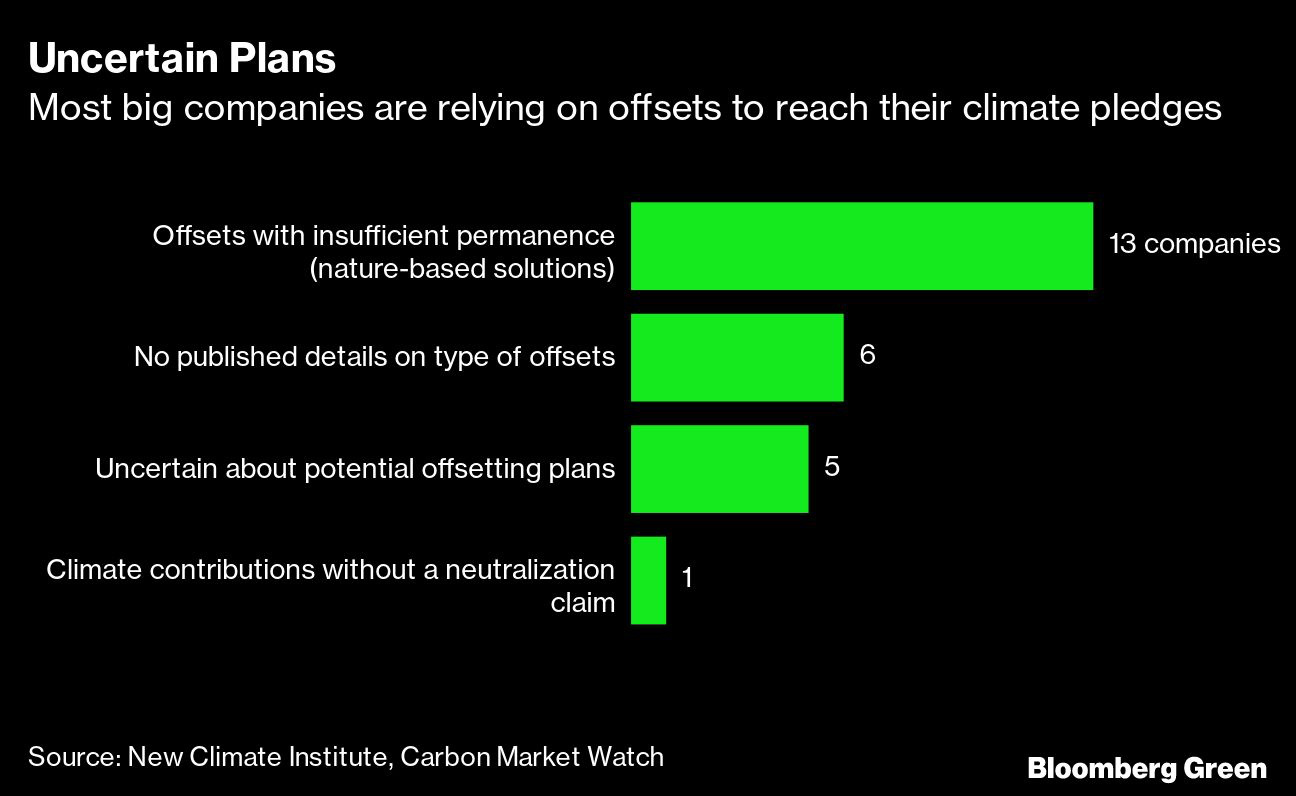
The report says that nearly half of the 25 businesses, including Nestle SA and JBS SA, don’t have specific commitments to reduce emissions by their target net-zero year. The remaining 13 plan to cut emissions across the value chain by 40% on average, rather than fully axe them as their pledges suggest. A.P. Moller-Maersk A/S, Vodafone Group Plc and Deutsche Telekom AG are the only ones on track to near-complete decarbonization, the authors find.

“Ambitious-sounding headline claims all too often lack real substance, which can mislead both consumers and the regulators,” said the New Climate Institute’s Thomas Day, a lead author of the study, in a statement. “We were quite shocked about the extent of creativity that some companies apply to claim a credible path to net zero, and the amount of effort that it takes to reveal that.”

It can be easy for companies to hide half-hearted efforts behind net-zero pledges because third-party analysts don’t know where to look. There’s no blueprint for how companies should disclose their climate ambitions and action plans. That makes it hard for outside eyes to grasp the true extent of corporate commitments.

Carrefour SA doesn’t count the emissions from its branded shops or upstream and downstream emissions, the report says, which make up almost all of its carbon footprint. Nestle and Unilever don’t offset their own emissions but they back individual consumer brands in their portfolio to do so. And JBS states its facilities will be powered exclusively by renewable energy by 2040, but the report says it doesn’t give information about its current and planned renewable energy supply.

The researchers find that the companies’ plans to offset their emissions are  particularly misleading. Two thirds of the businesses are banking on CO₂ reductions from forests and other nature-based solutions to erase their effect of their future emissions. If those forests are destroyed, the logic behind their plans would also fall.

In statements emailed to Bloomberg, Amazon, Google, JBS, Nestle, Unilever and Carrefour stood by their climate plans.

Google said it clearly defines the scope of its climate commitments, acknowledging that “100% renewable energy match and high-quality offsetting is only a step” toward its net-zero goal. JBS called the report’s methodology “misleading” and said that it had “established important milestones” to net zero. Unilever welcomed “external analysis of our progress” and said it had begun working on ways to evolve its approach, while Carrefour said it is “engaged across the full scope of its indirect emissions” and had been “working for a long time to make progress” on cuts.

UNCERTAIN PLANS
Among the companies to earn good marks was Maersk, which is investing in nature-based solutions to remove around 5 million metric tons of CO₂ every year until 2030, without claiming that this will neutralize its emissions. Likewise, Apple, Inc. already sources almost all of its energy from long-term agreements with renewable developers and its own installations, and it also backs the creation of energy storage systems.

Most of the 25 companies are working with the Science-Based Targets initiative, an arbiter of corporate climate plans. “Unfortunately, we find that these standard setting initiatives can end up lending some companies more credibility than they deserve,” Day said. “In the worst case, this can legitimize business-as-usual.” (Bloomberg LP, owner of Bloomberg News, is also working with SBTi. Bloomberg Philanthropies is an SBTi funder.) 

While many companies said that they had their plans approved by SBTi, Managing Director Alberto Carrillo Pineda said that only one company — CVS Health Corp. — has had its net-zero plan validated by the initiative. The confusion arises because SBTi has approved different plans over the years. Unilever’s climate plan has an SBTi stamp for near-term targets (typically until 2030) aligned with keeping warming below 1.5° Celsius, but it is yet to get approval for its full net-zero plan. Carrefour’s plan is SBTi approved for keeping warming below 2°C, which is a much less ambitious goal. JBS has committed to a net-zero target, but its climate plan has yet to receive any approval from SBTi.

“Scrutiny helps us to create stronger methods for assessing and validating corporate climate targets,” Pineda said. “The report also exposes important gaps in the level of transparency and integrity of corporate net-zero targets.” — Bloomberg

Vegetable shortage adds to Hong Kong’s COVID woes

REUTERS

HONG KONG  — Supplies of vegetables were running low in Hong Kong on Tuesday, with shoppers scrambling to buy whatever they could find, as the government blamed a resurgence of COVID-19 for a drop in deliveries of fresh produce from the mainland.

Leader Carrie Lam was due to announce further COVID restrictions later in the day after the city reported a record of more than 600 new cases on Monday. Broadcaster TVB said there were at least 380 confirmed infections on Tuesday with 400 preliminary positive tests.

Addressing a weekly news briefing, Ms. Lam said vegetable deliveries from across the border were down as a result of truck drivers testing positive for the virus, but she did not offer any specific solutions to solve the shortage.

Shelves stocking vegetables were bare across many supermarkets in the city while crowds surged into fresh markets to snap up the limited produce available. Other food remained available.

At a market in the city’s downtown Wan Chai market on Tuesday morning, a staff member from Qiandama vegetable store, shouted to crowds not to enter.

“No more veggies inside…It’s like the battlefield,” she said as people tried to charge in.

Some vegetable and fruit stalls selling mainland Chinese produce were shuttered while others were selling produce at double their usual prices.

For now, Ms. Lam said, the best option was to adhere to the “dynamic zero” strategy employed by mainland China to suppress all coronavirus outbreaks as soon as possible.

The official Chinese Communist Party newspaper, the People’s Daily, had encouraged Hong Kong to follow China’s approach to containing the virus in an editorial on Monday.

“We should contain the spread of the virus as much and as fast as possible,” Lam said.

ISOLATED
Hong Kong’s stringent coronavirus policies have turned the once top global travel and business hub into one of the world’s most isolated major cities.

The economic and psychological toll from the hardline approach are rapidly rising, with measures becoming more draconian than those first implemented at the start of the pandemic in 2020.

Flights are down around 90%, schools, playgrounds, gyms as well as most other venues are shut. Restaurants close at 6 p.m. (1000 GMT), while most people, including the majority of civil servants, are working from home. Government quarantine facilities are also nearing their maximum as authorities struggle to keep up with their rigid contact tracing scheme.

Many health experts have said the current strategy of shutting itself off as the rest of the world shifts to living with coronavirus, is unsustainable.

Doctors say mental health is suffering, particularly in families where people are earning less, or children cannot go to school due to the restrictions. — Reuters

S.Korea’s president prioritizes tackling inflation, rising household debt

REUTERS

SEOUL — South Korea’s economic policies should focus on stabilizing consumer inflation and managing household debt as higher interest rates have made repayments more onerous, President Moon Jae-said on Tuesday, with just a few months left in office.

Presiding a cabinet meeting, Mr. Moon said consumer price pressures are building which could hurt household finances at a time when interest payments for households are also higher following the Bank of Korea’s back-to-back policy rate hikes.

“Our utmost priority should be on stabilizing prices for staple goods for our citizens, and I ask for timely deployment of various policies to stabilize prices,” Mr. Moon said.

South Korea’s consumer inflation hovered near a decade high in January and remained above the central bank’s 2% target for a 10th straight month, as surging food and energy prices pushed prices higher.

A presidential election is set for March 9, and Mr. Moon will leave office on May 9, having served the single term permitted under South Korea’s constitution. — Reuters

11-member Japanese family shows allure of frugality, limits of stimulus

REUTERS

TOKYO  — When Japan handed Tokyo bus driver Keiki Nambu and his wife, Takako, $870 for each of their nine children, they spent it exactly as the government had feared: paying down a mortgage instead of going shopping.

That kind of financial prudence has helped Japanese households amass a staggering $17 trillion in assets over the years, with more than half of that parked in savings. But it also represents a headache for policymakers, who struggle to kick-start consumption and boost a moribund economy.

Prime Minister Fumio Kishida’s government has paid nearly $17 billion in cash stimulus to families. But unlike US stimulus that lifted consumer spending, the impact is seen as limited in Japan, where households are more likely to save the money or repay debt like the Nambus.

It highlights a consistent problem in the world’s No. 3 economy, where public debt is already more than twice the size of the gross domestic product (GDP).

“If dad’s salary remains the same but prices keep going up, all we can do is ask him to do his best and work as much as he can,” said 39-year-old Takako.

Her husband makes about $44,000 a year, including the discretionary “bonus” paid twice yearly by Japanese companies but cut when times are lean, as happened during the pandemic. In the end, the stimulus money is just helping to make up for that shortfall, Mr. Keiki said.

The Nambus’ children range in age from less than a year to 17. Kids only get water and milk to drink, although the family consumes about five liters of milk a day. Mr. Keiki makes sure the kids take quick showers to keep the water bill down.

In terms of size, the Nambus are hardly typical — the average Japanese household has shrunk to 2.21 people as of late 2020 from 2.82 in 1995, according to census data. Tokyo’s average was even smaller, at 1.92.

Their frugality is common, however.

BIG SAVERS
Private consumption accounts for more than half of Japan’s GDP.

But households may be spending just 10% of the stimulus cash and saving the rest, said Koya Miyamae, senior economist at SMBC Nikko Securities. Economic insecurity keeps consumption flat, Miyamae added, and a recent surge in Omicron infections has also made people hesitant to spend.

Another economist, Hideo Kumano of Dai-ichi Life Research Institute, reckons that about 75% of the handouts will end up as savings, although he cautions that number could be higher if parents decide to set aside more for their children’s education.

Concern that the money would end up in savings prompted some municipalities to pay half of the stimulus as vouchers. Tokyo wasn’t one of them.

Separate cash payments to all residents of Japan earlier in the pandemic saw about 27% of the money spent, according to a July 2020 survey by Mitsubishi Research Institute.

The Nambus received around $8,700 in total from this round of stimulus — 100,000 yen ($870) yen per child and another one-off payment from the government.

They initially flirted with the idea of an overnight family trip to a hotel run by their city ward. In the end, frugality won out, although they did spend about $210 on sushi and ice cream.

They will also use some of the money to buy a school bag and gym clothes for Keifu, 6, who is starting primary school in April.

The hand-me-down gym clothes were too threadbare after being worn by six of his older siblings. — Reuters

Freestyle skier Gu lands Big Air gold; China moves to top of medals table

BEIJING — China’s Eileen Gu got her maiden Olympics off to a dream start as the US born teenager landed a tricky jump to become the first freeski Big Air champion at the Beijing Games, taking the host country to the top of the medals table on Tuesday.

With the Shougang steel mill in the backdrop, Gu landed in the final run a 1620, a trick only Tess Ledeux had achieved in competition before. The Frenchwoman settled for silver.

Ledeux was leading after two runs but pressure got to the Big Air World Cup leader and she struggled on her final jump, ending up in tears while the crowds erupted in cheers for Gu.

Swiss Mathilde Gremaud took the bronze, unable to turn things around in the final run as she crashed.

“I’ve never done the 16 before, I haven’t really prepared for it that much either,” the 18-year-old Gu said.

“I think I did two days on the airbag but I’ve spent a lot of hours visualizing it if that counts. Generally, I’ve visualized for about an hour and a half before bed every day.

“Tess inspired me a lot with this jump. So even if she may be sad, this gold medal also belongs to her.”

Chinese tennis player Peng Shuai, wearing a black knit hat with the Olympic rings on them, watched and waved from the stands as Gu won the Big Air gold.

It first appeared that Gu, a fashion model and incoming Stanford University student, still had a lot to learn when “Air France”Ledeux landed her double cork 1620 in the first run.

The 20-year-old Frenchwoman, a three-time Winter X Games winner in Big Air, had a combined best of 187.50 after the first two runs. Gremaud was second on 182.50 and Gu was third on 182.25.

Already assured of a podium finish, Gu went for Ledeux’s double cork 1620 and achieved it, holding her head in disbelief in the finish area under the eyes of her mother.

“So my mum called me before my last jump and she told me not to do the 16. She told me to do the right 14 again and to see if I could do it better. But I kind of was adamant that I wanted to do the left 16,” said Gu, whose phone screen saver has been a gold medal for months.

Despite an imperfect landing, she scored 94.50 — Ledeux’s score in the first run, which took Gu’s tally up to 188.25 and earned her a 0.75 final advantage over the Frenchwoman.

“She has been skiing for a long time but she is new on the big stage. What she’s been doing is incredible,” said Gremaud.

Ledeux said Gu “killed the game today.” “It’s competitive sport. I’m stoked with my silver medal.”

Gu, who has nearly two million followers on China’s Twitter-like Weibo, will have more opportunities to increase her popularity as she participates in the slopestyle and halfpipe events in Beijing.

Minutes after Gu won Big Air gold, eight of the top 10 searches on Weibo were related to her.

China have so far won three gold and two silver medals at the Winter Games, leading the medals tally, while Sweden is at second place with three golds. — Reuters

Bengals QB Burrow undaunted by grandeur of Super Bowl stage

CINCINNATI Bengals quarterback (QB) Joe Burrow, whose talent is matched by an ice-cold demeanour, said on Monday he is calmer ahead of his first Super Bowl appearance than he was prior to playing in his high school state championship.

There is no shortage of players who have been overwhelmed by playing on the National Football League’s (NFL) biggest stage but the 25-year-old Burrow feels no added jitters ahead of the Bengals’ Sunday showdown against the hometown Los Angeles Rams.

“Obviously, the players get better and the schemes get better and everything, but at the end of the day, your mindset stays the same,” Burrow said during a virtual news conference.

“When I played in the state championship in high school, it feels the same as playing in the Super Bowl does now.

“Just at that moment in my life, that was the biggest game that I had ever played in and everything kind of feels the same. I’ve just had more reps in those situations so I am probably even a little calmer.”

Under the direction of Burrow, a confident quarterback who has displayed a precocious ability to thrive under pressure, the Bengals have become just the third team to reach the Super Bowl two years after finishing with the NFL’s worst record.

Given Burrow’s ability to quickly adapt to the complexities of NFL defenses, some might expect him and the Bengals to enjoy multiple trips to the Super Bowl but the Ohio native is not taking anything for granted.

“You see guys who go entire careers without ever even getting to a Super Bowl, so when you do get there you do really have to hunker down and take advantage of those opportunities,” said Burrow, who is scheduled to arrive in Los Angeles with his team on Tuesday.

“We have a team that’s capable of doing that… we are doing a great job of eliminating the distractions that come with a Super Bowl and it’s going to get heavier when we get to LA, but I think we have the guys that are capable of doing it.”

Burrow has enjoyed a meteoric rise since being selected by a long-suffering Bengals franchise with the first overall pick of the 2020 NFL Draft.

The quarterback with pinpoint accuracy said his confidence starts with a strong locker room culture where every player on the team has the utmost belief in each other.

“I am not afraid to make mistakes because I know our defense is going to pick us up if we do, so that allows me to go out and play freely and not be scared to throw an interception or miss a throw,” said Burrow.

“And our defense plays the same way knowing that the offence is going to pick them up if they are down, and so I think we just play great team football together and that starts with the culture in the locker room.” — Reuters