Home Blog Page 6821

NEDA backs move to relaxed quarantine setting by March

SOCIOECONOMIC Planning Secretary Karl Kendrick T. Chua wants a shift to the least strict form of quarantine by March, which he said would add P11.2 billion to the economy each week.

National Economic and Development Authority (NEDA) estimates indicate that a move from Alert Level 2 to Alert Level 1 would add 191,000 jobs per week.

“If we continue to work together and see Alert Level 1, hopefully by the next month, then we would have added P11.2 billion in gross value added per week in the NCR Plus area,” Mr. Chua said in a Management Association of the Philippines economic briefing on Thursday.

Metro Manila, Bulacan, Cavite, Laguna, and Rizal were placed under Alert Level 3 last month due to an Omicron-driven surge in coronavirus disease 2019 (COVID-19) cases after the holidays. Economic managers said this resulted in P3 billion in productivity losses each week.

In response to the current Alert Level 2 quarantine, Presidential Adviser for Entrepreneurship Jose Ma. A. Concepcion has also been asking the government to move to the least strict quarantine setting by March to restore economic activity.

The COVID-19 daily tally hit 4,575 on Thursday, bringing the active case count to 93,307.

Along with restoring economic activity, Mr. Chua has been supporting a return to face-to-face classes.

“Our thinking in NEDA is we will not get it right at the start, but it is crucial to pilot immediately (in) more schools so that we learn from the pilot,” he said. “The more we pilot, the more we will learn, the more we can get it right.”

The unavailability of physical classes could worsen the quality of education and cost the country P11 trillion in lost wages over the next four decades, NEDA has estimated.

“Learning was compromised by the prolonged school closure,” Brain Trust, Inc. Chair Cielito F. Habito said at the same event.

“Children of poor families in remote areas actually had no access… and therefore were left out of this remote learning exercise, and so the effect of these lost years will be felt years from now in terms of reduced worker productivity.” — Jenina P. Ibañez

IATA calls for more PHL action to restore air travel confidence, revive airline industry

REUTERS

THE International Air Transport Association (IATA) said it is optimistic about the Philippine government’s move to open its borders to fully vaccinated foreign travelers, but added that more measures are needed to boost passenger confidence in air travel.

“It is good for the aviation community, and will facilitate the recovery of the aviation industry and the tourism sector.  We urge other Asia-Pacific governments to look at similarly easing their travel restrictions and join this growing momentum we are seeing in the region during the past several weeks,” Philip Goh, IATA’s regional vice-president for Asia Pacific, said in  a statement on Wednesday.

Beginning Feb. 10, Philippine borders were opened to fully vaccinated travelers from countries whose citizens enjoy 30-day visa-free entry privileges.

Mr. Goh noted that easing travel restrictions is a “positive step” forward, but “more needs to be done in order to build greater confidence in air travel.”

“We urge the Philippine government to take the following additional actions: make permanent the standardization of measures and exemption of quarantine, improving from the current temporary suspension; accept antigen tests for pre-departure testing; recognize digital vaccination certificates and testing certificates that are presented on digital platforms, such as the IATA Travel Pass,” he said.

“It is through greater liberalization from air travel restrictions that aviation and travel businesses, and indeed economies, can advance to full recovery from two years of extreme hardship,” he added.

Flag carrier Philippine Airlines, Inc. said fully vaccinated ​foreigners will no longer be required to undergo quarantine at a designated facility.

“Instead, they shall self-monitor for any signs or symptoms for seven days, with the first day being the date of arrival, and shall be required to report to the local government unit upon the manifestation of symptoms, if any,” it said in a statement.

PAL also said that unvaccinated foreign children below 12 years, traveling with a Filipino parent, will need to observe the entry, testing, and quarantine protocols.

“Foreign children from ages 12 to 17 years of age traveling with their Filipino parent, shall follow the protocols based on their vaccination status (i.e., vaccinated or unvaccinated). If the child is unvaccinated, either parent should accompany the child during their facility based quarantine,” the flag carrier added.

The airline is currently flying to and from 33 international and 27 domestic destinations. — Arjay L. Balinbin

PEZA seeking to extend remote-work BPO scheme to September

THE Philippine Economic Zone Authority (PEZA) said it wants to allow information technology-business process outsourcing (IT-BPO) companies to continue with 90% work-from-home schemes until September, extending a previous arrangement that expires in March.

In a statement on Thursday, PEZA asked the Fiscal Incentives Review Board (FIRB) to allow IT-BPO firms to operate under work-from-home (WFH) arrangements until Sept. 12.

Economic zone locators’ incentives are tied up in performing work onsite, because areas outside the zone are considered a separate Customs territory. The pandemic has led to a reduction to the onsite work requirement to 10%.

Charito B. Plaza, PEZA director general, said the agency’s proposal is temporary. She added that the PEZA Board approved the proposal on Jan. 7.

“The approval of the PEZA Board of our proposed temporary measure was submitted to the FIRB for further approval as required under the rules. We have yet to receive formal notice on the FIRB’s decision regarding our recommendation,” Ms. Plaza said.

In September last year, FIRB released Resolution No. 19-21 which allows outsourcing firms in economic zones (ecozones) to conduct up to 90% of work remotely, with no diminution in their fiscal incentives until the end of March.

According to PEZA, such an extension has legal sanction from Rule 23, Section 3 of the implementing rules of Republic Act No. 11534 or the Corporate Recovery and Tax Incentives for Enterprises (CREATE) law. 

“Rule 23… provides that an investment promotion agency (IPA) may implement temporary measures to support the recovery of registered business enterprises (RBEs) from exceptional circumstances, upon prior approval of the FIRB,” PEZA said.

“Exceptional circumstances include pandemic, epidemic, war, armed conflict, state of national health emergency, outbreak of diseases, international or regional financial crises, major disasters such as a volcanic eruption, earthquake and super typhoon, or analogous circumstances,” it added.

PEZA is also appealing for the non-imposition of penalties under FIRB Resolution No. 19-21.

“PEZA-registered companies are coping with or recovering from the impact of the pandemic. If it’s supposed to be a relief measure, we should not penalize the companies; rather, we must continue to assist our registered companies as much as possible given that protecting livelihoods of millions of Filipinos is an important national interest,” Ms. Plaza said.  

PEZA asked its board to allow the transfer of IT equipment and assets as long as these are covered by surety bonds and appropriate permits.

PEZA also requested its board to approve the issuance of guidelines for WFH arrangements.

Separately, PEZA and the Board of Investments said they support Senate Bill No. 2306 filed by Senator Maria Imelda Josefa R. Marcos, which seeks to amend Section 309 of the CREATE law.

The bill cites the need for amendments because Section 309 only allows CREATE incentives to be awarded to activities conducted within economic zones.

   “However, instead of the 50% WFH arrangement which is based on revenue, both IPAs agreed that the percentage should be addressed in the proposed Strategic Investment Priorities Plan (SIPP) as the allowable threshold may even be increased to more than 50% but this time, it shall be based on total workforce or manpower of the IT enterprises instead of the revenue,” Ms. Plaza said.

The FIRB denied a PEZA request to allow remote work equivalent to up to 90% of an outsourcing firm’s revenue. It also stood by its decision to allow outsourcing firms operating within economic zones to maintain WFH arrangements until March as long as 10% of employees are on site.

PEZA said there were 297 registered IT parks and centers and 1,273 registered IT-BPO companies as of November.

“These companies and ecozones have contributed a total of 12.33% or P328.559 billion worth of investments, generated $11.537 billion worth of exports, and created 962,304 direct jobs as of September 2021,” PEZA said. — Revin Mikhael D. Ochave

Eastern Visayas red tide-free after five years

PHILIPPINE STAR/EDD GUMBAN

THE Eastern Visayas have been declared free from red tide toxins after nearly five years, the Bureau of Fisheries and Aquatic Resources (BFAR) reported.

The BFAR said that the results of laboratory tests on Feb. 7 detected no red tide organisms in the region.

The last time the region was red tide-free was in 2017.

The last areas cleared of red tide are: San Pedro Bay, Samar; Carigara Bay, Leyte; Cancabato Bay, Tacloban City; Guiuan, Eastern Samar; Matarinao Bay, Eastern Samar; and the waters off Biliran Island.

Red tide notices have been regularly issued for Matarinao Bay, Carigara Bay, and Cancabato Bay.

“After almost five years of regular issuance of red tide advisories, we’re now finally red tide-free. Hopefully, we will have a longer period like this with the interplay of weather. We need this for us to have a good harvest of shellfish products,” BFAR Eastern Visayas Regional Director Juan D. Albaladejo said in a statement.

“Even if shellfish ban is lifted in these areas, our active surveillance will continue since we are still experiencing rains. This may cause runoff of soil sediments rich in organic load that fertilized the cyst of red tide in these bays,” he added. — Luisa Maria Jacinta C. Jocson

Harvard institute says ‘moral duty’ to help island communities deal with climate change

PHILSTAR

SMALL ISLAND communities in the Asia-Pacific are at greater risk from climate change, and aiding them is a “moral duty” for larger states, according to the Harvard Humanitarian Initiative (HHI).

“Support for low-lying island communities throughout the Asia-Pacific must be a priority for the international community. We know that these communities will have to bear a terrible burden for a climate crisis they had virtually no role in creating,” HHI Resilient Communities Program Director Vincenzo Bollettino said in a statement.

“Larger states have both a strong moral and practical duty to support adaptation measures and think through feasible strategies to support communities where forced migration is inevitable,” he added.

HHI, an institute within Harvard University, reported that limited resources and supporting for disaster measures are hindering community resilience in small islands in the Philippines.

It cited as a case study of Barangay Pugad, Hagonoy, Bulacan, which is effectively an island because it lies within a river delta system that empties into Manila Bay.

HHI said the barangay has limited funds to implement its community-based disaster risk reduction and management (CBDRRM).

“Sadly, Pugad is not alone in this since the issue they face is but a mere reflection of scarce resources across the entire country. Although there is a… National Disaster Risk Reduction and Management Fund (NDRRMF), the Local Disaster Risk Reduction and Management Fund (LDRRMF), and the Quick Response Fund (QRF) which is a portion of the NDRRMF, such financial resources are not proportionally allocated across provinces and tend to be heavily focused on disaster response rather than preparedness and resilience,” HHI added.

HHI said typhoons are inevitable and governments must invest in pre-disaster measures.

“Being hit by only one (typhoon) can bring them to a disaster trap. Thus, it is increasingly important for the government, at all levels, to focus on pre-disaster investments. Such communities need policy and financial support in their CBDRRM plans. It will be good to start with assisting such communities in terms of disaster risk financing and disaster insurance education, alongside a human rights-based approach (HRBA) to DRR and gender mainstreaming in disaster management,” it said.

“The continued onslaught of disasters and climate change impacts to Pugad diminishes the positive impact of resources brought about by the community’s partnerships with external development actors,” the report added.

It proposed the construction of disaster mitigation infrastructure projects to prepare the communities ahead of time.

“For infrastructure, it is also proposed that the residents in Pugad must invest in stilted housing rather than spending much of their savings and external financial support they receive on regularly fixing their damaged houses due to floods and land subsidence. Stilted housing can be the most effective type of adaptation strategy for people in small island communities in the Philippines who choose to stay over relocation measures,” the report added. — Luisa Maria Jacinta C. Jocson

PHL’s ‘biggest’ economic zone registered in Quezon

THE Philippine Economic Zone Authority (PEZA) said it registered an economic zone in Quezon Province which is projected to cost P125 billion to develop, adding that the zone is expected to become the country’s largest.

PEZA said in a statement on Thursday that a registration agreement was signed with Achievement Realty Corp. (ARC) Chairman Philip M. Cea on Jan. 31, paving the way for the construction of the Quezon Techno-Industrial Special Economic Zone (QTISEZ) on a 1,836 hectare site in Mauban, Quezon.

“This huge investment ARC has entrusted to PEZA is going to be a historical project because this new economic zone shall come out as… the future biggest economic zone in the Philippines,” PEZA Director General Charito B. Plaza said.

According to Ms. Plaza, the zone will have the first international airport and seaport in that part of Luzon.

“QTISEZ is envisioned to have its own international seaport and international airport with an estimated budget of P25 billion each from the total P125 billion cost of developing the 1,836-hectare special economic zone,” Ms. Plaza said.

“With the P75 billion from the proposed development budget and under this signing, QTISEZ will create 2,000 factories (which will lead to) the creation of more than 200,000 jobs,” she added.

Mr. Cea said around 200 hectares will be dedicated to government offices, residential and commercial districts, and other uses.

He added that preliminary deals have been signed with potential Chinese and South Korean locators, with talks ongoing.

Under Republic Act No. 7916 or the Special Economic Zone Act, PEZA said ARC is entitled to establish, manage, and operate QTISEZ as an economic zone developer.

It added that ARC can construct, operate, and maintain infrastructure facilities, utilities, communication systems, and sewage and drainage systems either on its own or through another company.

Under the law, “(PEZA has) the exclusive power and prerogative to permit, supervise, and control the entry and exit of all goods, machinery, and equipment, merchandise, and article to and from QTISEZ,” the agency said.

“Meanwhile, ARC is responsible for providing security and maintaining peace and order within the QTISEZ and shall pay to PEZA all applicable fees and agrees that PEZA may withhold, suspend, or disapprove permits,” it added. — Revin Mikhael D. Ochave

Rice price impact on inflation expected to be minimal

PHILIPPINE STAR/ MICHAEL VARCAS

RICE PRICES are expected to remain stable in the first quarter, with a “negligible” impact on inflation, according to the Department of Agriculture (DA).

“Rice prices continue to be stable prices (with) a negligible effect when it comes to inflation. We also have many different kinds of rice to choose from,” Undersecretary for Operations and Agri-Fisheries Mechanization Ariel T. Cayanan said at a virtual briefing.

The DA said end-January rice stocks have been estimated at 2.9 million metric tons (MT). The other projections for the rest of the quarter are 2.7 million MT for the end of February and 3.3 million MT for the end of March.

“We are working hard to make our farmers more competent so that we can continue to thrive. According to our policy, we are value-chain driven now. Our farmers don’t just have to produce, they must have entrepreneurial skills as well,” he added.

He said the DA is working on a plan that will make towns specialize in key commodities to maximize production.

“We have a provincial commodity investment plan, which went through very precise and surgical study. One town, one product.  What is suitable to the area, that’s what we plant,” Mr. Cayanan said.

Meanwhile, the Federation of Free Farmers (FFF) said it expects to see a possible decline in palay (unmilled rice) prices during the dry season harvest following a surge in imports.

“We will have a supply glut when the farmers start harvesting their dry-season crop starting March. Farmers will again suffer from low prices even as the costs of fertilizer, fuel, and other farm inputs remain high. Having a large harvest is meaningless to farmers if it results in low prices for their produce,” FFF National Manager Raul Q. Montemayor said.

The FFF said that the increase in palay production will not benefit farmers significantly.

“Half of the incremental harvest in 2021 came from an expansion in harvested area and only half was due to an improvement in yields. Overall, output per hectare improved by only 1.6% in 2021, equivalent to an additional income of only P1,095 per hectare,” the FFF said.

“This is far off the DA’s unsubstantiated claim that farmers earned P10,000 more per hectare in 2021 despite the increase in fertilizer costs,” it added.

The FFF also questioned the reported increase in tariff collections on rice imports.

On Feb. 8, the Department of Finance  reported that rice tariff collections amounted to P18.9 billion in 2021.

Under Republic Act (RA) No. 11598, tariffs in excess of P10 billion a year will be used for cash transfers to farmers affected by the Rice Tariffication Law (RTL).

“Tariff collections increased because imports surged, and, as a result, palay prices went down. The P9 billion that will be given to farmers is very small compared to the P60 billion that farmers are losing every year compared to their income before RTL took effect. In addition, one out of every three rice farmers will not get any cash assistance because RA No. 11598 applies only to farmers tilling two hectares or less,” Mr. Montemayor said.

“We support calls to increase the budget for agriculture, but we must make sure that the money is being spent wisely and effectively. Spending one peso to get back just one peso is not a good way to use scarce government money,” he added. — Luisa Maria Jacinta C. Jocson

BSP planning new body to monitor stability of financial conglomerates

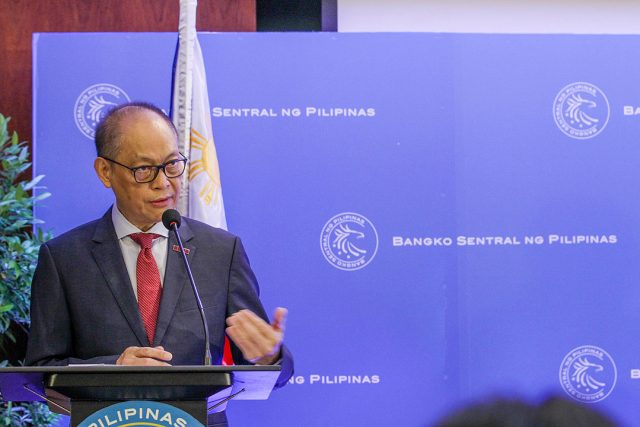
BANGKO SENTRAL NG PILIPINAS GOVERNOR BENJAMIN E. DIOKNO — PHILIPPINE STAR/ GEREMY PINTOLO

A NEW organization, to be known as a “supervisory college” consisting of various regulators, will be established later this year to monitor the stability of financial conglomerates, the Bangko Sentral ng Pilipinas (BSP) said.

A pilot run is expected in the second quarter of the year, BSP Governor Benjamin E. Diokno said at an online briefing on Thursday.

The supervisory college will consist of members of the Financial Sector Forum, which includes regulators like the BSP, the Securities and Exchange Commission, Insurance Commission, and the Philippine Deposit Insurance Corp.

“Financial conglomerates make up more or less 60% of the financial system. Given the systemic importance of these entities, (financial regulators) felt the need to further strengthen supervision for a more effective discharge of their mandates under their respective charters,” Mr. Diokno said.

Members of the college will undergo training in significant risk issues. The body will also carry out impact analyses of risks specific to each of the conglomerates, and draft a supervisory plan.

The work of the college will complement that of the Financial Stability Coordination Council (FSCC), which includes regulators as well as representatives of the Department of Finance.

“The supervisory college will take a micro prudential approach while the FSCC see takes more of a macro prudential approach in tackling risk of contagion among different financial markets as well as the financial and real sectors. So, the supervisory college may elevate to the FSCC financial stability issues,” Mr. Diokno said.

Earlier this month, the FSCC identified various issues that need to be addressed to sustain the economic recovery and to promote financial stability, citing the state of public infrastructure, supply bottlenecks, social inequity, and climate change.  — Luz Wendy T. Noble

Election body lets Marcos run for president 

FERDINAND “BONGBONG” R. MARCOS, JR. -- REUTERS

By John Victor D. Ordoñez and Kyle Aristophere T. Atienza, Reporter 

The Commission on Elections (Comelec) on Thursday rejected three consolidated lawsuits seeking to disqualify the son and namesake of the late dictator Ferdinand E. Marcos from the presidential race this year. 

In a 41-page decision, the election body’s First Division ruled former Senator Ferdinand “Bongbong” R. Marcos, Jr.’s conviction for tax evasion in the 1990s did not involve wicked, deviant behavior. 

“Is the failure to file tax returns inherently immoral? We submit that it is not,” according to a copy of the ruling written by election Commissioner Aimee P. Ferolino. “The failure to file tax returns is not inherently wrong in the absence of a law punishing it.” 

Commissioner Marlon S. Casquejo, who signed the ruling, also wrote a separate 12-page opinion in which he said Mr. Marcos’s crime did not involve “moral turpitude.” 

“We cannot justify such omission necessarily results in injustice; this is an overkill,” he said in his opinion, referring to the presidential bet’s failure to file tax returns. “We cannot link such omission to contravention of morals; this is an exaggerated innuendo.” 

Former First Division Presiding Commissioner Maria Rowena V. Guanzon released a separate opinion on Jan. 31 in which she voted to disqualify Mr. Marcos, whom she called an ex-convict. She said his repeated failure to file his tax returns showed a deliberate intent to violate the law. 

Ms. Guanzon, who has since retired, had accused Ms. Ferolino of delaying the decision to invalidate her vote. She said division members had agreed to rule on the lawsuit by Jan. 17. Ms. Ferolino has denied the accusation, citing case volume for the delay. 

She also alleged that a senator from Davao was meddling in the lawsuit filed by survivors of the dictator’s martial law regime. 

“The decision by the Comelec First Division to not disqualify Marcos, Jr. despite his criminal tax evasion spits in the face of common sense and basic morality,” vice-presidential candidate Walden F. Bello tweeted. “This is shown in their extremely insulting justification.” 

The Second Division last month dismissed a similar lawsuit seeking to bar Mr. Marcos, who is leading in opinion polls, from the presidential race. 

Comelec has six members and one chairman. Its two divisions have three members each. Decisions issued by the two divisions are eventually appealed to the seven-member en banc. The election body only has four members now after its chairman and two members retired this month. 

“The disqualification was never a consideration,” Ibarra “Barry” M. Gutierrez III, the spokesman of Vice-President Maria Leonor “Leni” G. Robredo who is Mr. Marcos’s main rival, said in a statement. “From the time she announced her candidacy, she always intended to achieve victory in the elections.” 

The Comelec decision is good news for Mr. Marcos but he needs to move away from motherhood statements and start laying down his plans for the country, said Ernest M. Ramel, Jr., chairman of the political party of Manila Mayor Francisco “Isko” M. Domagoso, who is also running for president. 

“His spokesperson may just run out of excuses for him not to attend any of the presidential debates and fora,” he said in a statement, alluding to Mr. Marcos’s avoidance of at least two major presidential fora. 

“The decision of the Comelec’s First Division allowing Ferdinand ‘Bongbong’ Marcos, Jr. to run in the May polls, despite his perpetual disqualification from public office, is a major setback for the country’s electoral democracy,” Akbayan Party-list nominee Percival V. Cendaña said in a statement.

Metro at low risk as COVID cases get under control

PHILIPPINE STAR/ MICHAEL VARCAS

By Kyle Aristophere T. Atienza, Reporter

THE PHILIPPINE capital and nearby cities are now at low risk from the coronavirus, as the country reported fewer than 5,000 coronavirus infections for the third straight day.

“As predicted two weeks ago, the National Capital Region improved to low risk as of Feb. 9,” OCTA Research Group fellow Fredegusto P. David tweeted late Wednesday.

He said Metro Manila’s coronavirus reproduction number on Feb. 3 to 9 declined to 0.25 from 0.41 a week earlier.

The virus positivity rate in the region has fallen to 9.1% from 15%, which is considered low but still above the 5% threshold set by the World Health Organization (WHO). The average daily attack rate also fell to a moderate 6.67 for 100,000 people from 17.83.

Mr. David said the capital region’s hospital use rate had improved to 29.6% from 37%.

The capital region is under Alert Level 2 until Feb. 15. The government is set to announce the virus alert level before the end of the week.

The Philippines posted 4,575 coronavirus infections on Thursday, bringing the total to 3.63 million, the Department of Health (DoH) said in a bulletin. The death toll from the virus hit 54,783 after 94 more patients died, while recoveries rose by 7,504 to 3.48 million.

It said 15.1% of 36,407 samples on Feb. 8 tested positive for COVID-19, still above the 5% level set by the WHO.

Of the 93,307 active cases, 3,316 did not show symptoms, 85,244 were mild, 2,991 were moderate, 1,444 were severe and 312 were critical.

DoH said 76% of the latest cases occurred on Jan. 28 to Feb. 10. The top regions with new cases in the past two weeks were Western Visayas with 451, Central Visayas with 400 and Metro Manila with 392 infections. It added that 70% of new deaths occurred in February and 12% in January.

It also said 176 duplicates had been removed from the tally, 132 of which were reclassified as recoveries and one was tagged as a death, while 47 recoveries were relisted as deaths. Five laboratories failed to submit data on Feb. 8.

The Health department said 39% of intensive care unit beds in the country had been used, while the rate for Metro Manila was 31%.

The country has allowed the entry of fully vaccinated foreign tourists.

In a statement, the Bureau of Immigration said it expects at least a 30% increase in arrivals on the first day of the opening of the country’s borders to travelers, noting that almost 7,000 tourists were expected to visit the country on Feb. 10.

It said most of the travelers would be Filipinos, while about 27% will be foreigners.

Meanwhile, foreign spouses and children of Filipino citizens, and former Filipino citizens with balikbayan privileges would no longer be required to carry return tickets, presidential spokesman Karlo Alexei B. Nograles told a televised news briefing, citing an order approved by a coronavirus task force.

He said citizens from 157 countries with visa-free arrangements with the Philippines may stay for more than a month for purposes other than tourism or leisure through an entry exemption document.

They must be fully vaccinated, except minors aged below 12 years traveling with a fully inoculated parent.

They must present a negative RT-PCR test taken within 48 hours before the date and time of departure from the origin country.

Mr. Nograles said foreign spouses and children of Filipino citizens who are not from these countries may now enter the Philippines “without need of an entry exemption document provided they have been issued a 9(a) visa with the appropriate visa notation.”

The Philippines is scrambling to test more Filipinos as it reopens the economy.

On Wednesday, the government took delivery of 16,000 COVID-19 test kits from Israel’s defense ministry. It received about 10,000 test kits from the Israeli Ministry of Defense in November.

Senator, ex-mayor removed from slate of Lacson and Sotto

A SENATOR and a former mayor were removed from the senatorial slate of the Lacson-Sotto tandem after they attended the proclamation rally of a rival candidate.

“They now cease to be part of the Lacson-Sotto team,” Senator and presidential candidate Panfilo M. Lacson tweeted on Thursday, referring to Senator Sherwin T. Gatchalian and former Quezon City Mayor Herbert M. Bautista.

The two attended the proclamation rally of presidential bet Ferdinand “Bongbong” R. Marcos, Jr. and Davao City Mayor Sara Duterte-Carpio at the start of the campaign period on Tuesday.

“I understand politics,” Mr. Lacson told reporters in mixed English and Filipino. “I’ve been in this business for 18 years and we understand that they also want to win by any means that will suit them, so we respect their decision but we also have to respect our own standards.”

Mr. Gatchalian in a statement said he understood his fellow senator’s decision. “I respect the decision of their leadership. I also apologize for any misunderstanding that I may have caused.”

Mr. Lacson said Mr. Bautista had written to him seeking permission to represent the Nationalist People’s Coalition (NPC), which is headed by his running mate Senate President Vicente C. Sotto III, to the political coalition supporting the Marcos-Duterte tandem. Mr. Gatchalian and Mr. Bautista are both running under NPC.

“His letter to me was hard to understand,” he said. “I asked my staff to think of a response, but no one could.”

Mr. Lacson said they would keep senatorial bets under their tandem as long as they don’t openly endorse other presidential and vice-presidential candidates.

Senator Juan Miguel F. Zubiri also attended the Marcos proclamation rally, while Senator Richard J. Gordon was at the rally of Vice-President Maria Leonor “Leni” G. Robredo, but they never endorse their candidacies, Mr. Lacson said.

Meanwhile, rival presidential bet and Manila Mayor Francisco “Isko” M. Domagoso said he would accept senatorial candidates who endorse him and his running mate Willie T. Ong.

“We won’t reject those who want to help us,” he told a news briefing in Rizal province in Filipino. “We only have one rule — that the senators who want to join us tell people that we are their candidates.”

Mr. Domagoso also said he hopes President Rodrigo R. Duterte would eventually back him up.

“We are hoping that we get all kinds of support from those mayors, congressmen, governors, vice governors and other local officials who haven’t decided on a president yet,” he said in Filipino. “But we are hoping that the senators and everyone else would help us. That includes President Duterte.”

Mr. Marcos, the son of the late dictator Ferdinand E. Marcos, is leading presidential opinion polls.

He continued to widen his lead in Laylo Research’s presidential opinion poll in January. His voter preference rose by 6 points to 64% from November, he said in a statement on Wednesday, citing the poll that had 3,000 respondents.

Mr. Marcos noted that despite the seemingly endless barrage of mudslinging and negative campaigning against him, the support he gets from voters remained solid. 

At a very distant second was Vice-President Maria Lenor “Leni” G. Robredo with 16%.  Tied for third place were Manila Mayor Francisco “Isko” M. Domagoso and boxing champion and Senator Emmanuel “Manny” D. Pacquiao with 7% each. Senator Panfilo “Ping” M. Lacson was in fourth place with 4%. — Alyssa Nicole O. Tan and Jaspearl Emerald G. Tan

SIM bill a threat to privacy — experts

PHILSTAR FILE PHOTO

A BILL that seeks to require the registration of subscriber identity module (SIM) cards could endanger privacy and is against democratic rights, according to science and technology experts. 

“We thus strongly urge President Duterte to veto this measure and bring back this monster to its grave,” the Advocates of Science and Technology for the People and Computer Professionals’ Union said in a joint statement on Thursday. 

While the bill seeks to deter cyber-crime and internet trolls, it does not offer a real solution to these problems and only limits people’s right to privacy, the group said. The measure also exposes citizens to risk by consolidating personal information on a centralized server, they said.  

“In recent years, we’ve seen how ineffective the state has been in protecting the people’s data and securing its own websites.” 

Online scams rose by 37% to 869 from March to Sept. 2020 from a year earlier, according to the national police’s Anti-Cybercrime Group. 

The groups said people living in rural areas and who have no identification documents would be disfranchised, as well as those who wish to remain anonymous. 

“Anonymity is also valuable to journalists, witnesses and whistleblowers, activists, human rights defenders, government critics and victims of domestic abuse and violence against women and children,” they said. “Requiring SIM card registration will make them more vulnerable to harassment and threats.” 

The reconciled bill has been sent to the presidential palace for President Rodrigo R. Duterte’s signature after both Houses of Congress ratified it. — Alyssa Nicole O. Tan