Home Blog Page 6811

Stocks may move sideways before BSP meeting

BW FILE PHOTO

PHILIPPINE SHARES are seen to move sideways this week due to rate hike fears ahead of the central bank’s policy review and the government’s retail Treasury bond (RTB) offer.

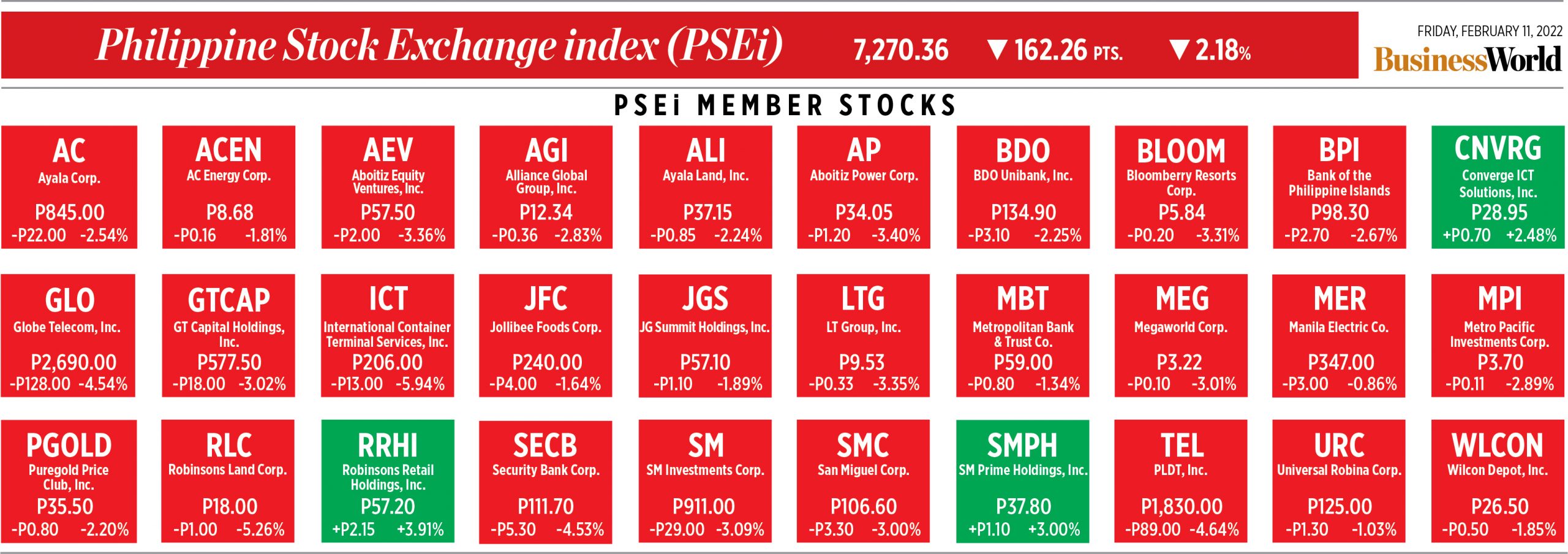
The 30-member Philippine Stock Exchange index (PSEi) sank by 162.26 points or 2.18% to end at 7,270.36 on Friday, while the broader all shares index also fell 52.61 points or 1.34% to finish at 3,872.13.

Week on week, the bellwether declined 185.99 points from its 7,456.35 finish on Feb. 4.

For the coming trading week, analysts said the market will monitor the Bangko Sentral ng Pilipinas’ (BSP) policy meeting for leads this week as well as the government’s RTB offer.

First Metro Investment Corp. Head of Research Cristina S. Ulang said in a Viber message over the weekend that lingering rate hike concerns following the release of US inflation data, which caused bets of aggressive tightening by the Federal Reserve in March, and ahead of the BSP’s review on Thursday could result in the PSEi continuing to trade within the 7,100 to 7,400 range.

Ms. Ulang added that the rate-setting auction for the five-year RTBs on Tuesday will also be a lead for the market.

“Worries over the hawkish outlook of the Federal Reserve’s policies this year may continue to weigh on sentiment. Adding to this is the ongoing tension between Russia and Ukraine and its consequences including the rise in global oil prices. These are seen to make it challenging for the market to do substantial rallies,” Philstocks Financial, Inc. Senior Research Analyst Japhet Louis O. Tantiangco said in a Viber message.

US consumer prices rose solidly in January, leading to the biggest annual increase in inflation in 40 years, fueling financial markets’ speculation for a hefty 50 basis points interest rate hike from the Fed next month, Reuters reported.

In the 12 months through January, the consumer price index jumped 7.5%, the biggest year-on-year increase since February 1982. That followed a 7.0% advance in December and marked the fourth straight month of annual increases in excess of 6%.

Meanwhile, all 16 analysts in a BusinessWorld poll expect the BSP’s policy-setting Monetary Board to keep borrowing costs steady at its meeting this week to support economic recovery.

“The government’s decision on the alert level restrictions in the country for the second half of February is seen to play as an important factor in [this] week’s trading,” Mr. Tantiangco added.

“Last week, the local bourse fell back below the 7,300 level. [This] week, the market is expected to test the validity of the said breach. If the market is able to regain its ground at 7,300, then this will remain as its support while 7,500 will be its resistance,” he said.

Otherwise, the market could go back to its former trading range, with support at the 7,000 to 7,100 levels and resistance at 7,300, Mr. Tantiangco said.

Rizal Commercial Banking Corp. Chief Economist Michael L. Ricafort said the next important resistance is at the 7,400 to 7,500 levels. — MCL with Reuters

Strong Q4 earnings, 2022 capex draw investors to Jollibee

By Bernadette Therese M. Gadon, Researcher

INVESTORS were upbeat on Jollibee Foods Corp. (JFC) last week after its strong fourth-quarter earnings report and bullish expansion plan this year.

A total of 3.33 million JFC shares worth P800.87 million were traded from Feb. 7 to 11, data from the Philippine Stock Exchange (PSE) showed.

Jollibee’s shares were up by 1% week on week to P240 apiece on Friday from its P237.60 finish on Feb. 4. For the year, the stock has gained 11.6%.

Mercantile Securities Corp. Analyst Jeff Radley C. See said that investors were bullish with JFC as the number of new infections from the coronavirus disease 2019 (COVID-19) continued to drop.

In an e-mail, he also attributed the bullish outlook to the company’s higher capital expenditures (capex)this year, which came after it “had a pretty good income last year.”

JFC has alloted P17.8 billion in capital expenditures for this year, higher than the P7.8 billion earmarked in 2020, as it plans to open 500 more stores.

RCBC Securities, Inc. Equity Research Analyst John Renz S. Alvarado said via e-mail: “The increase in capital expenditure is timely as newly opened stores would immediately benefit from declining COVID-19 cases and the global economic reopening.”

In a separate e-mail, First Metro Investment Corp. Head of Research Cristina S. Ulang said in a separate e-mail interview that investors bought further on the news because “JFC is a play on both the election year’s spending spree and reopening of the economy.”

The election campaign in the Philippines officially began on Feb. 8, with 10 presidential candidates, giving them three months to campaign and present their platforms before the voting on May 9. Also vying for votes are nine vice-presidential and 64 senatorial bets, and 177 party-lists.

“New stores are more geared abroad given the increasingly global orientation of the store network strategy as JFC takes advantage of the greater mobility in offshore markets compared to local,” Ms. Ulang said.

In a disclosure last Thursday, JFC’s attributable net income in the final three months of 2021 rose by 59.6% year on year to P3.24 billion.

This brought its full-year attributable bottom line to P5.94 billion, a turnaround from P10.45-billion net loss in 2020. However, the year’s profit was still below the P7.3 billion earned in 2019.

System-wide sales, which includes sales to consumers, both from company-owned and franchised stores, climbed by 25.2% annually to P62.03 billion in the fourth quarter of 2021. For full-year 2021, it went up by a fifth to P211.72 billion.

Fourth-quarter revenues likewise jumped by 22.8% to P44.93 billion year on year. For 2021, revenues rose by 18.7% to P153.51 billion.

For 2022, the bulk of JFC’s spending plan is earmarked for new stores and the renovation of existing ones.

Funds will be used for supply chain and business technology investments as the company plans to build a new commissary facility in Cebu to support its expansion in the Visayas and Mindanao.

This year’s capex will be funded by cash generated from operations, bank loans, and remaining proceeds from previous bond issuances.

As the recent earnings report “broadens the income runway” this year, Ms. Ulang expects JFC’s earnings to grow by 20% year on year in the first quarter and by 50% for the entire 2022.

JFC’s topline recovery will be sustained as movement restrictions further eased, Mr. Alvarado said. He also noted that international store expansion plans would further drive JFC’s growth this year.

JFC “would be more profitable assuming [it] can maintain or further expand Q4 operating margins,” Mr. Alvarado said.

However, Mr. See said the bearish sentiment globally might affect JFC’s performance locally. He foresees the company to trade sideways “for now.” He gave his support levels at P230 and P222, and resistance levels at P245 and P260.

While Ms. Ulang noted that increased market volatility might trim JFC’s recent gains, she placed the resistance and support levels at P250 and P210, respectively.

The lion won’t sleep tonight

Peugeot Philippines lands a one-two punch in the SUV segment as it now brings out the latest version of the 3008 five-seater, closely following the launch of the new 5008. — PHOTO FROM PEUGEOT PHILIPPINES

A ‘revitalized’ Peugeot PHL continues to keep busy, trots out new 3008 SUV

BARELY a month since officially debuting as the “new and sole” country distributor of the French automaker, Astara (formerly known as Bergé Auto) has bad-man intentions. It has clearly hit the ground running. Already, two vehicle launches have been tucked under its belt as it trotted out the newest iteration of the 3008 SUV last Friday via an online launch.

Established in 1979, Astara is among the largest auto distributors in Europe and Latin America. Peugeot Philippines said in a release that “the company carved out a successful path as a leading group in distribution and mobility services. Astara is instrumental in the selling of over three million cars as strategic partner of the world’s leading automotive groups.”

Before we get into the 3008, let’s also make mention of the fact that Peugeot Philippines is moving forward across multiple fronts. Its managing director, Raoul Picello, revealed that the dealership network will continue to grow this year. “Construction of our new dealership in Alabang is under way and we are on track to open in March. I can also confirm that Peugeot Cebu and Peugeot Davao will begin construction of their new facilities very soon,” he said. “Customer response to our brand has been positive since we re-launched the company last Jan. 17, and we look forward to continue this momentum with each new Peugeot vehicle and showroom that we will introduce to the Philippine market.” The target is to reach 12 dealerships before 2022 is done and dusted.

Peugeot Philippines Brand Head Maricar Parco described the 3008 as the “next step” in the marque’s “revitalization” in the Philippines, a “leader in the compact SUV market with an outstanding commercial performance in Europe and internationally. We are confident that its success will carry on in the Philippines.”

She stated confidently, “We are ambitious and we’re looking at improving our sales this year. As announced last month, we have two more products to introduce within the year.” Of course, the executives are, for now, keeping their cards close to the chest.

Replying to a question from “Velocity,” Mr. Picello said there are “three key areas of strategy over the short term.” These are brand awareness, network coverage, and processes and dealerships.

On brand awareness: “We have to be present. We have to be back on the Filipino’s shopping menu,” he declared, and continued that the dealership network needs to grow quickly while improving processes in pursuit of an excellent customer experience.

Over the mid to long term, Mr. Picello stated that Peugeot Philippines is looking at the digitalization of its processes to be in lockstep with what today’s customers want and need, and what the executive called an “alternative mobility business.”

For her part, Ms. Parco shared that the company will continue to “study other options and opportunities” for the brand.

Like the 5008, the 3008 is manufactured at the Stellantis factory in Gurun, Malaysia. “All vehicles built in this plant undergo specific endurance and quality testing to deliver best-in-class performance to meet the needs of customers in Southeast Asia,” reported the company. “The new Peugeot 3008, together with the… 5008 successfully endured a combined 300,000 kilometers of testing in the diverse local climate and environmental landscape.”

Priced at P2.09 million, the five-seater sport utility vehicle boasts an updated front fascia, highlighted by a new frameless grille to underscore its modernity “while maintaining a fluid design, (extending) with fins under the headlamps to connect all of the elements. To emphasize the sportiness, shiny black side scoops and a painted tread plate have been included into the new bumper.” Full LED headlamps are featured behind a redesigned assembly with “fang-like” DRLs with a chrome tip. This is said to update the 3008 in line with the current design ethos across the brand. LEDs also make their appearance in the rear, accentuated by a “3D claws” look – and the SUV receives “scrolling” turn indicators lighting up sequentially. Peugeot visually stretches the width of the rear through smoked glass for the lights, extending the black boot lid on both sides of the vehicle. The 3008 rolls on 18-inch Los Angeles alloy wheels, and features roof rails.

The driver and passengers will be welcomed into a refreshed cabin. The brand’s trademark i-Cockpit is seen to heighten the experience for the driver. The suite of tech has been enhanced “with bigger screens, configurable displays and a compact multifunction steering wheel for heightened response and improved agility.” A 12.3-inch digital head-up display is customizable and configurable, according to Peugeot, even as it promises better readability and contrast. A central infotainment high-definition touchscreen measures 10 inches. Meanwhile, toggle switches provide controls for the radio, air-conditioning, 3D connected navigation with voice command, vehicle settings, telephone, mobile applications, and hazard lights.

Powering the vehicle is a 1.6-liter twin-scroll turbo high-pressure (THP) engine mated with a six-speed automatic transmission. The system outputs 165hp and 240Nm.

Advanced driver assistance systems include: active blind spot detection, active lane keep assistance, and advanced driver attention warning. The 3008 is fitted with an anti-theft alarm, front parking sensors and power lift gate with foot control for added security, safety, and convenience. Customers can choose from Metallic Copper, Nera Black, Pearl White and Amazonite Grey exterior hues.

Peugeot Philippines is inviting customers to book a test drive at any of its dealerships. The two vehicles will also be on display at the Corte de las Palmas of Alabang Town Center until Feb. 28. For more details, check out https://www.peugeot.ph.

By Mr. Picello’s reckoning, there are now some 2,600 Peugeot owners in the Philippines. It’s no stretch to say that the new management is looking to multiply that number many times over in as short a time as possible.


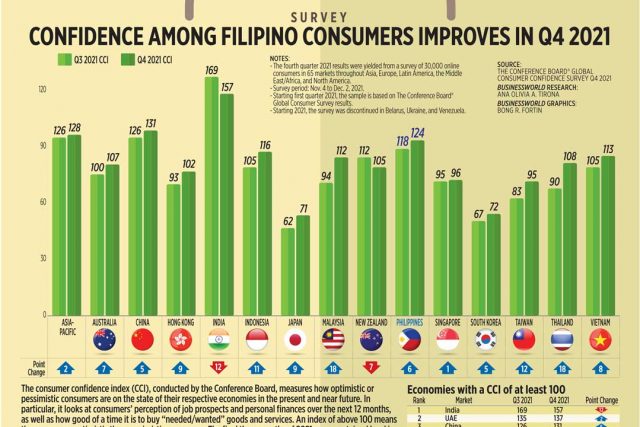
Confidence among Filipino consumers improves in Q4 2021

Confidence among Filipino consumers improves in Q4 2021

How PSEi member stocks performed — February 11, 2022

Here’s a quick glance at how PSEi stocks fared on Friday, February 11, 2022.


Nomura raises Philippines’ growth estimate for 2022

PHILSTAR

NOMURA Holdings, Inc. said it raised its 2022 economic growth forecast for the Philippines to 6.8% from 6.5% previously, but warned about the continuing risk posed by the pandemic and political instability associated with the impending change of government.

The projections were contained in a report, “Philippines: Election season in full swing” prepared by Nomura Chief ASEAN (Association of Southeast Asian Nations) Economist Euben Paracuelles and analyst Rangga Cipta.

“We raised slightly our GDP growth forecast in 2022, mainly reflecting stronger-than expected growth over the last two quarters,” according to the report.

“However, this is still below the government’s range of 7-9%, reflecting our view that still low vaccination rates and the risk of a re-acceleration in new COVID-19 cases could hinder further reopening which, alongside limited fiscal support, could weigh on growth,” it added.

Nomura likewise raised its growth projection for 2023 to 5.8% from 5.2% previously, also below the 7-9% growth target set by economic managers.

While the Omicron wave appears to have subsided, election season-related activities run the risk of increasing the case count again, which could in turn hinder further reopening, Nomura said.

Active cases rose by 3,792 on Saturday to 84,229, according to the Department of Health.

Further delays in vaccination will also pose a downside risk to growth this year, Nomura said.

The government hopes to fully vaccinate 77 million citizens by the end of March. The Health department estimates that more than 60 million are fully dosed as of Feb. 9.

The report also cited the possible implications of the Mandanas ruling on fiscal policy and government spending.

“This not only runs the risk of severe underspending, as local governments have weak absorptive capacity, but also leaves less resources for the central government to address the pandemic, in line with our view of some fiscal paralysis this year,” it said.

The Supreme Court ruled in favor of Batangas Governor Hermilando I. Mandanas, who successfully challenged the government’s restrictive definition of the portion of National Government revenue that local government units (LGUs) are entitled to. This year will be the first year that the more expansive definition of the LGU share of national revenue, known as Internal Revenue Allotments (IRAs), will be in force.

In response, the National Government has devolved many basic services to the LGUs commensurate to the LGUs’ increased IRA income.

Nomura also warned of the probability of a ratings downgrade for the Philippines this year.

“The likelihood of a credit rating downgrade by Fitch Ratings will also likely rise this year, owing to an uncertain medium-term fiscal consolidation path,” it said.

The Philippines’ debt levels and fiscal space will be tracked closely as the pandemic drags on, Sagarika Chandra, director, Fitch Asia-Pacific Sovereign Ratings, said at a speaking engagement last month.

In July, Fitch downgraded the Philippines’ “BBB” sovereign rating’s outlook to “negative” from “stable,” signaling a possible downgrade in the next 12-18 months. — Luz Wendy T. Noble

DoE’s Cusi urges NGCP to meet reserve contract requirement instead of seeking Palace intervention

By Marielle C. Lucenio

ENERGY Secretary Alfonso G. Cusi called on the power grid operator to meet the standards for power reserve contracts, which serve as a buffer in the event power plants fail unexpectedly, instead of asking the Palace to resolve its standoff on reserve levels with the Department of Energy (DoE).

“I don’t think (it’s necessary) all the National Grid Corp. of the Philippines (NGCP) has to do is comply with its obligation to provide firm reserves in accordance to the concession agreement,” Mr. Cusi told BusinessWorld in a text message.

The NGCP wrote to the Office of the President (OP) seeking its intervention, citing the need to ensure continuous power during the election period in May.

The DoE requires the grid to have reserve power, known as ancillary services (AS) on tap committed under firm contracts. The NGCP’s position is that full compliance with the firm-contract requirement will ultimately raise power prices because of the expense involved in committing reserves. It said it instead proposes to tap a network of AS providers under firm and non-firm contracts.

Non-firm contracts are verbal agreements to supply AS if needed.

In a news conference on Jan. 25, Electric Power Industry Management Bureau Director Mario C. Marasigan said the NGCP must have all of its power reserves committed under firm contracts to insulate it from power market disruption.

The NGCP’s letter to the OP specifically sought Palace intervention on demand-side management — referring to measures that will regulate consumer usage. Among its proposals were holiday declarations to ensure power is available during critical election and vote counting days.

“Non-working holidays can help as ensure there will be more power supply in the grid on the day and a day after the elections especially with the closure of commercial (establishments) and government offices,” NGCP Assistant Vice-President and spokeswoman Cynthia D. Perez-Alabanza told BusinessWorld via Viber Sunday.

The Jan. 31 letter, which the OP received on Feb. 3, noted that 2021 actual demand exceeded 2019 pre-pandemic demand by 296 megawatts (MW) with the 2022 projected demand peak expected to exceed 2019 levels by 1,043 MW or 9%.

This is the first time the NGCP has written to the OP regarding power supply matters. It is also the second time it has sought Palace intervention in connection with the elections.

The NGCP’s own data indicate a firm contract level equivalent to 809.3 MW. It estimates that it requires 1,776.7 MW more to meet the full coverage level on firm contracts. Non-firm contracts are equivalent to 2,807.2 MW.

Bohol returns to power spot market after restoration of grid

BW FILE PHOTO

BOHOL is back to the spot market trading after the Energy Regulatory Commission (ERC) lifted its trade suspension over the province after the grid operator has powered the 138-kilovolt (KV) Maasin–Ubay Line, which connects northeastern Bohol to Leyte Island.

“The recent resynchronization is a welcome development. In view of this, we are now lifting the market suspension in Bohol to ensure sustainable power supply and help in the province’s economic recovery after the devastation caused by Typhoon Odette,” the ERC said in a statement late Friday.

The 138-KV line connects the island to the grid and serves as an internal backbone, the National Grid Corp. of the Philippines (NGCP) said in a Viber message last month.

The province returned to the spot market operations on Feb. 10, a day after the grid operators reintegrated the island into the Visayas Grid.

Under ERC Resolution No. 12, Series of 2018, the regulator must determine when the spot market is ready to resume operations 24 consecutive hours after the grid operators resynchronize the portion of the grid that had been isolated.

On Jan. 17, the regulator directed the resumption of spot market trading on Visayas grid, except for Bohol, after the commission suspended the Wholesale Electricity Spot Market (WESM) on Dec. 16 due to oversupply conditions among power generators after Typhoon Odette (international name: Rai).

The grid operator said it restored all lines in Bohol on Jan. 18, 13 days ahead of the initial target, after the reconnection of the Ubay-Trinidad-Carmen 69kV line serving the franchise areas of Bohol 1 Electric Cooperative (BOHECO 1) and Bohol 2 Electric Cooperative (BOHECO II). — Marielle C. Lucenio

Clearer POGO tax regime seen producing steady revenue growth

PHILSTAR FILE PHOTO

THE GOVERNMENT expects to collect steadily higher revenue from Philippine Offshore Gaming Operators (POGOs) after more clearly defining their tax obligations, the Bureau of Internal Revenue (BIR) said.

Since the new taxes were enacted late last year, the BIR said the government has collected P1.22 billion from the industry.

“As we already have rules and regulations in place for the POGO industry, we expect POGO operations to continue and we foresee an increase in revenue arising from said activities,” the BIR said in a document sent to reporters on Friday.

An Act Taxing Philippine Offshore Gaming Operations, or Republic Act No. 11590, took effect on Oct. 9, 2021. Since the implementation date up to Dec. 31, the BIR collected P1.22 billion from licensees, service providers, and employees.

The law subjects offshore gaming licensees to 5% tax on gross gaming revenue. Foreign individuals employed by a POGO or its service provider must also pay 25% withholding tax on gross income.

The nongaming revenue of Philippine-based POGOs is subject to 25% regular income tax.

Of the P1.22 billion, the government collected P409.9 million in tax on gaming revenues, which includes gaming tax and franchise tax.

Including taxes not covered by the law, withholding taxes accounted for P709.4 million, while income taxes represented P89.7 million.

Value-added and percentage tax came in at P5.3 million, while documentary stamp tax generated P3.3 million. Other taxes amounted to P4.9 million.

“We started collecting from Philippine Offshore Gaming Operations (POGOs) entities and their employees (starting) 2018. This was not without any legal and administrative difficulties,” BIR said.

The passage of the law, it added, created a “clear regulatory and taxation framework for POGO entities and their employees.”

Tax collections from POGOs stood at P2.38 billion in 2018, P6.4 billion in 2019 and P7.18 billion in 2020, according to the Department of Finance (DoF).

With the new taxes, the DoF expects collections from POGOs to hit P76.2 billion by 2023.

POGOs have been leaving the Philippines during the pandemic, with a kock-on effect on demand for office space. — Jenina P. Ibañez

Country’s food exporters exhibit at Dubai trade fair

THIRTY-NINE food exporters are exhibiting their goods at Dubai’s Gulf Food Hotel and Equipment Exhibition Salon Culinaire 2022, known as Gulfood, which runs between Feb. 13 and 17. 

The Department of Trade and Industry (DTI), through its Center for International Trade Expositions and Missions (CITEM) said the Philippine delegation to Gulfood is the largest ever.

The exhibitors hope to “strengthen (their) presence within the Middle East and African region with Philippine halal-certified products, high-value coconut products, and other distinct and quality food products,” the DTI said in a statement.

According to Trade Secretary Abdulgani M. Macatoman, participation in Gulfood promises to expand the reach of Philippine halal products.

Other goods on offer are plant-based foods, processed marine, fruit and vegetable products, frozen native delicacies, noodles, coffee, cacao nibs, spices, and condiments.

Philippine participation is both onsite and virtual, via terminals displaying the IFEXConnect and FOODPhilippines websites.

“We are bringing a holistic-sourcing experience through a mix of digital and physical showcases in the pavilion that will act as the onsite storefront of IFEXConnect. It will showcase the exhibitors’ products in a curated retail store-like setting and these products can be viewed online through the QR codes that we set in place,” CITEM Executive Director Paulina Suaco-Juan said. 

Companies participating in Gulfood 2022 include Agrinurture, Inc., Brandexports Philippines, Inc./8VX Corp., Business Innovations Gateway, Inc., Century Pacific Food, Inc., CJ Uniworld Corp., FedWeration of People’s Sustainable Development Corp., Fenor Foods Corp., Fisher Farms, Inc., Fruits of Life, Inc., Gem Foods International, Inc., Greenlife Coconut Products Philippines, Inc., Innovative Packaging Industry Corp., Janicahh Food Products, JNRM Corp., KLT Fruits, Inc., Krystle Exports Philippines, Inc., Limketkai Manufacturing Corp., MagicMelt Food, Inc., and Marikina Food Corp.

Other food export firms present in the exhibition are Market Reach International Resources, Mega Global Corp., Miguelitos International Corp., Pasciolco Agriventures, Peter Paul Philippines, Philippine Grocers Food Exports, Inc., Q-Phil International Trading, Sabroso Chocolate Manufacturing, SandPiper Spices and Condiments Corp., SL Agritech Corp., Unilab, Inc. /Sekaya Global, Universal Canning, Inc., Cocoturmeric Health Products, KF Nutri Foods International, Inc., AG Pacific Nutriceuticals Corp., Nutrarich Nutraceutical Innovations, Ahya Coco Organic Food Manufacturing, Gacayan General Merchandise, PMTZ Care Marketing, and Malagos Agri-Ventures Corp.

“As one of the world’s biggest expos for the food and hospitality industries, Gulfood has historically attracted huge numbers and key players to Dubai. This year, more than 98,000 professional attendees from 120 countries are expected to discover different productions of over 5,000 exhibitors from a wide range of product sectors,” the DTI said.

During a recent speech at the Expo 2020 Dubai, Trade Secretary Ramon M. Lopez said various companies from the United Arab Emirates (UAE) are expected to invest $580.5 million in the Philippines by this year or next year.

Mr. Lopez said the estimated investments are a result of long-term interest by UAE firms. He added that the projected investments are expected to create around 3,900 jobs. — Revin Mikhael D. Ochave

DA’s Dar calls for more private sector investment to boost agri output

PHILSTAR

AGRICULTURE Secretary William D. Dar pitched private sector investors to support agriculture to ensure that the sector grows this year.

“We have untapped natural resources, a skilled labor force, and a government that supports investors with favorable national policies and incentives. We will be open to producing more and exporting more,” Mr. Dar said at a  briefing in Dubai.

The Philippine agriculture sector accounts for 43% of the workforce.

The crops subsector makes up nearly 60% of agricultural gross value added, led by banana, sugarcane, and mango.

Mr. Dar said that mango was an “untapped product with promising export and investment opportunities.”

He also recommended ventures involving coconut and pineapple.

“Our country’s coconut farmers are among the best in Southeast Asia, leading the world with the export of coconut products. We now have globally competitive processing technologies to power our production and exports with high-quality products,” he said.

“For pineapple, there is ample room for investment in planting materials, post-harvest facilities and technology. Overall, the potential value of our pineapple exports can hit up to $881 million,” he added.

He also cited opportunities in the fisheries sector, specifically for crab and tuna.

“Our waters are also home to an astonishing abundance of wildlife, including tuna. In fact, there are a lot of investment opportunities in tuna management,” he said.

“We can earn much more with sufficient investment in infrastructure and packaging technology,” he added.

Mr. Dar said the government is open to public and private enterprises.

“There are promising investment opportunities in infrastructure and technology in New Clark City, a nascent economic zone. We are expanding to renewable energy and solar irrigation, tapping into role of agri eco-tourism. Our policies allow investors excellent returns for food packaging and warehouses,” he said. — Luisa Maria Jacinta C. Jocson

The CEO as the overall risk executive

We all understand the critical role played by the Chief Executive Officer (CEO) in protecting and enhancing the company’s value, but we should consider that the CEO is also responsible for managing significant uncertainties that may become obstacles to the achievement of the company’s objectives or desired outcomes. These uncertainties are referred to as business risks. This makes the CEO the Overall Risk Executive (ORE), being technically the owner of all the critical risks of the company.

With this enhanced risk management responsibility given to the CEO, it is imperative that he or she is very much familiar with the framework, principles and process of risk management, particularly enterprise risk management (ERM), which has been recommended by the Philippine Securities and Exchange Commission (SEC) in its various codes of corporate governance. ERM has also been mentioned in the guidelines for well-governed companies released by the Philippine Stock Exchange (PSE).

THE RISK MANAGEMENT EXECUTIVE TEAM
The CEO as the ORE should be assisted by his executive team, usually composed of executives who are co-risk owners in the organization. This is usually referred to as their Risk Management Executive Team (RMET). In most companies, this could be the management committee or executive committee. Oftentimes, the RMET is composed of the following:

• Chief Financial Officer — for financial risk;

• Chief Operating Officer — for operational risk;

• Chief Information Officer — for information risk;

• Chief Legal Officer — for legal risk;

• Compliance Officers — for regulatory risk;

• Chief Innovation Officer — for new and emerging risk related to markets and competition; and

• Other key executives who are critical in identifying and managing uncertainty

Another role which is critical is that of the Chief Risk Officer (CRO) or its equivalent. The CRO is usually part of the RMET unless the board requires the CRO to functionally report to the Board Risk Oversight Committee (BROC) directly and to the CEO for administrative support (similar to that of the internal auditors). Another factor to consider is the sector to which the company belongs as there can be some regulations in the area of reporting protocols.

There is a common misconception that the CRO, which should ideally be a full-time role, is the owner of all the risks in the organization. The reality is that the CRO (again in a full-time capacity) does not own any risk except for the failure of the risk management process, making the CRO the owner of this process. It is important to note that the function/process owners (i.e., CFO, CIO, CLO, among others) are actually the respective owners of the risks within their purview.

The CRO’s primarily role is to make sure that all the members of the RMET, who are co-owners of the risks, are working together as a highly integrated, collaborative, cross-functional team. Let us liken the CRO to a conductor of an orchestra, whose job it is to ensure that all the different instruments and performers come together into a harmonious whole. As most of the risks are interrelated and have interdependencies, business risks should not be managed in silos to better maximize the resources needed to manage them. This also ensures that no critical risks fall between the cracks.

The CRO (or its equivalent) is the face of the CEO in the risk management activities of the company. But the tone from the top is the responsibility of the CEO supported by the leadership team.

THE CEO AT THE FOREFRONT OF IDENTIFYING AND MANAGING BUSINESS RISKS
In most of the board sessions that I have attended, the CRO reports to the BROC on behalf of the CEO. However, for questions on decisions made about how risks are prioritized and managed, the CEO provides his insights to the BROC and also solicits from the latter additional insights to further strengthen their risk management strategies. This emphasizes that the CEO is given the responsibility to ensure that critical risks that will significantly impact the company are identified and managed at acceptable levels.

A layman’s definition of business risk is “anything that keeps management awake at night.” That is why the CEO is also referred to as the chief paranoia officer in some circles. Of course, that is just to emphasize the critical role they play in risk management.

I would like to share an anecdote about a presentation I made to the board of one listed company. I showed a slide presenting the layman’s definition of business risk. The CEO immediately made a comment that he can sleep well at night. His colleagues in the board room said jokingly that this made the CEO their biggest risk, since he did not know they had risks to manage. At an event after that session, the CEO approached me and said, “You know, Leo, after your session with us, I can no longer sleep well at night.”

We had a good laugh but that said it all.

This article is for general information only and is not a substitute for professional advice where the facts and circumstances warrant. The views and opinions expressed above are those of the author and do not necessarily represent the views of SGV & Co.


Leonardo J. Matignas is the EY ASEAN risk management leader and a business consulting partner of SGV & Co.

ADVERTISEMENT
ADVERTISEMENT