LILLE’S Sven Botman in action with Chelsea’s Kai Havertz. — REUTERS
LONDON — Chelsea rediscovered some of their fluent attacking form as they beat Lille (2-0) in the first leg of their Champions League last-16 tie on Tuesday, but the talk at Stamford Bridge was more about the striker who did not play than the ones who did.
Record signing Romelu Lukaku sat on the bench as an unused substitute while fellow strikers Kai Havertz and Christian Pulisic claimed the goals that put reigning champions Chelsea in the driving seat to advance to the quarterfinals.
On Saturday, against Crystal Palace, Lukaku had the fewest touches of the ball — seven — ever recorded for a player on the pitch for at least 90 minutes in a Premier League game since such data began to be collected in full in the 2003-04 season.
That unwanted record added to the questions being asked about the Belgian’s role in Thomas Tuchel’s side which has often looked more dangerous this season when Lukaku was absent with injury or due to coronavirus disease 2019 (COVID-19).
Lukaku scored 24 league goals and provided 11 assists for Inter Milan last season to help them clinch the Serie A title and he got off to a good start in his second spell at Stamford Bridge after his move to London in August.
He scored three goals in his first three Premier League games and linked up well with fellow strikers.
But he has scored only two more goals in the league since then and comments that he gave in a television interview, in which he said Tuchel’s system did not suit him, only added to the sense that Lukaku is not the right fit for Chelsea.
Tuchel told reporters after the win over Lille that he had decided Lukaku needed a break after starting in a string of games recently.
“The focus was today on intensity, on a high-speed game and hard work off the ball,” the German coach said. “Romelu struggled in the last games to deliver that.”
Lukaku did score two of Chelsea’s three goals during the Club World Cup tournament that the Londoners won in Abu Dhabi earlier this month.
But the threat posed by Havertz throughout Tuesday’s defeat of Lille, and his hard work rate, suggested the German may get the nod ahead of the Belgian when Chelsea comes out of the tunnel at Wembley on Sunday for the League Cup final against Liverpool. — Reuters
THE Major League Baseball Players Association made a counteroffer with minor adjustments during Tuesday’s bargaining sessions with the league in Jupiter, Fla., multiple outlets reported.
The union lowered its ask of 80 percent of players with two to three years of service being arbitration-eligible down to 75 percent. It also reduced its call from an eight-team draft lottery to seven, one day after the league outlined a four-team lottery.
The MLBPA sought $30,000 increases of the players’ minimum salary year over year — up from $25,000 — raising the minimum from $775,000 in 2022 to $895,000 by 2026.
For the second time, management asked for the talks to continue with a federal mediator, but the union again refused.
The issue of the competitive balance tax, better known as the luxury tax, was not brought up Tuesday, reports said.
The two sides will return to the table Wednesday, with the league set to take its turn countering.
Spring training has been postponed as a result of the lockout, with games delayed until March 5 at the earliest.
A recent report by USA Today said the owners provided a deadline of Feb. 28 for a new agreement in order to begin the regular season on time. Opening Day is tentatively slated for March 31. — Reuters
PHIL Mickelson apologised on Tuesday for comments he made about the proposed Saudi-backed Super Golf League that set off a firestorm of controversy and said he planned to take “time away” from the sport.
In a November interview that was published on the firepitcollective.com last weekend, Mickelson criticised the government of Saudi Arabia for its “horrible record” on human rights, which he said included the 2018 killing of journalist Jamal Khashoggi and the execution of gay people.
Despite the government’s “scary” actions, he said he would use the prospect of a new, highly-lucrative tour to gain economic leverage over the PGA Tour, a position that drew the ire of fellow golfers including Rory McIlroy and Justin Thomas.
Saudi Arabia’s government denies accusations of human rights abuses.
“Although it doesn’t look this way now given my recent comments, my actions throughout this process have always been with the best interest of golf, my peers, sponsors, and fans,” Mickelson said at the beginning of a lengthy social media post, where he claimed his previously reported comments were “off the record,” a charge the journalist denies.
“The bigger issue is that I used words I sincerely regret that do not reflect my true feelings or intentions. It was reckless, I offended people, and I am deeply sorry for my choice of words. I’m beyond disappointed and will make every effort to self-reflect and learn from this.”
The six-time major champion said golf “desperately needs change” and that real change is always preceded by disruption.
“I have always known that criticism would come with exploring anything new. I still chose to put myself at the forefront of this to inspire change, taking the hits publicly to do the work behind the scenes.”
No golfers have publicly signed up for the proposed rival league, which is trying to lure top players away from the PGA Tour with the promise of huge paydays.
Mickelson praised LIV Golf Investments, Super Golf League’s financial backer, and called the people he has worked with there “visionaries”.
“They have a clear plan to create an updated and positive experience for everyone including players, sponsors, networks, and fans,” he said.
But the 51-year-old closed by saying he planned to take a break from the sport.
“The past 10 years I have felt the pressure and stress slowly affecting me at a deeper level,” he said.
“I know I have not been my best and desperately need some time away to prioritize the ones I love most and work on being the man I want to be.”
Accountancy firm KPMG, who began sponsoring Mickelson in 2008, said shortly after his statement that both parties had “mutually agreed to end our sponsorship effective immediately.” — Reuters
RUSSIA’S Daniil Medvedev defeated Benoit Paire of France 6-3 6-4 in the first round of the Abierto Mexicano tournament in Acapulco on Tuesday to get his quest for the world number one ranking off to a winning start.
World number two Medvedev is looking to ascend to the top ranking for the first time by displacing Serbian Novak Djokovic, who is competing at the Dubai Tennis Championships.
Djokovic will be forced to relinquish the crown even if he wins Dubai for a sixth time, provided the Russian wins the ATP 500 event in Acapulco, where he is making his tournament debut.
“If Novak would not be playing, then maybe it would be a little bit more in my mind because it would only be me and it depends on what I can do,” Medvedev said.
Taking to the main showcourt after Medvedev’s win, Rafa Nadal breezed past 100th-ranked American Denis Kudla 6-3 6-2 in his first match since winning the Australian Open last month for his 21st Grand Slam title.
The 35-year-old Spaniard seemed to have some problems with the humidity on a warm night in the coastal resort town and decided to save as much energy as he could, sealing the contest in 76 minutes with his 16th forehand winner and 26th overall.
Nadal lost just four points on his serve while breaking his opponent three times to race to his 11th consecutive win in the 2022 season.
Medvedev’s contest also appeared to be a one-sided affair when Paire dumped a lifeless forehand into the net to hand the Russian the first set in 51 minutes. But Paire flexed his muscle in the second, attacking the Russian’s serve for a 4-2 lead.
Playing for the first time since his defeat to Nadal in the Australian Open final, Medvedev kept his focus and outworked the Frenchman in a back-and-forth deuce game to level at 4-4 and sealed the win when Paire’s backhand sailed into the net.
“It’s always not easy to come back after some rest and some time off competition,” Medvedev said. “Sometimes better, sometimes worse.
“I felt like my sensations were not at the top today, but I managed to fight until the end against a very tough opponent and I’m happy that I managed to win.”
In other contests, Italian world number six Matteo Berrettini won the first set 6-4 against American Tommy Paul but retired with injury while trailing 1-5 in the second.
Australian John Millman was also forced to retire against American Marcus Giron when he suffered a freak injury by hitting the tennis ball into his own eye. — Reuters
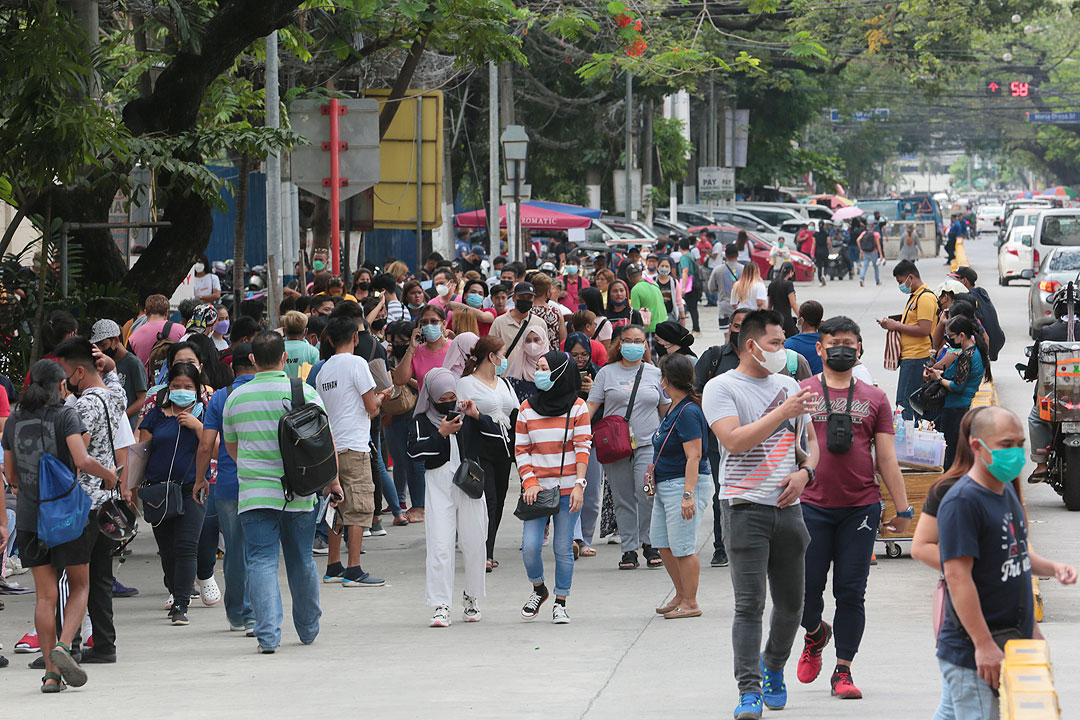
PEOPLE go about their daily lives as seen at a busy stretch of Taft Ave., Manila. — PHILIPPINE STAR/ MICHAEL VARCAS
Metro Manila mayors met Tuesday night, according to news reports quoting Parañaque City Mayor and Metro Manila Council (MMC) Chairman Edwin Olivarez, and “unanimously” voted to downgrade the National Capital Region to Alert Level 1 starting next week, March 1. Metro Manila is under Alert Level 2 until Feb. 28.
Personally, I have misgivings about the recommended downgrade. I believe we need to give ourselves a longer runway. Perhaps until after Easter on April 17. That is, if we can maintain the downtrend in COVID-19 cases and related hospitalizations until then. To me, the question is not whether the NCR (National Capital Region) qualifies for a downgrade by March 1, but whether Metro Manila and its residents are actually ready for further easing of restrictions from then, and onwards.
Timing is crucial, especially now that school is still ongoing but mostly online; public transportation is not at 100% capacity; and, fuel prices are at all-time highs and continue to rise. Add to this the start of the campaign season for the 2022 elections: Feb. 8 for national candidates, and March 25 for local candidates.
I would not want to think the mayors are batting for Level 1 by next week mainly as a way to court more votes or to make it easier for their supporters to prepare, and then go out and campaign starting March 25. I am worried that campaign sorties, and similar activities, under Alert Level 1 can become super-spreader events for COVID-19, and might just prompt another surge. The same goes for Holy Week events under Alert Level 1.
By government definition and rules, Alert Level 1 can be recommended for areas “wherein case transmission is low and decreasing, and total bed utilization rate and intensive care unit utilization rate is low.” This is based on IATF (Inter-Agency Task Force for the Management of Emerging Infectious Diseases) Guidelines for the implementation of the Alert Level system nationwide. Given recent statistics, Metro Manila qualifies for a downgrade.
Under the same rules, Level 1 also means “intrazonal and interzonal movement shall be allowed without regard to age and comorbidities,” and “all establishments, persons, or activities, are allowed to operate, work, or be undertaken at full on-site or venue/seating capacity provided it is consistent with minimum public health standards; provided further, that face-to-face classes for basic education shall be subject to prior approval of the Office of the President.”
In short, under Alert Level 1, perhaps other than keeping masks on in public and best-efforts in maintaining physical distance, everything goes for Metro Manila businesses and residents. No more restrictions on capacity and movement. It will be as if COVID-19 is already a thing of the past, and that people need not worry about the virus anymore. While this may not really be the case, the downgrade will surely bring on the feeling that the battle is over and has been won.
Until the next surge occurs.
And this is where the problem lies for me. We have always been just a step ahead of the next COVID-19 surge. In the near future, COVID mutations will continue to outpace medical advances intended to eliminate the virus. Medical science will continue to play catch-up at least until the end of the year. And other than present ad hoc tools that have been in use since March 2020, nothing new has been implemented or has been put in place for the long term.
Under Alert Level 2, some local restrictions continue to apply with respect to “intrazonal and interzonal movement.” Also, establishments or activities are allowed only up to 50% indoor venue capacity for fully vaccinated individuals and those below 18 years of age, even if unvaccinated, and 70% outdoor venue capacity. Provided, that all workers/employees of these establishments are fully vaccinated against COVID-19 and minimum public health standards shall be strictly maintained.
By next week, however, if Metro Manila mayors will have their way, all these limits will be removed, including those on face-to-face or in-person classes for schools; in-person religious gatherings; licensure examinations; and transactions at government offices, among others.
As for the private sector, offices will resume work on site, and all restrictions will be removed on dine-in services; personal care establishments such as barbershops, hair spas, hair salons, and nail spas; fitness studios, gyms, and venues for individual non-contact exercise and sports; film, music, and television production; contact sports; funfairs or kid amusement industries such as playgrounds, playroom, and kiddie rides; and, venues with live voice or wind-instrument performers and audiences such as in karaoke bars, clubs, concert halls, and theaters.
Is Metro Manila really ready to go back to normal? For that is what Level 1 means: Business-As-Usual, but with face masks. In the case of Makati City where I live, from March 2021 to date, it saw the number of local COVID cases peak at 1,544 on April 22, 2021 (old variant), then on Sept. 9, 2021 at 3,298 (Delta), then on Jan. 30, 2022 at 2,435 (Omicron). The lowest case count ever was on Dec. 21, 2021 at 16 active cases. Even with that, we never went to Alert Level 1. As of Feb. 22, 2022, the active case count was still at a higher 95.
My take is that we are far from being in the clear. And while cases may be declining to date, and that based on government guidelines we can already be downgraded to Alert Level 1, I still doubt if we are ready for it. There have been mitigating factors, of course, including the massive vaccination effort since 2021. But with lifting of restrictions, the demand for vaccination will also likely wane.
We need to give Alert Level 2 a little more time to work its magic, and for authorities to ensure that based on available data, the risk of another surge is minimal. Yes, I call for at least one more month under Alert Level 2, if feasible, especially now that we have again opened our borders to travelers and foreign visitors. We shouldn’t rush into shifting to Alert Level 1. I believe it can wait until after Holy Week.
Complacency was, is, and will always be the enemy. In December, under Alert Level 2, we celebrated the Christmas holidays amidst the arrival of Omicron. But people confidently went out, on the back of the declining case count. A surge occurred, but luckily, the healthcare system managed to cope with it. Still, a lot of people got sick in December and January, with case numbers hitting new highs.
Invariably, as we downgrade to Alert Level 1 by March 1, complacency will surely be a problem once again. But will luck still be on our side in the next surge? Or should we stop relying on luck and exercise restraint instead?
Marvin Tort is a former managing editor of BusinessWorld, and a former chairman of the Philippine Press Council
SMART PHONES have made life so much more convenient for everyone — well, apart from compliance sheriffs and record keepers at global banks.
HSBC Holdings Plc alerted investors on Tuesday that it was being investigated in the US for its bankers’ use of WhatsApp and other personal messaging services for business purposes. It put the news in a single line in its 2021 results and declined to give more detail.
This is the latest of several signs of a growing crackdown by US market regulators worried that communications convenience has led to complacency. But this isn’t about finance alone. In an era of greater freedom to work wherever, monitoring messages is going to become an uncomfortable issue for employers and their bosses in many more industries.
Bankers’ use of WhatsApp and similar tools has grown alongside the rest of society, but bankers have serious regulatory responsibilities to track information and record who has had access to private news about companies or pending trades. Concern about this has been bubbling for years, but the unavoidable switch to remote working for most people during the COVID-19 pandemic over the past two years has sharpened regulators’ attention on communications in financial markets.
Deutsche Bank AG has begun tightening up its rules and monitoring around messaging apps, Bloomberg reported this month, while Credit Suisse last year asked employees for access to their personal mobile phones.
It’s not that banks or regulators think they can block people from quick and easy modern technology, it’s about ensuring that complete records are kept. Banks need to be able to show that inside information has been controlled and procedures for things like risk management were followed – for banks’ own financial safety as well as for preventing wrongdoing.
JPMorgan Chase & Co.’s failures to ensure proper records were kept, including among senior bankers, led to $200 million in fines late last year from the Securities and Exchange Commission (SEC) and the Commodity Futures Trading Commission (CFTC). The SEC said the failures had hindered several investigations.
HSBC, which is being investigated by the CFTC, declined to say whether or not it could face any fines. But Ewen Stevenson, its chief financial officer, said the bank “obviously” has procedures and requirements governing staff use of non-official communications.
Banks aren’t alone. Politicians’ use of personal communications — private e-mail accounts and messaging apps — has been tied up in several scandals. In the US, Hilary Clinton’s personal e-mail use became a major point of contention in the 2016 Presidential election. In the UK, there have been calls for inquiries into health ministers’ use of non-official e-mails to deal with people seeking government business related to pandemic-fighting equipment.
In fact, most companies of any size ought to think harder about what communications they need to archive. It’s not only tightly regulated financial activities that can be investigated. In late 2019, the Dutch competition authority said it hit an unidentified company that was being investigated for anticompetitive practices with a roughly $2-million fine because staff deleted WhatsApp messages during a dawn raid.
Most of us want to resist our work lives bleeding into our personal lives. Companies have growing reasons to keep a good barrier there too.
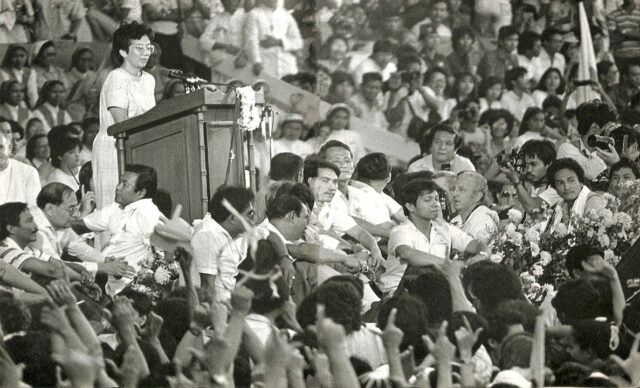
AMID thunderous cheers, President Corazon Aquino addresses her people. — BIEN BAUTISTA / PRESIDENTIAL MUSEUM AND LIBRARY PH (2010-2016)
Those who were at EDSA 36 years ago, from Saturday, Feb. 22 to Feb. 25, 1986, and the immediate events leading to the People Power uprising must still have vivid memories of history unfolding before their eyes.
Ferdinand Marcos had called for a presidential snap election one December morning (in Manila) in 1985 before an astonished American media during a press conference. American, in fact, western, media had been traditionally rough on him and other dictators.
They did not expect Marcos to risk his presidency by calling for an election in the middle of widespread protests triggered by the execution of exiled opposition leader and Marcos’ main rival, Ninoy Aquino. The inescapable conclusion was that US President Ronald Reagan had “convinced” Marcos to get a new mandate. For Americans, holding elections in the face of a serious political crisis in leadership and doubts about the acceptability of the incumbent is their standard formula.
President Reagan and his first lady, Nancy, were friends of the Marcoses dating back to 1966 when both men assumed their respective positions as president (Marcos) and governor of California (Reagan). One interesting highlight of this friendship was that the Reagans were the high-profile guests of the Marcoses during the inauguration of the Cultural Center of the Philippines (CCP) in 1967. It was Imelda’s first step in owning the title “patroness of the arts.” The Film Center and the Philippine International Convention Center (PICC) followed in rapid succession.
Marcos announced that the elections would be held on Feb. 7, 1986. The campaign period started shortly with Marcos running under the monolithic Kilusang Bagong Lipunan (KBL) while Ninoy’s widow, Corazon or Cory, ran under the coalition United Nationalist Independent and Democratic Opposition or UNIDO.
The campaigns of both sides got off to rousing starts, with the KBL using massive government resources and the Local Government infrastructure to overwhelm the Opposition. The latter, however, leaned on dissatisfaction with Marcos’s human rights record, widespread poverty, economic mismanagement, and the flawed character of the regime that depended on brutal force to remain in power. In contrast, the campaign of Corazon Aquino evolved into a people’s campaign with volunteers from all walks of life casting their lot with the opposition that was, for most of the people, the last hope for change. Corazon Aquino campaigned from the perspective of moral ascendancy and restoring trust in government. She sought to offer a contrast between herself and Marcos. She would say. “I’m everything Marcos is not,” which prompted an angry response from the grizzled political veteran supposedly used to political campaign rhetoric and needling.
But the campaign went way beyond needling and resulted in mayhem: I was at the Cory Aquino Media Bureau and daily we monitored opposition campaign casualties, injuries, and disappearances. We kept a running total of those confirmed killed or injured, abductions, etc. We did not keep tabs anymore of opposition rallies and motorcades being harassed, broken up, and denied permits — they were too many to be kept in our floppy disks which were then used in the mid-1980s. There were instances of uncommon brutality and savagery: a pastor campaigning for Corazon Aquino was murdered and strung up a tree in Quirino province; an opposition partisan in Tarlac was murdered and beside his corpse were his thumb and forefinger in the “L” gesture for “Laban” cut off from the rest of his hand, for everyone to see. Indeed, a chilling reminder for those who went against Marcos. A few days after the EDSA uprising, President Aquino instructed me to turn over my files to newly appointed chairman of the Presidential Commission on Human Rights, former senator Ka Pepe Diokno.
On election day, the Media Bureau was inundated, like all other offices allied with the opposition, by reports of violence and fraud. Who could forget Elizalde Diaz from Bicol rushing into our office pursued by goons all the way from the Maharlika or Pan-Philippine highway to Manila? A few moments later, men in bloodied clothes and bandaged heads sought shelter and assistance from the Media Bureau. All in all, the day had become a gloomy one for the opposition as reports of intimidation, voter denial, and voter suppression instigated by the Commission on Elections (Comelec), then led by the troika of Chairman Victorino Savellano, Vicente Santiago, and Jaime Opinion, clogged the bureau’s reporting system which was not equipped for such. Public disgust with the Comelec was expressed in a variety of ways, including the throwing of human excreta in Opinion’s house in Quezon City.
The elections were held with international observers and media, led by the then six-year-old CNN, chronicling the cheating, the intimidation. Seen on American prime time TV were ordinary Filipinos protecting ballot boxes from being snatched by armed Marcos goons in opposition strongholds. International media showed Comelec tabulators walking out of the main hall of the PICC when they noticed that trends were being manipulated by Comelec officials to favor Marcos. The courageous ladies sought protection with the Redemptorist Fathers in nearby Baclaran church where they were interviewed and they revealed the organized cheating taking place.
Observers sent by Reagan, mostly belonging to his own Republican party, confirmed the massive fraud, cheating, and election violence that could very well defeat the purpose for which he arm-twisted Marcos to call the elections. Reagan would later go on television to report to the American people that — as a concession to Marcos and on the advice of Paul Manafort (as early at that time, already serving as a lobbyist for Marcos) — “cheating occurred on both sides,” to the shock and dismay of Filipinos. To this date, Manafort, who had been sentenced to prison for various offenses during the administration of his fellow Republican and patron, the equally unethical Donald Trump, is remembered for his shady deals including getting a Russian puppet elected president of Ukraine. What a group — Manafort, Trump, Marcos, and Reagan!
As expected, Comelec declared Marcos the winner by about 1.5 million votes while election monitor Namfrel (National Citizens’ Movement for Free Elections) announced from its main tallying center, La Salle Green Hills, that Corazon Aquino won by a little over half a million votes. The Comelec announcement precipitated the proclamation by the KBL-dominated parliament of Marcos as president. On Feb. 20, Corazon Aquino led more than a million people in a prayer rally at Luneta Park and promptly declared a boycott of Marcos crony-owned businesses, just short of calling for civil disobedience a la Mahatma Gandhi.
On the other hand, the military had started to implement its own plans for a rebellion, riding on the massive dissatisfaction and the rampant election cheating that even Marcos’s own defense minister, Juan Ponce Enrile, denounced. With Jaime Cardinal Sin and a big sector of the Catholic Church hierarchy, and substantial portions of the military led by General Fidel V. Ramos expressing support for Corazon Aquino, Reagan, through Republican Senators Paul Laxalt and Richard Lugar, advised Marcos to “cut and cut clean” and leave the Philippines. Reagan did not see it fit to talk to Marcos, who said he was “so very disappointed” that his old friend could be of no help to him during this moment of great need.
Marcos fled to Guam and then to Hawaii, bringing with him tons of cash, jewelry, securities, and documents that helped put together a paper trail leading to Marcos’ ill-gotten billions of dollars.
There are many more highlights of the EDSA People Power uprising worth telling. Each person who participated in the uprising, especially those who had opposed Marcos as early as 1969 when he won an unprecedented reelection, has fascinating and breathtaking stories to tell. And they should be told over and over again to counter the massive and well-funded historical falsification.
Certainly, the EDSA uprising and the struggle against untruths are worth retelling.
Philip Ella Juico’s areas of interest include the protection and promotion of democracy, free markets, sustainable development, social responsibility and sports as a tool for social development. He obtained his doctorate in business at De La Salle University. Dr. Juico served as secretary of Agrarian Reform during the Corazon C. Aquino administration.
THERE are advantages to delaying certain decisions. In a recent outburst by a retiring government official decrying delay of a decision as a political tactic, there is a hidden agenda, even when this is too obvious to be kept secret. Delay of a decision on a disqualification issue makes the candidate viable, for a while.
Procrastination, which etymologically means “forward to tomorrow” refers to deferring action and avoiding a sense of urgency on anything.
Delay is considered a valid subject in behavioral economics. Delaying a deed has economic consequences. Opportunity cost is one concept that delay brings up. Not doing something in a timely manner (say, the sale of a property prior to the pandemic) is sure to incur opportunity losses.
Lawyers use delay as a reasonable strategy. They routinely reschedule the submission of their response to a “show cause” order. Can a decision be “dribbled” until after the retirement of a pesky judge? Delay as a strategy is surely taught in law school as it seems to be used too often by its practitioners.
Cramming is one form of procrastination seen as a bad management practice, seemingly disdainful of planning or an orderly allocation of time. (You lack a sense of urgency.) The student who submits his book report a week ahead of the deadline is seen as more conscientious than the one panting to get the report through the door with only minutes left before the teacher shuts it. Online submissions can be timed to the last second. Still, the procrastinator may have gotten more help and insights from those who submitted early. He may even get a better grade than the eager beaver he copied from.
Another form of procrastination involves deferring gratification, like getting a massage only after working out in the gym. Reward is seen as having to be earned and therefore needing to be delayed.
Does deferring gratification mean getting unpleasant tasks out of the way first? Do they pay for airline tickets two months in advance and check-in at the airport two hours before departure? Are they always 15 minutes ahead of schedule in attending meetings? In a virtual meeting, they are also ahead of schedule— I’m now at the “waiting room.”
The two types of procrastinators are often at odds with each other. Those who defer gratification are natural masochists who hate crammers on sight.
Deferring gratification is seen as a good character trait. Postponing difficult tasks until the last minute is not viewed in the same light. Crammers are never on time and have the most optimistic estimates of drive time (flying time of crows). When setting the alarm clock for a certain time, crammers only wake up to stop the ringing and then go back to sleep, only to scramble awake later predictably behind schedule for an appointment. They postpone meetings regularly. Even working from home, crammers can be late going down the stairs, and forgetting their shorts.
Still, delaying tactics can offer advantages.
The late opinion-giver learns from the mistakes of eager beavers whose ideas get shot down first. In a panel discussion, the last panelist has the most brilliant insights, synthesizing or demolishing previous ideas.
The “first mover” advantage is overrated. Pioneers can lose money as their copycats learn the business and avoid their mistakes. In the fast-food business, the copycat who introduced “unlimited rice” was acquired by the pioneer at a premium.
Most noteworthy entrepreneurs and successful leaders in their youth were crammers, or even copycats. Pressed for time, these enemies of urgency and getting there first bent the rules to get their assignments submitted in the nick of time, without having to put in the required days for research and writing. In this, they depended on pleasure-deferring classmates to bail them out.
The Roman general Quintus Fabius Maximus had appended the word “Cunctator” (or Delayer) to his name, preferring delay and a war of attrition and keeping close rather than engaging Hannibal and his elephants in a pitched battle. This wearying strategy worked at that time. It is too at the heart of the guerrilla strategy (hit and hide) in more recent wars against formidable foes, as in the Vietnam war. And more recently in Afghanistan.
Of course, the ultimate delayer is the one who just opts out of the process — I have better things to do. Is this dereliction of duty going to be harmful? What will the surveys say? And more importantly, the elections in May.
Allan Jay Dumanhug, an ethical hacker and startup cybersecurity mentor, has been appointed as CEO of Secuna, a Philippine cybersecurity firm. Previously its chief information security officer, he replaces Iannis Hanen, who has been appointed Secuna’s vice-president for global sales.
Mr. Dumanhug will be responsible for overseeing operations and driving business growth in the Philippines and the Asia Pacific region. Drawing from his mentorship work for startups through Ideaspace Philippines, Mr. Dumanhug will also lead the company’s efforts in providing solutions for both multinationals and small businesses alike.
One perennial challenge in the cybersecurity landscape is a lack of security training for professions in the field, he told BusinessWorld. This gap is exacerbated by a lack of public awareness of cyberattacks, which Mr. Dumanhug said gives rise to inevitable attacks.
“Security is not a priority of [either] private or public entities,” he said, adding that the appropriate response to the growing sophistication of cybercriminals is innovation of existing solutions.
No company is immune to cyberthreat actors, GoDaddy noted in 2021. The impact of a compromised online resource, the web hosting provider said, can lead to issues such as penalization, blacklisting, and loss of trust.
Worldwide, the cost of cybercrime is projected to reach $8 trillion by 2022.
Secuna – whose name is a combination of “sec” (for “security”) and “una” (the Filipino word for “first”) – counts Palawan Express, Kumu, and Paymongo as among its clients. It has also worked with a few government agencies, said Mr. Dumanhug.
“We are open to also working with the national government,” he added in an e-mail. “We believe that government agencies should be open to collaborate with private entities like what the US, Singapore, and UK governments are doing.” – Patricia Mirasol
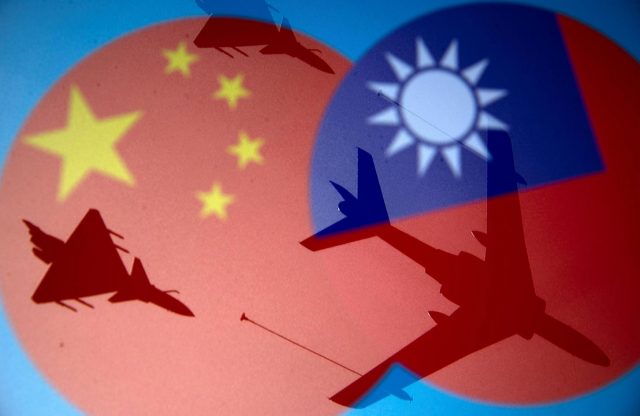
TAIPEI — Taiwan is nervous that Beijing may take advantage of a distracted West to ramp up pressure on the island amid the crisis in Ukraine, but there have been no unusual maneuvers by Chinese forces in recent days, officials in Taipei say.
The government, always on alert to what they view as Chinese provocations, last month set up a Ukraine working group under the National Security Council. China views Taiwan as its own territory and has stepped up military activity near the self-governing island during the past two years.
President Tsai Ing-wen told a meeting of the working group on Wednesday that Taiwan must increase its surveillance and alertness on military activities in the region and tackle foreign misinformation, though she did not directly mention China.
Although Taiwan’s government says the island’s situation and that of Ukraine’s are “fundamentally different”, Ms. Tsai has expressed “empathy” for Ukraine’s situation because of the military threat the island faces from China. Read full story
Taiwan Foreign Minister Joseph Wu warned in two foreign media interviews this month that they were watching very closely to see whether China would take advantage of the Ukraine crisis to attack.
“China may think about using military action against Taiwan at any moment, and we need to be prepared for that,” he told Britain’s ITV News.
A senior Taiwan official familiar with the government’s security planning told Reuters that the chances of a sudden uptick of military tension are “not high,” but that Taipei has been watching closely for any unusual Chinese activities.
The person pointed to the People’s Liberation Army’s joint military drills in areas between Taiwan’s northeast and near the Miyako Strait close to Japan’s southern islands, which have become more frequent in the past month or so.
The drills included fighter jets, bombers and warships and were meant to increase pressure on Japan, the official said, who declined to be identified due to the sensitivity of the matter.
A Japanese Defence Agency spokesperson declined to comment.
Ma Xiaoguang, a spokesperson for China’s Taiwan Affairs Office, said on Wednesday that Taiwan’s government in concert with the West was using Ukraine to “maliciously hype up” military threats and whip up anti-China sentiment.
WESTERN CONCERN British Prime Minister Boris Johnson said on Saturday that if Western nations failed to fulfil their promises to support Ukraine’s independence, it would have damaging consequences worldwide, including for Taiwan.
Two Taiwan-based diplomatic sources told Reuters that President Xi Jinping’s primary focus at the moment was preparing for a tricky once-every-half-decade congress of the ruling Communist Party this year, where he will cement a historic third term in office.
“Once that’s done, he will be able to focus once more on Taiwan,” said one of the sources, who spoke on condition of anonymity as neither was authorized to speak to the media.
Taiwan, which rejects Beijing’s sovereignty claims, has lived under the threat of Chinese invasion since the defeated Republic of China government fled to the island in 1949 after losing a civil war to the Communists.
Su Chi, a former head of Taiwan’s Mainland Affairs Council under the previous administration of President Ma Ying-jeou, said Taiwan, like Ukraine, was caught between two great powers.
Mr. Xi and Russian President Vladimir Putin deal with their respective territorial claims very differently, added Su, who runs the Taipei Forum think tank.
“So far Xi has been firm but gradual, not lightning fast like Putin.”
One Western security official familiar with policy planning toward China said Beijing was most likely looking at how the Ukraine situation developed in terms of sanctions on Russia.
“It’s probably seen as a laboratory by China, on what they might face in a Taiwan contingency,” the official said, referring to how Western countries may react to a Chinese attack on the island.
The Taiwan official said there were some similarities between Mr. Putin’s and Mr. Xi’s military moves in recent years, pointing to Russia’s “grey zone” tactics towards Crimea before annexing it in 2014. Taipei has called China’s frequent air missions near the island a “grey zone” tactic.
“Rather than conjecturing whether Xi would restrain actions before the party congress, it is more realistic to analyze its daily military activities and make preparations accordingly,” the official added. — Reuters
A SHEET of 1000 Russian Rouble notes at Goznak printing factory in Moscow, Russia, July 11, 2019. — REUTERS
THE FORTUNES of Russia’s super-rich have tumbled $32 billion this year, with the escalating conflict in Ukraine poised to make that wealth destruction much larger.
US President Joseph R. Biden on Tuesday unleashed sanctions targeting Russia’s sale of sovereign debt abroad and the country’s elites, and said he’s sending an unspecified number of additional US troops to the Baltics in a defensive move to defend NATO countries.
Gennady Timchenko heads the list of Russian billionaires who have seen their fortunes drop, with almost a third of his wealth disappearing since Jan. 1, according to the Bloomberg Billionaires Index, a listing of the world’s 500 richest people.
Mr. Timchenko, 69, the son of a Soviet military officer who met and befriended Russian Federation President Vladimir Putin during the early 1990s, now has a fortune of about $16 billion, with the bulk of his wealth derived from a stake in Russia gas producer Novatek, according to Bloomberg’s wealth index.
Fellow Novatek shareholder Leonid Mikhelson’s fortune has tumbled $6.2 billion this year, while Lukoil Chairman Vagit Alekperov’s net worth has declined about $3.5 billion in the same period as the energy company’s stock has slid almost 17%.
The country’s 23 billionaires currently have a net worth of $343 billion, according to the wealth list, down from $375 billion at year-end.
Markets slumped further this week after Mr. Putin recognized two separatist republics in Ukraine, leading to Germany halting an energy project with Russia and the UK imposing sanctions on five of the country’s banks and three of its wealthy individuals, including Mr. Timchenko.
Also on the UK’s sanctions list are Boris Rotenberg, 65, and his nephew, Igor, 48, whose families made their fortune through gas-pipeline construction firm Stroygazmontazh.
Igor’s father, Arkady, one of Mr. Putin’s former judo sparring partners, sold the pipeline firm in 2019 for about $1.3 billion. He purchased a minority stake from his younger brother Boris five years earlier when both siblings and Mr. Timchenko were hit with US sanctions over Russia’s annexation of Crimea. — Bloomberg
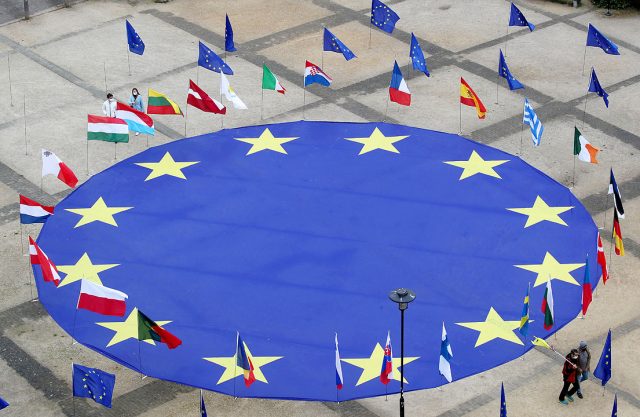
BRUSSELS— European Union (EU) countries agreed on Tuesday to open their borders to travelers from outside the bloc who have had shots against coronavirus disease 2019 (COVID-19) authorized by the World Health Organization (WHO), easing restrictions on those who received Indian and Chinese vaccines.
The EU has so far authorized vaccines produced by Pfizer-BioNTech, Moderna, AstraZeneca (when produced in Europe), Johnson & Johnson and Novavax.
In addition to these shots, the WHO has also approved the vaccines produced by Chinese makers Sinopharm and Sinovac and by Indian company Bharat Biotech. It has also authorized the AstraZeneca vaccine made in India by the Serum Institute.
Until now, most EU countries have not admitted people from outside the bloc travelling for non-essential reasons if they have been vaccinated with shots not approved in the EU.
“Member states should lift the temporary restriction on non-essential travel to the EU for persons vaccinated with an EU- or WHO-approved vaccine,” said a recommendation adopted on Tuesday by EU governments which would be applicable from March 1.
Restrictions will be lifted for travelers who received the final dose of the primary vaccination cycle at least 14 days and no more than 270 days before arrival. Boosted travelers will also be accepted.
EU states also agreed to lift a temporary restriction on non-essential travel for people who have recovered from COVID-19 within 180 days prior to travelling to the EU.
For people inoculated with a WHO-approved vaccine, EU states could also require a negative PCR test taken at the earliest 72 hours before departure and could apply additional measures such as quarantine or isolation. — Reuters