Home Blog Page 6737

SMC aims to cut in half its water use by 2025
SAN Miguel Corp. (SMC) said it is working on reducing its group-wide water consumption by 50% in three years.

“Water is a valuable resource not just for San Miguel, but for all of us. We have not stopped working on improving water use efficiency across all our businesses as we all continue to face water scarcity challenges,” SMC President Ramon S. Ang said in a statement.

Since 2017, SMC reported saving 27.4 billion liters of water under its “Water For All” water stewardship initiative.

Mr. Ang said that the company saved 4.54 billion liters of water in 2021, which was a 18.4% cut in the company’s water use compared with 18.09% in 2019 and 13% in 2020.

“Savings, however, dropped in 2020 due largely to the shutdown of most of the company’s facilities amid the pandemic. Plant shutdowns and intermittent production are inefficient, resulting in more frequent startups and draining of water tanks in between, so more water is used as opposed to having the facilities continuously running,” he added.

In 2021, the company reported a return to pre-pandemic water savings, with an improvement, as lockdown restrictions eased and operations had more mobility.

“From a water savings perspective, we seem to have recovered from the pandemic, but we’re still challenged by low production volumes and continuing inefficiencies,” Mr. Ang said.

“The good thing is the majority of our businesses still showed improvement in 2021, particularly Northern Cement, San Miguel Foods, SMC Infrastructure and SMC Global Power. Ginebra San Miguel also improved slightly. Petron also improved, it still has the highest accumulated water savings, about 15.29 million cubic meters. But this is not yet their former peak performance,” he added.

To reach its water saving target, SMC utilizes sea water, water recycling, and rainwater harvesting for cooling machines, cleaning, and other utility, non-product water usage.

SMC has also mandated that all its newly built facilities be fitted with rainwater collection systems.

“A number of older facilities are also being retro-fitted to increase rainwater harvesting and to replace leaking underground pipes with above-ground, easy to monitor installations,” SMC said.

In the third quarter of 2021, the company reported an attributable net loss of P1.1 billion, reversing from a net income of P7.17 billion year on year.

In the January-September period last year, its attributable net income reached P11.97 billion, turning around from a net loss of P425 million in 2020.

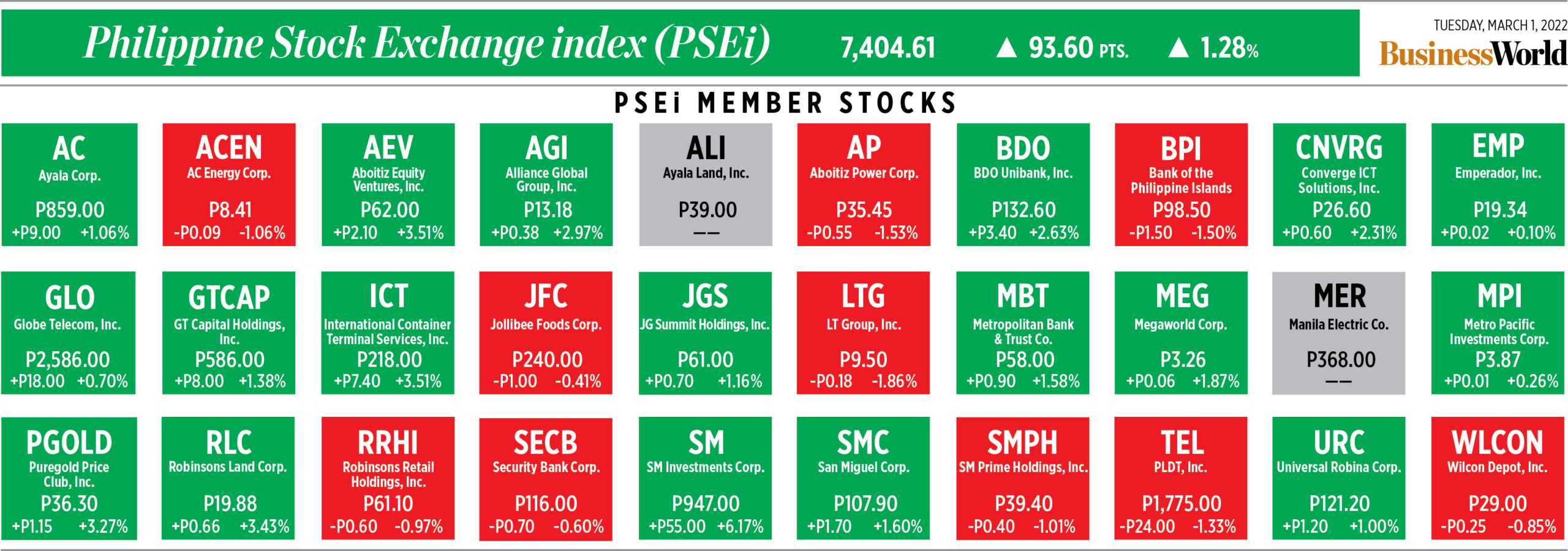
At the stock exchange on Tuesday, SMC shares went up by 1.6% or P1.70 to close at P107.90 apiece. — Luisa Maria Jacinta C. Jocson

No change in country’s gender equality score in past year, says WB

By Jenina P. Ibañez, Senior Reporter

LEGAL and economic gender equality in the Philippines registered no changes over the past year on metrics such as rights concerning parenthood, marriage, and assets, the World Bank (WB) said in a report.

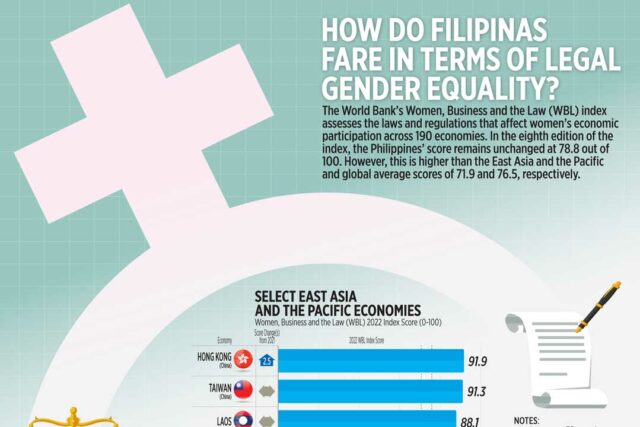
The World Bank’s Women, Business and the Law (WBL) 2022 report, which identifies the laws and regulations that restrict economic opportunity for women across 190 economies, gave the Philippines a score of 78.8 out of 100, unchanged from 2021. The 2020 score was 81.3.

The Philippine score exceeded the global average of 76.5 and the East Asia and Pacific average of 71.9.

The WB study uses eight indicators to compute the WBL score: mobility, workplace, pay, marriage, parenthood, entrepreneurship, assets and pensions.

A score of 100 indicates complete legal parity.

The Philippines scored 100 in the workplace, pay, and entrepreneurship indicators, but scored 75 for mobility and pensions.

The Philippine score was 60 in the marriage, parenthood, and assets categories.

“Since October 2020, no country has instituted reforms to address women’s rights to divorce and remarry,” the WB said.

“Two economies still do not permit legal divorce (Eswatini, the Philippines).”

Eylla Laire M. Gutierrez, a research manager for the Asian Institute of Management, said the report demonstrates the complexity of measuring women’s empowerment.

“Empowerment cannot be fully realized by merely providing them economic opportunities, but will also require the improvement of their psychological, social, and political empowerment,” she said via Viber.

She said the Philippines’ low scores in the marriage, parenthood, and assets indicators show that despite their active economic participation, society’s perception of women is still unequal to men.

“With these in mind, improving economic opportunities for women does not simply mean creating jobs for them or increasing the number of women participating economically,” she said.

“This also entails a re-examination of the entrenched cultural structures that influence how women participate in economies and how society perceives them.”

These cultural structures, she said, includes discrimination based on the gendered division of labor, with women expected to do unpaid domestic and care work.

Among East Asian economies, Hong Kong and Taiwan posted overall scores of 91.9 and 91.3, respectively.

Also beating the Philippines score were Laos (88.1), Timor-Leste (86.3), Mongolia (85), Vietnam (85), South Korea (85), Singapore (82.5), and Cambodia (81.3).

Japan was level with the Philippines, while Thailand (78.1), China (75.6), Indonesia (64.4), Myanmar (58.8), Brunei (52.1), and Malaysia (50) were lower.

Globally, women still have three-quarters the legal rights enjoyed by men, the report concluded.

The most progress seen in the past year were in the parenthood, pay, and workplace indicators, with many focused on protecting against sexual harassment at work, stopping discrimination, and increasing paid leave for new parents.

“While progress has been made, the gap between men’s and women’s expected lifetime earnings globally is $172 trillion — nearly two times the world’s annual GDP,” WB Managing Director of Development Policy and Partnerships Mari Pangestu said.

How do Filipinas fare in terms of legal gender equality?

How do Filipinas fare in terms of legal gender equality?

LEGAL and economic gender equality in the Philippines registered no changes over the past year on metrics such as rights concerning parenthood, marriage, and assets, the World Bank (WB) said in a report. Read the full story.

How do Filipinas fare in terms of legal gender equality?

SeekCap eyes to process P33.5B in MSME loans

ABOITIZ-LED lending marketplace SeekCap is looking to process P33.5 billion in credit this year to extend more financing for small businesses, it said in a statement.

“Our goal is to reach 100,000 new customers this year or about 10% of the total growing businesses in the country,” UBX Managing Director for Lending Marcy Pilar-Inajada said. UBX is the financial technology venture studio and fund of the UnionBank of the Philippines, Inc.

Last year, the platform was able to process P6 billion in loans, a fourfold increase from 2020. These financing went to more than 40,000 micro-, small-, and medium-sized enterprises (MSMEs).

SeekCap said it will continue to seek partnerships with more MSME ecosystems and players from e-commerce, franchising and wholesale industries to expand its reach.

Its current partners include Lazada Philippines and foodpanda. Last year, it also inked a partnership with Maxicare HealthCare Corp., allowing Maxicare MSME users to avail of credit ranging from P50,000 to P1 million.

SeekCap has also partnered with the local government of Pasig for the city’s business loan program.

“Our strategy is to activate as many channels as we can. With the partnerships with the government, we hope to activate more channels within the different cities and provinces, especially in the far-flung areas where the unserved and underserved are,” Ms. Pilar-Inajada said.

MSMEs account for about 99.5% of total registered businesses in the Philippines and are among the worst hit by the pandemic.

UnionBank, the parent of SeekCap, recorded a net profit of P12.6 billion in 2021, higher by 9% from a year earlier. This was driven by improving revenues and declining loan loss provisions.

The bank’s shares closed at P99.60 apiece on Tuesday, down by 40 centavos or 0.40% from its previous finish. — L.W.T. Noble

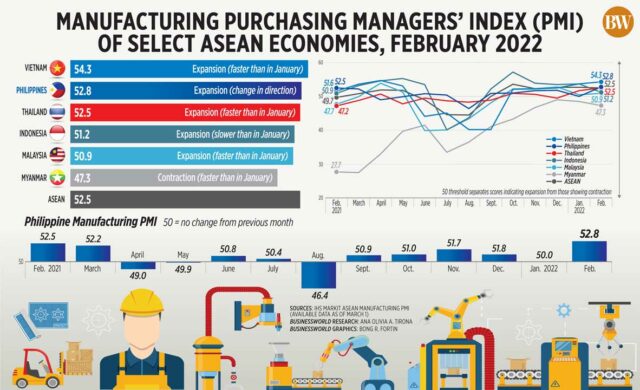
Manufacturing Purchasing Managers’ Index (PMI) of select ASEAN economies, February 2022

MANUFACTURING ACTIVITY in the Philippines rebounded to its highest level in over three years in February, as demand and production picked up amid the further easing of mobility restrictions. Read the full story.

Manufacturing purchasing managers’ index of select ASEAN economies, February 2022

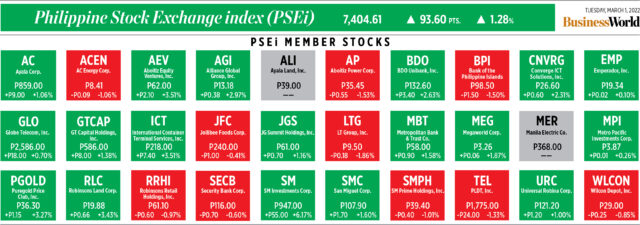
How PSEi member stocks performed — March 1, 2022

Here’s a quick glance at how PSEi stocks fared on Tuesday, March 1, 2022.


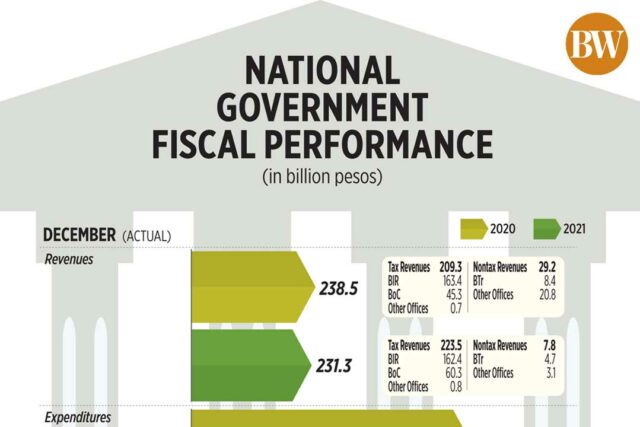
National government fiscal performance (Dec. 2021)

THE GOVERNMENT fell short of its budget deficit ceiling in 2021, as it generated better-than-expected revenues but missed its spending target, data from the Bureau of the Treasury (BTr) showed. Read the full story.

220302Fiscal_Performance(NEW)

Peso up on strong manufacturing PMI

BW FILE PHOTO

THE PESO strengthened versus the greenback on Tuesday on strong manufacturing data and gains in the stock market.

The local unit closed at P51.23 a dollar on Tuesday, appreciating by four centavos from its P51.27 finish on Monday, based on data from the Bankers Association of the Philippines.

The peso opened Tuesday’s session at P51.24 per dollar. Its weakest showing was at P51.295, while its intraday best was at P51.21 versus the greenback.

Dollars exchanged increased to $942.21 million on Tuesday from $780.5 million on Monday.

A trader said the peso rose as manufacturing data released on Tuesday showed improved activity.

The Philippine Purchasing Managers’ Index (PMI) was at 52.8 in February, above the 50-mark that separates expansion from contraction, IHS Markit said on Tuesday. This is higher than the 50 in January and the highest since December 2018.

IHS Markit economist Shreeya Patel said easing restrictions as well as improvements in material availability helped improve factory activity last month.

Meanwhile, Rizal Commercial Banking Corp. Chief Economist Michael L. Ricafort said the peso strengthened following gains in the stock market.

The Philippine Stock Exchange index rose by 93.60 points or 1.28% to end at 7,404.61 on Tuesday, while the all shares index gained 31.96 points or 0.82% to close at 3,921.05.

For Wednesday, Mr. Ricafort gave a forecast range of P51.10 to P51.30 per dollar, while the trader expects the local unit to move within P51.05 to P51.25. — L.W.T. Noble

Local stocks extend gains on bargain hunting

SHARES extended their gains on Tuesday as investors picked up bargains following the first round of talks between officials of Russia and Ukraine.

The benchmark Philippine Stock Exchange index (PSEi) rose by 93.60 points or 1.28% to close at 7,404.61 on Tuesday, while the broader all shares went up by 31.96 points or 0.82% to close the session at 3,921.05.

“The index continued to rally today, consistent with some markets across Asia following the first round of talks between Kyiv and Moscow officials, which somehow gave investors a sigh of relief while assessing the current state of the tensions between both countries,” Timson Securities, Inc. Trader Darren Blaine T. Pangan said in a Viber message on Tuesday.

“Bargain shoppers trooped to the local bourse, lifting the PSEi,” online brokerage 2TradeAsia.com said in a report. “Participants cheered G7’s concerted efforts given Russia’s invasion of Ukraine.”

Asian stocks regained some composure on Tuesday as the massive selling that rocked financial markets after Russia’s invasion of Ukraine last week paused for breath, while surging crude prices supported oil exporters in the region, Reuters reported.

Global stock markets have tumbled in recent days following Russia’s invasion of Ukraine and Western sanctions, which include cutting off some of Russia’s banks from the SWIFT financial network and limiting Moscow’s ability to deploy its $630-billion foreign reserves.

High-level talks between Kyiv and Moscow on Monday ended with no agreement except to keep talking, but Asian markets stabilized on signs of no immediate escalation of sanctions.

MSCI’s broadest index of Asia-Pacific shares outside Japan gained 0.42% and Japan’s Nikkei jumped 1.47%.

Back home, majority of sectoral indices ended in the green, except for industrials, which went down 76.65 points or 0.74% to 10,264.62, and property, which fell by 3.13 points or 0.08% to 3,537.66.

Meanwhile, holding firms increased by 231.92 points or 3.36% to 7,127.91; mining and oil gained by 249.96 points or 2.04% to 12,482.70; services climbed by 26.59 points or 1.39% to 1,940.14; and financials advanced by 15.58 points or 0.92% to 1,705.46.

Value turnover decreased to P7.84 billion with 1.01 billion shares changing hands on Tuesday from the P11.61 billion with 2.11 billion issues seen the previous day.

Advancers outnumbered decliners, 135 versus 60, while 49 names closed unchanged.

Foreigners turned sellers on Tuesday with P83.13 million in net outflows from the P202.74 million in net purchases seen on Monday.

Mr. Pangan placed the PSEi’s support at 6,940 this week, with its nearest resistance at 7,510, while 2TradeAsia.com put immediate support at 7,270 and resistance at 7,400-7,450. — L.M.J.C. Jocson with Reuters

Pandemic shaved off P3.8-T from PHL economy, NEDA says

THE extent of the economy’s losses after nearly two years of the public health crisis was estimated at P3.8 trillion, based on government economic planners’ projections for the size of economy had the pandemic not intervened.

“As the economy bounces back, we now have to recover all the losses we experienced in the last two years,” Socioeconomic Planning Secretary Karl Kendrick T. Chua said in a televised briefing late Monday.

“If not for the pandemic, dapat tuloy-tuloy ’yung ating growth (our growth would have been continuous),” and estimated the size of the economy at P25.3 trillion by 2022, stripping out the pandemic’s impact.

The agency Mr. Chua heads, the National Economic and Development Authority (NEDA), currently estimates the size of the economy at P21.5 trillion this year.

The P3.8 trillion gap between the two estimates includes P1.3 trillion in lost household income, P2.2 trillion in lost corporate income, and P300 billion in indirect taxes foregone.

The shift to the more relaxed Alert Level 1 quarantine setting, he said, will help speed up the recovery. NEDA estimates that P9.4 billion will be added to the economy each week with the easing of restrictions this month.

The ranks of the unemployed are also expected to fall by about 170,000 over the next quarter.

If the entire Philippines shifts to Alert Level 1, he added, the additional economic activity is valued at P16.5 billion each week.

The employment recovery at the end of last year will likely drive economic growth in 2022 despite the effects of the Omicron variant, First Metro Investment Corp. (FMIC) and University of Asia and the Pacific (UA&P) said in a joint report on Tuesday.

“A surge in Omicron-variant cases in January notwithstanding, we think growth will accelerate in 2022 specially considering the huge job gains in the fourth quarter of 2021,” FMIC and UA&P in their market call report.

Infrastructure spending will support growth in the first half because election spending bans exclude major projects, the report said.

“Manufacturing will likely continue to robustly expand in the first half, despite the usual slowdown in January after the Christmas holidays.”

Meanwhile, Mr. Chua said that the resumption of face-to-face schooling increases economic activity by about P12 billion a week, with services like accommodation, food, and transport for students resuming. — Jenina P. Ibañez

Negros Occidental court issues injunction against plan to import 200,000 MT of sugar

PHILSTAR FILE PHOTO

THE Sugar Regulatory Administration (SRA) has been issued a writ of preliminary injunction by a court in Negros Occidental, ordering it to desist from implementing a plan to import 200,000 metric tons (MT) of sugar.

In a six-page decision, Judge Reginald M. Fuentebella of Sagay City’s Regional Trial Court (RTC) Branch 73 ordered the maintenance of the status quo prior to the implementation of the import plan. The freeze on the imports applies until the resolution of the case, unless earlier lifted by order of the court.

United Sugar Producers Federation (UNIFED) President Manuel R. Lamata said the decision is a “victory” for sugar producers.

“This decision just affirms that the industry was right and the SRA was wrong,” Mr. Lamata said in a statement.

Sugar Order (SO) No. 3 calls for the import of 200,000 MT of standard and bottler’s grade refined sugar to serve as a supply buffer in storm-hit regions and to stabilize prices.

“We are not against imports per se, but we have been pushing for proper consultation and a calibrated import program which is beneficial to all and not just for a particular sector,” UNIFED Director Joseph Edgar M. Sarrosa said.

Mr. Sarrosa sought the injunction on behalf of the Rural Sugar Planters Association, Inc., a member of UNIFED.

UNIFED has been urging the government to recall the sugar order because of the lack of consultation and poor timing. The order was issued during the milling season, depressing the price obtained by planters from the mills.

“News of SO No. 3 led to a huge drop in sugar prices, prompting us to (seek) a temporary restraining order against it,” UNIFED said.

Asked to comment on the court ruling, the SRA said in reply to a query that it has “yet to officially receive any decision from RTC Sagay as to whether a writ of preliminary injunction had been issued on SO No. 3, or the sugar importation program. This legal matter shall be seasonably endorsed to the Office of the Government Corporate Counsel for appropriate action. Meantime, as SRA is precluded from discussing the merits of the pending case, all it could maintain is that the assailed SO is within the mandate of SRA, on the valid grounds as stated in the SO. The SRA shall endeavor to avail of legal remedies to ensure that it adheres to its legal mandates, all for the sake of the sugarcane industry.”

Separately, the Philippine Chamber of Food Manufacturers, Inc. (PCFMI) expressed its support for the import order, suggesting a divergence of interests between planters and the food industry.

“Due to the current local shortage of refined sugar that conforms with the quality requirements of food manufacturers, particularly premium and bottler’s grade refined sugar, we join the SRA in its assessment that there is an urgent need for such imports,” the PCFMI said in a statement.

“The inability to import refined sugar that meets the quality standards of food manufacturers poses a threat to food security, specifically the continued supply of essential food commodities. Existing sugar stocks for food manufacturing are dwindling, and therefore imports under the circumstances are necessary,” it added.

At the House of Representatives, Deputy Speaker and Negros Occidental Rep. Arnulfo A. Teves, Jr. said at a committee hearing on Tuesday the sugar industry was not adequately consulted on the import order.

“First of all, I’d like to say that what (SRA Administrator Hermenegildo R.) Serafica said about stakeholders not knowing the intricacies of business was insulting. I’m also a stakeholder. I grew up on sugar,” he said in Filipino in an online committee hearing. “One more thing, it is a lie to say that all stakeholders agreed. I did not agree. He could say that most stakeholders agreed, but not all. So, he’s wrong.”

Mr. Teves also asked why the SRA was not addressing high fertilizer and fuel costs.

“If they are really looking at the big picture, why are they so focused on imports? Why are they not looking at importing cheap fertilizer? And having cheaper fuel?” he said. — Luisa Maria Jacinta C. Jocson, Jaspearl Emerald G. Tan

Philippine smartphone market shrank in 2021 amid lockdowns, supply pressures

STOCK PHOTO | Image by terimakasih0 from Pixabay

THE Philippine smartphone market contracted 5.6% to 17.8 million units in 2021, with lockdowns dampening buying activity and global supply bottlenecks restricting supply, the International Data Corp. (IDC) said.

“The recurring lockdowns and global supply constraints in the second half of 2021 hampered the market’s growth with several vendors struggling to fulfill orders during the holiday season, resulting in low inventories across the channels,” the IDC, a market research company for the tech industry, said in a statement on Tuesday.

The IDC said sales in the fourth quarter of 2021 declined 23.3% year on year even as shipments increased 18.4% quarter on quarter.

“The gradual reopening of retail shops resulted in more consumers buying through physical stores,” it said.

The IDC expects “double-digit growth” in the smartphone market this year, recovering from a weak second half of 2021, and as supply constraints ease.

Angela Jenny V. Medez, client devices market analyst at IDC Philippines, said the smartphone market’s growth this year will be driven by fifth-generation (5G) smartphones, which accounted for 12.7% of shipments in 2021.

“The share is expected to double in 2022. In addition, aggressive pricing among Chinese vendors has dragged the average price for 5G Android smartphones down from $471 in 4Q20 (fourth quarter of 2020) to $386 in 4Q21 (fourth quarter of 2021), with some 5G models priced less than $200,” she added.

The top five smartphone brands in terms shipments to the Philippines last year were realme (3.96 million), OPPO (2.62 million), Transsion (2.47 million), Samsung (2.40 million), and vivo (2.39 million).

Last year, realme had a 22.2% market share in the Philippines, followed by Samsung (15.3%), OPPO (14.7%), Transsion (13.8%), and vivo (13.4%).

“Shipments to retail channels are expected to bounce back in 2022, as foot traffic continues to increase in the shopping malls, where most of the key smartphone stores and kiosks are located in the larger cities. The vendors are expected to restart their retail expansion and open more stores across the country, which had taken a hiatus during the lockdowns,” Ms. Medez said. — Arjay L. Balinbin

ADVERTISEMENT
ADVERTISEMENT