Home Blog Page 6704

WeClean plans to open 500 branches by 2025 

LAUNDRY service company WeClean Philippines is eyeing to establish 500 branches across the country by 2025 as part of its expansion plans.

WeClean Chief Operating Officer Ignacio Phelan said the company plans to open and manage 500 laundromats nationwide in the next three years after securing $1.4 million in additional funds from local and foreign investors last year.

“The funding we secured last year has really fueled us to aggressively expand our operations to open and manage 500 laundromats not just in nearby provinces but across the whole of the Philippines in the next three years. It is a massive goal for us to be able to stay true to our plans and move forward with our plans for the year,” Mr. Phelan said in a statement on Tuesday.

WeClean Chief Executive Officer Alfonso Bigeriego Patiño said the company plans to expand outside of Metro Manila and also to other Southeast Asian (SEA) countries. Currently, WeClean operates 63 branches.

“We look at residential areas with a lot of traffic such as those within distance from high-rise condominiums or barangays where people cannot afford to have washing machines at home. These nearby provinces are key to our business growth plan. And in a few months after successfully opening in Bulacan, Cavite, Laguna and Palawan, we are eyeing to open our first branches in other SEA countries like Thailand, Malaysia, and Indonesia,” Mr. Patiño said.

Meanwhile, WeClean said it plans to launch the “WeClean Mobile App” on April 1, which will allow customers to have easier access to the company’s laundry services. It will be available on the Apple AppStore and Google Play Store.

The app has features such as booking a pickup and delivery service as well as pre-booking a laundry branch drop-off with certain customer specifications, including the type of clothing, type of fold, type of wash/dry, and how much soap or fabric conditioner to be used.

“This platform will up the notch when it comes to listening to and providing our customers what they really need — time-saving accessible laundry services at the tip of their fingers. We want to offer direct communication at a time when laundry has really become part and parcel of everyday life,” Mr. Phelan said.

“With our aim to bring our laundry shops closer to Filipinos, we are hoping that we will be able to help our customers realize the true benefit of trusting a reliable laundromat like ours. And as we launch our mobile app, we are eyeing to be able to have between 25,000 to 30,000 downloads in Metro Manila alone by yearend,” he added. — Revin Mikhael D. Ochave 

Insurer urges clients to claim benefits

AIA PHILIPPINES is reaching out to thousands of customers who have unclaimed benefits and maturities, it said in a statement on Tuesday.

“AIA Philippines…has reported it is seeking thousands of its policy holders and beneficiaries who have yet to claim their benefits ranging from policy maturities, reinstatements, claims, redemptions, and even refunds. Despite fervent efforts to contact its customers through registered mail, e-mail, callouts, and their agents, there are still a huge number who have yet to be reached,” the insurer said.

“We are making this campaign public in the hopes of reaching customers from many years ago — those who we have lost touch with amid changes in communications technology and who have bought their policies under our former brand, Philam Life,” AIA Philippines Chief Operating Officer Margarita B. Lopez said. The company was rebranded last year.

“We are doing this because we have a promise to fulfill — a promise that goes beyond passively responding when our customers make a claim. The promise of helping our customers live healthier, longer, better lives includes making sure these hard-earned benefits get to the intended recipients. We’re asking for everyone’s help in finding our customers or their beneficiaries so we can give them their benefits,” she said.

The company said benefits are often unclaimed due to loss of contact between insurers and customers. This may be because of a change in contact details, a customer’s lack of information on the insurance policy or when the insurer is not informed about the death of a customer, among others.

AIA Philippines said it is encouraging its clients to check if they have unclaimed benefits. This can be verified through this link: https://bit.ly/AIAPH_BenefitVerification.

Those who know people or beneficiaries who have yet to claim their benefits are urged to contact AIA, Ms. Lopez added.

Some P4.2 billion worth of claims were fulfilled by the insurer in 2021, over 40% more than the claims made in 2020, AIA Philippines said. Majority or 90% of these claims were for death, followed by critical illness and health and medical claims.

In 2020, AIA Philippines had the largest assets among life insurers with P291 billion, based on data from the Insurance Commission.

It ranked second in terms of net income worth P4.52 billion, and placed fourth in its net premiums amounting to P16.77 billion. — T.J. Tomas

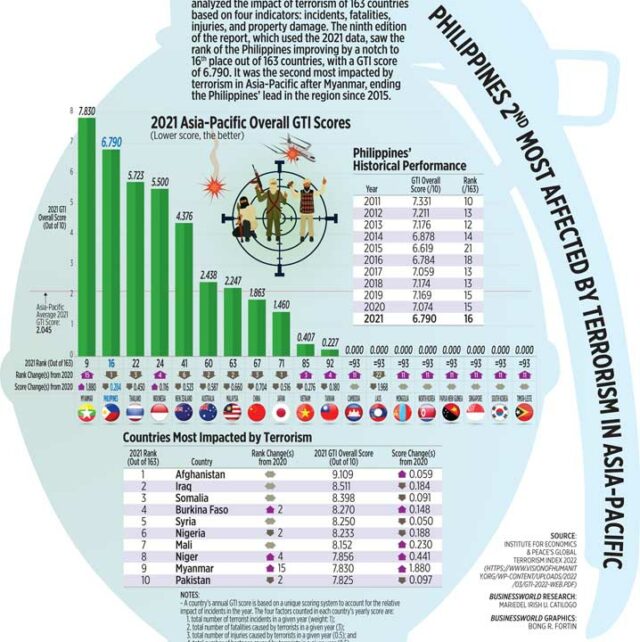
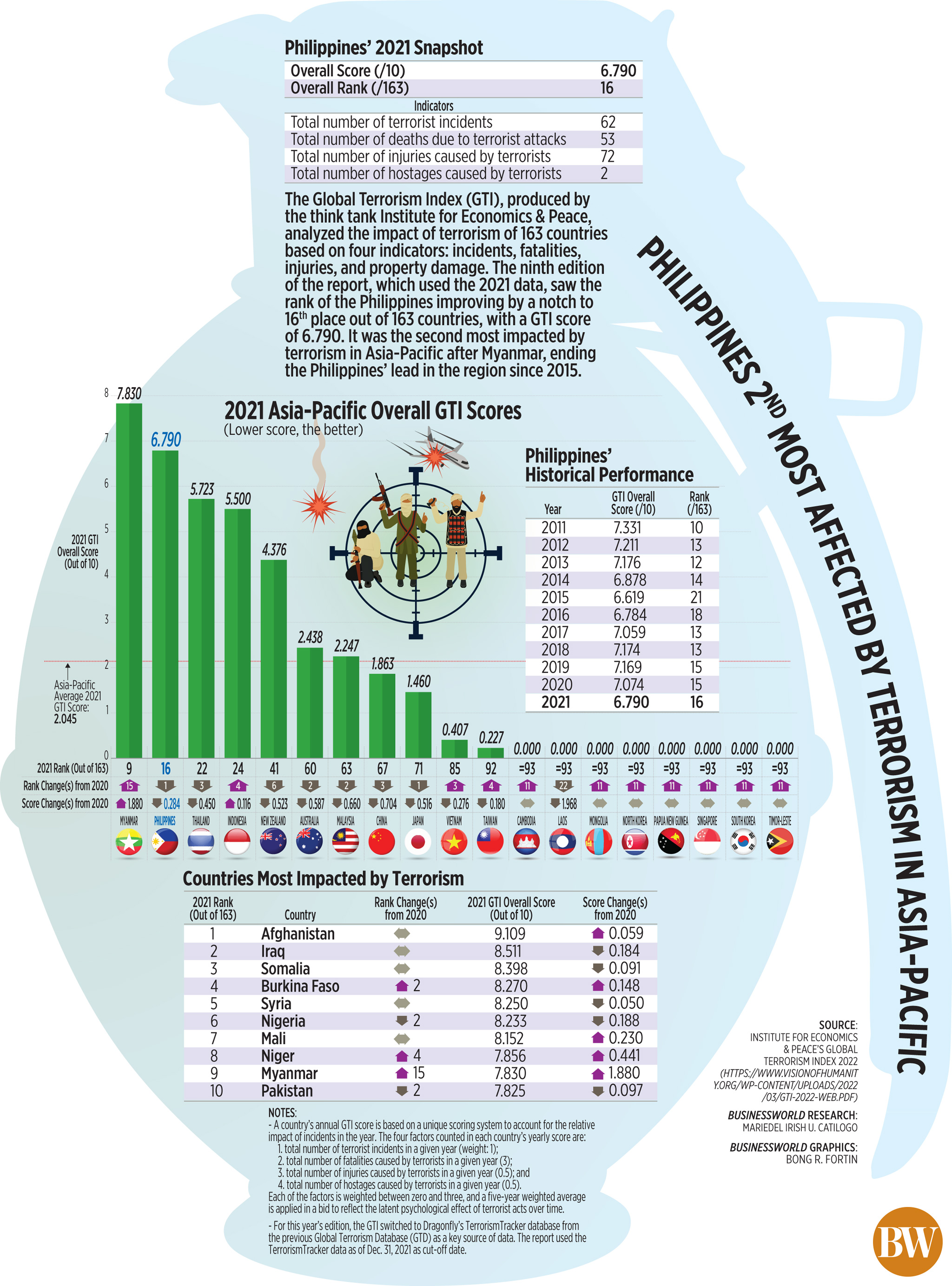
Philippines 2nd most affected by terrorism in Asia-Pacific

The Global Terrorism Index (GTI), produced by the think tank Institute for Economics & Peace, analyzed the impact of terrorism of 163 countries based on four indicators: incidents, fatalities, injuries, and property damage. The ninth edition of the report, which used the 2021 data, saw the rank of the Philippines improving by a notch to 16th place out of 163 countries, with a GTI score of 6.790. It was the second most impacted by terrorism in Asia-Pacific after Myanmar, ending the Philippines’ lead in the region since 2015.

Philippines 2<sup>nd</sup> most affected by terrorism in asia-pacific

How PSEi member stocks performed — March 8, 2022

Here’s a quick glance at how PSEi stocks fared on Tuesday, March 8, 2022.


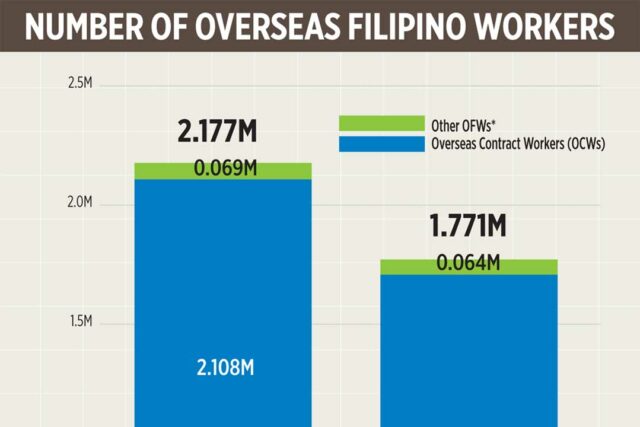
Number of overseas Filipino workers

THE NUMBER of registered overseas Filipino workers (OFW) declined by nearly a fifth year on year in 2020 amid the coronavirus disease 2019 (COVID-19) pandemic, data from the Philippine Statistics Authority (PSA) showed. Read the full story.

Number of overseas Filipino workers

Duterte appoints ex-Marcos lawyer to Comelec

PHILSTAR FILE PHOTO

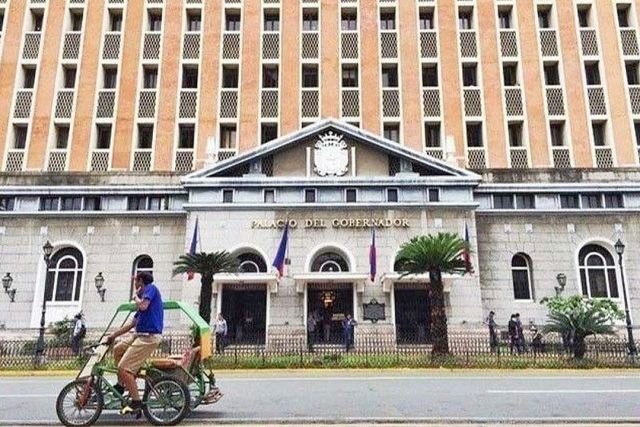
PRESIDENT Rodrigo R. Duterte has appointed three new election officials, including a lawyer who represented the son of the late dictator Ferdinand E. Marcos in his vice-presidential protest in 2016 that he eventually lost.

Appointed commissioner was George Erwin M. Garcia, who lawyered for former Senator Ferdinand “Bongbong” R. Marcos, Jr. in his election protest against Vice-President Maria Leonor “Leni” G. Robredo, acting presidential spokesman Jose Ruperto Martin M. Andanar told a televised news briefing on Tuesday.

His appointment comes while the Commission on Elections (Comelec) has yet to resolve lawsuits seeking to disqualify Mr. Marcos, who has topped opinion polls, from the presidential race.

Mr. Garcia did not immediately reply to a mobile phone message seeking comment.

Also named commissioner was Aimee Torrefranca-Neri, who was an undersecretary of the Social Welfare department. The president also named Saidamen B. Pangarungan, who was the secretary of the National Commission on Muslim Filipinos, chairman of the Comelec.

“The directive of the president is to ensure honest, peaceful, credible and free elections,” Mr. Andanar said. Filipinos will choose the replacement of Mr. Duterte, who is limited by law to a single six-year term, on May 9.

Mr. Garcia also lawyered for Senator Grace Poe-Llamanzares in a lawsuit that sought to disqualify her from the 2016 presidential race.

“That went through a vetting process,” Mr. Andanar said. “We should respect the prerogative of the president. It was not a haphazard selection. It was a very long process,” he said in Filipino.

“If a possible conflict of interest arises, we are confident that the new commissioners will deal with that appropriately,” Comelec spokesman James B. Jimenez told an online news briefing.

Under the Constitution, Comelec commissioners have a seven-year term and cannot be reappointed. Their appointment must be approved by the Comelec, which is made up of senators and congressmen.

Pending election cases would remain with the previously assigned divisions, Mr. Jimenez said. The en banc will also decide whether the new election officials may vote on these cases, he added.

Election watchdog Kontra Daya questioned the track record of the new Comelec appointees.

“While Garcia has experience as an election lawyer, Neri proves to be no different from certain Duterte-appointed commissioners with little to no clean election advocacy or lawyering track record, having transferred from one agency to another,” it said in a statement.

It also found Mr. Pangarungan’s background wanting, noting that just like other commissioners before him, he came from San Beda University — Mr. Duterte’s alma mater.

Kontra Daya said the new commissioners should try to live up to public expectations at a time when Comelec’s credibility is in doubt.

“At this point, we ask the three people: What is your track record in election advocacy or lawyering?” the group said. “What is your relationship with the Duterte administration? What is your assurance that you will maintain independence from the powers-that-be, including former clients who are now running in the 2022 elections?”

The Comelec First Division last month dismissed three consolidated lawsuits seeking to disqualify Mr. Marcos from the presidential race, as it ruled that his failure to file his tax returns in the 1980s did not involve wicked, deviant behavior. The case is on appeal before the Comelec en banc.

Comelec has six members and one chairman. Its two divisions have three members each. Decisions issued by the two divisions are eventually appealed to the seven-member en banc. Three Comelec members retired last month.

Retired First Division Presiding Commissioner Maria Rowena V. Guanzon’s vote for Mr. Marcos’s disqualification was never counted because the ruling came out after she retired. She earlier accused the writer of the decision of delaying the case.

She also said a senator from Davao, Mr. Duterte’s hometown, was trying to meddle in the case.

A trial court in the 1990s convicted Mr. Marcos of tax evasion after he repeatedly failed to file his tax returns in the 1980s. Human rights survivors of the late dictator’s regime have cited that as the basis for his disqualification.

Ms. Guanzon released a separate opinion on Jan. 31 in which she voted to disqualify Mr. Marcos, whom she called an ex-convict. She said his repeated failure to file his tax returns showed a deliberate intent to violate the law.

Political analysts have said Comelec risks losing its credibility after the delayed ruling that favored the former senator.

Election Commissioner, who wrote the decision, said Mr. Marcos’s failure to file his tax returns was not “inherently immoral” since there was no law that punishes it.

Commissioner Marlon S. Casquejo, who signed the ruling, wrote a separate 12-page opinion in which he said Mr. Marcos’s crime did not involve “moral turpitude.” Saying that his omission resulted in injustice was “overkill,” he said. — Kyle Aristophere T. Atienza and John Victor D. Ordoñez

SC stops election body from taking down big posters

PHILIPPINE STAR/ MICHAEL VARCAS

THE Supreme Court (SC) on Tuesday stopped the Commission on Elections (Comelec) from dismantling oversized campaign posters inside private property.

The tribunal gave the election body 10 days to comment on a lawsuit filed by supporters of Vice-President Maria Leonor “Leni” G. Robredo and a college in Roxas City, its Public Information Office said in a statement.

The plaintiffs said they were owners of tarpaulins, posters, murals and other election materials displayed in their private properties that law enforcers had removed.

Comelec has issued an order for law enforcers to take down oversized campaign materials even inside private property, which legal experts said is equivalent to warrantless seizure.

Civic groups and former Comelec officials have criticized the Comelec order, which provides that election posters even on private property must not be bigger than six square feet.

Candidates are also barred from shaking hands, hugging, kissing, going arm-in-arm and having selfies taken with political supporters as part of health protocols amid a coronavirus pandemic. — John Victor D. Ordoñez

Philippines takes delivery of 5.2M Pfizer vaccines

THE Philippines took delivery on Monday of more than 5 million doses of the coronavirus vaccine made by Pfizer, Inc., according to the presidential palace.

The United States donated 4 million doses under a global initiative for equal access while the government bought the remaining 1.17 million doses, newly appointed presidential spokesman Jose Ruperto Martín M. Andanar told a televised news briefing on Tuesday.

The government had fully vaccinated 63.79 million people as of March 7, while 69.23 million people have received their first dose, he said. He added that 10.61 million booster shots have been injected.

He said 111,783 of kids aged 5 to 11 years and 8.62 million children aged 12 to 17 had been fully vaccinated. 

The government has partnered with the Philippine Medical Association and Philippine College of Occupational Medicine to expand COVID-19 vaccination to doctors’ clinics and workplace health facilities, Health Undersecretary Myrna C. Cabotaje told a separate televised news briefing.

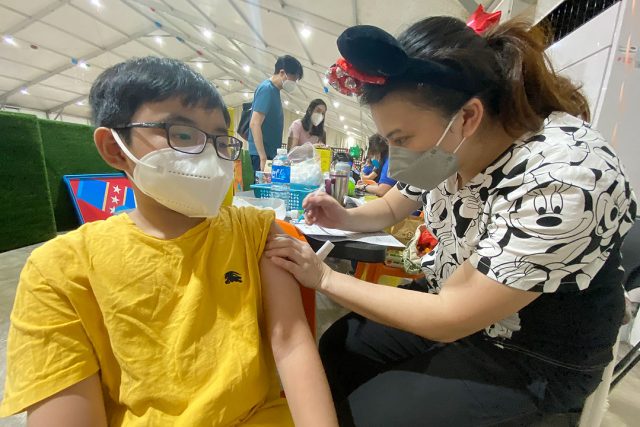
The government will hold a fourth round of its vaccination drive on March 10 to 12. Ms. Cabotaje said the campaign aims to vaccinate 1.8 million people, particularly the elderly. Authorities would focus on giving out boosters to people aged 18 and above, she added.

She said the Philippines might donate coronavirus vaccines to Myanmar and African countries to boost their vaccination efforts, noting that the country had enough supply. “We have sufficient vaccines and some of their shelf life is nearing its expiry,” she said.   

The country has received 232.67 million doses since vaccine deliveries started in February last year.

Ms. Cabotaje said only a quarter of Filipinos in the Bangsamoro region have been fully vaccinated against the coronavirus. About a third have gotten their first shots, while a quarter have been fully vaccinated. 

The government has placed many parts of the country under the lowest virus alert level amid decreasing infections.

COVID-19 hospitalization rates in Metro Manila were plateauing, Health Undersecretary Leopoldo J. Vega told the briefing. He added that the country’s command center responsible for referring patients to hospitals had been receiving fewer calls. 

The Department of Health on Monday said 4,543 of 24,678 non-intensive care unit (ICU) beds had been used as of March 6, while 807 of 3,138 ICU beds were occupied. There were 1,055 severe and critical admissions as of March 6. — Kyle Aristophere T. Atienza

Lacson says amended Foreign Investments Act has safeguards for micro, small entrepreneurs

DTI.GOV.PH

PRESIDENTIAL aspirant and Senator Panfilo M. Lacson, Sr. on Tuesday assured micro and small enterprises that there are provisions in the new law that relaxes restrictions on foreign investments to protect their sector.

“We opened up to foreigners the opportunity to invest here but it has safeguards. As long as the starting capital is $200,000 (or about P10 million) and below, that is protected, no foreign investors can get involved. This covers the micro and small (enterprises),” he said in Filipino in a statement on Tuesday.

Micro enterprises have an asset size of up to P3 million with less than 10 workers while small enterprises have up to P15 million in assets with up to 99 employees, as defined by the Philippine government.

Micro, small and medium enterprises (MSMEs) collectively accounted for 99.5% of all businesses in the country, based on the Philippine Statistics Authority’s 2020 List of Establishments.

Of the total 952,969 MSMEs, micro enterprises accounted for 88.77% or 850,127 while small enterprises were 10.25% or 98,126.

Mr. Lacson said that the recently-signed Republic Act 11647, which amended the three-decade-old Foreign Investments Act, will open more credit windows and capital sources for micro and small entrepreneurs.

Under the law, foreign investors can venture into a local enterprise at up to 100% of its capital.

They may fully own small- and medium-sized enterprises with a minimum paid-up capital of less than $100,000 or P5 million if majority of their direct employees are Filipinos.

The law trims down the list of investment areas reserved for Filipinos to just defense-related businesses and small and micro domestic market enterprises with paid-up capital of less than $200,000, or about P10 million.

Mr. Lacson said the new law makes the country more investment-friendly, which could lead to the opening of more businesses and jobs. — Alyssa Nicole O. Tan

Bill filed to lure more private sector participation in agri enterprise development

BW FILE PHOTO

SENATOR Francis “Kiko” N. Pangilinan, a vice-presidential candidate, on Monday filed a bill that seeks to increase incentives to private businesses participating in enterprise development programs for farmers and fisherfolk.

“Apart from the existing tax exemptions provided under the Sagip Saka Act, private-sector donations to accredited enterprises of farmers and fishermen may be deducted from the gross income of private businesses,” he said in Filipino in statement on Tuesday.

“This will be equivalent to 150% of the value of their donation,” he said.

Senate Bill 2509 seeks to amend Sagip Saka Act or Republic Act 11321 to provide additional tax incentives to gifts and donations given by the private sector to accredited farmers and fisherfolk enterprises under the Farmers and Fisherfolk Enterprise Development program of the agriculture department.

“The expected increase in active participation from the private sector in the Sagip Saka due to the new incentives will mean greater production and income of farmers and fishermen,” Mr. Pangilinan said.

Apart from incentives for the private sector, the Sagip Saka Act signed into law in 2019 authorizes all government offices and local government units to directly buy goods and produce from farmers and fisherfolk cooperatives, bypassing the complicated and time-consuming bidding process.

The passage of the proposed amendment will “channel much-needed capital into agriculture,” said the senator, since the private sector has the “deepest pockets” and can provide the farming and fisheries sectors with adequate support. — Alyssa Nicole O. Tan

Cebu bans poultry products from Luzon due to avian flu outbreak

DA.GOV.PH

THE CEBU provincial government has temporarily banned the entry of all poultry products from Luzon starting March 8 following the confirmation of avian flu outbreaks in at least four provinces.

The ban will be in effect for 45 days, according to an executive order issued late Monday by Cebu Governor Gwendolyn F. Garcia.

She said the prohibition is necessary “to protect” the province’s P12-billion poultry industry and consumers.

Based on the order, the ban covers “live poultry and/or wild birds, including day-old chicks, semen, fresh eggs, embryonated eggs, manure, other poultry products and by-products.”

All mayors in Cebu have also been ordered to “strengthen and implement minimum biosecurity measures in their area of jurisdiction, particularly at the poultry establishments, slaughterhouses/abattoirs, poultry dressing plants, live bird markets, and poultry farms.”

The Department of Agriculture (DA) first confirmed an avian influenza outbreak in Bulacan and Pampanga on Feb. 22. It has since reported to the World Organization for Animal Health that infections were also detected in Laguna and Camarines Sur.

The DA has already issued guidelines on the movement of poultry and poultry products.

Ms. Garcia said the local ban directive is necessary as the DA has not imposed a “no movement” policy from Luzon to areas free from avian flu.

She said “poultry products and embryonated duck eggs from Luzon” continue to arrive in Cebu, which could compromise the local industry. — MSJ

Davao City lifts all pandemic-related restrictions except face mask mandate

DAVAO CIO

ALL coronavirus pandemic-related restrictions have been lifted in Davao City, except wearing of face mask outside residence.

In an executive order issued on Monday evening and immediately taking effect, Mayor Sara Duterte-Carpio said withdrawing pandemic regulations such as border controls and business operations capacity is needed “to swiftly reopen the city for economic recovery.”

Business establishments and offices are still required to ensure the provision of hand washing and sanitation facilities and supplies. They are also given authority to draft and implement their own COVID-19 restrictions within their premises.

The order notes that the city’s full vaccination rate was already at 80% of total population with inoculation activities continuing, while coronavirus cases were down to 174 as of March 7.

The directive also allows home isolation for coronavirus patients. — Maya M. Padillo

ADVERTISEMENT
ADVERTISEMENT