Home Blog Page 6653

First Gen logs P12.4-B attributable recurring net income

FIRST GEN Corp. ended last year with “flat earnings” of P12.4 billion attributable to equity holders, with more expensive fuel prices offsetting higher electricity sales as power demand recovered to pre-pandemic levels, the company said on Monday.

“First Gen generated higher revenues in 2021 as we saw power demand recover to pre-pandemic levels. Unfortunately, revenue growth was also an effect of higher fuel prices experienced all over the world and the supply restrictions in the grid that reflected in high spot market prices,” First Gen President and Chief Operating Officer Francis Giles B. Puno said in a statement.

“Our gas-fired plants necessarily ran on liquid fuel to ensure adequate supply for the grid. We are working to address gas supply uncertainty and are confident this will be addressed once our LNG (liquefied natural gas) import terminal operates this year,” he added.

The company’s natural gas platform registered 8% more in recurring earnings last year to P9.7 billion from P9.2 billion in 2020.

“The older natural gas-fired plants, the 1,000-megawatt (MW) Santa Rita and the 500-MW San Lorenzo [power plants], reaped the benefits of lower income tax rates under the CREATE Law and lower interest expenses from regular debt service payments,” the company said, referring to Republic Act No. 11534.

The benefits, however, were partially offset by lower operating income from the 420-MW San Gabriel power plant caused by outages and higher replacement power, the company said.

First Gen said that while its 97-megawatt Avion power plant “had its share of plant damage issues in 2021, it still benefitted from high electricity sales in the early part of the year as it supplied the grid with supplemental power during constraint periods.”

Meanwhile, Avion plant’s Unit 2 “was discovered to have incurred a damage in its gas compressor last August after a routine inspection. The unit was quickly replaced and restored to full commercial operation by late October.”

In December, Avion’s Unit 1 was found to have incurred damage. It was brought back to operations by February 2022.

“From an attributable net income to parent of P9.3 billion in 2020, the natural gas platform increased to P9.8 billion (US$199 million) for 2021,” it detailed.

Energy Development Corp. (EDC), meanwhile, shared a P4 billion recurring attributable earnings generated from its geothermal, wind, and solar assets. This is 8% lower than 2020’s recurring income of P4.5 billion.

Although EDC had generating higher revenues, it incurred higher power plant and steam field maintenance expenses last year as it made up for deferred activities from 2020.

“These were partly offset by lower interest expenses and income taxes. The renewable energy company’s attributable net income to parent of P4.3 billion for 2021 was also 18% lower due to extraordinary income from the collection of insurance claims in 2020,” it said.

First Gen’s hydro platform’s recurring earnings contribution climbed to P180 million in 2021 from P70 million in the previous year.

“The 132.8-MW Pantabangan-Masiway power plants generated higher revenues as the commencement of its contract with Meralco (Manila Electric Co.) were augmented by merchant sales. The increase was slightly offset by higher expenses due to replacement power costs,” the company said.

The Lopez-led company recorded consolidated revenues of P106 billion from electricity sales, 18% higher than the P91 billion in the previous year. This consists of 60% natural gas revenues; 35% EDC’s geothermal, wind, and solar revenues; and 5% hydro plant revenues.

First Gen shares at the local bourse dropped a peso or 3.85% to close at P25 apiece on Monday. — Marielle C. Lucenio


Is there such a thing as the perfect alarm tone?

ANNA TARAZEVICH/ PEXELS

We think so (and this is what it might sound like)

WITH the return to office work — and no longer being able to roll out of bed and straight into a Zoom meeting — many of us will be waking up earlier to beat the morning rush. So it’s important to ensure we’re on top of our alarm game.

But what type of alarm provides peak alertness upon waking? Pythagoras posited this same question in around 500 BCE. He believed specific songs — melodies that roused the energies — had the ability to counteract the drowsiness waking may bring.

And he appears to have had a point. Research has now shown certain alarm sounds can indeed enhance our alertness upon waking.

In particular, alarms that have the qualities of “tunefulness” (think of the song “ABC” by The Jackson 5) have melodies that energize the listener, and are great for effective waking.

But to understand why this is the case, we first need to understand how our brains respond to complex stimuli when moving out of the sleep state.

Waking up groggy never feels right. And how we wake up can not only affect our mood and the day’s outlook, but also our cognition and mental performance.

In some instances, grogginess after waking has the potential to be dangerous several hours later, by reducing our performance in critical decision-making (such as in health settings, emergency responses, security, or while driving).

This cognitive state of reduced alertness is referred to as “sleep inertia.” It’s a growing concern as it can have serious consequences while performing high-risk tasks, including driving.

Transitioning from sleep to alertness does not follow an on/off switch-like system, as brain imaging techniques have revealed.

Waking relies on complex biological processes, including increased blood flow allocation to the brain. Studies show the brain regions important for alert performance (the prefrontal cortical regions) take longer to “start-up” than other areas (such as the basal ganglia) which are important for arousal. This means you can be awake, but not quite with it.

Research has also shown blood flow activity within the brain to be diminished after waking, in comparison to the pre-sleep state. Thus, alert wakefulness may in part require mechanisms that encourage a redistribution of blood flow to the brain — something certain types of sound and music can do.

Another factor that influences alertness upon waking is the stage of sleep at the time. You’re less likely to feel groggy if you wake up from a light sleep, compared to a deeper slow-wave or REM sleep.

A light sleep stage is characterized by Theta wave frequencies (as measured from the brain’s electrical activity) and can be associated with feeling drowsy. In this sleep stage, arousal from external stimuli such as an alarm can quickly draw a person out of sleep.

Conversely, deep sleep or slow-wave sleep consists of Delta wave frequencies, which are associated with unconsciousness. This is the more challenging sleep stage to fully wake up from.

Alarm effectiveness also depends on age. Young adults aged 18 to 25 need louder alarms than older people, and preteens need an even greater threshold than young adults. You may require an alarm as much as 20 decibels louder at 18 than you would at 80.

But when it comes to choosing an alarm, what exactly is the best choice? A growing body of evidence suggests different alarm sounds can positively influence human performance after waking.

Our systematic review published in 2020 showed temporal frequencies (the pitch of the sound as measured in Hertz) around 500 Hz are better at arousing young children than 2000+ Hz varieties.

We lack research to say whether this also applies to adults, but it’s assumed the same alarm types would be beneficial.

Voice notifications such as a person yelling “wake up!” work better than higher frequencies. However, they are not as effective as 500 Hz tonal beeping alarms — similar to those preinstalled in most mobile phones.

Our research also explores how qualities of music, and specifically melody, play a role in encouraging alert wakefulness. We found that the way in which people interpret their alarms “tunefulness” also reflects how groggy they feel after waking.

Here, people who use alarms that carry a tune they will readily hum along to will experience less grogginess than those with a standard “beeping” alarm.

With this in mind, we developed a custom rhythmic melody that led to significantly better performance upon and after waking, when compared to standard beeping alarms.

Other studies have also found popular music (which can be interpreted as being melodic) is good to counteract sleep inertia after a short nap, and even more yet if it is music the listener personally enjoys.

What does all this mean for the day-to-day? Well, given all of the above, we believe the perfect alarm must sound something like this:

it has a melody you can easily sing or hum along to;

it has a dominant frequency around 500 Hz, or in the key of C5; and,

it is not too fast or too slow (100 – 120 beats per minute is ideal).

Also remember the alarm must be louder for younger people (or for particularly deep sleepers).

If we consider the default alarms available on our devices, much more work is needed — especially since research in this area is relatively new. Hence, we suspect the availability of custom alarm downloads will increase with time.

Most pre-loaded alarms at the appropriate loudness will wake you, but specific designs (such as the one above) have been modelled on the latest research to not only encourage arousal, but also provide increased alertness.


Stuart McFarlane is a researcher of Auditory Perception and Cognition at RMIT University. He has received funding from the Australian Government Research Training Program Scholarship. Adrian Dyer is an Associate Professor at RMIT University. He receives funding from the Australian Research Council.

ACEN unit signs deal to buy UPC Philippines’ stake in 12 firms

AC ENERGY Corp. (ACEN) on Monday said its subsidiary had signed an agreement to buy the ownership interest and subscription rights of UPC Philippines Wind Investment Co. BV and a certain Stella Marie L. Sutton in 12 power companies.

In a disclosure to the exchange, the Ayala-led company said its subsidiary ACE Endevor, Inc. signed on March 18 the agreement for the sale and purchase of the shares in the target companies.

It will pay up to P4.5 billion for the acquisition. The price is still subject to adjustments and agreed conditions. ACE Endevor is intended to be ACEN’s project development, management, and operations platform.

The companies involved in the transaction are: North Luzon Renewable Energy Corp. (NLR); Bayog Wind Power Corp. (BWPC); Buduan Wind Energy Co, Inc.; Caraballo Mountains UPC Asia Corp.; Pangasinan UPC Asia Corp.; Sapat Highlands Wind Corp.; Mindanao Wind Power Corp.; Itbayat Island UPC Asia Corp.; Laguna Central Renewables, Inc.; Laguna West Renewables, Inc.; Suyo UPC Asia Corp.; and Solar Ace4 Energy Corp.

ACEN will buy out UPC Philippines’ 30% share in NLR consisting of 16,670 common shares with a par value of P100 per share and 740 preferred shares with a par value of P228,712.35 per share. It will also take over the 40% ownership interest of UPC Philippines in BWPC, consisting of 4,165 common shares priced at P100 apiece.

“The acquisition by the company of UPC Philippines’ ownership interest in NLR and BWPC will enable the company to have a controlling interest in the currently operating 81-megawatt (MW) wind farm and full ownership of the 160-MW Pagudpud Wind Farm, which is nearing completion, thereby increasing the company’s share in the revenues of NLR and future revenues of BWPC,” ACEN said in its disclosure.

“The Company will further have ownership of UPC Philippines development projects consisting of more than 2,300 MW of pipeline projects currently under development,” it added.

ACEN aims to become the biggest listed energy platform in Southeast Asia as plans to put up 5,000 MW of renewable energy (RE) capacity by 2025.

At home, the company is building around 484 MW of wind and solar capacity. Across the region, it has around 3,800 MW of attributable net capacity, of which, renewables account for 87% or 3,300 MW.

In the same disclosure, the renewable energy firm said its board of directors had also approved a separate transaction for the issuance of up to 390 million ACEN common shares to the owners, affiliates, and/or partners of UPC Philippines priced at P11.32 apiece.

ACEN shares at the local bourse slipped 30 centavos or 3.66% to close at P7.90 apiece on Monday. — Marielle C. Lucenio

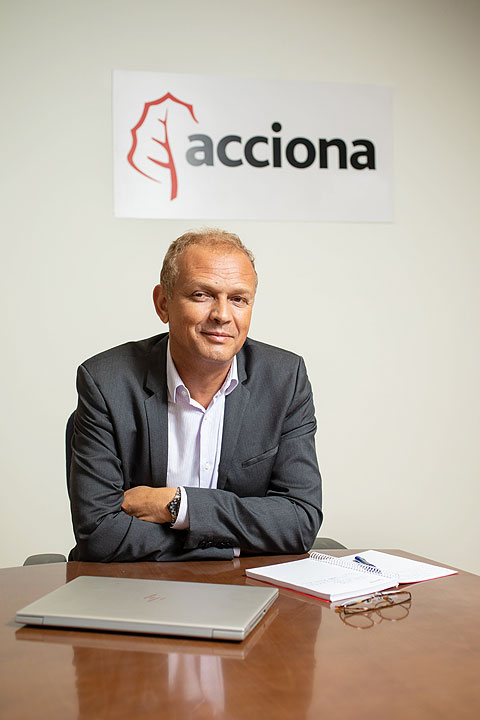
Acciona offers solutions to address PHL water problems

By Luisa Maria Jacinta C. Jocson

AMAR MORKANI
Acciona Regional Director for
Development for Southeast Asia

THE Philippines should invest in rain harvesting and other sustainable water solutions to combat the impact of climate change and secure clean water for its population, an Acciona executive said.

“We have to understand the reason for those droughts is the impact of climate change. The rain pattern is changing and the drought season is much longer. It rains more in a shorter time, which then creates flooding and landslides,” Acciona Regional Director Development South East Asia  Amar Morkani said in a virtual interview.

The unit of the Spanish infrastructure giant Acciona offers sustainable, end-to-end water treatment and management solutions.

Mr. Morkani cited water harvesting and the desalination of seawater, among many sustainable solutions.

“The first thing is to enhance rain harvesting and storage. Harvesting rain from areas where pollution isn’t that present, like the forest. Its side effect is that you will decrease the probability of flooding and landsliding. It is essential to study the rain pattern in the necessary facilities, in order to help during the drought season,” he said.

“It is also difficult to handle the degradation of the water quality in the water table. You need to decrease the stress in the water table, meaning to pump in deep wells less than what we used to, in order for the water table to regenerate through the rainy season and harvesting season,” he added.

Water scarcity, which affects 40% of the population, is increasing due to global warming.

Mr. Morkani said that water desalination, which is a treatment process that converts seawater or brackish water into drinking water, may help boost water supply.

Acciona has been working on local projects such as Maynilad Water Services, Inc.’s Putatan Water Treatment Plant 2 in Muntinlupa City. The plant treats up to 150,000 cubic meters of water daily from Laguna de Bay.

“Acciona has sustainable solutions not only for the treatment of water but as well for the implementation. We have very strong engineering to develop water storage. We work with the government to fund the plan since each region has its complications, like the solution for Cebu may not work for Palawan,” Mr. Morkani said.

Wastewater must be treated sustainably through recycling, so that it can be released into the environment, he said.

“We have to treat wastewater. We must recycle the water in two steps: the first is the industrial (sector), all the wastewater produced must find a way to be recycled in the facilities. Then, release it to the environment so it can be used for agriculture watering, municipal watering of gardens, and the like,” Mr. Morkani said.

In the future, Mr. Morkani said that the water treatment technology will only become cheaper and consume less energy.

27 national athletes, 11 coaches support the PATAFA leadership

Chairman Rufus Rodriguez — PHILIPPINE STAR FILE PHOTO

TWENTY-SEVEN national athletes including five Southeast Asian Games gold medalists and 11 coaches rallied behind the Philippine Athletics Track and Field Association in the aftermath of its 90-day ban slapped by the Philippine Olympic Committee recently.

Decathlete Aries Toledo, marathoner Christine Hallasgo, heptathlete Sarah Dequinan, hurdler Clinton Bautista and javelin thrower Melvin Calano, who struck gold in the 2019 SEA Games at New Clark City in Capas, Tarlac were among the signatories who signed the petition supporting the PATAFA leadership.

Other notable signatories are SEAG medalists Harry Diones, Mariano Masano, Anfernee Lopena, Francis Medina, Edgardo Alejan, Michael del Prado, Frederick Ramirez, Joyme Sequita and Janry Ubas.

Among the members of the national coaching staff who also inked the letter were Eduardo Buenavista, Jobert Delicano, Arniel Ferrera, Danilo Fresnido, Sean Guevarra, John Lozada and Julius Nierras.

“We are giving our whole-hearted support to PATAFA headed by chairman Rufus Rodriguez and president Philip Ella Juico and the rest of the board of trustees in this critical times,” said the athletes.

“We hope that they wouldn’t forget that we’re also national athletes and the majority, and we’re directly affected by this decision.

“However, of all the tests that our federation is facing, we remained focused in our training so that we can deliver our best performance in our forthcoming competitions and with a full mind, we’re determined to give our country honor in spite of the bad things that happened recently,” they added.

According to PATAFA officials, more athletes could have signed including Fil-foreigners but they are busy training abroad. — Joey Villar

Berlin concert draws 10,000 in solidarity with Ukraine

FRANKFURT — Some 10,000 people attended a concert in solidarity with Ukraine in Berlin on Sunday, police said, with the crowd waving Ukrainian flags or holding banners with slogans opposing the Russian invasion.

Gathering near the Brandenburg Gate, symbol of a divided Germany during the Cold War, many performers on the stage wore shades of blue and yellow, the colors of the flag. Musicians included Natalia Klitschko, a Ukrainian singer who is married to the mayor of Kyiv, Vitali Klitschko.

Jamala, a Ukrainian singer who won the Eurovision Song Contest with her song “1944” in 2016, was broadcast via videolink on a big screen, telling attendees that “music is a peaceful force.”

“I think if all the musicians united it would be the strongest peace army in the world,” she said to the crowd, listening under clear blue skies. — Reuters

Rising mortgage rates won’t be enough to end US housing boom

A “For Sale” sign is posted outside a residential home in the Queen Anne neighborhood of Seattle, Washington, U.S. May 14, 2021. — REUTERS/KAREN DUCEY

RISING mortgage rates are already pricing out first-time homebuyers, but it’s not enough to extinguish the US real estate frenzy.

US mortgage rates crossed 4% last week for the first time in nearly three years, a rapid ascent that has taken some industry experts by surprise.

While higher borrowing costs may cool the pace of price increases modestly in some markets, the severe housing shortage and intense pent-up demand for real estate — from both traditional buyers and investors — will continue to drive housing costs higher, according to economists.

“Even if a number of buyers get knocked out of the running or put their plans on hold, some will still be forging ahead,” said Jeff Tucker, senior economist at Zillow. “There are a lot of people determined to make that home purchase — and because there are so few homes available, it doesn’t take that many determined buyers to keep the gears in motion.”

Tucker acknowledged that the quick increase in borrowing costs this year has been a humbling reminder that the housing market and rates are notoriously hard to predict, especially in a tumultuous global economy.

While Zillow’s most recent model had home-price appreciation peaking at 22% in May and then gradually slowing to 18% by February 2023, the recent spike in rates has led Tucker to cut his forecasts. The pace of price growth is more likely to slow to about 13% by early next year, he said.

So far, rising rates have stoked demand as buyers rush to lock in purchases before borrowing costs move higher. Nearly 70% of offers written by Redfin agents in February faced bidding wars, according to the brokerage’s seasonally-adjusted measure of competitiveness. That’s the highest level in data dating back to April 2020, just before the pandemic housing rally began.

“It’s the most competitive time in history to purchase a home because mortgage rates are rising from historic lows amid a worsening supply shortage,” said Redfin Chief Economist Daryl Fairweather. “Bidding wars intensified this year after rates started spiking, which lit a fire under buyers.”

With home prices rising at a record-breaking 19% in 2021 and the highest inflation in 40 years wearing down budgets, many would-be buyers have given up. The percentage of people who think now is a good time to buy has plummeted, even from the depths of the 2008 financial crisis.

Higher rates are likely to keep some buyers on the sidelines. But the US housing market is being driven by supply and demand, and prices will be pushed higher as buyers keep bumping into the shortage of available homes.

Right now, homes are being snapped up almost as soon as they’re listed, leading to critically low inventory. In places like Austin, Texas, that have seen an influx of tech workers with hefty salaries and stock options, it’s hard to imagine prices cooling off, according to Ryan Leahy, regional president of Hometown Lenders in Austin.

“That won’t happen here,” Leahy said. “There’s no way on God’s green earth.” — Bloomberg

Vivant says power generation drives 23% rise in net income

CEBU-BASED Vivant Corp. on Monday reported a 23% increase consolidated net income attributable to the parent firm to P1.78 billion in 2021 driven by its power generation segment.

Excluding a one-time gain, the listed firm with interest in the energy sector posted a 25% increase in its core income to P1.73 billion, it said in a media release.

“We’re proud of what we have accomplished amid the challenges brought by the pandemic. As we see businesses adapt to the changed landscape, we expect a demand for forward-looking, customizable solutions that will help them thrive in the new environment,” said Vivant Chief Executive Officer Arlo Angelo G. Sarmiento said.

Mr. Sarmiento added that government policies during the pandemic helped the company to survive.

Vivant recorded a one-time gain of P44.96 million in 2021 on the back of unrealized foreign exchange gains and its share in the fair value re-measurement of investment properties.

The company’s power generation business was the major driver of its earnings with a 69% share in the company’s total income from its business segments after its contribution increased 11% to P1.70 billion.

“The favorable spot market prices and the fresh contributions of newly acquired generation companies in 2021 led to the enhanced profit performance of the group,” the company said.

Meanwhile, its electricity distribution business contributed P745.57 million, 29% higher than its P579.02 million share in 2020.

“Although electricity sales for the year only grew marginally, Vivant’s improved bottom line performance was driven by reduction in systems loss, reduced tax payments under the Republic Act 11534 or the Corporate Recovery and Tax Incentives for Enterprises, and effective management of doubtful accounts,” the company said.

The retail electricity group’s share also soared to P64.40 million last year from the P3.93 million in 2020.

The firm said the increase in contribution was due to the expansion in the customer base of wholly owned subsidiary Corenergy, Inc., which now realized the importance of energy engineering solutions in its operations.

Vivant earlier invested in water solutions and saw the commissioning of a combined septage and sewage treatment plant in Puerto Princesa City in Palawan.

“The plant, a private-public partnership project with the City Government of Palawan, will help rehabilitate the Puerto Princesa Bay,” it said.

Vivant shares at the stock exchange on Monday were unchanged at P14.02 apiece. — Marielle C. Lucenio

LBC Ronda Pilipinas returns to South next year

LBC RONDA PILIPINAS

BAGUIO CITY — The LBC Ronda Pilipinas is going back to Visayas and Mindanao next year after a memorable 11th edition that was ruled by new millionaire king Ronald Lomotos of Navy Standard Insurance.

“We’re happy to announce that there will be a Ronda Pilipinas next year and LBC is targeting Visayas and Mindanao as venues,” said LBC Ronda Pilipinas executive project director Bernadette Guerrero in Sunday’s awarding rites hosted by city Mayor Benjamin Magalong at the Baguio Convention Center here.

It marks the first time the annual race will go to Mindanao since holding a five-stage leg from Butuan to Cagayan de Oro six year ago.

Ronda’s last sortie in the Visayas came three years back — a five-stage, UCI-sanctioned edition that started in Iloilo and wound up in Antique.

There were initial plans to hold its 10th anniversary race two years ago but it did not come to fruition.

But next year, expect a smashing return to the South by Ronda.

Meanwhile, Ronald Lomotos and his powerhouse Navy Standard Insurance squad are looking forward to defend their individual and team crowns next year.

“After a break, we hope to return to training to prepare for 2023,” said the 27-year-old Mr. Lomotos.

The proud son of San Felipe, Zambales pulled off one of the most shocking comebacks in Ronda history in topping this year’s 10-stage race that opened in Sorsogon and concluded here.

Mr. Lomotos came out of nowhere to rule the ninth and penultimate stage, erase the nine-minute lead by teammate and Navy captain Ronald Oranza and snatch the crown.

“The feeling is still unreal,” said Mr. Lomotos.

Navy Standard Insurance, also composed of runner-up and King of the Mountain winner Ronald Oranza, third placer El Joshua Carino, and fourth placer and Best Rookie and Under-23 awardee Jeremy Lizardo.

“The key is training hard and staying disciplined. If we keep that mindset, we’ll have a chance to win again next year,” said Navy coach Reinhard Gorantes. — Joey Villar

Ukraine band adds new meaning to Clash hit with ‘Kyiv Calling’

PHOTO FROM INSTAGRAM.COM/BETONBANDA/

LONDON — Ukrainian punk band Beton have reworked the Clash’s famous song “London Calling,” turning it into “Kyiv Calling” to highlight events in Ukraine and raise funds for a resistance movement.

The three-piece band, comprising an architect, orthopedist, and businessman, recorded their reworded take on the 1979 Clash hit in a studio in the western Ukrainian city of Lviv.

They hope it helps raise funds for the non-military operations of the Free Ukraine Resistance Movement (FURM), a publicist for FURM said, adding the Clash have agreed to donate all royalties raised to the movement’s communications department.

“Kyiv calling to the whole world …Come out of neutrality, you boys and girls,” read the new lyrics. The song is accompanied by a video of the band with clips of battle damage in Ukraine.

“Many Ukrainian musicians are now on battlefields or in territorial defense. This time they’ve changed guitars to guns,” said Beton lead singer Andriy Zholob. “We hope this song shows Ukrainians’ spirit and our defiance to Russian aggression.”

The Clash were one of the biggest bands to emerge from Britain’s punk scene in the late 1970s and had several hits, including “Should I Stay or Should I Go” and “Rock the Casbah.” — Reuters

Gov’t partially awards T-bills as rates rise further

BW FILE PHOTO

THE GOVERNMENT partially awarded the Treasury bills (T-bills) it offered on Monday as rates continued to rise on expectations of further rate hikes from the US Federal Reserve.

The Bureau of the Treasury (BTr) raised just P13.9 billion via the short-term securities auctioned off on Monday or less than the programmed P15 billion, even as the offering attracted P25.91 billion in bids.

Broken down, the Treasury awarded just P4.87 billion in 91-day T-bills versus the P5 billion on offer, even as total bids reached P9.47 billion. The average rate for the three-month T-bill climbed by 23.1 basis points (bps) to 1.536% from the 1.305% fetched during the previous auction.

The government also made a partial P4.03-billion award of 364-day papers versus the P5-billion offer even as bids totaled P7.7 billion. The average yield on the one-year paper went up by 5.8 bps to 1.792% from the 1.734% fetched previously.

Meanwhile, the BTr borrowed P5 billion as planned via the 182-day T-bills that attracted P8.74 billion in tenders. The tenor fetched an average yield of 1.607%, up by 14.9 bps from the 1.458% seen previously.

At the secondary market prior to the auction on Monday, the 91- 182- and 364-day T-bills were quoted at 1.2005%, 1.4172% and 1.7486%, respectively, based on the PHP Bloomberg Valuation Reference Rates published on the Philippine Dealing System’s website.

National Treasurer Rosalia V. de Leon said in a Viber message to reporters that T-bill rates continued to rise on expectations of further actions from the US Federal Reserve to curb inflation.

Still, the climb in yields was “tempered by expectations that BSP (Bangko Sentral ng Pilipinas) will keep rates steady,” Ms. De Leon said.

Meanwhile, a trader said via Viber that the T-bill yields were within expectations as the country moves towards policy normalization.

“While (the) market is pretty much assured of steady policy rate domestically, the indicators for consumer price index (are) not that favorable moving forward,” the trader said.

The trader noted that Dubai crude averaged at $95 per barrel year to date, which could make inflation to come in at 4%, based on the BSP’s sensitivity analysis.

“That, coupled with aggressive Federal Open Market Committee guidance, there will be continued pressure on domestic rates.”

The Fed last week raised rates by a quarter percentage point, the first time since 2018, to help combat rising inflation. It penciled in six more increases for the rest of 2022.

The US consumer price index was at 7.9% year on year in February, the fastest in four decades.

Global oil prices have been surging after the Feb. 24 Russian invasion of Ukraine, further raising inflation concerns here and abroad.

Despite inflationary pressures, the BSP is expected to keep benchmark interest rates steady at its March 24 meeting as it supports economic recovery, 15 out of 17 analysts polled by BusinessWorld said.

The BTr wants to raise P250 billion from the domestic market this month, or P75 billion via T-bills and P175 billion from T-bonds.

The government borrows from local and external sources to help fund a budget deficit capped at 7.7% of gross domestic product this year. — Jenina P. Ibañez

PHirst Park Homes eyes P3.5-B sales from Naic project

PHIRST PARK HOMES, Inc. (PPHI) is looking to generate P3.5 billion in sales from its new project in Naic, Cavite.

The joint venture of Century Properties Group and Mitsubishi Corp. is developing PHirst Park Homes Naic, a 21.2-hectare project with 1,948 units. The project is located along Governor’s Drive in Brgy. Halang, Sabang, and San Roque, Naic, Cavite. This is PHirst Park Homes’ 11th project, and third in Cavite.

“One of the country’s most historic provinces is also one of its fastest-growing as its economy is driven by many sectors — from agriculture, industrial and economic zones, to residential developments, making it a perfect place to settle down or begin a family,” PPHI President Ricky M. Celis said in a statement.

PHirst Park Homes Naic offers house-and-lot packages: the Calista townhouse and Unna single-attached. The Calista unit has a floor area of 40 square meters (sq.m.) on a lot area ranging from 44-60 sq.m. The Unna single-attached house has a floor area of 54 sq.m. on an 88 sq.m. lot.

ADVERTISEMENT
ADVERTISEMENT