Home Blog Page 6590

Robredo, Ka Leody, Domagoso tackle the green energy question

PHILSTAR FILE PHOTO

THREE presidential candidates on Sunday laid down their plans on expanding the countrys use of renewable energy sources to help mitigate the global climate crisis, but an environmental advocacy group pointed out the need for aspiring future leaders to be more well-versed with the different options and transition issues. 

During the second presidential debate of the Commission on Elections (Comelec), Vice-President Maria Leonor “Leni” G. Robredo said she plans on using more liquefied natural gas and stressed the need for the country to be carbon-neutral. 

“It is really clear that we need to be carbon-neutral, so we need to prepare how to transition from being fossil fuel-dependent,” said Ms. Robredo. “What the experts suggest is using liquefied natural gas.” 

She noted that the country should be carbon-neutral by 2050. 

Department of Energy data show that in 2020, the country’s power mix consisted of 57% coal-fired, 21% renewable energy, 19% natural gas, and 2% oil-based. 

The Philippinestransition plan has set a target of a more balanced energy mix by 2040 with 50% from green energy. 

Labor Leader Leodegario “Ka Leody” de Guzman also expressed his stance of doing away with coal-fired power plants and noted that there is already a law for green energy adoption.   

The Renewable Energy Act of 2008 aims to accelerate the exploration and development of different renewable energy sources such as solar, hydro, wind, and geothermal. 

Manila Mayor Francisco “Isko” M. Domagoso, for his part, put focus on solar energy. 

I will adapt on what Germany and Netherlands is doing right now: agrivoltaic system,Mr. Domagoso said, referring to the combined use of land areas for agricultural production and power generation.  

This is adaptable within the geography of our country because we are a tropical country. We have so much sun and we can harness the power of the sun to produce energy.” 

Greenpeace, an independent environmental group, commended Comelec for including climate issues on the debate agenda. 

Greenpeace Campaigner Khevin Yu said some of the answers last night showed us that our future leaders still have misconceptions on what a genuine renewable energy transition looks like.” 

In a statement released Monday, Mr. Yu said, Now that the gates of electoral discourse have opened up to environmental issues and renewable energy, it is our future leadersresponsibility to study and make informed decisions in addressing the climate crisis.” 

NEXT DEBATE
Meanwhile, Election Commissioner George Erwin M. Garcia said the second presidential debate on Sunday showed improvements from the first held last month. 

“This debate really showed the capabilities and qualifications of each candidate,” he said during a Laging Handa briefing on Monday. “Their positions and platforms were more clearly expressed.” 

The presidential debate was held at the Sofitel Harbor Garden Tent in Pasay City. There was no live audience except for the companions of the candidates and members of the media. 

During the debate, candidates were asked a general question per segment and in each succeeding portion, the candidates were divided into groups of three to debate on a topic. 

Mr. Garcia noted that the next Comelec-organized debate on April 23 will be in town-hall format, which will allow ordinary citizens to directly ask candidates questions. 

He also reiterated that Comelec may push for Congress to pass a law making the presidential debates mandatory in the next elections.  

In the first two debates, nine of the 10 presidential candidates participated.  The late dictators son and namesake Ferdinand BongbongR. Marcos was the only absentee on both events. John Victor D. Ordoñez with reports from Kyle Aristophere T. Atienza, Alyssa Nicole O. Tan, and Jaspearl Emerald G. Tan 

Singapore Airlines resumes Singapore-Davao-Cebu route

FLIGHT SQ906 receives a traditional water canon salute as it arrived on April 1, 2022 at the Davao International Airport.

SINGAPORE Airlines Ltd. has started daily flights on the Singapore-Davao-Cebu route, which used to be served by its now defunct subsidiary SilkAir.  

The commencement of our operations to Davao and Cebu is a testament of our commitment to expand our operations in the region and grow our network,Singapore Airlines General Manager Philippines Lee Yong Tat said in a statement on Monday.  

On Dec. 1 last year, the carriers low-cost subsidiary Scoot Tigerair Pte Ltd. started thrice a week flights between Singapore and Davao.  

The new service will bring about a more comfortable and seamless travel experience for our customers traveling on our regional routes and further strengthen Singapore as a destination and a premier air hub by providing customers with greater convenience and connectivity,he added.  

The company said travelers, regardless of vaccination status, are allowed to transit through Singapore on almost all Singapore Airlines and Scoot flights as long as they meet the entry requirements of their final destination.  

The Singapore Airlines and Scoot network covers 97 destinations in 34 countries. 

Singapore has also eased travel restrictions. Fully-vaccinated travelers on all Singapore Airlines flights with a negative coronavirus disease 2019 (COVID-19) test result taken two days before departure do not have to undergo quarantine nor test upon arrival. MSJ 

Manila mayor to push for law regionalizing party-list representation

PRESIDENTIAL aspirant Manila Mayor Francisco IskoM. Domagoso said on the weekend that the party-list system should be regionalized to limit the dominance of rich representatives from Metro Manila. 

It has to be regionalized to keep limiting (representatives) from Metro Manila, what they call imperial Manila. To keep limiting the rich from Metro Manila from being elected and making up the party-list system,he said in Filipino in a live-streamed presidential debate on Sunday organized by the Commission on Elections (Comelec). 

Are they really representing the marginalized? Are they really representing the intent of the law when it was crafted? Thats how I see it. We have to make a law, through the help, we have many lawmakers or through peoples initiative.”   

He said measures must also be established to empower Comelec to better sift through party-list applicants, noting that many of those vying for congressional seats are just extensions of political dynasties or representing privileged sectors.   

Under the 1987 Constitution, the party-list system was established to represent marginalized sectors including labor, peasant, urban poor, indigenous peoples (IP), cultural, women and youth in the House of Representatives. 

Mr. Domagoso said making the party-list voted by region will help ensure proper representation of sectors, especially those in remote provinces. 

He said senators should also be voted for per region. 

I want to see senators who are Moro, Igorot, Aetas or IPs across the country,he said. Jaspearl Emerald G. Tan 

Escudero plans to build shelters for homeless LGBT nationwide

A SENATORIAL aspirant on Monday said he aims to build shelters for homeless members of the LGBTlesbian, gay, bisexual and transgender community nationwide as a means of providing equal privileges to the sector.  

If we are committed to giving equal opportunities for all, every public servant should look after the welfare of their marginalized constituents, including the elderly and homeless LGBTs community,said Francis Joseph G. Escudero, currently governor of Sorsogon province, said in a statement. 

“We must embrace all sectors of society for equal care and assistance, including and parallel to those in the LGBT community,” he added. 

In his home province, Mr. Escudero is already establishing the first LGBT shelter called Home for Homeless Gays. The facility will include a livelihood training center for all LGBT members in the province. 

We don’t only want to provide a roof and shelter to our elderly and abandoned members of the LGBT community. We also want to give them economic skills and new opportunities to earn a living,he said. Alyssa Nicole O. Tan

Zamboanga co-ops gear up for cacao, banana PRDP-backed projects

BIAO Agrarian Reform Beneficiaries Multi-purpose Cooperative, with its trademark Cacao de Biao, won a gold award in the 2021 Edition of the Cocoa Excellence Programme in Paris, France. — CACAO DE BIAO SHOP FB

TWO agricultural cooperatives from the Zamboanga Peninsula Region in southwestern Philippines are preparing to venture into cacao and banana processing with support from the Philippine Rural Development Project (PRDP).  

Members of Nanan Multi-Purpose Cooperative and Dimataling Kalipi Federated Association visited cooperatives in Davao Region last week to learn about best practices in management and operations for export-quality products.  

The benchmarking activity is in line with the Department of Agricultures big brotherscheme wherein cooperatives are partnered with more experienced counterparts for knowledge sharing, PRDP said in a press release. 

Nanans big brother was the Biao Agrarian Reform Beneficiaries Multi-purpose Cooperative (BARBCO) in Davao City, which was also a beneficiary of the World Bank-funded PRDP program.   

BARBCO, which already has a post-harvest facility that can process 120 tons of dry fermented beans per year, makes cacao mass or tablea, cacao nibs, and chocolate products. 

With its trademark Cacao de Biao, BARBCO won a gold award in the 2021 Edition of the Cocoa Excellence Programme in Paris. The cooperative also produces coffee beans.  

For the Dimataling Kalipi group, their big brother was the Fairtrade Farmers Coconut Multi-purpose Cooperative (FFCC) in Davao del Sur, which completed its PRDP-backed organic banana chips project in June 2021.  

FFCCs banana chips are already certified under standards set by Japan, the European Union, and United States.  

With these (certifications), they now have access to high-end markets for their products and raw materials bought from local sources, which in turn are helping local farmers expand their livelihood,PRDP said. MSJ

LA Clippers rout Pelicans to clinch West play-in berth

LOS ANGELES Clippers guard Reggie Jackson (1) moves to the basket against New Orleans Pelicans forward Larry Nance, Jr. (22) during the second half at Crypto.com Arena. — REUTERS

MARCUS Morris, Sr. scored 22 points, and the refreshed Los Angeles (LA) Clippers routed the visiting New Orleans Pelicans 119-100 on Sunday night to clinch the eighth spot in the Western Conference heading into the play-in tournament.

Morris (knee) was one of four Clippers starters to return after sitting out a 153-119 victory at Milwaukee on Friday. The others included Paul George (elbow), who scored 15 points, and Reggie Jackson (rest), who had 11 points and 10 assists as the Clippers (39-40) began a season-ending four-game homestand.

Ivica Zubac added 16 points and 14 rebounds, and Terance Mann scored 15 points, Luke Kennard 14 and Isaiah Hartenstein 12.

CJ McCollum scored 19 points, Brandon Ingram added 15, and Jaxson Hayes had 12 points and 10 rebounds to lead the ninth-place Pelicans (34-44), who missed an opportunity to clinch a play-in berth.

The Clippers took control by outscoring the Pelicans 29-13 in the second quarter to build a 22-point half time lead.

The lead shrunk briefly to 19 points early in the third quarter, but Los Angeles extended it to 25 before holding a 92-71 lead at the end of the period.

New Orleans scored the first four points of the fourth quarter to pull within 17, but the Clippers scored the next six points.

The score was tied five times, and the lead changed hands five times in the first quarter, which ended with the Clippers holding a 37-31 lead after making all eight of their 3-point attempts.

Los Angeles scored the first four points of the second quarter to push the lead to double figures before Naji Marshall’s basket provided the Pelicans’ first points of the period.

The Clippers scored 12 straight points to take a 53-33 lead before Jonas Valančiūnas’ basket ended the run.

The lead grew to 23 points twice, and Los Angeles went into half time holding a 66-44 advantage. — Reuters

Carlos Alcaraz, 18, youngest Miami Open men’s champ

CARLOS ALCARAZ — REUTERS

SPANISH 14th seed Carlos Alcaraz capped a dream run at the Miami Open with a 7-5, 6-4 win over Norwegian world number eight Casper Ruud in the final on Sunday to secure the biggest win of his young career.

The 18-year-old Alcaraz earned his first Association of Tennis Professionals (ATP) Masters 1000 crown and is the first Spanish man to triumph in Miami after eight previous final appearances by his compatriots, including five by Rafa Nadal.

“I have no words to describe how I feel,” Alcaraz said after he replaced Novak Djokovic as the youngest champion in the 37-year-old tournament’s history. “But it’s so special to win my Masters 1000 here in Miami.”

Alcaraz was roughed up by Ruud in the early stages of the match between the two up-and-coming players but roared back from a 4-1 deficit to take the opener with an overhead smash on his third set point.

From there, the Spaniard refused to relinquish control as he went up a double-break for an early 3-0 lead in the second set where Ruud managed to get one back but ultimately had no answer as Alcaraz kept up the pressure in a match that featured two first-time ATP Masters 1000 finalists.

With victory within his grasp, Alcaraz dropped just two points in his final three service games and coolly served out the one hour, 52 minute match to love in the final game.

“I knew that Casper is playing unbelievable. He has a big forehand. I tried to play to his backhand first and attack all the time,” said Alcaraz.

“I tried not to let him dominate the match. Forehand down the line, backhand down the line was a key for me.”

The victory marked Alcaraz’s third ATP Tour title following triumphs at the Rio Open in February and his win at Umag last July when he became the youngest tour-level champion since Kei Nishikori won at Delray Beach in 2008. — Reuters

Farmers call for repeal of Golden Rice  

IRRI

Farmers and stakeholders opposed on Monday the use of Golden Rice, a genetically modified variety of rice co-developed by the International Rice Research Institute (IRRI).

“[Genetically modified] crops such as Golden Rice contaminate local rice varieties, ultimately erasing the genetic traits and characteristics of our traditional and farmer-bred rice varieties,” said environmental biologist Dr. Charito P. Medina at a blended press briefing. 

“Years of effort spent to breed climate change–resilient varieties that are ecologically apt will go extinct in the blink of an eye,” he added. 

The new rice variety will be deployed in areas with high prevalence of Vitamin A deficiency by the third quarter of 2022 before rolling out to the general public. 

In 2021, the Philippines issued a biosafety permit and approved the commercial propagation of the Vitamin A-enriched Golden Rice, after more than a decade of field tests that were opposed by farmers, scientists, and environmental groups like Greenpeace. 

 “IRRI has a long list of crimes against Filipino farmers,” said Cris C. Panerio, national coordinator of farmer-scientist group Magsasaka at Siyentipiko para sa Pag-unlad ng Agrikultura (MASIPAG), citing debts due to due to costly chemical requirements and ailments due to long-term exposure to chemical pesticides. 

The Philippine Rice Research Institute (PhilRice), the Department of Agriculture (DA), and IRRI have been quick to legitimize Golden Rice while offering little to no information on its environmental and health precautions, according to the network. 

To combat malnutrition and ensure food security, speakers instead suggested promoting readily available, diverse, and safe Vitamin A food sources from sustainable and ecological farming. 

Rodolfo Cortez, a Negros Occidental-based farmer-leader, shared that he worries about Golden Rice’s “marketability amid the unreasonably low price of rice grain in the market due to the Rice Tariffication Law.” 

The law, known as Republic Act No. 11203, liberalized rice imports that used to be heavily regulated, allowing private parties to import with fewer restrictions though requiring them to pay a 35% tariff on Southeast Asian grain. 

This February, farmers campaigned to repeal the act, claiming that it failed to meet its objective of improving their prosperity after three years. — Brontë H. Lacsamana

Corporate governance with a gender lens

FREEPIK

In celebration of Women’s Month, I had the privilege of speaking in a webinar organized by Women’s Business Council Philippines (WomenBizPH) and the Institute of Corporate Directors (ICD). As a current and past member of the boards of both organizations which support the advocacies close to my heart — women’s economic empowerment and corporate governance — the opportunity to speak on “Corporate Governance with a Gender Lens” could not have been more perfect. Allow me to share a few snippets from my talk.

SEX VS GENDER
Often times, the terms “sex” and “gender” have been used interchangeably. But it is important to understand that they are separate and distinct. Sex refers to biological differences between male and female. It is fixed, natural, unchanging, and consists of a male and female dichotomy. Gender, on the other hand, refers to the socially constructed roles, behaviors, norms, and attributes.

So, are females brains wired differently? According to a book entitled The Female Brain by Louann Brizendine, most aspects of male and female brains are similar — IQ averages are the same, and both are capable of excellence at physical, artistic, and intellectual pursuits. It also mentions differences: women tend to have faster and better fine-motor skills, as well as faster and broader verbal skills; women and men may come to the same answer in problem-solving tests, although they use different brain circuitry to find solutions; women have more neurons in the part of the brain devoted to emotions and to detecting emotions in order.

There are obvious differences between males and females observed in society and these are present from infancy through adulthood. Behaviors and school performance differences between men and women are strongly shaped by socialization at home, in school, in the workplace, and in media. Although 99% genetically alike, male and female brains have evolved and see the world through a unique lens. Gender cues such as “manly” and “ladylike” mold our abilities and behaviors, and most of the time, it is unconscious.

#BREAKTHEBIAS — THE UNCONSCIOUS BIAS
Insights from a book entitled, Invisible Women: Exposing Data Bias in a World Designed for Men by Caroline Criado-Perez uncovers how gender bias affects our everyday lives and examines different elements of the modern world that demonstrate the inconvenient consequence when “male” is the default form of humanity. Using “man” to represent all human beings is a subtle way of disregarding and alienating women — from policies, research, technology, transportation systems, product developments, and the media.

It further points out that industries and society in general fail to consider women’s needs and create this “unintentional male bias” often masked as “gender-neutral.”

WHAT DOES IT MEAN TO HAVE A GENDER LENS?
Gender Lens is all about recognizing and accepting the difference between males and females. Moreover, it is about taking conscious, deliberate, intentional, and proactive approaches in crafting an organization’s corporate governance practices regardless of size, nature of business, operations, among others.

So, why adopt a gender lens?

Numbers matter: Women make up 50% of the local and global population, therefore accounting for half of potential consumers, suppliers, and talent pool. Women also drive up to 85% of consumer purchasing decisions, an important consideration in product development and formulation of marketing strategies.

Diversity = Innovation: Applying a gendered and diverse perspective brings unique ideas and a broader range of backgrounds. Moreover, diverse groups collectively possess more information and will have a higher chance of making better decisions.

Improved Company Culture: Companies with progressive policies provide a less stressful work environment and have lower employee turnover.

THE 5 Cs OF GENDER LENS IN CORPORATE GOVERNANCE
Driving diversity will not happen on its own. It needs concerted efforts to address cultural barriers that prevent women from attaining leadership roles. What do we need to do?

Change: A mindset change is needed in order to accept that gender inequality exists and needs to be addressed.

Commitment: Forward-thinking organizations are serious about diversity. Diverse boards are catalysts for equality and inclusion and are more likely to insist on fairness from pay to promotion.

Culture: Diversity matters where all perspectives are regularly elicited and valued. Business leaders need to establish a more egalitarian culture — one that elevates different voices, integrates contrasting insights, and welcomes conversations about diversity.

Clarity: The visible presence of business leaders can play a vital role to ensure that the positive shifts towards gender equality are not lost as organizations respond to the changes.

Compliance: The board should set the tone “at the top.” This demonstrates the company’s commitment to integrity and legal compliance and sends a clear message to all levels of the organization.

THE BUSINESS CASE FOR GENDER LENS
The World Bank Group cites that a broad set of business benefits is associated with gender diversity in corporate governance. It helps firms improve performance, drive growth, manage risks, attract and retain investors, and weather financial crises. Other benefits include improved financial performance and shareholder value, increased customer and employee satisfaction, rising investor confidence, and greater market knowledge and reputation. More companies are recognizing the value of boards that feature a mix of well-qualified male and female directors representing a range of perspectives, experience, and background.

Gender equality is a fundamental human right, and thus a gender lens in corporate governance is necessary in achieving a formidable, thriving, and sustainable world. The conversation about corporate governance with a gender lens and diversity is gathering speed. It is crucial to emphasize the role of gender equality and Diversity and Inclusion to drive innovation, business competitiveness and good corporate governance, as well as highlight the critical role of active and visible leadership.

This article reflects the personal opinion of the author and does not reflect the official stand of the Management Association of the Philippines or MAP.


Ma. Aurora “Boots” D. Geotina-Garcia is member of the MAP ESG Committee, and the MAP Diversity and Inclusion Committee. She is vice-chair of ICD, the founding chair and president of the Philippine Women’s Economic Network, and president of Mageo Consulting, Inc., a corporate finance advisory services firm.

map@map.org.ph

magg@mageo.net

map.org.ph

Good luck trying to sanction China’s 4,762 Little Giants

UNSPLASH

AN UNPRECEDENTED catalogue of sanctions has proved to be a powerful weapon in hobbling the Russian economy in response to Vladimir Putin’s unprovoked invasion of Ukraine. And the threat of ensnaring Chinese companies in their web has restrained Beijing’s backing for its ally.

But sanctions lose their bite if your adversary is woven into the global supply chain. And that’s what China has done this century — it’s moved up the value chain from socks to robots. Beijing has stepped up efforts to nurture innovative small- and mid-sized enterprises, hoping some will become indispensable to multinational companies.

The so-called “little giants” initiative is not new — it goes back more than a decade. But it was in 2018, after the trade war between the US and China heated up, that Beijing began to seriously push this program. The government picked up the pace last year, offering 10 billion yuan ($1.6 billion) in grants and subsidies, as well as new financing channels. The new Beijing Stock Exchange, launched in November, is designed to help fund innovative SMEs.

As of 2021, China has recognized 4,762 little giants, with 74% in manufacturing and another 20% in scientific research and technology services, according to data compiled by HSBC Holdings Plc. It plans to spot 3,000 more this year.

These little giants are nothing like big tech behemoths such as Alibaba Group Holding Ltd. or Tencent Holdings Ltd., whose businesses span from social media, cloud computing, to e-commerce. They are highly specialized. For instance, Beijing-based ForwardX Robotics, which recently raised $31 million from a series C funding round, makes robots for warehouses and logistics companies. They aim to burrow deep in the global supply chain.

To be sure, the West is willing to take a hit to make a point. The US-sanctioned Huawei Technologies Co., which once spent $11 billion a year on its suppliers. However, when the risk of disruption is too great, cold feet can ensue.

Even when it comes to Putin’s Russia. While the Treasury sanctioned oligarch Alisher Usmanov, detaining his yachts and private jets, they exempted his businesses, many of which are important inputs to manufacturing. His companies supply half of the world’s merchant hot briquetted iron, a raw material for steel production. Officials worry that acting against Usmanov could drive up metals prices, the Wall Street Journal reported. After all, inflation already hit 7.9%, the highest since the 1970’s OPEC oil embargo.

By the same token, will the Treasury want to sanction a Chinese firm that is an essential supplier to American businesses such as Apple, Inc.? Sanctions are meant to inflict damage on your adversary, not on yourself. While behind on semiconductors and aerospace, Chinese firms are already leading forces in electric-vehicle batteries, machine tools and robotics, according to Gavekal Dragonomics, a research firm.

US sanctions have clearly damaged some of China’s tech ambitions. Huawei’s 29% slide in revenue last year was testament to that. But they also forced Beijing’s policy makers to shore up their economic vulnerabilities. These days, by thinking little, they are actually aiming big.

BLOOMBERG OPINION

Electoral campaigns, vaccination and causes of deaths

The general elections from President down to City and Municipal Councilors on May 9 are just five weeks or 35 days away. I checked some of the electoral campaigns of the leading presidential and vice-presidential candidates, the Bongbong Marcos (BBM)-Sara Duterte tandem, and the Leni Robredo-Kiko Pangilinan pair.

ELECTORAL CAMPAIGN CROWD
The Leni-Kiko tandem has attracted these record number crowds at campaign rallies as of April 1 (source: https://web.facebook.com/TeamLeniKiko/photos):

1. Pasig (March 20), 130,000+;

2. Bacolod, Negros Occidental (March 11), 86,000+;

3. Tagbilaran, Bohol (April 1), 80,000+;

4. Catarman, Northern Samar (March 28), 73,000+;

5. Borongan, Eastern Samar (March 29), 54,000+;

6. Tarlac (March 23), Camanava (March 26), Cabanatuan, Nueva Ecija (March 22), 50,000+ each;

7. Gen. Trias, Cavite (March 4), 47,000+;

8. Malolos, Bulacan (March 5) and Isabela, Basilan (March 16), 45,000+ each;

9. Iloilo City (Feb. 25), 40,000+; and,

10. Zamboanga (March 17), 35,000+.

The BBM-Sara tandem rallies also have huge crowds but they did not put crowd estimates. But from the photos shown (source: https://web.facebook.com/BongbongMarcos/photos), they seem to have larger crowds than the Leni-Kiko rallies, and they do it almost daily. Their Mindanao swing on March 27 to April 2 — from GenSan to Zamboanga, Sultan Kudarat, Davao del Norte and Sur, Lanao, and Bukidnon — showed crowds of the tens of thousands per event, morning till evening.

The Manny Pacquiao and Isko Moreno campaigns also have some big crowds but they are not held as often and are not as thick as the Leni and BBM crowds.

NO SURGE IN COVID CASES
Since the official campaign period for national office started on Feb. 8 or eight weeks ago, the political rallies have attracted tens of thousands of people per event, shoulder to shoulder, with no distancing for many hours, no temperature checks, no vax card checks. And yet there was not a single incidence of a COVID surge whether in any big city venues or nationwide — none. But we read the usual alarmist pronouncements by government virus “experts” of more infections. See for instance the Department of Health (DoH) warning which was contradicted by data in these two reports in BusinessWorld: “Ignoring protocols could lead to rise in infections — DoH” (March 29), “PHL logs among lowest daily coronavirus cases in SE Asia” (March 30).

Theory (and narrative) must conform with data. Always. No exception. In the COVID pandemic, the theory or narrative is: more huge gatherings, no distancing for hours, no widespread vaccination, then more infections and cases. Consider also the infamous and fallacious OCTA terms “super-spreader” events that require “circuit breaker” lockdowns.

So, what happens if theory and data do not conform with each other? In real natural science, one must uphold and respect the data and junk the “theory” or narrative — it reverts back to an ordinary hypothesis. But in politics and political science, one must ignore the data and uphold the narrative. And that is why despite eight weeks straight of having huge numbers of people packed together for many hours with no distancing, many even wearing their masks below their mouths, we see no COVID surges. But government retains the soft lockdown and mobility restrictions and pushes mass vaccination. It is no longer about medical science but political science and military science.

GOOGLE TRENDS IN THE CAMPAIGN
There are no results of voter preference surveys conducted in March by SWS and Pulse Asia, the top polling firms in the country. In the absence of such data, proxy data must be used, like estimated crowds per political rally by the leading contenders, discussed above. Another proxy is Google Trends “interest over time.”

“Interest over time” numbers and scores represent search interest relative to the highest point on the chart for the given region and time. Peak popularity is 100, 50 means that the term is half as popular, and 0 means there is not enough data for this term. While political surveys use sample sizes of only 1,200 to 3,000 people, Google Trends processes billions of bits of data, millions daily.

So, I searched Leni and BBM and this is the result.

The Leni campaign is gaining more interest — from 40 in the first half of February when official campaigns started, to 46 in early March, and 67 in late March. The score reached 96 on March 20, during the huge rally in Pasig, and peaked at 100 on March 21, when photos of the huge crowd that night were more circulated and reported the next day.

The BBM campaign is losing interest — from 34 in the first half of February to only 28 in first half of March. It recovered to 40 in the second half of March but this was way below the 67 of Leni over the same period.

So, from two data sets — photos of campaign rallies and caravans, and Google Trends — BBM seems to retain his lead in the first but he is losing in the second set of data. Good. His chances of becoming President are less.

CAUSES OF DEATHS, PSA DATA
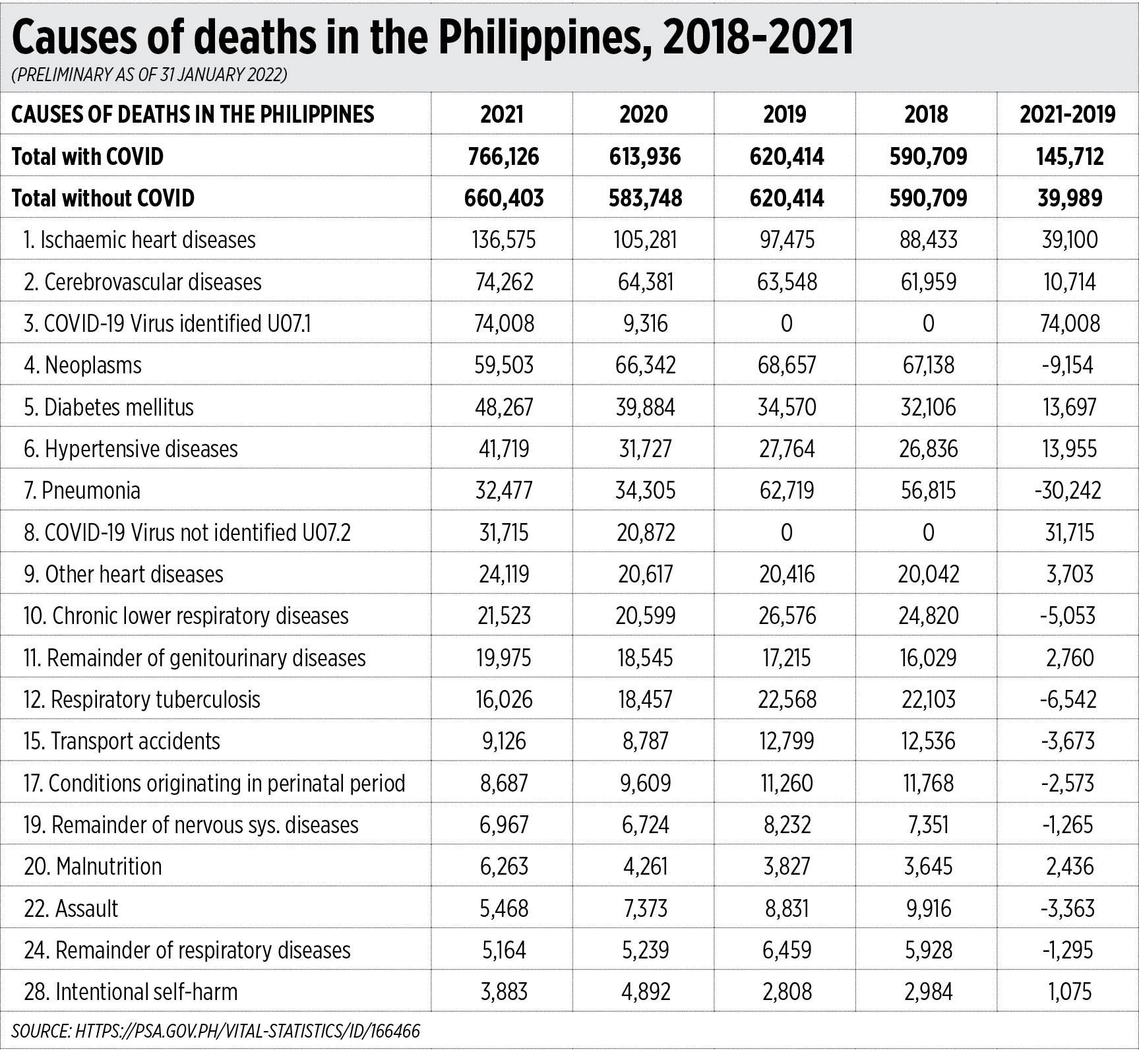
The Philippine Statistics Authority (PSA) released the Causes of Deaths data for 2020 and 2021 last week on March 29. I searched their previous reports and included data for 2018 and 2019 below. Since there was no excess mortality or deaths in 2020 over 2019, I compared 2021 with 2019. The data show the following.

One, there was a huge increase in deaths in 2021 when more COVID infections happened and mass vaccination started — 145,700 more deaths than in 2019 and 152,200 more deaths than 2020.

Two, if COVID deaths — virus identified UO7.1 and unidentified UO7.2 — are excluded, there were still 39,000 more deaths in 2021 over 2019.

Three, there were more deaths from ischemic heart diseases, diabetes, hypertension, and cerebrovascular diseases in 2021 than in 2019. This coincided with more reports of myocarditis, blood clots and related diseases days or weeks after vaccination in 2021, even until 2022.

Four, there were fewer deaths from pneumonia, cancer or neoplasms, lower respiratory diseases, and tuberculosis in 2021. The hypothesis “deaths from regular pneumonia were counted as COVID deaths” may fit in this situation.

Five, continued lockdown and business closures (KTV and music bars, some hospitality shops, etc.) led to fewer deaths from assault/fights and transport accidents, but more deaths from malnutrition and suicides or intentional self-harm (see Table).

Since the narrative “more huge gatherings, no distancing for hours, more COVID infections” is proven to be false by the huge electoral rallies, government should drop all mobility restrictions and presentation of mandatory vax card or negative PCR tests for work and travel.

Three real economic risks facing the Philippines this year: 1.) continued high public debt that will require high taxes, from P8.22 trillion (actual and guaranteed) in 2019 to P10.25 trillion in 2020, and P12.15 trillion in 2021; 2.) high inflation, from 2.6% in 2020 to 4.5% in 2021, and projected to reach 5% or more in 2022 with very high energy and commodity prices; and, 3.) low GDP growth this year, from -9.6% in 2020 and 5.7% in 2021. Our people and businesses should be freed from various mobility restrictions to produce more goods and services, reduce inflation and expand economic output.

The two leading Presidential candidates, especially VP Leni who is catching up, should have clear policies to open up the economy wide and clear, and remove all existing and planned mobility restrictions on people and businesses.


Bienvenido S. Oplas, Jr. is the president of Minimal Government Thinkers.

minimalgovernment@gmail.com

Retrofitting our democracy

Presidential aspirant and Vice President Leni Robredo visits fisher folks in Talisay, Cebu during her campaign sortie Feb. 24, 2022. — PHILIPPINE STAR/ MICHAEL VARCAS

As a Catholic congregation with a mission to provide human and Christian education to the young, we, the De La Salle Brothers, are constantly immersed in the world of young people. As mentors, teachers, and guides, we listen to their complaints, problems, stories, hopes, and dreams. We dialogue with them regardless of their creed, culture, and convictions, and learn from them, too. Because they are our primary concern, we believe that the upcoming election is not just about choosing a new leader. In our message to the Lasallian Family, “Discerning Our Future: The 2022 Elections” dated Dec. 8, 2021, we said that this election is also “about choosing the kind of future we want for ourselves, our children, and our children’s children.”

We offered eight ethical principles for discerning the kind of leadership our country needs and deserves. One of these principles is the “promotion of subsidiarity which favors grassroots empowerment for social development over autocracy and authoritarianism.” Subsidiarity is a key principle of Catholic Social Teaching. We believe that everyone has the right to participate in decisions that affect their lives. Subsidiarity requires that decisions are made by the people closest and most affected by the issues and concerns of the community. Enshrined, too, in Article XIII, Sec. 16 of our Constitution, this principle gives everyone both a space and a voice at the table, and empowers them to participate in creating the common good.

Subsidiarity is the dynamic cooperation principle in the multi-level governance of the European Union, and is also the guiding principle of the Canadian Federation. The same principle is behind Republic Act No. 11054, otherwise known as the Bangsamoro Organic Law. In business, an example can be found in the small-to-medium-sized enterprises (SMEs) in Germany, which is the third largest exporting nation worldwide. SMEs account for over 99% of all their businesses. A 2020 study by Fred Mear and Richard Werner of De Montfort University in the UK revealed that the application of subsidiarity coupled with adequate staff training in German SMEs resulted in “greater productivity and material performance as well as greater job satisfaction.” The study concludes that subsidiarity is the secret of success of their SMEs.

In the Philippines, one of the best models of governance guided by the subsidiarity principle is the Naga City People’s Council, initiated during the leadership of the late Jesse Robredo. During those 19 years as mayor of Naga, this Ramon Magsaysay awardee partnered with every sector of society and established an effective mechanism to public participation, particularly of the marginalized sectors and other vulnerable groups, in local governance.

Leni Robredo continues his legacy of partnership politics today. As Vice-President, her flagship anti-poverty program Angat Buhay has partnered with 372 organizations and mobilized P520 million worth of resources for more than 600,000 families in 223 communities nationwide. Although she is bereft of political machinery and resources, her presidential bid is driven by local people’s councils and the generosity of individuals and other volunteers campaigning on her behalf.

Are we ready for this kind of participatory and consultative democracy? Perhaps some still prefer taking orders instead of taking responsibility for their decisions. I suspect, however, that the youth are ready and capable of this kind of partnership politics. As digital pioneers and now digital natives, young people over the last two decades prefer collaborative, bilateral, experiential, and dialogical approaches to learning. We need to dialogue with them and ask what kind of future they want before we decide whom to vote for.

On Feb. 10, the De La Salle University Brothers expressed support for the Robredo-Pangilinan team: “In our collective discernment, the De La Salle Brothers of the Taft Community unanimously agreed that the tandem that has unceasingly defended our fundamental liberties and who continue to work in solidarity with those who empower and improve the plight of the poor and vulnerable sectors is the partnership of Leni Robredo and Kiko Pangilinan.” To date, more than 120 groups coming from different sectors of society have expressed their support for Leni and Kiko.

During the pandemic, a number of our schools took the opportunity to retrofit some old buildings in order to re-strengthen the existing structure, improve their sustainability, and make them seismic resistant. As we continue our democracy building since its restoration in 1986, we need to make it resistant to autocracy and authoritarianism. It is time to retrofit our democracy with subsidiarity through the Robredo-Pangilinan team.


Brother Richie P. Yap, Fsc is a member of the Brothers of the Christian Schools founded in France by St. John Baptiste de La Salle. He is a Humanities and Social Sciences faculty member of the Senior High School of De La Salle University and specializes in Religious Education.

richie.yap@dlsu.edu.ph

ADVERTISEMENT
ADVERTISEMENT