Home Blog Page 6548

Romblon reelectionists, other candidates seek Comelec probe on alleged rampant vote buying

CANDIDATES (from left) Joey G. Venancio for congressman and Eduardo C. Firmalo for governor, with Provincial Board Member Jose M. Madrid who is seeking reelection, hold a press conference in Odiongan, Romblon to urge the poll body to probe alleged vote-buying activities by other candidates.  

CANDIDATES for local positions, including reelectionists, and the lone congressional seat in Romblon have called on the Commission on Elections (Comelec) to investigate what they called rampantvote buying in the province by incumbent officials aligned with presidential candidate Ferdinand BongbongR. Marcos, Jr.   

Its very alarming. Reports of vote buying has started in several towns of Romblon, as early as the first week of this month,Provincial Board Member Jose M. Madrid, who is seeking reelection under the Aksyon Demokratiko party, is quoted in a press release following a recent press conference held in the town of Odiongan.   

Mr. Madrid said incumbent officials under the party of presidential candidate Bongbong Marcoshave started making a list of voters who will be given cash gifts a day before the May 9 election.  

Its another style of vote buying this time since the reportedly ayuda, is a cash assistance under the governments social amelioration program and not from the provincial government,he said.  

Election Commission George Erwin M. Garcia declined to comment on the issue for now.   

“No comment/s po muna in the meantime,he told BusinessWorld via Viber.  

Jean Encinas-Franco, a political science professor at the University of the Philippines, said Comelec should immediately investigate the issue to preserve the credibility of the 2022 elections and to allay fears that the presidential race is highly favorable to Mr. Marcos. 

She said in a text message that the Comelec should probe the incident thoroughly and prove its independence given that it is now governed by people whose appointment papers were signed by President Rodrigo R. Duterte.  

“All the more that it should prove its independence.”  

Mr. Marcos’ spokesman, Victor D. Rodriguez, did not reply to a request for comment via Viber.   

The press briefing was attended by congressional candidate Joey G. Venancio, also running under Aksyon Demokratiko; Liberal Partys Eduardo C. Firmalo, a former governor who is aiming for the same position; and Vice Governor Felix F. Ylagan, who is seeking reelection under Aksyon Demokratiko.   

Mr. Firmalo said penalties against individuals engaged in vote buying, especially candidates themselves, should be strictly imposed. with reports from John Victor D. Ordoñez and Kyle Aristophere T. Atienza 

How China’s lockdowns are rippling through the economy 

REUTERS

CHINA’S lockdowns to contain the country’s worst COVID outbreak since early 2020 have battered the economy, stalling production in major technology and financial hubs like Shenzhen and Shanghai, and halting spending by millions of people shut in their homes.  

The restrictions are intended to eradicate any trace of the virus in the community, but they’ve also pressured everything from manufacturing and trade to inflation and food prices.  

Premier Li Keqiang has repeatedly warned of risks to economic growth, telling local authorities on Monday they should “add a sense of urgency” when implementing existing policies. The government is holding firm to its COVID Zero approach for now, a strategy economists say will push growth down to 5% this year, below the official target of around 5.5%. 

Here’s a deeper look at how the lockdowns are impacting critical sectors across the world’s second-largest economy.   

COMMODITIES HIT
China posted sluggish commodities imports in March, as elevated prices due to the war in Ukraine and tightening virus restrictions took their toll on demand.  

Natural gas purchases were worst affected, dropping below 8 million tons to their lowest level since October 2020. Crude and coal purchases were also running well behind last year’s schedule. 

China’s domestic metals fabricators are facing hurdles to transport raw materials and finished products, which have led to output cuts. Six out of twelve copper-rod plants in Shanghai’s neighboring provinces surveyed by Shanghai Metals Market earlier said they either have halted or plan to halt output. The researcher also predicted a rise in aluminum inventories. 

Meanwhile, Chinese buyers have slashed liquefied natural gas purchases in the world’s biggest LNG importer as prices soar and domestic demand stalls. Imports in the first quarter fell 14% from the same period last year, according to shipping data, and private companies are spurning offers to use once-highly coveted slots at state-owned receiving terminals. 

Shanghai’s city-wide lockdown has created congestion at the world’s largest port, with queues of vessels building there and at other stops handling diverted shipments. The number of container ships waiting off Shanghai as of April 11 was 15% higher than a month earlier, according to Bloomberg shipping data.  

A shortage of port workers in Shanghai is slowing the delivery of documentation needed for ships to unload cargoes, according to ship owners and traders. Meanwhile, vessels carrying metals like copper and iron ore are left stranded offshore as trucks are unable to send goods from the port to processing mills, they said. 

Data on Wednesday also showed the lockdowns having a notable impact on imports, which fell 0.1% on year in March, the first contraction since August 2020.  

MANUFACTURING WOES
China’s purchasing managers surveys show manufacturing contracted in March, with small and medium-sized firms particularly shaken by operational snags. The Caixin index, based on surveys of smaller, export-oriented businesses, dropped to its worst level since the start of the pandemic two years ago.  

Some large manufacturing firms have been able to keep operations going by adopting a so-called closed loop system, in which employees were kept at factory locations and tested regularly. However, those protocols aren’t perfect: One member of a European Union trade group said last week that work can be “very, very difficult,” even with permission to operate amid restrictions. 

Some technology companies have suspended production as China’s restrictive policies weigh on a sector already contending with a shortage of components. 

Most major tech manufacturers — from Semiconductor Manufacturing International Corp. to Taiwan Semiconductor Manufacturing Co. and iPhone maker Foxconn Technology Group — froze operations in the early days of Shanghai’s outbreak. Many have since resumed after setting up closed-loop systems.  

Logistics jams are constricting shipments of components, draining inventories to the point where some manufacturers including Pegatron, Wistron Corp. and Compal Electronics Inc. are down to just a few weeks’ stocks, consultancy Trendforce estimates. The ongoing global supply crunch could worsen if local manufacturing is disrupted, constraining stock of computers and gaming consoles to smartphones, servers and electric vehicles.  

AUTOMOTIVE PAIN
Overall passenger vehicle sales slid 10.9% last month, suggesting pressure in the massive car market.  

Some automakers are hitting production snags because of lockdowns. Tesla, Inc.’s Shanghai factory has been shut down since March 28 because of restrictions in the city. The plant typically produces more than 2,000 cars every day, according to an estimate earlier this month from Dan Ives, an analyst at Wedbush Securities, Inc.  

Volkswagen AG was also forced to suspend production in Shanghai this month, while Chinese EV upstart Nio, Inc. said Saturday it halted production and delayed deliveries because many suppliers had to close shop.  

Auto parts maker Robert Bosch GmbH said Monday it shuttered two of its factories in China and operated closed-loop systems at two others, adding that it was seeing “temporary effects on logistics and supply chain sourcing.” 

CONSTRUCTION SNAGS
Domestic sales of excavators — a leading indicator for construction — plunged almost 64% in March from a year ago, indicating strain in the sector. 

China’s home sales slump also deepened last month: The 100 biggest companies in the debt-ridden property industry saw a 53% drop in sales from a year earlier, according to preliminary data from China Real Estate Information Corp. The decline was the steepest this year. 

Steel rebar inventory in China suggests construction activity “may have shifted to a lower gear,” according to analysis published last week by David Qu, an economist covering China for Bloomberg Economics. 

INFLATION RISKS
The lockdowns have driven up food costs and may endanger the nation’s ability to secure enough grains for the year as the curbs complicate China’s important spring planting season.  

Fresh vegetable prices jumped 17.2% on year in March, compared to a drop of 0.1% in February, data from the National Bureau of Statistics showed this week. Chinese farmers in some parts of the northeast, which produces more than a fifth of China’s national grain output, have had to contend with restrictions that prevent them from plowing their fields and sowing seeds. — Bloomberg


Economic risk trend for PHL banks revised to ‘stable’ amid eased restrictions

S&P GLOBAL RATINGS has revised its economic risk trend for Philippine banks to “stable” from “negative” as the easing of mobility restrictions could help improve lenders’ asset quality. 

“We have revised our economic risk trend for the Philippines to stable from negative. Philippines’ ratio of restructured loans is significantly lower than that of regional peers such as Indonesia, Malaysia, and Thailand,” it said in a report. 

The debt watcher in a note on Tuesday said the industry’s nonperforming loan (NPL) ratio has likely already peaked and is set for a gradual decline. It said the economy’s rebound and write-offs could help improve asset quality. 

“[However,] some slippage is possible from the restructured pool, especially from the services sector and from stretched consumers. We believe Philippine banks are well placed to absorb this residual stress given their improved capitalization and adequate provisioning coverage,” S&P said. 

Central bank data showed banks’ NPL ratio hit a three-month high of 4.24% in February. Soured loans rose by 2.38% to P472.664 billion from a year earlier. 

The industry’s NPL ratio reached a 13-year high of 4.51% in July and August 2021, still well below the 17.6% seen in the aftermath of the Asian Financial Crisis in 2002. 

The banking sector is seen to benefit from the gradual easing of mobility restrictions amid declining coronavirus cases, the debt watcher said. 

However, potential outbreaks remain a risk given uncertainties regarding the severity of its impact, it added. 

“A reimposition of strict mobility curbs will hurt businesses and consumers, resulting in further asset quality pain for the banking sector,” S&P said. 

Metro Manila and some provinces were under Alert Level 3 in January to curb the Omicron surge that followed the holiday season. Restrictions were gradually eased and most areas in the country are now under the most relaxed Alert Level 1. 

However, officials are monitoring another transmissible variant of the virus called Omicron XE, which has already been detected in some parts of Asia like Thailand and India.  

Based on S&P’s assessment, as for economic risks, the Philippine banking industry sees very high risk in terms of economic resilience and low risk of economic imbalances. Credit risks in the economy also pose a high risk to the sector. 

Meanwhile, for industry risks, there is high risk for institutional framework but low when it comes to competitive dynamics and system-wide funding. 

Net earnings of Philippine banks climbed by 44% to P223.66 billion in 2021 from a year earlier, based on central bank data. It was driven by a decline in lenders’ loan loss provisioning as the economy rebounded. — Luz Wendy T. Noble 

TDF yields mixed on hawkish Fed, Samurai bond issuance 

BW FILE PHOTO

YIELDS on the term deposit facility (TDF) of the Bangko Sentral ng Pilipinas (BSP) were mixed following hawkish statements from US Federal Reserve officials and the Philippine government’s latest yen-denominated bond issuance. 

Total tenders for the central bank’s term deposits amounted to P458.91 billion on Wednesday, above the P410-billion offering but lower than the P480.045 billion logged a week earlier. 

Broken down, tenders for the seven-day papers reached P187.396 billion, more than the P170 billion auctioned off by the central bank but lower than the P189.303 billion in bids seen last week. 

Accepted rates for the one-week term deposits were from 1.825% to 2%, wider than the 1.85% to 1.99% band recorded the previous week. This caused the average rate of the tenor to rise by 0.18 basis point (bp) to 1.9195% from 1.9177% previously.  

Meanwhile, the 14-day deposits fetched bids amounting to P271.514 billion, surpassing the P240-billion offer but declining from the P290.742 billion seen on April 6. 

Lenders asked for yields ranging from 1.8% to 1.965%, slightly lower than the 1.825% to 1.975% margin last week. With this, the average rate of the two-week papers fell by 2.94 bps to 1.9196% from 1.949% in the previous auction.  

The BSP has not offered 28-day term deposits for more than a year to give way to its weekly auction of securities with the same tenor. 

The term deposits and the 28-day bills are used by the central bank to gather excess liquidity in the financial system and to better guide market rates. 

TDF yields were down due to hawkish statements from Fed officials, Rizal Commercial Banking Corp. Chief Economist Michael L. Ricafort said in a Viber message. 

Fed Governor Lael Brainard said on Tuesday they are seeing signs that inflation has cooled, but stressed they will proceed with their rate hike plans and trimming the central bank’s balance sheet, Reuters reported. 

Meanwhile, Chicago Fed President Charles Evans on Monday said he would not necessarily oppose a 50-bp increase that will take interest rates to a neutral 2.25% to 2.5% by the end of 2022. 

Another factor that affected TDF yields is the government’s Samurai bond issuance, Mr. Ricafort said. 

The Bureau of the Treasury on Tuesday said the government raised ¥70.1 billion or P29 billion through its multi-tranche offering of sustainable Samurai bonds. 

Proceeds from the issuance will fund climate change mitigation and sustainable development projects. — L.W.T. Noble 

Peso up on remittance flows 

STOCK PHOTO | Image by iiijaoyingiii from Pixabay

THE PESO rebounded versus the greenback on Wednesday on remittance flows ahead of the Holy Week break and the government’s latest bond issuance. 

The local unit closed at P52.03 per dollar on Wednesday, appreciating by seven centavos from its P52.10 finish on Tuesday, data from the Bankers Association of the Philippines showed. 

However, it weakened by 44 centavos from its P51.59 close on April 8. The market will be closed on April 14-15 for holidays in observance of Maundy Thursday and Good Friday. 

The peso opened at P52.10 versus the dollar on Wednesday, which was also its weakest showing. Meanwhile, its intraday best was P51.88 against the greenback. 

Dollars exchanged decreased to $1.195 billion on Wednesday from $1.416 billion on Tuesday. 

A trader in a Viber message said the peso strengthened on the back of remittance flows for the holidays. 

“Traders also lightened up their positions ahead of the long weekend,” she said. 

The peso appreciated following the Samurai bond issuance of the government, Rizal Commercial Banking Corp. Chief Economist Michael L. Ricafort said in a Viber message. 

The government raised ¥70.1 billion or P29 billion from its offer of multi-tranche sustainable Samurai or yen-denominated bonds, the Bureau of the Treasury announced on Wednesday. Proceeds from the issue will fund projects related to climate change mitigation and sustainable development. — L.W.T. Noble 

Real Madrid survives superb Chelsea comeback to reach Champions League semis 

Real Madrid’s Karim Benzema celebrates scoring their second goal against Chelsea at the Santiago Bernabeu, in Madrid, Spain, April 12. — REUTERS/JUAN MEDINA

MADRID — Real Madrid saw off a stirring Chelsea fightback to book their place in the Champions League semifinals following a 3-2 defeat after extra time in a scintillating second leg at the Santiago Bernabeu on Tuesday to go through 5-4 on aggregate. 

Chelsea had looked on course to complete an astonishing comeback after taking a 3-0 lead in their quarterfinal second leg with goals from Mason Mount, Antonio Rudiger and an excellent individual effort from Timo Werner. 

Yet the hosts came roaring back, with Rodrygo finishing from a superb pass by Luka Modrić to level the tie 4-4 on aggregate and force extra time when Karim Benzema headed home to decide a remarkable encounter. 

Real Madrid will now face either Manchester City or local rival Atletico Madrid in the last four, with the English side taking a 1-0 lead into their quarterfinal second leg in Spain on Wednesday. 

It was a Champions League night for the ages at a packed stadium as a brilliant Chelsea came within 10 minutes of completing a rescue act that their manager Thomas Tuchel had said they were unlikely to accomplish. 

His team took the game to Real Madrid as they looked to turn around a two-goal deficit from the first leg and it took only 15 minutes for Mount to open the scoring from a through ball behind the defense. 

Chelsea was even more aggressive after the break and scored their second in the 51st minute when Rudiger guided home a header from a Werner corner to level the tie 3-3 on aggregate. 

Four minutes later, Werner found Marcos Alonso inside the area and he thrashed his finish into the top corner only to see his effort chalked off by the video assistant referee who had spotted a handball from the Spanish left back. 

With the visitors on top, however, it was only a matter of time until they scored their third which arrived in the 75th minute from a brilliant piece of individual skill from Werner, who left two opponents on the ground before dispatching a precise shot past Courtois and inside the far post. 

In the very next move, Kai Havertz was denied by former Chelsea keeper Courtois, who made a magnificent save to stop his close-range header. 

Yet just when Real looked completely out of the game, Modrić worked his magic, finding substitute Rodrygo at the far post with a delightful pass with the outside of his boot that the Brazilian volleyed past Edouard Mendy in the 80th to take the game to extra time. 

That was the cue for Vinicius, Jr. and Benzema to show up and rescue Real Madrid from what would have been one of the biggest shocks they had ever suffered at home. 

Vinicius worked his way inside from the left corner, and sent a lovely cross onto Benzema’s head, and the Frenchman bulleted it past Mendy as the ecstatic home fans exploded with joy. 

“It was another incredible night, what a sweet tasting loss,” Modrić told Movistar Plus. 

“We didn’t give up until the end. Despite going 0-3, I don’t think we played a bad game. Another night of suffering, but the important thing is that we have qualified.” — Reuters 

Djokovic falls to Davidovich Fokina in Monte Carlo 

MONTE CARLO — World number one Novak Djokovic slumped to defeat in only his fourth match of the season, losing 6-3, 6-7(5), 6-1 to unseeded Alejandro Davidovich Fokina in the Monte Carlo Masters second round on Tuesday. 

The 20-times Grand Slam champion endured a tough start to the year as he was unable to defend his Australian Open title in January after being deported from the country for being unvaccinated against coronavirus disease 2019 (COVID-19). 

Djokovic, who only played three matches in Dubai ahead of the Masters 1000 event in Monaco, struggled to find his range early in the contest as Spaniard Fokina raced to a 4-1 lead before taking the opening set on Court Rainier III. 

The world number 46 grabbed an early break in the second set to go up 3-0, but Djokovic battled back before overcoming issues with a wobbly serve to level the contest in a tight tie-break. 

Fokina then raised his game in the decider, preying on mistakes made by a tiring Djokovic and completed the victory as the Serb found the net. 

“This win is so special to me because I grew up watching Nole (Djokovic) and I’m a big fan of his,” Fokina, 22, said in his post-match interview. 

Djokovic was broken nine times and made 51 unforced errors and Fokina said rustiness could have played a part.  

“I knew Nole didn’t have the confidence because he didn’t play a lot this season… I had my chances in the beginning of the match and I took them,” he said.  

“When he won the second set it was tough mentally, but I worked hard to be focused. I had to be prepared for the war.” 

Greek Stefanos Tsitsipas, who did not lose a set en route to the title last year, began his defense with a comfortable 6-3, 6-0 win over 2019 champion Fabio Fognini of Italy. 

“Great tennis out there. It’s never easy to adjust to the cold and windy conditions… but I came through very well and performed to my best,” third seed Tsitsipas said. 

“You are used to the ball bouncing more on clay but there was less of that today… But I was able to generate pace and create good angles.” 

Earlier, Taylor Fritz got past Lucas Catarina 6-7(6), 7-6(5), 6-4, Dan Evans beat Benjamin Bonzi 6-0, 7-6(4), and David Goffin downed Jiri Lehecka 6-4, 6-3 in their first-round matches. — Reuters 

Bayern shocked by late equalizer as Villarreal reaches semis

MUNICH, Germany — Bayern Munich was stunned as underdog Villarreal scored an 88th minute equalizer through substitute Samuel Chukwueze to snatch a 1-1 draw and reach the Champions League semifinals with a 2-1 aggregate win over the Germans on Tuesday. 

Six-time European champion Bayern, who had won 12 of their previous 13 home games in the competition, leveled the tie when Robert Lewandowski drilled the ball in off the post after 52 minutes with his 13th Champions League goal of the season. 

Yet despite controlling the game, they failed to score again. 

Instead, it was Villarreal, semifinalist in 2006, who netted against the run of play with Chukwueze beating goalkeeper Manuel Neuer with a left-foot effort to silence the home crowd. 

Villarreal will play Liverpool or Benfica in the last four, with the English side leading 3-1 after the first leg in Portugal, with the return at Anfield on Wednesday. 

“We feel a lot of happiness. Ever since the draw paired us with Bayern, we have been telling ourselves that we could do it,” Villarreal forward Gerard Moreno said. “The belief and the way this team competes has helped us to achieve it.” 

“In the first leg, we made the mistake of not finishing the tie, and all the comments served as motivation for us. They made the mistake today of not killing us off and we took advantage of that.”  

ATTACKING FORMATION
Bayern coach Julian Nagelsmann fielded an attacking formation with Jamal Musiala, Lewandowski and Thomas Mueller up front, but they had only one effort on target in the first half with Musiala’s weak header on the half hour mark. 

Villarreal, unchanged from last week’s 1-0 win in Spain, was comfortable with staying back and efficiently absorbing the waves of Bayern attacks while remaining a threat on the break. 

But Unai Emery’s team looked out of sorts after the break, piling up errors and losing possession as Bayern instantly upped the pressure. 

Home defender Dayot Upamecano should have done better when his shot from eight meters flew over the bar in the 49th minute but Lewandowski did not miss three minutes later. 

Bayern intercepted a sloppy Villarreal pass and the Pole finished the quick move with a low drive off the post. 

The Bavarians, who had scored a total of 20 goals in their previous four home games in the competition this term, came close to a second goal in the 71st but Mueller’s diving header went wide. 

It was left to Villarreal, Europa League winners last year, to punished the hosts with a sucker punch through Nigeria winger Chukwueze, to reach the semis for the first time in 16 years. 

“If you want to achieve something in this competition, you need to beat the big teams,” Emery said. “We took the first step (in the last 16) with Juventus. With Bayern, we analyzed the game well.” 

“Now, Benfica or Liverpool, it is the same. We have a semi where we will try to use our chances,” he added. — Reuters

Stocks rebound ahead of Holy Week break

PHILIPPINE STAR/KRIZ JOHN ROSALES

SHARES went up on Wednesday as investors chose to maintain their positions ahead of the Holy Week break and despite data showing US inflation hit a 16-year high last month.

The benchmark Philippine Stock Exchange index (PSEi) gained 89.54 points or 1.29% to close at 6,984.90 on Wednesday, while the broader all shares went up by 40.74 points or 1.10% to close at 3,726.58.

“Investors returned to the Philippine market as they stayed away from other regions that have seen their inflation numbers continue to increase. Wall Street continued to tumble on Tuesday as US inflation spiked to 8.5%, the highest since 1981, further fueling concerns about tighter monetary policy from the Fed (US Federal Reserve),” Regina Capital Development Corp. Head of Sales Luis A. Limlingan said in a Viber message.

US consumer prices increased by the most in 16 and a half years in March as Russia’s war against Ukraine boosted the cost of gasoline to record highs, cementing the case for a 50-basis points interest rate hike from the Federal Reserve next month, Reuters reported.

The US consumer price index increased 8.5% year on year, with March advancing by 1.2%, the biggest monthly gain since September 2005.

US central bankers are split on whether high inflation will be a recurring problem in the future requiring repeated rate hikes, comments from two officials showed on Tuesday, a stark contrast to their broad consensus on the current policy path.

Separate remarks from Federal Reserve Governor Lael Brainard and Richmond Fed President Thomas Barkin on the post-pandemic outlook showed an emerging rift in the views of Fed leaders, who all currently see the need to raise interest rates aggressively this year.

Meanwhile, Timson Securities, Inc. Trader Darren Blaine T. Pangan said the PSEi rose as investors chose to maintain their positions ahead of the Holy Week break.

“The market is higher but on very thin volume most likely as investors are already on holiday break,” COL Financial Group First Vice-President April Lynn C. Lee-Tan added in a Viber message.

Philippine financial markets are closed from April 14-15 in commemoration of Maundy Thursday and Good Friday, respectively. Trading will resume on April 18, Monday.

All sectoral indices ended in the green on Wednesday. Industrials climbed by 219.01 points or 2.32% to 9,633.81; services rose by 23.66 points or 1.24% to 1,927.11; property gained by 36.95 points or 1.16% to 3,221.44; holding firms added 69.43 points or 1.06% to close at 6,570.64; financials went up by 7.24 points or 0.44% to 1,653.45; and mining and oil increased by 45.18 points or 0.37% to 12,217.61.

The MidCap index advanced by 7.68 points or 0.66% to 1,173.69 and the Dividend Yield index added 17.37 points or 1.05% to close at 1,676.36.

Value turnover decreased to P4.21 billion with 1.42 billion shares changing hands from P5 billion with 1.51 billion issues seen on Tuesday.

Advancers outnumbered decliners, 100 versus 66, while 54 names closed unchanged.

Net foreign selling declined to P294.89 million on Wednesday from P749.76 million the previous trading day. — Luisa Maria Jacinta C. Jocson with Reuters

All in the family 

Third generation keeps Mama Sita’s memory alive 

YOU and I are not quite the same as Alvin Reyes Lim. Our grandmothers’ faces, after all, are not found on bottles of sauce.  

Mr. Lim, a grandchild of Teresita Reyes (known to her family and the whole country as Mama Sita), was asked what it was like to have a culinary icon supervising their Sunday lunches. With laughter, he says, “For us, she wasn’t a Filipino icon in the kitchen. She was just lola (grandmother).”  

“It was just an environment of fun. Very informal. We’d be rushing to the dining table to get there ahead of our cousins.”  

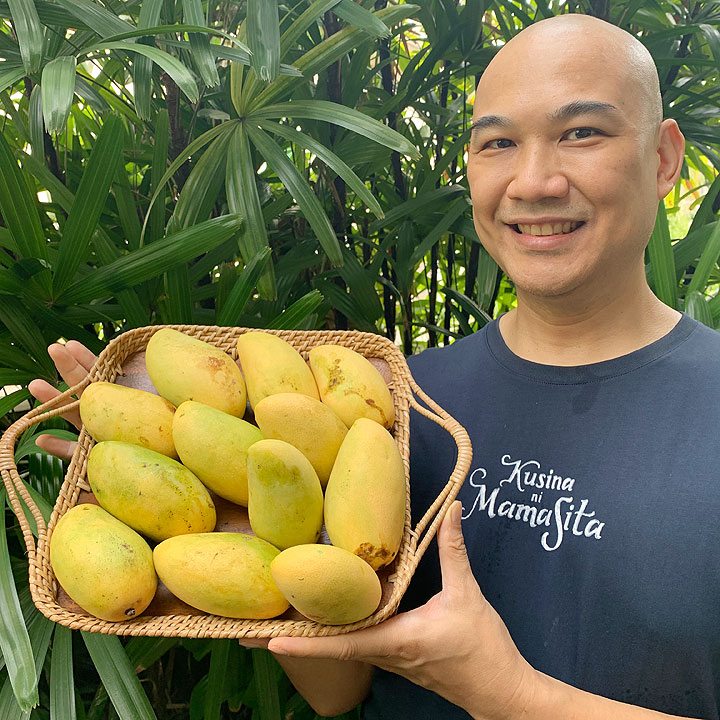
Mr. Lim serves as Communications Officer for the Mama Sita Foundation, which held a mango-picking picnic last week in a farm in Mexico, Pampanga. The picnic is reminiscent of Mr. Lim’s childhood, as Mama Sita used to take her family on trips just like that. While reminding the family of their roots, it served to remind media guests about the importance of heritage and ingredients through the foundation’s project, Mga Kwentong Pagkain (Stories of Food). 

“The secret to good cooking is to have good ingredients.” Mr. Lim said that he’d heard that from both his grandmother and nouvelle cuisine proponent Paul Bocuse, who spoke at Mr. Lim’s graduation dinner after his culinary studies in France. “I don’t know where she got this,” he said of his grandmother, though he recalled that Mama Sita was used to going around markets to search for ingredients along with her mother (thus, his great-grandmother), The Aristocrat founder Engracia Cruz-Reyes. “Your output can only be as good as your ingredients. If you want the best food, then you need the best ingredients,” he said.  

As we’ve mentioned, Mr. Lim comes from a long line of culinarians. His great-grandmother’s passion for food was passed to her descendants: while Mr. Lim’s Reyes line has Mama Sita, other cousins own Reyes Barbecue, Alex III, and Casa Reyes, among other food-related ventures. Mr. Lim spoke about the advantages of family-owned ventures. “I can speak for Mama Sita. Your brand is your family. In a way, you’re continuing the legacy. All you’re doing is just bringing back your memories of how it was while you were growing up. That way, the brand is very strong. It’s not contrived… it’s really who you are. 

“When I got into the company, it was like second nature. I’m just talking about my family,” he said.  

Going back to the Sunday lunches of his childhood (which continue to this day), he said, “It’s a fun environment, but we really enjoy eating, and being together. I guess those are the values of Mama Sita. We’re espousing Filipino food, because that’s the food that we grew up eating.” 

In fact, he says that the reason for Mama Sita’s creation of the brand was due to her own concern for her family. Visiting a daughter in the United States, she was disappointed with the quality of the Filipino food found there back in the 1980s. “Kawawa naman iyong mga Filipino na nasa America. Hindi sila nakakain ng masarap (The Filipinos in America are so unfortunate. They don’t get to eat delicious food),” said Mr. Lim, quoting his grandmother. That was when she decided to develop her recipes for packed and dried sauces and marinades. “The reason why there’s Mama Sita in the first place is to share that experience.”  

Mama Sita has just opened a new plant in Pasig, and is currently working on a line of sustainable packaging (through a subsidiary). One can say that they’re going strong, but not all family-owned corporations can say the same. An old adage goes that it takes three generations to make a fortune, and another three to lose it. Mr. Lim is currently in the third generation of the Mama Sita family.   

Asked how to make a corporation last in the family, he said, “I think one way is to keep on doing these activities. We’re making people familiar with the taste of Mama Sita. Not just you, outside the family, but even among us.” He gestured to his son, seated at another table. “As long as the family is familiar with the experience — we try to expose our children to the same — then that’s how the brand will be perpetuated.”  

As we’ve mentioned, few of us can say that our own lolas’ faces were on sauce packs. We wonder what it’s like to share someone so important with the rest of the world. “If you use it (the sauces), you get a taste of what we had during our Sunday lunches,” said Mr. Lim. 

“It makes us proud, siempre (of course). We’re proud of our heritage. We feel privileged that we grew up in that environment of family fun. Not everybody had that. We were able to try out good food,” he said. “Sometimes, you take it for granted… but we’re realizing that okay pala iyong mga nab-contribute ni Lola (what Lola contributed was ok).” — Joseph L. Garcia

Keeping things hot  

FILIPINO-born Romeo Joven grew up in the United States and worked as a television commercial producer there. Traveling to a variety of cities most days of the year was part of his job. Since he spent most of his time in hotels and on the road, Mr. Joven would often order takeout or food deliveries. It often worried him that the food would get cold while on its way to him, or when they had to wait before being able to consume the takeout.     

Mr. Joven wanted to find a solution to make food stay warm.

In 2018, he started to research online about technology and methods to do so — which he admits was born out of “curiosity that turned into an obsession.” He found information about how the US military kept meat, rice, and potatoes in small pouches and had a separate heating pad utilizing hot water to heat the food in 15 minutes.     

To make the process more convenient, Mr. Joven and his business colleagues customized a portable hotbox with a heating pad that is activated by pulling a string. In 2019, the product was ready, and Hotbox Philippines began commercial operations in May 2020.     

“I think it’s all about pushing ourselves to the limit and finding out what’s not discovered yet and how we can improve our lives,” Mr. Joven, Hotbox Philippines CEO, said at a press conference on April 5.   

BEST SERVED WARM
The hotbox was originally created for those who are busy and on-the-go. However, the coronavirus pandemic (COVID-19) lockdown gave their team an opportunity to improve the product.   

“All of a sudden, we were all home. So, what we did during that time is to improve the product, to create different sizes from individual boxes to family size platters for groups of 10,” Mr. Joven said.     

The Hotbox is equipped with steam technology which heats the food up to 30 minutes at over 80 degrees Celsius.  

The hotboxes are available to order without food and come in three sizes: Premium (P8 to P750), Benta (P85 to P175), and Platter (P255 to P1,375).      

Hotbox Philippines offers several Filipino and international cuisine choices in its online menu. Orders are also accepted for customized boxes to be delivered for meetings or special occasions. Deliveries are available within Metro Manila and Cavite.    

“You could put [the box] in the refrigerator, but it just takes longer for the heating mechanism to activate,” Mr. Joven explained. If the customer wants to refrigerate the food first, it is advised to remove the food to be refrigerated from the hotbox, and return the food to the box for heating.  

The single-use heating pad’s contents, according to Mr. Joven, can be used as “a neutralizer for the soil.” 

Since the product’s launch, Hotbox Philippines has partnered with several hotels and restaurants including Megaworld hotels, Shangri-La Hotels, Sofitel, and restaurants such as House of Lasagna.     

NEW PRODUCTS AND EXPANSION 
To be launched within the year are a pizza box, a burger box, and a soup box for ramen.    

Hotbox Philippines also plans to expand outside of Metro Manila to Cebu, parts of Mindanao and Northern Luzon starting in June. At the same time, the plan to expand abroad, starting in the United States.     

“We are definitely looking at expansion in the Philippines and strengthening our presence here, but at the same time, the expansion abroad,” Mr. Joven said.     

For more information about Hotbox Philippines and hotbox food orders, visit www.hotboxph.com or follow their Facebook and Instagram accounts @hotboxphils. Deliveries are available within Metro Manila and Cavite. Michelle Anne P. Soliman

Stuff to Do (04/13/22)

DOC RESURECCION: Gagamutin ang Bayan

TP’s Doc Resureccion goes online  

THE STAGE-to-screen performance of Tanghalang Pilipino’s (TP) Doc Resureccion: Gagamutin ang Bayan will stream from April 17 to 30 via www.ticket2me.net. Set in a poor fishing village, the play follows an idealistic young doctor, Jess Resureccion, who is running for mayor with the promise of helping uplift the status of its residents. But standing in his way is his cousin, Boy Pogi Resureccion, who was paid by the incumbent mayor to run as a nuisance candidate and hopefully spoil the votes for Jess. Jess tries to convince his cousin to withdraw his candidacy. Marco Viaña stars as Doc Jess Resureccion, while Jonathan “Tad” Tadioan stars as Boy Pogi Resureccion. Also in the cast are Nanding Josef as Papang, Sherry Lara as Mamang, and Lhoryie Nuevo as Elsa. Tickets are priced at P350 (general audience), and P550 (barkada promo for three tickets). Access to the show is for 24 hours on the buyer’s chosen date starting at 10 a.m. to 10 a.m. the following day.   

Rock opera on Bonifacio streams online  

THE STAGE-to-screen performance of ²BAYANI: Isang Rock Operang Alay Kay Andres Bonifacio streams on ktx.ph until April 23. The play is directed by Ricardo G. Abad, with music and lyrics by Zosimo Quibilan, Jr. and Khavn. It stars indie-folk musician Bullet Dumas in the titular role. The musical was shot at Ateneo’s Areté in Nov. 2021. The rock opera was first staged in 1996 with performers from Tanghalang Ateneo. Tickets are priced at P450. The show is available to stream at 10 a.m. on the chosen show date and is accessible for 24 hours.

ADVERTISEMENT
ADVERTISEMENT