


GT Capital Holdings, Inc. to conduct annual stockholders’ meeting virtually on May 11

Spotlight is BusinessWorld’s sponsored section that allows advertisers to amplify their brand and connect with BusinessWorld’s audience by enabling them to publish their stories directly on the BusinessWorld Web site. For more information, send an email to online@bworldonline.com.
Join us on Viber to get more updates from BusinessWorld: https://bit.ly/3hv6bLA.
Remittance growth slows in February


CASH REMITTANCES from overseas Filipino workers (OFWs) increased in February, although at its slowest pace in 13 months, reflecting the impact of the resurgence of coronavirus disease 2019 (COVID-19) infections in many countries.
Data from the Bangko Sentral ng Pilipinas (BSP) released on Monday showed cash remittances rose 1.3% to $2.509 billion in February from $2.476 billion a year earlier.
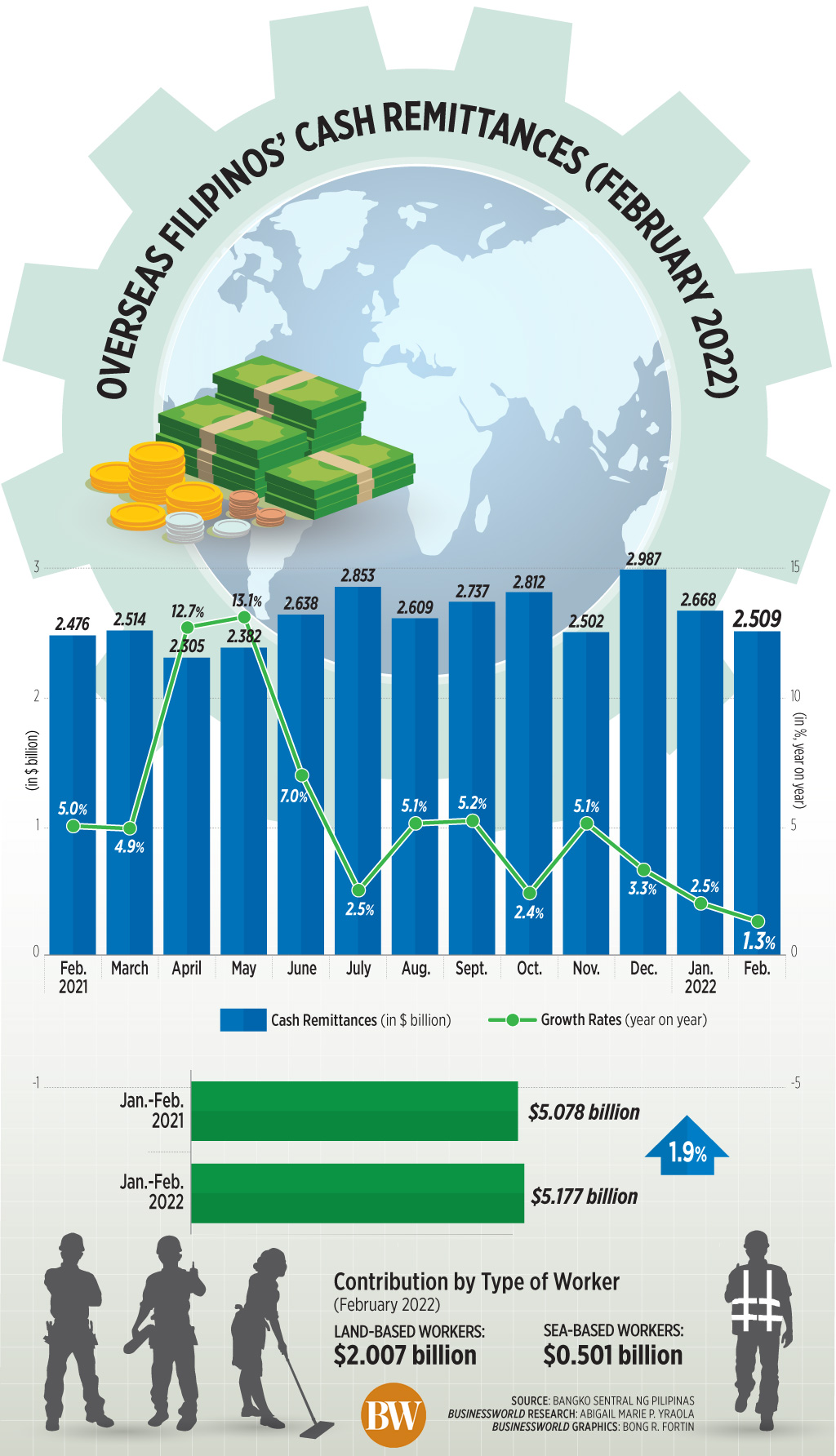 This is the smallest monthly inflow in three months or since the $2.502 billion haul in November.
February remittance growth was the slowest since the 1.7% fall seen in January 2021.
“The growth in personal remittances in February 2022 was slower, however, compared to that in January at 2.5% due in part to the reimposition of restrictions in OF (overseas Filipino) host countries and the Philippines amid a resurgence in COVID cases across the globe,” the BSP said.
In February, remittances sent by land-based workers went up 1.2% to $2.007 billion, while those sent by sea-based workers rose 1.6% to $501 million.
“(February remittance data) has yet to capture any impact from the Ukraine invasion which may impact remittances from Europe and those host countries near Ukraine and Russia,” UnionBank of the Philippines, Inc. Chief Economist Ruben Carlo O. Asuncion said.
Russia began its invasion of Ukraine on Feb. 24.
However, Mr. Asuncion said the protracted Russia-Ukraine war may be a drag on remittance growth, especially for OFWs in some European countries.
The central bank has said that both Russia and Ukraine have minimal contribution to total remittance inflows. However, it warned that a war that would involve Europe and Western countries like the United States, that are major remittance sources, could mean a bigger impact for inflows.
ING Bank-NV Manila Senior Economist Nicholas Antonio T. Mapa said the slower remittance growth in February was also likely due to the depreciation of the peso versus the greenback.
“A weaker peso allows OFWs to send home a smaller amount of dollars to cover peso expenses. In an environment of a weakening local currency and (largely) fixed peso expenditures, there will be less pressure on OFWs to send home more remittances in dollar terms,” Mr. Mapa said.
“For example, now that peso is at P52 per dollar, if an OFW has to send home enough dollars to pay for a P50,000-tuition, he needs to send less in dollar terms to pay the tuition ($961). Unlike last year, when peso was at P48, the OFW has to send $1,042,” he added.
With the peso’s continued depreciation against the US dollar, Mr. Mapa said it is unlikely that remittance inflows will offset the widening trade gap.
Money sent home by Filipino migrants in the first two months of 2022 amounted to $5.177 billion, up 1.9% from the $5.078 billion in the same period of 2021.
The expansion in cash remittances during the January to February period was driven mainly by inflows from the United States, Japan, and Singapore.
For the January to February period, the US, Singapore, Saudi Arabia, Japan, the UK, the United Arab Emirates, Canada, Taiwan, Qatar, and Malaysia were the 10 biggest sources of remittances. These countries accounted for 79.6% of the inflows.
Meanwhile, personal remittances, which include inflows in kind, inched up 1.2% to $2.793 billion in February. This brought personal remittances 1.9% higher to $5.759 billion in the first two months of 2022.
UnionBank’s Mr. Asuncion said OFWs will likely price in higher household spending in the next few months, as the economy continues to reopen.
“It is possible that OFWs are already thinking of the return-to-school costs even as early as now, especially that face-to-face schooling may be restored soon,” Mr. Asuncion said.
The BSP expects remittances to grow by 4% this year. — L.W.T.Noble
Agri trade deficit widens in 2021
By Luisa Maria Jacinta C. Jocson
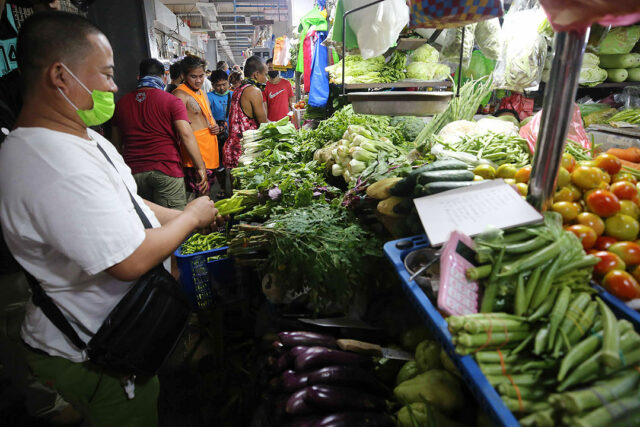
THE agricultural trade deficit widened 40% year on year to $8.92 billion in 2021, as the country imported more agricultural products to address increased consumer demand after the economy reopened.
Data from the Philippine Statistics Authority released on Monday showed that total agricultural imports jumped by an annual 25% to $15.71 billion.
Exports also increased by 9.4% to $6.79 billion in 2021.
Total trade in agricultural goods — or the sum of exports and imports — went up by 19.8% to $22.491 billion. In 2020, total trade in agricultural goods contracted by 7.1%.
Agricultural imports accounted for 13.3% of the country’s total imports in 2021.
Among the commodity groups, cereals accounted for the largest share or 20% of agricultural imports by value at $3.15 billion in 2021. This was followed by imports of residues and waste from food industries and prepared animal fodder with a value of $1.86 billion and miscellaneous edible preparations worth $1.76 billion.
Imports from the Association of Southeast Asian Nations (ASEAN) member-countries stood at $5.44 billion or 16.8% of the total.
Indonesia was the top source of agricultural products from ASEAN with $1.65 billion or 30.3% of the total, followed by Vietnam ($1.4 billion) and Malaysia ($973.7 million).
Animal or vegetable fat and oils and other related products were the top agricultural imports from ASEAN.
The Philippines imported $1.62 billion worth of agricultural products from the European Union (EU), with imports from Spain reaching $333.49 million.
Meanwhile, agricultural exports accounted for 9.1% of the country’s total exports in 2021.
By commodity group, the value of exports of edible fruit and nuts and the peel of citrus fruits and melons was at $1.93 billion, accounting for 28.5% of the total.
The Philippines’ agricultural exports to ASEAN stood at $767.01 million, with Malaysia as the top destination of farm goods at $247.95 million.
Tobacco and manufactured tobacco substitutes were the top agricultural exports to ASEAN countries, with the total value at $253.85 million.
The Philippines’ agricultural exports to EU countries reached $1.39 billion in 2021, with the Netherlands accounting for half or $698.11 million.
ECONOMIC REOPENING
Analysts attributed the higher imports of agricultural products to the gradual reopening of the economy in the last quarter as pandemic restrictions eased.
“The wider agricultural external trade deficit of the country in 2021 may be largely attributed to the further reopening of the economy that fundamentally increased agricultural imports, as well as the higher prices of global agricultural commodities amid improved economic recovery prospects vis-a-vis some disruptions in the global supply chains due to the pandemic from 2020 to 2021 that reduced production activities while demand picked up,” Rizal Commercial Banking Corp. Chief Economist Michael L. Ricafort said in a text message.
Pampanga State Agricultural University Professor Roy S. Kempis said a string of typhoons disrupted domestic agricultural output, particularly exports of fruits.
“The reason for this poor performance in the biggest segment of our agricultural exports could be attributed to losses in the production of fruits brought about by weather disturbances in 2021… Fruits are affected from flowering up to fruiting, and many of these follow a duration of six to nine months. Therefore, weather disturbances can strike, from flowering to fruiting. This was punctuated by Typhoon Odette (international name: Rai),” Mr. Kempis said in a Viber message.
Mr. Ricafort said that the trade deficit could further widen this year due to the Russia-Ukraine crisis, which has destabilized the prices of global commodities.
“Furthermore, non-monetary measures in terms of the increase in the imports of pork or meat, fish, and other food products at lower tariffs in an effort to increase local food supply and help mitigate inflationary pressures especially on food prices that account for the biggest share of the (consumer price index) basket have also partly widened the country’s agricultural trade deficit in recent months and could still be widened by these non-monetary measures in the coming months as higher global commodity prices could still bloat the country’s agricultural imports,” Mr. Ricafort added.
RBAP says raising capital requirements to hurt small lenders

REGULATORY REFORMS that will require bigger capital for rural banks which would encourage mergers may be detrimental to small lenders that have been affected by the pandemic, according to the Rural Bankers Association of the Philippines (RBAP).
“We agree that mergers and consolidations lead to stronger banks and a healthy rural banking industry. Though its intended goals are laudable, the timeline for implementation should be carefully reviewed as rural banks are still recovering from operational losses during the pandemic,” RBAP President Albert T. Concha, Jr. said in a Viber message.
Bangko Sentral ng Pilipinas Governor Benjamin E. Diokno in March said they are in the final stages of reviewing the minimum capital requirements for rural banks, taking into account that a strong capital base will be crucial to address challenges faced by the industry.
The minimum required capital for rural banks starts at P10 million up to P200 million, depending on the location and the number of branches that will be set up by lenders.
Mr. Concha urged regulators to consider that smaller banks are in need of “extraordinary support” from the government amid the pandemic.
“Some rural banks may be unduly classified as undercapitalized due to loan loss provisioning brought about by temporary delays in collection from borrowers whose businesses have been affected by the pandemic,” he said.
“These setbacks may be temporary and does not necessarily mean that the rural bank is unstable.”
Based on central bank data, the gross nonperforming loan (NPL) ratio of the rural and cooperative banking sector stood at 12.84% as of end-2021. This was lower than the 14.67% NPL ratio a year earlier.
However, it was still much higher than the sector’s 10.48% NPL ratio seen at end-2019.
Meanwhile, Mr. Concha said that a survey among rural banks that have merged or consolidated showed that such transactions are very costly and time-consuming for small lenders.
“Some mergers actually fell apart while trying to consolidate due to the costs and pain points involved,” Mr. Concha said.
“Tax incentives and tax breaks coupled with an easier inter-agency government approval process will definitely encourage more rural banks to merge and consolidate,” he added.
The central bank said that they have closed the operations of 21 rural banks since the pandemic started in March 2020. It also processed nine rural bank transactions for mergers, consolidations and acquisitions in the same period. — Luz Wendy T. Noble
BoC fuel marking program raises P60B in Q1
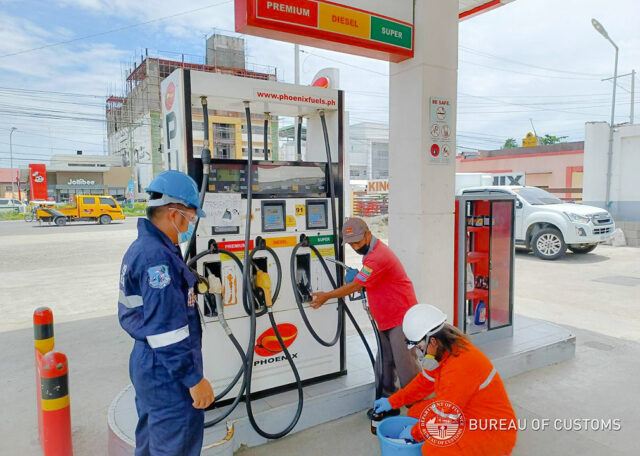
THE Bureau of Customs (BoC) on Monday said it has collected P60.15 billion in duties and taxes from its fuel marking program in the first quarter of 2022.
In a statement, the BoC said it marked 4.72 billion liters of gasoline, diesel, and kerosene in the January to March period as part of its efforts to curb smuggling.
Since the program started in September 2019 up to March this year, Customs has collected P374.13 billion in duties and taxes from marking 39.316 billion liters of gasoline, diesel and kerosene.
Over 73% of the fuel was marked in Luzon, while 21% was marked in Mindanao, and the rest in the Visayas.
Diesel accounted for 60% of the total volume marked, followed by gasoline at 39%. Kerosene made up the remainder.
The Bureau said that 28 oil firms were currently participating in the government’s fuel marking program.
The government sought to deter fuel smuggling through the fuel marking program, which involves injecting a special dye into fuel products to signify tax compliance. Absence of the dye is considered an indication that the fuel was likely smuggled.
The BoC and the Bureau of Internal Revenue seized 93,043 liters of diesel, 18,839 liters of kerosene, and two trucks carrying unmarked fuel, with a total estimated value of P13.36 million. The BoC said it has recommended filing criminal cases against the two private companies and 12 retail stations where the unmarked fuel was found.
“The Bureau of Customs will continuously implement its mandate to mark petroleum products under the fuel marking program to raise revenues while curbing fuel smuggling and leveling the playing field in the Philippine oil industries,” the agency said.
Meanwhile, fuel retailers were set to raise pump prices on Tuesday. The price of gasoline per liter will go up by P0.45, while diesel will increase by P1.70. Kerosene prices will jump by P0.45 per liter.
Based on data from the Department of Energy, the year-to-date price increase for diesel is P25.65 per liter, P21.10 per liter for kerosene, and P15 per liter for gasoline. — Tobias Jared Tomas
Gov’t seeking bids for 20-year Davao port management deal
By Arjay L. Balinbin, Senior Reporter
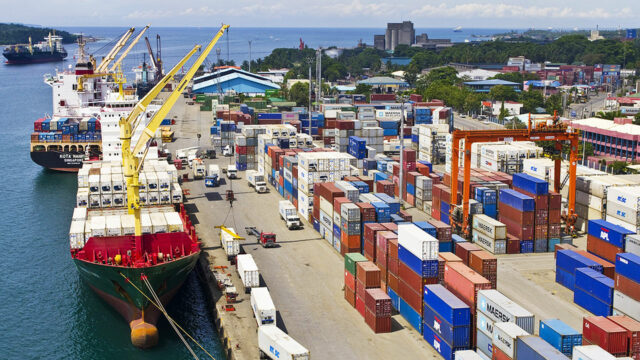
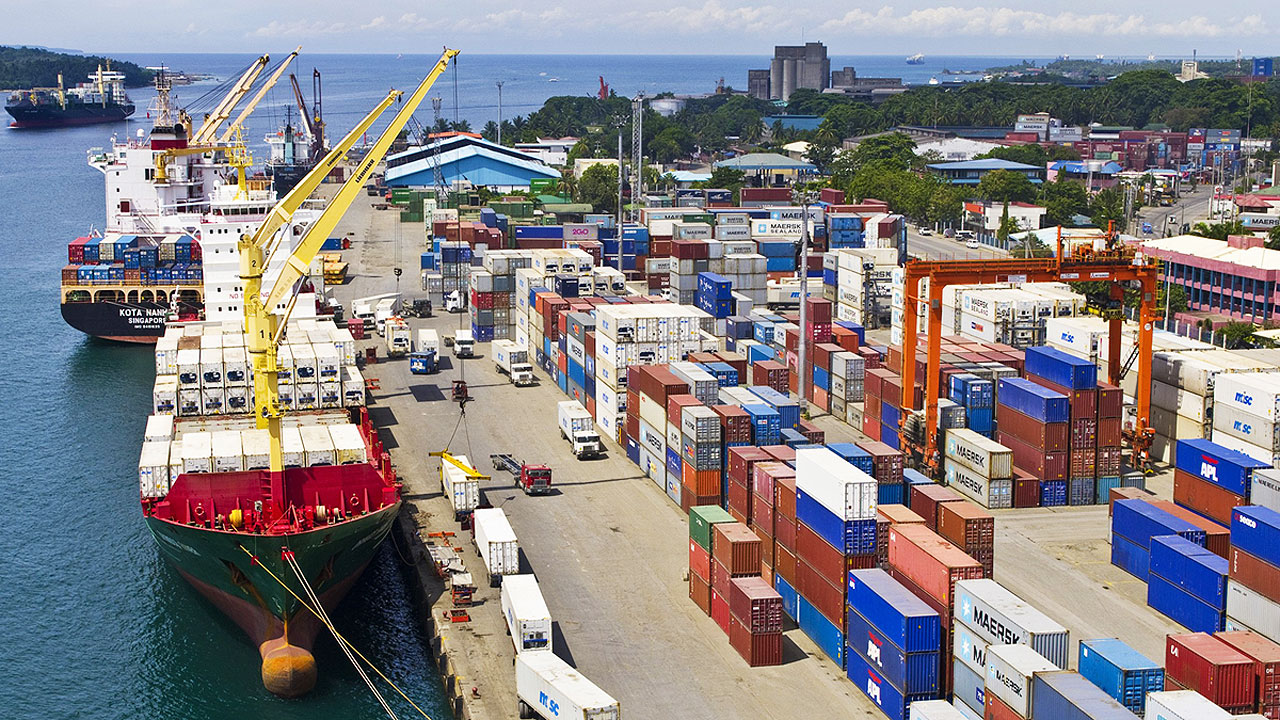
THE GOVERNMENT is now seeking bidders for the contract to manage the Davao port for 20 years with a minimum concession fee of P8.7 billion.
It has also awarded the P3.9-billion port terminal management contract for the Tagbilaran port in Bohol.
Documents from the Philippine Ports Authority (PPA) showed the government is inviting potential bidders to submit letters of intent for the public bidding for the management and operation of the cargo handling, passenger, roll-on/roll-off services (RORO) and other port-related services of the Port of Sasa, Davao.
Under the contract, the operator will also build the port’s physical landside infrastructure, which will cost a minimum of P9.9 billion.
The minimum concession fee for the project is exclusive of all taxes, the PPA said.
The agency said a prospective bidder must not be engaged in any business activity, whether primarily or otherwise, which will prevent it from properly discharging its contractual obligations.
The deadline for the submission of bids and bid opening has been set for May 5.
To recall, Dennis A. Uy-led Chelsea was awarded the original proponent status in 2019 for its unsolicited offer to modernize Davao’s Sasa port.
PPA General Manager Jay Daniel R. Santiago said in September last year that the proposal was still being evaluated by the National Economic and Development Authority.
Bidding out was an option, he also said, because the proponent had concerns about the length of the process. Chelsea Logistics President and Chief Executive Officer Chryss Alfonsus V. Damuy also said last year that the company could “explore any option depending on how it can be repackaged.”
Mr. Damuy had yet to respond to a BusinessWorld query on Monday on whether Chelsea is still interested in the Sasa port.
TAGBILARAN PORT
Meanwhile, the PPA recently awarded the port terminal management contract for the Port of Tagbilaran to the Pasig City-based joint venture of Globalport Terminals, Inc. and GlobalPort Ozamis Terminal, Inc.
The project was awarded at the proposed concession fee of P3.9 billion, exclusive of all taxes.
The PPA is hoping to complete and inaugurate 31 more port projects before President Rodrigo R. Duterte’s term ends on June 30.
Indonesian adaptation of Pretty Little Liars tackles depression, cyberbullying

THE SECOND season of the Indonesian adaptation of the drama series Pretty Little Liars premieres this month on PCCW’s pan-regional OTT video streaming service Viu in its original language and a Filipino dub.
The Indonesian adaptation of the Warner Bros. series is a Viu Original production.
Its first season, which premiered in April 2020, won awards for Best Adaptation of an Existing Format at the 2020 Asian Academy Creative Awards, and Best TV Format Adaptation (Scripted) Award at the 2020 ContentAsia Awards.
Set in Amerta, Bali, the adaptation focuses on four estranged undergrads whose clique falls apart when their queen bee, Alissa, goes missing. The remaining members of the clique receive messages from a mysterious figure named “A” who threatens to expose their darkest secrets.
Directed by Emil Hiradi, the series stars Anya Geraldine (in the role of Hanna), Yuki Kato (Alissa), Shindy Huang (Aira), Caitlin Halderman (Ema), and Valerie Thomas (Sabrina).
The series tackles themes on friendship, female empowerment, body positivity, and the consequences of cyberbullying.
“When we do collaborations like these, we look forward to putting social issues in front of the audience and enable conversations that happen around them,” Varun Mehta Country Manager of Viu Indonesia, said at an online press launch with Indonesian and Philippine media on April 7.
“There is a lot of conversation happening around [depression among young adults] as well. So, cyberbullying and bullying in school is the reason why this kind of depression creeps in,” he said.
“The good part is people are talking about it and what we want to do is we want to continue enabling conversations around topics like this. It’s not a stigma, it is something people can get out of,” Mr. Mehta said.
“Through our content, we want to bring these issues out for awareness and take it further from that,” he said.
Season 2 of Pretty Little Liars is now available on Viu. Episodes dubbed in Filipino are accessible at https://www.viu.com/ott/ph/en-us/vod/432400/Pretty-Little-Liars-S2-Tagalog. The Viu app is available on the App Store and Google Play. — Michelle Anne P. Soliman
Globe’s Asticom in talks for JVs, acquisitions

GLOBE TELECOM, Inc. announced on Monday that its subsidiary, Asticom Group of Companies, is looking to expand its portfolio of businesses through strategic partnerships, joint ventures (JVs), and acquisitions.
The company is currently “in talks with several parties,” Globe said in a statement.
Asticom President and Chief Executive Officer Mharicar Castillo-Reyes revealed that “a number of private equities” have approached the company in the past three months and have raised interest.
“We’re making sure that we find the right strategic partners that will help us grow the business and add value to the solutions we offer to address the needs of our customers,” she added.
Meanwhile, Asticom’s subsidiary Fiber Infrastructure and Network Services, Inc. (FINSI), a solutions provider for the telecom and technology industries, is also open to joint ventures and acquisitions.
“We’re in discussion with several companies for joint ventures. Our main goal is to increase our capabilities, grow the business, and eventually, create a connected nation,” FINSI General Manager Marc Kerveillant said.
Globe announced last week that BRAD, a shared services provider under Asticom, is targeting to cover areas beyond Luzon this year.
Asticom has formed various subsidiaries, including BRAD, Asti Business Services, Inc. (ABSI), FINSI, and HCX Technology Partners, Inc.
ABSI is Asticom’s business process solutions arm, while HCX is a provider of human resources, customer relationship management, and digital solutions.
Asticom is hoping to go public in five years.
Globe Telecom shares closed 0.98% lower at P2,424 apiece on Monday. — Arjay L. Balinbin
BillEase raises $20 million to expand PHL BNPL services

BILLEASE secured $20 million through a funding round to expand its Buy Now Pay Later (BNPL) platform in the Philippines.
The debt facility was granted by UK-headquartered Lendable, which is an emerging market credit facility.
“This facility is a further validation of our business and the platform our team has built over the past few years and helps to firmly position BillEase as the leading BNPL brand in the Philippines,” Georg Steiger, chief executive officer and co-founder of First Digital Finance Corporation (FDFC), which operates the BillEase app, said in a statement.
“We share the same focus on creating financing solutions that serve the emerging consumer segment as the Lendable team and we are excited to work with them to further financial inclusion in the Philippines,” Mr. Steiger added.
The result of the latest funding round follows the $11 million raised in January through Series B equity, with investor participants including BurdaPrincipal Investments, MDI Ventures, and KB Investment, among others.
This brings the company’s total fresh funds to $31 million.
“BillEase has grown tremendously as a business and we are keen to continue supporting their growth trajectory by providing sustainable and better access to financial products,” said Hani Ibrahim, Lendable’s chief investment officer.
Mr. Steiger said the volume of transactions done on BillEase climbed by nearly five times in the first three months of 2021 from a year earlier.
BillEase also turned a profit last year, he added.
The company offers a one-stop platform that offers BNPL, installment schemes, low-cost loans, and e-wallet top-up services. It also provides retailers with payment solutions to attract and retain customers.
Mr. Steiger is bullish on prospects for fintech services in the Philippines amid the population’s rapid adoption of digital transactions during the lockdown and regulatory reforms to help more Filipinos have access to financial services.
“The population is young, tech savvy and largely underbanked. Several regulatory initiatives are coming together to significantly improve market infrastructure — instant retail payment networks, National ID, national credit bureau, digital banking licenses, just to name a few,” Mr. Steiger said.
The central bank wants 50% of all payments done online by 2023. — Luz Wendy T. Noble
Gov’t fully awards T-bills

THE GOVERNMENT fully awarded the Treasury bills (T-bills) it offered on Monday as rates moved sideways amid strong demand for short-term debt papers and expectations of aggressive rate hikes from central banks due to growing inflation risks.
The Bureau of the Treasury (BTr) raised P15 billion as planned via T-bills at its auction on Monday as total tenders reached P54.12 billion, nearly four times as much as the program but lower than the P71.25 billion in tenders seen at last week’s auction.
Broken down, the BTr raised P5 billion as planned via the 91-day instruments as bids reached P26.23 billion. The average rate of the three-month T-bill went up by 2.1 basis points (bps) to 1.25% from 1.223% last week.
The government also made a full P5-billion award of the 182-day securities as the offer attracted P15.85 billion in bids. The average rate of the six-month tenor rose by 1.3 bps to 1.568% from the 1.555% fetched at the previous auction.
Lastly, the Treasury also raised P5 billion as programmed from the 364-day debt papers from P11.954 billion in tenders. The average rate of the one-year paper went up by 2 bps to 1.877% from 1.857% a week earlier.
At the secondary market prior to the auction, the 91-, 182-, and 364-day bills fetched rates of 1.2659%, 1.5051%, and 1.7997% respectively, based on the PHP Bloomberg Valuation Reference Rates published on the Philippine Dealing System’s website.
National Treasurer Rosalia V. de Leon in a Viber message to reporters said the BTr made a full award of its T-bill offer as there was strong demand for shorter tenors due to fears of aggressive tightening by the US Federal Reserve.
“Market [was] biased on the short end, with anticipated aggressive Fed actions with combined policy rate hikes and balance sheet runoff, as reflected in Fed minutes,” she said.
A trader said via Viber that demand was skewed towards shorter tenors “given rising concerns on inflation and global central banks’ monetary tightening.”
“We have entered in a cycle of monetary tightening, not just onshore but also globally — therefore, investors are still anticipating for interest rates to rise,” the trader said.
“While there’s still a need for central banks to hike their rates to quell inflation, short-end bonds will continue to be market’s preferred choice of outlet,” the trader added.
Central banks around the world have been tightening their monetary policies to temper inflation despite lingering risks to economic growth.
A Reuters poll last week showed analysts expect the Fed to raise rates by 50 bps each for its May and June review to respond to runaway inflation. These analysts also expect a 40% probability of recession by 2023.
US inflation surged to 8.5% year on year in March, the biggest gain in four decades but still in line with market expectations, amid record high fuel costs.
Minutes of the Fed’s March meeting, where the central bank hiked borrowing costs from near-zero for the first time since 2018, also showed they plan to raise rates several times this year and trim their asset holdings.
At home, the Bangko Sentral ng Pilipinas (BSP) kept benchmark rates untouched for the 11th straight meeting last month but warned it could begin unwinding its pandemic-driven easy policy due to inflation risks. BSP Governor Benjamin E. Diokno earlier said the policy rate could reach up to 2.75% by next year from the current 2%, which is a record low.
Headline inflation was at 4% in March, matching the upper end of the central bank’s 2-4% target. It was quicker than the 3% in February, showing the impact of the surge in oil prices caused by the Russia-Ukraine war.
Meanwhile, a second trader in a Viber message said the auction result came as expected, adding that “demand most likely came from scheduled T-bill maturities.”
The second trader added that yields moved sideways from last week’s auction as the market is still waiting for a “major catalyst.”
On Tuesday, the BTr is auctioning off P35 billion in reissued seven-year Treasury bonds (T-bonds) with a remaining life of six years and three months.
The first trader said demand for the bond offer may be muted compared to Monday’s T-bill auction as investors continue to prefer shorter tenors amid fears over looming Fed and BSP rate hikes and rising inflation.
The BTr wants to raise P200 billion from the domestic market in April, or P60 billion through T-bills and P140 billion via T-bonds.
The government borrows from local and external sources to help fund a budget deficit capped at 7.7% of gross domestic product this year. — T.J. Tomas with Reuters
Meralco Bolts go all out for the equalizer in Game 6, says Black

By Olmin Leyba
FALLING to a precarious 3-2 situation against nemesis Barangay Ginebra further strengthened Meralco’s resolve to push harder and save its fourth attempt at a breakthrough Philippine Basketball Association (PBA) Governors’ Cup diadem.
“It takes four wins to win a championship and they only won three games so obviously, I’m not giving up, my players aren’t giving up,” said defiant Bolts coach Norman Black, whose troops go all out for the equalizer in tomorrow’s Game 6 at the Smart Araneta Coliseum.
“We still have a chance to tie the series so we’ll work hard the next couple of days to try to fix some of our mistakes (in Game 5).”
The Gin Kings pushed the Bolts to the brink with a 115-110 victory on Easter Sunday, following up on their series-tying 95-84 romp in Game 4 last Wednesday.
The Justin Brownlee-led crowd darlings fired a franchise record-matching 16 triples to gain the upper hand against the Bolts in the pivotal fifth match witnessed by a pandemic-high of 18,251 spectators.
“Amazing shooting game by Ginebra,” noted Mr. Black of their rivals’ 40-of-78 (51.3%) field goal clip and 16-of-34 (47.1%) three-point marksmanship.
“There were a lot of times when we actually played decent defense but they were still able to knock down their threes. It’s hard to beat a team that shoots like that.”
Mr. Black underscored the importance of executing their defensive rotations better next time if they want to extend the series to a do-or-die Game 7.
“We seemed to be one rotation late a lot of times against the offense of Ginebra. We really have to work on that,” he said.
Knowing fully well the Bolts’ fighting spirit and capabilities, the Gin Kings are staying on an even keel and firmly fixed on the task at hand.
“It’s very tough closing out games so for us, we won’t look back or look forward, focus lang sa Game 6 and we’ll see what happens,” said Ginebra star Scottie Thompson, who went a rebound shy of a triple-double in helping the team to its third win with his 19-9-11 outing in Game 5.