Home Blog Page 6538

TUCP files petition for P820 daily minimum wage in Central Luzon
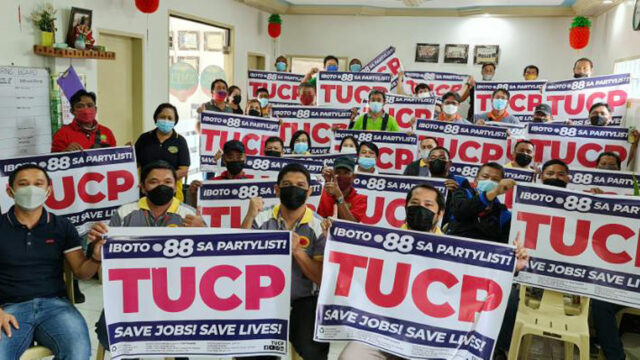
TUCP FB PAGE

THE Trade Union Congress of the Philippines (TUCP) on Tuesday filed a petition seeking to increase the daily minimum wage in Central Luzon to P820 from P420, in line with petitions filed with other regional wage boards.

The TUCP said in a statement that the current P420 daily wage in Central Luzon is no longer sufficient to provide workers a decent living.

It said the region’s current daily wage was set almost three years ago, “when the regional wage board granted a measly P20.00 increase in 2019 which had been long dissipated by the succeeding price increases since that year.”

The TUCP said that with the rising prices of food and other essentials, the current minimum wage in the region “can only accord them and their families with nutritionally deficient survival meals.” 

“With the current minimum wage in Region III, a measly P15 per meal can be allocated per member of the family,” it said. “What kind of food can be bought for P15 nowadays?”

The TUCP said the minimum wage in Central Luzon puts earners and their families well below the poverty threshold of P16,226.00 per month The minimum wage implies monthly income of P10,920.00, or P9,570.55 when adjusted for inflation.

“Poverty incidence among families in Central Luzon is in the double digits except in Pampanga with 6.2% poverty rate,” it said, citing government data.

It said that the poverty rate was estimated at 24% in Aurora, 12.8% in Bataan, 14.9% in Bulacan, 17% in Nueva Ecija, 13.2% in Tarlac, and 22% in Zambales. — Kyle Aristophere T. Atienza


Manila Water targeting ‘smart, lean’ operations, signs Singapore tech deal

PHILSTAR FILE PHOTO

MANILA WATER Co., Inc. said it expects to exercise enhanced “cost discipline” this year as it undertakes major projects to supply its core East Zone water services business.

In a report, Manila Water President and Chief Executive Officer Jose Victor Emmanuel A. de Dios said: “We will streamline operations and rationalize operating expenses. Cost discipline will be reinforced to ensure the delivery of results through a smarter and leaner deployment of resources.”

The company’s main businesses are water services to Metro Manila’s East Zone (EZ), Non-EZ Philippines, and Non-EZ international.

The major EZ projects the company is currently undertaking are the Wawa Calawis water treatment project in Antipolo with a capacity of 80 million liters of water per day (MLD), and the 250 MLD East Bay Water Treatment Plant along Laguna de Bay.

Phase 1 of the Wawa Calawis water treatment plant is currently under construction. Its output will augment the water supply for EZ customers upon completion.

The report did not provide an estimate of capital expenditure (capex) this year. In 2021, the company allocated capex of P16.9 billion, with P13.9 billion invested in EZ operations. The bulk of the projects it pursued involved wastewater treatment capacity expansion, network reliability improvements, and tapping new water sources.

The company has 41 EZ wastewater treatment facilities. It also broke ground on the 53-kilometer (km) Mandaluyong West Sewerage System Project and the Aglipay Sewage Treatment Plant (ATP) with a 60 MLD capacity, expandable up to 120 MLD.

Non-EZ initiatives include potential projects in Central and Northern Luzon.

“We will work to improve our financial performance as well and introduce innovations that are thoughtful, swift, effective and most importantly, long-lasting to ensure the continued enhancement of shareholder value,” Mr. De Dios added.

Separately, Manila Water said it signed a memorandum of understanding (MoU) with Enterprise Singapore (ESG) to pursue technology exchanges.

The partnership will involve water technology test deployments by Singapore companies in the East Zone as well as outside Metro Manila.

ESG is an arm of Singapore’s Ministry of Trade and Industry (MTI).

It aids startups, small firms, and high-growth companies by supporting new, productivity-enhancing technologies.

Manila Water’s East Zone covers Marikina, Pasig, Taguig, Makati, San Juan, Mandaluyong, parts of Quezon City and Manila, and Rizal province. — Ram Christian S. Agustin with Luisa Maria Jacinta C. Jocson

DTI seeks more resilient pharma supply chain

THE government has promised its support to make the pharmaceutical industry more competitive while making its supply chain more resilient to disruptions like the coronavirus disease 2019 (COVID-19) pandemic.

Trade Undersecretary Ceferino S. Rodolfo said during the first general membership meeting of the Philippine Pharmaceutical Manufacturers Association (PPMA) on April 8 that “by 2024, it is forecasted that the total pharmaceutical market will be valued at $4.17 billion. Philippine health expenditure is on the rise, with consumer health expenditure posting double-digit growth in the last three years with an average of 11%.”  

“The Philippine pharmaceutical market is dominated by a few key players in almost the entire value chain — from production to distribution and retail. While the Philippine pharmaceutical industry is dominated by multi-national companies (which) account for more than half the total value of sales (56.5%) — local companies are now putting up strong competition, specifically in the sale of generic drugs,” he added.  

Mr. Rodolfo pushed for the development of herbal medicine production.

“The growth of local production of herbal medicines will spur (their) development… as a robustly expanding wholesale and retail sector for herbal medicines will generate income and employment opportunities,” Mr. Rodolfo said.

The Board of Investments (BoI), of which Mr. Rodolfo is the Managing Head, is encouraging investment in research and development and supply chain development for herbal products.

“The Philippines is making significant progress in developing nature-based products. Herbal drugs for COVID-19 and dengue are being developed by the industry, while active pharmaceutical ingredients (API) in herbal drug products such as lagundi and sambong, are already being produced locally,” the BoI said.  

Recently, the BoI approved the registration of Lloyd Laboratories, Inc. for a project worth P24 million as a domesic producer of Molnupiravir, an oral drug for COVID-19 patients. The production facility is located in Malolos, Bulacan and has an annual capacity of 1 million 400-milligram capsules of Molnupiravir. — Revin Mikhael D. Ochave

PHL seeking to join US-led Indo-Pacific Economic Framework 

REUTERS

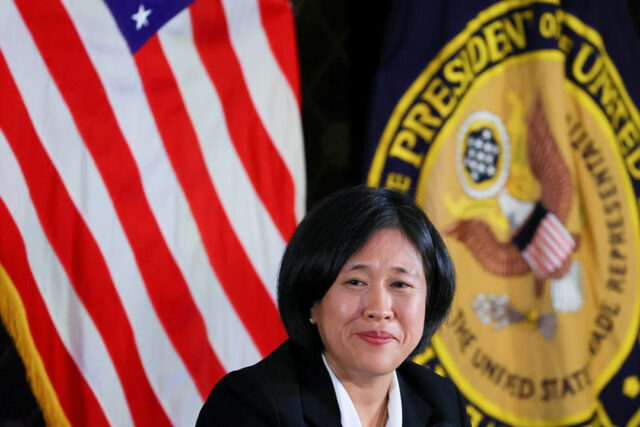
THE Philippines is seeking to join the Indo-Pacific Economic Framework (IPEF) organized by the US, according to the Department of Trade and Industry (DTI).

In a statement on Tuesday, the DTI said Trade Secretary Ramon M. Lopez led a Philippine trade delegation to Washington, DC in bilateral talks with US Trade Representative Katherine Tai.

Mr. Lopez expressed the Philippines’ interest in joining the initiative during the meeting.

The DTI described the IPEF as a “vehicle” for improved US economic engagement in the Indo-Pacific region, focused on trade facilitation setting, standards for the digital economy and technology, making the supply chain more resilient, pursuing initiatives in decarbonization and clean energy, infrastructure, and labor standards.  

According to the DTI, the Philippines is interested in elements of the IPEF that have to do with micro, small, and medium enterprises (MSME) promotion and development, the digital economy, supply chain resiliency, the environment, sustainability, and infrastructure investment.

Ms. Tai said during the meeting that the Philippines is welcome to join IPEF.

Meanwhile, Mr. Lopez also said the Philippines is interested in participating in the Alaskan seafood trade.

“The Philippines would be a good choice for processing… seafood from Alaska for re-export. The Philippines has extensive experience and a competitive edge in terms of processing and toll packing, as exemplified by our engagement with the European Union (EU). This may assist in boosting agricultural trade between the US and the Philippines,” Mr. Lopez said.  

The DTI said the two countries are further discussing Philippine plans to export pineapples to the US, with Mr. Lopez also noting the increased activity in the Philippines of US data center developers that cater to hyperscalers.  

“These also lead to more renewable energy capacity since renewable energy is the required source of energy for these facilities. These efforts are underway and will support building stronger trade and investment ties with the US,” Mr. Lopez said.

In 2021, the US was the Philippines’ third largest trading partner, top export market, and fifth largest import supplier, according to the DTI. Bilateral trade with the US was $19.6 billion, with the Philippines enjoying a modest trade surplus. The US was also the Philippines’ fifth largest investor that year with approved investments worth $77.64 million. — Revin Mikhael D. Ochave 

IP protections touted as key benefit of RCEP participation

REUTERS

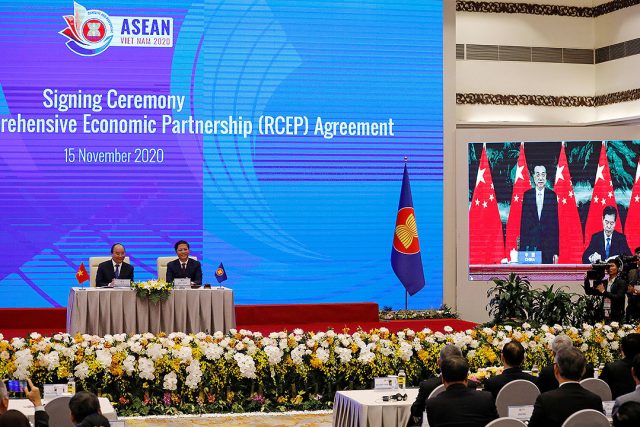
THE PHILIPPINES stands to benefit from the intellectual property (IP) provisions of the Regional Comprehensive Economic Partnership (RCEP), according to the Department of Trade and Industry (DTI).

Trade Assistant Secretary Allan B. Gepty said at a recent webinar organized by the Association of Southeast Asian Nations (ASEAN)-Japan Center that the RCEP’s IP protections will help create a business environment that fosters competition and innovation.

“On the aspect of business, some of the benefits of a robust IP regime in the RCEP region, (include) streamlined procedures for IP applications, a level playing field in IP protection and enforcement, and a standard protection of the interests of inventors, authors and performers, particularly on digital platforms,” Mr. Gepty said.

Mr. Gepty added that a solid IP regime encourages inventiveness and creativity while balancing the rights of IP owners and the public interest.

“We have to know, if not master, the utilization of our intellectual capabilities. The IP System is a great equalizer that can facilitate the generation of value from our creativity, inventiveness, and innovativeness. Let us therefore promote, protect, and respect intellectual property,” Mr. Gepty said.  

RCEP is a trade agreement involving Australia, China, Japan, South Korea, New Zealand and the 10 members of the ASEAN. It started taking effect in many member countries on Jan. 1.  

The Philippines has yet to sign on to RCEP after the Senate failed to ratify it before adjourning on Feb. 3 for the election break. President Rodrigo R. Duterte signed the trade agreement on Sept. 2.  — Revin Mikhael D. Ochave

Napocor missionary-area power capacity 88.53 MW at end of 2021

BW FILE PHOTO

THE National Power Corp. (Napocor) said the power it generates in missionary areas rose to 88.53 megawatts (MW) at the end of 2021, from 13.66 MW in 2016.

In a report filed to Finance Secretary Carlos G. Dominguez, who also serves as the company’s chairman, Napocor said it added 321.5 circuit kilometers of transmission lines over the same period in remote, missionary areas, which are served by an arm of Napocor known as the Small Power Utilities Group (SPUG).

The starting point in 2016 was 776.03 circuit kilometers, Napocor Officer-in-Charge Melchor P. Ridulme was quoted as saying in a statement issued by the Department of Finance (DoF).

Mr. Ridulme, who is also Napocor’s Chief Operating Officer, also said the company hopes to increase the number of SPUG facilities to 296 by June from 285 at the end of 2021, servicing  240 missionary areas, from 229 at the end of 2021.

“Napocor plans to expand capacity additions in missionary areas to 106.58 megawatts and its transmission lines to 1,125.46 circuit kilometers, along with increasing substation capacity to 225 megawatts by June 2022,” Mr. Ridulme said in his report.

The number of SPUG plants operating round the clock has also increased to 82, from 41 plants in 2016, he added.

“Napocor is also active in the reforestation of watershed open areas to support sustainable hydro and geothermal plant operations in the main grids,” the DoF said in its statement.

Reforestation in watershed areas covered 4,419 hectares (has.) at the end of 2021, from 1,881 has. in 2016, Mr. Ridulme added.

Last month, Napocor sought approval from the Energy Regulatory Commission (ERC) to use P335.35 million from collected universal charges for watershed rehabilitation.

Under Republic Act (RA) No. 9136, or the Electric Power Industry Reform Act (EPIRA), Napocor is responsible for providing power to areas that are not connected to the transmission system.

Electrification projects in off-grid areas are funded by their own revenue supplemented by universal charges (UC) collected from all other consumers.

The National Transmission Corp. (Transco) also reported to Mr. Dominguez that it inspected 85 assets and four projects of the National Grid Corp. of the Philippines (NGCP) to ensure compliance with Department of Energy (DoE) policies.

Transco President and CEO Jainal A. Bahjin II said, however, that most of the inspections were virtual, due to mobility restrictions in force during the pandemic. Transco resumed physical inspections starting March 22, Mr. Bahjin said.

Under Republic Act No. 9136, or the Electric Power Industry Reform Act of 2001 (EPIRA), Napocor is responsible for power generation in areas not connected to the main grid.

Mr. Bahjin said Transco validated 173 right-of-way claims and filed expropriation cases or approved right-of-way claims involving the company’s transmission lines and substations in 2021. — Tobias Jared Tomas

IPOPHL signs piracy monitoring partnership with US movie trade association

PHILIPPINE STAR/ MICHAEL VARCAS

THE Intellectual Property Office of the Philippines (IPOPHL) said it entered into a partnership to monitor piracy with the Motion Picture Association (MPA), the US trade group for the movie industry. 

The IPOPHL said in a statement on Tuesday that the MPA committed to support the creation of a piracy monitoring system and a rolling site-blocking regime that will disrupt accessibility to piracy sites.

It said the memorandum of understanding (MoU) was signed on April 12 to finalize the partnership.

“This newest partnership with MPA elevates IPOPHL’s whole-of-society efforts in fostering a digital environment that respects intellectual property (IP) rights,” IPOPHL Director General Rowel S. Barba said.

Mr. Barba said the pandemic worsened digital privacy, leading to billions in lost revenue for legitimate content providers.

According to IPOPHL, the MOU allows for information-sharing to reduce digital piracy in the Philippines.

“The MPA also commits to conduct training on various piracy prevention measures. The group will also provide reasonable assistance to help IPOPHL and other relevant agencies effectively implement rolling site blocking and take down,” IPOPHL said.  

Jan van Voorn, MPA executive vice-president of global content protection, said piracy remained rampant in the Philippines, with a negative impact on job creation and the overall economy.

“A site blocking framework, which incorporates transparency and due process, can be incredibly effective at reducing levels of online piracy in key markets like the Philippines,” Mr. Van Voorn said.  Revin Mikhael D. Ochave

ARTA sees e-complaints management system clearing case backlog

THE ANTI-Red Tape Authority (ARTA) said a new complaints management system (CSM) known as e-ARTA will help clear the case backlog for persons reporting delayed government transactions.

ARTA Director General Jeremiah B. Belgica said at a briefing Tuesday that the CMS will reduce the number of complaints that are not addressed.

“Through this system, (the backlogs) will be reduced since the government agencies will immediately act on the complaints and applications. They would be called upon not only by the public, but also by ARTA. Their answers to ARTA could be almost real-time. When the concern enters the system, they will be able to answer via online. There will also be an opportunity for them to revisit their systems and processes that actually could be causing the delays,” he added.

The e-ARTA CMS was officially launched Tuesday. It features a fully automated referral system which will be piloted between April 19 and May 19, according to ARTA Memorandum Circular No. 2022-03, Series of 2022.

The pilot project will involve the committees on anti-red tape (CART) of the Bureau of Internal Revenue, Social Security System, Department of Environment and Natural Resources, Food and Drug Administration, Department of Agrarian Reform, Land Transportation Franchise and Regulatory Board, Land Registration Authority, Bureau of Customs, Home Development Mutual Fund, Department of Public Works and Highways, and local government units in the National Capital Region. — Revin Mikhael D. Ochave 

Sta. Romana, PHL ambassador to China and veteran journalist, 74 

THE LATE Philippine Ambassador to China Jose Santiago “Chito” Sta. Romana talks about Philippine products at the China International Import Expo in Shanghai in Nov. 2021. — AMBASSADOR STA ROMANA FACEBOOK PAGE

JOSE Santiago ChitoSta. Romana, Philippine ambassador to China and previously a Beijing-based broadcast journalist for over 30 years, passed away on April 19, the Department of Foreign Affairs announced.  

He was 74.   

The Department of Foreign Affairs (DFA) offers its sincere condolences to the family and loved ones of Ambassador Chito, to our nation for its great loss,the department said in a statement.  

Mr. Sta. Romana was appointed envoy to China in Dec. 2016 by President Rodrigo R. Duterte, who pursued a foreign policy of friendly ties with China amid growing maritime tensions over the South China Sea dispute.   

He was chosen for the Beijing post in recognition of his deep knowledge of Chinas history and people,DFA said. We honor his important legacy of selfless service to the Filipino in the most challenging foreign post.”   

In a 2011 email interview with UCLA language students posted on the www.liwanagatdilim.cdh.ucla.edu website, when he had just retired as a journalist and was recently back in the Philippines, he talked about seeing Chinas growth as an economic power.  

The Philippines can learn a lot from the experiences of China in terms of development of economyThis includes the effort to solve the problem of poverty through appropriate policies. This problem will not be solved if we don’t focus on the progress of the economy to be able to give the poor a chance to be able to better their situations,Mr. Sta. Romana said.  

Chinas Foreign Ministry Spokesperson Wang Wenbin said in a statement, After assuming the post of the Philippine Ambassador to China in 2017, he worked actively and industriously, making important contributions to promoting bilateral relations and friendship between our two peoples.”    

Chinese Ambassador to the Philippines Huang Xilian, in a Facebook post on Tuesday, also extended his condolences to the ambassadors family and friends.  

China-Philippine relations have been strengthened and indeed flourished under his distinguished tenure as the Philippine Ambassador to China,said Mr. Huang. I greatly value our time working together and will always be grateful for his friendship and undeniable contribution to the development of China-Philippines relations.Alyssa Nicole O. Tan 

Several injured in shooting at Bukidnon IP protest attended by presidential bet Ka Leody

LABOR leader and presidential candidate Leodegario "Ka Leody" de Guzman (in black jacket and red shirt) in a consultation meeting with indigenous community leaders in Bukidnon on April 18, the night before the shooting incident. — KA LEODY DE GUZMAN TWITTER ACCOUNT 

AT LEAST five people were injured after gunshots were fired at a protest of an indigenous peoples community against alleged land-grabbing in Quezon, Bukidnon on Tuesday, which was attended by labor leader and presidential candidate Leodegario “Ka Leody” de Guzman.  

“Thank you for those who were concerned, Roy Cabonegro, David D’Angelo, and I are safe,” Mr. de Guzman said in Filipino on Twitter, referring to two senatorial candidates from his party who were also at the site.   

“An organizer of farmers and a leader of the Manobo-Pulangiyon tribe beside me were hit,he added.   

The protest action by the Manobo-Pulangiyon IP community was against the alleged land grabbing of their ancestral land, according to a Facebook post by Mr. De Guzman’s party, the Partido Lakas ng Masa.  

The IP community claims to have been forced to leave their ancestral domain of about 900 hectares by a large corporation linked to the incumbent mayor of Quezon, said Mr. de Guzman’s media team in a Viber message.  

The municipal government of Quezon has yet to respond to a query on the response of Mayor Pablo M. Lorenzo III, who is running for reelection.   

“Those responsible did not fire warning shots, but directly fired at us which lasted for about 15 minutes,” Mr. de Guzman told a press briefing on Tuesday via Zoom. “Land grabbers look at our indigenous peoples as pigs who can be shot.”  

Election Watchdog Kontra Daya, in a tweet, also condemned the incident as an apparent case of election-related violenceand urged the Commission on Elections (Comelec) to conduct an investigation.    

Commissioner George Erwin M. Garcia said via Viber, This is a cowardly act that should be condemned by peace-loving Filipinos. If this is an election-related incident, count the Comelec in to use all our powers to get to the bottom of this and hold accountable the culprits and face the full force of the law.”  

Presidential Spokesperson Jose Martin M. Andanar, in a statement on Tuesday, called on local authorities to investigate and prosecute those behind what he described as a “dastardly act.John Victor D. Ordoñez 

Storm Agaton agri damage climbs to P1.4B; death toll at 175 

PCG

AGRICULTURAL damage due to tropical storm Agaton, with international name  Megi, has risen to P1.4 billion, the Department of Agriculture reported on Tuesday.   

Damage and losses have been reported in the regions of Western Visayas, Eastern Visayas, Zamboanga Peninsula, Soccsksargen and Caraga, affecting 23,188 farmers and fishers.   

Volume of production loss stood at 35,258 metric tons (MT) across 17,384 hectares of agricultural areas.  

The increase in overall damage and losses is due to additional reports on fisheries in Western Visayas,the department said in its April 19 bulletin.  

Affected commodities include rice, corn, high value crops, livestock, and fisheries.  

Available interventions include at least P662.5 million worth of financial assistance, including: P500 million worth of Quick Response Fund for the rehabilitation of affected areas, and P100 million under the Survival and Recovery (SURE) Assistance Program of the Agricultural Credit Policy Council for Western Visayas.  

The department is also providing P42.07 million worth of rice seeds, P16.76 million worth of corn seeds, and P3.61 million worth of assorted vegetables.  

The Philippine Crop Insurance Corporation will also allocate funding to indemnify affected farmers.  

CASUALTIES
Meanwhile, search and retrieval operations were continuing as of Tuesday, according to authorities, with 110 still classified as missing while the death toll has reached 175 based on the national disaster agencys latest report.    

The Department of the Interior and Local Government said on Tuesday that 8,823 police officers and firefighters were deployed to assist in the evacuation, search, rescue, and retrieval operations as storm Agaton triggered flooding and landslides last week, mostly in central parts of the country.   

Military officers and local emergency teams have also been part of the response operations.   

Most of those who died were due to massive landslides in the province of Leyte in Eastern Visayas, with at least 110 in Baybay City and more than 50 in Abuyog town. Luisa Maria Jacinta C. Jocson and John Victor D. Ordoñez

US donates additional P17.5 million to support ecosystem and community recovery post-Odette

THE UNITED States government has donated an additional P17.5 million to support recovery efforts for the ecosystem and communities in areas heavily affected by typhoon Odette, internationally known as Rai, which struck southern and central parts of the Philippines in mid-December.   

This additional assistance will support local organizations in assessing the extent of damage to ecosystems and wildlife habitats, enhancing their resilience and recovery, and provide assistance to farmers, fisherfolk, and indigenous peoples whose livelihoods were destroyed by the typhoon,the US Embassy in Manila said in a statement on Tuesday.  

American government aid for Odette response and recovery now totals P1.1 billion, it said.   

Seven civil society organizations in Siargao Island, Dinagat Islands, Palawan, Cebu, Bohol, Southern Leyte, and mainland Caraga will be given P2.5 million each to implement projects to mitigate long-term damage and environment risks.  

The goal is to rehabilitate coastal and terrestrial ecosystems, support disaster risk reduction and management initiatives, rebuild livelihoods through biodiversity-friendly enterprises, and provide incentives for local communities helping with the rehabilitation.  

Meanwhile, China has donated over P10 million to provide assistance to those affected by tropical storm Agaton, internationally known as Megi, which hit the country last week.  

We wish all those affected could overcome the difficulties and rebuild their homes at an early date,Chinese Ambassador to the Philippines Huang Xilian said in a Facebook post on Monday.  

The Philippines, which sits within the typhoon belt in the western Pacific Ocean, gets an average of 20 storms every year. Alyssa Nicole O. Tan 

ADVERTISEMENT
ADVERTISEMENT