PILIPINAS Shell Petroleum Corp.’s (PSPC) upcoming import facility in Davao del Sur province, which broke ground on April 22 and expected to be operational by the third quarter of 2024, is seen to help stabilize fuel supply and prices in Mindanao, the country’s southern mainland.
The project is a 50-50 joint venture between Northern Star Energy Corp. and DMCI Construction and Equipment Resources, Inc. (DMC-CERI), and will be leased exclusively to Shell.
The Sta. Cruz Storage Corp. (SCSC) will operate the facility.
“Once operational, this facility will allow energy companies such as Shell Philippines to efficiently manage inventory and external volatility,” DMC-CERI Chairman Isidro A. Consunji said during the groundbreaking ceremony.
“In doing so, they can mitigate or avoid sudden and dramatic price increases for our countrymen, particularly, those in Mindanao,” he said.
Located in Barangay Darong in Sta. Cruz town, the Darong Import Facility will have a capacity of 67 million liters.
Mr. Consunji also said the venture will further boost the local economy of Sta. Cruz and its development as an industrial hub.
The town is already host to several major firms such as San Miguel Brewery, Inc.; Aboitiz Power’s Hedcor Sibulan, Inc.; and processed coconut products exporter Franklin Baker Company.
DMC-CERI President Tulsidas C. Reyes said that once the Darong Import Facility is completed, it will be one of the biggest and most modern of its kind in Mindanao.
It is also seen to provide fuel supply to ensure mobility during storms, floods, and other natural calamities.
Kit M. Bermudez, Shell vice president for supply and distribution, said the facility will help protect the Philippine’s south from external challenges in the fuel supply industry.
“We can ensure that even if there are a lot of challenges with the Ukraine war and in the global economy, once we have a depot here definitely the availability of fuels will be more secure,” he said.
Meanwhile, Mr. Bermudez also announced that Shell is planning to establish more than 80 new Shell mobility sites in the southern part of Mindanao by 2025.
“We believe in the prospect of Mindanao. We are growing the business nationwide and Mindanao is one of the priorities in terms of expanding,” he said. — Maya M. Padillo
THE TOURISM office of Sta. Cruz in Davao del Sur, one of entry points for treks to Mt. Apo, has advised visitors not to bring pork and pork products to mitigate the threat of African swine fever (ASF) infection among the mountain’s Philippine warty pig population, which have been frequently sighted recently.
Julius R. Paner, the town’s senior tourism operations officer, has issued an advisory that prohibits bringing, cooking, and serving of pork-related food during climbs to Mt. Apo, the country’s highest peak and a declared protected area.
“All Sta. Cruz mountain guides are also directed to monitor from time to time the presence of Philippine Warty Pig which was frequently seen lately in the saddle grassland of the summit and have it reported to this office through actual photo and video footage. Geotagged photos are preferred,” the advisory said.
A team from the Department of Environment and Natural Resources’ Davao Region office also reported sightings of the endemic Sus Philippensis or Philippine warty Pig during a monitoring activity from April 11 to 17.
“These wild pigs, locally known as baboy-ramo or baboy-ihalas, are categorized as vulnerable due to its decreasing population. If the said threat worsens, they may soon be listed as endangered,” according to the regional environment office
Mr. Paner noted that swine fever remains a threat in the region and steps must be taken to ensure that it does not get into the Mt. Apo Natural Park.
He said the local advisory has yet to be passed as a municipal ordinance or a resolution by the Protected Area Management Board, but he expressed confidence that their trained guides will comply.
“But I can always assure that our licensed guides will always follow advisories,” he said. — Maya M. Padillo
LOCAL and foreign tourists take photos on April 24 at the viewing deck of the Chocolate Hills, one of the most iconic attractions in Bohol. The province, which depends largely on agriculture and tourism, is still reeling from the economic impact of the coronavirus pandemic as well as tropical cyclone Rai, locally known as Odette, which struck southern and central Philippines in mid-Dec. 2021.
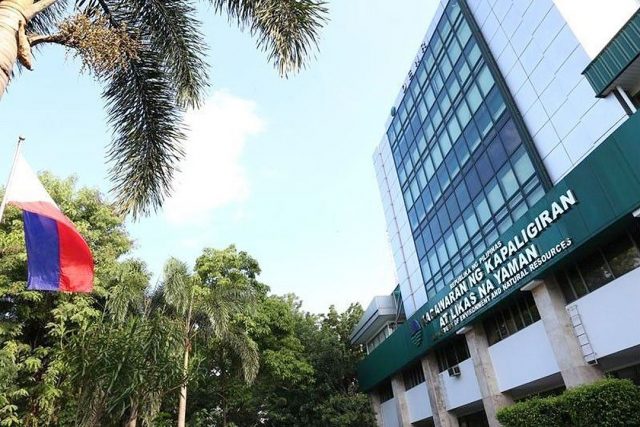
THE DEPARTMENT of Environment and Natural Resources (DENR) said the online application process for an Environmental Compliance Certificate (ECC) has been simplified with a goal of generating approvals or rejections after 20 working days.
The 20-day deadline is in line with the recommended processing time for “highly technical transactions” under the Ease of Doing Business Law (Republic Act 11032).
The 20-day category also includes projects that pose a risk to public health, safety, or morals, or activities that run counter to public policy.
In a memorandum circular, the DENR said the new online procedure applies to projects for which proponents must submit documents listed in the Initial Environmental Examination (IEE) checklist.
“Since 2015, no updating of procedures and requirements of the established ECC online system has been made,” the DENR said.
The ECC is a key document that must be obtained before undertaking major projects. It includes an assessment of the project’s impact on its surroundings, and is mandatory for mines, power plants and infrastructure projects.
The minimum documentary requirements for ECC applications filed online were listed as proof of authority over the project site, certification from the local government unit (LGU) on the compatibility of the proposed project, the project description, and geotagged photographs of the site, among others.
The new ECC application fee costs P5,070 while the amendment application costs P2,030.
The law requires simple transactions to be concluded within three days and complex transactions within seven days. — Luisa Maria Jacinta C. Jocson
MANILA Water Co., Inc. said it is not currently implementing any water service interruption schemes, after a Senator said the dry season should not be used as a pretext to discontinue services.
“Water supply for the East Zone remains normal and we are not implementing any off-peak or rotational water interruptions,” Manila Water Corporate Strategic Affairs Group Head Nestor Jeric T. Sevilla, Jr. said in a Viber message to BusinessWorld.
He said Manila Water can tap additional sources to cater to increased demand during the dry months. These include the Cardona Water Treatment Plant, which can produce up to 100 million liters of water per day (MLD), deep wells with output of about 115 MLD, and the Marikina Portable Water Treatment Plant which can add 20 MLD.
“We continue to maximize our distribution reservoirs, reduce our water losses to 13%, as well as install line boosters to ensure water reaches the elevated and farthest points of our service area,” Mr. Sevilla said.
Senator Mary Grace S. Poe-Llamanzares, who chairs the chamber’s Committee on Public Services, said the water concessionaires in the capital region should not use the dry season as a pretext for imposing water service interruptions.
Maynilad Water Services, Inc. Corporate Communications Head Jennifer C. Rufo had said the water interruptions that were supposed to end in April may extend to May due to the increased demand.
“We expect our water concessionaires to deliver on their commitments under their renewed franchise and revised concession agreement, and complete the projects necessary to have safe and reliable water on the taps,” Ms. Poe said.
“It would be a disservice to fail our people in their most basic need at this time of struggle to recover from the pandemic,” she added. “Complacency certainly has no place in these back-to-back threats.”
Ms. Rufo told BusinessWorld in a Viber message that water interruptions at night give the company the opportunity to fill up its reservoirs in preparation for daytime peak demand.
“Hence, we can sustain water service during hours of the day when it is needed most, minimizing inconvenience to customers,” she said, noting that the service interruptions will likely run from 10 p.m. to 4 a.m. when most customers are asleep and not using water.
The need to manage supply in the network comes from the increasing demand for water due to hotter days, Ms. Rufo said.
“If it appears, based on our projections, that the demand is still likely to deplete our reservoirs without this intervention, then we extend the implementation of these daily off-peak interruptions for another 15 days,” she added, advising customers to consistently store clean water during the dry season.
Ms. Rufo confirmed that Maynilad also has several supply augmentation measures, including the activation of deep wells and operation of modular treatment plants, which allow them to keep the service interruptions within off-peak hours.
Metro Pacific Investments Corp., which has a majority stake in Maynilad, is one of three Philippine units of Hong Kong-based First Pacific Co. Ltd., the others being Philex Mining Corp. and PLDT, Inc.
Hastings Holdings, Inc., a unit of PLDT Beneficial Trust Fund subsidiary MediaQuest Holdings, Inc., has an interest in BusinessWorld through the Philippine Star Group, which it controls.
MOST of the policies required to implement the Energy Efficiency and Conservation (EEC) Act (Republic Act No. 11285) have been implemented, and companies need to respond by stepping up their efforts to conserve energy in their organizations, Senator Sherwin T. Gatchalian said Friday.
Speaking at the Energy Efficiency Day 2022 webinar organized the Philippine Energy Efficiency Alliance (PE2), Mr. Gatchalian, chairman of the Senate committee on energy, said 35 out of the 40 provisions of the EEC Act are in force as of March 15.
Prior to the passage of the law, the Philippines was the only country in ASEAN without a law encouraging the efficient utilization of energy or providing tax incentives for energy-efficient projects.
He said that at present 34 companies have registered as Energy Service Companies to pursue efficient projects.
“I urge more companies to start undertaking energy efficiency and conservation measures to realize energy savings early on while we recover from the ill effects of the Covid-19 pandemic,” Mr. Gatchalian, who is seeking re-election, said.
Between April and June 2021, only 13.13% of the overall 30,333 designated establishments (DEs) were able to comply with the requirement to submit an annual utilization report.
Mr. Gatchalian said the Inter-Agency Energy Efficiency and Conservation Committee’s (IAEECC) recently-issued advisory requiring all government agencies to reduce their power and fuel consumption by at least 10% was a step in the right direction.
“Improving energy efficiency is an essential element of the transition to net zero. While the energy sector grapples with clearer policies, it’s good to know that some multi-national corporations and conglomerates in the country have started wrapping up their initiatives to achieve net zero by 2050,” he said..
In a separate statement, Mr. Gatchalian also highlighted the need for consumer education on maximizing energy efficiency by using the right appliances and devices with proper energy efficiency labeling.
Energy Undersecretary Felix William B. Fuentebella, meanwhile, said that by the Department of Energy’s own reckoning, it has issued 25 out of 31 policies required by the EEC Act.
“Energy efficiency will have to be complemented with the right investment and financing vehicles,” he added.
The DoE recently verified the Department of Budget and Management’s energy management practices, noting its adoption of a 50-kilowatt peak (kWp) solar power system and other measures.
“The active implementation of the Government Energy Management Program or GEMP through the adoption of EEC best practices should be among the top priorities of our government agencies and entities,” said Energy Secretary Alfonso G. Cusi.
PE2 President Alexander D. Ablaza said that with more specific guidelines supporting the EEC Act, the Philippines holds the potential to conserve up to 182 million tons of oil equivalent via energy-saving practices.
“The Energy Efficiency and Conservation Act is the one of the most significant policy tools to shift a market from a voluntary to a mandatory market regime, to send an assuring market signal to investors, lenders and end-users, and to enable innovative procurement, financing and business models,” he added.
Energy Efficiency Day marks the anniversary of the EEC Act becoming law. — Ram Christian S. Agustin
THE NATIONAL Privacy Commission (NPC) said it has launched a reporting system for data breaches that facilitates notifications in instances where data has been compromised.
In a statement, the NPC said the system, called the Data Breach Notification Management System (DBNMS), was launched on April 20. The system aids personal information controllers (PICs) in submitting annual security incident reports and personal data breach notifications as required by NPC Circular No. 16-03.
“The DBNMS addresses the limitations of manual submission and processing, as well as increases public transparency by allowing PICs to access pertinent and real-time information on their data breach notification,” the NPC said.
Privacy Commissioner John Henry D. Naga said that the data privacy efforts go “hand-in-hand with embracing emerging technologies that will revolutionize data privacy and protection. Hence, the NPC continuously adopts and implements digitization of our processes to efficiently achieve our objectives.”
Following the launch of the DBNMS, the NPC said it will no longer accept Breach Notification and Annual Security Incident Reports via e-mail, personal filing, ordinary mail, licensed courier service, and other mode of physical submission.
The commission added that a PIC, including those with multiple branches or offices, can only have one account in the online system.
“If the PIC has other related companies or entities, each company or entity must register in the system under separate accounts. The company or entity is responsible for maintaining and submitting its reporting requirements to the NPC,” it said. —Revin Mikhael D. Ochave
For many organizations trying to regain their footing post-pandemic, it can be quite a paradigm shift to make decisions on adopting hybrid work models, especially since health alert levels continue to be lowered as a means of stimulating economic activity. Hence, under the new normal, corporate leaders will have to address new challenges and questions in managing hybrid teams.
There can be great reluctance on the part of organizations to come to terms with the need for a flexible workforce post-pandemic. While opinions vary on the actual productivity that remote work has delivered in the past two years vis a vis pre-pandemic operations, flexible work arrangements offered an avenue for many organizations to remain operational despite the lockdown. There is also anecdotal evidence in support of how various organizations remained productive with telecommuting. However, each organization will need to gauge productivity for themselves given the scale and nature of their operations.
A look into worker sentiment points to a general preference for an arrangement that involves flexibility in when and where employees perform their duties. The recent EY Future Consumer Index shows employees “losing interest in pre-pandemic work patterns,” a finding that reinforces those made in the EY 2021 Work Reimagined Employee Survey that showed the majority of surveyed employees in Southeast Asia preferred not to return to pre-COVID ways of working.
In the case of the business process outsourcing industry, which employs an estimated 1.4 million workers, there has been overwhelming preference on the part of the talent for a balanced, hybrid work arrangement. This has prompted industry leaders to propose that the government reconsider its order for the outsourcing companies to prepare for a return to full office operations lest they lose their tax perks that are contingent on full on-site operations.
Over the past two years, hybrid teams have attracted an abundance of attention. Employees generally favor the opportunity to distance themselves from the workplace — both geographically and emotionally. Filipinos working in the National Capital Region and key cities notorious for traffic congestion found great relief from the hassles of the daily commute. In the human resources domain, the conversations these days among experts often gravitate to the paths that organizations plan to take post-pandemic.
The idea of hybrid work models being in the forefront of conversations in human resources did not happen by chance though, even with the lockdowns providing the impetus for organizations to stay agile and quickly find ways to keep operations going amid the restrictions on mobility especially in the first few months of the community quarantine. If you look at legislation related to hybrid work models, telecommuting was a concept already found in our legislative bills before health authorities detected the first COVID-19 case in the Philippines.
REMOTE WORK POLICY Republic Act 11165 or the Telecommuting Act was signed in Dec. 2018 or more than a year before the pandemic. The law formalizes the option for employees to work from home and declares telecommuting as an alternative work arrangement that both employers and employees may implement upon mutual consent. The law also sets out the rights and duties of both employers and employees and promotes employee welfare.
Telecommuting and other alternative work models have since become an important subject for legislation and policymaking.
A look into our evolving policy regime on flexible work models brings to mind the Department of Labor and Employment’s Labor Advisory No. 09 Series of 2020 which seeks to assist and guide employers and employees in the implementation of “various flexible work arrangements as alternative coping mechanism and remedial measures” during the pandemic. This may not, however, bolster the narrative for hybrid teams because its use of the term “flexible work arrangements” can actually worry employees; “arrangements” referred to in the policy are reduced work hours or workdays, rotation of workers, and forced leave — so-called “better alternatives than outright termination of the services of the employees or the total closure of the establishments.”
Responsibilities of employers to their employees are likely to evolve as well if hybrid work models were indeed to become the norm.
The experience with telecommuting during the pandemic has, in fact, called the attention of lawmakers to the issue of rest hours as employers’ control over employees now extends beyond work hours through the use of phone, email, and messaging apps. With technology and the ease of communication that it brings, it is easy for lines to blur between work and home. Employees can easily fall into the trap of voluntarily keeping lines of communication open and their devices switched on beyond work hours even if not required by their superiors.
Senate Bill 2475 or the Workers Rest Law proposes penalties on employers who intrude on workers’ rest hours to prevent work from depriving employees of their personal time.
COMPRESSED WORKWEEK The government’s economic managers have also considered a proposal for a four-day workweek to help businesses cut costs. There are still no clear signs on whether this proposal will lead to a new law or a department order since the government is likely to present this as management prerogative rather than a mandate for companies to follow.
Two years of telecommuting has also given rise to a host of concerns on the part of employees who are responsible for staying available for tasks and meetings during work hours. While remote work saves them the costs and hassles of the daily commute, in return they carry the burden of logistics, internet and utility expenses. Senate Bill 1706 seeks to ease this burden by providing a tax break equivalent to a P25 reduction from the taxable income for every hour worked from home.
There have been companies that have opted to extend financial assistance to specific teams within the organization, whose continued productivity weigh more than the cost of any internet connectivity subsidy.
OFFICE SPACE Other practical considerations that many companies choosing the hybrid team path will have to tackle include the use of leased office space. Some have had to contend with being unable to negotiate significant discounts on office lease contracts despite the extended lockdowns in the Philippines that kept most workstations unoccupied. A decision to pursue a hybrid work model post-pandemic will mean reconsidering an organization’s pre-pandemic need for space.
As organizations explore options to adjust their use of space and optimizing every square meter, some have looked into the hoteling concept (telecommuters reserve a workstation or desk for their in-office days) or hot desking (an employee finds and works at any open seat when in the office). Hoteling is seen as a way of cutting an organization’s office space requirements and costs while also ensuring that social distancing can be managed should employees physically enter the workplace. This can offset investments in equipment and technology that may be needed to support a hybrid team and keep members collaborating as well as responsive to client needs.
There can be many more challenges to learn along the way as most organizations take this route, and leaders’ responses can vary from one company to another. As organizations devise their own mix of work arrangements that are suitable to their business models, this direction cannot be seen as a partial return to the old “normal.” Instead, this charts a new path forward that acknowledges the changes in workforce needs and the opportunity for leadership to reimagine the future of work.
In the second part of this article, we will talk about the challenges of keeping employee well-being at the forefront in the hybrid work environment.
This article is for general information only and is not a substitute for professional advice where the facts and circumstances warrant. The views and opinion expressed above are those of the author and do not necessarily represent the views of SGV & Co.
Czarina R. Miranda is the People Advisory Services Leader of SGV & Co.
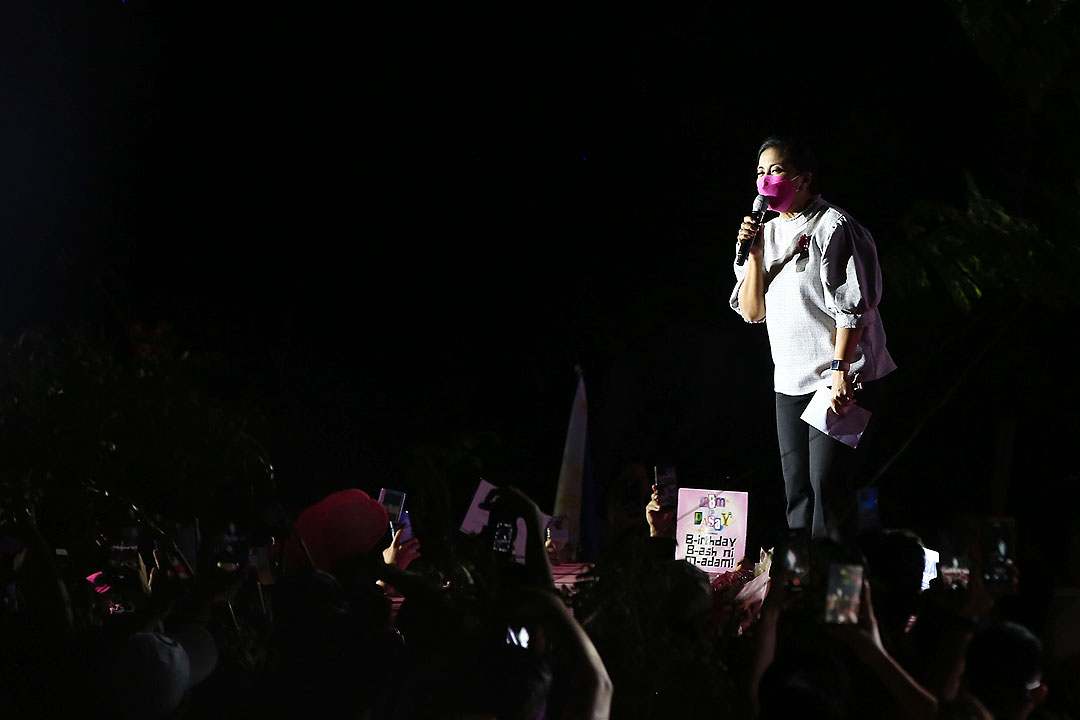
SUPPORTERS of Presidential aspirant Vice-President Leni Robredo attend the grand campaign rally along Diosdado Macapagal Blvd. in Pasay City on April 23. — PHILIPPINE STAR/ MIGUEL DE GUZMAN
At the end of his term, President Rodrigo Duterte continues to enjoy high satisfaction ratings. In Social Weather Stations’ Dec. 2021 survey, Duterte’s net satisfaction rating remained “very good” at +60, a first for an outgoing president. To illustrate, Noynoy Aquino had a +27 satisfaction rating when he ended his term in 2016, and Gloria Macapagal-Arroyo ended with a low -53 net rating in 2010.
Now that we’re in the endgame of the May 2022 elections, candidates are pulling out all the stops for their campaigns. In this piece, I will address the supporters of the Duterte administration who have yet to decide on their next president, and argue that even for die-hard Duterte supporters, a Robredo presidency would be in their best interest.
Why should a Duterte supporter vote for Vice-President Leni Robredo, the leader of the opposition, who many view as the antithesis of Duterte and who the administration has reviled over the past six years?
Duterte has yet to endorse a presidential candidate, despite his own party’s support for Ferdinand Marcos, Jr. There are several contradictions and complications in our political landscape today, but one thing is for sure: There is a very good reason why quite a few Duterte supporters, politicians aligned with the administration, and Duterte himself refuse to support Ferdinand Marcos Jr., even as Mayor Sara Duterte runs as his vice-president. President Duterte has been toning down his vitriol against VP Leni lately and directing it towards Marcos Jr., implying that Marcos is a weak leader with no accomplishments, and reliant on his family name.
VP Leni has opposed many of the administration’s policies, including its human rights abuses and weak response to the pandemic. In almost all ways, she is the exact opposite of Duterte.
Despite this, VP Leni embodies true unity. Rather than focusing on differences, she focuses on points of convergence. During Duterte’s term, for example, he raised taxes on alcohol and tobacco products to fund universal health care and passed the Universal Health Care Law. VP Leni, a staunch health advocate, has expressed her support for sin taxes and universal health care, and she will protect the gains from these reforms.
Trolls have painted her as the figure of disunity. But if you peel back the layers of misinformation, VP Leni has the unique capability to work with people of other political colors, despite their attacks against her. When she was appointed as the lead of the ICAD (Inter-agency Committee on Illegal Drugs), she took on the job willingly. She did not allow attacks and a lack of cooperation from some local government units (LGUs) to get in the way of her ability to serve effectively and innovate through her anti-poverty programs at the Office of the Vice-President (OVP).
VP Leni can work with any vice-presidential candidate. Of course, her ability to work with her running mate, Senator Kiko Pangilinan, is a given. Senator Kiko is VP Leni’s ideal running mate. But VP Leni has also expressed her openness to working with other vice-presidential candidates.
When she was running for the vice-presidency, Robredo said that she and Mayor Sara Duterte are friends: Magkaibigankami. They came to know each other from the time when Jesse Robredo was Department of Interior and Local Government (DILG) Secretary and Sara Duterte was Davao City mayor. VP Leni also said: “I hope politics will not ruin our friendship.” (See Inquirer’s “Leni and Sara Duterte: Friendship beyond politics,” Dec. 23, 2015.) Supporters of the Robredo-Sara tandem or RoSa say that these two women are a combination of tapang and malasakit (courage and caring).
Also running for vice-president in these elections, Dr. Willie Ong also recently noted that he has more points of unity on issues with VP Leni than his own running mate, Manila Mayor Isko Moreno. On April 4, over 12,000 medical doctors nationwide expressed their support for VP Leni, praising her COVID-19 initiatives. And in the case of Senate President Tito Sotto (also running for VP), he was one of the senators who supported increasing the budget of the OVP’s Angat Buhay Program.
When VP Leni talks of unity, it isn’t just a motherhood statement conveniently positioned to avoid accountability. Dr. Jayeel Cornelio wrote in a Rappler article “Solidarity, not unity” (April 22, 2022), the buzzword “unity” for another candidate is simply an excuse to avoid the critical questions. By pretending to “stay above the fray,” Marcos Jr. laughs off allegations and criticisms and is shielded from the responsibility of explaining issues of public concern, such as his non-participation in presidential debates and his 1997 tax evasion conviction.
“Manahimik na lang tayo, huwag na tayo kumontra, unity and positivity na lang (Let us just be quiet, let us not respond, just unity and positivity)” is the mindset that will probably prevail in a “unified” administration under Marcos Jr. But, as actor John Arcilla said in the Leni-Kiko Grand Rally in Pasay on Saturday, “Ang pagpupuna sa gobyerno ay hindi pagrerebelde o hindi pagrereklamo. Ang pagpuna sa gobyerno ay pagmamahal (Criticizing the government is not rebelling or complaining. Criticizing the government is an act of love).” VP Leni, in her proclamation speech on Oct. 7, 2021, said: “Ang pag-ibig, nasusukat hindi lang sa pagtitiis, kundi sa kahandaang lumaban (Love is measured not only by endurance, but by willingness to fight).” VP Leni’s idea of unity isn’t one that silences people and forces them to accept the status quo. It challenges people to set aside their differences to fight for a more just and more humane country.
VP Leni’s unity comes from a place of selflessness, a desire to serve the marginalized, and an absence of self-importance. VP Leni does not carry the burden of an obtrusive ego, a need to vindicate herself, or a yearning for personal glory. Her willingness to help forge a united opposition ticket rather than running for the presidency herself in 2021 proves this.
There is nothing impressive or surprising about the people Marcos is uniting under his “Uniteam.” It’s the same old, same old — the power brokers like Estrada and Arroyo, two former presidents we revolted against — converging for a transaction.
What is more impressive is the ability of VP Leni to consolidate the support of people from all walks of life and all backgrounds: most recently, labor leaders, Muslims, Christians, and Catholics. Just last weekend, VP Leni earned the momentous endorsement of 1,000 Catholic bishops and priests, Kilusang Mayo Uno, the Moro Islamic Liberation Front (MILF) and its United Bangsamoro Justice Party. The MILF has made a historic decision, for previously, since its founding, it never endorsed a presidential candidate.
It is in everyone’s best interest to vote for a candidate who stands for true unity, has zero allegations of corruption, and will bring in foreign investments, build strong institutions, inspire and collaborate with an engaged and energetic civil society, and put in place an honest, participatory, and democratic government.
The global financial services group Nomura Global Research named Robredo as the most “market-friendly” presidential candidate for her pandemic recovery program and good governance platform. They caution that a Marcos presidency would bring about a decline in foreign investments because of his tax evasion cases and lack of credibility.
In the wake of the recession, should we elect a president who lacks the credibility to manage our fiscal deficit? During the COVID-19 pandemic, should we elect a president who vehemently opposed taxes earmarked for health?
In her Oct. 2021 proclamation speech, the Vice-President affirmed that there is a way out of the current crisis we are facing, and the way out is rallying together towards a common goal. The way out is Leni Robredo, the symbol of true unity.
Pia Rodrigo is the strategic communication officer of Action for Economic Reforms
Like countless other people quarantined by COVID protocols, I sought solace in, among others, auditory stimulation. Those of us with more educated hearing found it in, say, Rachmaninoff’s 2nd Piano Concerto or Bach’s fugues. I rather sought it in the more accessible airs of my generation. Among them is John Denver’s lovely tune “Perhaps Love” with its eternal comfort for every age.
But while one can get lost in one’s own heavily, though perhaps subconsciously, photoshopped personal past, one cannot ignore the present’s sometimes unpleasant realities.
On May 9, Filipinos will go to the polls to elect, among others, a new president. Will we have a renewal and catharsis for which democratic elections were originally intended or will we have even deeper divisions and rancor? Putin’s war in Ukraine is raging with thousands of innocent lives mangled or snuffed out. The price of oil and gas is spiking with higher price of food, more hunger and poverty in tow. Net direct foreign investment (DFI) remains on retreat (16% in January) while foreign investment pledges to PEZA (Philippine Economic Zone Authority) shrank 94% in Feb. 2022, upending all the Departments of Trade and Industry and of Finance’s (DTI and DOF) cheery prognosis of bloated DFI response to CREATE and PSA (Corporate Recovery and Tax Incentives for Enterprises and Public Service Act) laws. The economy has shrunk and the burning question is who among the candidates can engineer the best rebound.
Easter Monday saw social media screaming about the macho laggards in the May 9 presidential race advising VP Leni, the strongest among the pursuers — with a preference rating of 24% and rising — to quit. The crabbiest of crab mentalities on display! As expected, the wriggle out artists came out in force on the days following: “Not I,” said the cat, “I wasn’t in the podium.” “Not I,” said the dog, “I wasn’t even in the room.” “I won’t apologize for a rhetorical revert,” said the goat.
For as everyone knows, time-worn wisdom suggests the exact opposite. Nicolo Machiavelli (The Prince) once counseled that the best strategy for also-runs is to rally around the second strongest to keep the strongest from making slaves of everyone else. To rally away from the best challenger is just currying favor with the frontrunner, who was surely elated to know who his real friends are.
For not all tributaries are created equal. Currying favor with the strongest can earn one a higher caste tributary, a tax farmer perhaps, exacting tribute from lower caste tributaries and growing rich from crumbs deliberately misplaced. A tributary collector for the overlord is no small reward for playing into the overlord’s design. The Benedictos, the Enriles, the Floirendos, Cojuangcos, and the Lucio Tans did very well indeed as high caste tribute collectors for dictator Ferdinand Marcos.
Subsequent regimes were either incapable or unwilling to punish Ka Ferdie’s co-blood suckers. As national artist, F. Sionil Jose (may he rest in peace) once put it with utter venom, “This is what ails us all — we do not ostracize them, we do not punish them -— no, we anoint these vermin instead.” It seems we are once again embarked on our vaunted tradition of anointing vermin: number crunchers maintain the May 9 vote will, absent cataclysmic events, hand the presidency over to one whose only claim to fame was a conviction for tax evasion. He keeps mum as to what he will do apart from protecting his family and recoating his father’s legacy. Since, according to the old adage, “The apple does not fall far from the tree,” instead of punishing, he may well reward his father’s centurions with a burial in the Libingan ng mga Bayani. That will reunite in death what in life was a glorious brotherhood of plunder and lies.
Democracy is strange that way: it sometimes commits suicide. People can vote freely to put on their shackles. In 1932, the highly educated democratic Weimar Republic voters handed Adolf Hitler and his goons the mantle of power. It was democratic suicide. “Uncle” Adolf ran with the scepter into the unthinkable horrors of death, destruction, and gas chambers. In 2017, the world’s so-called bastion of democracy, the USA, the public voted freely to hand the scepter of power to Donald Trump who only narrowly, by the grace of God or sheer luck, failed to engineer the execution of US democracy.
In our case, cold punters insist that, cataclysms aside, the May 9 elections will hand the presidency over to a convicted tax evader, one who from his father has the genes to turn the whole country into his personal tax-free tributary and from his mother to turn the judiciary into an umbrella holder, a bit of personal bling few autocrats can match! A Philippines run like hell? But if the vote is reasonably clean, his presidency, like Hitler’s or Putin’s, would be vox Dei.
One may object: “But true democracy is predicated on the voters deciding on the basis of truths not un-truths.” Such objection is deep. It was the underlying assumption of the Condorcet Jury Theorems in the political science of voting: an electorate with a higher than 50% competence to decide correctly, will beat any autocrat in decision competence (vox Dei); but the opposite is also true: an electorate of less than 50% competence will be beaten in decision competence by any average autocrat (vox Diaboli)! The electorate will also additionally have to don the famous Rawlsian “veil of ignorance”: a temporary amnesia to individual, family, and class built-in advantages. Well-nigh impossible in the age of “fake news” and “echo chambers”!
For who determines truths from untruths in the post-truth era? Democracy precisely celebrates diversity of thought, lifestyles, and values. Contradictions are bound to arise as Kenneth Arrow (1950) reminded us before the age of the internet. Modern human coexistence survives in a form we call “truth apartheid” whose motto is “To each his/her own truth.” Thus, the “cancel culture.” And apartheid always presumes cancellable “heathens.” Putin has his truths and thus its cancellable heathens; Qi Jin Ping has his. Biden has his. If we subject these competing “truths” to a clean global one-man-one-vote tournament, Xi Jinping’s “truths” would likely win. It is no different if we choose outcomes (economic growth and poverty reduction) rather than process (one-man-one-vote) as criterion.
In the dialectics of democracy, the truth is elusive if it exists at all. To Pontius Pilate’s question “What is truth?,” Jesus Christ responded with a deafening silence. It seemed a query too tricky even for the divine. What is democracy? I prefer to register my own silence through the lyrics of John Denver’s “Perhaps Love.”
“For love to some is like a cloud, for some as strong as steel. For some a way of living, for some a way to feel. And some say love is holding on and some say letting go. And some say love is everything and some say they don’t know.”
Substitute “democracy” for “love” in Denver’s lines and we have, to my limited mind, a dialectics of democracy as good as any.
Raul V. Fabella is a retired professor of the UP School of Economics, a member of the National Academy of Science and Technology and an honorary professor of the Asian Institute of Management. He gets his dopamine fix from bicycling and tending flowers with his wife Teena.
Among the urgent tasks of the incoming administration is to address our underperforming agricultural sector. Doing so will solve three of the country’s festering problems — poverty, income inequality, and food security.
It will be recalled that the Philippines was once the agriculture superpower in the region. At its peak in the 1960s, the Philippines was the world’s 9th largest sugar producer and the second largest exporter of coconut products. As for rice, President Carlos Garcia’s International Rice Research Institute (IRRI) ushered-in a boom in rice production, making the Philippines one of the world’s leading rice producers. We were also a net exporter of tropical fruits.
On the back of a vibrant agricultural industry, the Filipino people were among the richest populations in Asia with a per capita income of $210 in 1965. Note that the peso was worth P3.92 to one US dollar back then.
Unfortunately, a spate of wrong policies caused the rapid demise of the agricultural sector. For expediency, let me cite the three principal causes for the downfall.
The first was the nationalization and monopolization of the sugar, coconut, and rice industries. This was done by President Ferdinand Marcos to consolidate his stronghold over the agricultural sector.
The Philippine Coconut Authority, the Coconut Investment Fund, and later, the Coconut Industry Investment Fund were established to control the coconut industry with Danding Cojuangco at the helm. Meanwhile, the sugar monopoly was controlled by Roberto Benedicto through the Philippine Sugar Commission and the National Sugar Trading Corp. (Nasutra). The rice industry was controlled through the National Food and Agriculture Council.
The nationalization and monopolization of sugar, coconut, and rice trades squeezed the profits away from the farmers in favor of the monopolies. This left no incentives for farmers to expand their plantations, let alone modernize through mechanization.
The second reason is the ill-conceived Comprehensive Agrarian Reform Program (CARP). Following Marcos’ ouster 1986, the government of Cory Aquino enacted CARP with the objective of democratizing the farm sector. While CARP succeeded on a political level, it failed to arrest the continued drop in agricultural output.
CARP resulted in an average farm size of one hectare with a maximum holding of five. Exacerbated by an inefficient cooperative system and expensive farm inputs (seeds, fertilizers, machinery), farmers were relegated to subsistence farming characterized by low farm outputs, low incomes, and zero bandwidth for mechanization.
The failure of CARP to uplift the lives of our farmers resulted in them selling their land to buyers who would repurpose it for residential or commercial uses. In hindsight, the CARP law should have installed a proviso that agricultural land cannot be reclassified and that should land remain idle for three years or more would revert back to government. But this is water under the bridge now.
The third reason is the influx of imported agricultural products due to liberalization. With low farm outputs, market forces compelled traders to import agricultural products to feed our ever-growing population. Unfortunately, the local farm sector was so inefficient that it was unable to compete with imported alternatives in both price and quality. It still is. Such inability only made the country more dependent on imported food.
The situation has become so worrisome that we now rely on imports to augment our needs for sugar, rice, wheat, flour, pork, chicken, beef, milk, potatoes, garlic, onions, peas, vegetables, fruit, and salt. The fact that we import salt, even if we are an archipelago, exemplifies the desperate state of the agricultural sector. The country has become so dangerously dependent on imports for our daily sustenance that it is now a social and security risk.
As for farmer incomes, 23% of our workforce, or roughly 10 million Filipinos, derive their livelihood from the agricultural sector. Yet, the sector’s contribution to gross domestic product is only 9%. The average farmer has a monthly income of only P9,930 per month, which is below the poverty line.
AGRI HUBS The problems of the agricultural sector are complex. Apart from the ill effects of CARP and competition from abroad, there is the issue of insufficient irrigation, expensive seeds and fertilizers, lack of farm to market infrastructure, a malfunctioning cooperative system, lack of farmland (due to the non-passage of the Land Use Law), among many others.
Is there a more expedient solution? University of the Philippines professor and Sanford Ph.D. holder Carlos Primo C. David offers an innovative solution.
According to Mr. David, there must be a confluence of five elements for agriculture to flourish in a sustainable manner. Vast tracks of land must be available for farming. Industrial farming methods must be adopted. Small farmers must be integrated into the business model to make it economically inclusive. Post-harvest processing plants must be integrated into the supply chain to achieve higher value-added. And finally, there must be a research and development arm by way of an agriculture-based colleges or universities.
Mr. David proposes that select state universities and colleges around the country be transformed into self-contained agricultural production hubs (or Agri Hubs).
There are approximately 112 state universities and colleges, not counting their 421 satellite campuses. By law, each campus is endowed with anywhere from 50 to 650 hectares of land, the majority of which are idle. Mr. David proposes that the Department of Agriculture build fully integrated Agri Hubs on as many campuses as possible. Each hub will specialize in crops that are most suitable for its climate. The goal is for the Agri Hubs to produce specialized crops at the lowest cost and at a scale enough to meet local demand. They will also produce finished goods of their crops in canned, bottled, dried, and powder form.
As a part of a college or university, the Agri Hubs can adopt science-based farming for maximum yield. Students stand to benefit too from on-site learning and hands-on research.
Since Agri Hubs are to be situated on government land, they can achieve enough scale to make industrial farming viable without the incumbrance of CARP. Each hub will be equipped with modern farming equipment, post-harvest processing plants and storage facilities, funded by the government. The business model can even be adjusted to make it attractive for private-public partnerships.
In terms of management, it is easier to professionally administer self-contained Agri Hubs than thousands of fragmented farms scattered around the country.
Mr. David’s proposal is one that makes a lot sense given its do-ability without need for new legislation.
There is no way out of it. Government must address our underperforming agricultural sector if we are to achieve food self-sufficiency and increase incomes of the farming sector. Mr. David’s Agri Hub concept is an innovative solution that deserves serious consideration.
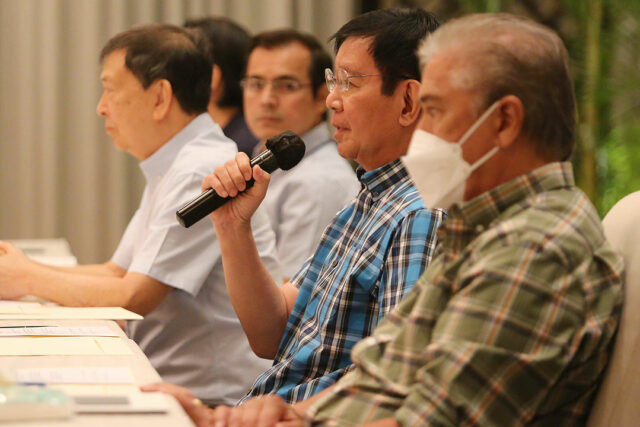
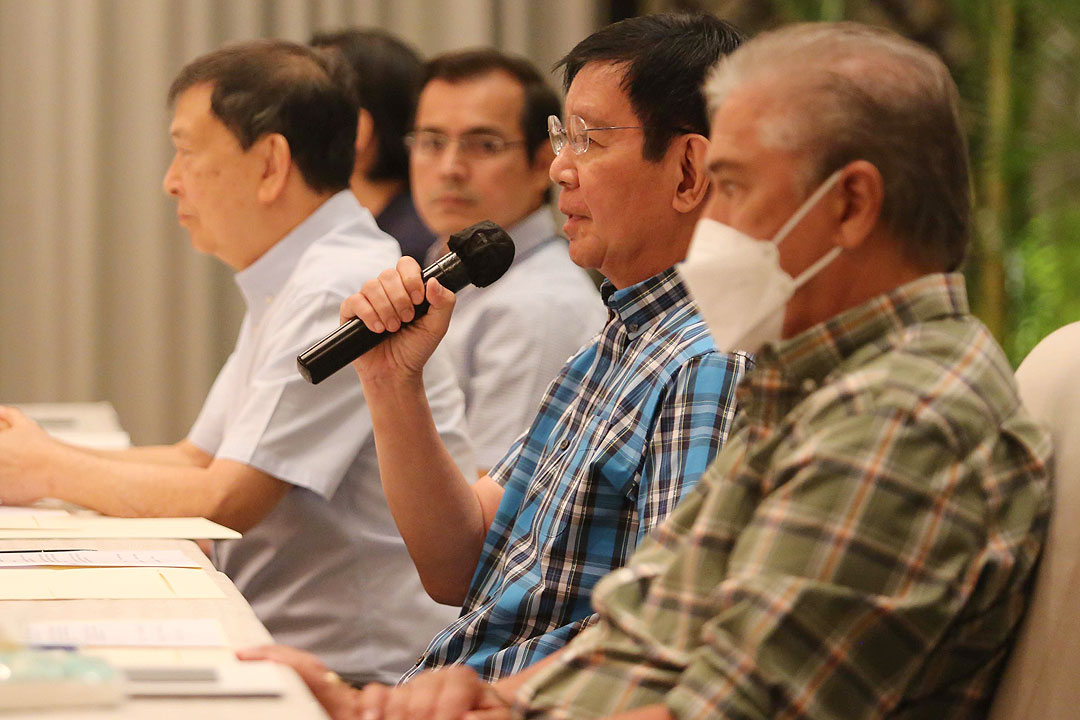
PRESIDENTIAL ASPIRANTS Isko Moreno, Norberto Gonzales and Ping Lacson held a joint press conference at the Peninsula hotel in Makati City on April 17. — PHILIPPINE STAR/RUSSELL PALMA
A press conference was held at The Peninsula Manila hotel on Easter Sunday, April 17, by Panfilo “Ping” Lacson, Francisco “Isko” Domagoso, and Norberto Gonzales, all candidates for president in the May 9, 2022 national elections. They said they just wanted to tell the public that they were not withdrawing from the presidential race because they had been “talked to” by “the other camp,” Leni Robredo’s, to withdraw their candidacies. A fourth candidate, Manny Pacquiao, was expected to join the press con and publicly sign the joint four-way manifesto. Pacquiao was a no-show. Julio Teehankee, a political scientist, called the press con “A unity among non-players” (CNN Philippines, April 19, 2022).
“According to its ‘Ulat ng Bayan’ national survey conducted from March 17 to 21, Pulse Asia Research, Inc. said 56% of the qualified Filipino voters would elect Ferdinand “Bongbong” Marcos, Jr. as president if the elections took place during the survey period… while closest rival Vice-President Leni Robredo got 24% or an improvement of 9% from the February survey. Francisco Domagoso ranked third at 8%, followed by Senator Emmanuel “Manny” Pacquiao, 6%; Senator Panfilo “Ping” Lacson at 2%; Faisal Mangondato at 1%; former Palace spokesperson Ernesto “Ernie” Abella at 0.1%; Jose Montemayor Jr. at 0.05%; Leodegario “Leody” De Guzman at 0.02%; and former Defense chief Norberto Gonzales at 0%” (pna.gov.ph April 6, 2022).
That Pulse Asia survey must have been the basis of Prof. Teehankee’s labeling of the press con participants as “non-players.”
“The other presidential contenders (after Marcos and Robredo) register voter preferences of at most 8%. Additionally, 1% of likely voters are still undecided about whom to vote for as president, another 1% are not supporting any candidate for the post, and 0.5% refused to identify their preferred presidential bet,” according to Pulse Asia.
Pulse Asia further said, “If their original choice for president does not pursue his/her candidacy for whatever reason, 23% of likely voters would instead vote for Manila Mayor Francisco “Isko” Domagoso.” And that is perhaps what so excited Isko that he chanted “Leni, withdraw” throughout that press con which was not originally meant to go so far as to ask second-ranking Robredo to withdraw her candidacy. Imagine what the 23% second-choice of him would be, added to his own 8%, plus a good percentage of those voters who would have chosen Marcos Jr., but would then have an alternative who is not Leni Robredo? Third-ranking Isko can dethrone Marcos Jr!
And so the press con, moderated mainly by Isko, diverted and perceptively digressed into a character assassination of Leni Robredo — cleverly starting from the individually experienced but collectively angering so-called efforts of the Robredo camp to outrightly ask the “non-players” to withdraw, and ending with the undisguised cry to crucify Leni for her “sins” against the Filipino people.
The three “non-players” recited their personal gripes against Leni, all united in decrying her for saying (before the deadline of filing candidacy) that she was not going to run for the presidency. Norberto Gonzales (lowest ranked in the Pulse Asia survey of winnables) declared that “People seem not to want #2 to fight #1; we need a new #2.” Isko strongly suggested that the phenomenon of Marcos Jr. being #1 was “not because they like Marcos Jr., but because they hate Dilawan (the ‘Yellows’ or original Cory Aquino followers, which include Leni).” (Please refer to YouTube video of press con for exact quotes). “Are you delivering ourselves to a Marcos presidency?,” a reporter asked from the floor.
“I don’t believe 60% of our people are loyalists to Marcos,” Isko said, evidently correlating Marcos Jr.’s consistently near-60% popularity in the Pulse Asia surveys. And Ping Lacson agreed with Isko. “Withdraw, Leni, if you love your country!” Isko chanted. “Sobra lang ang galit sa inyo! (The hatred for you is just too much).”
“Galit po kayo kay Leni Robredo? (Are you angry at Leni Robredo),” a reporter in the audience at the press con asked from the floor. “This is not an anti-Leni press con,” Ping Lacson replied. “It is not about them. It is about the people,” Isko added. Even at the start of the press con, Isko’s intro was: “This is not about us (the #3 Isko, #5 Lacson, and last# Gonzales). Once and for all, tao muna (the people first). Buhay mo, buhay ng mga anak mo (Your life, your children’s lives).”
Another reporter asked from the floor: “Why then, is this press con in a five-star hotel? (the brunch buffet at the hotel on Easter Sunday was at P4,300++ per head.) There is a calamity in Leyte caused by the typhoon, she added, complaining also about the “macho politics” that overhung the discussions. Ping Lacson dismissed it with “I don’t think that deserves a comment or an answer; Sorry.” And then Isko mischievously shouted out, “Good luck!”
We, the Filipino people certainly need a lot of good luck.
Political scientist Richard Heydarian has called the coming May 9 elections the most critical in the history of the last half century of Philippine history (CNN Philippines, April 19, 2022). Truly, we are facing a most critical national election at this time, when we are still in the throes of a persistent COVID-19 pandemic, and suffering physical, social, and economic trials, even spiritual/moral and psychological anxieties from it, aggravated even by natural calamities. Fake news and disinformation in social media compromise the truth of the situation. Institutions and traditions are challenged in a governance sometimes doubted and feared. Just a few days ago, on April 20, the Commission on Elections (Comelec) ruled that a case calling for Marcos to be barred from the contest based on his failure to file income tax returns lacked merit.
“Regardless of the fact that the non-filing of income tax return was done repeatedly by the respondent, there is still no tax evasion to speak of as no tax was actually intentionally evaded. The government was not defrauded,” the Comelec’s first division said in the ruling. Five other cases seeking to keep Marcos from running were also earlier dismissed by the poll body. These are now under appeal and could be escalated to the Supreme Court (reuters.com, April 20, 2022).
Mr. Teehankee at the CNN-Ph postmortem called the three candidates’ Easter Sunday press con, “gaslighting.” It is a tactic of emotional bullying whereby “a person or entity manipulates another person in the hopes of acquiring power over them. Often this manipulation leads to the victim questioning their own reality, and in doing so, not questioning the motives and actions of the person gaslighting them” (healthline.com).
Ping Lacson, the military-intelligence strategist, immediately sensed when the press con crossed the line beyond decent and forthright communication of a message, and on to vicious ad hominem attacks betraying personal motivations and objectives of the individuals in his group. He knew that attacking the “Yellows,” “Pinks,” and Leni Robredo would be counter-productive, and so he made it clear that his message was simply that he will not withdraw his candidacy at the elections — period. Norberto Gonzales wavered between attacking and declaring respect for Leni while admitting fear of a repeat Marcos rule.
But the former movie star Isko Moreno did not stick to the original script of the press con and improvised on a script figuratively made in the deceptive haze of a gaslight. He jeered at those who raise the chimera of Marcos’ 14-year Martial Law and the 1986 EDSA Revolution that ousted the dictator, those who urge remembrance of the past to guide choices in the coming elections. Isko outrightly bullied minds and hearts into admitting complacency and even complicity in not standing up for the ideals of EDSA I. “Never again” never worked, Isko said at the press con. “Why then did ‘Ocho-Derecho’ (the all-Yellow or EDSA believers) candidates in the (May 13, 2019) senatorial elections get ‘zero’?” he chided.
If we Filipinos are indeed guilty of forgetting the ideals of freedom, truth, and justice fought for at the EDSA People Power Revolution, we must now be truly sorry for our neglect and redeem ourselves by voting for honest, fair, and truly patriotic, God-fearing leaders with no past sins in the coming May 9 elections.
“Never again!”
Amelia H. C. Ylagan is a doctor of Business Administration from the University of the Philippines.