Home Blog Page 6516

House, Senate probes sought on IP issues highlighted in Bukidnon shooting 

LABOR leader and presidential candidate Leodegario "Ka Leody" de Guzman (in black jacket and red shirt) in a consultation meeting with indigenous community leaders in Bukidnon on April 18, the night before the shooting incident. — KA LEODY DE GUZMAN TWITTER ACCOUNT 
KA LEODY DE GUZMAN TWITTER ACCOUNT

RESOLUTIONS have been filed in both chambers of Congress seeking investigations on a shooting incident in Bukidnon province during a protest activity of an indigenous peoples (IP) community that was attended by labor leader and presidential candidate Leodegario Ka Leodyde Guzman on April 19.  

This violence and the attacks against indigenous people have been ongoing with impunity for quite some time now without resolution and proper intervention by the government,Bayan Muna Party-list representatives said in House Resolution 2561. 

Five members of the Manobo-Pulangihon IP community in Quezon town were injured after private security personnel shot at the group. The regional police office said last week that charges have been filed against the suspects.   

The recent shooting incident that includes the party of Ka Leody de Guzman is emblematic of how our justice system continues to fail them, an act which members of Congress should not countenance,they added. 

The Manobo-Pulangihon are asserting their claim on their ancestral domain, which they said has been illegally taken by a private firm that grows and exports pineapples.       

Meanwhile, Senator Ana Theresia RisaN. Hontiveros-Baraquel has also filed a Senate resolution to probe the land-grabbing allegation.  

Land disputes have been a longstanding issue in our country that often end in violence,she said in a statement on Monday.   

Such incidents are repeated because we do not have a proper policy that will finally end the violence, especially against our indigenous people.”  

Its time we have proper legislation that can address this,she added. Alyssa Nicole O. Tan

Gatchalian plans to refile satellite access bill for internet service in all schools

DICT

A SENATOR on Monday promised to pursue internet connection in all public schools if he wins his reelection bid in May by refiling a bill that will further liberalize the use of satellite technology.   

We will continue to promote internet access in every public school,Senator Sherwin T. Gatchalian, who heads the Senate basic education committee, said in Filipino in a statement.

We will also ensure that our teachers and students are prepared for the wider use of technology when it comes to learning and teaching,he added.  

Mr. Gatchalian filed last year Senate Bill 2250 or the Satellite-Based Technologies for Internet Connectivity Act of 2021, but the measure remained pending in Congress as of February this year.    

Under the measure, government and volunteer organizations as well as public and non-profit private institutions will be allowed to own and operate satellite-based systems to augment internet access, especially in remote areas.   

He also seeks to file another bill that will speed up the digital transformation of the basic education sector by enhancing the information and communications technology capacity of the education department.  

Citing a report from the Asia Foundation in 2019, the senator said 74% of public schools in the Philippines have no internet connectivity. The 2019 National ICT Household Survey also showed 82% of Filipino households do not have access to the internet.  

“I believe that even after the pandemic, blended learning will be part of the new normal, so we must expand the use of the internet to deliver quality education,” he said. Alyssa Nicole O. Tan

De Lima calls for Senate probe on implementation of 4Ps, cash aid programs

A SENATOR on Monday filed two separate resolutions urging the appropriate Senate committees to probe the supposed lapses of the Department of Social Welfare and Development (DSWD) in implementing the governments conditional cash grant program and pandemic financial aid distribution.  

Senator Leila M. de Lima, who is seeking reelection, filed Senate Resolutions 1000 and 1001 to determine if the targeted beneficiaries did receive the assistance and to explore possible revisions to the law to improve implementation. 

The conditional cash grant program, which has been institutionalized through a law and intended as a poverty-alleviation measure that also involves improvements in health and education, is known as the Pantawid Pamilyang Pilipino Program (4Ps).  

Information recently gathered from some beneficiaries indicates that there were possible lapses in the implementation of the program, including, but not limited to, delayed monthly financial benefits as well as reduction in the amounts received in many areas covered by the Program nationwide,Ms. De Lima said in a statement.  

Moreover, the senator said the proposed investigation will help allay public fears and dispel rumors that the legislation is being used for politicking.  

This issue needs to be thoroughly investigated to protect the beneficiaries of 4Ps. They should not fall prey to fake news and go through concerns about the benefits of 4Ps because of the self-interest of some who want to stay in power,Ms. De Lima said.  

As for Senate Resolution 1001, the senator said it is important to determine whether DSWD is capable of delivering its services and programs, which has become more crucial amid a pandemic. 

The pandemic response cash aid is called social amelioration program (SAP). 

Given the DSWDs crucial role in poverty alleviation, it can ill-afford any setbacks or inefficiencies in the implementation of its key social protection program,she said.   

It behooves the Senate to ascertain whether the DSWD still has the capacity to ensure that none of (the) programs are compromised by reason of institutional weaknesses brought about by the various duties it has been tasked to fulfill above and beyond its current mandate,she added. 

The DSWD has been flagged several times by the Commission on Audit (COA), said Ms. De Lima.  

In the COA 2020 report, P780 million of the agencys funds were unutilized due to an insufficient validation process.These were allocated for cash assistance to pandemic-hit Filipinos and SAP overpayments to more than 20,000 beneficiaries. 

State auditors also flagged DSWDs oversight in the implementation of its Assistance to Individuals in Crisis Situation, which resulted to deficiencies of around P722.8 million and certain inappropriately documentedDSWD funds for former armed rebels. Alyssa Nicole O. Tan

Brandon Ingram, Pelicans tie Suns in playoff series

NEW ORLEANS Pelicans forward Brandon Ingram (14) dribbles against Phoenix Suns forward Cameron Johnson (23) during the first half of game four of the first round of the 2022 NBA playoffs at Smoothie King Center. — REUTERS

BRANDON Ingram scored 30 points and Jonas Valančiūnas added 26 points and 15 rebounds as the host New Orleans Pelicans defeated the Phoenix Suns 118-103 on Sunday night to even their first-round playoff series 2-2.

Game 5 is set for Tuesday in Phoenix.

Ingram scored 16 points as the Pelicans outscored the Suns 35-23 in the third quarter. Valančiūnas finished with a career playoff high in points, CJ McCollum scored 18 and Herbert Jones, Jr. 13.

Deandre Ayton scored 23 points, JaVale McGee had 14, Cameron Johnson 13 and Jae Crowder 11 to lead the top-seeded Suns. Chris Paul had 11 assists, but scored just four points on 2 of 8 shooting.

The Suns remained without leading scorer Devin Booker, who suffered a hamstring injury in Game 2.

Ingram made three straight baskets then assisted on consecutive baskets by Valančiūnas and Jaxson Hayes to start the third quarter. The resulting 10-2 run gave the Pelicans a 59-53 lead.

New Orleans led by as many as seven before Crowder made three free throws to trim the lead to 65-63.

Devonte’ Graham made two free throws to give the Pelicans their biggest lead to that point at the end of the third quarter, 84-74.

Phoenix scored the first five points of the fourth quarter, but New Orleans rebuilt the lead to nine.

Landry Shamet’s jumper pulled the Suns within 89-85 before Valančiūnas answered with seven straight points. Jones scored three and Jose Alvarado made two free throws to complete a 12-0 run that gave the Pelicans a 101-85 lead.

Crowder’s steal and layup ended a three-minute scoring drought for the Suns and got them within 14 points, but they couldn’t get any closer.

The Pelicans led for most of the first quarter and finished the period with a 25-22 edge as Ingram scored 11 points. Ayton had 10 points, but the Suns missed all five of their 3-point attempts.

McCollum made three baskets to help New Orleans take its largest lead of the half at 39-31.

The Pelicans didn’t make a field goal during the final six minutes of the half. Phoenix pulled even on a basket by Cameron Payne, and Crowder’s 3-pointer helped provide a 51-49 half time lead. — Reuters

Liverpool backs on Manchester City’s tail after derby win over Everton

LIVERPOOL, England — Divock Origi came off the bench to make the difference as Liverpool secured a hard-fought 2-0 win over Everton in a feisty Merseyside derby on Sunday to close the gap at the top of the Premier League standings back to one point.

As well as keeping Liverpool in the title chase, a point behind leaders Manchester City, the result left Frank Lampard’s Everton inside the relegation zone, in 18th place, two points behind Burnley, who have played one game more.

After City had opened up a four-point lead over Liverpool at the top with a 5-1 demolition of Watford on Saturday, Jürgen Klopp’s side struggled to break down Everton in a bad-tempered first half at Anfield.

Everton continued to hold their own in a raucous derby atmosphere until, with the first shot on target from either side in the match, Scottish fullback Andy Robertson headed Liverpool in front in the 62nd minute.

Mohamed Salah combined with substitute Origi before floating a cross to Robertson, who headed past the diving Jordan Pickford.

Demarai Gray then went within inches of a stunning equalizer before substitute Origi finally ended all hope of an Everton comeback with a goal five minutes from time to put the game to bed.

Luis Diaz tried a bicycle-kick volley from a Jordan Henderson cross and the ball bounced to Origi, who headed home from close range.

The Belgian, a fringe player for most of his time at Anfield, has now scored six goals in nine Merseyside Premier League clashes.

His introduction with Diaz, when the game was goalless, proved to be a masterstroke by Klopp although Everton felt they should have had a penalty before that change.

The lively Anthony Gordon went down under a challenge from Joel Matip in the 53rd minute but his appeal was waved away by referee Stuart Attwell.

Klopp felt Gordon had no case and should have been booked but was relieved with his side’s second-half improvement.

“Thank God, the game has two halves. We didn’t play particularly well in the first half. They made it uncomfortable but we didn’t get in behind the last line. We didn’t have enough movement,” said the German.

“We weren’t quick enough. We passed the ball into the area where they had nine players. Second half, we were much more direct and caused them much more problems. The goals were wonderful.”

A 12th win in their last 13 league games, moved Liverpool on to 79 points from 33 matches, one behind City, who must slip up if Liverpool are to win back their Premier League crown.

Liverpool faces a Champions League semifinal, first leg, at home to Villarreal on Wednesday.

Everton can take heart from a spirited performance, but their away form leaves them facing a real battle for top-flight survival. The Toffees have lost eight consecutive away matches in all competitions for the first time since 1948.

“The result is (disappointing) but the performance isn’t,” said Lampard. “I’m very pleased and proud of the work ethic. We didn’t get the clinical finishes at 0-0. If we take one of those chances, counterattacking behind their line… I can’t ask for any more of the players.”

Burnley’s 1-0 win over Wolves left Everton in 18th place on 29 points from 32 games with the Clarets on 31 points from 33 games.

“We’ll give everything until the end,” said Lampard. — Reuters

Teenager Alcaraz mirrors Nadal with Barcelona crown

BARCELONA — Spanish teenager Carlos Alcaraz captured the fourth title of his young career by beating eighth seed Pablo Carreno Busta 6-3, 6-2 in the Barcelona Open final on Sunday, hours after winning a grueling semifinal that was postponed due to rain.

The 18-year-old will enter the top 10 of the world rankings on Monday at the same age, on the same date and after a triumph in the same tournament as compatriot and 21-times major winner Rafa Nadal did in 2005.

The US Open quarterfinalist joins countrymen including Nadal, coach Juan Carlos Ferrero and Carlos Moya in lifting the trophy in the ATP 500 claycourt tournament.

“It means a lot. I’ve watched this tournament since I was a kid. I always wished to play in this tournament and of course be able to win this tournament,” Alcaraz said. “I’m really happy to be part of the (historic) Spanish list.”

His singles tally stands at four titles following triumphs at Miami and Rio de Janeiro this year and a victory at Umag last July, when he became the youngest tour-level champion since Kei Nishikori claimed the title at Delray Beach in 2008.

Alcaraz is projected to rise as high as number nine when the latest ATP rankings are released.

The Next Gen ATP Finals champion had to work hard for his latest crown, with the semi-finals at Barcelona pushed to Sunday because of rain on Saturday and Alcaraz saved two match points to overcome Alex de Minaur 6-7(4), 7-6(4), 6-4.

His victory in three hours and 40 minutes earned him a title clash with mentor Carreno Busta.

“It’s tough to play a final this afternoon after this match, after this week, but it’s a final,” Alcaraz said earlier.

“You have to give 100%, fight until the last ball. It’s no time to be tired, you have to fight like the first day.” — Reuters

Grayson Allen, Giannis Antetokounmpo power Bucks past Bulls

GRAYSON Allen continued to torture the host Chicago Bulls with 27 points off the bench in 28 minutes, Giannis Antetokounmpo scored 32 more and the Milwaukee Bucks completed a two-game road sweep with a dominant 119-95 victory in Game 4 of their Eastern Conference playoff series on Sunday afternoon.

The third-seeded Bucks, who have won 15 of their last 17 first-round playoff games, own a 3-1 series lead and will go for the clincher in the best-of-seven series on Wednesday night in Milwaukee.

Getting increased playing time in the absence of injured Khris Middleton, Allen shot 10-for-12 overall and 6-for-7 on 3-pointers en route to his second straight postseason career-high.

After totaling just three points in the first two games of the series, Allen exploded for 22 points in Friday’s 111-81 win at Chicago.

Antetokounmpo chipped in with 11-for-22 shooting from the field, helping the Bucks scorch the nets to the tune of 52.3%. The Most Valuable Player candidate completed his third double-double of the series and 44th of his postseason career with a game-high 17 rebounds.

Attempting to rebound from a defeat as they had in Game 2 in Milwaukee to draw even, the Bulls hung within 25-24 into the second minute of the second quarter before falling gradually behind.

The Bucks’ biggest push occurred over the final 2:39 of the period, when Allen contributed two- and 3-point hoops to an 8-2 run that turned a nine-point game into a 56-41 halftime advantage.

Chicago suffered a key blow during that stretch when Alex Caruso took a Jevon Carter forearm in the face and had to leave the game. Caruso had a bloody nose as he went to the locker room, was examined for a concussion and did not return.

The sixth-seeded Bulls got no closer than eight in the second half.

Antetokounmpo also found time for seven assists and two blocks, while Jrue Holiday had 26 points and seven assists and Bobby Portis 14 points to complement 10 rebounds.

Holiday added 5-for-8 accuracy on 3-pointers to Allen’s 6-for-7, helping Milwaukee go 17-for-33 and outscore the hosts 51-27 points advantage from deep.

DeMar DeRozan finished with 23 points for Chicago, while Zach LaVine (24 points, 13 assists), Patrick Williams (20 points, 10 rebounds) and Nikola Vucevic (11 points, 10 rebounds) all recorded double-doubles.

The Bulls have never rallied to win a playoff series after falling behind 3-1. — Reuters

Rublev outlasts Djokovic to claim Serbia Open crown

WORLD number one Novak Djokovic’s barren title spell in 2022 continued as he went down 6-2, 6-7(4), 6-0 to Russian Andrey Rublev in the final of the Association of Tennis Professionals (ATP) 250 Serbia Open in Belgrade on Sunday.

Playing his second tournament on clay this season after being knocked out by Alejandro Davidovich Fokina in Monte Carlo earlier this month, Djokovic was off to a slow start as second seed Rublev broke him twice to clinch the opening set 6-2.

Djokovic had prevailed from a set down in his last three matches and the 20-times major winner, cheered on by a capacity home crowd, raised his game in the second set to take the tie-breaker despite earlier squandering five set points on the Rublev serve.

The Serbian missed a chunk of the early season, including the Australian Open as well as ATP Masters 1000 events in Miami and Indian Wells, due to his refusal to get vaccinated against coronavirus disease 2019 (COVID-19) — and his lack of match practice showed in the deciding set on Sunday.

Rublev galloped to an early lead and barely gave his opponent a chance as he closed out the match with a powerful forehand winner for his first win over Djokovic and 11th career title.

“It was unfortunate that in the third set I really ran out of gas,” Djokovic told reporters. “I couldn’t deliver more of a fight but congratulations to Andrey on another great week.”

The 34-year-old added that his surrender in the final set could have been down to a recent illness that also caused him trouble in the second-round defeat in Monte Carlo.

“I didn’t like the feeling towards the end of the second set, and basically the entire third set was similar to what I was experiencing in Monte Carlo. Whether or not it is due to that illness I had or something like that, I don’t know,” he said, adding that the problem wasn’t related to COVID-19.

“At least this bad feeling came in the fourth match rather than the first. Things are progressing slowly but surely.” — Reuters

I vote for Leni

PHILIPPINE STAR/ MIGUEL DE GUZMAN

On Feb. 26, 1986, the day after People Power chased Ferdinand Marcos and his entire family out of the country, Makati Business District office workers marched on Ayala Avenue, the leaders of the march holding up a large streamer with the words “NEVER AGAIN!” Never again will they let a tyrant rule over the land, the marchers vowed. Never again will they submit to Conjugal Dictatorship, they swore. “Never again” reverberated all over the land.

Now looms the return of the evil People Power banished from the land in 1986. The specter of Ferdinand Marcos the Dictator, as he was generally known, and “Greatest Robber of Government” as the Guinness Book of Records describes him, is coming back to life. There is now BBM, which stands for Babangon muli and for Bongbong Marcos. Babangon muli implies that President Ferdinand Marcos will rise again. He will rise again in the person of his son Bongbong. And Bongbong Marcos as president will bring about a new Golden Age.

Bongbong’s vast and lavishly funded propaganda machine has been propagating these past six years the fiction that the Ferdinand Marcos presidency was the Golden Age — the years of robust economy, construction of magnificent infrastructures, and enduring peace and order — of Philippine history. The pre-election surveys indicate that the majority of the people believe the story.

The folks in the countryside were too distant from the center of power and those belonging to the low socio-economic strata were too pre-occupied with meeting their basic survival needs to have been aware of the ransacking of the national treasury. People who were born during the martial law years were too young to realize how hard life was then.

These people assume that the son is capable of replicating the supposed achievements of the father. They do not take cognizance of the fact that the son does not have the brilliance of mind, the zeal for work, and the perseverance to finish what he had set out to accomplish to be capable of beginning another Golden Age.

Philippine history books prescribed as textbooks in schools gloss over the atrocities and abuses of martial law. Not only that, Philippine History as a subject was removed from the high school curriculum in 2013. The truth is the Marcos Presidency was a horrific period in the annals of the country — 13 years of tyranny and 20 years of looting.

Ferdinand Marcos swore twice, in 1965 and in 1969, to uphold and defend the Constitution but disregarded it totally when he held on to the post of president after his term had expired under that Constitution. He promulgated laws and decrees that the basic law of the land had not empowered him to do. He made a travesty of the 1973 Constitution, which was drafted based on his promptings, by usurping the powers vested by that Constitution before it was ratified.

Upon proclamation of martial law, he ordered his troops to arrest and detain his political opponents, militant student and labor leaders, and media critics. According to Task Force Detainees, more than 70,000 citizens were arrested and detained, and at least 2,250 tortured and salvaged, from the time martial law was imposed on Sept. 23, 1972 to October 1985. In most cases, no charges or complaints were filed against those arrested. Many gave gruesome accounts of beatings with rifle butts, burning of private parts, the water cure, electric shock, and savage gang rapes.

He muzzled the press. He shut down media establishments and imposed government control over the other means of communication. He padlocked printing machines and broadcast facilities. However, he reopened within hours Kanlaon Broadcasting System Channel 9, a broadcast facility owned by his crony Roberto Benedicto, to announce the proclamation of martial law and to propagandize his New Society.

He subjugated and prostituted the judiciary. He turned the Supreme Court, which in the early 1950s earned the sobriquet “the last bulwark of the civil liberties,” into a political instrument by packing it with fawning former classmates and docile followers. He reduced the judiciary into a submissive adjunct of Malacañang. By issuing LOI No. 11, which required judges to submit their resignations, a judge could be dismissed from the service for any fancied cause by simply accepting his resignation. The judiciary could only do the despot’s bidding.

He politicized and corrupted the officer corps of the military. He licensed commanding generals and provincial commanders to exercise political powers previously exercised by civilian authorities. Generals regularly sat in Cabinet meetings and even in his party, the Kilusan Bagong Lipunan, caucus sessions. Many amassed unexplained wealth. A number of generals ran smuggling, gambling, drug, and even carnapping syndicates.

He looted the country clean. The Imelda Marcos trial in New York gave the minutest details of this thievery. The details were never disputed. If the jury acquitted Imelda, it was because the naïve members (Americans) of the jury fell for the ludicrous claim that Imelda never knew of the 20 years of looting.

He forced takeovers of flourishing business enterprises and received kickbacks and commissions from multinationals doing business in the Philippines. He skimmed foreign aid and other forms of international assistance.

He issued decrees and executive orders so that his cronies would have monopoly of certain industries: sugar, coconut, tobacco, banana for export, cigarette, plastics, synthetic fiber, construction, logging, broadcast media, print media, and catering for multilateral summits and international conventions. He ordered the government to guarantee the loans the companies of his cronies got from government-owned financial institutions. When his cronies’ companies failed to amortize the loans, the government absorbed the obligations.

Speaking of special friends, First Lady Imelda Marcos had her own coterie of friends, infamously known as Blue Ladies. She and the Blue Ladies embarked on chartered flights a number of times to go on unbridled shopping sprees in New York, their travel and hotel expenses and fabulous purchases charged to the Philippine government.

The Marcos years were also known for soaring prices of basic commodities, long lines for rice rations, frequent widescale blackouts, the construction of white elephants, huge foreign borrowings, and an economy ever on the brink of collapse.

Leni Robredo lived through eight years of martial law, including the tumultuous years between the assassination of Ninoy Aquino and the Snap Election, as a teenager. If she as a young woman did not get a full grasp of the iniquity of Marcos’ martial rule, I am sure her father, Antonio Gerona, a municipal trial court, would have pointed out the immorality and malevolence of that horrific period in our history.

When pre-election polls on preferred presidential candidates showed high ratings for Davao City Mayor Sara Duterte and Bongbong, prominent personages of civil society approached VP Leni to convince her to oppose either of the two scions of authoritarian presidents. Leni said she would decide to run for president only if she was chosen as the standard bearer of a united opposition and if Ferdinand Marcos’ son Bongbong runs for president. “I don’t want him to win,” she declared.

On Nov. 17, 2021, Bongbong and Sara agreed to run as a tandem, Bongbong as the candidate for president and Sara his vice-presidential running mate. That made Leni decide to accept the nomination of the coalition of the pro-democracy forces.

Said Leni Robredo on Oct. 7:

“We should change not just the surnames of those in power, the corruption, the incompetence, the lack of compassion must be replaced by competence and integrity in leadership. We should be prepared to take out entirely the agendas, the interests, the very people, and kind of politics that is the root of all that we are going through right now.

“Today, I stand with full resolve: We must free ourselves from the current situation. I will fight. We will fight. I offer myself as a candidate for the Presidency in the 2022 elections.”

I vote for Leni.


Oscar P. Lagman, Jr. is a retired corporate executive, business consultant, and management professor. He has been a politicized citizen since his college days in the late 1950s.

The Global Food Crisis and us

JCOMP-FREEPIK

A global food crisis is coming, if it’s not already here.

The major driver of this food crisis is the Ukraine-Russia war. Both Ukraine and Russia are major exporters of wheat, barley, sunflower oil, and corn. Together, Ukraine and Russia account for about a third of global wheat exports and 20% of corn exports. Disruptions due to the war, from sanctions against Russia to fighting in the fields in Ukraine, have sent wheat and corn prices soaring.

Expect the price of bread, pasta, and ensaymada to soar due to rising wheat prices, but also pork, chicken, and beef, because corn is feedstock for livestock.

However, rising wheat and corn prices are just the tip of the iceberg. More importantly, fertilizer prices are skyrocketing. One factor is the soaring price of natural gas, from which nitrogen-based fertilizer is derived. Another factor is that Russia (and its ally Belarus) and Ukraine are major producers of potash, ammonium nitrate, and phosphorous, which are ingredients for the soil.

If farmers use less fertilizer because of high prices, agricultural production will fall — worldwide.

Although our food staple is rice rather than bread, and therefore the impact of rising wheat prices is not as bad, we won’t be unaffected by the global food crisis. Worse, our agricultural sector is so weak that it can’t be relied upon to produce more in response to the global food shortage.

The next administration will, therefore, confront an enormous crisis. The fiscal stresses caused by the pandemic will be nothing compared to the food crisis that is to come.

A food crisis will affect everybody, especially the poor, whose meager incomes are spent mainly on food. Hunger and malnutrition will increase by several orders of magnitude.

The problem is that a food crisis is inevitably a political crisis. A hungry populace will lash out at the political leadership, even if geopolitical events are the real cause. An analyst pointed out that rising food prices in 2008-2010, caused by high oil and wheat prices, sparked the Arab Spring wherein riots and revolts rocked Tunisia, Egypt, and other Middle Eastern countries.

Therefore, the next administration, if it’s not to lose the mandate and political goodwill it got from the May election, must act decisively as soon as it takes over.

It must dramatically increase supply, even if it must resort to imports. Our local production capacity is so weak that it can’t ramp up supply. Bereft of fertilizers, local agricultural production will fall even further.

The next administration should move quickly to expand the agriculture import quotas, or abolish the quantitative restrictions of corn, chicken, pork, and fish. If possible, agricultural trade must be liberalized, as it is with our Southeast Asian neighbors. (Corn tariffs in Vietnam is just 4% vs. 35% for our in-quota tariffs and 50% for out-quota tariffs). This will enable the private sector to quickly import much-needed food, albeit at higher prices, to alleviate the expected shortage of food.

Protectionism is not serving the interests of farmers and Filipino consumers, not if massive hunger and malnutrition is the alternative. As for government, it must act as if there’s a war or as if we are facing another pandemic. It must discard years of neglect of the agricultural sector and adopt a whole of society approach to solve the food crisis.

Government must mobilize the private sector, particularly conglomerates like San Miguel, RFM, Universal Robina, and Ayala, to go into food production. Let’s face it: big is better. Study after study have shown that bigger farms have higher productivity and lower costs than smaller farms. In a study for the Philippine Institute for Development Studies (PIDS), agricultural economist Dr. Roehl Briones reported that the cost of swine meat in 2018 was P148 per kilo for backyard operators and P112.40 for commercial operators or about a 30% difference. For broilers, the cost per kilo was P78 for backyard operators compared to P71 for commercial operators.

However, compared to its ASEAN peers, the Philippines is the champion cost producer. In 2018, the Philippines came in at P112.4 per kilo; compared to Vietnam, P93.85 per kilo; Thailand P99.16 per kilo; and China, P106.97 per kilo.

Bigger is not only about scale economics but also biosecurity. Bigger farms are much better when it comes to biosecurity controls, so they are less susceptible to African Swine Fever or other plant and animal viruses. The principal cause of the spread of the African Swine Fever has been backyard operators.

However, a deeper reason why chicken and pork prices are so high in the Philippines is that corn prices are high, at least double that of Thailand. Corn accounts for about 60% of the cost of chicken and pork.

Local corn prices are high because productivity is so low. According to agricultural economist Dr. Karlo Adriano, corn production per hectare is 4.215 MT, among the lowest in ASEAN, compared to Indonesia, which is one MT higher at 5.2 MT/hectare.

The real culprit is our small-scale agriculture, thanks to the Comprehensive Agrarian Reform Law (CARL). The average farm size of corn farmers’ plots is only .54 hectare, according to Dr. Adriano.

Productivity is so low in this sector that poverty incidence among corn farmers is 45%.

Kawawa naman (Pity them). That’s the objection to liberalizing imports and enabling larger commercial farms into the sector.

First, we can’t allow the status quo to remain. A food crisis will hurt the entire nation, including the very farmers who are supposedly being protected but who are also consumers. It will exacerbate hunger and malnutrition, which is already causing poor educational performance among our schoolchildren. It will spark demands for higher wages and make industry even more uncompetitive.

Second, these farmers are already poor, among the poorest of the poor. The status quo won’t help them. Better that change happen so that they can increase their productivity or that they move toward more productive endeavors with the help of social transfer payments from the government.

Third, if the farmers can lease their land (and they can’t due to their indebtedness with the Land Bank), they can earn a lease income and possibly be hired as farm workers in a commercial farm. As farm workers, they can be entitled to a stable salary and social security benefits, which they don’t enjoy as farmer-owners.

They can also be encouraged to migrate to urban centers or agriculture processing zones, where their productivity and wages will be much higher. However, this needs labor market reform to ease their transition from the rural to urban areas.

Therefore, the next administration must consider debt condonation for farmers (to allow farmer-entrepreneurs and agricultural companies to sell or lease their lands) together with amending the Comprehensive Agrarian Reform Law to increase the land retention limit from five hectares to a commercially viable 25 hectares. This is the only way to usher in commercial farming.

For the sake of food security, agricultural modernization must happen. The decades-long policy of agricultural protectionism and traditional small-scale agriculture must end. The food crisis is an opportunity to end this policy because the alternative is a status quo of rising food prices, food shortages, rising hunger, severe malnutrition — and who knows what else? — perhaps political and social instability.

The global food crisis is coming for us. Because our agricultural sector is so weak, we are like an unvaccinated diabetic 80-year-old who’s going to catch COVID. The next administration can’t resort to the usual populist nostrums like free irrigation, free fertilizer, government subsidies, and protectionism. That would be like prescribing Ivermectin instead of vaccinations. Food inflation and social instability will ensue. Instead, it must use its new mandate to modernize agriculture by cutting the Gordian Knot of agricultural protectionism, land fragmentation, and traditional small-scale agriculture.


Calixto V. Chikiamco is a member of the board of IDEA (Institute for Development and Econometric Analysis).

totivchiki@yahoo.com

Willful Certification of Incomplete, Inaccurate, False, or Misleading Statements or Reports

FREEPIK

Under Section 162 of the Revised Corporation Code (RCC), any person who “willfully certifies” a report required under the Code, knowing that it contains “incomplete, inaccurate, false, or misleading information or statements,” shall be punished with a fine ranging from P20,000 to P200,000; but that, when injurious or detrimental to the public, the fine shall range from P40,000 to P400,000.

Although Section 162 defines the criminal act as one that constitutes “willful certification,” it nevertheless uses criminal measurements that are overly broad, thus, “incomplete,” “inaccurate,” or “misleading.” To drive home the point, if the Securities and Exchange Commission (SEC) rules require that the taxpayer identification numbers of directors and officers should be included in the General Information Sheet (GIS), and the Corporate Secretary unfortunately forgets to include the same in the report filed with the SEC, does that constitute a criminal offense under Section 162 to have certified to an “incomplete” GIS?

When does the “inaccuracy” of information or a statement in a report rise to the level of being criminal or malicious? Whose point of view shall be determined when a report item is “misleading” as to rise to a criminal offense? In short, the subjective and broad language used to describe the essential requisites of the offense defined under Section 162 may constitute a denial of the accused director’s, trustee’s, or officer’s right to due process of being properly informed of the offense that he had supposedly committed.

It would be possible to involve the Corporate Secretary or a reporting officer in prolonged criminal litigation to be able to prove whether the criminal acts under Section 162 should be considered mala in se (wrong or evil in and of itself) rather than mala prohibita (conduct that constitutes an unlawful act only by virtue of statute). The inaccurate Section 162 can be a real source of harassment suits against directors, trustees, and officers.

Finally, when the corporation or its business activities are not vested with public interest, it would be difficult to show how the reports had been especially injurious or detrimental to the public as to warrant the increased penalty provided under Section 162 of the RCC.

SEC’S RESTATEMENT OF SECTION 162 OFFENSE
SEC Memorandum Circular No. 16-2020, entitled “Guidelines on Authentication of Articles of Incorporation in Applications for Registration of New Domestic Corporations,” restates Section 164 of the RCC by providing under Section 7 as follows:

SECTION 7. Willful Certification of Incomplete, Inaccurate, False, or Misleading Statements or Reports. — Willfully certifying a report required under the RCC, knowing that the same contains incomplete, inaccurate, false, or misleading information or statements, shall be punished with a fine ranging from P20,000 to P200,000. When the wrongful certification is injurious or detrimental to the public, the responsible person may also be punished with a fine ranging from P40,000 to P400,000.

It is pretty clear that the SEC is not defining an administrative offense through the foregoing provision in its memorandum circular, since the fines imposed are beyond the amounts authorized under Section 158 of the RCC, and that both the language and amounts tract the language of Section 162 (Willful Certification of Incomplete, Inaccurate, False, or Misleading Statements or Reports; Penalties) of the Code. Certainly, the SEC cannot in the exercise of quasi-legislative powers complete the parameters of an inadequately defined statutory offense, especially not in a memorandum circular pertaining to the filing of the articles of incorporation, which does not fall within the coverage of “reports” under Section 162 of the RCC.

Consequently, SEC Memorandum Circular No. 16-2020 fails to define an offense that can be the subject of an administrative sanction, nor can it complete the inadequacies of the language of Section 162 of the RCC to comply with rudiments of criminal due process.

INDEPENDENT AUDITOR’S CRIMINAL COLLUSION
Under Section 163 of the RCC, an independent auditor who, “in collusion with the corporation’s directors or representatives,” certifies the corporation’s financial statements (FS) despite its incompleteness or inaccuracy, its failure to give a fair and accurate presentation of the corporation’s condition, or despite containing false or misleading statements, shall be punished with a fine ranging from P80,000 to P500,000.

In addition, Section 163 provides that when the statement or report certified is fraudulent, or has the effect of causing injury to the general public, the auditor or responsible officer may be punished with a fine ranging from P100,000 to P600,000.

The use under Section 163 of the term “An independent auditor who … certifies the corporation’s financial statements,” is quite unfortunate and misses the professional role of the independent auditor. An independent auditor’s professional obligation is to undertake auditing procedures on the financial and other records of the corporation in accordance with generally accepted auditing standards that would allow him render an “opinion that the audited financial statements present fairly, in all materials respects, the corporation’s financial position (as of a given date) and its financial performance (for the covered period).”

When the independent auditor finds through his audit procedures that the FS do not fairly present the corporation’s financial condition and/or performance, he issues an “adverse opinion” to that effect in his report. Unless the engagement agreement provides otherwise, it is not the purpose of the auditing procedures to detect fraud in the operations of the company, although when fraud is detected, it is the professional responsibility of the auditor to so indicate this in the report. On the other hand, when the audit procedures cannot be completed because of the state of the financial and corporate records to allow the rendering of the opinion, the independent auditor renders a “no opinion” report, explaining its reasons. An independent auditor, therefore, does not certify, but actually renders a professional opinion on the fairness in material respects (not in the details) of the audited FS.

ESSENCE OF SECTION 163 OFFENSE
Section 163 of the RCC defines an offense that can only be committed by the corporation’s independent auditor but specifically done “in collusion with the corporation’s directors or representatives.” It has no application to a situation where the independent auditor wrongfully certifies a corporation’s FS on the basis of professional incompetence, i.e., when no collusion is shown to exist with the directors or representatives of the corporation.

Since demonstrating that the wrongful certification of the audited FS must be part of a collusion with the corporation’s directors or representatives, no conviction of the independent auditor may be obtained under Section 163 without showing that the directors or representatives of the corporation have sought to achieve the wrongful certification of the corporation’s audited FS to achieve a wrongful end. Although the primary guilt must necessarily lie with the corporation’s directors or representatives, the latter cannot be held liable with the independent director under Section 163 of the RCC which specifically applies only to the independent auditor.

Section 162 of the RCC which covers “willful certification of incomplete, inaccurate, false or misleading statements or reports,” may be applied in tandem with Section 163 since it is now the practice that the particular officers render a “statement of management responsibility” on the FS of the corporation.

Section 165 of the RCC on “fraudulent conduct of business” is likewise a provision in the Code that supports an accusation against the directors or representatives of the corporation for seeking to collude with the independent auditor to wrongfully certify the corporation’s audited FS. However, as discussed below, there are due process considerations that make conviction under Section 165 difficult.

What is clear is that when the essential element of “certification in collusion with the corporation’s directors or representatives” is not proven, no conviction of the independent auditor under Section 163 may be obtained, even when the other elements of “false or wrongful certification of audited FS” are proven. As will be shown by the succeeding discussions, the element of “certification in collusion with the corporation’s directors or representatives” is the most defining element for the offense covered by Section 163 of the RCC, without which the other elements would have no criminal significance to stand on.

FALSE OR WRONGFUL CERTIFICATION OF AUDITED FS
In defining the offense of false or wrongful certification of an audited FS by an independent auditor, Section 163 of the RCC uses criminal measurements that are either too subjective (subject to various interpretations) or overly broad, as to constitute a denial of the criminal due process right of the accused independent director to be informed, thus: a.) “incompleteness or inaccuracy” of the audited FS; b.) the audited FS “fail… to give a fair and accurate presentation of the corporation’s condition:” or, c.) the audited FS contains “false or misleading statements.”

In providing for each of the afore-quoted elements, Section 163 does not use the term “knowingly” in reference to the independent auditor, but rather substitutes the criminal term “certification in collusion with the corporation’s directors or representatives.”

INCOMPLETE OR INACCURATE AUDITED FS
Section 163 of the RCC does not indicate what aspect of the audited FS’ “incompleteness or inaccuracy” would rise to the level of being malicious and criminal on the part of an independent auditor. Since the section does not define the mala prohibita offense, not every incompleteness or inaccuracy of the audited FS would rise to be level of being malicious and criminal.

Auditing standards do not impose an obligation on the part of external auditors to certify to the “completeness” or “accuracy” of the audited FS, since auditing procedures involve representative testing on key areas of corporation’s operations and record keeping in order to render an opinion; they do not involve examination of all the transactions, supporting documents, and book entries that go into the figures appearing in the audited FS. In fact, the independent auditor’s report essentially expresses an “opinion that the accompanying FS present fairly, in all material respects, the financial position of the company,” as of a given date or period.

Unless it is done in collusion with the directors or representatives of the corporation (which has substituted the term “knowingly” as to contain the element of malice), the independent auditor who has undertaken the proper audit procedures, cannot really be held accountable, much less criminally liable, for certifying an audited FS that turns out to be incomplete or inaccurate.

FAIR, ACCURATE PRESENTATION OF FINANCIAL CONDITION
When the independent auditor has undertaken proper audit procedures and renders an opinion that the corporation’s FS presents fairly, in all material respects, the financial condition of the corporation as of a given date, outside of showing collusion with the corporation’s directors or representative to commit fraud, would the judge be in a position to substitute his honor’s own assessment that in fact the FS did not fairly present the corporation’s financial condition based on perhaps another auditor’s financial findings? In addition, the very nature of auditing standards do not require that the independent directors certify that the audited FS “accurately” reflects the financial condition and performance of the corporation.

The requisite quantum of evidence to establish guilt beyond reasonable doubt for conviction under Section 163 would mean that outside of proving “collusion with the corporation’s directors or representatives” who must be shown to have committed fraud, the prosecution would be hard-pressed in obtaining a conviction.

FALSE OR MISLEADING FS
What amount of “falseness” in the audited FS would lead to criminal malice under Section 163 of the RCC? From whose point of view would the judge determine how “misleading” the FS are?

It must be emphasized that the corporation’s FS, even when audited, is not the “work” or the “product” of the independent auditor. The relationship of the independent auditor to the corporation’s FS is to express an opinion — officially called “Independent Auditor’s Report” — that they fairly present, in all material respects, the financial position and performance of the corporation. Outside of when he colludes with the directors or representatives of the corporation who are proven to have committed fraud, an independent director cannot be held criminally liable for rendering an opinion on a FS which contains false or misleading statements.

HIGHER CRIMINAL PENALTIES
Section 163 of the RCC provides for higher criminal penalties on “the auditor or responsible officer” when “the statement or report certified is fraudulent, or has the effect of causing injury to the general public.”

Section 163 imposes criminal penalties on an “independent auditor,” whether such auditor is a natural person or a partnership; in the case of the latter, the penalty of a fine is imposed upon the partnership as a separate juridical person. Therefore, when Section 163 authorizes the imposition of higher penalties on the “responsible officer,” whom does it actually cover?

Certainly, it cannot be the responsible officer of the corporation whose FS is being audited since the crime defined under Section 163 pertains solely to the independent auditor. Also, it cannot be the “responsible officer” of the auditing firm because the penalty is imposed on an independent director of which the auditing firm as a partnership is the very one indicated as “auditor.”

The term “fraudulent” is not defined, and may include all sorts of accusations such as when the statement or report tends to defraud the government of the right amount of taxes that would have been paid by the corporation, to that of depriving the shareholders of the rightful amount of dividends that could have been declared from the unrestricted retained earnings, to that of luring banks to extend loans to the corporation at a premium rate, to that of luring investors to invest in the corporation, all based on the statements or the report that was verified.

Under the principles of criminal due process, no matter how fraudulent any act or report is, it cannot be criminally penalized unless the fraudulent act itself is defined as a criminal offense by law.

This article reflects the personal opinion of the author and does not reflect the official stand of the Management Association of the Philippines or MAP.


Attorney Cesar L. Villanueva is co-chair for Governance of the MAP ESG Committee, the chair of the Institute of Corporate Directors, the first chair of the Governance Commission for GOCCs, a former dean of the Ateneo Law School, and a founding partner of Villanueva Gabionza & Dy Law Offices.

map@map.org.ph

cvillanueva@vgslaw.com

http://map.org.ph

Under scarcity: Leni service, BBM welfarism, and Isko overspending

The first lesson of economics is scarcity: there is never enough of anything to fully satisfy all those who want it. The first lesson of politics is to disregard the first lesson of economics. — Thomas Sowell, American economist, historian and social theorist

This piece will quickly review some of the fiscal and economic performances of the three leading candidates for President in the coming May 9 elections — Vice-President Leni Robredo, former Senator Bongbong Marcos (BBM), and Manila Mayor Isko Moreno.

THE UPSE ALUMNI, STUDENTS STATEMENT
Ms. Robredo is a graduate of the University of the Philippines School of Economics (UPSE) batch 1986, before she took up Law. More than 400 of her fellow alumni and some 150+ students signed a Manifesto expressing support for her and her running mate Kiko Pangilinan for Vice-President. The signature drive was initiated in early March and cut off was March 31. Alumni range from as old as batch 1968 to batch 2019.

The main reason given by the nearly 600 UPSE alumni and students for their support is that the Leni-Kiko pair is “subok na sa kakayanan at integridad at may track record. Si VP Leni ay ekonomista at isang public interest lawyer…. Si Kiko ay abogado (UP Law batch 1993) at batikang Senador (tested in competence and integrity and has a track record. VP Leni is an economist and a public interest lawyer… Kiko is a lawyer (UP Law batch 1993) and a veteran senator).”

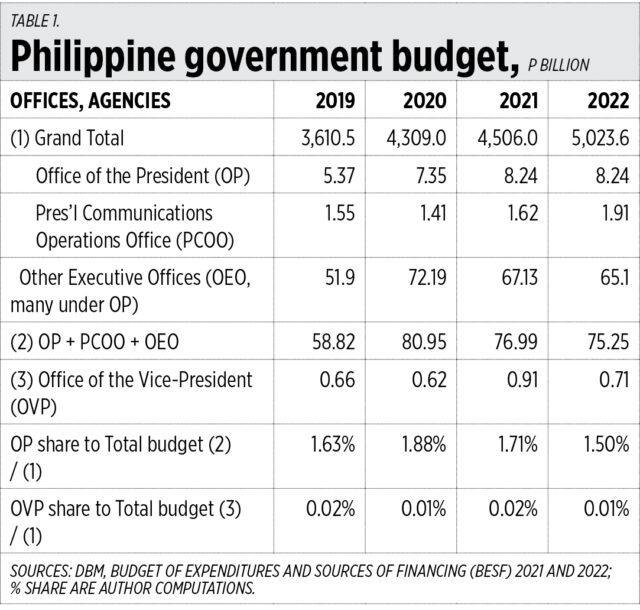
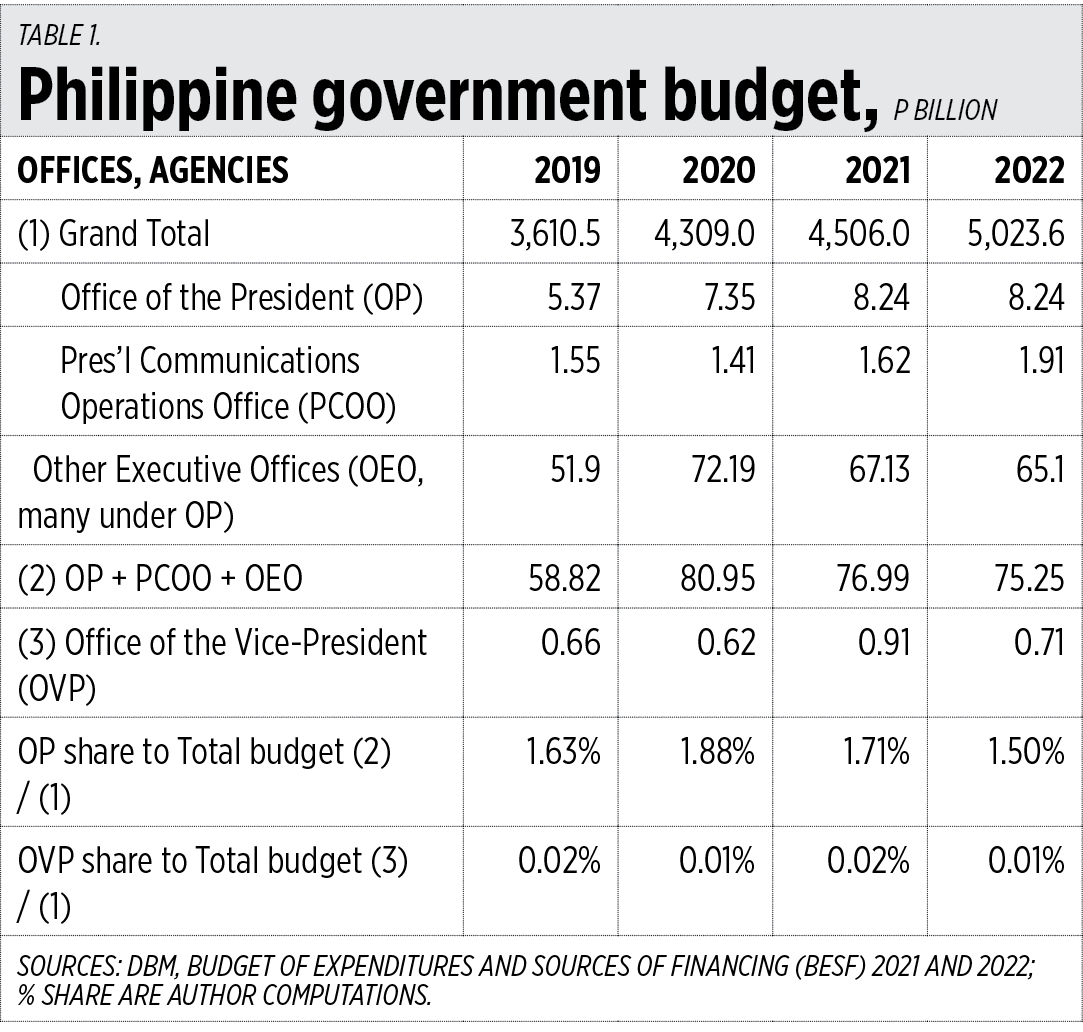
VP Leni has shown that having big agency budgets via big taxes and huge borrowings is not a guarantee of real public service and improving the ordinary Filipinos’ lives. The budget for six years (2017-2022) of the Office of the Vice-President (OVP) was only P0.6 to P0.9 billion a year, always below P1B/year. The total budget for 2022 is P5 trillion, of which the OVP budget is only P0.71 billion, or 0.0001 or 1% of 1%. Thus, for every P100 in total budget, the OVP budget is only P0.01 or 1 centavo. Compare that to the budget of the Office of the President (OP) amounting to P8.24 billion plus discretionary and intelligence funds and other offices of P65.1 billion.

And yet VP Leni was able to inspire confidence and transparency and attracted many private donations during the pandemic that enabled her office to deliver PPEs to many frontline health workers and COVID treatment kits to poor households.

In Table 1, Other Executive Offices (OEO) under the OP include, among others, the Presidential Management Staff (PMS), National Intelligence Coordinating Agency (NICA), National Security Council (NSC), and the Office of the Presidential Adviser on the Peace Process (OPAPP).

BBM’S NON-ACHIEVEMENT AND PROGRAMS
Of public achievement over the past six years, BBM practically has none. His own official website shows no private business engagement, no government position even as a consultant — 2016-2022 is blank. He just spent the past six years campaigning and revising Philippine history to say that the country had great economic performance, often referred as “the golden years,” under his father’s Presidency from 1966-1985.

So, achievement-wise — zero. Yet he promises plenty of welfarist, bordering on socialistic, programs: 1.) free health insurance for all senior citizens, rich and poor; 2.) subsidized food nationwide via permanent Kadiwa rolling stores in every barangay; 3.) free EDSA Carousel rides all year round; 4.) immunization registry and mass vaccination in every local government unit (LGU); and, 5.) energy rationing by killing all coal plants and use mainly renewables.

He and his running mate Sara Duterte also promise to continue many economic programs of the current administration. Well, the Philippines had a GDP contraction of -9.6% in 2020, the worst in Asia that year and the worst in Philippine economic history since the post-World War 2 era. Public debt also rose big time, from P8.22 trillion (actual and guaranteed) in 2019 to P10.25 trillion in 2020, P12.15 trillion in 2021, and P12.51 as of February 2022. High public debt will require high and multiple taxes.

From 2016 to 2021, the Philippines has had the lowest increase in per capita income among the ASEAN-6 — only 15%, while Vietnam has had 37%, Singapore 28%, while Malaysia, Indonesia, and Thailand have had 19-22% (Table 2).

ISKO MORENO’S OVERSPENDING
While VP Leni’s office has an annual budget of only P0.6 to P0.9 billion a year for the past six years, Isko Moreno as Manila Mayor has had expenditures of P30 billion in 2021 and P71 billion in 2022. He is the only Mayor in the National Capital Region (NCR) to undertake annual and large-scale privatization of city assets. Here are the revenues or proceeds from the sale of City government assets: P90 million in 2019, P4.936 billion in 2020, P14.761 billion in 2021, and P44.146 billion in 2022.

So, with huge one-time revenues, he splurged in huge public spending. The ending share of Manila City’s expenditures to total NCR (16 cities and one municipality) rose from 10% in 2019 to 22% in 2022. (Table 3).

Let’s go back to the quote of Dr. Thomas Sowell. VP Leni is a practitioner of doing public service while given a very small budget and resources. BBM and Isko are the politicians who disregard the lesson of scarcity and just spend huge amounts or promise to spend for huge freebies. These spend-spend-spend politicians will also be the tax-tax-tax authoritarians when they splurge on nationwide public spending. Voters will note this when they cast their votes in two weeks.


Bienvenido S. Oplas, Jr. is the president of Minimal Government Thinkers.

minimalgovernment@gmail.com

ADVERTISEMENT
ADVERTISEMENT