Home Blog Page 6512

Musk gets Twitter for $44 billion, to cheers and fears of ‘free speech’ plan

STOCK IMAGE | SYIFA5610-FREEPIK

Elon Musk clinched a deal to buy Twitter Inc TWTR.N for $44 billion cash on Monday in a transaction that will shift control of the social media platform populated by millions of users and global leaders to the world’s richest person.

It is a seminal moment for the 16-year-old company, which emerged as one of the world’s most influential public squares and now faces a string of challenges.

Musk, who calls himself a free speech absolutist, has criticized Twitter‘s moderation. He wants Twitter‘s algorithm for prioritizing tweets to be public and objects to giving too much power on the service to corporations that advertise.

Political activists expect that a Musk regime will mean less moderation and reinstatement of banned individuals including former President Donald Trump. Read full story Conservatives cheered the prospect of fewer controls while some human rights activists voiced fears of a rise in hate speech. Read full story

Musk has also advocated user-friendly tweaks to the service, such as an edit button and defeating “spam bots” that send overwhelming amounts of unwanted tweets.

Discussions over the deal, which last week appeared uncertain, accelerated over the weekend after Musk wooed Twitter shareholders with financing details of his offer.

Under pressure, Twitter started negotiating with Musk to buy the company at his proposed $54.20 per share price. Read full story

“Free speech is the bedrock of a functioning democracy, and Twitter is the digital town square where matters vital to the future of humanity are debated,” Musk said in a statement.

Former Twitter CEO Jack Dorsey weighed in on the deal late on Monday with a series of tweets that thanked both Musk and current Twitter CEO Parag Agrawal for “getting the company out of an impossible situation.”

Twitter as a company has always been my sole issue and my biggest regret. It has been owned by Wall Street and the ad model. Taking it back from Wall Street is the correct first step,” he said.

Twitter shares rose 5.7% on Monday to finish at $51.70. The deal represents a near 40% premium to the closing price the day before Musk disclosed he had bought a more than 9% stake.

Even so, the offer is well below the $70 range where Twitter was trading last year.

“I think if the company were given enough time to transform, we would have made substantially more than what Musk is currently offering,” said Jonathan Boyar, managing director at Boyar Value Group, which holds a stake in Twitter.

However, he added, “If the public markets do not properly value a company, an acquirer eventually will.”

Musk’s move continues a tradition of billionaires’ buying control of influential media platforms, including Jeff Bezos’ 2013 acquisition of the Washington Post.

Twitter said Musk secured $25.5 billion of debt and margin loan financing and is providing a $21 billion equity commitment.

Musk, who is worth $268 billion according to Forbes, has said he is not primarily concerned with the economics of Twitter.

“Having a public platform that is maximally trusted and broadly inclusive is extremely important to the future of civilization. I don’t care about the economics at all,” he said in a recent public talk.


OUTSIZED IMPORTANCE

Musk is chief executive of both electric car maker Tesla Inc TSLA.O and aerospace company SpaceX, and it is not clear how much time he will devote to Twitter or what he will do.

“Once the deal closes, we don’t know which direction the platform will go,” Agrawal told employees on Monday. Read full story

Edward Moya, an analyst at currency broker OANDA, said in an email to clients the deal was “great news for Twitter shareholders as it doesn’t seem like the company was going to get things right anytime soon.”

But he also said: “Tesla shareholders can’t be happy that Musk will have to divert even more attention away from winning the EV (electric vehicle) race.”

Still, Musk‘s 84 million-strong Twitter account is seen as an important, free public relations and marketing tool for Tesla.

The Twitter transaction was approved by the company’s board and is now subject to a shareholder vote. No regulatory hurdles are expected, analysts said.

Daniel Ives, an analyst at Wedbush, said the company’s board of directors had its back “against the wall” once Musk detailed his financing package and no other bidders emerged.

Although it is only about a 10th of the size of far larger social media platforms like Meta Platforms Inc’s FB.O Facebook, Twitter has been credited with helping spawn the Arab Spring uprising and accused of playing a role in the Jan. 6, 2021, storming of the U.S. Capitol.

After Twitter banned Trump over concerns around incitement of violence following the U.S. Capitol attack by his supporters, Musk tweeted: “A lot of people are going to be super unhappy with West Coast high tech as the de facto arbiter of free speech.”

Trump, whose company is building a rival to Twitter called Truth Social, said in a Fox News interview on Monday that he will not return to Twitter.

The White House declined on Monday to comment on Musk‘s deal, but said President Joe Biden has long been concerned about the power of social media platforms.

“Our concerns are not new,” said White House spokesperson Jen Psaki, adding that the platforms need to be held accountable. “The president has long talked about his concerns about the power of social media platforms, including Twitter and others, to spread misinformation.” – Reuters


Airbus, Qatar Airways back in court as plane row heats up

YASSINE KHALFALLI-UNSPLASH

A British judge will on Tuesday rule whether Airbus must keep building A321neo jetliners for estranged Qatar Airways in a decision with implications for future multi-billion-dollar jet deals, as their public bust-up returns to London’s High Court.

Airbus revoked the A321neo deal in January in retaliation for Qatar‘s refusal to stop taking A350s in a separate legal and safety dispute over damage to the surface of the larger jets.

The knock-on decision to cancel the A321neo deal alarmed some airlines, with the head of the International Air Transport Association describing it as a “worrying” development in a corner of the market where Airbus enjoys the bulk of new orders.

The head of Dubai’s Emirates has said he is “not unsympathetic” to its main Gulf rival over the A321neo fallout.

Airbus says the two contracts are connected by a “cross-default” clause that allows it to pull the plug on one deal when an airline refuses to honour the other.

It has accused Qatar Airways, the A350’s biggest customer, of airing invalid safety concerns to avoid taking jets at a time of weak demand, and to activate a $1 billion compensation claim.

Qatar says it was right to stop taking A350 deliveries over what it describes as genuine safety concerns by Doha’s regulator over gaps or corrosion in a sub-layer of lightning protection left exposed by cratered paint on over 20 grounded A350s. It says the cross-default clause does not in any case apply.

Airline officials worry the A321neo case may set a precedent allowing disputes to ricochet from one contract to another, tightening the grip of plane giants Airbus and Boeing BA.N.

“People will look at this and take extra care to resist such cross-default clauses,” the head of a large airline fleet said.

Backed by European regulators, Airbus denies any A350 safety flaws, though it has acknowledged that paint peeling is a feature of modern carbon jets, requiring re-painting more often.

Qatar Airways says the problem of decaying paint, and the resulting exposure of anti-lightningmesh surrounding the carbon fuselage, results from a defect in the plane‘s design.

A Reuters investigation in November revealed the problem affected other carriers though apart from Qatar none has taken planes out of service, except for surface repairs. Read full story

The two sides have clashed over the extent to which exposed lightning protection means a safety risk. Airbus says the planes have backup protections and the affected areas would have to be much larger to pose a hazard. Qatar Airways has said it cannot rule out such risks without deeper analysis from Airbus and is unwilling to take any more A350s until the point is settled.

Qatar‘s refusal to take deliveries led to both sides calling foul and spilled over to the row over the cancelled A321neos.


RARE SPOTLIGHT

The court battle has punctured the secrecy surrounding more than a decade of aircraft negotiations and taken the lid off closely guarded planning methods inside the global jet industry.

Multiple industry sources say it is in neither side’s interest to spark a full-scale trial, producing a flood of further disclosures and testing relations between France and Qatar at a time when Europe urgently seeks new gas supplies.

But while neither side has closed the door to a negotiated settlement, Tuesday’s preliminary hearing is expected to reflect the gloves-off nature of their unusually acrimonious divorce.

An earlier hearing saw Airbus take the unusual step of minimising the advantages of its best-selling A321neo over Boeing’s 737 MAX, in contrast with its own marketing rhetoric.

Most experts described it as a legal tactic to blunt Qatar‘s bid to reinstate the A321neo contract, whose success depends on convincing the UK judge that no real alternative is available.

Chief Executive Guillaume Faury returned to the offensive against Boeing a week later, telling a shareholder meeting, “our planes are more competitive for the majority of them than … the competition; the A321 in particular is extremely performing.” – Reuters

Higher inflation factors into review of tariffs on Chinese goods- White House

THE White House in Washington, D.C. — STOCKSNAP/PIXABAY

The Biden administration is carefully studying the inflationary impact of tariffs imposed on China by former President Donald Trump’s administration given a surge in consumer prices, White House press secretary Jen Psaki said on Monday.

Ms. Psaki said she had no news on tariff reductions since U.S. Trade Representative Katherine Tai is still reviewing Trump-era tariffs on Chinese goods. But she made clear that higher inflation was a factor in the deliberations.

“This is an ongoing process, and we’re certainly looking at where we see costs being raised and, at a time where we’re seeing heightened inflation, certainly that’s on our minds,” Ms. Psaki said.

She said the review was also looking at larger issues, such as China’s behavior in global markets and the impact of tariffs on wages, job opportunities and America’s competitive edge.

The White House comments came days after U.S. Treasury Secretary Janet Yellen said it was “worth considering” taking steps to lower U.S. tariffs on Chinese goods given the “desirable effects” such a move could have on lowering U.S. inflation, which has hit 40-year highs this year. Read full story

Deputy national security adviser Daleep Singh told a separate event on Thursday that easing tariffs on non-strategic Chinese goods such as bicycles or apparel could help combat inflation. Read full story

Mr. Biden’s approval ratings have fallen as the costs of energy, food and other staples have risen, with mounting public frustration threatening to cost Democrats their slim majorities in Congress in midterm elections in November.

Chad Bown, a senior fellow at the Peterson Institute for International Economics, said Psaki’s comments compounded expectations that the Biden administration was considering tariff reductions.

Mr. Bown said that would likely require behind-the-scenes negotiations with Beijing. Such a move would also likely cause tensions with a Biden administration push to move supply chains from China and closer to home.

No comment was immediately available from Ms. Tai’s office. – Reuters

[B-SIDE Podcast] What women want: femtech in the Philippines

Follow us on Spotify BusinessWorld B-Side

Femtech, or technology focused on women’s health, is an unexplored space in the Philippines, where the startup ecosystem is mostly male.

“We need more investors to see that femtech presents a viable investment opportunity. And that can be explained by an ongoing trend in diversity and recognition of the importance of preventive health, not just sick care,” said Maria Jessica J. de Mesa, co-founder and chief executive officer of Kindred, a femtech startup.

In this B-Side episode, she tells BusinessWorld reporter Brontë H. Lacsamana what needs to be done in order to translate policy into programs when it comes to women’s health.

“Women have waited long enough for the reproductive health services and information we deserve,” she said.

Recorded remotely in April 2022. Produced by Earl R. Lagundino and Sam L. Marcelo.

Follow us on Spotify BusinessWorld B-Side

DepEd partners with SM Supermalls to promote anti-Covid 19 reminders amid back to school efforts

In photo from L-R, DepEd Undersecretary Wilfredo Cabral, DepEd Undersecretary Annalyn Sevilla, DOH Secretary Dr. Francisco Duque III, DepEd Secretary Leonor M. Briones, USAID Mission Director Ryan Washburn, SM Supermalls Senior Vice President for Operations Bien Mateo, and DepEd Assistant Secretary Malcolm Garma.

DepEd, along with sole local partner SM Supermalls and the United States Agency for International Development (USAID), recently concluded the BIDA Kid Program – a campaign tasked to relay anti-Covid 19 safety reminders following the expansion of face to face classes. Held at the SM Mall of Asia Music Hall and attended by guests such as DepEd Secretary Leonor M. Briones, DOH Secretary Dr. Francisco Duque III, DepEd Undersecretary Wilfredo Cabral, DepEd Assistant Secretary Malcolm Garma, DepEd Undersecretary Annalyn Sevilla, DepEd Director Roger Masapol, and USAID Mission Director Ryan Washburn, the BIDA Kid Program was launched in support of the Department of Health’s efforts to reopen schools safely this incoming school year.

DOH Secretary Dr. Francisco Duque III and SM Supermalls Senior Vice President for Operations Bien Mateo led the partnership of their institutions with DepEd’s BIDA Kid campaign.

“As the government pushes forth with getting all students safely into the classroom, it has been our top priority to help provide the necessary protection they need against Covid-19. Our pediatric vaccination sites will remain open to cater to the vaccination needs of our children aged 5 to 11 and 12 to 17. We assure you that we remain committed to providing a safe, convenient, and fun vaccination experience for the kids and their family members and friends,” said Bien Mateo, SM Supermalls SVP for Operations.

DepEd, DOH, and SM Supermalls representatives strike a pose with BIDA kids from the Pasay City East High School.

With over 9.4M jabs and 1.2M pedia jabs administered since April 2021, SM Supermalls continues to serve as the government’s largest private-sector partner in its vaccination efforts. In line with their commitment to serving the Filipino people, SM has extended promotional assistance to the DOH and DepEd by reflecting the BIDA Kid safety reminders on their social media pages with a combined following of over 31M individuals, as well as the LED screens found in their malls.

As children begin to return to their classrooms, Bien Mateo ensures that SM Supermalls “will continue to work together with the government to reboot the system and get back on track. It could take time, but we believe that our collaboration and concerted efforts will lead us to a safer, better normal for everyone.”

For more information and up-to-date news on vaccination schedules at the SM Malls in your LGU, follow @smsupermalls on all social media platforms.


Spotlight is BusinessWorld’s sponsored section that allows advertisers to amplify their brand and connect with BusinessWorld’s audience by enabling them to publish their stories directly on the BusinessWorld Web site. For more information, send an email to online@bworldonline.com.

Join us on Viber to get more updates from BusinessWorld: https://bit.ly/3hv6bLA.

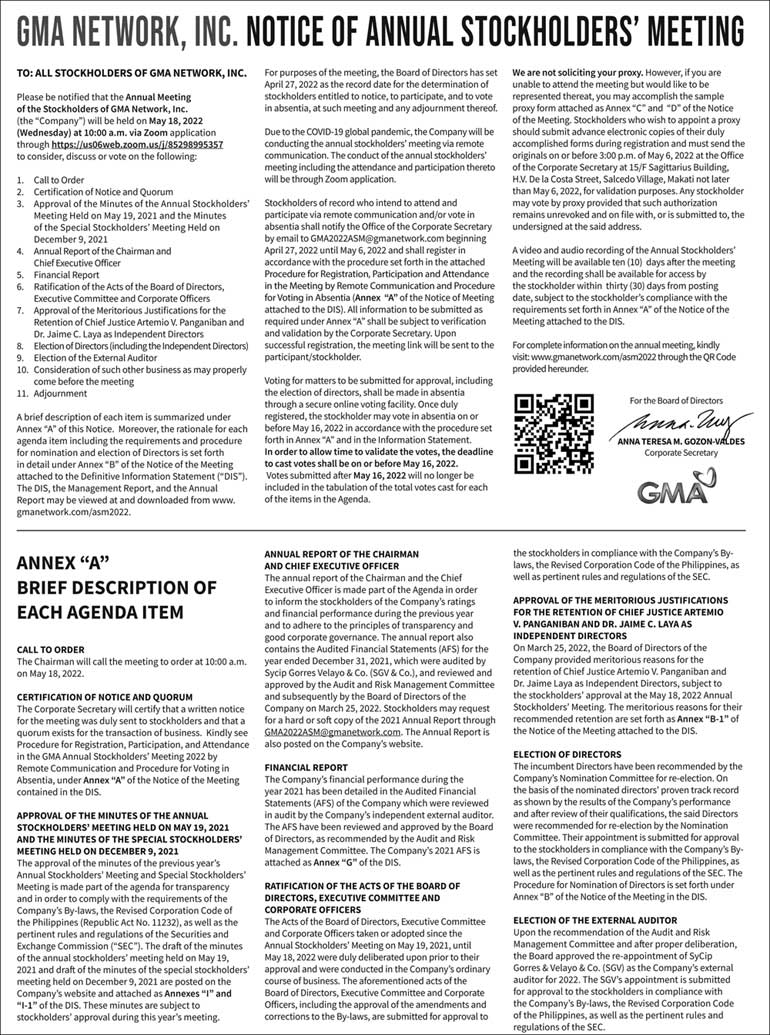
GMA Network, Inc. to conduct annual stockholders’ meeting on May 18

Click to enlarge.
Click to enlarge.


Spotlight is BusinessWorld’s sponsored section that allows advertisers to amplify their brand and connect with BusinessWorld’s audience by enabling them to publish their stories directly on the BusinessWorld Web site. For more information, send an email to online@bworldonline.com.

Join us on Viber to get more updates from BusinessWorld: https://bit.ly/3hv6bLA.

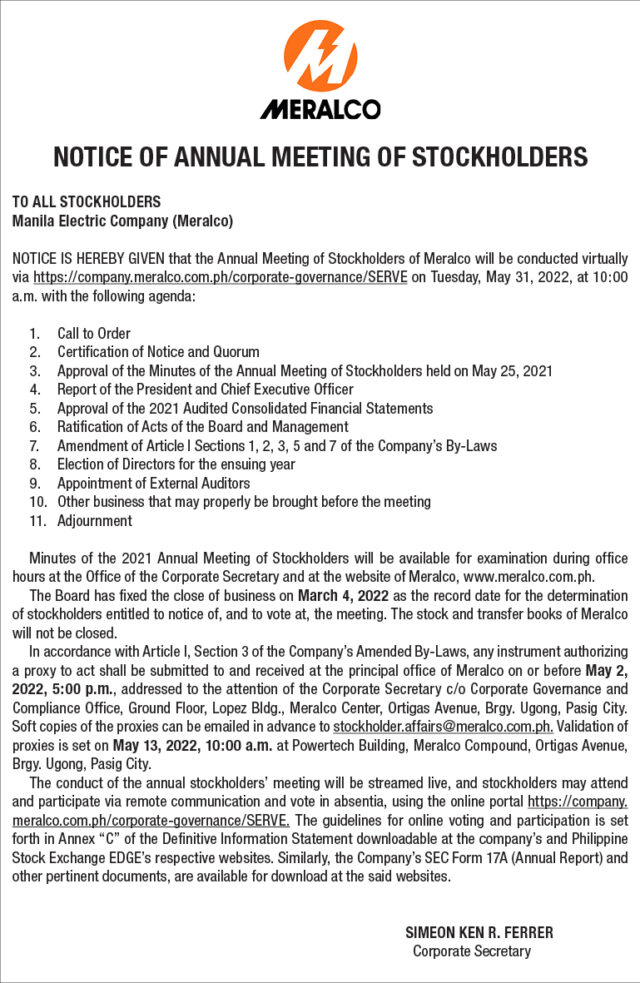
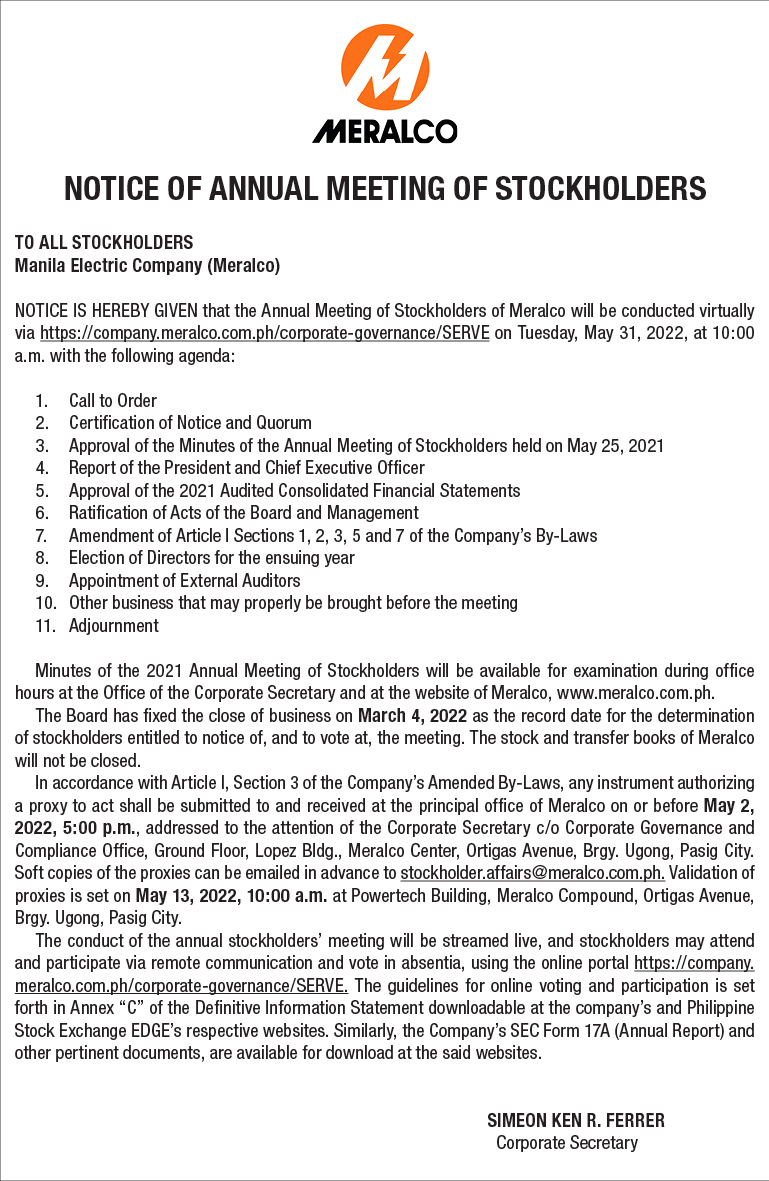
MERALCO to hold annual meeting of stockholders virtually on May 31


Spotlight is BusinessWorld’s sponsored section that allows advertisers to amplify their brand and connect with BusinessWorld’s audience by enabling them to publish their stories directly on the BusinessWorld Web site. For more information, send an email to online@bworldonline.com.

Join us on Viber to get more updates from BusinessWorld: https://bit.ly/3hv6bLA.

Oil deregulation law revision unlikely

Vehicles line up at a gas station on Monday. — PHILIPPINE STAR/ RUSSELL PALMA

THE PHILIPPINE Congress is unlikely to pass a proposed measure that would give the government powers to intervene in the event of a spike in oil prices, according to the Energy department.

This as fuel retailers announced gasoline prices will go up by P3 per liter on Tuesday, while diesel and kerosene prices will increase by P4.10 and P3.50 per liter, respectively.

In a televised news briefing on Monday, Energy Undersecretary Gerardo Erguiza, Jr. said amending the country’s oil deregulation law before the end of President Rodrigo R. Duterte’s six-year term may be challenging because lawmakers are now focused on the election campaign.

He said the law is still under review in both chambers of Congress, with only months left before Mr. Duterte leaves Malacañang.

“Whether or not the (proposed) amendment in this Congress would be finished, the House and Senate would still have to convene,” he said. “Based on our estimates, it will be difficult for any amendments to be passed because the election season has changed their priorities.”

“After the polls, canvassing, lawmakers have to go around of course and maybe thank their constituencies and maybe even take lighter loads,” he added.

In early March, Malacañang asked Congress to review the country’s oil deregulation law after successive increases in global oil prices.

The House Committee on Energy in March approved amendments to the Republic Act No. 8479, also known as the Downstream Oil Industry Deregulation Act of 1998. If passed into law, the measure would prevent oil companies from raising prices of old stock and require them to increase their minimum inventory to prevent fluctuations in local fuel prices. It would also require oil players to unbundle domestic prices.

On March 23, Senate President Vicente C. Sotto III said lawmakers still have time to change the 24-year-old law even if Mr. Duterte decides not to call for a special session.

Congress is currently on a break for the elections until May 22. Lawmakers resume session on May 23 until the 18th Congress adjourns sine die on June 4.

“If the Duterte administration is really serious in pushing for the amendments, it can certify the amendatory bill as an urgent measure. The real question is: Is there a political will for the Duterte administration to do it?” House Minority Deputy Leader and Bayan Muna Rep. Carlos Isagani T. Zarate said in a Viber message.

The oil deregulation law had removed government control on the pricing, exportation, and importation of petroleum products, allowing market forces to dictate oil prices.

Progressive groups have been urging the government to review the law, saying it has allowed oil price increases to go unchecked.

Data from the Department of Energy as of April 19 showed year-to-date adjustments stand at a net increase of P15.45 per liter for gasoline, P27.35 per liter for diesel, and P21.55 per liter for kerosene.

Mr. Erguiza said oil prices in the global markets remain volatile, mainly due to the Russia-Ukraine war and the European Union’s (EU) possible sanctions against Russian oil imports.

Russia is Europe’s biggest oil supplier, providing nearly a fourth of the EU’s oil imports in 2020.

Ukraine has been urging the EU to ban Russian oil and gas as the war continues.

Reuters reported on Monday that Brent crude futures fell by 4.5% to a two-week low of $101.78 barrel, as investors worry that coronavirus lockdowns in China will dampen global demand. — Kyle Aristophere T. Atienza

PHL needs to support recovery while ensuring stable prices — IMF

A couple shops at a supermarket in Makati City. — PHILIPPINE STAR/ RUSSELL PALMA

THE PHILIPPINE government should carefully balance the need to support the economy’s recovery, while maintaining price stability, the International Monetary Fund (IMF) said.

“While the recovery is expected to strengthen in 2022, the authorities will need to carefully balance the policy mix to provide adequate support to the recovery while ensuring price stability,” Cheng Hoon Lim, IMF mission chief for the Philippines, said in an e-mail last week.

The IMF last week raised its 2022 growth projection for the Philippines to 6.5% from the 6.3% forecast given in January. However, this is lower than the government’s 7-9% target for this year.

“Monetary policy can remain accommodative in the short term, provided inflation expectations remain well-anchored,” Ms. Lim said.

The Bangko Sentral ng Pilipinas (BDP) has kept policy rates at a record low to boost the economy’s recovery, but has signaled rate hike adjustments in the second half of 2022.

The Monetary Board now expects inflation to breach the target at 4.3% for 2022 from 3.7% previously, citing the surge in oil and commodity prices due to the Russia-Ukraine war.

At the same time, Ms. Lim said the government should also proceed with its fiscal consolidation plan, “while continuing to fund health-related programs and providing cash transfers or subsidies for the hardest-hit sectors.”

The government is currently working on a fiscal consolidation plan, after the budget deficit widened during the pandemic.

In 2021, the budget deficit reached P1.7 trillion, equivalent to 8.61% of gross domestic product (GDP). For this year, the government’s budget deficit cap is at P1.65 trillion, which is equivalent to 7.7% of GDP.

The Philippines ended 2021 with P11.73 trillion in outstanding debt, pushing the debt-to-GDP ratio to a 16-year high of 60.5%. This is higher than the 60% threshold considered manageable by multilateral lenders for developing economies.

The IMF in a blog dated April 20 said governments recovering from the pandemic are confronted with the need for agile fiscal policies to address the spike in food and fuel prices.

“Governments face difficult choices in this highly uncertain environment. They should focus on the most urgent spending needs and raise revenue to pay for them,” it said.

Ms. Lim said policy support should be focused on ensuring inclusive and sustainable recovery.

“The planned introduction of the national ID system and implementation of the financial inclusion initiative would complement the social assistance programs by facilitating the identification of eligible households and delivery of cash aid,” she said.

More than 60 million Filipinos have already completed the second step of the registration for the national ID as of March — which include the capturing of biometric information.

Ms. Lim also stressed the need for the government to continue investing in education and infrastructure.

“Progress in the digitalization of public services and improving digital and physical connectivity throughout the Philippines’ archipelago would be another important pillar to bolster growth prospects,” she said. — L.W.T.Noble

Food, consumer businesses to bear brunt of war impact

Customers eat at a restaurant in Quezon City, March 1. — PHILIPPINE STAR/ MICHAEL VARCAS

CONSUMER GOODS and food manufacturing businesses in the Philippines will likely be the most affected by a potential price shock in oil and commodities if the Russia-Ukraine war escalates, analysts said.

The Philippines is currently affected by the Russia-Ukraine war mainly through the surge in oil and food prices, and supply chain disruptions, Security Bank Corp. Chief Economist Robert Dan J. Roces said.

“More significant to the Philippines is that Russia and Ukraine are major commodities producers, with wheat from both countries accounting for around 30% of global exports, and thus making food production input costs jump globally,” Mr. Roces said in a Viber message.

First Metro Investment Corp. Head of Research Cristina S. Ulang said food processing firms that heavily rely on imported raw materials and some power generation companies will be hurt by rising costs.   

“Strains [are] evident in gross profit margin compression, and pressure to increase prices versus competition, which can weaken sales volume and capacity utilization,” Ms. Ulang said in a Viber message.

UnionBank of the Philippines, Inc. Chief Economist Ruben Carlo O. Asuncion in a Viber message said industries like transport and manufacturing that use petroleum will also bear the brunt.

Mr. Asuncion said micro, small and medium enterprises (MSME) that are dependent on transport to sell their goods will also be affected by the higher fuel prices.

Headline inflation jumped to a six-month high of 4% in March, already matching the upper end of the central bank’s 2-4% target band. This reflected the surge in global oil prices since the war started on Feb. 24.

Latest data from the Department of Energy showed gasoline, diesel, and kerosene prices increased by P15.45, P27.35, and P21.55 per liter since the year started.

Mr. Roces said oil traders and energy-generating companies are more “vulnerable in the sense that inputs are more costly.”

“Commodity traders, notably steel, cement, fertilizers are also risking costly inputs. Same with flour and wheat importers as well as freight/cargo organizations,” he added.

Mr. Roces said the war has dampened global business confidence and created more investor uncertainty, which will weigh on asset prices and may potentially drive capital outflows from emerging markets.

On the other hand, the war in Ukraine may present opportunities for some industries.

Mr. Asuncion said potential “winners” include companies that are “high on electric-based products or ones seeing potential in renewable energy; firms with production not skewed to petroleum-based inputs.”

Coal, nickel and gold miners are also among potential winners, Ms. Ulang said.

Global supply has faced disruption due to the war as Russia is a major exporter of metals.

In a note on Monday, Moody’s Investors Service said nonfinancial companies in Asia-Pacific may face deepening risks caused by rising prices and economic disruption as the war in Ukraine escalates.

“The credit implications for companies depend on their direct exposure to each channel, and their capacity to mitigate shocks,” Moody’s said.

Moody’s noted that a quarter of rated Asia-Pacific companies will likely be at risk in case of a global recession and a severe liquidity squeeze in case of a prolonged war.

“A small number of rated companies face material credit pressure under our baseline scenario because of refinancing risks amid current market volatility. However, under a more severe downside scenario, more than 27% are vulnerable, particularly speculative-grade companies and those with limited balance-sheet buffers or exposed to a supply chain shock,” Chris Park, a Moody’s associate managing director, said in a statement. — L.W.T.Noble

A Mother’s Day series

iWantTFC offers a Mother’s Day limited series with Misis Piggy which streams this week.

The series is described as a “poignant love letter to all mothers who strive to shower their kids with all the love and care despite enduring their own seemingly insurmountable struggles and pains.” It is produced by ABS-CBN Entertainment, iWantTFC, Dreamscape Entertainment, Nathan Studios, and Epic Media.

Writer and director Carlo Catu said that the series revolves around a mother who was separated from her husband and how the children react to the separation.

In an online press conference on April 21, Mr. Catu said that it is not the usual story where a parent works hard to provide for her young children and this does not end when the children in the story are already grown-ups.

“Graduate na sila (the children), pero nakaka-graduate din ba ang mga nanay sa responsibilidad nila? (The children have already graduated. But do mothers also graduate from their responsibilities?),” Mr. Catu said. “I think this series will have that answer.”

“It’s my love letter not only to mothers, but to my mom as well,” he added.

In the iWantTFC original series, Sylvia Sanchez plays Marivic, a selfless and strong-willed single mom of three adult children. Marivic wants nothing but the best for her children which is why she whole-heartedly dedicates her time to running a meat stall at a market.

As her children get older, Marivic struggles to accept the fact that they are mature enough to live their own lives as they carve their own career paths in different countries. Her eldest daughter Lani (Ria Atayde) aims to boost her career as a nurse by going to Canada; Steffi (Iana Bernardez) is a teacher taking up a master’s degree who gets a scholarship offer in the United States; and Jeffrey (Elijah Canlas), Marivic’s youngest son, intends to pursue an internship in Australia as he finishes his studies. Marivic’s relationship with her children is further complicated when they suddenly make an effort to reconnect with their estranged father Rupert (played by Ricky Davao).

Ms. Sanchez stars alongside her real life daughter Ria Atayde for the first time.

“It made the whole experience easier. I did not have to think that ‘Ok, she is my mom,’ because she is my real mom,” Ms. Atayde said, referring to doing emotional scenes alongside her mother.

“This time, more than being my mom on the set, we’re able to have a more professional relationship. She really gave me my space and I appreciate that. It really helped with what we were doing. As much as she is my mom, she treated me like an actress, more than anything,” Ms. Atayde added.

Ms. Sanchez responded by saying that she was confident of her daughter’s capabilities.

Nakita ko naman yung capacity ng anak ko. Hindi ko sasabihin na magaling siya kung hindi siya magaling, kasi ako ang critic niya (I saw my daughter’s capacity. I will not say that she is good if she is not, because I am her critic),” Ms. Sanchez said.

Prior to the pandemic, Misis Piggy was meant to be a movie with Mr. Catu as director. It eventually evolved into a TV series instead, with Mr. Catu also the scriptwriter. The story became loosely based on Mr. Catu’s experience growing up in a family with two siblings.

Kailangan nating pahalagahan yung magulang natin (We need to value our parents),” Mr. Catu said of the show’s message.

“It’s very cliché, but we are growing up, they are growing old. Our time with them is limited,” he said.

Misis Piggy streams on iWantTFC with new episodes released daily at 8 p.m. — Michelle Anne P. Soliman

ACEN allots P55-B investment for renewable energy

AC ENERGY Corp. (ACEN) is allocating P55 billion as capital expenditure budget for the expansion of its renewable energy business, its chairman said during the Ayala-led firm’s annual meeting on Monday.

“We have earmarked P55 billion for our renewable energy expansion,” ACEN Chairman Fernando Zobel de Ayala told stockholders during the virtual event.

“Last year was a noteworthy period, as we added 1,200 megawatts (MW) of renewable attributable capacity. The company also increased its project pipeline to 18,000 MW, putting its position to aggressively expand its renewable investments,” he said.

During the same meeting, ACEN President and Chief Executive Officer Eric T. Francia said the company had raised “significant capital” of about P48 billion last year “to help enable and convert” a pipeline of renewable energy developments into operating projects.

“Given our strong growth momentum, the company is beginning to look ahead to 2030, and we will soon firm up our 2030 vision and strategy,” he said, noting that the company’s 2030 vision will be unveiled later in the year.

Currently, 87% of ACEN’s capacity, or 3,300 MW, is sourced from renewables such as solar, wind, and geothermal.

The Philippines remains to be ACEN’s core market, accounting for 40% of the listed energy platform’s capacity, while the other 60% comes from various international ventures.

The company plans to continue building on three key strategies for its aggressive growth plans: expanding its geographic footprint, investing in new technologies, and forming strategic partnerships.

To complement its renewable energy generation projects, ACEN has embarked on battery storage development, floating solar, and offshore wind energy.

In 2021, the company tapped Nefin for distributed generation, German-based IB Vogt for Asia Pacific solar projects, and Super Energy for solar energy facilities particularly in the Greater Mekong area in Southeast Asia.

“These recent developments strengthen both ACEN’s organic development and operating capabilities and our partner network across the region,” Mr. Francia said.

Last year, the company started building more than 500-MW worth of projects, including the 283-MW San Marcelino solar farm in Zambales and the 160-MW Pagudpud wind farm in Ilocos Norte.

Mr. Francia said the two projects are set to be the country’s largest solar and wind farms once operational in 2023.

Within the region, ACEN has reached 1,000 MW of attributable capacity in Vietnam as it completed several wind farms with a combined 360 MW of attributable capacity, including the acquisition of a 49% stake in Super Energy’s 837-MW solar platform in Vietnam.

The company is also constructing the 520-MW-peak New England solar farm, which it expects to be the largest solar farm in Australia and the 420-MW-peak solar farm in India.

“To unlock the potential of our core solar and wind projects, we will be complementing these with battery storage to help manage the intermittency,” Mr. Francia said.

ACEN last year started operating the 40-MW Alaminos energy storage project, its first battery storage, which complements a 120-MW solar plant.

“We also started the construction of a 15-MW-hour battery storage project in Vietnam. This is a pilot utility-scale project supported by the US government,” Mr. Francia said.

On Monday, shares in the company slipped P0.04 or 0.49% to close at P8.16 each at the stock exchange. — Ram Christian S. Agustin

ADVERTISEMENT
ADVERTISEMENT