Home Blog Page 6461

It’s a battle of pride for Southeast Asians

FOR Southeast Asians, the Beijing Winter Olympics will be a battle of pride.

Knowing a medal is out of reach, Fil-Am Asa Miller will be eyeing to come through with the best finish ahead of the seven other representatives from Southeast Asia — a fully tropical region.

Apart from the 21-year-old Portland, Oregon native, there will be skiers from Timor-Leste, Thailand and Malaysia in alpine skiing, which unfurls on Monday at the Ice River located atop Xiaohaituo Mountain.

It included Yohan Goutt Goncalves, a French-East Timorese who is making his third Winter Games stint after racing in Sochi 2014 and Pyeongchang 2018.

Thailand, meanwhile, has four entries in Zanon Nicola (men’s alpine skiing), Jaiman Mida Fah (women’s alpine skiing), Mark Chanloung (men’s cross country skiing) and sister Karen (women’s cross country skiing), while Malaysia has Jeffrey Webb and Aruwin Salehhudin.

Mr. Gonclaves admitted he and Mr. Miller are friends.

“We trained together and I think he [Miller] is a very good skier,” said Goncalves, who was 43rd in slalom in Sochi but didn’t finish in Pyeongchang where Mr. Miller wound up 70th. “I believe he could be faster than me but let’s see on the race day.

“We are still very far from a medal but what is important is that Timor-Leste is represented here,” he added.

The Philippines prides itself as the first fully tropical country to participate in the Winter Olympics when alpine skiers Ben Nanasca and Juan Cipriano, who are cousins, saw action in Sapporo 1972.

The cousins set the tone for more Filipinos seeing action in the Winter Games and to date, the country has the most participation in the quadrennial competitions among Southeast Asian nations at six — Sapporo, Calgary 1988, Albertville 1992, Sochi 2014, Pyeongchang and Beijing. — Joey Villar

Vanilla in the Philippines?

VANILLA is the 2nd most expensive spice next to saffron. And yes, it grows in the Philippines! Vanilla is a tropical plant that grows best in warm climate between 21-32 Celsius. High humidity is key and its humid in the Philippines.

Demand for vanilla is as flavoring in food preparations: ice creams, dairy products, bread, desserts, beverages. Recently, also perfumes and personal care products. And it has healing properties, too. Top producers are Madagascar and Indonesia. According to Zion Market Research, the vanilla global market was $510 million in 2018 and is expected to grow to $735 million by 2026, thanks to growing demand for frozen dessert and bakery products. While there are about 100 species of vanilla, there are only three cultivated, of which Vanilla Planifolia is the most popular with highest vanillin content and with economic importance.

I first saw a vanilla plant, an orchid vine, some 10 years ago during a trip to Bali. Thereafter, I met Ester Manuel who gave me some vanilla cuttings that are now growing “wild” in my Antipolo garden. This inspired me to attend Edilee Omoyons’ Vanilla webinar in Feb 2021 and to start a new vanilla industry. Sadly, Edilee, owner of Milea Bee Farm, passed away last year.

Vanilla production is in its infancy stage in the Philippines. Dr. Reynaldo Lantin, a retired professor and former dean of the UPLB College of Engineering and Agro Industrial Technology, envisions the Philippines to be the second-largest producer of the best natural quality vanilla in the world. Being a newcomer, the Philippines can “leapfrog” by starting right with the correct foundation and scientific approach.

Dr. Rey said vanilla, endemic to Mexico, was first brought to the Philippines through Indonesia and results of scientific studies were published in UPLB in the 50s. In the 1990s, an 18-hectare vanilla plantation was operated in Negros by the Dr. Ramon Valmayor in partnership with Dr. Rafael Creencia, who worked as an international vanilla consultant in Indonesia and is recognized as the authority of vanilla in the Philippines. Unfortunately, the farm is no longer operational as it was subjected to land reform.

To date, we are almost 100 enthusiasts started by Dr. Rey. The newly organized Vanilla Growers Association of the Philippines (VGAP), still to apply for SEC registration, is spearheaded by a Core Planning Group led by Basil Bolinao and is developing the 2022-2026 Philippine Vanilla Industry Roadmap. VGAP has a set of senior advisers composed of consultants, practitioners and scientists among whom are Drs. Paeng Creencia, Rey Lantin, Ted Tepora, Mark Belendres and Jan Seraspi of Dream Vanilla Philippines.

VGAP is proposing to the Department of Agriculture to classify Vanilla as a High Value Crop. Basil Bolinao, an agripreneur and an accomplished business development and marketing executive, is the President of the Association. Basil is currently leading the development of the Vanilla Road Map 2022-2026 with strong support from DA Undersecretary Evelyn Lavina. Other DA officers assisting are: Jovy Diaz and Maria Rabi Mendez.  As well as Region 4A Director Arnel de Mesa, Riza Gruzeo, Agricultural Training Institute Director Ana Mula, Nemelyn Panganiban, BPI Director George Culaste, NaSIC’s Ruel Gesmundo, Diego Roxas, with members Toto Barcelona, Maila Toreja and Jay Cabutihan, among others. 

With Basil, the other association officers are:

• Executive Vice-President Andrew Diaz, an agripreneur

• Director for Luzon: Frat Amarra, an engineer

• Director for Visayas: Cristopher Fadriga (won gold medal for his Bacolod Cacao in Paris)

• Director for Mindanao: Josephine “Joji” Gamboa Lim, the “mother” of natural farming

• Director for Marketing: Roberto Martin, a software engineer   

• Director for Finance: Pablito Villegas, international consultant, owner of Villegas Organiks Farm

The group has done the strength weakness opportunities and threats (SWOT) analysis:

STRENGTH

• Favorable climate

• Government (DA) us supportive to develop vanilla as high value crop

• Private sector initiative with scientists, academe, farmers, agripreneurs

WEAKNESS

• High start-up cost (four years) gestation before vanilla pods production

• Still Need to have protocols/standards on planting, curing  (NSICBPI, DoST)

OPPORTUNITIES

• Infant industry, start with right foundation

• Commands high price

• Good demand

• Relatively easy propagation of  planting materials

THREATS

• Competition with low-priced synthetic vanilla   

• Volatile price fluctuations in the world market

• Natural calamities/climate change

Vanilla holds a lot of promise but still has a long way to go. With God’s help and both private and public sector working together, we can make it happen. “FAST GROW AN INCLUSIVE VANILLA INDUSTRY!”

*****

(The views expressed herein do not necessarily reflect the opinion of these institutions.)


Ms. Flor G. Tarriela was the first chairwoman of the Philippine National Bank. She was the first and only independent director/ chairwoman in the commercial banking industry. She is a former Undersecretary of Finance and the first Filipina vice-president of Citibank N.A. She is a trustee of FINEX and an Institute of Corporate Directors fellow.  A gardener and an environmentalist, she established Flor’s Garden in Antipolo, an ATI Accredited National Extension Service Provider and a DoT Accredited Agri Tourism Site.


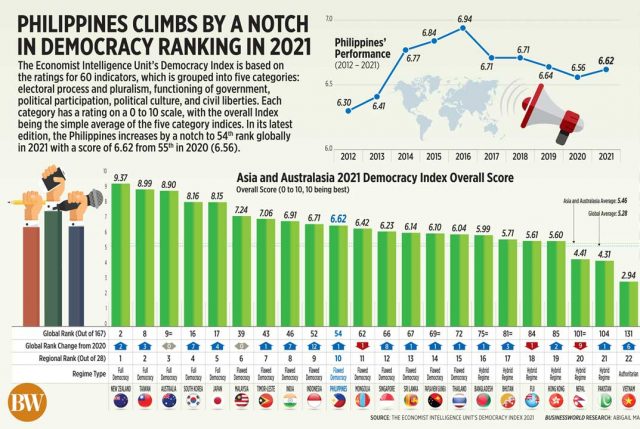
Philippines climbs by a notch in democracy ranking in 2021

THE PHILIPPINES jumped one spot to 54 out of 167 countries in a London-based think tank’s democracy index last year, as the coronavirus pandemic resulted in an “unprecedented withdrawal” of civil liberties in both developed democracies and authoritarian regimes. Read the full story.

Philippines climbs by a notch in democracy ranking in 2021

How PSEi member stocks performed — February 10, 2022

Here’s a quick glance at how PSEi stocks fared on Thursday, February 10, 2022.


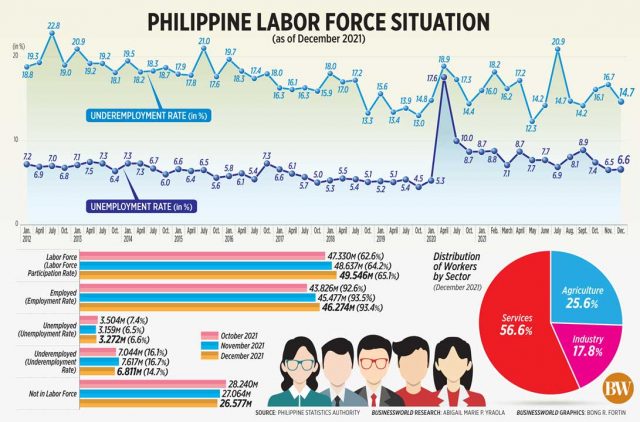
Philippine labor force situation (Dec. 2021)

THE PHILIPPINES’ jobless rate rose month on month in December, as more Filipinos joined the workforce amid increased business activity and relaxed mobility curbs during the holidays. Read the full story.

Philippine labor force situation (Dec. 2021)

NEDA backs move to relaxed quarantine setting by March

SOCIOECONOMIC Planning Secretary Karl Kendrick T. Chua wants a shift to the least strict form of quarantine by March, which he said would add P11.2 billion to the economy each week.

National Economic and Development Authority (NEDA) estimates indicate that a move from Alert Level 2 to Alert Level 1 would add 191,000 jobs per week.

“If we continue to work together and see Alert Level 1, hopefully by the next month, then we would have added P11.2 billion in gross value added per week in the NCR Plus area,” Mr. Chua said in a Management Association of the Philippines economic briefing on Thursday.

Metro Manila, Bulacan, Cavite, Laguna, and Rizal were placed under Alert Level 3 last month due to an Omicron-driven surge in coronavirus disease 2019 (COVID-19) cases after the holidays. Economic managers said this resulted in P3 billion in productivity losses each week.

In response to the current Alert Level 2 quarantine, Presidential Adviser for Entrepreneurship Jose Ma. A. Concepcion has also been asking the government to move to the least strict quarantine setting by March to restore economic activity.

The COVID-19 daily tally hit 4,575 on Thursday, bringing the active case count to 93,307.

Along with restoring economic activity, Mr. Chua has been supporting a return to face-to-face classes.

“Our thinking in NEDA is we will not get it right at the start, but it is crucial to pilot immediately (in) more schools so that we learn from the pilot,” he said. “The more we pilot, the more we will learn, the more we can get it right.”

The unavailability of physical classes could worsen the quality of education and cost the country P11 trillion in lost wages over the next four decades, NEDA has estimated.

“Learning was compromised by the prolonged school closure,” Brain Trust, Inc. Chair Cielito F. Habito said at the same event.

“Children of poor families in remote areas actually had no access… and therefore were left out of this remote learning exercise, and so the effect of these lost years will be felt years from now in terms of reduced worker productivity.” — Jenina P. Ibañez

IATA calls for more PHL action to restore air travel confidence, revive airline industry

REUTERS

THE International Air Transport Association (IATA) said it is optimistic about the Philippine government’s move to open its borders to fully vaccinated foreign travelers, but added that more measures are needed to boost passenger confidence in air travel.

“It is good for the aviation community, and will facilitate the recovery of the aviation industry and the tourism sector.  We urge other Asia-Pacific governments to look at similarly easing their travel restrictions and join this growing momentum we are seeing in the region during the past several weeks,” Philip Goh, IATA’s regional vice-president for Asia Pacific, said in  a statement on Wednesday.

Beginning Feb. 10, Philippine borders were opened to fully vaccinated travelers from countries whose citizens enjoy 30-day visa-free entry privileges.

Mr. Goh noted that easing travel restrictions is a “positive step” forward, but “more needs to be done in order to build greater confidence in air travel.”

“We urge the Philippine government to take the following additional actions: make permanent the standardization of measures and exemption of quarantine, improving from the current temporary suspension; accept antigen tests for pre-departure testing; recognize digital vaccination certificates and testing certificates that are presented on digital platforms, such as the IATA Travel Pass,” he said.

“It is through greater liberalization from air travel restrictions that aviation and travel businesses, and indeed economies, can advance to full recovery from two years of extreme hardship,” he added.

Flag carrier Philippine Airlines, Inc. said fully vaccinated ​foreigners will no longer be required to undergo quarantine at a designated facility.

“Instead, they shall self-monitor for any signs or symptoms for seven days, with the first day being the date of arrival, and shall be required to report to the local government unit upon the manifestation of symptoms, if any,” it said in a statement.

PAL also said that unvaccinated foreign children below 12 years, traveling with a Filipino parent, will need to observe the entry, testing, and quarantine protocols.

“Foreign children from ages 12 to 17 years of age traveling with their Filipino parent, shall follow the protocols based on their vaccination status (i.e., vaccinated or unvaccinated). If the child is unvaccinated, either parent should accompany the child during their facility based quarantine,” the flag carrier added.

The airline is currently flying to and from 33 international and 27 domestic destinations. — Arjay L. Balinbin

PEZA seeking to extend remote-work BPO scheme to September

THE Philippine Economic Zone Authority (PEZA) said it wants to allow information technology-business process outsourcing (IT-BPO) companies to continue with 90% work-from-home schemes until September, extending a previous arrangement that expires in March.

In a statement on Thursday, PEZA asked the Fiscal Incentives Review Board (FIRB) to allow IT-BPO firms to operate under work-from-home (WFH) arrangements until Sept. 12.

Economic zone locators’ incentives are tied up in performing work onsite, because areas outside the zone are considered a separate Customs territory. The pandemic has led to a reduction to the onsite work requirement to 10%.

Charito B. Plaza, PEZA director general, said the agency’s proposal is temporary. She added that the PEZA Board approved the proposal on Jan. 7.

“The approval of the PEZA Board of our proposed temporary measure was submitted to the FIRB for further approval as required under the rules. We have yet to receive formal notice on the FIRB’s decision regarding our recommendation,” Ms. Plaza said.

In September last year, FIRB released Resolution No. 19-21 which allows outsourcing firms in economic zones (ecozones) to conduct up to 90% of work remotely, with no diminution in their fiscal incentives until the end of March.

According to PEZA, such an extension has legal sanction from Rule 23, Section 3 of the implementing rules of Republic Act No. 11534 or the Corporate Recovery and Tax Incentives for Enterprises (CREATE) law. 

“Rule 23… provides that an investment promotion agency (IPA) may implement temporary measures to support the recovery of registered business enterprises (RBEs) from exceptional circumstances, upon prior approval of the FIRB,” PEZA said.

“Exceptional circumstances include pandemic, epidemic, war, armed conflict, state of national health emergency, outbreak of diseases, international or regional financial crises, major disasters such as a volcanic eruption, earthquake and super typhoon, or analogous circumstances,” it added.

PEZA is also appealing for the non-imposition of penalties under FIRB Resolution No. 19-21.

“PEZA-registered companies are coping with or recovering from the impact of the pandemic. If it’s supposed to be a relief measure, we should not penalize the companies; rather, we must continue to assist our registered companies as much as possible given that protecting livelihoods of millions of Filipinos is an important national interest,” Ms. Plaza said.  

PEZA asked its board to allow the transfer of IT equipment and assets as long as these are covered by surety bonds and appropriate permits.

PEZA also requested its board to approve the issuance of guidelines for WFH arrangements.

Separately, PEZA and the Board of Investments said they support Senate Bill No. 2306 filed by Senator Maria Imelda Josefa R. Marcos, which seeks to amend Section 309 of the CREATE law.

The bill cites the need for amendments because Section 309 only allows CREATE incentives to be awarded to activities conducted within economic zones.

   “However, instead of the 50% WFH arrangement which is based on revenue, both IPAs agreed that the percentage should be addressed in the proposed Strategic Investment Priorities Plan (SIPP) as the allowable threshold may even be increased to more than 50% but this time, it shall be based on total workforce or manpower of the IT enterprises instead of the revenue,” Ms. Plaza said.

The FIRB denied a PEZA request to allow remote work equivalent to up to 90% of an outsourcing firm’s revenue. It also stood by its decision to allow outsourcing firms operating within economic zones to maintain WFH arrangements until March as long as 10% of employees are on site.

PEZA said there were 297 registered IT parks and centers and 1,273 registered IT-BPO companies as of November.

“These companies and ecozones have contributed a total of 12.33% or P328.559 billion worth of investments, generated $11.537 billion worth of exports, and created 962,304 direct jobs as of September 2021,” PEZA said. — Revin Mikhael D. Ochave

Eastern Visayas red tide-free after five years

PHILIPPINE STAR/EDD GUMBAN

THE Eastern Visayas have been declared free from red tide toxins after nearly five years, the Bureau of Fisheries and Aquatic Resources (BFAR) reported.

The BFAR said that the results of laboratory tests on Feb. 7 detected no red tide organisms in the region.

The last time the region was red tide-free was in 2017.

The last areas cleared of red tide are: San Pedro Bay, Samar; Carigara Bay, Leyte; Cancabato Bay, Tacloban City; Guiuan, Eastern Samar; Matarinao Bay, Eastern Samar; and the waters off Biliran Island.

Red tide notices have been regularly issued for Matarinao Bay, Carigara Bay, and Cancabato Bay.

“After almost five years of regular issuance of red tide advisories, we’re now finally red tide-free. Hopefully, we will have a longer period like this with the interplay of weather. We need this for us to have a good harvest of shellfish products,” BFAR Eastern Visayas Regional Director Juan D. Albaladejo said in a statement.

“Even if shellfish ban is lifted in these areas, our active surveillance will continue since we are still experiencing rains. This may cause runoff of soil sediments rich in organic load that fertilized the cyst of red tide in these bays,” he added. — Luisa Maria Jacinta C. Jocson

Harvard institute says ‘moral duty’ to help island communities deal with climate change

PHILSTAR

SMALL ISLAND communities in the Asia-Pacific are at greater risk from climate change, and aiding them is a “moral duty” for larger states, according to the Harvard Humanitarian Initiative (HHI).

“Support for low-lying island communities throughout the Asia-Pacific must be a priority for the international community. We know that these communities will have to bear a terrible burden for a climate crisis they had virtually no role in creating,” HHI Resilient Communities Program Director Vincenzo Bollettino said in a statement.

“Larger states have both a strong moral and practical duty to support adaptation measures and think through feasible strategies to support communities where forced migration is inevitable,” he added.

HHI, an institute within Harvard University, reported that limited resources and supporting for disaster measures are hindering community resilience in small islands in the Philippines.

It cited as a case study of Barangay Pugad, Hagonoy, Bulacan, which is effectively an island because it lies within a river delta system that empties into Manila Bay.

HHI said the barangay has limited funds to implement its community-based disaster risk reduction and management (CBDRRM).

“Sadly, Pugad is not alone in this since the issue they face is but a mere reflection of scarce resources across the entire country. Although there is a… National Disaster Risk Reduction and Management Fund (NDRRMF), the Local Disaster Risk Reduction and Management Fund (LDRRMF), and the Quick Response Fund (QRF) which is a portion of the NDRRMF, such financial resources are not proportionally allocated across provinces and tend to be heavily focused on disaster response rather than preparedness and resilience,” HHI added.

HHI said typhoons are inevitable and governments must invest in pre-disaster measures.

“Being hit by only one (typhoon) can bring them to a disaster trap. Thus, it is increasingly important for the government, at all levels, to focus on pre-disaster investments. Such communities need policy and financial support in their CBDRRM plans. It will be good to start with assisting such communities in terms of disaster risk financing and disaster insurance education, alongside a human rights-based approach (HRBA) to DRR and gender mainstreaming in disaster management,” it said.

“The continued onslaught of disasters and climate change impacts to Pugad diminishes the positive impact of resources brought about by the community’s partnerships with external development actors,” the report added.

It proposed the construction of disaster mitigation infrastructure projects to prepare the communities ahead of time.

“For infrastructure, it is also proposed that the residents in Pugad must invest in stilted housing rather than spending much of their savings and external financial support they receive on regularly fixing their damaged houses due to floods and land subsidence. Stilted housing can be the most effective type of adaptation strategy for people in small island communities in the Philippines who choose to stay over relocation measures,” the report added. — Luisa Maria Jacinta C. Jocson

PHL’s ‘biggest’ economic zone registered in Quezon

THE Philippine Economic Zone Authority (PEZA) said it registered an economic zone in Quezon Province which is projected to cost P125 billion to develop, adding that the zone is expected to become the country’s largest.

PEZA said in a statement on Thursday that a registration agreement was signed with Achievement Realty Corp. (ARC) Chairman Philip M. Cea on Jan. 31, paving the way for the construction of the Quezon Techno-Industrial Special Economic Zone (QTISEZ) on a 1,836 hectare site in Mauban, Quezon.

“This huge investment ARC has entrusted to PEZA is going to be a historical project because this new economic zone shall come out as… the future biggest economic zone in the Philippines,” PEZA Director General Charito B. Plaza said.

According to Ms. Plaza, the zone will have the first international airport and seaport in that part of Luzon.

“QTISEZ is envisioned to have its own international seaport and international airport with an estimated budget of P25 billion each from the total P125 billion cost of developing the 1,836-hectare special economic zone,” Ms. Plaza said.

“With the P75 billion from the proposed development budget and under this signing, QTISEZ will create 2,000 factories (which will lead to) the creation of more than 200,000 jobs,” she added.

Mr. Cea said around 200 hectares will be dedicated to government offices, residential and commercial districts, and other uses.

He added that preliminary deals have been signed with potential Chinese and South Korean locators, with talks ongoing.

Under Republic Act No. 7916 or the Special Economic Zone Act, PEZA said ARC is entitled to establish, manage, and operate QTISEZ as an economic zone developer.

It added that ARC can construct, operate, and maintain infrastructure facilities, utilities, communication systems, and sewage and drainage systems either on its own or through another company.

Under the law, “(PEZA has) the exclusive power and prerogative to permit, supervise, and control the entry and exit of all goods, machinery, and equipment, merchandise, and article to and from QTISEZ,” the agency said.

“Meanwhile, ARC is responsible for providing security and maintaining peace and order within the QTISEZ and shall pay to PEZA all applicable fees and agrees that PEZA may withhold, suspend, or disapprove permits,” it added. — Revin Mikhael D. Ochave

Rice price impact on inflation expected to be minimal

PHILIPPINE STAR/ MICHAEL VARCAS

RICE PRICES are expected to remain stable in the first quarter, with a “negligible” impact on inflation, according to the Department of Agriculture (DA).

“Rice prices continue to be stable prices (with) a negligible effect when it comes to inflation. We also have many different kinds of rice to choose from,” Undersecretary for Operations and Agri-Fisheries Mechanization Ariel T. Cayanan said at a virtual briefing.

The DA said end-January rice stocks have been estimated at 2.9 million metric tons (MT). The other projections for the rest of the quarter are 2.7 million MT for the end of February and 3.3 million MT for the end of March.

“We are working hard to make our farmers more competent so that we can continue to thrive. According to our policy, we are value-chain driven now. Our farmers don’t just have to produce, they must have entrepreneurial skills as well,” he added.

He said the DA is working on a plan that will make towns specialize in key commodities to maximize production.

“We have a provincial commodity investment plan, which went through very precise and surgical study. One town, one product.  What is suitable to the area, that’s what we plant,” Mr. Cayanan said.

Meanwhile, the Federation of Free Farmers (FFF) said it expects to see a possible decline in palay (unmilled rice) prices during the dry season harvest following a surge in imports.

“We will have a supply glut when the farmers start harvesting their dry-season crop starting March. Farmers will again suffer from low prices even as the costs of fertilizer, fuel, and other farm inputs remain high. Having a large harvest is meaningless to farmers if it results in low prices for their produce,” FFF National Manager Raul Q. Montemayor said.

The FFF said that the increase in palay production will not benefit farmers significantly.

“Half of the incremental harvest in 2021 came from an expansion in harvested area and only half was due to an improvement in yields. Overall, output per hectare improved by only 1.6% in 2021, equivalent to an additional income of only P1,095 per hectare,” the FFF said.

“This is far off the DA’s unsubstantiated claim that farmers earned P10,000 more per hectare in 2021 despite the increase in fertilizer costs,” it added.

The FFF also questioned the reported increase in tariff collections on rice imports.

On Feb. 8, the Department of Finance  reported that rice tariff collections amounted to P18.9 billion in 2021.

Under Republic Act (RA) No. 11598, tariffs in excess of P10 billion a year will be used for cash transfers to farmers affected by the Rice Tariffication Law (RTL).

“Tariff collections increased because imports surged, and, as a result, palay prices went down. The P9 billion that will be given to farmers is very small compared to the P60 billion that farmers are losing every year compared to their income before RTL took effect. In addition, one out of every three rice farmers will not get any cash assistance because RA No. 11598 applies only to farmers tilling two hectares or less,” Mr. Montemayor said.

“We support calls to increase the budget for agriculture, but we must make sure that the money is being spent wisely and effectively. Spending one peso to get back just one peso is not a good way to use scarce government money,” he added. — Luisa Maria Jacinta C. Jocson