Home Blog Page 6462

U.S. considers authorization of first COVID vaccine for children under 5

U.S. regulators are considering the first COVID-19 vaccine for children under the age of 5, the only age group not yet eligible for the shots, after Pfizer Inc and BioNTech SE began the regulatory approval process on Tuesday.

A decision is expected as soon as this month.

The companies said they began submitting data for an emergency use authorization even though they did not meet a key target in their clinical trial of 2- to 4- year olds. They are submitting the data at the request of the U.S. Food and Drug Administration in order to address an urgent public health need in the age group, they said.

The arrival of a vaccine for younger children could help harried parents who have had to contend with quarantines and closures of pre-schools and daycare centers.

“Having a safe and effective vaccine available for children in this age group is a priority,” acting FDA Commissioner Janet Woodcock said. She said the agency asked for the application because of the recent Omicron surge.

The FDA said an outside committee of expert advisers would meet on Feb. 15 to discuss the authorization. If that goes forward, the U.S. Center for Disease Control and Prevention also needs to sign off on how the vaccinations will be implemented, following a meeting of its own advisers. Those meetings have tended to follow within a week or so of FDA decisions.

The drug companies said they are asking the FDA for authorization of the first two doses of a planned three-dose regimen.

“If two doses are authorized, parents will have the opportunity to begin a COVID-19 vaccination series for their children while awaiting potential authorization of a third dose,” Pfizer Chief Executive Albert Bourla said.

He said the company believes three doses of the vaccine will be needed “to achieve high levels of protection against current and potential future variants.”

The companies expect to complete submitting data to the FDA in the coming days, with data on the third dose to follow.

Pfizer and BioNTech are testing a 3-microgram dose of the vaccine in the age group, compared with a 10-microgram dose in 5- to 11-year-olds and 30 micrograms for people aged 12 and older.

The companies said they expect to have ample supply of the 3-microgram shots should the FDA authorize the vaccine.


EVIDENCE OF CLINICAL BENEFIT?

The move could speed up the inoculation timeline for this age group by months. If a third dose is eventually authorized, many children could already have begun the regimen. Pfizer is currently testing two doses three weeks apart, followed by a third dose at least eight weeks later.

In December, Pfizer said it was amending its clinical trial to test a three-dose version of the vaccine because the lower-dose generated an immune response in 2- to 4-year-olds that was inferior to the response measured in those aged 16 to 25. In 6- month- to 24-month-old children, the vaccine generated an immune response in line with 16- to 25-year-olds.

John Grabenstein, former executive director of medical affairs for vaccines at Merck, said he believes regulators should consider the vaccine as a two-dose course, rather than as the first two doses of a planned three dose regimen.

“I cannot think of any example ever where the FDA reached a regulatory decision without knowing the data from the end of the trial,” Grabenstein said. “I just can’t believe that they would authorize getting started without knowing what the third dose would do.”

But John Moore, a professor of microbiology and immunology at Weill Cornell Medical College, said the plan “sounds like a creative solution to a real problem, and there’s no safety implications, which would otherwise be a dealbreaker.”

The vaccine is already approved for emergency use in children in the United States as young as 5. It has full approval for adults.

The FDA also has authorized a third booster dose of the Pfizer/BioNTech shot for adults and children aged 12 and older. It gave the green light for a two-dose vaccine for children ages 5 to 11.

It remains unclear how many parents will choose to vaccinate their younger children.

Vaccinating children has been slow in the United States with only around 22% of 5- to 11 year-olds having received two shots since the campaign to inoculate that age group began in November. – Reuters


Former U.S. security officials urge Congress to act on China legislation

WASHINGTON – More than a dozen former senior U.S. national security officials have pressed congressional leaders to quickly pass legislation to boost technology funding, calling it “critical” to compete against China.

A letter signed by 16 officials from past Democratic and Republican administrations – including Leon Panetta, who served as defense secretary under President Barack Obama, and President George W. Bush’s national security advisor Stephen Hadley – said the legislation would “ensure the U.S. stays on the cutting-edge of microelectronics.”

The Senate passed the U.S. Innovation and Competition Act last year, including $52 billion for the semiconductor industry and authorizing $190 billion to strengthen U.S. technology and research to compete with China.

The House of Representatives began considering its “America Competes” act this week. If it passes, the two chambers will have to resolve differences with the Senate bill.

“This is the time to prioritize comprehensive, bipartisan competitiveness legislation, which will ensure that federal investment matches our national security interests and allows the United States to maintain strengths and comparative advantages against rising adversaries,” the officials wrote in the letter dated Feb.1, seen by Reuters.

The letter was addressed to Democratic House Speaker Nancy Pelosi and Senate Majority Leader Chuck Schumer, as well as Republican House and Senate leaders Kevin McCarthy and Mitch McConnell.

Former CIA directors John Brennan and Michael Hayden, former Director of National Intelligence James Clapper, deputy national security advisor in the Trump administration Matthew Pottinger, and under secretary of defense for policy during the Obama administration Michele Flournoy also signed it.

Signers also included former Google chief executive Eric Schmidt, who served on a government artificial intelligence commission, and Jane Harman, a former ranking member on the House Intelligence Committee.

More than 500 amendments to the House bill have been submitted, including one that would bar semiconductor firms receiving government subsidies from paying dividends or repurchasing company stock.

The U.S. Chamber of Commerce has said it was pleased the House had begun to consider its version of the bill, and the largest U.S. labor organization said on Monday it strongly supported the House legislation. – Reuters

OPEC+ seen sticking to policy despite oil price rally -sources

LONDON – OPEC+ will likely stick to existing policies of moderate output increases on Wednesday, five sources from the producers’ group said even as it expects demand to rise to new peaks this year and as oil prices trade near their highest since 2014.

The group, which comprises of the Organization of the Petroleum Exporting Countries and allies led by Russia and produces over 40% of global supply, has faced pressure from top consumers such as the United States and India to pump more to help the economic recovery from the pandemic.

But OPEC+ has refused to adhere to speedier increases arguing that the world is facing an energy shortage due to poorly calculated energy transitions to greener fuels by consuming nations.

Several OPEC members have struggled to pump even in line with their quotas due to under-investments of the past few years.

Five OPEC+ sources told Reuters on Tuesday they expected the ministers to agree to go ahead with a planned increase of 400,000 barrels per day in March, despite high oil prices.

“The issue (of speedier increases) did not come up and I doubt it will,” an OPEC+ source said, asked if an OPEC+ expert committee meeting had discussed an increase of above 400,000 bpd when it virtually met on Tuesday.

A report prepared by the committee, known as the Joint Technical Committee (JTC), and seen by Reuters on Tuesday kept the forecast for world oil demand growth unchanged for 2022 at 4.2 million bpd.

It said it expected demand to rise to pre-pandemic levels in the second half of the year. Oil demand reached its peak of slightly above 100 million bpd in 2019.

The report still said the world would face a crude surplus in 2022 reaching 1.3 million bpd, slightly less than its previous forecast of 1.4 million bpd.

The report noted, however that a number of risks continue to linger over the oil market, including “significant uncertainties” associated with the potential impact of the Omicron coronavirus variant, ongoing supply chain bottlenecks and central bank policy to counter inflation.

The JTC also flagged other risks to the oil market recovery, citing volatility in commodity markets, restraints on oil production capacity from underinvestment, the challenge of high sovereign debt levels in many regions and geopolitical risks.

Brent crude prices were about $89 a barrel on Tuesday, not too far from the seven-year high of $91.70 reached last week, driven largely by geopolitical tensions.

Goldman Sachs said in a note there was a chance of a faster OPEC+ ramp up given the pace of the market’s recent rally. – Reuters

Putin accuses U.S. of trying to lure Russia into war

RUSSIAN President Vladimir Putin. — REUTERS

KYIV/MOSCOW – Russian President Vladimir Putin accused the West on Tuesday of deliberately creating a scenario designed to lure it into war and ignoring Russia’s security concerns over Ukraine.

In his first direct public comments on the crisis for nearly six weeks, a defiant Putin showed no sign of backing down from security demands that the West has called non-starters and a possible excuse to launch an invasion, which Moscow denies.

“It’s already clear now … that fundamental Russian concerns were ignored,” Putin said at a news conference with the visiting prime minister of Hungary, one of several NATO leaders trying to intercede with him as the crisis has intensified.

Putin described a potential future scenario in which Ukraine was admitted to NATO and then attempted to recapture the Crimea peninsula, territory Russia seized in 2014.

“Let’s imagine Ukraine is a NATO member and starts these military operations. Are we supposed to go to war with the NATO bloc? Has anyone given that any thought? Apparently not,” he said.

Russia has massed more than 100,000 troops on the Ukrainian border and Western countries say they fear Putin may be planning to invade.

Russia denies this but has said it could take unspecified military action unless its security demands are met. Western countries say any invasion would bring sanctions on Moscow.

The Kremlin wants the West to respect a 1999 agreement that no country can strengthen its own security at the expense of others, which it considers at the heart of the crisis, Foreign Minister Sergei Lavrov said.

He raised the charter signed in Istanbul by members of the Organisation for Security and Cooperation in Europe, which includes the United States and Canada, during a call with U.S. Secretary of State Antony Blinken.

Lavrov said Blinken accepted the need to discuss the matter further whilst a U.S. account of the call focused on the need for Moscow to pull back.

“If President Putin truly does not intend war or regime change, the Secretary told Foreign Minister Lavrov then this is the time to pull back troops and heavy weaponry and engage in a serious discussion,” a senior State Department official told reporters.

The U.S. is willing to discuss giving the Kremlin a way to verify the absence of Tomahawk cruise missiles at NATO bases in Romania and Poland, if Russia shares similar information about missiles on certain Russian bases, Bloomberg reported.

The White House and State Department did not immediately respond to requests for comment but a source familiar with the situation said the United States has only offered to have talks on a variety of Russia’s concerns, such as arms control issues in the appropriate forums.


‘INSTRUMENT’

Putin had not spoken publicly about the Ukraine crisis since Dec. 23, leaving ambiguity about his personal position while diplomats from Russia and the West have been engaged in repeated rounds of talks.

His remarks on Tuesday reflected a world view in which Russia needs to defend itself from an aggressive and hostile United States. Washington is not primarily concerned with Ukraine’s security, but with containing Russia, Putin said.

“In this sense, Ukraine itself is just an instrument to achieve this goal,” he said.

“This can be done in different ways, by drawing us into some kind of armed conflict and, with the help of their allies in Europe, forcing the introduction against us of those harsh sanctions they are talking about now in the U.S.”

Hungarian Prime Minister Viktor Orban, who has often sparred with Western European leaders over democracy in his own country, said he believed after his talks with Putin that there was room for a compromise.

“I got convinced today that the existing differences in positions can be bridged and it is possible to sign an agreement that would guarantee peace, guarantee Russia’s security and is acceptable for NATO member states as well,” Orban said.


GUN TO UKRAINE’S HEAD

As Western countries rush to show solidarity with Ukraine, the U.S. urged Brazilian President Jair Bolsonaro to cancel a visit with Putin in Russia, a source told Reuters.

On Tuesday, British Prime Minister Boris Johnson met President Volodymyr Zelenskiy in Kyiv and accused Putin of holding a gun to Ukraine’s head to demand changes to the security architecture in Europe.

“It is vital that Russia steps back and chooses a path of diplomacy,” Johnson said. “And I believe that is still possible. We are keen to engage in dialogue, of course we are, but we have the sanctions ready, we’re providing military support and we will also intensify our economic cooperation.”

Johnson said any Russian invasion of Ukraine would lead to a military and humanitarian disaster.

“There are 200,000 men and women under arms in Ukraine, they will put up a very, very fierce and bloody resistance,” he said. “I think that parents, mothers in Russia should reflect on that fact and I hope very much that President Putin steps back from the path of conflict and that we engage in dialogue.”

Polish Prime Minister Mateusz Morawiecki, also visiting Kyiv, said Poland would help Ukraine with gas and arms supplies, as well as humanitarian and economic aid.

“Living close to a neighbour like Russia, we have the feeling of living at the foot of a volcano,” said Morawiecki.

Zelenskiy, who has repeatedly played down the prospect of an imminent invasion, signed a decree to boost his armed forces by 100,000 troops over three years. He urged lawmakers to stay calm and avoid panic.

The troop increase was “not because we will soon have a war … but so that soon and in the future there will be peace in Ukraine,” Zelenskiy said. – Reuters

Tesla recalls nearly 54,000 vehicles that may disobey stop signs

Logo of Tesla, Inc.

WASHINGTON – Tesla Inc will recall 53,822 U.S. vehicles with the company’s Full Self-Driving (Beta) software that may allow some models to conduct “rolling stops” and not come to a complete stop at some intersections posing a safety risk.

The National Highway Traffic Safety Administration (NHTSA) said the recall covers some 2016-2022 Model S and Model X, 2017-2022 Model 3, and 2020-2022 Model Y vehicles. NHTSA said the feature also known as FSD Beta may allow vehicles to travel through an all-way stop intersection without first coming to a stop.

Tesla will perform an over-the-air software update that disables the “rolling stop” functionality, NHTSA said. The agency added it “maintains regular discussions with all manufacturers to discuss potential safety concerns of these types of systems.”

Tesla Chief Executive Officer Elon Musk said on Twitter “there were no safety issues” with the function. “The car simply slowed to ~2 mph & continued forward if clear view with no cars or pedestrians,” Musk wrote.

NHTSA noted federal law “prohibits manufacturers from selling vehicles with defects posing unreasonable risks to safety, including intentional design choices that are unsafe.”

Last week, Tesla said the number of FSD beta vehicles in the United States increased to nearly 60,000 from a few thousand at the end of September. Tesla has been testing the improved version of its automated driving software on public roads, but the carmaker and the regulator have said the features do not make the cars autonomous.

Tesla said as of Jan. 27 it was not aware of any warranty claims, crashes, injuries or fatalities related to the recall.


STATE LAWS

Tesla told the auto safety agency it released on Oct. 20 an updated version to introduce the “rolling stop” functionality. The automaker said to use the feature vehicles must be traveling below 5.6 miles (9 km) per hour and no relevant moving cars, pedestrians or bicyclists are detected near the intersection.

The feature, which appeared to violate state laws that require vehicles to come to a complete stop and required drivers to opt-in for what it dubbed “Assertive” mode, drew attention on social media and prompted NHTSA to raise questions with Tesla.

According to a defect report filed with the auto safety agency, Tesla said it met with NHTSA staff on Jan. 10 and Jan. 19 “to discuss the functionality, including operating parameters” and the automaker on Jan. 20 agreed to the recall.

In November, Tesla recalled nearly 12,000 U.S. vehicles sold since 2017 for another software update because a communication error could cause a false forward-collision warning or unexpected activation of the emergency brakes.

NHTSA said last week it had sought additional information from Tesla in its probe into 580,000 vehicles over the automaker’s decision to allow games to be played by passengers on the front center touchscreen.

In December, NHTSA opened a preliminary evaluation into 2017-2022 Tesla Model 3, S, X, and Y vehicles over the vehicle’s “Passenger Play” feature the agency said “may distract the driver and increase the risk of a crash.”

In August, NHTSA opened a formal safety probe into Tesla‘s Autopilot driver assistance system in 765,000 U.S. vehicles after about a dozen crashes involving Tesla models and emergency vehicles. That investigation also remains open. – Reuters

PHL ends 2021 with P11.7-trillion debt

PHILIPPINE STAR/ MICHAEL VARCAS
The government has increased its borrowings to fund its pandemic response, including the purchase of coronavirus vaccines. — PHILIPPINE STAR/ MICHAEL VARCAS

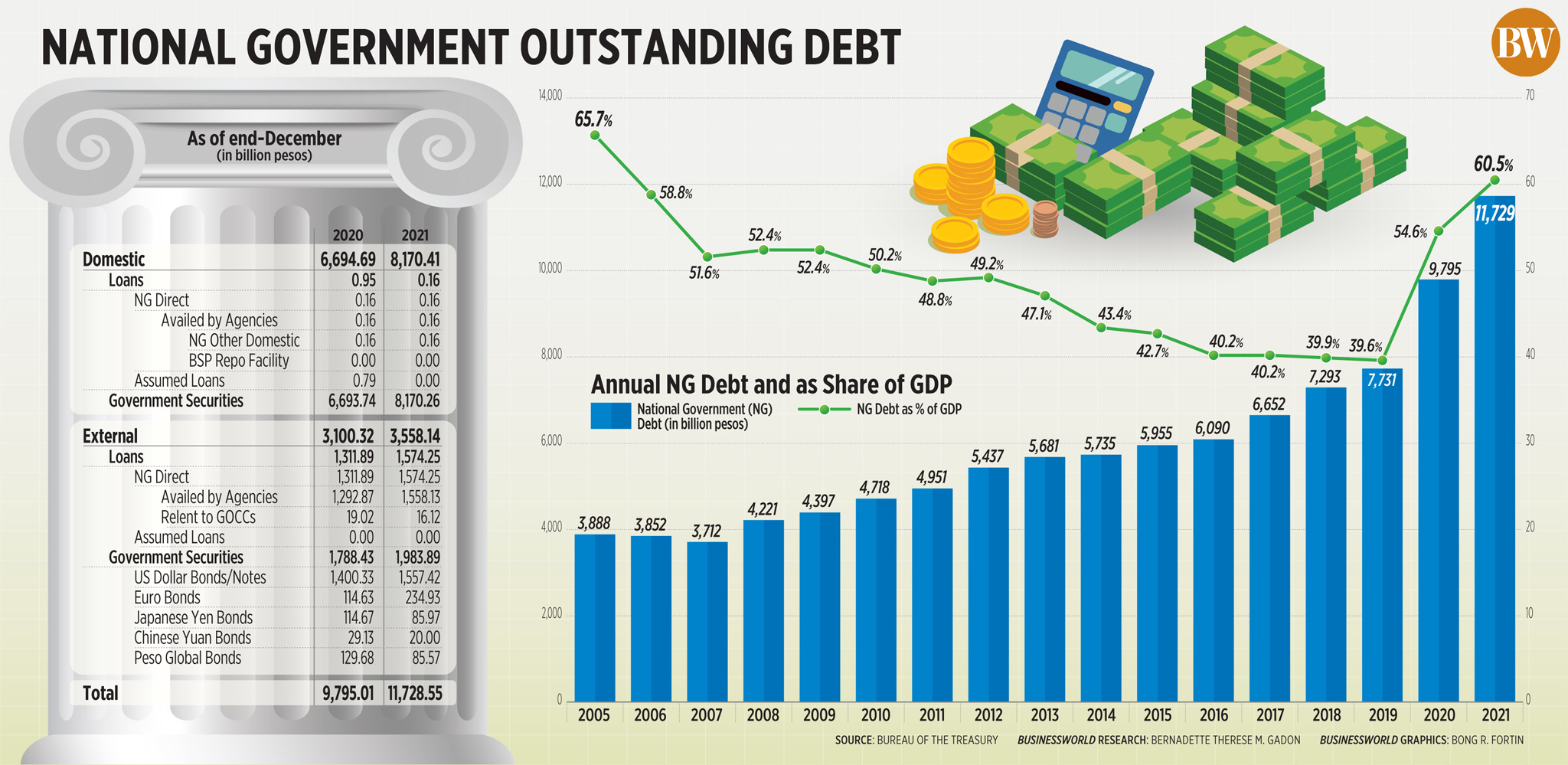
THE National Government (NG) recorded P11.73 trillion in outstanding debt as of end-December, pushing the debt-to-GDP ratio past the international threshold, preliminary data from the Bureau of the Treasury (BTr) showed.

Government debt over the course of 12 months grew by nearly P2 trillion, or by 19.7% year on year. 

The year-on-year debt growth was slower than the 26.7% expansion in 2020 due to better fiscal performance and lower financing requirements, the BTr said in a statement on Tuesday.

National government outstanding debt

Month on month, the debt stock slipped by 1.7%, mostly because of the net redemption of domestic securities, BTr added.

The end-December debt figure meets the government’s P11.73-trillion projection.

However, this meant the debt-to-GDP ratio is now at 60.5%, higher than the 54.6% a year earlier and slightly above the 60% threshold considered as manageable by multilateral lenders for developing economies. It is also the highest debt-to-GDP ratio since the 65.7% seen in 2005.

“(The ratio is) still within the accepted sustainable threshold as the economy continues to recover from the effects of the pandemic,” the Treasury said.

The Philippine government has ramped up borrowings to finance its pandemic response, which included the purchase of coronavirus vaccines.

Domestic borrowings represented 69.7% of the debt total, while the rest was sourced from foreign creditors.

As of end-December, domestic debt fell by 3.2% to P8.17 trillion from the previous month, but grew by 22% year on year.

This consisted of P8.17 trillion in government securities, which went up by 3.4% from P7.9 trillion as of end-November and increased by 22.1% from 2020.

The state’s other domestic obligations stood at P156 million, after its P540-billion loan from the central bank was repaid in December.

The growth of local debt is “in line with the domestic borrowing program which favors domestic issuance to mitigate foreign exchange risk and support local capital market development,” BTr said.

Meanwhile, foreign debt inched up by 1.9% to P3.56 trillion month on month and increased by 14.8% from full-year 2020.

“For December, the increment in external debt was attributed to the impact of Peso depreciation against the USD (US Dollar) amounting to P40.87 billion and the net availment of external obligations amounting to P33.83 billion,” the Treasury said.

Broken down, foreign debt included P1.57 trillion in loans, which rose by 1.9% since end-November.

Government securities also edged higher by 1.1% month on month to P1.98 trillion.

This included P1.56 trillion in dollar notes, P235 billion in euro bonds, P86 billion in yen securities, P19.9 billion in yuan notes and P85.6 billion in peso global bonds.

Total outstanding guaranteed debt jumped by 1.5% to P423.91 billion as of end-December from a month earlier.

However, outstanding guaranteed debt slid by 7.5% from a year earlier.

The end-2021 debt level is better than expected, UnionBank of the Philippines, Inc. Chief Economist Ruben Carlo O. Asuncion said.

“This is may be due to the better-than-expected performance of the economy toward the end of 2021, with improving revenue collection performance versus 2020,” he said in a Viber message.

The economy grew by 5.6% in 2021, thanks to a 7.7% gross domestic product expansion in the fourth quarter as lockdown restrictions were loosened.

Mr. Asuncion said the debt-to-GDP ratio has improved since the 63.1% seen in September.

“This is welcome news and may bode well for markets and partially pacify uncertainties hovering over the country’s fiscal situation, especially as the national elections draw near.” — Jenina P. Ibañez

‘Hot money’ continued to exit in 2021

REUTERS

By Luz Wendy T. Noble, Reporter

MORE FOREIGN FUNDS left than entered the Philippines in 2021, marking the third straight year of net outflows, as the country gradually recovered from the pandemic.

Foreign portfolio investments (FPIs) — also called “hot money” due to the ease by which these funds enter and leave an economy — saw a net outflow of $574.46 million last year, significantly smaller than the $4.24-billion net outflow in 2020.

This was the smallest since the $195.4-million net outflow in 2017. It also missed the Bangko Sentral ng Pilipinas’ (BSP) $1.5-billion net inflow projection for the full year.

“Outflows were slimmer because 2021 was really a better year compared to 2020 with continuous vaccination and more relaxed restrictions,” Asian Institute of Management (AIM) economist John Paolo R. Rivera said in a Viber message.

The government eased lockdown restrictions during the fourth quarter, allowing more businesses to reopen. The economy expanded by 5.6% in 2021 after the record 9.6% contraction in 2020 that was caused by stringent lockdowns.

The Philippines also made progress in vaccinating its population against the coronavirus disease 2019 (COVID-19), although it remained a laggard in the region.

In December alone, hot money posted a $4.38-million net outflow, much lower than the $523.86 million outflows seen in the prior year. However, it was a reversal from the $109.56-million net inflow in November.

“Net outflow may be due to the looming threat of the Omicron in December while other countries were already ending their surge,” Mr. Rivera said.

While restrictions were loosened during the holidays, Metro Manila and other areas were once again placed under a stricter Alert Level 3 starting January due to an Omicron-driven surge in cases.

Rizal Commercial Banking Corp. (RCBC) Chief Economist Michael L. Ricafort said the more hawkish tone from the US Federal Reserve also prompted foreign investors to become more cautious.

In December, the Fed said it would quicken the tapering of its bond-buying program and will push for at least three interest rate increases in 2022.

Gross inflows in December reached $1.331 billion, rising by 22.8% from the $1.084 billion in the same month a year ago and up by 3.7% from November.

For the full year, gross inflows increased by 16.6% to $13.62 billion, from the $11.678 billion in 2020.

Gross outflows in December stood at $1.336 billion, down by 16.9% from the $1.607 billion last year but higher by 13.8% than the $1.174 billion in November. This brought full-year outflows to $14.194 billion, falling by 10.9% from the $15.918 billion in 2020.

Five investor countries accounted for 79.5% of short-term foreign investments in December, namely the United Kingdom, United States, Singapore, Luxembourg and Switzerland.

These bulk or 97% of these investments were mainly put into securities of utilities, food, beverage and tobacco, holding firms, property, and banks. The remaining 3% were invested in government securities.

AIM’s Mr. Rivera is hopeful that hot money will yield a net inflow this year on the back of sustained recovery and the higher-than-expected growth last year.

For RCBC’s Mr. Ricafort, there may still be lingering concerns caused by emerging COVID-19 variants. He said investors will also be factoring in the Fed’s more hawkish signals.

Last week, the Fed Chairman Jerome H. Powell said the US central bank was likely to begin hiking interest rates in March to tame runaway inflation.

The BSP expects hot money to yield a $5.7-billion net inflow in 2022.

Coronavirus alters college life as schools move online to stay afloat

College student John Sorba, 20, attends an online class in his family’s home in Tondo, Manila, Oct. 6, 2020. — REUTERS/ELOISA LOPEZ

By Jenina P. Ibañez, Senior Reporter

HANNAH ANGELA E. NERI is studying to become a nurse and wants to be on the frontlines of a future pandemic.

“The country needs more health workers and I want to help,” the freshman from the Central Philippine University in Iloilo City said in a Facebook Messenger chat.

Ms. Neri is one of many young Filipinos pursuing healthcare studies in the middle of a coronavirus pandemic, when applications for pre-medicine degrees such as Biology and Health Sciences have increased at some universities.

“Among applicants for school year 2021-2022, there was a surge in students who wanted to take pre-med courses,” Jose Maria Edito K. Tirol, director of admissions at the Ateneo de Manila University, said in an e-mail. “I suspect they’re inspired by the work of medical frontliners.”

More students applied this school year at the Ateneo, which ended the previous school year early after the Philippine capital and nearby cities were locked down in mid-March 2020 to contain the pandemic, giving most students an automatic passing mark.

Mr. Tirol declined to provide numbers.

As lockdowns were extended, schools stopped physical classes and shifted to virtual ones.

This could worsen educational quality and cost the country P11 trillion in lost wages in the next four decades, according to the National Economic and Development Authority.

When coronavirus cases declined toward the end of last year, Ateneo announced plans for a January return to campus at a limited capacity. This was postponed amid a fresh surge in infections spurred by the highly mutated Omicron variant.

The coronavirus has sickened 3.6 million and killed more than 50,000 people in the Philippines. Worldwide, more than 379 million have been infected and about 5.7 million people have died.

Jaime Noel J. Santos, president at business school Thames International in Quezon City, said they held online classes even before the pandemic, which helped boost enrollment when the global health crisis hit.

Schools that adapted more quickly took on the enrollees lost by colleges that failed to roll out online education fast enough, he said by telephone.

Across various schools, students also stopped enrolling because their parents lost their jobs during the pandemic.

“A lot of students really stopped, mainly because of financial issues,” Mr. Santos said. “But then we were bouncing back, economy-wise, before the Omicron variant spread. Parents who lost their jobs found new ones. Students started coming back.”

For some schools, the pandemic led to an initial decline in enrollment before student numbers bounced back.

Publicly listed Far Eastern University, Inc. in its financial report said it posted a 10% decline in first semester enrollment for the school year 2020-2021.

This academic year, first semester enrollment increased by 14% year on year, with the number of students just about exceeding the pre-pandemic level, it said.

At STI Education Systems Holdings, Inc., which runs STI schools and iAcademy, tertiary-level enrollment fell to 40,176 in the 2020-2021 school year from 45,902 a year earlier as the pandemic disrupted operations, according to a stock exchange filing.

“STI’s demographic remains the same at lower B to Broad C segment amidst the challenges that the pandemic has brought to the academic learning continuity of the students,” STI Vice-President for Academics Aisa Q. Hipolito said in an e-mail.

“The financial impact is seen as one of the major problems of the students and their parents when the pandemic started.”

The school rolled out financial aid and reduced school fees, she said. By the 2021-2022 school year, enrollment rebounded to 56,342.

Ms. Hipolito said enrollment recovered after STI started aggressive recruitment campaigns and delivered classes online.

STI schools still expect strong demand for its information technology curricula.

“We are closely monitoring the potential impact of COVID-19 on our hospitality and tourism-related courses due to the threat of the pandemic, but we haven’t really seen a downward trend for these programs over the past year,” Ms. Hipolito said.

“We think that students who want to pursue careers in the fields of hospitality and tourism understand that the present situation is temporary.”

At De La Salle University in Manila, applications before and after the pandemic have remained more or less the same, Office for Strategic Communications Executive Director Johannes Leo D. Badillo said.

Biology, accountancy, computer science, business management, engineering, psychology and information technology are posting top numbers.

Meanwhile, the shift to online learning has helped the schools reach a larger demographic of students that otherwise would not have applied due to distance or heavy traffic.

“Students from the provinces who tend to shy away from Manila schools before the pandemic are now open to apply in National Capital Region universities with the online learning setup,” Mr. Badillo said in an e-mail.

Mr. Santos said a third of Thames students are outside Metro Manila. “People who were not able to enroll with us because they were far away are able to enroll now.”

Mr. Santos noted that in the future, his school plans to offer both online and in-person education.

“The perfect way of delivery for college-level is that there is a face-to-face component because you still need socialization,” he said. “The ideal situation is that there is partial face-to-face teaching. It cannot be 100% online.”

The online setup can be difficult for students, including those trying to study healthcare.

“We haven’t been able to experience actual laboratory activities that could really help us,” said Ms. Neri, the nursing student.

The lack of social activities at the end of long days of heavy school work has led to burnout, she said.

“A world where medical students are expected to excel all the time and not fail takes its toll on their mental health,” she said. “But we are human too.”

National asset management plan released

PHILSTAR

ECONOMIC MANAGERS on Monday released a national asset management plan (NAMP) to maximize government funds as it invests in infrastructure projects.

The Department of Finance, Department of Budget and Management, and the National Economic and Development Authority in a Joint Memorandum Circular No. 2022-1 said that the government’s two-year asset management plan will be used to spend the country’s limited resources on assets that need funding most.

The NAMP, which covers fiscal years 2022-2023, provides information that can be used for timely infrastructure investment decisions by the government.

“Asset management essentially enables an organization to realize value from assets in the achievement of its organizational objectives,” the plan said.

“Hence, the NAMP serves as a vital tool to help the government realize value from its various assets towards achieving its strategic and overall objectives.”

Seen as the first of many plans, the NAMP will focus on assets that have a significant socioeconomic impact to the country, including schools, government buildings, roads, bridges, hospitals, dams, irrigation facilities, and treatment and welfare centers.

The NAMP focuses on challenges in urbanization, serving rural communities, dealing with population growth, and managing disaster risks. The plan is expected to guide decision making for urbanization investment priorities.

Analyzing the effects of population growth on infrastructure, the NAMP said older assets, such as those from the 1960s, may also need funding.

Natural disaster and pandemic-related risks would also prompt “prudent investment in infrastructure,” it added.

“As infrastructure gets old, or growth exceeds its capacity to deliver, investment is required to meet the need. Hence, monitoring capacity and planning funding for this need is vital.”

By managing assets, the plan aims to protect against wasted assets and make sure that government operations are efficient.

“The NAMP is envisioned to be revisited annually, as needed, and its time horizon may be expanded from the initial two years to three years in the development of the succeeding NAMPs, to align with the medium-term planning processes.”

This first NAMP will become one of the medium-term plans of the government, the Department of Budget and Management (DBM) Fiscal Planning and Reforms Bureau said in an e-mail.

“We envision the NAMP as a way to embed asset management practices in day-to-day activities,” DBM said. Through the plan, the government aims to meet its budget needs by identifying data that would support its investment decisions.

The NAMP enforces the Philippine Government Asset Management Policy, which was issued after the government in 2018 found that the Philippines has limited institutional accountability for asset management.

The country lacked policies on asset management, insurance, and disaster risk management, DBM added. — Jenina P. Ibañez

DITO CME trading suspension lifted; sentiment mixed

THE Philippine Stock Exchange (PSE) has lifted the trading suspension on DITO CME Holdings Corp. shares after the company published additional details on the postponement of its stock rights offering (SRO).

The company will resume trading on Wednesday, the PSE said in disclosure notice on Monday evening.

“In view of the foregoing, trading of DITO (the company’s ticker symbol) will resume on Feb. 2, 2022 at 10:30 a.m.,” the PSE said. Financial markets are closed on Tuesday in observation of the Lunar New Year holiday.

The exchange halted the trading of DITO CME shares on Monday, 9 a.m., after the company announced plans to defer its SRO over the weekend.

First Grade Finance, Inc. Managing Director Astro C. del Castillo is expecting investors to “react negatively” towards the stock once trading resumes.

“I think expect DITO to eventually succumb to the negative sentiment of investors in the market,” Mr. Del Castillo said in a phone interview on Tuesday. He added that DITO CME’s postponement of its offering might have a “reverberating effect on other companies” planning to do SROs.

“It could possibly affect sentiment, especially [on] small, emerging companies like DITO,” Mr. Del Castillo said.

Meanwhile, Regina Capital Development Corp. Head of Sales Luis A. Limlingan said overall market sentiment towards future SROs “probably won’t be affected.”

“Sentiment probably won’t be affected since it’s isolated to DITO. I think investors look [at] offerings on a per-issue basis and not as a whole,” Mr. Limlingan said in a Viber message on Monday.

In its disclosure on Monday evening, DITO CME said that the postponement of the offering came after “extensive discussions” with its majority shareholder, Udenna Corp., and its sole underwriter, China Bank Capital Corp.

“In consultation with China Bank Capital and the support of Udenna, DITO CME decided that a deferment of the SRO would be in the best interest of the Company, and especially its minority shareholders,” DITO CME said.

The company cited “less than ideal market conditions” as the Philippine financial markets opened the year on “a negative note,” following the surge in coronavirus disease 2019 (COVID-19) infections due to the Omicron variant and the hawkish stances of the US Federal Reserve.

“We note that various investors have expressed disappointment in not being able to continue the SRO, but the Company will definitely pursue options of relaunching the SRO, a public offer, or other fund raising means, as soon as market conditions have improved, with the approval of the regulators,” DITO CME said.

Proceeds of the SRO were supposed to be used to invest in the expansion of its telecommunications services under DITO Telecommunity Corp. To finance the move, DITO CME on Monday said it had secured commitments worth $4 billion in long-term debt under a project finance arrangement with foreign lenders.

DITO Telecommunity has received “strong support from users and subscribers” since it was commercially launched, DITO CME noted. DITO Telecommunity has obtained over 5 million subscribers within nine months.

Meanwhile, DITO CME said it is working with AB Stock Transfers Corp. “to ensure that funds received by investors are returned at the soonest possible time.”

Refunds to certified shareholders, the Philippine Depository & Trust Corp., and institutional buyers are scheduled on Feb. 2, while refunds for trading participants and scripless shareholders will be made on Feb. 3.

However, in its disclosure notice on Monday, the PSE also said that the lifting of the trading halt does not mean it already approves of DITO CME’s SRO deferment.

“We wish to emphasize that the lifting of the trading halt should not be construed as an approval by the exchange of the deferment of the offering and is without prejudice to any regulatory action that the exchange may pursue in order to ensure full compliance with the applicable rules and for the protection of the investing public consistent with the mandate of the exchange, as a self-regulatory organization, to maintain a fair and orderly market,” the PSE said.

“The company, its underwriter, and other advisers are responsible for strict compliance with the rules of the exchange,” it said. — Keren Concepcion G. Valmonte

National Arts Month

celebration goes digital for 2nd year

IT is going to be another year of virtual activities as the National Commission for Culture and the Arts (NCCA) celebrates the 31st National Arts Month with online activities for the second consecutive year.

The celebration has the theme “Sining ng Pag-asa” (Art of Hope).

“During these challenging times, the artistic team together with its NAM (National Arts Month) Secretariat is challenged to mount activities that, while online, can still be engaging and relevant, for the public to value and appreciate the importance of arts in our lives,” NCCA Deputy Executive director Marichu G. Tellano said during the online press launch on Jan. 26.

“We are confident that what our artistic community has prepared are responsive and relevant to the current situation of our country,” she added.

The celebration is mainly composed of the flagship projects of the seven national committees NCCA’s Subcommission on the Arts — Architecture and Allied Arts, Cinema, Dramatic Arts, Literary Arts, Visual Arts, Music, and Dance. A calendar of activities will be released on the NCCA Facebook page.

“The National Arts Month is an essential platform to cultivate appreciation for the arts and bring out a deep sense of respect for our cultures and traditions,” NCCA Chairperson Arsenio “Nick” J. Lizaso said.

The National Arts Month opening ceremony will be held on Feb. 4, streamed via the NCCA Facebook page, and will showcase performances, virtual exhibits, poem and story reading, and film excerpts, among others from the seven art forms.

THE PROGRAMS
From webinars to film screenings to performances, the celebration has something for everyone.

The Architecture and Allied Arts committee will offer Saan KaLulugar: Creativity as the Catalyst for Recovery,” four webinars on the transformation of public and private spaces in the “new normal.” The webinar series will be hosted via Zoom and livestreamed via Facebook from Feb. 11 to March 4. The schedule of sessions will be announced via https://www.facebook.com/NCAAAexecon.

Webinars, roundtable discussions among regional film makers, and film screenings of the best regional films produced in 2021 are on offer in the National Committee on Cinema’sCinema Rehiyon: Cinema Society in World Change.” These will be conducted from Feb. 16 to 28. The films will be available for viewing from Feb. 16 to March 31 at the Cinema Rehiyon official Vimeo page. For webinars and film screening schedules, visit https://www.facebook.com/cinemarehiyonofficial.

The 16th Tanghal National University & Community Based Theater Festival will run from Feb. 14 to 26. A project of the National Committee on Dramatic Arts, it features 30-minute school/university-based and collaborative performances from all over the country. For performance schedules, visit https://www.facebook.com/NCCACDA.

Meanwhile, the National Committee on Literary Arts will conduct “Himaya: Panitikan ng Pagbabanyuhay,” a two-day conference on March 25 and 26. The events will be streamed on www.facebook.com/NCCANCLA. The Literary Arts committee is also hosting the Gawad Bienvenido Lumbera 2022 NCLA National Literary Contest for short story, poetry, and essay writing. The works can be written in Filipino, Ilocano, Cebuano, Hiligaynon, Waray, Pangasinense, Kapampangan, Bahasa Sug, and Meranaw. More information is available at, and entries can be sent to, https://bit.ly/GBL22.

“Bagong Biswal 2022,” a five-part project by the National Committee on Visual Arts, includes exhibition walk throughs, an outdoor exhibition, and a webinar series, among others. For details, visit https://www.facebook.com/NCCA-National-Committee-on-Visual-Arts-107693327543362.

Musikapuluan: Gems of Contemporary Music in the Different Genres is the project of the National Committee on Music. The concert series feature various type of music written in the last five to 10 years including choral works/ a cappella groups, pop-ethnic/protest songs, classical music, traditional ensemble (rondalla, kulintang ensemble), vocal classical music (kundiman, art songs), Philippine music theater, and large instrumental ensembles (orchestra, pop orchestra, symphonic band, and pop music).

The National Committee on Dance and the NAM’s longest running program, Sayaw Pinoy, goes virtual with “Dance of Hope.” It provides a venue for established and upcoming dance groups from all over the country to interact and exchange choreographic ideas, and to discover more groups from the regions and provide them with opportunities to showcase their works. Sayaw Pinoy hopes to engage about 80 groups and hold shows on Feb. 5, 12, 19, 26 and March 5.

Meanwhile, details for this year’s Ani ng Dangal awards, which recognizes artists, cultural workers, and works that have earned international awards and accolades during the past year, will be posted soon.

For more details, visit the NCCA Facebook page (https://www.facebook.com/NCCAOfficial) or its web page (www.ncca.gov.ph). — MAPS

Dr. Google, self-medicating preferred by Filipinos — survey

UNSPLASH

By Patricia B. Mirasol

FILIPINOS would rather Google medical information and self-medicate than consult a doctor, according to a recent survey.

A 2021 wellness index by health maintenance organization PhilhealthCare, Inc. (PhilCare) found that only 7.4% of 1,500 respondents do not self-medicate.  

The majority, meanwhile, self-medicate because they have been able to treat themselves before (with 28.6% strongly agreeing and 40.3% agreeing); they are also able to seek advice from friends and family (28.6% strongly agreeing and 43.1% agreeing), and search online for medical information (25.5% strongly agreeing and 40.2% agreeing).

“We are not at all surprised with this result, especially if you view it from the context of how the pandemic has changed the mindset of Filipinos when it comes to health,” said Joseph Agustin “Jaeger” L. Tanco, PhilCare president and chief executive officer, in an e-mail to BusinessWorld. Mr. Tanco noted that Filipino workers now see healthcare as among the top things they value in a workplace.  

The PhilCare survey also found that Filipinos would rather do online research than online consultation. Almost half of the respondents said they are not comfortable consulting a doctor online or over the telephone. Another 39% said they prefer not to spend on a new consultation to get prescription refills.  

Inasmuch as health professionals use online platforms to disseminate health-related information, the medium can also provide a fertile ground for misinformation.  

A January 2021 study at the Journal of Medical Internet Research found that the prevalence of health misinformation was high on the following public health issues: smoking products, drugs, and vaccines. The study also singled out Twitter as the social media platform with the highest prevalence of health misinformation.

“We need to rethink the way health is delivered, especially under this so-called next normal. That way, people still get the professional healthcare that they need, while addressing their anxiety resulting from the pandemic,” said Mr. Tanco, adding telemedicine should gain more traction.

“Despite being less anxious about going to hospitals as compared to 2020, Filipinos still worry about getting COVID-19 if they [have to] physically go there to get medical attention,” he added.

The heightened need for health, coupled with the worry of getting COVID-19 in hospitals, has resulted in the decision to self-medicate among many Filipinos, according to Mr. Tanco.

Self-medication is the use of drugs to treat self-diagnosed medical conditions. Without medical guidance, self-medication can lead to incorrect or inappropriate therapy, missed diagnoses, increased morbidity, and resistance to antibiotics.

Antimicrobial resistance stems from “superbugs” evolving from the misuse of antibiotics. It caused the deaths of 1.27 million people in 2019 — higher than HIV/AIDS or malaria, per the Global Research on Antimicrobial Resistance report.

The PhilCare Wellness Index was conducted via a nationwide telephone survey Sept. 4-20, 2021. A majority of the respondents — who were randomly selected from Metro Manila and 65 provinces — are employees (96.1%), with 64.5% working for private firms.