Home Blog Page 6431

Borneo island’s Sabah state spearheads green palm oil revolution

PIXABAY

KUALA LUMPUR — Malaysia’s Sabah state, on Borneo island, is looking to revolutionize its palm oil industry with a decade-long initiative that will ensure all growers adopt ethical standards and are certified as sustainable producers by 2025. 

The innovative project, launched in 2015, brings together the state’s authorities, plantation owners, palm oil traders and buyers, green groups and local communities. 

Led by the Sabah government, the scheme will help all oil palm growers — big and small — first earn national-level green certification as a stepping stone to meeting the global standard managed by the Roundtable on Sustainable Palm Oil (RSPO). 

It is hoped the state’s effort will help protect and restore forests, improve agriculture practices and oil palm yields, resolve land disputes, end labor abuses and eventually give producers access to international premium-paying buyers. 

The “jurisdictional” approach being pursued across Sabah is “globally recognized as a pioneering model” to tackle deforestation and improve labor rights in the supply chain, said Robecca Jumin, head of conservation in Sabah for green group WWF-Malaysia, which is backing the initiative. 

While large companies have the resources to earn RSPO certification, small and medium-sized growers find it harder to comply and need a support system like Sabah’s, she added. 

Here’s why the state’s scheme matters, both to communities and global efforts to protect ecosystems and the climate: 

What is palm oil and what are its uses? 

The oil palm tree originates in West Africa where it grows in the wild to heights of more than 60 feet (18.3 meters). 

Oil palm was introduced to Malaysia by the British and to Indonesia by the Dutch in the mid-1800s, and was first planted as an ornamental tree. 

The palms start bearing fruit about 30 months after planting, and are productive for the next 20 to 30 years. They produce four to 10 times more oil than other vegetable oil crops per unit of cultivated land. 

Palm oil is used in a wide range of food and household products, from biscuits, ice-cream and chocolate spread to soaps and cosmetics, as well as in biofuels. 

Malaysia and Indonesia account for about 90% of global palm oil output, while India, China, Indonesia and Europe are the main consumers. 

Sabah produced about 5 million tonnes of palm oil in 2020, or 6% of the global total, according to WWF. 

How have palm plantations impacted Southeast Asia’s forests? 

Across Indonesia and Malaysia, about 4.5 million people earn their living from palm oil production. The business has helped lift millions out of poverty, industry officials say. 

But in many parts of the two Southeast Asian nations, the clearance of land to grow oil palm has caused deforestation, despite pledges by big firms to end it. 

Indonesia, which introduced a moratorium on primary forest clearing in 2011, was among the top four countries for rainforest loss in 2020, according to Global Forest Watch, a satellite monitoring service. Malaysia was ranked ninth. 

Malaysia, which has lost nearly a fifth of its old-growth forest since 2001, set a five-year cap on its total palm oil plantation area in 2019 and, before the coronavirus disease 2019 (COVID-19) pandemic, had plans to increase fines and jail terms for illegal logging. 

About 65% of Sabah state is still covered by lush forests home to often-endangered wildlife including wild boar, orangutans, proboscis monkeys and pygmy elephants. 

Just over half of its forests are designated as reserves or protected by law, officials say. 

Why is forest protection so important globally? 

Destroying rainforest has major implications for international goals to curb climate change as trees absorb about a third of the planet-warming emissions produced worldwide, but release carbon back into the air when they rot or are burned. 

Forests also help clean up air and water, support human health, offer flood protection and mitigate heat in cities. 

Slash-and-burn practices linked to palm oil production are often blamed for the annual Indonesian forest fires whose smoke creates a thick haze over large parts of Southeast Asia. 

Malaysia and Indonesia are among the more than 100 nations that pledged to halt deforestation by 2030 at November’s COP26 climate summit, after previous efforts failed to make headway. 

Conservationists say Sabah’s green standards drive could be replicated elsewhere and help countries achieve their pledges to cut climate-heating emissions. 

What is the palm oil industry doing to stop deforestation? 

Over the last decade, pressure from consumers and campaigners has pushed big corporations that grow, trade and buy palm oil to tackle labour abuses on plantations and commit to ending deforestation. 

Some major buyers — including Italian confectioner Ferrero and Cheerios cereal-maker General Mills — have pledged only to procure supplies certified as sustainable. 

Both producers and buyers have also teamed up with green groups to monitor and rid supply chains of deforestation, including by investing in tracking technologies. 

Some other palm oil buyers have switched to using alternative vegetable oils. 

But all those efforts have yet to bear much fruit. 

High-profile companies in the Consumer Goods Forum struggled to meet a 2020 goal set a decade earlier to buy only sustainably produced commodities, including palm oil, soy and beef. 

Forum members, including Carrefour, Walmart, General Mills, Mars, Nestle, Unilever and PepsiCo, in 2020 launched a “Forest Positive Coalition of Action” in a new bid to stop commodity supply chains fueling forest loss and to curb climate change. 

The RSPO, an industry body of consumers, green groups and growers that promotes the use of certified sustainable palm-oil products, tightened its rules in 2018, imposing a ban on clearing forests and converting peatland for plantations. 

Singapore, meanwhile, has set its sights on becoming the first country to use only sustainable palm oil by 2023 under a green push to tackle forest fires and air pollution. — Michael Taylor/Thomson Reuters Foundation

Facebook prohibits voter interference, but won’t remove all misinformation

REUTERS

By Patricia B. Mirasol

Voter interference and offers to buy or sell votes are not allowed on Facebook, as outlined in a Jan. 28 Zoom call by Meta Platforms, Inc., the Menlo Park-based technology conglomerate that owns the social media platform. Facebook’s latest policy updates also includes its continual removal of coronavirus disease 2019 (COVID-19) misinformation that “could contribute to imminent physical harm.”

“We have policies in place to address the most harmful types of misinformation,” said Alice Budisatrijo, Meta’s head of misinformation policy in the Asia Pacific.

Facebook, however, will not remove all misinformation found on its platform.

“[The reason] why we don’t remove all misinformation is because, as a private company, we are not the arbiters of truth. … We don’t think any single actor should be,” she said.

“It would require us to know ‘the truth’ about every single thing in the world — which is impossible,” she added in a presentation.

Facebook’s voter interference policy disallows misrepresentation of whether a candidate is running or not, as well as misleading information on the details, methods, qualifications, and requirements for voting. It also disallows offers to buy or sell votes, instructions for illegally participating in a voting process, and claims that participation in voting leads to catching a communicable disease.

False claims related to COVID-19’s cures, treatments, and vaccines — particularly those that are unsupported by evidence or have already been debunked — are likewise removed from the platform.

“Community standards are a living document,” Ms. Budisatrijo said. “We continue to update policies as the pandemic evolves.”

Facebook has since removed 24 million pieces of false COVID-19 and vaccine content, with a further 195 million pieces of content having a warning label applied in relation to COVID-19 misinformation. According to the platform, two million people from 189 countries have connected to reliable health information via news feed pop-ups and its COVID-19 Information Center.

The social media network has three pillars for addressing misinformation: removing content that violates community standards; reducing distribution of low-quality content; and informing people by providing context.

In response to a query about the possibility of buying reactions to inflate the survey numbers of specific candidates on Facebook, Ms. Budisatrijo said the platform can already detect and demote content from such behavior. Moreover, while celebrities may change their page names to show support for a specific candidate, Facebook’s policy requires each of its users to carry their true names, and not misrepresent themselves and their intentions.

US urges de-escalation over Ukraine, offers Russia diplomatic path

REUTERS
Ukraine’s biggest national flag on the country’s highest flagpole and the giant ‘Motherland’ monument are seen at a compound of the World War II museum in Kyiv, Ukraine, Dec. 16, 2021. Picture taken with a drone. — REUTERS/VALENTYN OGIRENKO

WASHINGTON/MOSCOW — The United States said on Wednesday it had set out a diplomatic path to address sweeping Russian demands in eastern Europe, as Moscow held security talks with Western countries and intensified its military build-up near Ukraine with new drills. 

In a written response to Russia’s demands delivered in person by its ambassador in Moscow, the US repeated its commitment to upholding NATO’s “open-door” policy while offering a “principled and pragmatic evaluation” of the Kremlin’s concerns, Secretary of State Antony Blinken said. 

Mr. Blinken spoke to Chinese Foreign Minister Wang Yi about Ukraine on Wednesday, highlighting the global security and economic risks that could stem from further Russian aggression, the State Department said. 

“Secretary Blinken … conveyed that de-escalation and diplomacy are the responsible way forward,” department spokesman Ned Price said in a statement. 

Russia has demanded NATO pull back troops and weapons from eastern Europe and bar its neighbor Ukraine, a former Soviet state, from ever joining. Washington and its NATO allies reject that position but say they are ready to discuss other topics such as arms control and confidence-building measures. 

“Putting things in writing is … a good way to make sure we’re as precise as possible, and the Russians understand our positions, our ideas, as clearly as possible. Right now, the document is with them and the ball is in their court,” Mr. Blinken told reporters. 

Whether President Vladimir Putin is prepared to accept Washington and its allies’ agenda will determine the next phase of the crisis, in which Moscow has massed around 100,000 troops near the border with Ukraine while denying it plans to invade. 

NATO says it is putting forces on standby and reinforcing eastern Europe with more ships and fighter jets, while the U.S., Britain and others are providing weapons to help Ukraine defend against Russia’s much larger army. 

Asked how much time Russia would need to study NATO’s response, Deputy Foreign Minister Alexander Grushko told Interfax news agency: “We will read it. Study it. The partners studied our project for almost a month and a half.” 

DIALOGUE
In Paris, diplomats from Russia, Ukraine, France and Germany held more than eight hours of talks on ending a separatist conflict in eastern Ukraine, part of the wider crisis between Moscow and Kyiv that risks becoming a full-scale war. 

The so-called “Normandy” talks were a good signal from Russia and a step toward defusing broader tensions, though major differences remained with further talks planned in Berlin in two weeks, a French official said. 

Western-Russian differences were on full display on Tuesday with US President Joseph R. Biden, Jr., saying he would consider imposing sanctions personally on Putin if he invades Ukraine, part of an attempt by Washington to convince Moscow that any new action against Ukraine would bring massive costs. 

Kremlin spokesman Dmitry Peskov said personal sanctions on Mr. Putin would be “politically destructive,” adding that Russia’s top leaders were legally barred from holding assets, property and bank accounts abroad. 

Mr. Putin’s personal wealth is a sensitive topic in Russia. According to his most recent official disclosure, he earned just shy of 10 million rubles ($126,175) in 2020. 

Mr. Peskov has previously said that imposing sanctions on Putin would amount to a severing of diplomatic relations. 

MILITARY MANEUVERS, ENERGY PRECAUTIONS
Russia staged new military drills on land and on the Black Sea on Wednesday and moved more paratroopers and fighter jets to Belarus, north of Ukraine, for what it describes as joint exercises there next month. 

Ukraine Foreign Minister Dmytro Kuleba said Moscow had not yet massed sufficient forces for a large-scale offensive, but that did not mean it could not do so later. Blinken said Americans in Ukraine should consider leaving. 

A day after the US delivered Javelin anti-tank missiles, launchers and other hardware to Ukraine, Germany came under criticism for saying it would supply Kyiv with 5,000 military helmets while stopping short of providing weapons. 

Kyiv Mayor Vitali Klitschko told Bild newspaper the German helmets were a joke. “What kind of support will Germany send next?” he asked. “Pillows?” 

The spat highlights the complicated task the U.S. faces in trying to build agreement with European allies, who maintain strong business relations with Russia and rely heavily on it for energy, on a strong sanctions package if Moscow attacks. 

Top Italian business leaders, including UniCredit bank , went ahead with a video conference with Putin on Wednesday despite a call from their government not to take part. Ukraine was not discussed, the Italian organizer said. 

US State Department spokesperson Ned Price said on Wednesday the Nord Stream 2 pipeline between Russia and Germany “will not move forward” if Russia invades Ukraine, though he did not elaborate on whether Germany had taken the same position. 

Washington worries Nord Stream 2 would increase Europe’s reliance on Russia for gas. 

US officials say they are in talks with major energy-producing countries and companies worldwide over a potential diversion of supplies to Europe if Russia invades Ukraine. 

When asked about reports that industry had little or no capacity to provide the required supplies, White House press secretary Jen Psaki said on Wednesday the United States faced logistical challenges, especially around moving natural gas. 

“That’s part of our discussions with a lot of companies and countries,” Ms. Psaki said. “But again, these conversations are ongoing and we don’t intend to fail.” — Reuters

UN chief tells Security Council: Afghanistan ‘hanging by thread’

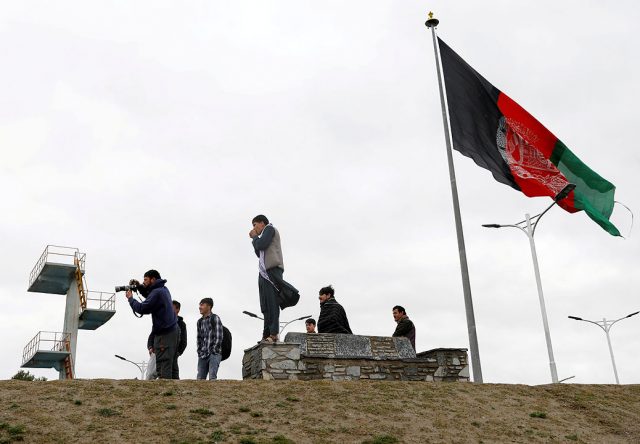
Youths take pictures next to an Afghan flag on a hilltop overlooking Kabul, Afghanistan, April 15, 2021. — REUTERS/MOHAMMAD ISMAIL/FILE PHOTO

UNITED NATIONS — Afghanistan is “hanging by a thread,” United Nations Secretary-General Antonio Guterres told the Security Council on Wednesday, calling for countries to authorize all transactions needed to carry out humanitarian activities in the Taliban-ruled state. 

He also pushed for a suspension of any rules or conditions constricting “lifesaving” aid operations as millions in the country suffer extreme hunger, education and social services are on the brink of collapse, and a lack of liquidity limits the capacity of the United Nations and aid groups to reach people in need. 

“We need to give financial institutions and commercial partners legal assurance that they can work with humanitarian operators without fear of breaching sanctions,” said Mr. Guterres, noting that the 15-member council last month adopted a humanitarian exemption to UN sanctions tied to Afghanistan. 

Some $9.5 billion in Afghan central bank reserves remain blocked abroad and international development support has dried up since the Taliban seized power in August. Donors seek to use the money as leverage over the Taliban on issues including human rights. 

“There is compelling evidence of an emerging environment of intimidation and a deterioration in respect for human rights. This suggests that the consolidation of government authority may be leading toward control of the population by fear,” the UN special envoy on Afghanistan, Deborah Lyons, told the council. 

In December, donors to a frozen World Bank-administered Afghan Reconstruction Trust Fund agreed to transfer $280 million to the World Food Program and UN children’s agency UNICEF to support nutrition and health in Afghanistan. Guterres said the remaining $1.2 billion in the fund needed “to be freed up urgently to help Afghanistan’s people survive the winter.” 

The US ambassador to the United Nations, Linda Thomas-Greenfield, told the council that Washington had moved to ensure that U.S. sanctions do not impede humanitarian activity and it is examining various options to ease the liquidity crunch.” 

NEED FOR CASH IN AFGHAN ECONOMY 

UN aid chief Martin Griffiths and International Committee of the Red Cross (ICRC) President Peter Maurer met virtually with US Secretary of State Antony Blinken earlier this month on Afghanistan. 

Dominik Stillhart, ICRC director of operations, said “intense” discussions between the United Nations, the ICRC, the World Bank and key donor countries were centered on a “humanitarian exchange facility” that would be supported or managed by the World Bank and allow for cash to be injected into the Afghan economy. 

He told reporters that money could be deposited in the facility and “under certain conditions that cash could be made available to traders in Afghanistan,” though he said it was a stopgap measure because “it needs to be the central bank that has to be capacitated to discharge these functions.” 

Ms. Thomas-Greenfield said that “ultimately, a functioning Afghan economy will require an independent and technically competent central bank that meets international banking standards.” 

Mr. Stillhart said agreement was needed between the UN, World Bank and key donors to “kick-start this facility,” noting that the discussion was not related to the unfreezing of Afghan assets or changes to sanctions on the Taliban. 

He said a separate idea was also being discussed that would involve using money from the World Bank-administered Afghan Reconstruction Trust Fund to pay non-security public sector employees. 

The United Nations earlier this month appealed for $4.4 billion in humanitarian aid for Afghanistan in 2022. On Wednesday, it said it needed a further $3.6 billion for health and education, basic infrastructure, promotion of livelihoods and social cohesion, specifically the needs of women and girls. — Michelle Nichols and Jonathan Landay/Reuters

Israel broadens eligibility for fourth shot of COVID vaccine

PHILIPPINE STAR/ MICHAEL VARCAS

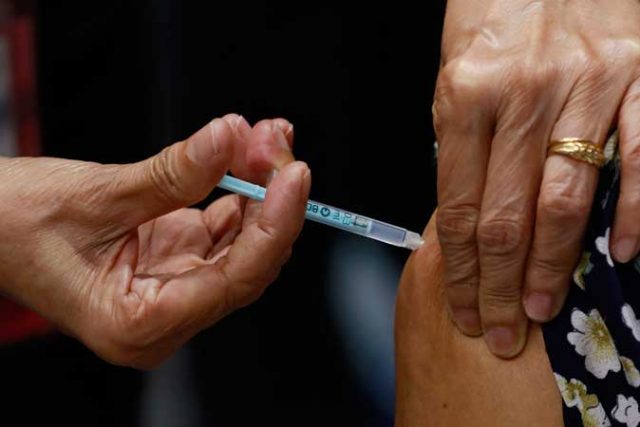
JERUSALEM — Israel on Wednesday broadened eligibility for a fourth dose of coronavirus disease 2019 (COVID-19) vaccine to include adults under 60 with underlying medical conditions, their caretakers, and others over 18 at significant risk of exposure to the coronavirus.

An official statement said the Health Ministry’s director-general had approved the measure, which fell short of a recommendation on Tuesday by a ministry panel of experts to offer the so-called second booster shot to all adults.

No reason was given in the statement as to why a more restricted rollout of a fourth dose of the Pfizer/BioNTech to people under 60 was approved.

Earlier this month, as the Omicron variant swept the country, Israel began offering the fourth jab to people over 60, on condition that at least five months have passed since they received the third or recovered from COVID-19 infection.

Those newly eligible for the fourth shot can receive it if at least four months have passed since their third dose.

The ministry noted that an Israeli research study had found that people over 60 who received a fourth shot this month were three-to-five times as protected against serious illness and twice as protected against infection, compared to the thrice-vaccinated. — Reuters

Hong Kong risks exodus over extended COVID isolation, Euro chamber says

HONG KONG — Hong Kong may not reopen until early 2024 because of its strict coronavirus disease 2019 (COVID-19) policies, which could trigger an exodus of foreign firms and staff and jeopardize the city’s role as a financial hub, its European Chamber of Commerce said in a draft report.

The limited effectiveness of locally developed vaccines has forced mainland China to maintain tight restrictions on travel, the chamber said in the draft, which was reviewed by Reuters but has not been made public.

The European Chamber of Commerce declined to comment on the report.

The most likely scenario for Hong Kong would be that it would not reopen until China rolls out its mRNA vaccine across its 1.4 billion population, which could take until late 2023 or early 2024, it said.

In that case, the chamber said there was a risk of a “cascade effect” of firms leaving the Asian financial hub.

“We anticipate an exodus of foreigners, probably the largest that Hong Kong has ever seen, and one of the largest in absolute terms from any city in the region in recent history,” it said.

While Hong Kong succeeded in keeping the virus under control for much of 2021, it has become one of the world’s most isolated places because of its travel restrictions and intermittent lockdowns that have accelerated a brain drain from the former British colony.

Hong Kong has seen a surge of infections this month, which authorities have struggled to control. Health authorities reported 107 new cases on Wednesday, the fourth consecutive day of triple digit infections.

Given the scenario, multinational firms would increasingly relocate China-focused teams to the mainland or shift their Asian regional teams to Singapore or Seoul, the chamber said.

Hong Kong could lose its appeal as an international business hub as well as its potential to contribute to China’s economy.

The departure of international talent could also undermine the city’s “potential to maintain world class universities,” it said.

FASTER VACCINES, SHORTER QUARANTINE 

Unlike the mainland, Hong Kong depends on business travelers and imported goods.

Its role as one of the world’s main transhipment and passenger hubs has been curtailed by tough flight restrictions, which mean very few people are allowed to land and hardly anyone is allowed to transit.

In contrast, the rival financial hub of Singapore has eased its coronavirus curbs including border controls.

Only about 70% of people in Hong Kong have been double-vaccinated compared with 91% of Singapore’s eligible population.

Most of Hong Kong’s elderly people have not been vaccinated.

The chamber outlined other scenarios of “average likelihood” including the possibility of an uncontrolled outbreak in the mainland leading to Hong Kong sealing its boundary with China and reopening with the rest of the world.

Another scenario was an uncontrolled outbreak in Hong Kong, which would make any additional restrictions meaningless. This could cause up to 20,000 deaths among the elderly.

The chamber made recommendations to the government including accelerating vaccinations and shortening quarantine from 21 days to 7 to 14 days, which would please the international business community.

Foreign businesses should assume that Hong Kong would very likely be “semi-closed for international travel in the coming 12–36 months.” Talent, and holding on to it, would be “a precious commodity,” it said. — Farah Master/Reuters  

Philippines’ GDP rises 7.7% in Q4, 5.6% full-year 2021

The country’s gross domestic product (GDP) grew in the fourth quarter last year, beating market estimates, Philippine Statistics Authority (PSA) reported this morning.

Preliminary data by the statistics agency showed the country’s GDP accelerated by 7.7% in the fourth quarter, a reversal of the 8.3% contraction in the fourth quarter of 2020. This was also higher than the revised 6.9% in the third quarter last year.

This brought the full-year growth to 5.6%, rebounding from record 9.6% contraction in 2020.

Last year’s fourth-quarter GDP was above the 6.5% median estimate of 18 economists yielded from a BusinessWorld poll conducted last week.

Likewise, full-year GDP print was higher than the 5.3% median estimate and the 5%-5.5% 2021 growth assumption of the Development Budget Coordination Committee (DBCC).

Quarter on quarter, the economy grew by a seasonally adjusted 3.1%.

All major sectors posted growths in the fourth quarter, led by industry (9.5% from -10.6% in fourth-quarter 2020), services (7.9% to -8%), and agriculture (1.4% from -2.5%).

On the expenditure side, private consumption posted a 7.5% growth in the fourth quarter, a reversal from the 7.3% decline in the final three months of 2020.

Government spending grew by 7.4%, higher than 5.1% in the same period in 2020.

Likewise, gross capital formation expanded by 12.6% versus the 32.2% contraction recorded in 2020

Exports of goods and services also went up by 8.3% (from -10.2% in fourth-quarter 2020, while imports grew by 13.7% (from -20.2%). — A. O. A. Tirona

Fed likely to hike rates in March as Powell vows sustained inflation fight

REUTERS/KEVIN LAMARQUE/FILE PHOTO

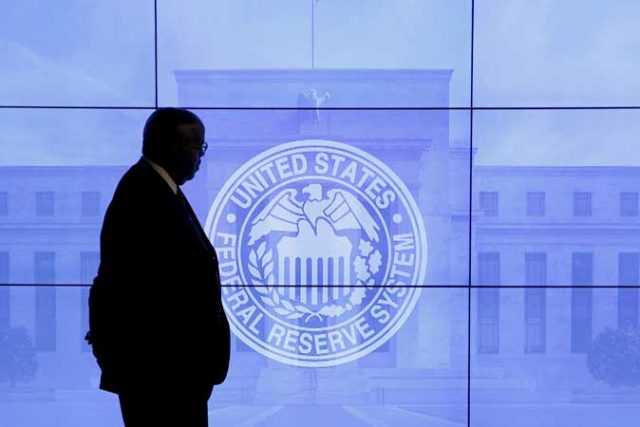
WASHINGTON — The Federal Reserve on Wednesday said it is likely to hike interest rates in March and reaffirmed plans to end its bond purchases that month in what US central bank chief Jerome Powell pledged will be a sustained battle to tame inflation.

“The committee is of a mind to raise the federal funds rate at the March meeting assuming that the conditions are appropriate for doing so,” Mr. Powell said in a news conference, pinning down a policy statement from the central bank’s Federal Open Market Committee (FOMC) that only said rates would rise “soon.”

Subsequent interest rate increases and an eventual reduction in the Fed’s asset holdings would follow as needed, Mr. Powell said, while officials monitor how quickly inflation falls from current multi-decade highs back to the central bank’s 2% target.

Much was left undecided, he told reporters after the end of the Fed’s latest two-day policy meeting, including the pace of subsequent rate hikes or how quickly officials will let its massive balance sheet decline.

But Mr. Powell was explicit on one key point: that with inflation high and for now apparently getting worse, the Fed this year plans to steadily clamp down on credit and end the extraordinary support it has provided to the US economy during the coronavirus pandemic.

Since the Fed’s last policy meeting in December, Mr. Powell said, inflation “has not gotten better. It has probably gotten a bit worse … To the extent that situation deteriorates further, our policy will have to reflect that.”

“This is going to be a year in which we move steadily away from the very highly accommodative monetary policy we put in place to deal with the economic effects of the pandemic,” he added.

STOCKS FALL AGAIN 

US stocks, pummeled to start the year on worries about how fast the Fed may move to contain inflation, slid as Mr. Powell repeatedly emphasized the economy’s underlying strength and inflation’s persistence, and refused to rule out more aggressive tightening as needed.

The S&P 500 index, at one point in the day up by more than 2%, sold off sharply through the course of Mr. Powell’s news conference to close 0.15% lower. The Nasdaq Composite, which had taken a hard blow in this month’s sell-off, ended the day little changed.

Yields on longer-dated Treasury securities, sensitive to the Fed’s balance sheet policy, rose as Powell signaled that a decision would be made soon on when to start shrinking the central bank’s more than $8 trillion portfolio of US government bonds and mortgage-backed securities (MBS). The dollar surged 0.5% to its highest level in a month against a basket of key trading partners’ currencies.

Mr. Powell was “trying to balance the fear factor but at the same time he’s talking about inflation might get worse, he’s talking about the Fed might have to use more tools, he’s talking about the balance sheet reduction,” said Peter Cardillo, chief market economist with Spartan Capital Securities in New York. “The bottom line is his response is causing the market to fear the uncertainty.”

The extent of the Fed’s policy pivot away from battling the economic fallout from the pandemic and towards an inflation fight will take more shape in coming weeks.

It will be contingent on how inflation itself behaves, and Mr. Powell said officials still hope much of the improvement will come as the aftershocks of the pandemic ease, perhaps allowing them to do less of the work through tighter monetary policy.

A myriad of risks remain, from a pandemic that is still underway to a potential Russia-Ukraine military conflict.

But Mr. Powell said policymakers at this point feel they have “quite a bit of room to raise interest rates” without threatening progress on jobs or slowing an economic recovery they want to keep underway.

In a refrain that has become common, he noted “the economy is quite different” than when the Fed last began raising interest rates in 2015, with higher inflation, lower unemployment, and what Powell regards as enough momentum to make its way without the Fed’s help.

In that shift to tighter policy the Fed moved at an initially glacial pace, with one quarter-percentage-point rate increase in 2015 and only an additional one in 2016.

Investors are expecting much more this time, with pricing in federal funds future contracts anticipating four rate increases this year. The Fed’s benchmark overnight interest rate is currently set at the near-zero level.

FOMC members also agreed at this week’s meeting on a set of principles for “significantly reducing” the size of the Fed’s asset holdings. Officials said they will shrink holdings “primarily” by limiting how much of the principal from maturing bonds the Fed would reinvest each month. That plan would start after the liftoff in interest rates, the central bank said, without yet setting a specific date, pace or final size.

Over time the Fed’s balance sheet would not only be pared down, but shifted away from MBS and weighted towards US Treasuries, “thereby minimizing the effect of Federal Reserve holdings on the allocation of credit across sectors of the economy,” the central bank said.

The Fed’s statement, in moving ahead with a plan to tighten monetary policy, cited “solid” recent job gains that continued even as the outbreak of the Omicron variant of the coronavirus pushed daily case numbers to record levels. While the Fed has stopped trying to assess when inflation might ease, the statement said officials continue to expect improvements in global supply chains will ease the pace of price increases.

“Supply and demand imbalances related to the pandemic and the reopening of the economy have continued to contribute to elevated levels of inflation,” the Fed said, with consumer prices increasing at a 7% annual rate, the highest level since the 1980s.

Policy makers did not release new economic and interest rate projections on Wednesday. — Howard Schneider and Ann Saphir/Reuters 

2021 agri output contracts by 1.7%

PHILIPPINE STAR/ MICHAEL VARCAS
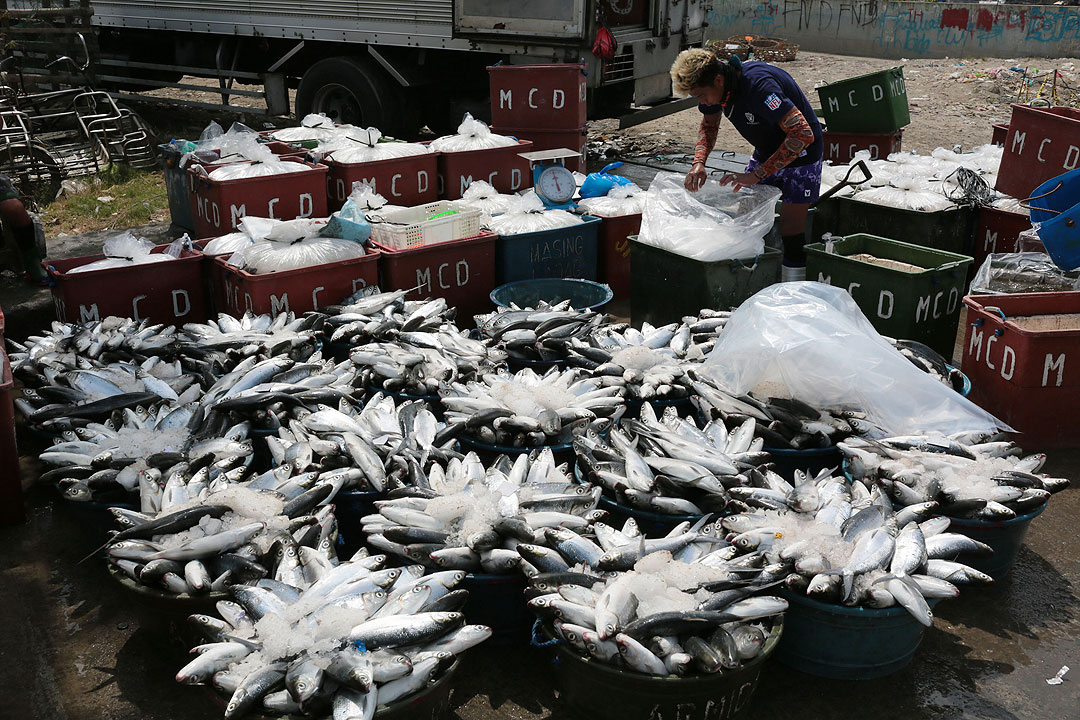
BUCKETS of fish are seen at the Navotas fishport, May 21, 2021. — PHILIPPINE STAR/ MICHAEL VARCAS

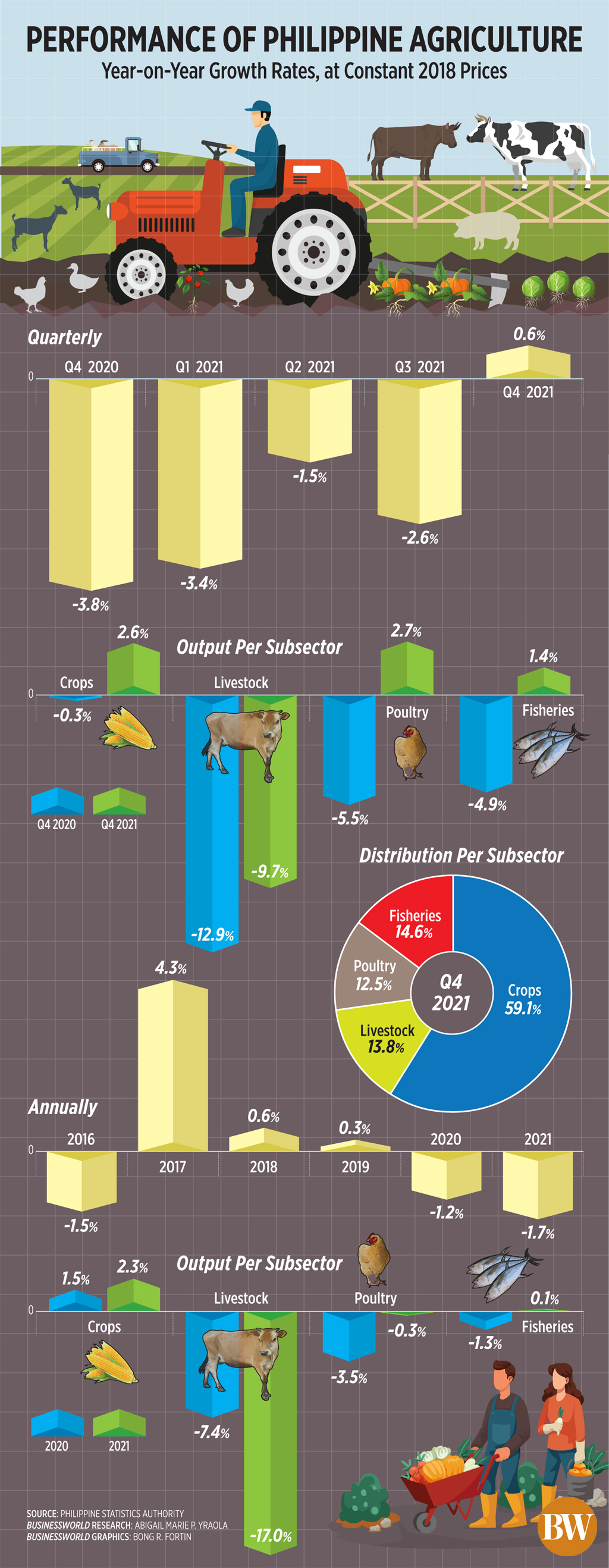
PHILIPPINE AGRICULTURAL output contracted by 1.7% in 2021, despite growing by 0.6% in the last three months, the statistics agency said on Wednesday.

Data from the Philippine Statistics Authority (PSA) showed the full-year value of production in agriculture and fisheries worsened from the 1.2% decline recorded in 2020 and missed the Department of Agriculture’s (DA) 2% growth target.

This was also the steepest annual contraction of agricultural production on record since 2001. The PSA said it has no data using constant 2018 prices before 2001.

In the fourth quarter, agricultural output inched up by 0.6% after four straight months of contraction. This was a turnaround from the 3.8% drop recorded in the fourth quarter of 2020.

The PSA attributed this growth to higher production in crops, poultry and fisheries, which offset the continued decline in livestock.

“At current prices, the value of production in agriculture and fisheries is at P560.39 billion,” the PSA said.

Agriculture typically makes up about 10% of economic output, and a fourth of the country’s jobs. Fourth-quarter and full-year gross domestic product (GDP) data will be released today (Jan. 27).

Despite the annual decline, Agriculture Secretary William D. Dar said the latest data “show we are on the right track in our continuing efforts to increase the production of our major staples.”

He said the coronavirus pandemic, mobility restrictions and typhoons were the biggest challenges the agriculture sector faced in 2021.

Damage to agriculture caused by Typhoon Odette reached P13.3 billion, according to the DA’s final tally.

“Even without Typhoon Odette, agriculture would still have ended up with a negative growth rate in constant 2018 prices,” Federation of Free Farmers Cooperatives, Inc. (FFFCI) national manager Raul Q. Montemayor said in a Viber message.

Crop production expanded by 2.6% in the fourth quarter, a reversal from the 0.3% drop in the same quarter in 2020. It accounted for about 60% of the agricultural production during the three-month period.

For the full year, crop output grew by 2.3%, higher than 1.5% in 2020.

“The crop sector improved a little bit, but the gain was more than offset by the decline in gross value added (GVA) of the livestock, principally the hog sector, despite an improvement in market prices,” Mr. Montemayor said.

Fourth-quarter palay production value inched up by 0.2%, while corn output surged by 28.6%. Cacao, coconut and tobacco production also rose by 11.4%, 3.6% and 3.4%, respectively.

However, production declines were seen for onion (13.1%), abaca (11.6%), potato (8.7%) and coffee (6%).

“Production was still a challenge because of the weather disturbances. Vegetable areas are more difficult to access, or farmers encounter problems of bringing their produce to the market because of bad road conditions during heavy rains,” Pampanga State Agricultural University Professor Roy S. Kempis said in a Viber interview.

Total annual palay production volume reached an all-time high of 19.96 million metric tons in 2021, 3.4% higher than a year earlier.

“We would have easily breached the 20-million-ton level as Typhoon Odette damaged more than 130,000 metric tons of palay,” Mr. Dar said.

ASF OUTBREAK CONTINUES
Livestock production slumped by 9.7% in the fourth quarter, amid an African Swine Fever (ASF) outbreak. For the full year, livestock output plummeted by 17%, worse than the 7.4% decline in 2020.

“We are surprised to hear about a 17% decline. There have been fewer cases of African Swine Fever, as pronounced by DA that they have controlled it and most recent sporadic cases are in backyard farms,” National Federation of Hog Farmers, Inc. (NFHFI) President Chester Warren Y. Tan said in a Viber interview.

Hogs, a major contributor to livestock output, fell by 12.6% in October to December, and by 20.8% for the entire year.

“Farmgate prices have been steady about P190 to P210 per kilogram in Luzon. There seems no reason why swine farmers would decrease their production especially if this is a source of livelihood for many backyard farmers,” Mr. Tan said.

Meanwhile, poultry output contracted by 0.3% in 2021 despite a 2.7% growth in the fourth quarter. Chicken egg production grew by 12.7% in the three months to December, while lower production was seen for duck (-13.3%), duck eggs (-8.6%) and chicken (-0.3%).

“Full-year growth in poultry was basically flat. Output during the first three quarters of 2021 was already 2.5% lower than in 2020 and it was impossible for the fourth quarter to offset this,” Mr. Montemayor said.

Fishery production rose by 1.4% in the fourth quarter and by 0.1% for the entire year. This was attributed to double-digit growth in blue crab (33.1%), tilapia (17.8%) cavalla or talakitok (15.9%), mudcrab or alimango (15.1%), grouper or lapu-lapu (13.8%), and roundscad or galunggong (11.2%).

However, lower production was recorded for skipjack (20.5%), seaweed (0.3%) and yellowfin tuna (10.7%). — Luisa Maria Jacinta C. Jocson

Performance of Philippine Agriculture (Q4 2021)

BoP surplus hits $1.35B, smallest since 2008

FREEPIK

THE PHILIPPINES’ balance of payments (BoP) position stood at a $1.345-billion surplus in 2021, its smallest since 2008, due to a wider trade deficit, according to the central bank.

Data released by the Bangko Sentral ng Pilipinas (BSP) on Tuesday evening showed last year’s BoP surplus was significantly smaller than the $16.022-billion surfeit seen in 2020, and below the projected $1.6-billion surplus for 2021.

Last year’s BoP surplus was also the lowest since the $89-million surplus in 2008.

For December alone, the payment position stood at a $991-million surplus, much lower than $4.236 billion a year earlier and a turnaround from a deifict worth $123 million in November.

“In December 2021,… [the] BoP surplus…reflected the structural inflows for the year, such as the BSP’s income from its investments abroad, personal remittances, trade in services, foreign direct investments, and net foreign borrowings by the National Government (NG),” the BSP said in a statement.

“However, these inflows were moderated by a wider trade in goods deficit,” it added.

The BoP reflects the end-December gross international reserves worth $108.79 billion, 0.89% lower than $107.82 billion as of end-November.

At this level, the country’s dollar reserves were enough to cover 10.3 months’ worth of imports of goods and payments of services and primary income. It was also equivalent to 8.7 times the country’s short-term external debt based on original maturity and 5.8 times based on residual maturity.

The BoP gives a glimpse into the country’s transactions with the rest of the world. A deficit means more funds left the country, while a surplus shows that more money came in.

“The smaller 2021 BoP surplus was caused by the wider trade deficit. The pre-pandemic level of import growth supported the bigger trade balance for 2021,” UnionBank of the Philippines, Inc. Chief Economist Ruben Carlo O. Asuncion said in an e-mail.

Latest data from the Philippine Statistics Authority showed the trade balance had ballooned to a $37.92-billion deficit as of end-November, bigger than the $22.15-billion trade gap in 2020’s comparable 11 months.

“The reopening of the local economy and improving levels of infections encouraged domestic demand toward the last quarter of 2021, while exports slowed further due to the softening recovery growth of our trading partners, particularly that of the biggest one, China,” Mr. Asuncion said.

He said the BoP is likely to post a slimmer surplus or even a deficit on prospects of economic recovery that will be supported by domestic demand. Mr. Asuncion said the peso could weaken versus the greenback as a result.

The peso closed at P50.999 a dollar on Dec. 31, 6.2% weaker than its P48.023 finish a year earlier.

Rizal Commercial Banking Corp. Chief Economist Michael L. Ricafort said an improvement in global vaccination rates would likely lift the economic outlook.

“This could in turn support increased recurring dollar flows into the country such as remittances, business process outsourcing revenues, and foreign investments. There could also be some pickup in foreign tourism receipts if fully vaccinated people would be allowed greater mobility,” he said in a Viber message.

The BSP expects the BoP to post a surplus worth $700 million this year, equivalent to 0.2% of the gross domestic product. — Luz Wendy T. Noble

Presidential candidates harness TikTok during Philippine ‘silly season’

REUTERS

By John Victor D. Ordoñez
and Jaspearl Emerald G. Tan

MANILA MAYOR Francisco “Isko” M. Domagoso knows how to tickle your fancy.

Now eyeing the presidential palace, he can be seen showing off his dance moves on TikTok, not unlike the ones he did as a matinee idol in the 1990s.

In one viral video with 2.2 million views and almost 200,000 likes, the former actor is shown squaring off with the mayor of Lapu-Lapu City during a political sortie in central Philippines. Fans wildly cheered as his hips undulated to the tune of Meghan Trainor’s “Me Too.”

Politicians are expected to use TikTok, which has more than a billion active users, and other social media more during the campaign period, but these won’t necessarily ensure victory in the May elections, according to political analysts.

“The number of likes and engagements are not reliable indicators of winnability,” said Michael Henry Ll. Yusingco, a senior research fellow at the Ateneo de Manila University Policy Center.

More than 90% of Filipinos are on social media, which can help candidates gain or sustain popularity, he said in a Facebook Messenger chat. “But winning an election will require more substantive engagements in social media as well as a robust ground game in the offline world.”

Candidates can harness the power of TikTok, Facebook, YouTube and Twitter during the silly season of Philippine elections, when some candidates choose to sing and dance to get votes. But social media can also be used to spread fake news and information.

TikTok removed more than 340,000 videos in the US in the second half of 2020 for breaking rules on election misinformation, manipulation or disinformation, it said in a report last year.

“We further removed 1.75 million accounts that were used for automation during the timeframe of the US elections,” it said on its website. “While it’s not known if any of the accounts were used specifically to amplify election-related content, it was important to remove this set of accounts to protect the platform at this critical time.”

Like traditional media, social media can be a “double-edged sword,” Maria Ela Atienza, a political science professor from the University of the Philippines, said in an e-mailed reply to questions.

Progressive groups can utilize them to educate the public, who use Facebook not just to connect to family and friends but also as a source of news. But others can exploit these to spread fake news and hatred, she said.

Most active social media users are young Filipinos. Data from the Department of Health showed that 59% of Filipinos aged 15-24 use the internet, while 53% of young people have a social networking account.

The Commission on Elections (Comelec) has said 31.4 million of the country’s 60.5 million voters this year are aged 18 to 40.

Social media platforms have brought political campaigns closer to the youth, Comelec spokesman James B. Jimenez told CNN Philippines last year. Before, political conversations were only read and heard at meetings and conventions.

NEWS MEDIA
Mr. Domagoso has 3.2 million TikTok and 5.4 million Facebook followers. Senator Ferdinand “Bongbong” R. Marcos, Jr., who leads presidential opinion polls, has more than 700,000 followers on TikTok and 4.4 million on Facebook.

Vice-President Maria Leonor “Leni” G. Robredo has 1.8 million followers on Facebook and more than 700,000 on Twitter, while Senator Panfilo “Ping” M. Lacson has fewer than half-a-million followers on Facebook.

Senator Emmanuel “Manny” D. Pacquiao leads the chart with 18 million Facebook followers, probably obtained through the years as an international boxing champion. He also has 2.6 million followers on Twitter.

Ms. Robredo has topped Facebook political ad spending at P14.1 million, according to Facebook Ad Library data. Much of it came from volunteers, the presidential aspirant told the ABS-CBN News Channel.

Most Filipino voters are still heavy TV viewers and would likely be influenced by paid political ads, said Gerardo A. Eusebio, a political science professor at De La Salle University.

“While social media can be effective venues for democratization, majority of voters would or could not care less because they are more interested in food on their tables than in freedom and rights,” he said in a Messenger chat.

“The target market especially from the lower classes consists of heavy TV viewers and will be influenced a lot by paid political ads than fewer educated, elite participants of e-rallies and issue-oriented platforms,” Mr. Eusebio said

Mr. Yusingco said e-rallies could help candidates interact more meaningfully with voters because they can answer questions directly.

Social media virality should be complemented by substantial news media coverage, Danilo A. Arao, a convenor of watchdog Kontra Daya, said in an e-mail.

“This explains why candidates and political parties try their best to control the narrative through ad placements and engage in various gimmicks to be part of the news cycle,” he added.

The Comelec would stream the e-rallies of national candidates for the May 9 elections live starting Feb. 8 to help those with fewer followers gain more exposure, Mr. Jimenez said this month.

Ms. Atienza said political campaigns should allow candidates to connect with voters, and should be less about personal attacks. These should also let presidential aspirants bare their political and economic platforms.

Google’s ban of election ads in the Philippines could limit excessive campaigning by rich candidates, she said.

“It will insulate, for some part, our netizens from fake news and politically misleading ads,” Marlon M. Villarin, a political science professor from the University of Santo Tomas, said by e-mail. “It’s also a corporate image cushion on the part of Google in securing their corporate value.”