Home Blog Page 6406

SSI Group forms joint venture with Gucci

SPECIALTY retailer SSI Group, Inc. said its subsidiary entered into a joint venture agreement with the entity behind Gucci to form a company named Luxury Goods Philippines, Inc. (LGPI).

It said the agreement was forged on May 17 between its unit Stores Specialists, Inc. and G Distribution B.V. (Gucci).

“The joint venture between SSI and Gucci further strengthens the cooperation between Gucci and SSI, and is expected to further accelerate the growth of the Gucci brand in the Philippines and enable operating efficiencies, as Gucci and SSI transition from a franchisor-franchisee relationship, to joint venture partners,” SSI told the stock exchange on Wednesday.

SSI said LGPI will have an initial capital of P350 million. The listed company will own 25% of the joint venture while Gucci will own the remaining 75%. The numbers translate to an initial investment amount of P87.5 million for SSI and P262.5 million for Gucci.

“LGPI is expected to commence operations on June 1, 2022, and shall own and operate Gucci stores in the Philippines,” it added.

SSI said the joint venture’s profits will be distributed pro-rata between SSI and Gucci.

On Tuesday, reported a net income of P67.7 million in the first quarter, turning around from a loss of P99.5 million in the similar period the year before. Sales during the quarter were up 28% to P4.5 billion, with e-commerce sales also increasing by 21% year on year.

In 2021, the company’s net income was up 117% to P151 million. Revenues likewise rose by 26% to P15.5 billion.

The company’s brand portfolio ranges from luxury, casual, fast fashion, footwear, accessories and luggage, among others.

SSI’s specialty retail footprint consists of 570 stores located within approximately 83 malls across the Philippines.

At the stock exchange, shares in the company were unchanged at P1.27 each on Wednesday. — VVS

Musk signs Twitter deal without asking for more info

TRUSTPAIR.COM

TWITTER, Inc. published its account on Tuesday of its deal negotiations with Elon Musk, showing he opted out of asking the questions about the social media company’s business he has now cited in declaring the $4-billion acquisition is “on hold.”

The account, published in Twitter’s proxy statement that outlines what shareholders need to know to vote on the deal, paints a picture of Musk in a rush to clinch a deal with his “best and final” offer.

Mr. Musk negotiated the Twitter deal over the weekend of April 23 and April 24 without carrying out any due diligence, the proxy statement shows.

Since signing the deal on April 25, Mr. Musk has questioned the accuracy of Twitter’s public filings about spam accounts representing less than 5% of its user base, claiming they must be at least 20%. This is despite Twitter stating in its filings that the numbers could be higher than it estimates.

Independent researchers have projected that 9% to 15% of the millions of Twitter profiles are bots.

Mr. Musk tweeted on Tuesday that Twitter Chief Executive Parag Agrawal has refused to show proof for his company’s estimate and that the deal cannot move forward until he does. Twitter’s proxy statement shows that in the run-up to the deal Mr. Musk made no effort to get information about the issue.

“Mr. Musk did not ask to enter into a confidentiality agreement or seek from Twitter any non-public info regarding Twitter,” Twitter said in its proxy statement.

The proxy statement makes no mention of threats Mr. Musk has tweeted about not going ahead with the deal if he does not get to the bottom of how many spam accounts are on the platform.

Twitter investors appeared convinced that a deal at the agreed price was now out of the question. Twitter shares were trading around $37.55 on Tuesday afternoon, a discount of more than 30% to the $54.20 per share deal price.

Mr. Musk suggested for the first time on Monday at a conference in Miami that the deal could be done at a lower price, without specifying what that could be. He has yet to inform Twitter that he wants to renegotiate the deal.

Legal experts have said Mr. Musk would likely lose in court if he tried to walk away from a deal. But they say that any litigation would likely be protracted and cast uncertainty over Twitter’s business. Even companies that have prevailed in court over their acquirers have ended up negotiating financial settlements.

Mr. Musk is contractually obligated to pay a $1-billion breakup fee if he does not complete the deal, but Twitter can sue for “specific performance” to force Mr. Musk to complete a deal and obtain a settlement from him as a result.

Ann Lipton, a professor at Tulane University Law School, said the fact that Mr. Musk had not asked Twitter for information before signing the deal meant he would now have to show that the company’s public filings were wrong and posed significant long-term financial issues — a high legal bar.

“Twitter has long said ‘this is our estimate of spam but we might be wrong.’ So it’s not clear that they said anything false,” Ms. Lipton said.

COMMITTED TO THE DEAL
Twitter said on Tuesday it remained committed to the deal at the agreed price and expected it to be completed in 2022.

The San Francisco-based company said in its proxy statement that Mr. Musk expressed his interest in joining its board or taking it private on March 26. This would indicate that Mr. Musk mischaracterized his stake of more than 9% in Twitter as passive when he revealed it in a regulatory filing on April 4. He subsequently clarified it was an active stake.

Representatives of Mr. Musk did not respond to requests for comment.

Mr. Musk also told Twitter that he contemplated starting a competitor, according to the proxy statement.

Twitter’s CEO, Mr. Agrawal, is entitled to a $60.2-million golden parachute if the deal closes, while the company’s chief financial officer, Ned Segal, would get $46.4 million, the proxy shows. Twitter’s top lawyer, Vijaya Gadde, would be paid $30 million.

Goldman Sachs Group, Inc. stands to be paid $65 million for advising Twitter once the deal is completed, having already been paid $15 million, the proxy statement shows.

Another Twitter adviser, JPMorgan Chase & Co., stands to be paid $48 million once the deal closes, having already made $5 million for its fairness opinion to the company. — Reuters

Hokkaido inks Dwight Ramos for 2022-23 season in Japan B.League

BLEAGUE

GILAS Pilipinas ace Dwight Ramos is staying put in the Japan B.League albeit with a different squad after striking a deal with Levanga Hokkaido.

Hokkaido announced Mr. Ramos’ signing on Wednesday, securing his services for the 2022-2023 season in a bid to boost its playoff bid after struggling this season.

“I’m looking forward to playing with very talented players in Hokkaido and hopefully making a run in the playoffs next season,” said Mr. Ramos, who suited up for the Toyama Grouses in his debut B.League season.

The 23-year-old Filipino import played 46 games for Toyama, registering solid averages of 10.0 points, 3.9 rebounds, 2.3 assists and 1.1 steals in 24 minutes of action.

The Grouses, however, missed the playoffs with a 24-35 slate at 14th place of the 22-team B.League standings.

Levanga Hokkaido also struggled at 16th place with a 21-35 record but is counting on Dwight Ramos’ contribution this time to make a deep run.

Other Filipino players playing in Japan are Thirdy Ravena (San-en), Kiefer Ravena (Shiga), Kobe Paras (Niigata), and Ray Parks, Jr., (Nagoya), who was the only one to make the playoffs this season.

Top prospect Justine Baltazar is reportedly on his way to join other Filipinos in the Land of the Rising Sun for the Hiroshima Dragonflies while Javi Gomez de Liaño made the jump to the PBA after one season with the Ibaraki Robots.

Gibson guitar smashed on night rock band Oasis split sold at auction

1960 – Oasis- Noel Gallagher | Gibson — PHOTO FROM MILLESIMEGUITARS.COM

PARIS — A 1960 Gibson electric guitar used by Oasis star Noel Gallagher before it was smashed up by his brother and former band mate Liam Gallagher during a row on the night the band split sold at auction in Paris for €300,000 ($315,900) on Tuesday.

Liam Gallagher wrecked the red Gibson at a festival in the French capital in 2009, shortly before the band had been due on stage, in a fit of fury that was to become a cult moment in music history.

It was later painstakingly repaired by a French luthier.

“This 1960 Gibson 355 serial #A34884 was the guitar that Liam Gallagher smashed up in Paris 2009 the night Oasis split up,” Noel Gallagher wrote in a note presented with the guitar.

“It was also my #1 favorite guitar that I used to both writing and recording using it on many Oasis recordings as well as using it live! Peace, love + bananas!!”

Formed in Manchester in 1991, Oasis had its heyday at the height of Britpop fame in the 1990s, with hits such as “Don’t Look Back In Anger” and “Wonderwall.”

But the brothers’ famous feuds led to a break-up in 2009, after tempers flared at the Rock en Seine festival in Paris, prompting Noel to quit the group. — Reuters

Mastercard begins facial-recognition rollout with retailers

MASTERCARD, INC. has begun to trial a biometric payment system for brick-and-mortar stores, using facial recognition rather than contactless cards, smartphones or memorable PINs.

The company said its Biometric Checkout Program would let a shopper scan their face using a retailer’s smartphone app and assign their likeness to a bank card stored on file. The technology is comparable to how Apple, Inc.’s iPhone uses Face ID to approve payments or unlock a device.

“When the pandemic happened, we saw that everybody went digital and consumers embraced new technologies,” Mastercard Cyber & Intelligence President Ajay Bhalla said in an interview.

“Consumers actually all over the world asked us for that for shopping, for their retail experiences.”

A pilot program began this week inside five St Marche supermarkets in Sao Paulo, Brazil, Mastercard said in a statement. The stores will use an app developed by Brazilian startup Payface, one of the small businesses Mastercard promotes as part of its Start Path engagement program. 

On the hardware side, Mastercard is working with companies including NEC Corp. and Fujitsu General Ltd., with plans to roll out internationally soon.

“We’ve got the Middle East and Africa lined up, Asia and Latin America,” Nili Klenoff, a senior vice president of product innovation at Mastercard, said in an interview. “We’re really looking forward to bringing this solution everywhere.”

She said more features that can use this technology are in the works. Age verification for purchasing restricted store items “is one actually that we’re beginning to explore and one that we’re really excited about,” she said.

Facial recognition is just one of many technologies being trialed by retailers, banks and payments firms to eliminate cash and reduce fraud.

Amazon.com, Inc. has a system that uses in-store cameras to track what shoppers put in a basket and charges them on exiting its physical stores in the US and UK. It won interest from Britain’s J Sainsbury Plc, which installed it at a trial store, and Starbucks Corp. has a cafe in New York using it, too. — Bloomberg

Telstra forms partnership with Converge 

TELECOMMUNICATIONS firm Telstra International has forged a new partnership with Converge ICT Solutions, Inc. for a joint venture that seeks to improve connectivity in the Philippines.

In a statement on Wednesday, Telstra said its partnership with Converge has created Telstra Converge Inc. (TCI), which was previously known as Digitel Crossing, Inc., in a bid to offer end-to-end solutions for customers.

“The joint venture has allowed Telstra to build new terrestrial fiber routes between its East Asia Crossing (EAC) and City-to-City (C2C) submarine cable landing stations in the Philippines, as well as into Makati City in the Metro Manila region, the country’s financial, commercial, and economic hub. This expansion enables Telstra to provide quality end-to-end solutions for its customers,” Telstra said.

“As the largest foreign submarine cable owner in the Philippines, Telstra also has access to two submarine cable landing stations in the country. They form part of the EAC-C2C network, which is the largest privately-owned submarine cable network, with a design capacity of 17.92 terabytes per second Tbps (terabits per second) to 30.72 Tbps and a total cable length of 36,800 kilometres,” it added.

Further, Telstra also launched a new point of presence (PoP) in Pasig City, which allows ethernet private line (EPL) services of 10G and 100G, to ensure a stable and more accessible internet service. The new PoP is linked to the two existing PoPs in Makati City.

Alfred Au Yeung, Telstra global wholesale head of strategic transactions, said that the company is looking to explore more opportunities and collaborations in the Philippines.

“Telstra has been operating in the Philippines for more than 25 years with in-country telecommunication expertise and a dedicated local support team. Our enhanced infrastructure further enables us to offer faster and quality connectivity in and out of the Philippines. Not only does it equip our customers with cable diversity and options for network resiliency, it also offers a truly end-to-end solution that fits their increasing bandwidth demand,” he said.

“Looking ahead, Telstra will continue to explore opportunities and collaborate with industry partners, to fully maximize the potential of the Philippines as a new connectivity hub in Asia,” he added. — Revin Mikhael D. Ochave 

Lady Bulldogs aim for a first round wipeout against Fighting Maroons

NATIONAL University Lady Bulldogs — UAAP

By John Bryan Ulanday

IMMACULATE National University (NU) aims to complete a first-round wipeout against University of the Philippines (UP) to shore up its Final Four drive while multiple squads jockey for position in the middle pack of the University Athletic Association of the Philippines (UAAP) Season 84 women’s volleyball tournament on Thursday at the Mall of Asia Arena.

Undefeated in six starts, the Lady Bulldogs tie knots with the slumping Fighting Maroons at 12 p.m. to take a pristine record on to the second round, where they are expecting to carry a bigger target on their backs.

Not far behind are Santo Tomas (4-2) and La Salle (4-2), which will clash against different counterparts to stay a stone’s throw away from pace-setting NU entering the second round.

The Golden Tigresses collide with streaking champion Ateneo (3-3) in a rematch of the last UAAP volleyball finals before the pandemic at 4 p.m. while the Lady Spikers seek to add to the piling woes of FEU at 6 p.m.

In the opener at 10 a.m., University of the East (UE) (0-6) is bent on dodging a first-round shutout against Adamson (3-3).

The young Lady Bulldogs behind the brilliance of debuting mentor Karl Dimaculangan has been a revelation this season after surrendering only two sets so far in their sizzling 6-0 start.

But while that should be enough to install them as the tall favorites against the Fighting Maroons, Mr. Dimaculangan wants more from his wards.

“I’m always reminding the team to stay hungry. Wala pa kaming napapatunayan. Hopefully, matapos namin itong round nang maayos at maging mas ready pa sa second round,” said coach Karl Dimaculangan after NU mauled Far Eastern University (FEU), 25-10, 25-11, 25-12, in only 79 minutes for the season’s fastest game the other day.

The Fighting Maroons, for their part, are out to catch a big fish in the Lady Bulldogs while bidding to end their three-game losing skid after a 3-0 start to fall deep in the standings.

Five ways an efficient supply chain and logistics management system can boost business

TRUSTPAIR.COM

By Soham Chokshi, CEO and Co-Founder – Shipsy

THE efficiency of supply chain and logistics systems can make or break a business. A small challenge can trigger a wildfire of inefficiencies. For instance, a store has run out of a specific product and has placed a replenishment order. However, the store was notified that the supplier could not deliver the order due to production delays. Without a backup plan and foresight, the product’s availability will be highly dependent on this sole supplier, leading to delays and impacting the consumer experience. With no guarantees on when the product will be made available, customers will look for alternatives or purchase the item elsewhere. Brands are also likely to lose these customers permanently.

Most recently, the global supply chain has gone through massive delays in the movement of goods due to the pandemic. According to the United Nations Economic and Social Commission for Asia and the Pacific (UNESCAP) 2021 trade report, 73% of the respondents have encountered significant delays from the supply side due to widespread factory closures, illness, loss of talent and skills, as well as disruption on the transportation network. In Southeast Asia, for instance, container vessels may have to wait five to seven days from a maximum of two days to unload shipments in Singapore due to port, depot, and warehouse congestion.

The gaps in supply chain and logistics highlighted due to the pandemic point toward the need for building resilient, agile, and customer-centric supply chains. Here are some critical ways supply chain and logistics management technologies can boost business outcomes:

IMPROVING LOGISTICS TRANSPARENCY
The supply chain industry runs on thin margins. Any logistical delays can cascade the supply chain process. Thereby having complete visibility over goods movement is crucial. To strengthen their supply chains, businesses need to know where their goods are at any given time. They should also be able to track the product down from point A to B.

Innovative logistics management tools empower businesses with granular-level visibility to boost delivery productivity by eliminating idle times, unnecessary route diversions, unprecedented stoppages, etc. Predictive analytics and advanced reporting help companies gain advanced visibility into seasonal peaks, changing shipping demands, transportation issues, etc., dealing with delays, exceptions, and exigencies.

ENHANCING COLLABORATION ACROSS SUPPLY CHAIN STAKEHOLDERS
For decades, manual processes and siloed systems have challenged the supply chain and logistics processes by hindering timely and efficient data sharing. This lack of visibility results in data inconsistencies and leads to inaccurate decision making. Moreover, it also impacts the timely resolution of exceptions and emergencies.

Advanced logistics management platform update delivery stakeholders with real-time shipment information. It expedites resolution by alerting senior management on delivery exigencies. Such a platform enhances decision making, reduces delivery latency, and significantly improves accountability, thereby, saving 34% in incidental costs.

BOOSTING CUSTOMER EXPERIENCE
One negative experience is enough for customers to leave a brand they love. Rising cross-border e-commerce and intensifying competition are rapidly shifting customers’ delivery expectations. For instance, 69% of Singapore Millennials made cross-border purchases in 2020, and the country had the highest percentage of online cross-border purchases in the Asia-Pacific. Free (65%) and fast (49%) shipping were the top drivers of these online purchases. While speed is critical to boosting customer satisfaction, promising faster delivery SLAs without ensuring product availability affects business reputation and customer loyalty.

Ensuring inventory fidelity is critical to boosting customer experience. Smart logistics management tools allow businesses to quickly partner with the most reliable logistics partner to meet stock replenishment needs to increase on-time deliveries by 24%. Such tools also keep the customers notified about where their order is, who will be delivering it, what’s the exact ETA, should they expect delays, and more at any given time. These tools also ensure that customers can change delivery location and time on the fly and drive flexible payment options.

OPTIMIZING COSTS
As much as 53% of the shipping costs are incurred in the last mile, making it the most expensive leg of logistics operations. Inefficiencies, such as poor route selection, lack of ground-level visibility, and poor capacity planning challenges businesses to bring logistical costs down.

AI and ML-powered logistics management tools allow businesses to chart out the most cost-efficient route to the customer location to reduce last-mile delivery costs by 12%. Such tools automate delivery operations, shrink investments in manual effort, optimize fuel consumption, reduce the distance traveled, eliminate empty miles, optimize capacity utilization, and more. All these pockets of optimization lessen the total cost of ownership incurred while executing logistics operations.

MEETING SUSTAINABILITY GOALS
Environmentalism is becoming mainstream. Going by numbers, 57% of consumers are willing to change their purchasing habits to reduce negative environmental impact. Customers are spearheading the need to ensure an eco-friendly supply chain and logistics operations.

Moving ahead, customers are likely to favor brands that embrace solutions to lower their carbon footprint. Businesses will need to optimize their first, middle, and last-mile operations to achieve this.

They must focus on reducing the distance traveled, increasing first-attempt success, eliminating empty miles, decreasing trip volumes, planning multi pickup and drop delivery routes, lowering fuel consumption, and improving resource and capacity utilization. Smart logistics management tools drive sustainable logistics operations by curbing distance traveled by 5% and decreasing trip volumes by 6%.

With growing global trade volumes, the supply chain and logistics complexities will increase. Going forward, new-age logistics technology platforms will play an instrumental role in ensuring transparency in logistics processes to boost customer experience, sustainability, and overall operational productivity.


Soham Chokshi is the CEO and Co-Founder – Shipsy

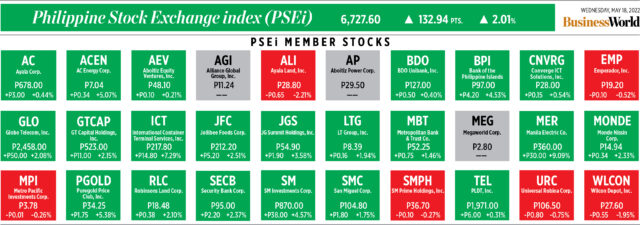
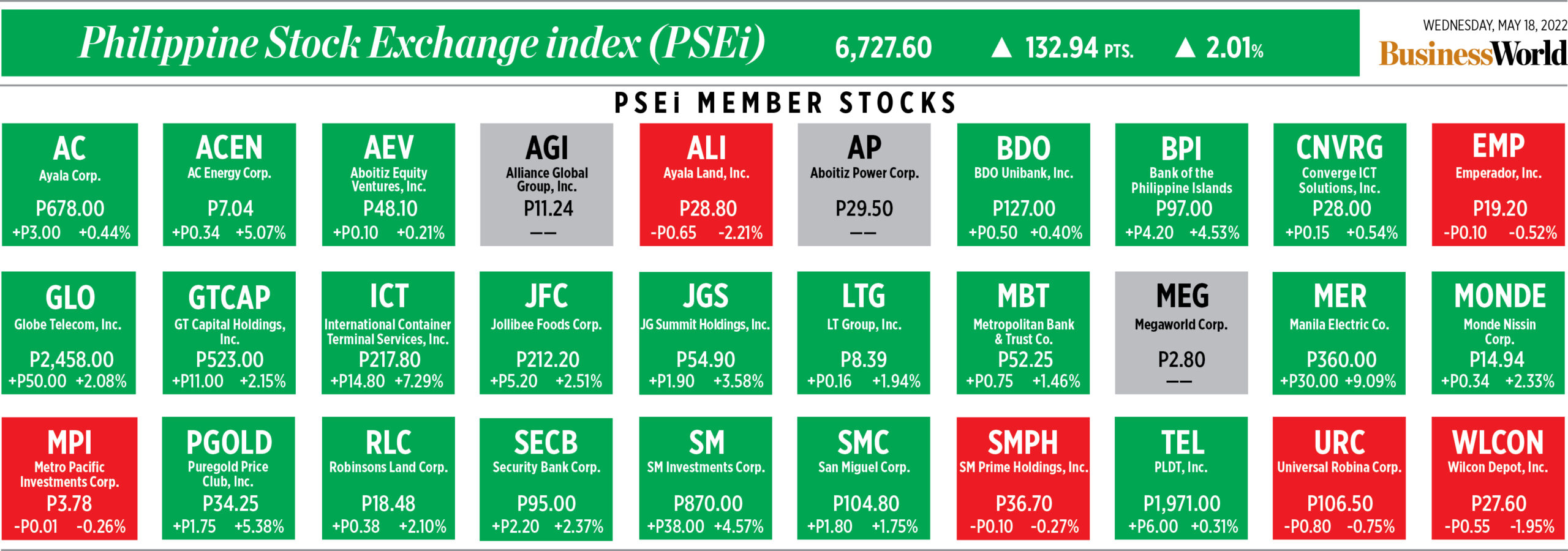
How PSEi member stocks performed — May 18, 2022

Here’s a quick glance at how PSEi stocks fared on Wednesday, May 18, 2022.


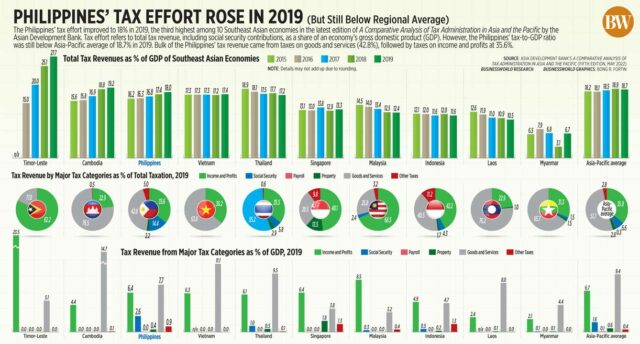
Philippines’ tax effort rose in 2019

The Philippines’ tax effort improved to 18% in 2019, the third highest among 10 Southeast Asian economies in the latest edition of A Comparative Analysis of Tax Administration in Asia and the Pacific by the Asian Development Bank. Tax effort refers to total tax revenue, including social security contributions, as a share of an economy’s gross domestic product (GDP). However, the Philippines’ tax-to-GDP ratio was still below Asia-Pacific average of 18.7% in 2019. Bulk of the Philippines’ tax revenue came from taxes on goods and services (42.8%), followed by taxes on income and profits at 35.6%.

Philippines’ tax effort rose in 2019

Peso weakens on hawkish Fed, fears over cases of subvariant

BW FILE PHOTO
THE PESO declined against the dollar on Wednesday as the US Federal Reserve’s chief said they could raise rates more aggressively to curb rising inflation. — BW FILE PHOTO

THE PESO weakened versus the greenback on Wednesday as the US Federal Reserve chief said they could tighten rates more aggressively to control rising inflation and amid the confirmation of local transmission of a new subvariant of the coronavirus disease 2019 (COVID-19).

The local unit closed at P52.45 per dollar on Wednesday, losing 2.5 centavos from its P52.425 finish on Tuesday, based on Bankers Association of the Philippines data.

The peso opened Wednesday’s session at P52.35 against the dollar. Its weakest showing was at P52.465, while its intraday best was at P52.35 versus the greenback.

Dollars traded went down to $805.9 million on Wednesday from $843.1 million on Tuesday.

The peso weakened following hawkish statement from Fed Chairman Jerome H. Powell, a trader said in a Viber message.

Mr. Powell, in his most hawkish remarks to date, said the US central bank will keep raising interest rates until there is “clear and convincing” evidence that inflation is in retreat, Bloomberg reported.

“What we need to see is inflation coming down in a clear and convincing way, and we’re going to keep pushing until we see that,” Mr. Powell said Tuesday during a Wall Street Journal live event. “If that involves moving past broadly understood levels of ‘neutral,’ we won’t hesitate at all to do that.”

The Fed chair repeatedly stressed the need to curb the hottest inflation in decades during the roughly 35-minute interview, calling price stability “the bedrock of the economy” and acknowledging that some pain in achieving this — including a slight rise in the unemployment rate — was a cost worth paying in order to achieve it.

If the Fed doesn’t see clear and convincing evidence of abating inflationary pressures, “then we’ll have to consider moving more aggressively,” Mr. Powell said. “If we do see that, then we can consider moving to a slower pace.” The target range for the benchmark federal funds rate currently stand at 0.75% to 1%. The Federal Open Market Committee next meets June 14-15.

Meanwhile, Rizal Commercial Banking Corp. Chief Economist Michael L. Ricafort said the weaker peso also reflects market worries following the local transmission of another Omicron subvariant.

Health Undersecretary Maria Rosario S. Vergeire on Tuesday said there has been local transmission of the Omicron subvariant BA.2.12.1 in some parts of the country. This is the dominant subvariant in the US and is said to be more contagious.

The Philippines has detected 17 cases of the subvariant, 16 of which were locally acquired while one was a returning Filipino.

For Thursday, Mr. Ricafort gave a forecast range of P52.30 to P52.50 per dollar, while the trader expects the local unit to move within P52.35 to P52.50. — L.W.T. Noble with Bloomberg

Shares rise as market expects BSP to hike rates

REUTERS

THE MAIN INDEX surged on Wednesday as investors bought shares ahead of the Bangko Sentral ng Pilipinas (BSP) policy meeting on Thursday, where analysts expect a rate hike to combat inflation.

The benchmark Philippine Stock Exchange index (PSEi) climbed by 132.94 points or 2.01% to close at 6,727.60 on Wednesday, while the broader all shares index went up by 56.41 points or 1.59% to 3,590.06.

“Philippine shares were bought ahead of the BSP meeting and as investors digested the retail numbers that came in line with consensus expectations,” Regina Capital Development Corp. Head of Sales Luis A. Limlingan said in a Viber message.

BSP Governor Benjamin E. Diokno said in an online briefing on Wednesday that “[the] space for maintaining an accommodative policy stance has considerably narrowed” as inflation continues to notch multi-year highs.

Inflation rose to a 40-month high of 4.9% annually last month, from 4% in March and 4.1% in April a year ago, preliminary data from the Philippine Statistics Authority showed.

It was the quickest pace since the 5.2% print in December 2018. The headline figure also breached the central bank’s 2-4% target for the year.

For the first four months, inflation averaged 3.7%, lower than the 4.1% seen in the same period last year and the central bank’s 4.3% forecast for the year.

Some market players are pricing in a rate hike at the BSP’s meeting on Thursday as faster-than-expected economic growth in the first quarter is seen to put upward pressure on inflation.

A BusinessWorld poll of 17 analysts conducted last week showed they are divided on the BSP’s next move, with nine betting rates will remain unchanged, while eight are expecting a 25-bp hike.

Benchmark rates have been at record lows since November 2020, when the BSP cut rates by 25 bps.

Meanwhile, Philstocks Financial, Inc. Senior Research Analyst Japhet Louis O. Tantiangco attributed the local market’s rise to positive spillovers from Wall Street’s rally overnight.

Back home, the majority of the sectoral indices ended in the green except for property, which declined by 18.05 points or 0.59% to 3,008.81.

On the other hand, mining and oil gained 297.06 points or 2.72% to 11,201.53; services went up by 50.15 points or 2.70% to 1,907.66; holding firms added by 163.38 points or 2.67% to end at 6,261.46; industrials improved by 218.63 points or 2.41% to 9,288.61; and financials rose by 31.28 points or 1.98% to 1,604.87.

Value turnover increased to P7.75 billion on Wednesday with 1.6 billion shares switching hands from the P7.32 billion with 1.17 billion issues recorded the previous trading day.

Advancers beat decliners, 134 against 60, while 45 names closed unchanged.

Foreigners turned buyers with P270.89 million in net purchases from the P65.05 million in net selling seen on Tuesday. — L.M.J.C. Jocson with Reuters

ADVERTISEMENT
ADVERTISEMENT