Home Blog Page 6384

Vista Land & Lifescapes, Inc. to conduct annual meeting of stockholders on June 15


Spotlight is BusinessWorld’s sponsored section that allows advertisers to amplify their brand and connect with BusinessWorld’s audience by enabling them to publish their stories directly on the BusinessWorld Web site. For more information, send an email to online@bworldonline.com.

Join us on Viber to get more updates from BusinessWorld: https://bit.ly/3hv6bLA.

Marcos to prioritize stimulus package

REUTERS
Ferdinand R. Marcos, Jr speaks to foreign correspondents at his headquarters in Mandaluyong City, Philippines, May 11. — REUTERS

By Kyle Aristophere T. Atienza, Reporter

PHILIPPINE presumptive president Ferdinand “Bongbong” R. Marcos, Jr. on Monday confirmed that a new stimulus measure will be part of his priority legislation for the incoming Congress, although potential revenue sources are still being studied.

At a news conference at his headquarters on Monday, Mr. Marcos said he will look at the 2023 national budget, which is still being prepared, to “find sufficient funds” for the proposed economic relief package.

He said he plans to “move some public expenditure away from non-investment expenditures to more investment expenditures” to “revitalize the economy.”

“There are slight differences because although (this year’s budget) has been disbursed, not all of it has been spent, so meron pa tayong breathing room pero konti na lang, and so that’s why we will have to look at the new budget,” Mr. Marcos said. 

Asked if he would consider selling government assets to fund the stimulus package, Mr. Marcos said: “I’m always very wary of selling government assets, so as a matter of principle I would rather not.

Leyte Rep. Martin G. Romualdez, a leading candidate for House Speaker of the 19th Congress, last week said one of the priorities is the passage of a stimulus package dubbed as “Bayan Bangon Muli.” He said the measure would allow the President to use resources available during the final months of 2022 to address the country’s pandemic response and use leftover funds to stimulate the economy.

However, Albay Rep. Edcel C. Lagman told CNN Philippines on Monday that the next administration may not have enough funds to fund another stimulus package as the government has already disbursed 90% of the P5-trillion national budget for this year.

“Unless the new administration can find or create fresh funds, the stimulus package monikered as ‘Bayan Bangon Muli’ will be mere sloganeering and simply a change in nomenclature from the original Bayanihan,” Mr. Lagman said, referring to the two stimulus packages approved by President Rodrigo R. Duterte during the pandemic.

Economists said the next administration should first provide a clear pandemic recovery plan and assess the status of public finances to make any stimulus package more efficient and responsive to emerging needs. 

“The first order of business of the next administration is to first design a post-pandemic economic program which so far has been nonexistent,” said Leonardo A. Lanzona, who teaches economics at the Ateneo de Manila University.

“If proven to be viable, then the questions of financing should be easier,” he said in a Messenger chat.

Zyza Nadine Suzara, a public finance expert, said the Marcos team needs to come up with a recovery strategy first, which should be broken down into specific programs that will address the most urgent socioeconomic challenges.

“How will it know how much the total funding requirement really is if there is no plan,” she said in a Messenger chat.

She said the next administration may either find available funds under the 2022 national budget or identify available cash in the Treasury to fund the stimulus package.

While working within the 2022 national budget might not be a huge problem, Ms. Suzara said passing a supplemental budget to fund the proposed stimulus might be an issue because the Department of Finance has to certify that excess revenue sources are available “to foot the bill.” 

She noted that there might still be funds left unspent or unreleased under the 2022 budget due to the recent election ban. She said the incoming 19th Congress “can authorize the reallocation of those funds.”

However, Ms. Suzara said the Marcos family could pay its pending tax liabilities, which Congress could then earmark to fund the target stimulus, “as a sign of goodwill and unity.”

Emy Ruth D. Gianan, an economist at the Polytechnic University of the Philippines, said it would also be prudent to examine the state of the country’s public finances to assess what kind of measure should be implemented to aid economic recovery.

“The questions should be: How deep are we in debt? Which dole outs have yet to be distributed?” she said in a Messenger chat. “We cannot rely on stimulus packages alone, and then wonder where we would get the money to support such large spending later on.”

Mr. Duterte will step down on June 30 with a record amount of debt, which reached a record high P12.68 trillion as of end-March.

Balisacan to return to NEDA under Marcos

Arsenio M. Balisacan — Courtesy of Philippine Competition Commission

FORMER Socioeconomic Planning Secretary Arsenio M. Balisacan, former Labor Secretary Bienvenido E. Laguesma and migrant workers’ rights advocate Susan “Toots” Ople have accepted presumptive president Ferdinand “Bongbong” R. Marcos, Jr.’s invitation to join his Cabinet.

At a news conference at his campaign headquarters on Monday, Mr. Marcos said he had asked Mr. Balisacan to “return” to the National Economic and Development Authority (NEDA), a Cabinet-level agency responsible for economic planning.

“I’ve worked with him extensively at the time when I was governor, we have very similar thinking in that regard kaya’t malakas ang loob ko (which is why I am confident),” Mr. Marcos said of Mr. Balisacan who he described as an “old friend.” “I know he’s very competent, I know his policies are policies that will be for the betterment of our country.”

Victor D. Rodriguez, who is set to become Mr. Marcos’ executive secretary, confirmed in a text message to reporters that Mr. Balisacan has already accepted the offer.

Mr. Balisacan in a statement said he looks forward to working with the economic team and the private sector “to bring back the country to its pre-pandemic high-growth trajectory, deliver rapid poverty reduction, and reduce socioeconomic inequality.”

A native of Ilocos Norte, Mr. Balisacan was Socioeconomic Planning secretary and NEDA director-general from May 2012 to January 2016 under the Aquino administration. After he resigned from NEDA, President Benigno S.C. Aquino III appointed him as the first-ever chairman of the Philippine Competition Commission (PCC).

He is a former dean of the University of the Philippines School of Economics. He has a PhD in Economics from the University of Hawaii, MS in Agricultural Economics from the University of the Philippines Los Baños, and BS in Agriculture (Magna Cum Laude)from the Mariano Marcos State University in Batac, Ilocos Norte.

Mr. Rodriguez said Mr. Laguesma and Ms. Ople have also accepted Mr. Marcos’ offer to head the Labor department and the newly established agency for migrant workers, respectively.

“For employment, for the development of our economy, nag-usap kami ng ilang oras at mukha namang tumutugma ang aming pag-iisip patungkol sa approach natin dito sa darating na mga taon when it comes to economic managers (we talked for a few hours and I think we are of the same mind on the plans for the next few years),” Mr. Marcos said.

Mr. Laguesma was Department of Labor and Employment (DoLE) secretary from 1998 to 2001, while Ms. Ople was a DoLE undersecretary from 2004 to 2009 under the Arroyo administration.

Ms. Ople is the founder of the Blas F. Ople Policy Center and Training Institute. The center is named after her late father who served for 19 years as the Labor minister under President Ferdinand E. Marcos.

Mr. Marcos is expected to face major economic obstacles once he takes his oath of office on June 30, such as the ballooning budget deficit, rising debt, soaring inflation and lackluster government revenues.

The Philippine economy grew by 8.3% in the first quarter, a sign that economic recovery may have become more entrenched.

However, the ongoing Russia-Ukraine war, soaring oil and commodity prices and supply chain disruptions are creating uncertainty not just for the Philippines, but the global economy.

Mr. Marcos said the Philippines under his leadership will join a United States-backed economic framework for the Indo-Pacific region, as Washington boosts its economic presence in the region in a bid to counter China’s growing influence.

US President Joseph R. Biden on Monday unveiled the Indo-Pacific Economic Framework for Prosperity (IPEF) in Tokyo, Japan.

Reuters quoted the White House as saying the deal offers no tariff relief to the countries that join, including India, Malaysia and the Philippines, but provides a way to sort through key issues from climate change to supply chain resilience and digital trade.

“The future of the 21st century economy is going to largely be written in the Indo-Pacific — in our region,” Mr. Biden said at a launch event in Tokyo. “We’re writing the new rules.”

Mr. Biden wants the deal to raise environmental, labor and other standards across Asia. The other initial founders are Australia, Brunei, Indonesia, Japan, South Korea, New Zealand, Singapore, Thailand, Vietnam and the United States.

But those founding countries will need to negotiate what standards they wish to abide by, how they will be enforced, whether their domestic legislatures will need to ratify them and how to consider potential future members, including China, officials told reporters. — Kyle Aristophere T. Atienza with inputs from Reuters

PHL risks slower growth without RCEP membership

A bridge is seen in the municipality of Pagudpud, Ilocos Norte. — PHILIPPINE STAR/KRIZ JOHN ROSALES

By Revin Mikhael D. Ochave, Reporter

THE Philippine economy may expand at a slower pace if it fails to become a member of the world’s largest trade bloc, the Joint Foreign Chambers in the Philippines (JFC) said, as it once again urged the Senate to ratify the Regional Comprehensive Economic Partnership (RCEP) trade deal before session adjourns next week.

“Studies show the Philippine economy will grow at a slower pace without membership in RCEP. Nobody wants this to happen… we appeal to you (the Senate) to vote to approve the RCEP agreement when you return to session this week,” the JFC said in a statement on Monday.

Senators on Monday resumed the third and last regular session of the 18th Congress. However, time appears to be running out for the Senate to ratify the RCEP as the session ends on June 3.

Sought for comment, Senator Aquilino Martin L. Pimentel III, who heads the Foreign Affairs Committee, said in a Viber message that RCEP will be on the agenda for the May 30 session.

Mr. Pimentel said he is still hoping that RCEP will be ratified before Senate adjourns.

“That’s my hope. And I am working on it. (RCEP) should have been (discussed) today but (was) moved to May 30 by the leadership. Let us see. I am for RCEP ratification,” he said.

Senate President Vicente C. Sotto III said the senators will “not blindly vote on any measure.”

Asked if it will be hard to ratify the RCEP with the remaining time, he replied: “It depends on how the interpellations evolve.”

The JFC said the Philippines cannot afford not to participate in the RCEP, which it described as the largest trade bloc in the world representing 30% of global GDP.

“The Philippines cannot afford to leave itself out of the bloc since being a member will bring economic benefits that will hasten recovery from the scars, higher debt, and other damage caused by the ongoing COVID-19 pandemic,” it said.

The Philippine economy grew by 8.3% in the first quarter. The government is targeting 7-9% gross domestic product (GDP) growth for the full year.

The JFC said RCEP’s ratification will expand the network of foreign markets already accessible to Philippine exports.

“When this happens a large number of our current investors will invest more, and new investors from Australia, Europe, New Zealand, North America, and Northeast Asia, will be attracted, creating many thousands of new jobs. RCEP also offers other new advantages for exporters located in the Philippines that will benefit our member companies,” it added.

The JFC statement was approved by the American Chamber of Commerce of the Philippines, Australian-New Zealand Chamber of Commerce of the Philippines, Canadian Chamber of Commerce of the Philippines, European Chamber of Commerce of the Philippines, Japanese Chamber of Commerce and Industry of the Philippines, Inc., Korean Chamber of Commerce of the Philippines, Inc., and Philippine Association of Multinational Companies Regional Headquarters.

RCEP took effect on Jan. 1, and is already in force in Australia, Brunei, Cambodia, China, Japan, Korea, Laos, New Zealand, Singapore, Thailand, and Vietnam.

The Philippines is still not a participant in the RCEP as the Senate was unable to give its concurrence before session was adjourned on Feb. 3 for the election break. President Rodrigo R. Duterte ratified the trade deal on Sept. 2 last year.

“If we don’t participate, there would be the reverse of the benefits. So, instead of the positive gains on gross domestic product like 1.98% (growth), investments, exports, employment, and poverty level could be the reverse or worse,” Trade Secretary Ramon M. Lopez said in a mobile phone message.

If the Philippines fails to join, potential investments may be diverted to RCEP members, he added.

“We should join now. If we don’t join, the investments to increase production will be affected. The investors will go to other countries. That can be an additional input to our production capacity and cut our trade deficit. That is how you address the trade deficit, by having capacity locally so that we can export,” Mr. Lopez said.   

Meanwhile, Rizal Commercial Banking Corp. Chief Economist Michael L. Ricafort said the delay in the country’s participation in RCEP will result in lost opportunities for foreign direct investments (FDIs), imports and exports.

“A foregone opportunity is the potential increase in FDIs to locate in the country as a production/manufacturing and marketing base, especially FDIs of global/multinational companies that are attracted to locate in a RCEP member country in order to also access the bigger export markets of other RCEP member countries as well, as part of managing and hedging their respective global/regional supply chains,” Mr. Ricafort said in a Viber message.

Bank of the Philippine Islands (BPI) Chief Economist Emilio S. Neri, Jr. said in a Viber message that the Philippines may face more supply issues if it does not join RCEP.

“The Philippines will miss out a lot if it fails to join RCEP. The country may suffer from food supply and other supply chain-related challenges that can worsen combined inflation and economic stagnation resulting from the armed conflict in Eastern Europe and the persistent global supply chain issues,” Mr. Neri said. 

In case the Senate fails to act, the RCEP ratification may have to wait until the 19th Congress opens its first session on July 25.

RCEP has faced strong opposition from the local agriculture industry groups, saying that the sector is not ready for free trade in the global market.

Ports authority urged to stop container monitoring policy

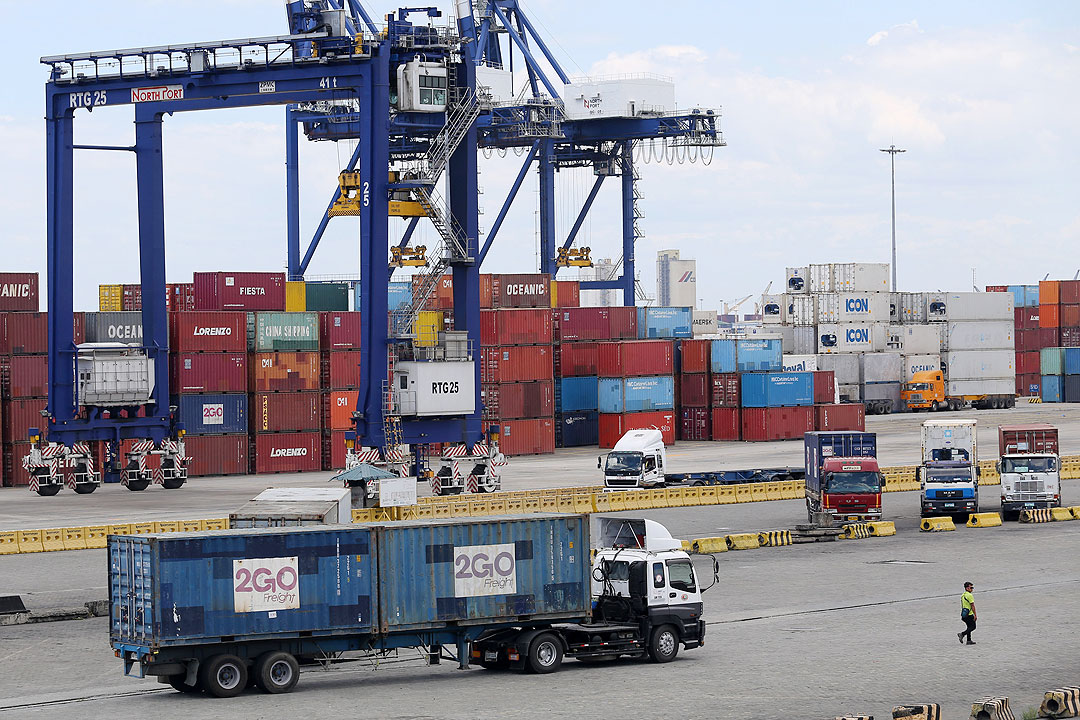
Trucks enter the port area in Manila. — PHILIPPINE STAR/EDD GUMBAN
Containers are seen at the Manila port area. — PHILIPPINE STAR/ EDD GUMBAN

VARIOUS business groups, which include shipping companies, truckers, exporters, and customs brokers, want the Philippine Ports Authority (PPA) to stop its container monitoring policy, saying this duplicates the functions of the Customs bureau and disrupts port operations.

The heads of 14 business groups issued a statement calling for the “immediate revocation” of PPA Administrative Order (AO) No. 04-2021, which sets policies on the registration and monitoring of containers using a technology solution.

The statement, which was published in a newspaper on Monday, was signed by Philippine Chamber of Commerce and Industry President George T. Barcelon, Philippine Exporters Confederation, Inc. President Sergio R. Ortiz-Luis, Jr., Supply Chain Management Association of the Philippines President Pierre Carlo Curay and Philippine Liner Shipping Association (PLSA) President Mark Matthew F. Parco, among others.

The groups said the PPA “acted outside of its jurisdiction in monitoring the movement of containers that pass through international ports handling containerized cargo that do not fall under [its] authority,” such as those administered by the Cebu Ports Authority, Cagayan Economic Zone, and Poro Point Management Corp., among others.

The AO, outlining the agency’s policy on the registration and monitoring of containers, was signed by PPA General Manager Jay Daniel R. Santiago in September 2021.

AO required the registration and monitoring of containers arriving and leaving PPA ports. Scheduling, loading, unloading, release, and movement of containers will be monitored. It was aimed at developing a container identification, accountability, and protection program to demonstrate commitment to international standards.

However, the groups seeking the revocation of AO said the PPA’s monitoring tasks under the AO are functions of the Bureau of Customs (BoC).

The BoC, the groups noted, has its own monitoring policy under Customs Administrative Order No. 08-2019, which took effect in August 2019.

The involvement of PPA in container monitoring using a technology is “an unnecessary redundancy outside of [its] own scope of responsibilities,” the groups added.

They noted that the agency’s AO will “create inefficiencies and lead to dramatically higher costs for consumers and businesses especially the micro, small, and medium enterprises.”

The AO is also seen to derail the country’s recovery from the coronavirus pandemic, they said.

“Deeper analysis shows that this administrative order will not improve port efficiency and attract more commerce through the country’s two international seaports but has the potential to derail any improvements made in recent years and discourage the flow of more cargo,” the groups said.

The PPA has yet to respond to a request for comment as of press time.

According to documents posted on the PPA website, the agency awarded the P877.600-million Trusted Operator Program-Container Registry Monitoring System (TOP-CRMS) & Empty Container Storage Shared Service Facility Design Specifications and Implementation project to the Cebu City-based Nextix, Inc./Shiptek Solutions Corp. joint venture (JV). The notice of award was signed by Mr. Santiago on April 27.

Mr. Santiago and the JV entered into a contract agreement on May 2.

PLSA’s Mr. Parco told BusinessWorld in a phone message on May 19 that “the intervention [of] PPA in the Unified Ticketing Scheme and the implementation of TOP-CRMS will only increase cost to customers and complexity in business.” — Arjay L. Balinbin

Computer retailer Upson files for P4.9-billion IPO

BW FILE PHOTO

UPSON International Corp. (UIC) announced on Monday that it had filed an application for an initial public offering (IPO) that is expected to raise P4.88 billion.

The company, a retailer of personal computers and information technology (IT) products, submitted on May 17 its registration statement with the Securities and Exchange Commission (SEC).

UIC plans to offer up to 888,157,800 common shares comprising up to 789,473,600 primary shares and up to 98,684,200 secondary shares. The net proceeds will be used for store network expansion and general corporate purposes.

“There are rapid technological developments in computers and other IT products matched with growing market segments like educational needs and computer and IT-related jobs in all 17 regions. These are compelling opportunities that fuel the need for an aggressive expansion of our retail network nationwide,” UIC Chief Executive and President Arlene T. Sy said.

The company offers its products through outlet brands including Octagon Computer Superstore, Micro Valley, and Gadget King.

“We plan to open 250 branches over the next three to five years to add to our existing 183 branches as of 2021. We pride ourselves with Certifications of Authentic and Untampered products awarded by leading suppliers of computer and IT brand,” she added.

The company tapped First Metro Investment Corp. as the sole issue manager, bookrunner, and lead underwriter for the offering. The proposed offer period and target listing date on the main board of the stock exchange is in September, subject to regulatory approvals.

First Metro President Jose Patricio A. Dumlao said UIC “has a long-standing presence in the retail industry and has been consistently growing and performing so well in the Philippine market.”

“With restrictions slowly easing up, UIC has been taking strategic initiatives to adapt to the constant change in behavior amongst its consumers and to ensure that they’re able to cater to more customers by providing a complete, quality, and an up-to-date suite of IT products both through their physical stores and online platforms,” he said.

In 2021, the company’s net income increased by 95% to P403.6 million from P206.7 million in 2020. — Luisa Maria Jacinta C. Jocson

Fruitas swings to profit despite no seasonal uptick

FRUITAS Holdings, Inc. reported on Monday that its first-quarter earnings reached P6 million, improving from a net loss of P16 million in the same period the year before.

Net sales were up by 26% to P330 million from P261 million in 2021.

“This was achieved despite the lack of seasonal uptick from the Christmas season, including lechon sales, in the first quarter of 2022 and the Level 3 restrictions imposed in January 2022,” the company said in a disclosure.

Earnings before interest, taxes, depreciation, and amortization (EBITDA) also improved to P53 million from P15 million.

In 2021, the company trimmed its net loss to P16 million from a loss of P48 million in 2020.

In February, the registration statement for the initial public offering (IPO) of Balai ni Fruitas, Inc., a wholly owned subsidiary of Fruitas, was formally received by Securities and Exchange Commission (SEC).

It is targeting to list on the small, medium and emerging board of the Philippine Stock Exchange (PSE), subject to compliance with SEC and PSE requirements.

“We are fully committed to deliver value to our shareholders by improving operations and profitability. The potential IPO of Balai ni Fruitas will be an important exercise for us, which we expect to complete in first half of 2022,” Fruitas President and Chief Executive Lester C. Yu said.

At the stock exchange on Monday, Fruitas shares closed higher by 0.91% or P0.01 at P1.11 apiece. — Luisa Maria Jacinta C. Jocson

ABS-CBN, Kroma launch interactive channel

ABS-CBN and Kroma Entertainment, which is backed by the 917Ventures Retirement Fund, launched the Pinoy Interactive Entertainment or PIE Channel (pie.com.ph) on May 23.

PIE channel is a real-time and multi-screen interactive channel where programs will be accessible to both television and digital platform audiences who can participate, often directly, with the shows. The programs air from 5 a.m. to 2 a.m.

“We always look at means to innovate and deliver fresh entertainment. We joined forces with 917Ventures and Kroma for their ecosystem of unique solutions expertise and technology and distribution scale. Combining this with our expertise in content creation, we are ushering in a new one-of-a-kind format for TV and digital entertainment that is designed to celebrate the fun and joy that viewers love,” ABS-CBN Head of Digital Jamie Lopez said during an online press conference on May 18.

“We are always looking for ways to uplift the lives of Filipino people by giving them access to essential services such as health services, financial services, groceries and even education,” 917Ventures managing director Vince Yamat said. “But we also realize that Filipinos should be given access to entertainment and participate in shows from the comfort of their homes.”

“Whether on their TV sets, laptops, desktops, or mobile devices, PIE is accessible to Filipinos who want to try a new way to consume — and play with — the shows they love,” KROMA Entertainment Chief Executive Officer Ian Monsod said.

THE SHOWS
PIE Channel’s programs include talk shows, interactive game shows, and talent shows. Viewers can participate in the programs by creating an account through the channel’s website.

The morning talk show — it airs at 7 a.m. — Piesilog offers inspiring stories and information needed for the day. It is hosted by Home Buddies Facebook community creator and Nobi Home founder Frances Cabatuando.

The variety show Barangay Pie airs at noon. It is hosted by Mayor TV, Abby Trinidad, Ruth Paga, Sunshine Teodoro, Inah Evans, Patsy Reyes, and Coco Cordero.

The talent show Piegalingan hosted by actor and online streamer Ralph Malibunas, beauty queen and actress Sam Bernardo, and actor Eris Aragoza — highlights the achievements and skills of contestants.

PIE Channel’s Pienalo offers an interactive experience on the viewer’s chosen device. On it, the familiar game “Pera o Bayong” is given a new interactive format. An online player is selected and they have to choose from among 10 bayongs (woven market bags) containing cash prizes ranging from P3,000 to P100,000, winning the money contained in the bag of their choice. Meanwhile, online viewers are also given a chance to select a bag labeled as the “Tambahayan’s Choice.” Five viewers whose names will be raffled will win the amount contained in the “Tambahayan’s Choice” bag.

Another interactive show is the program Palong Follow, where viewers work together to find the country’s next big digital content creator.

Hosted by Aaron Maniego, Karen Bordador, and Renee Dominique, the interactive show PIE Night Long features relatable stories and situations with viewers able to share their opinions and be involved in the storytelling process.

Meanwhile, the interactive soap opera UZI allows viewers to suggest what happens in a story and complete an episode.

P10 MILLION UP FOR GRABS
In line with the launch, the PIE Channel is giving away P10 million in cash prizes over three months to viewers who engage with the shows and join games.

“As technology continues to evolve. We’re going to see more innovations that will make entertainment more immersive, engaging and rewarding. Just as technology evolves, so does the behavior of our audience. We embrace this and look at ways to complement this through entertainment,” ABS-CBN’s Mr. Lopez said.

PIE Channel is accessible to digital TV households in Metro Manila, Cebu, Davao, Iloilo, Zamboanga, Naga, Baguio, and nearby provinces through partner station BEAM. Aside from digital TV (PIE can be found by scanning the digibox), the channel can be viewed on its website pie.com.ph, on YouTube (http://youtube.com/iampieofficial), and on Sky Cable Channel 21. PIE will also be available on GCash GLife beginning May 28. — Michelle Anne P. Soliman

Megawide swings to net loss as expenses rise

MEGAWIDE Construction Corp. swung to an attributable net loss of P112.76 million for the first quarter of the year from a profit of P2.85 million in the same period a year ago.

Despite its total revenues increasing by 12% during the quarter to P4.16 billion from P3.72 billion previously, Megawide incurred a net loss due to higher expenses, its first-quarter report showed.

Its net loss after tax widened to P278.89 million from a loss of P137.92 million in the same period last year.

“The impact of additional expenses from other charges net and tax expense resulted in the higher net loss in 2022,” the company said.

In terms of revenues, the company’s construction businesses contributed P2.79 billion, an 11% improvement from the previous year’s construction revenue.

“The construction segment has maintained its momentum in delivering projects on time despite quarantine measures at the start of the year,” the company said.

“With a healthy orderbook, the company is in the position to work on its order which are earmarked to be completed within two to three years from various projects such as Suntrust Home Developers’ Suncity West Side City project, Megaworld’s Newport Link project, and the Department of Transportation’s Malolos Clark Railway Phase 1 Project,” it added.

At the same time, the company said its landport operations delivered revenue of P131 million from office towers and commercial spaces during the period, and contributed 3% to the total consolidated revenues.

“Due to the restrictions in foreign travel, Philippine Offshore Gaming Operators experienced indefinite disruption on their operations, resulting in lower office occupancy levels and translated to 30% or P56 million lower revenue from the same period last year.”

Meanwhile, its airport segment showed “slight recovery” with an increase in revenues by 93% or P106 million. The company’s airport business “remains optimistic of a turnaround as global vaccination program has been effectively rolled out and consumers are starting to travel,” it said.

Revenue for the first quarter reached P220 million, 93% higher than the same period last year and contributed 3% to the total revenues.

The company said passenger volume more than doubled from last year’s pandemic level “although not enough to breach the pre-pandemic level” with domestic passenger volume of 590,000 from last year’s 190,000, and international passenger volume of 60,000 from last year’s 2,000. — Arjay L. Balinbin

Coca-Cola teams up with SBCorp. to offer MSME loans 

COCA-COLA Beverages Philippines, Inc. (CCBPI) has recently partnered with the Small Business Corp. (SBCorp.) to help the recovery of micro, small, and medium enterprises (MSMEs) across the country by expanding the access to loan programs.

The CCBPI said in a statement on Monday that the partnership will allow SBCorp. to expand the reach of its RISE UP Tindahan loan program to CCBPI’s partner retail stores, dealers, distributors, and other MSMEs.

Loans under the RISE UP Tindahan project seek to help businesses adjust to the realities of doing business in the new normal. The project offers loans ranging from P300,000 for micro-tindahan loans to P5 million for SME loans, with three years repayment term inclusive of a grace period of up to 12 months and no collateral required.

“The process in RISE UP Tindahan is simple, which is key to reaching more MSMEs. We need to overcome the challenge of inaccessibility, and part of this is making sure that procedures aren’t overly complicated — that MSMEs don’t feel intimidated or overwhelmed,” CCBPI General Trade Director Chris Pesigan said.

“The partnership with SBCorp. manifests the collective, urgent goal of helping the MSME sector recover, stabilize, and progress,” he added.

SBCorp. Chief Operating Officer Santiago S. Lim said the project allows the project to reach more entrepreneurs in the metro and the rest of the country.

“Reaching out to the far ends can be a daunting task, but since we have Coca-Cola now as our partner, with your seasoned experience on the ground, we are confident that this project will be successful,” Mr. Lim said.

Those that will be eligible for the loans are micro, small, and medium businesses such as sari-sari stores or family-run convenience stores, retail stores, distributors that are under the partner, which is CCBPI.

“Applicants must also be ready with documents such as their barangay business permit, and government-issued IDs among others. The loan application will undergo credit, business, and financial assessments. Applicants will then be contacted via e-mail regarding the results of each stage,” CCBPI said.

The CCBPI is the bottling arm of Coca-Cola in the Philippines while the SBCorp. is the financing arm of the Department of Trade and Industry. — Revin Mikhael D. Ochave

‘We’ll be back next year for that three-peat,’ declare Abando, Yu

LETRAN Knights enjoying their trophy. — SYNERGY/GMANETWORK INC.

A NEW chapter is being written in the National Collegiate Athletic Association (NCAA). And the Letran Knights are the ones transcribing it.

Moments after they were crowned back-to-back champions, the fantastic boys from Muralla have unabashedly declared they would shoot for nothing less than a three-peat feat in Season 98 and extend their reign in the oldest collegiate league in the land.

And at the forefront of the campaign are no less than the men of the hour — reigning MVP Rhenz Abando and the cerebral Fran Yu.

“We’ll be back next year for that three-peat,” said Mr. Yu, who opted to say for one final season to chase that coveted third crown.

Both Messrs. Abando and Yu were instrumental in the Knights’ immaculate season where they went 12 straight games without a single defeat.

The uncanny duo should and would remain in the pedestal next year as they spearhead an ambitious bid to establish a new order.

Or did they establish a dynasty already?

For the first time in the last 15 seasons, a school not named San Beda reigned supreme in the NCAA more than two straight times.

During that long span, the San Beda Red Lions has made the finals 14 seasons in row starting in 2006 and won 11 titles along the way.

A Calvin Abueva-paced San Sebastian and an Aldin Ayo-mentored Letran broke the order when it prevailed in 2009 and 2015, respectively, but the two never won it two in a row.

Until this league of extraordinary gentlemen came to fore in destroying the old order and forming a new one. — Joey Villar

Cannes Film Festival News: Squid Game star Lee Jung-jae steps behind the camera for Hunt

CANNES — Squid Game star Lee Jung-jae flexes his filmmaking muscles with Hunt, a spy thriller he wrote, directed, produced and also acts in.

Mr. Lee’s directorial and screenwriting debut received its world premiere at the Cannes Film Festival, where it is screening out of competition.

The fast-paced, action-packed movie centers around two South Korean spies who are tasked with uncovering a North Korean mole, and wind up investigating each other in the process.

Mr. Lee, 49, stars as one of the spies opposite his long-time friend and business partner Jung Woo-sung.

He said his nearly three-decade long career was a big help when stepping behind the lens.

“I have acted in many different genres and I could remember scenes I’d shot as an actor that were difficult to film or that didn’t come out as I expected,” he told Reuters in Cannes.

“I tried to remember those scenes when I was writing the script to ensure I could be as effective as possible when directing.”

Mr. Lee makes his debut riding on the high of the success of his Netflix series, which became the streaming giant’s most popular show globally, and the triumphs of other Korean TV shows, films, and music around the world.

“I am so thankful that I am making my directorial debut during this renaissance of Korean culture,” Mr. Lee said.

“I hope to get to meet international audiences and fans more often with other movies and content as well.”

Asked which of the many hats he wore on the project he enjoyed the most, Lee did not hesitate.

“Of course acting. I’m an actor. It’s my identity. So, I just loved acting the most.”

UKRAINIAN DIRECTOR DENOUNCES RUSSIAN PRESENCE
Ukrainian director Dmytro Sukholytkyy-Sobchuk criticized the Cannes Film Festival for including a Russian director in its line-up, as the debut filmmaker’s Pamfir was shown at Cannes’ Directors Fortnight on Saturday.

The festival has banned official Russian delegations from attending, but Russian dissident Kirill Serebrennikov, who has spoken out against the invasion of Ukraine, premiered his in-competition film Tchaikovsky’s Wife at the festival last Wednesday.

“When he’s here, he is part of the Russian propaganda, and they can use him,” Sukholytkyy-Sobchuk told Reuters on Saturday.

The Russian director Serebrennikov had said earlier last week that Russian culture should not be boycotted, saying that Russian culture “has always promoted human values.”

The Ukrainian director Sukholytkyy-Sobchuk described the sensation of being in Cannes while his country fights against a Russian invasion as “alien.”

“Everything what’s happened here, it’s something that would not belong in Ukraine — the peaceful life… We have (an) opposite reality,” he said.

Set in the forests of western Ukraine’s Chernivtsi region, Pamfir begins with the return of a father, Leonid, to his family after months of working in Poland. A church fire attributed to Leonid’s son Nazar forces the father to take up a quick smuggling job, angering the local contraband boss.

With references to Greek tragedy and the bible story of Abraham and Isaac, the story of fighting for redemption has resonance with the ongoing conflict.

“(The film) is a reflection of the strength and power of the Ukrainian people, who are very strong and who will win. It’s just a question of time… because we can’t be defeated,” said Oleksandr Yatsentyuk, who plays Leonid.

ALI ABBASI INTRODUCES ‘PERSIAN NOIR’
Iranian director Ali Abbasi premiered Holy Spider at the Cannes Film Festival on Sunday, the tale of a serial killer in the holy city Mashhad — based on a true story — dubbing the genre “Persian noir.”

“This is a film noir. This is a Persian noir,” Mr. Abbasi told Reuters.

The movie takes viewers to the outskirts of the Iranian city, where serial killer Saeed Hanaei, played by Mehdi Bajestani, hunts down destitute prostitutes in what he sees as a cleansing mission. Pursuing him, investigative journalist Rahimi, played by Zar Amir Ebrahimi, suspects local corruption is hampering his arrest.

“We want to build a universe, a universe which is dark, which has an underbelly, which has vice, which has trouble, which has all sorts of conflicts ongoing,” said Mr. Abbasi. “Is that an accurate portrait of Iran?”

The movie shows a society that is unforgiving to those who deviate from its religious rules. When the real life “spider killer” was caught in 2001, he found support for his argument that he was stamping out what he called moral corruption, although he was convicted and executed the following year.

“I’m talking about a real case — we didn’t know… would he be convicted? Would he be punished?” said Mr. Abbasi.

The movie, distributed by Metropolitan Filmexport, is one of 21 films vying for the festival’s top prize, the Palme d’Or. Mr. Abbasi won the Cannes prize in the Un Certain Regard, category in 2018 with Border.

Describing the contradictory nature of Iranian society, where women may be highly trained doctors and engineers but are also subject to tight controls over what they wear and how they look in public, the director said he sought to expose these tensions.

“This picture is not one sided. There is reason to hope. There’s also reason to fear.” — Reuters