Home Blog Page 6340

Dimon says brace for US economic ‘hurricane’ due to inflation 

REUTERS/KEVIN LAMARQUE/FILE PHOTO

Jamie Dimon, Chairman and Chief Executive of JPMorgan Chase & Co. described the challenges facing the US economy akin to an “hurricane” down the road and urged the Federal Reserve to take forceful measures to avoid tipping the world’s biggest economy into a recession. 

Mr. Dimon’s comments come a day after President Joseph R. Biden, Jr., met with Federal Reserve Chair Jerome Powell to discuss inflation, which is hovering at 40-year highs. 

“It’s a hurricane,” Mr. Dimon told a banking conference, adding that the current situation is unprecedented. “Right now, it’s kind of sunny, things are doing fine. Everyone thinks the Fed can handle this. That hurricane is right out there down the road coming our way. We just don’t know if it’s a minor one or Superstorm Sandy,” he added. 

The Fed is under pressure to decisively make a dent in an inflation rate that is running at more than three times its 2% goal and has caused a jump in the cost of living for Americans. It faces a difficult task in dampening demand enough to curb inflation while not causing a recession. 

“The Fed has to meet this now with raising rates and QT (quantitative tightening). In my view, they have to do QT. They do not have a choice because there’s so much liquidity in the system,” Mr. Dimon said. 

Major central banks, already plotting interest rate hikes in a fight against inflation, are also preparing a common pullback from key financial markets in a first-ever round of global quantitative tightening expected to restrict credit and add stress to an already-slowing world economy. 

The inflation battle has become the focal point of Biden’s June agenda amidst his sagging opinion polls and before November’s congressional election. 

Uncertainty about the US central bank’s policy move, the war in Ukraine, prolonged supply-chain snarls due to coronavirus disease 2019 (COVID-19) and higher Treasury yields have rocked global stock markets, with the benchmark S&P 500 index falling 13.3% year-to-date. 

“You gotta brace yourself. JPMorgan is bracing ourselves, and we’re going to be very conservative in our balance sheet,” Mr. Dimon added. 

SOFT LANDING?
Wells Fargo & Co’s CEO warned that the Federal Reserve would find it “extremely difficult” to manage a soft landing of the economy as the central bank seeks to douse the inflation fire with interest rate hikes. 

The CEO of the fourth-largest US lender also said that Wells Fargo is seeing a direct impact from inflation on consumers’ spending, particularly on fuel and food. 

“The scenario of a soft landing is … extremely difficult to achieve in the environment that we’re in today,” Wells Fargo Chief Executive Officer Charlie Scharf said at the conference. 

“If there is a short recession, that’s not all that deep… there will be some pain as you go through it, overall, everyone will be just fine coming out of it,” he added. 

Mr. Scharf said while the overall consumer spending is strong, growth is slowing. 

“Corporations are still spending, where they can, they’re increasing inventories … we do expect the consumer and ultimately businesses to weaken, which is part of what the Fed is trying to engineer but hopefully in a constructive way,” he added. 

Recent Fed reports and surveys reported households on average in a strong financial position, with working families doing well, and unemployment at levels more akin to the boom years of the 1950s and 1960s. Wages for many lower-skilled occupations are rising, and bank accounts, on average, are still flush with cash from coronavirus support programs. 

But confidence has waned, and in a recent Reuters/Ipsos poll the economy topped respondents’ list of concerns. 

“I don’t think our crystal ball relative to the macro later this year, 2023, 2024 is necessarily any better than others. Clearly, we’re going to see with the Fed actions different impacts in different businesses,” GE CEO Larry Culp, told the conference. 

Still, not everyone in corporate America is seeing slowdown. 

“Of the vast majority of the markets we serve are still quite strong,” Caterpillar Inc CEO Jim Umplebly said. 

“And our challenge at the moment, quite frankly, is supply chain, our ability to supply enough equipment to meet all the demand that’s out there,” he added. — Elizabeth Dilts Marshall and Niket Nishant/Reuters

How a Russian billionaire shielded assets from European sanctions

Sailing Yacht A, a 470-foot superyacht with a price tag of 530 million euros, belonging to Russian businessman Andrey Melnichenko. The vessel was seized by Italy this March. — WIKIMEDIA COMMONS

ISTANBUL/BRUSSELS — Russian businessman Andrey Melnichenko ceded ownership of two of the world’s largest coal and fertilizers companies to his wife the day before he was sanctioned by the European Union, according to three people familiar with the matter. 

Mr. Melnichenko, who built his fortune in the years following the 1991 fall of the Soviet Union, gave up his stakes in the coal producer SUEK AO and fertilizer group EuroChem Group AG on March 8, the day of his 50th birthday, leaving his wife, Aleksandra Melnichenko, the beneficial ownership of the companies, the people said. 

Until March 8, Mr. Melnichenko owned the two companies through a chain of trusts and corporations stretching from Moscow and the Swiss town of Zug to Cyprus and Bermuda, according to legal filings reviewed by Reuters. 

Since 2006, Mr. Melnichenko’s wife was second in line behind her husband on the list of beneficial owners of the two companies in trust documents, according to the three people, who spoke on condition of anonymity because they aren’t allowed to speak publicly about the couple’s assets. That meant that she stood to inherit ownership of the companies in the event her husband died, the people said. 

When the war in Ukraine began in February, however, Mr. Melnichenko grew concerned that he would be designated under the European Union’s Russia sanctions regime, the people familiar with the matter said. On March 8, Mr. Melnichenko notified trustees of his retirement as the beneficiary, the people said. That triggered the same chain of changes in trust records that would have happened if the businessman had passed away, and made his wife the beneficiary. 

Reuters was unable to reach Mr. Melnichenko and his wife for comment. 

A spokesman for Russia-based SUEK didn’t respond to messages seeking comment. Switzerland-based EuroChem confirmed that Aleksandra Melnichenko had replaced her husband as beneficial owner. 

“Following the departure of its founder, the primary beneficial ownership of a trust holding a 90% stake in the global fertilizer company has automatically passed to his wife,” the company said in a statement to Reuters on Wednesday. 

The role of Mr. Melnichenko’s wife at EuroChem was first reported by Swiss newspaper Tages-Anzeiger. Her role at SUEK as well as the timing of ownership changes and other details are reported here for the first time. 

Mr. Melnichenko, who founded SUEK and EuroChem two decades ago, was ranked as Russia’s eighth richest man last year by Forbes, with an estimated fortune of $18 billion. 

The European Union sanctioned Mr. Melnichenko, citing his alleged proximity to the Kremlin, on March 9 as part of a Western attempt to punish Russian President Vladimir Putin for the Feb. 24 invasion of Ukraine. The sanctions — which include freezing his assets, banning him from entering the European Union and prohibiting EU entities from providing funds to him — do not apply to his wife nor the couple’s daughter and son. 

Britain also put Mr. Melnichenko, who is Russian but was born in Belarus and has a Ukrainian mother, on its sanction list on March 15. Switzerland imposed sanctions against him the following day. 

The businessman said in a statement to Reuters in March, after the EU sanctions were imposed, that the war in Ukraine was “truly tragic” and he appealed for peace. A spokesman for Mr. Melnichenko said at that time he had “no political affiliations”. 

Western governments have imposed sweeping sanctions against Russian companies and individuals in an effort to force Moscow to withdraw. 

But some sanctioned Russian businessmen, including Roman Abramovich and Vladimir Yevtushenkov, have transferred assets to friends and family members, fueling doubts over the effectiveness of these attempts to pressure Moscow. 

Mr. Melnichenko, whose residence was registered in the Swiss alpine resort town of St. Moritz until he was hit by sanctions, gave his instructions to change the ownership of his companies from a retreat near Mount Kilimanjaro where he was celebrating his birthday, according to a person familiar with the matter. A Boeing 737 emblazoned with the billionaire’s signature “A” on the fuselage had landed in Tanzania on March 5, arriving from Dubai, according to flight-tracking service Flightradar24. 

A lawyer for Mr. Melnichenko didn’t respond to questions about the Kilimanjaro trip. 

Mr. Melnichenko’s transfer of ownership at SUEK and EuroChem had far-reaching implications. 

After reviews lasting several weeks, Swiss financial authorities concluded that the two companies could continue operating normally on the grounds that Mr. Melnichenko was no longer involved with them. SUEK and EuroChem said that British and German financial regulators have reached similar conclusions. 

The British and German regulators didn’t respond to requests seeking comment. 

Upon completion of the reviews in late April, SUEK and EuroChem — which had revenues last year of $9.7 billion and $10.2 billion respectively — were able to resume distribution of millions of dollars in interest payments to bondholders. 

In recent weeks, SUEK and EuroChem have also approached Western clients, showing them documents with the new ownership structure in a bid to reassure them that they can continue doing business with Mr. Melnichenko’s former companies, two people familiar with the matter said. 

NO MORE PAYMENTS
In Switzerland, the Secretariat for Economic Affairs (SECO) said neither SUEK nor EuroChem were under sanctions in the country. 

SECO said that, as far as it was aware, Mr. Melnichenko was no longer a beneficiary of the trust to which EuroChem belonged at the time of his sanction by the EU and Switzerland. 

SECO also said it sought confirmation from Eurochem that it would no longer provide funds to Mr. Melnichenko. 

“The company and its management have guaranteed in writing to SECO that the Swiss sanction measures will be fully complied with and in particular that no funds or economic resources will be made available to sanctioned persons,” SECO said in response to a query. 

Swiss authorities have defended their decision not to extend sanctions to Mr. Melnichenko’s wife or to his former companies, pointing to the fact that EU authorities had not sanctioned them either. 

“In this case, we have done exactly what the EU has done,” Switzerland’s Economy Minister Guy Parmelin told Swiss television on Wednesday. 

Mr. Parmelin added that Switzerland was also wary that sanctioning EuroChem at a time when fertilizer prices have soared in most parts of the world could have dire consequences on agriculture markets. EuroChem said it produced more than 19 million metric tons of fertilizer last year — roughly equivalent to 5% of the world’s output, according to UN data. 

The European Commission, the EU’s executive arm, said it had no information about the transfer of Mr. Melnichenko’s assets to his wife. The commission has said it is willing to close loopholes allowing individuals and companies to elude its sanctions. Earlier this week, it unveiled proposals aimed at criminalizing moves to bypass sanctions, including by transferring assets to family members, across the 27-nation bloc. 

Under the trust structure, control over SUEK and EuroChem is exercised by independent trustees while beneficial ownership, which was in the hands of Mr. Melnichenko until March 8, has moved to his wife. 

A mathematician who once dreamt of becoming a physicist, Mr. Melnichenko dropped out of university to dive into the chaotic — and sometimes deadly — world of post-Soviet business. 

He founded MDM Bank but in the 1990s was still too minor to take part in the privatizations under President Boris Yeltsin that handed the choicest assets of a former superpower to a group of businessmen who would become known as the oligarchs due to their political and economic clout. 

Mr. Melnichenko then began buying up often distressed coal and fertilizer assets, making him one of Europe’s richest men. 

The EU said, when it announced its sanctions, that Mr. Melnichenko “belongs to the most influential circle of Russian business people with close connections to the Russian government.” 

Mr. Melnichenko was among dozens of business leaders who met with Mr. Putin on the day Russia invaded Ukraine to discuss the impact of sanctions, showing his close ties to the Kremlin, the EU said in its March 9 sanction order. 

At the time, a spokesman for Mr. Melnichenko denied that the businessman belonged to Mr. Putin’s inner circle and said he would dispute the sanctions in court. On May 17, Mr. Melnichenko challenged the sanctions by lodging an appeal with the EU’s General Court, which handles complaints against European institutions, court records show. 

Russia calls its actions in Ukraine a “special operation” to disarm Ukraine and protect it from fascists. Ukraine and the West say the fascist allegation is baseless and that the war is an unprovoked act of aggression. 

Italy seized Mr. Melnichenko’s superyacht — the 470-foot Sailing Yacht A, which has a price tag of 530 million euros — on March 12, three days after he was placed on an EU sanctions list. 

SUEK and EuroChem said on March 10, a day after the EU announced sanctions against Mr. Melnichenko and 159 other individuals tied to Russia, that their founder had resigned from his board positions at the companies. — David Gauthier-Villars and Gabriela Baczynska/Reuters

Elon Musk tells Tesla staff: return to office or leave

DANIEL OBERHAUS-FLICKER

Tesla Inc. Chief Executive Elon Musk has asked employees to return to the office or leave the company, according to an email sent to employees and seen by Reuters. 

“Everyone at Tesla is required to spend a minimum of 40 hours in the office per week,” Mr. Musk wrote in the email sent on Tuesday night. 

“If you don’t show up, we will assume you have resigned.” 

“The more senior you are, the more visible must be your presence,” Mr. Musk wrote. “That is why I lived in the factory so much — so that those on the line could see me working alongside them. If I had not done that, Tesla would long ago have gone bankrupt.” 

Two sources confirmed the authenticity of the email reviewed by Reuters. Tesla did not respond to a request for comment. 

Major tech firms in Silicon Valley do not require workers to return to the office full-time, in the face of resistance from some workers and a resurgence of coronavirus cases in California. 

Tesla has moved its headquarters to Austin, Texas, but has its engineering base and one of its factories in the San Francisco Bay area. 

“There are of course companies that don’t require this, but when was the last time they shipped a great new product? It’s been a while,” Mr. Musk wrote in the email. 

“Tesla has and will create and actually manufacture the most exciting and meaningful products of any company on Earth. This will not happen by phoning it in.” 

One of Mr. Musk’s Twitter followers posted another email that Mr. Musk apparently sent to executives asking them to work in the office for at least 40 hours per week or “depart Tesla.” 

In response to this tweet, the billionaire, who has agreed to take Twitter Inc. private in a $44 billion deal, said, “They should pretend to work somewhere else.” 

Some Tesla workers expressed displeasure over Mr. Musk’s latest comments in posts they placed on the anonymous app Blind, which requires users to sign up using company email as proof of employment at firms. 

“If there’s a mass exodus, how would Tesla finish projects? I don’t think investors would be happy about that,” one Tesla employee wrote. 

“Waiting for him to backpedal real quick,” another worker posted. 

A California-based workers advocacy group assailed Mr. Musk’s return to office plan. 

“Employers including the state government are finding that mandating a return of all employees is a recipe for outbreaks,” Stephen Knight, executive director at Worksafe, wrote in an emailed statement to Reuters. 

“Unfortunately Tesla’s disregard for worker safety is well documented, including their flouting of the county public health department at the start of the pandemic,” he wrote. 

In May 2020, Mr. Musk reopened a Tesla factory in Fremont, California, defying Alameda County’s lockdown measures to curb the spread of the coronavirus. Tesla reported 440 cases at the factory from May to December 2020, according to county data obtained by legal information site Plainsite. 

Last year, Mr. Musk’s rocket company SpaceX reported 132 COVID-19 cases at its headquarters in the Los Angeles-area city of Hawthorne, according to county data. 

Mr. Musk previously played down the risks of coronavirus, saying “the coronavirus panic is dumb” and children were “essentially immune” to the coronavirus. He later got COVID-19 twice. 

Musk said last month, “American people are trying to avoid going to work at all,” whereas Chinese workers “won’t even leave the factory type of thing.” 

“They will be burning the 3 a.m. oil,” he said at a conference. 

Tesla’s Shanghai factory has been working all out to ramp up production following the lockdown of the Chinese economic hub which forced the factory to shut for 22 days. 

While some big employers have embraced voluntary work-from-home policies permanently, others, including Alphabet Inc.’s Google, are asking employees to return to office gradually. 

Alphabet has required employees be in offices at least three days a week starting in early April, but many employees have been approved for fully remote work. 

Twitter CEO Parag Agrawal tweeted in March that Twitter offices would be reopening but employees could still work from home if they preferred. — Hyunjoo Jin and Tiyashi Datta/Reuters

New global fund invests in nature to shore up climate change fight

KUALA LUMPUR — A new international fund backed by wealthy nations aims to invest at least $500 million in protecting nature in developing countries and giving indigenous people a bigger role in conserving their environment and tackling climate change.

The Climate Investment Funds (CIF), one of the world’s largest multilateral climate financing instruments, launched its “Nature, People, and Climate” (NPC) program on Wednesday at a major United Nations (UN) environment conference in Stockholm.

Backed so far by Italy and Sweden, and with a target of raising $500 million by November, the NPC will provide finance and expertise to initiatives that conserve wildlife, plants and forests, promote sustainable agriculture and food supplies, and enable people to cope with rising seas and extreme weather.

“Nature-based solutions help reduce emissions, support communities adapting to a changing climate and protect biodiversity,” Matilda Ernkrans, Sweden’s international development minister, said in a statement.

Improving conservation and management of natural areas, such as parks, oceans, forests and wildernesses, is seen as crucial to safeguarding the ecosystems on which humans depend and to limiting global warming to internationally agreed targets.

But forests are still being cut down — often to produce commodities such as palm oil, soy and beef — destroying biodiversity and threatening climate goals, as trees absorb about a third of planet-warming emissions produced worldwide.

The new NPC program expects to invest in efforts to expand approaches like carbon storage, mangrove restoration,

 and climate resilience in small island developing states, sub-Saharan Africa and forested countries around the globe

They are among the places hit hardest by the impacts of the coronavirus disease 2019 (COVID-19) pandemic and rising food and energy prices fueled by the Ukraine war, said Paul Hartman, a senior environmental specialist at the CIF.

“Many of these shocks that you see globally to food systems have an impact on countries’ economies but particularly on (the) economies of the farmers and livelihoods of people,” he told the Thomson Reuters Foundation.

Global annual spending to protect and restore nature on land needs to triple this decade to about $350 billion by 2030, a UN report said last year.

Boosting finance for developing nations to better protect their nature-rich ecosystems is a longstanding challenge.

Earlier this year, international green groups called on the world’s richest nations to provide at least $60 billion a year to protect and restore biodiversity in developing countries.

The NPC platform aims to invest in nature projects that are part of larger, national investment plans, also involving multilateral development banks, with the aim of raising more finance from the private sector and other sources, said Hartman.

In addition, the NPC aims to partner with indigenous groups and communities living in and around protected areas, who experts say play a vital role in conservation.

“This is more than just about working with them — it’s about putting them in positions of being the decision-makers,” Mr. Hartman said.

“It’s not just about involving them, it’s about them being at the table and making decisions and using their knowledge.” — Michael Taylor/Thomson Reuters Foundation

Some real estate markets seen falling as global frenzy fades

UNSPLASH

BENGALURU/LONDON — The global property market frenzy that gathered pace during the pandemic as people scrambled to buy more living space is likely over as interest rates rise, and house price inflation is expected to drop off, Reuters surveys of market experts showed. 

Huge price rises of as much as 50% through the past few years may be coming to an end, turning to modest falls in 2023 in some countries, according to analysts covering nine key world property markets. 

But they also say any declines won’t make housing more affordable, especially for first-time buyers, just as the basic cost of living soars and mortgage rates go up — for the first time in many young people’s lifetimes. 

“There is definitely a slowdown. So the pace of growth is slowing pretty much everywhere … (and) it is likely that a number of markets will see price falls,” said Liam Bailey, global head of research at Knight Frank. 

“The question really is whether there is a risk of a kind of crash scenario in certain markets.” 

For now, most real estate specialists aren’t forecasting even a 10% correction in house prices, instead sticking to the view that housing inflation will slow substantially, in most cases to less than the rate consumer prices are currently rising. 

With wages unlikely to match any of these inflation trends any time soon, agreement is exceptionally strong among analysts about the hit to basic affordability in the next few years from record high house prices and higher interest rates. 

A more than two-thirds majority of analysts, or 83 of 119, who answered an additional question said affordability for first-time buyers would either worsen or worsen significantly over the next two years. The remaining 36 said it would improve. 

Even in property markets like India and Dubai — which avoided the panic buying and high double-digit annual price appreciation seen during the worst of the pandemic in markets like the United States, Canada and Australia — analysts still agree affordability will worsen. 

INFLATION CHALLENGES 

Part of that has to do with the cost of building new homes, which almost universally are not being constructed fast enough to keep up with demand. 

Soaring costs from supply chain disruptions facing all businesses around the world are set to be passed on to first-time buyers, in much the same way as consumers are paying more for everything they buy. 

“The same inflation challenges … specifically in the construction market, and supply chain woes, which continue to plague … developers and house builders … are not being mitigated to any extent,” said Adam Challis, executive director of research and strategy for EMEA at JLL. 

“In fact over the short term, it’s very much likely to get worse as people have returned to the cities … and becoming much more excited about their urban living choices.” 

Indeed, while analysts are generally reluctant to predict the thinking behind consumer behavior, it was the urge for people to move while struck by coronavirus disease 2019 (COVID-19) lockdowns that got them bidding for property. Very few expected that to happen. 

Looking forward there seems little reason to predict existing homeowners, flush with home equity from soaring prices, will be much more restrained acting on a desire to return to city life. 

That leaves first-time buyers, who have been in a difficult situation coming up with a deposit for a property for the better part of a generation, in a worse situation every year that goes by. That may hold even if prices fall. 

“Your purchase price may be reduced … but actually the cost of servicing a loan may not actually decline along with that price,” added Knight Frank’s Mr. Bailey. 

Swathes of people in most countries, particularly the young, have resigned themselves to renting over owning. But the shortage of homes has also driven up rents everywhere. 

Asked what would happen to affordability in the home rental market over the next two years, more than 80% of analysts, or 82 of 99, said it would worsen. The rest said it would improve. — Reuters

AllHome Corp. to hold annual meeting of stockholders on June 24


Spotlight is BusinessWorld’s sponsored section that allows advertisers to amplify their brand and connect with BusinessWorld’s audience by enabling them to publish their stories directly on the BusinessWorld Web site. For more information, send an email to online@bworldonline.com.

Join us on Viber to get more updates from BusinessWorld: https://bit.ly/3hv6bLA.

Jollibee Foods Corp. to conduct annual meeting of stockholders on June 24


Spotlight is BusinessWorld’s sponsored section that allows advertisers to amplify their brand and connect with BusinessWorld’s audience by enabling them to publish their stories directly on the BusinessWorld Web site. For more information, send an email to online@bworldonline.com.

Join us on Viber to get more updates from BusinessWorld: https://bit.ly/3hv6bLA.

Arthaland Corp. announces annual stockholders’ meeting on June 24

NOTICE OF ANNUAL STOCKHOLDERS’ MEETING

NOTICE is hereby given that the 2022 annual stockholders’ meeting of ARTHALAND CORPORATION will be held on 24 June 2022, Friday, 9:00 A.M. and will be convened by the Presiding Officer in Taguig City through remote communication. Attendees must register at https://us02web.zoom.us/webinar/register/WN_Y5YQixvvR5araoU3Dz1uIQ in order to participate during the meeting.

The Agenda for the meeting is as follows:

  1. Call to Order
  2. Secretary’s Proof of Due Notice of the Meeting and Determination of Quorum
  3. Approval of Minutes of the Annual Stockholders’ Meeting held on 25 June 2021
  4. Notation of Management Report
  5. Ratification of Acts of the Board of Directors and Management During the Previous Year
  6. Proposed Amendment of Article SEVENTH of Articles of Incorporation – Decrease of Authorized Capital Stock
  7. Election of Directors (including Independent Directors)
  8. Appointment of External Auditor for 2022
  9. Other Matters
  10. Adjournment

Only stockholders of record on 02 June 2022 will be entitled to further notice of and to vote at this meeting. Electronic copies of the Information Statement which will include the manner of conducting the meeting and the process on how one can join the same, as well as vote in absentia, among other relevant documents, will be made available in www.arthaland.com and the Electronic Disclosure Generation Technology of the Philippine Stock Exchange (PSE EDGE).

WE ARE NOT SOLICITING YOUR PROXY. However, if you cannot personally attend the meeting or participate through remote communication but would still like to be represented thereat and be considered for quorum purposes, you may inform the Office of the Corporate Secretary at the address indicated below or through investor.relations@arthaland.com not later than 17 June 2022 (Friday). You will thereafter be advised the following business day of any further action on your part, which may include accomplishing a proxy.


RIVA KHRISTINE V. MAALA (Sgd.)
Corporate Secretary


Spotlight is BusinessWorld’s sponsored section that allows advertisers to amplify their brand and connect with BusinessWorld’s audience by enabling them to publish their stories directly on the BusinessWorld Web site. For more information, send an email to online@bworldonline.com.

Join us on Viber to get more updates from BusinessWorld: https://bit.ly/3hv6bLA.

ABS-CBN Corporation announces schedule of annual stockholders’ meeting

NOTICE

To the stockholders of ABS-CBN Corporation:

Please take notice that the annual stockholders meeting on July 28, 2022, Thursday, at 8:00 a.m. by remote communications.  The record date of stockholders entitled to attend and vote at the said meeting shall be June 9, 2022.


Spotlight is BusinessWorld’s sponsored section that allows advertisers to amplify their brand and connect with BusinessWorld’s audience by enabling them to publish their stories directly on the BusinessWorld Web site. For more information, send an email to online@bworldonline.com.

Join us on Viber to get more updates from BusinessWorld: https://bit.ly/3hv6bLA.

Manufacturing PMI slips in May

REUTERS

FACTORY ACTIVITY in the Philippines dipped in May, as the growth in production and new orders slightly eased, S&P Global said on Wednesday.

The S&P Global Philippines Manufacturing Purchasing Managers’ Index (PMI) stood at 54.1 in May, slightly down from 54.3 in April.

“The latest headline index reading signaled a further expansion across the manufacturing sector, and one that was the second-fastest since November 2018,” it said.

Manufacturing purchasing managers’ index (PMI) of select ASEAN economies, May 2022

May marked the fourth consecutive month that the PMI was above the 50 mark, which separates growth from contraction.

The headline PMI measures manufacturing conditions through the weighted average of five indices: new orders (30%), output (25%), employment (20%), suppliers’ delivery times (15%) and stocks of purchases (10%).

The Philippines’ PMI reading was the second fastest among five Association of Southeast Asian Nations (ASEAN) countries in May, behind only Vietnam’s reading of 54.7.

S&P Global said that production and new orders grew at “solid” rates in the Philippines last month, although the pace of growth softened from April.

However, foreign demand for Philippine goods contracted for a third straight month, which S&P Global attributed to the strict lockdowns in China that caused shipment delays.

Domestic demand improved amid the further loosening of pandemic restrictions in the country.

Metro Manila and various other parts of the country have been on Alert Level 1 since March, as coronavirus disease 2019 (COVID-19) cases remained low.

“As pandemic restrictions ease, strong demand conditions resulted in firms increasing hiring activity for the first time since (February) 2020,” S&P Global economist Maryam Baluch was quoted as saying.

Manufacturing firms also sharply increased their purchases of pre-production inputs and build up their stocks. Holdings of raw materials and semi-finished items went up for a ninth straight month, while post-production inventories expanded at the fastest rate since December 2016.

“Companies continued to accumulate stocks in anticipation of greater demand in the coming months,” Ms. Baluch said.

S&P Global said that the average cost burden and output costs jumped in May, while lead times also lengthened to a greater extent than in the previous month.

“Additionally, business confidence remained strongly optimistic, with firms hopeful of greater output in the coming 12 months. However, the downside risks to the sector come in the form of persistent inflationary pressures and supply chain disruptions which have been further exacerbated by the war in Ukraine and China’s zero-COVID policy,” Ms. Baluch said.

The Bangko Sentral ng Pilipinas (BSP) on Tuesday said inflation likely settled between 5% and 5.8% in May, due to higher pump prices and a weaker peso. Headline inflation for April was at a three-year high of 4.9%. Inflation data for May will be released by the Philippine Statistics Authority (PSA) on June 7.

ING Bank N.V. Manila Senior Economist Nicholas Antonio T. Mapa said in an e-mail that the increase in employment by manufacturing firms was a good development, as it indicates an increase in business confidence.

“Inflation and production costs remain issues and will likely stay until supply chain constraints are removed or mitigated,” he added.

UnionBank of the Philippines, Inc. Chief Economist Ruben Carlo O. Asuncion said the Ukraine-Russia conflict and China’s lockdowns will continue to impact the supply chain.

“I think that geopolitical risks are going to be protracted and would be difficult to unwind even when hostilities actually stop,” Mr. Asuncion said.

Rizal Commercial Banking Corp. Chief Economist Michael L. Ricafort said that despite the slight decline in the country’s PMI this month, it was still among four-year highs.

“Higher inflation/prices could have eaten some of the investments/growth that would otherwise have been intended for the manufacturing sector had it not been for the Russia-Ukraine war… Higher interest rates, especially long-term tenors/bond yields led to higher borrowing costs/financing costs that could have also led to some slowdown in the PMI manufacturing gauge,” Mr. Ricafort said. — Tobias Jared Tomas

Asia’s factory activity slows in May as China COVID curbs weigh

REUTERS
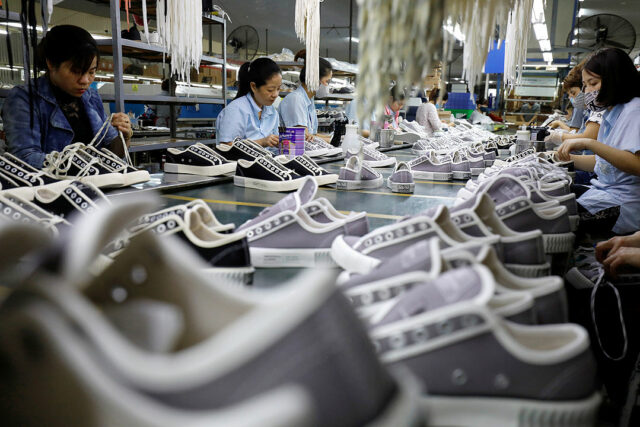
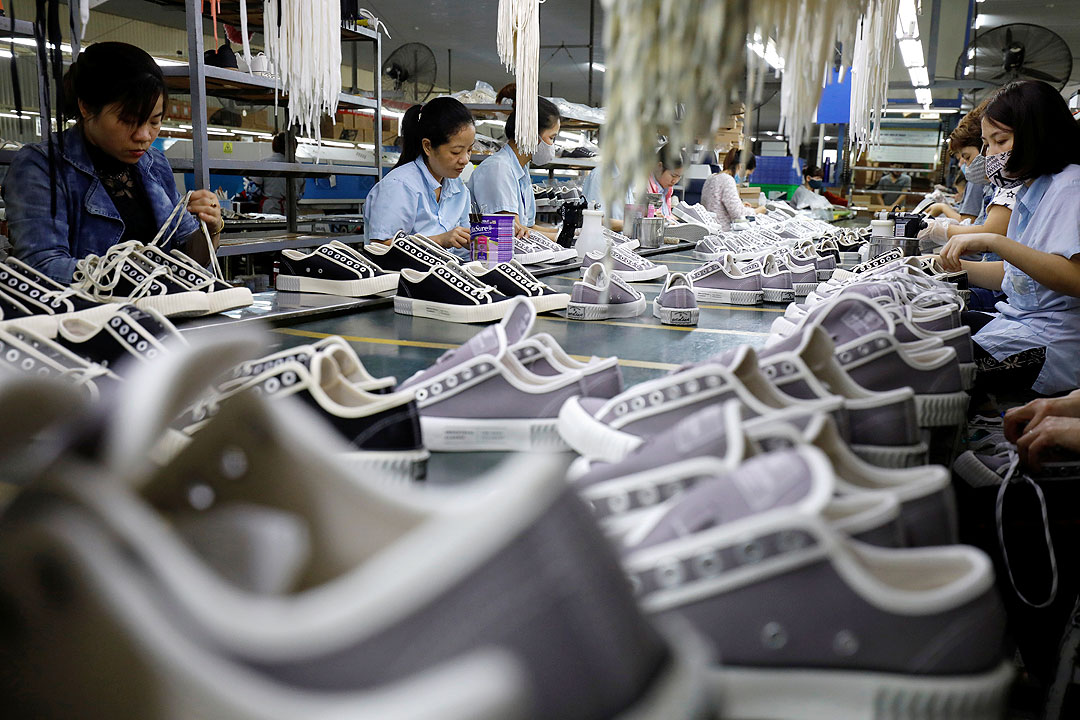
Employees work at a shoe factory for export in Hanoi, Vietnam, Dec. 29, 2020. — REUTERS

TOKYO — Asia’s factory activity slowed in May as China’s heavy-handed coronavirus curbs continued to disrupt supply chains and dampen demand, adding to woes for some of the region’s economies that are already under strain from surging raw material costs.

Manufacturers slowed activity last month in countries ranging from Japan to Taiwan and Malaysia, business surveys showed on Wednesday, a sign of the challenge policy makers face in combatting inflation with tighter monetary policy — without crippling growth.

China’s Caixin/Markit Manufacturing Purchasing Managers’ Index (PMI) stood at 48.1 in May, improving slightly from 46.0 the previous month but staying below the 50-point threshold that separates contraction from expansion, a private survey showed.

The outcome was in line with Tuesday’s official data that showed China’s factory activity fell at a slower pace in May. While coronavirus disease 2019 (COVID-19) curbs are being rolled back in some cities, they continue to weigh heavily on confidence and demand.

“Disruptions to supply chains and goods distribution may gradually ease as Shanghai’s lockdown ends. But we’re not out of the woods as China hasn’t abandoned its zero-COVID policy altogether,” said Toru Nishihama, chief economist at Dai-ichi Life Research Institute in Tokyo.

“Rising inflation is forcing some Asian central banks to tighten monetary policy. There’s also the risk of market volatility from US interest rate hikes. Given such layers of risks, Asia’s economy may remain weak for most of this year.”

CHINA SPILLOVER
Lockdowns in China have snarled regional and global logistics and supply chains, with both Japan and South Korea reporting sharp declines in output.

Japan’s manufacturing activity grew at the weakest pace in three months in May and manufacturers reported a renewed rise in input costs, the PMI survey showed, as the fallout from China’s lockdowns and the Ukraine conflict pressured the economy.

The final au Jibun Bank Japan PMI fell to a seasonally adjusted 53.3 in May from the previous month’s 53.5, marking the slowest pace since February.

“Both output and new orders rose at softer rates, with the latter rising at the weakest pace for eight months amid sustained supply chain disruption and raw material price hikes,” said Usamah Bhatti, an economist at S&P Global Market Intelligence.

“Disruptions were exacerbated by renewed lockdown restrictions across China, and contributed to a further sharp lengthening of suppliers’ delivery times.”

Factory activity in the Philippines also slowed to 54.1 in May from 54.3 in April, while that for Malaysia fell to 50.1 from 51.6 in April, PMI surveys showed. Taiwan’s manufacturing activity stood at 50.0 in May, down from 51.7 from April.

In a glimmer of hope, South Korea’s exports grew at a faster pace in May than a month earlier, data showed on Wednesday, as a rise in shipments to Europe and the United States more than offset the fallout from China.

South Korea’s monthly trade data, the first to be released among major exporting economies, is considered a bellwether for global trade. — Reuters

PHL Senate fails to ratify RCEP

PHILIPPINE STAR/EDD GUMBAN

By Alyssa Nicole O. Tan, Reporter

THE PHILIPPINE Senate deferred the ratification of the Regional Comprehensive Economic Partnership (RCEP), after some senators voiced concern over the lack of safeguards for the agriculture sector.

Senators on Wednesday adjourned its last session without taking a vote on the RCEP, touted as the world’s biggest trade agreement since it represents 30% of the global gross domestic product (GDP).

RCEP, which entered into force on Jan. 1, is a trade agreement involving Australia, China, Japan, South Korea, New Zealand and the 10 members of the Association of Southeast Asian Nations (ASEAN).

Aside from the Philippines, only two other countries have not yet ratified the RCEP — Indonesia and Myanmar.

It will now be up to the 19th Congress to tackle the RCEP when the session opens in late July. 

Earlier on Wednesday, the Financial Executives Institute of the Philippines (FINEX), the Makati Business Club (MBC), and the Management Association of the Philippines (MAP) once again appealed to the Senate to ratify the Philippines’ membership in the RCEP. 

“Exclusion from RCEP would be immensely costly to our economy and our people. We can anticipate a significant decline in our exports to RCEP countries, which now account for nearly two-thirds (64%) of our total exports, as trade with us will logically be diverted to fellow members,” the business groups said.

Without RCEP membership, the business groups said the Philippines would become “even more unattractive to job-creating investments than we already are.”

“Our membership could attract more foreign investments into the country from firms wishing to produce and sell to the large RCEP market,” they added.    

President-elect Ferdinand R. Marcos, Jr. earlier said he wants a review of the RCEP to determine whether the agriculture sector is adequately protected.

Some senators had raised concerns over the RCEP, citing the lack of safeguards for the agriculture sector.

“We have an incoming government who has expressed his concern about being able to review RCEP. We believe that government intervention for the agriculture sector is critical for us to be able to ensure that our entry into RCEP will not undermine our agriculture sector and will not further weaken our local manufacturers, produces, our farmers, and our fisherfolk,” Senator Francis N. Pangilinan said during plenary debates late Tuesday.

“To my mind, there is no reason why we should not enter RCEP at a time when we are ready, and another 18 months, I hope, would be a set target, a deadline, so that the government will be compelled by June 2023,” he added.

Senator Ana Theresia “Risa” N. Hontiveros-Baraquel also said the country is not yet ready for RCEP.

“With our market access right now, we can continue to trade as we do today even if we do not ratify RCEP… RCEP is predicted to worsen the Philippines’ trade balance which would cause job losses and $58 million per year in tariff revenue losses,” she said at a press conference on Wednesday.

‘TREMENDOUS’ COST
Senate Foreign Relations Committee Chair Senator Aquilino Martin L. Pimentel III on Tuesday said the Philippines’ international reputation will be damaged if it fails to ratify RCEP, noting that the country has spent years actively negotiating the terms of the deal.

“The cost of delay is tremendous… Investors who want to take advantage of the largest trading bloc in the world would want to locate in RCEP countries, so we will not be in the radar. What’s worse is if those located in the country will relocate to RCEP ratifying countries,” Mr. Pimentel said.

Asked if the country was ready, Mr. Pimentel said 30 agencies have been studying this treaty and the Philippines has been preparing for eight years.

“Sometimes we just need to be pushed to compete, and the value of a free trade agreement is actually in its use… so we should use it,” she said.

At the same time, the three business groups said RCEP would help micro, small, and medium enterprises (MSMEs) expand market access, as well as reduce costs of doing business through improved trade facilitation.

“We see our membership in RCEP as an important challenge to our government to step up genuine and meaningful support for Filipino producers, especially in the agriculture sector, which is the backbone of the Philippine economy. We, therefore, urge the government to provide a substantial increase in the agriculture budget commensurate to that provided in our comparable ASEAN neighbors, as we urge our senators to ratify the RCEP Agreement without delay,” they added.    

Meanwhile, farmers group Federation of Free Farmers (FFF) National Manager Raul Q. Montemayor said in a letter sent to the Senate on Monday that the incoming Marcos administration should be given the opportunity to study the RCEP in order to maximize the benefits and reduce the adverse effects on various sectors.    

“Concurring with the agreement now, even as questions on trade remedies and the preparedness of our agriculture sector have yet to be fully answered, will unnecessarily tie the hands of the incoming administration and preempt whatever measures it might have to take to prepare the country for accession,” Mr. Montemayor said. — with Revin Mikhael D. Ochave