Home Blog Page 6334

N. Korea fires volley of missiles

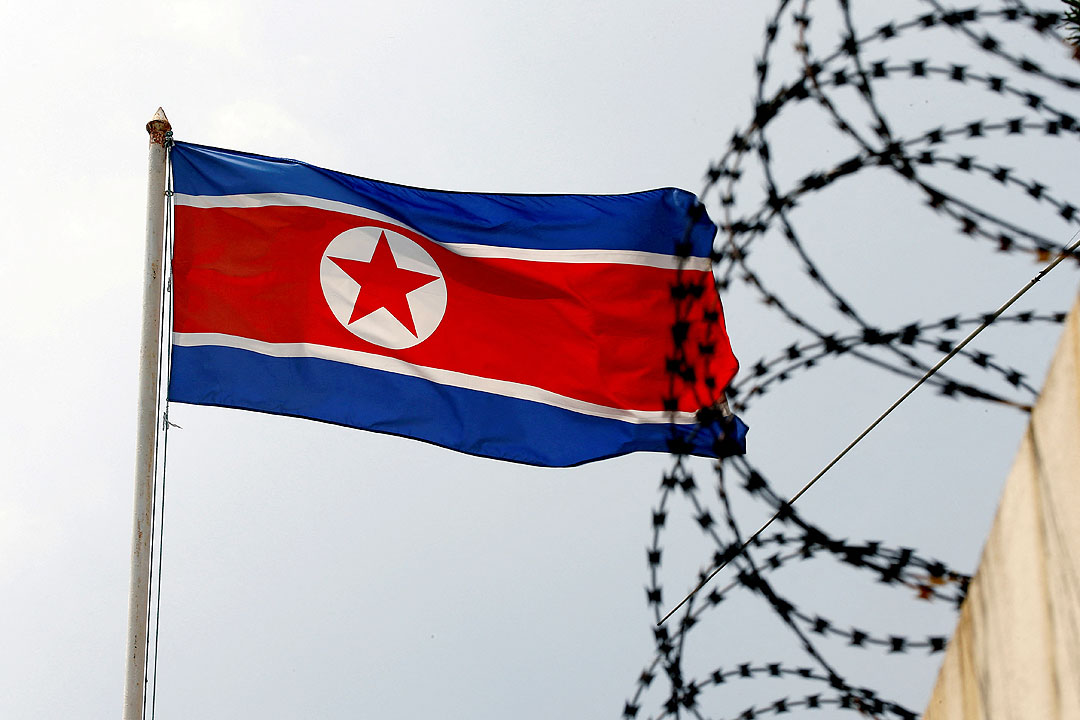
A North Korea flag flutters next to concertina wire at the North Korean embassy in Kuala Lumpur, Malaysia March 9, 2017. — REUTERS/EDGAR SU/FILE PHOTO

South Korea calls it a ‘test’ of new government

SEOUL — North Korea fired eight short-range ballistic missiles towards the sea off its east coast on Sunday, likely its largest single test, a day after South Korea and the United States ended joint military drills.

The bilateral exercises involved an American aircraft carrier for the first time in more than four years.

South Korea’s Joint Chiefs of Staff said that at least eight missiles were fired from the Sunan area of the North Korean capital Pyongyang and they flow between 110 km-600 km (70-370 miles) at altitudes between 25 km to 90 km.

In response, South Korea President Yoon Suk-yeol convened a National Security Council (NSC) meeting and ordered “expanded deterrence of South Korea and the United States and continued reinforcement of united defense posture”.

The NSC meeting concluded that the missile launch was North Korea’s “test and challenge” of the security readiness of South Korea’s new administration, which took office last month, the president’s office said in a news release.

South Korea’s Ministry of Foreign Affairs said Kim Gunn, its Special Representative for Korean Peninsula Peace and Security Affairs, discussed the provocation with US Special Representative Sung Kim, the US point man on North Korean affairs. Kim Gunn also held a telephone conference with his Japanese counterpart Funakoshi Takehiro.

Japanese Defense Minister Nobuo Kishi said the North had launched multiple missiles, and that the act “cannot be tolerated.” He said at a briefing that at least one missile had a variable trajectory, which indicates it could maneuver to evade missile defenses.

The US Indo-Pacific Command said in a statement that North Korea’s multiple ballistic missile launches highlighted the destabilizing impact of its illicit weapons program but that the event didn’t pose an immediate threat.

Michael Duitsman, with the US-based James Martin Center for Nonproliferation Studies (CNS), said it appeared to be the largest single test ever by North Korea. A large number of missiles also suggests a military drill or show of force, rather than a test of new technology.

The launch also followed a visit to Seoul by Sung Kim, who departed on Saturday.

He met his South Korean and Japanese counterparts on Friday to prepare for “all contingencies” amid signs North Korea was preparing to conduct a nuclear test for the first time since 2017.

MORE SANCTIONS
Washington has made very clear directly to Pyongyang that it is open to diplomacy, Kim said during the visit, noting that he was willing to discuss items of interest to Pyongyang, such as sanctions relief.

Last week, the United States called for more U.N. sanctions on North Korea over its ballistic missile launches, but China and Russia vetoed the suggestion, publicly splitting the U.N. Security Council on North Korea for the first time since it started punishing it in 2006, when North Korea conducted its first nuclear test.

In recent weeks, North Korea has test-fired a range of missiles, including its largest intercontinental ballistic missile (ICBM).

North Korea’s last tests were on May 25, when it launched three missiles after US President Joseph R. Biden ended an Asia trip where he agreed to new measures to deter the nuclear-armed state.

The first missile appeared to be the North’s largest ICBM, the Hwasong-17, while a second unspecified missile appeared to have failed mid-flight, South Korean officials said at the time. The third missile was a short-range ballistic missile (SRBM).

On Saturday, South Korean and American ships concluded three days of drills in international waters off the Japanese island of Okinawa, including air defense, anti-ship, anti-submarine, and maritime interdiction operations, South Korea’s Joint Chiefs of Staff said.

It has said the exercises “consolidated the two countries’ determination to sternly respond to any North Korean provocations”.

The exercises included the USS Ronald Reagan, a 100,000-ton nuclear-powered aircraft carrier, among other major warships.

South Korean President Yoon Suk-yeol, who took office on May 10, had agreed with Mr. Biden to increase bilateral military drills to deter North Korea.

North Korea has criticized previous joint drills as an example of Washington’s continued “hostile policies” toward Pyongyang, despite its talk of diplomacy. — Reuters

Prince Charles pays heartfelt tribute to mum Queen Elizabeth

A DRONE DISPLAY is seen during the BBC Platinum Party at the Palace, as part of the Queen’s Platinum Jubilee celebrations, in London, Britain, June 4. — REUTERS/HENRY NICHOLLS/POOL

LONDON — Prince Charles paid an emotional personal tribute to his mother, Queen Elizabeth, on Saturday during celebrations to mark her Platinum Jubilee, praising the monarch for uniting the nation and continuing to make history during her 70-year reign.

Charles spoke at a pop concert that opened with a comic sketch of the 96-year-old monarch having tea with Paddington Bear and tapping out the tune to the Queen anthem “We Will Rock You” on her china teacup.

The heir-to-the-throne appeared towards the end of the concert at Buckingham Palace. As images of Elizabeth’s reign were displayed on the walls, Charles, 73, said the Jubilee had given the country the chance to say thank you.

“You pledged to serve your whole life — you continue to deliver. That is why we are here,” he said in a message to the queen, who was at her Windsor Castle residence outside London.

“You have met us and talked with us. You laugh and cry with us and, most importantly, you have been there for us, for these 70 years,” he added, referring to the queen as “mummy”.

The Saturday festivities were among a number of Jubilee events that Elizabeth has missed because of “episodic mobility problems” that have caused her to cancel engagements recently.

The opening video with the fictional character Paddington had echoes of 2012 when the queen appeared with Britain’s most famous fictional spy, James Bond, in a video for the opening ceremony of the London Olympics.

In the clip released on Saturday, she told Paddington she always kept the Bear’s favorite — a marmalade sandwich — in her ever-present handbag.

A palace spokesman said: “The opportunity to invite a famous bear to tea was just too much fun to miss.”

Queen’s “We Will Rock You” then opened the show before the cast of “Hamilton,” Andrea Bocelli, Alicia Keys and Diana Ross performed in front of tens of thousands of people crammed around the palace, down the Mall grand boulevard and in a nearby park.

Charles and wife Camilla; son William, wife Kate and their two eldest children sang along with the crowd before an aerial drone light show projected images into the sky, including the monarch on a stamp and the outline of her dogs.

The four days of celebrations to mark the monarch’s seven decades as queen began on Thursday with a military parade and a Royal Air Force flypast, and a National Service of Thanksgiving on Friday.

At the concert, Prince William spoke about his family’s record on the environment, while Charles also acknowledged his father, Prince Philip, who died last year aged 99.

“My papa would have enjoyed the show and joined us wholeheartedly in celebrating all you continue to do for your country and your people,” he said.

“You continue to make history.”

Elizabeth ascended the throne aged 25 on the death of her father, George VI, in 1952, inheriting dominion over a Britain still emerging from the ravages of World War II and with Winston Churchill as prime minister.

In total, there have been 14 prime ministers and 14 US presidents during her reign; the Berlin Wall rose and fell; Britain joined and left the European Union; and her nation’s own once-mighty empire disintegrated, replaced by a Commonwealth of 54 nations. Elizabeth was instrumental in creating the latter and many regard its success as her greatest achievement.

Polls suggest a comfortable majority believe the monarchy should remain. A recent Ipsos survey put support for the queen at 9 out of 10 respondents. But Charles is less popular and support among the young is waning.

Supporters see the queen as a source of soft power in the world and a stabilizing factor: a bridge between the nation’s past and its present.

As Charles delivered his tribute, projections of the queen, which he had selected, were beamed onto the walls of the palace.

These included a carriage ride with former South African President Nelson Mandela during his 1996 state visit and her famous 2012 handshake with former IRA guerrilla commander Martin McGuinness, who later became the deputy first minister of Northern Ireland. — Reuters

Australia says Chinese fighter jet intercepted surveillance craft in May

REUTERS

SYDNEY — A Chinese fighter aircraft dangerously intercepted an Australian military surveillance plane in the South China Sea region in May, Australia’s defense department said on Sunday.

The Royal Australian Air Force P-8 maritime surveillance aircraft was intercepted by a Chinese J-16 fighter during “routine maritime surveillance activity” in international airspace in the region on May 26, the defense department said in a statement.

“The intercept resulted in a dangerous maneuver which posed a safety threat to the P-8 aircraft and its crew,” it said.

Prime Minister Anthony Albanese told reporters in Perth that his government had expressed concerns to China “through appropriate channels”.

China’s embassy in Australia did not immediately respond to a request for comment.

Defense Minister Richard Marles said the Chinese jet flew very close in front of the RAAF aircraft and released a “bundle of chaff” containing small pieces of aluminum that were ingested into the Australian aircraft’s engine.

“Quite obviously this is very dangerous,” Mr. Marles told ABC television.

Australia has previously joined the United States in stating that China’s claims around contested islands in the South China Sea do not comply with international law.

The Defense department said for decades it had undertaken maritime surveillance in the region and “does so in accordance with international law, exercising the right to freedom of navigation and overflight in international waters and airspace”.

Relations between Australia and China, major trading partners, have been strained recently over growing Chinese influence in the Pacific after China sought a regional security deal with Pacific Island nations.

Also in May, a Chinese intelligence ship was tracked off Australia’s west coast within 50 nautical miles of a sensitive defense facility, which is used by Australian, US and allied submarines. — Reuters

Top Duterte critic insists drug charges against her fabricated

SENATOR Leila de Lima listening to a police officer who served the warrant for her arrest at the Senate grounds in Pasay City on Feb. 24, 2017.

ONE of President Rodrigo R. Duterte’s most vocal critics on Sunday said the government had fabricated the drug trafficking charges against her to shut her out, after four witnesses retracted their charges against her.

“The fact that all of this is coming out as Duterte’s term ends indicates that the Duterte administration’s cases against me are purely manufactured and fabricated in order to persecute, destroy and silence me,” Senator Leila M. de Lima, 62, said in a statement.

The Justice department, which will have a new chief chosen by incoming President Ferdinand R. Marcos, Jr., has said it would review evidence against Ms. De Lima.

Justice Secretary Menardo I. Guevarra, a Duterte appointee, on Saturday said the review would take a few days.

“The prosecution needs to reassess the strength of its overall evidence in the light of the retractions of certain witnesses,” he said. “If the prosecution believes that such recantations do not affect its case, then the prosecution will maintain its course.”

The drug charges against Ms. De Lima started after she led a Senate investigation of Mr. Duterte’s war on drugs that has killed thousands.

As head of the Commission on Human Rights, she also probed the assassination of suspected drug pushers by the so-called Davao Death Squad, allegedly upon the orders of Mr. Duterte when he was still the city mayor.

In April, self-confessed drug lord Rolan “Kerwin” Espinosa took back his testimony implicating Ms. De Lima in illegal drugs when she was still Justice secretary.

“Any statement I made against the senator is false and was the result only of pressure, coercion, intimidation and serious threats to my life and family members,” he said in an affidavit submitted to the Justice department.

He claimed to have been coerced by police into testifying against Ms. De Lima during Senate hearings investigating the illegal drug trade inside the national jail when the senator was still Justice secretary. He apologized to the senator for linking her to the illegal drug trade.

Days later, former Bureau of Corrections Director General and ex-National Bureau of Investigation Deputy Director Rafael Z. Ragos took back his allegations that Ms. De Lima had received P5 million in drug money from him — care of convicted drug lord Peter Co — when she was still Justice secretary in 2012. She allegedly used the fund to finance her senatorial bid in 2016. 

Another witness, Joel Capones, testified at Ms. De Lima’s bail hearing in a Muntinlupa trial court that he did not have knowledge of drug money worth P1.4 million she had allegedly pocketed.

On May 24, Marcelo L. Adorco said he had been coerced into implicating the senator and other people in the illegal drug trade.   

“The truth is, I was only forced to sign my previous affidavit which accused these people of being involved in illegal drugs because I feared for my life and safety,” he said in a statement.

He said a former high-ranking police officer had forced him to sign affidavits in 2016 and 2017, which said Ms. De Lima and Espinosa had met up in Baguio City.

“The affidavit was written by a police officer in a police station in Albuera, Leyte, by the orders of the former chief of the Albuera police,” Mr. Adorco said.

Ms. De Lima has asserted her innocence, saying she was being prosecuted for criticizing Mr. Duterte’s drug war.

Human Rights Watch has said Ms. De Lima has suffered five years in detention for a crime that key witnesses now dispute. “The authorities should immediately drop the politically motivated charges and release her, and impartially investigate the witnesses’ claims that they were coerced to give false testimony,” Phil Robertson, deputy Asia director at Human Rights Watch, said in a statement. — Alyssa Nicole O. Tan

Marcos to continue vlogging despite busy presidential schedule

PHILIPPINE STAR/KRIZ JOHN ROSALES

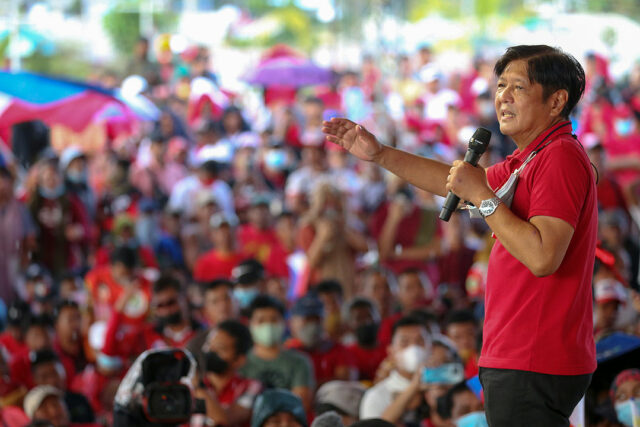
PRESIDENT-ELECT Ferdinand “Bongbong” R. Marcos, Jr. at the weekend said he would continue vlogging during his presidency.

This would allow him to update the public on his latest activities, he said in a YouTube video.

“We will continue this vlog,” he said. “Every so often, we will explain our activities so that you don’t just get your news about us from newspapers but also from the horse’s mouth.”

Mr. Marcos made the statement in his latest video blog after a follower asked him to continue vlogging despite his busy schedule.

He said vlogging would allow his camp “to hear your comments on the shortcomings that we need to address.”

Incoming Press Secretary Rose Beatrix Cruz-Angeles, a pro-administration blogger, earlier said they would accredit vloggers who want to cover presidential events, including news briefings.

Danilo A. Arao, a press freedom advocate and journalism professor at the University of the Philippines, earlier said the Marcos camp should clarify whether it had consulted the Malacañang Press Corps and other sectors about the plan.

YouTube is not doing enough to tackle the spread of misinformation and disinformation on its platform, according to a global coalition of fact-checking organizations.

YouTube, “a major conduit” of falsehoods, is “allowing its platform to be weaponized by unscrupulous actors to manipulate and exploit others, and to organize and fundraise themselves,” according to a letter to YouTube Chief Executive Officer Susan Wojcicki signed by more than 80 fact-checking groups. “Current measures are proving insufficient.” — Kyle Aristophere T. Atienza

Court upholds charges vs agent for hiding wealth

PHOTO BY MIKE GONZALEZ

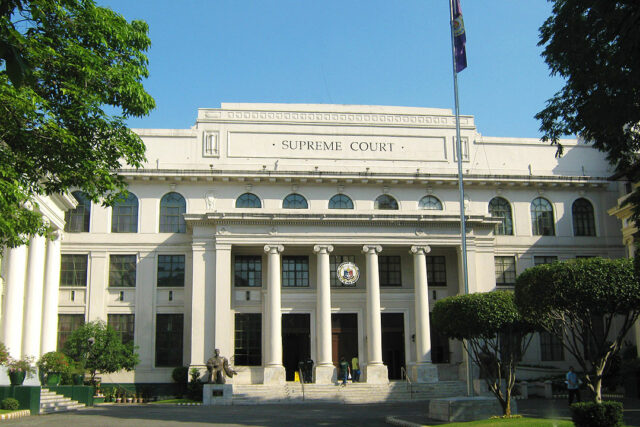
THE SUPREME Court has upheld the indictment by the Ombudsman of a Customs agent for hiding properties he bought while working for the bureau.

In a Nov. 24 decision posted on the High Court’s website on May 18, the tribunal ruled that Ramir S. Gomez should be charged with corruption for failing to file his net worth statement for 2003.

The Department of Finance Revenue-Integrity Protection Service earlier accused the agent of failing to file the statement, failing to disclose six residential lots in Olongapo City and falsely declaring his handguns, cars and housing loans.

Mr. Gomez had denied the charges. He also said he did not declare his 9mm caliber pistol in his net worth statement because it was being repaired.

The Ombudsman in 2017 charged him with three counts of perjury for allegedly lying about the properties.

The Finance department appealed the indictment as it sought to include more charges for four more counts of perjury of falsification of public documents under the Revised Penal Code. The agent also filed his own petition for review.

It said the Customs agent had willfully lied in his net worth statements for 1996, 2004 and 2005. The Ombudsman rejected the proposed changes. Under the law, a person convicted of perjury faces up to 10 years in prison.

Both the Finance department and Mr. Gomez said the Ombudsman had gravely abused its authority.

In its ruling, the tribunal said it does not generally interfere with the Office of the Ombudsman’s findings.

It added that the other false assertions made by Mr. Gomez had lapsed and he could no longer be prosecuted for perjury.

The discovery of falsification and perjury should have been considered at the time of the filing of his net worth statement since the false assertions were discovered only in 2015, the court said.

“An act of a court or tribunal can only be considered a grave abuse of discretion when such act is done in a capricious or whimsical exercise of judgment as is equivalent to lack of jurisdiction,” it added.

“Disagreement with its findings is not enough to constitute grave abuse of discretion. There must be a showing that it conducted its proceedings in such a way that amounted to a virtual refusal to perform a duty under the law. — John Victor D. Ordoñez

Ombudsman orders suspension of ARTA officials for graft 

The Ombudsman has ordered the suspension of five officials of the Anti-Red Tape Authority including its chief pending a corruption investigation in connection with the grant of  telecommunication frequencies to a local player. 

In a three-page order dated May 24 and made public only on Sunday, Ombudsman Samuel R. Martires said their six-month suspension would prevent the officials from influencing the case and harassing witnesses.  

“The evidence on record shows that the guilt of the respondents… is strong,” according to a copy of the order. “The charges against them involve grave misconduct, gross neglect of duty and conduct prejudicial to the best interest of the service.”  

Mr. Martires issued the suspension order based on a complaint filed by Dito Telecommunity, Inc., which is being represented by Adel A. Tamano, its chief administrative officer.  

The Anti-Red Tape Authority in March last year issued an order of automatic approval for the assignment of contingent frequencies to Dito rival Now Telecom Co., Inc. after the National Telecommunications (NTC) failed to act on its application.  

But Dito said these frequencies had been assigned to it as a new major player. Dito has sought to intervene in the ARTA case, while the NTC asked the agency to recall the automatic approval.  

NTC proceedings are quasi-judicial in nature and are not covered by the automatic approval clause, it said, citing an opinion of the Justice department.  

In its order, the Ombudsman asked Executive Secretary Salvador C. Medialdea to enforce the suspension of the ARTA officials. — John Victor D. Ordoñez 

Distance makes the vote grow farther: The Filipino migrant vote

The recently concluded Philippine elections saw the landslide win of Ferdinand Marcos, Jr., whose victory is historical for two reasons. First, while parts of the world have voted to reject candidates linked to former dictators and far right parties (e.g., Chile 2021, Peru 2021, France 2022), the Filipino people have thrown their support behind the son and namesake of the country’s former dictator. Second, this is the first election in more than 30 years that the winning presidential candidate has garnered a majority of the votes. This victory is also thanks to the millions of Filipino migrants worldwide.

THE FILIPINO MIGRANT
In 2019, the Philippines was the ninth highest migrant-sending country and the fourth highest remittance-sending country in the world. According to the Philippine Statistics Authority (PSA), as of 2020, there were 1.77 million overseas Filipino workers, most of whom reside in the Middle East (57.5%) and East Asia (17.7%), with Saudi Arabia and Hong Kong as the top two destinations.1 Filipino migrants are mostly engaged in low-skilled work: 46.7% in elementary occupations, 14.4% in service and sales, and 11.5% in plant and machine operations.2

These overseas Filipino workers comprise a large proportion of the Filipino voters abroad, which also include migrants who permanently reside in their host countries and are already dual citizens. Extraterritorial voting was first implemented in the 2004 elections and has since seen ever-larger figures for voter registration and turnout. While the numbers have grown tremendously, the COVID-19 pandemic caused migrants to go home in droves, leading to a reduction in the number of registered overseas voters for the 2022 elections at 1.7 million, down from 1.82 million in 2019. Data from the Commission on Elections shows that more than 40% of registered overseas voters come from the Middle East, and around 23% reside in East and Southeast Asia.

2022 PHILIPPINE ELECTIONS: A HISTORICAL JUNCTURE
The 2022 elections in the Philippines looked like a case of history repeating itself: the two main presidential contenders were the former dictator’s son Ferdinand Marcos, Jr. and the incumbent vice-president Leni Robredo, both of whom ran for vice-president in 2016. Interestingly, their contrast, as reported by the media, cannot be more stark: Marcos Jr. and his family have unpaid estate taxes of $3.9 billion, and he has lied about his educational background, while Robredo has no corruption cases to her name (a rare occurrence in top government posts), and her programs have been awarded for their best practices and efficiency. Despite this, history did not repeat itself: this time, Marcos Jr. won convincingly.3

HOW DID THE FILIPINO MIGRANTS VOTE?
According to the latest available data, around 620,000 overseas voters cast their votes, resulting in a 36.5% turnout rate, which is significantly higher than the two previous presidential elections.4 While domestic voters gave Marcos Jr. 58.6% of the vote, overseas voters gave him a much greater majority — an unprecedented 72.7% of the vote. Of the countries and voting centers with available data, Marcos Jr. won all but one of those, with the main opposition candidate Robredo winning only one (Vatican City).

How does this compare with migrants’ historical voting behavior? Looking at the data, Filipino migrant voting behavior seems to be fairly consistent across space and time. In the 2016 elections, then presidential candidate Rodrigo Duterte received 38.7% of the domestic vote and 72% of the diaspora vote. Duterte went on to win 58 of 59 countries, with the second placer Mar Roxas getting only one (Vatican City). In the 2010 and 2004 elections, the winning candidates also received higher vote shares from the diaspora than the domestic voters: Benigno Aquino got 42% domestically and 55.7% overseas, while Gloria Macapagal-Arroyo got 40% and 44.4% respectively.

While the magnitudes vary, the trend of the diaspora providing stronger support towards the winning candidate is consistent. If any, the difference lies in the type of candidate that migrants support: sometimes they vote to maintain the status quo (in the case of Macapagal-Arroyo, who was the incumbent, and now Marcos Jr., who was seen as the “continuity” candidate to Duterte’s populism), and sometimes they vote for change (in the case of Aquino, who ran under a platform of eliminating corruption, of which Macapagal-Arroyo was accused; and in turn with authoritarian-leaning Duterte, who was the opposition candidate to Aquino’s liberal governance). 

WHAT EXPLAIN THE DIASPORA VOTE?
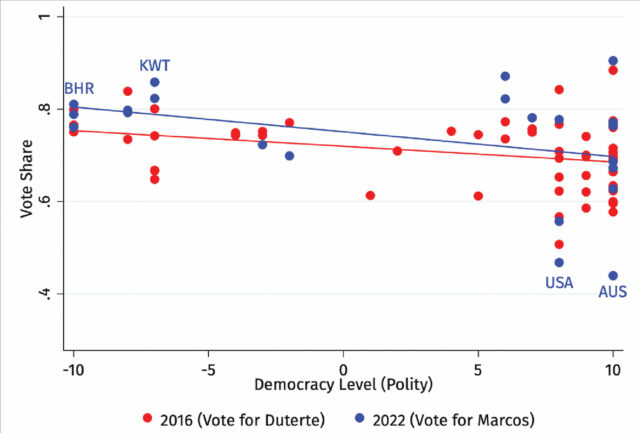
At an aggregate level, it seems that migrants tend to vote in high proportions for the same candidate. However, breaking the results down by country of residence shows a more interesting picture. Using the Polity score to proxy for democracy status, the Figure shows that migrants from less democratic countries, such as Bahrain and Kuwait, are more likely to support Marcos Jr. (and Duterte back in 2016), as evident in the higher vote shares.5

This suggests the potential link between migration to democratic countries and support for more liberal candidates. However, without further data, it is hard to disentangle two distinct but plausible hypotheses: 1.) the migrant’s environment shapes his/her voting behavior (i.e., political socialization), and, 2.) the host environment attracts a particular profile of migrants (i.e., migrant selection).

On the one hand, it is possible that moving to democratic countries exposes migrants to more democratic ideals, and hence support candidates who engender such principles.

On the other hand, it could be the case that certain countries attract specific types of migrants largely due to immigration policies and job opportunities. In the case of the Philippines, countries in the Middle East and Asia (particularly Hong Kong) have greater demand for low-skilled workers (e.g., domestic work).

While the two mechanisms are likely at play in the Philippine case, the findings above might also reflect the broader trend towards authoritarianism and democratic backsliding, as evidenced by the migrant support for Aquino in 2010 and for Duterte and Marcos, Jr. in 2016 and 2022, respectively.

UNDERSTANDING EMIGRANT VOTING PATTERNS
Ultimately, better analysis would be possible with more disaggregated data: election results from 2004 onwards for each country of residence, and migrant characteristics for each host country across time. While migrants are rarely pivotal to the result, studying their voting behavior can be illuminating, not just of their political preferences, but the potential impact of their migration experience as well.

This article asks more questions than it aims to answer: 1.) What explains OFWs’ stronger support for the winning candidate? 2.) Can OFWs influence their families back home to vote for their chosen candidates? 3.) Why is diaspora turnout lower than the domestic turnout despite the special 30-day window, and, 4.) Can OFWs’ turnout improve in the future and their votes prove pivotal to upcoming Philippine elections?

1 The Survey of Overseas Filipinos found that the number of Filipino migrant workers decreased by 18.6% from 2019 to 2020, mostly attributable to the COVID-19 pandemic.

2 In contrast, Filipinos at home are less likely to be low-skilled: 25.6% in elementary occupations, 19.6% in service and sales, and 7.9% in plant and machine operations. A larger proportion is high-skilled: 15% of domestic Filipinos are managers and professionals, while this figure is only 9.7% for Filipino migrants.

3 The reason behind his rise is beyond the scope of this article, although pundits claim that social media played a central role.

4 Compared to the historical diaspora turnout of 27% in 2010 and 65% in 2004, domestic turnout has been consistently high, ranging from 73-82% in the past decades.

5 In 2010, regional vote shares suggested the opposite: voters from Europe and the Americas gave Aquino stronger support (61-63%), while those from the Middle East, North Africa and Asia Pacific supported him less (51-58%). Due to lack of data, only regional-level shares are available for 2010, and only the diaspora aggregate share is available for 2004. We use the latest available Polity score data for the Philippines, 2018 for 2022.


Laurence Go is a senior fellow of Action for Economic Reforms and leads its program on data-driven development (3D).

Rule-of-law, credible commitment, and investment under President Marcos Jr.

TEAMBBM2022OFFICIAL
TEAMBBM2022OFFICIAL

There is a wise game theory principle called “backward induction rationality” which states that no matter what came before, your next and subsequent moves should be dictated by the best outcome you can attain at the conclusion of the process. Ferdinand Marcos, Jr. is president of the Philippines for the next six years. Our best course of action should now be anchored on the best possible outcome for the nation given these new political and economic realities.

One salient economic reality is the draconian P13-trillion public debt and 8% fiscal deficit — worrying because these were fellow travelers when the Philippine economy was hurtling to the bottom of the East Asian barrel. A debt crisis? Not if the economy grows rapidly and sustainably faster than the debt. But since sustained economic growth flows from sustained high investment, the question is: How will investment behave moving forward?

The healthy Q1 2022 growth was widely hailed as a portent for that future. But is not the Q1 growth largely a low base effect and vengeance spending story? The massive 20% growth in investment baked in a catapult sling of -14% growth in Q1 2021. The 8.3% Q1 2022 GDP growth got an adrenalin boost from a -3.8% GDP growth in Q1 2021. For all the hullaballoo, the investment rate (Gross fixed capital formation or GFCF share in GDP) in Q1 2022 stayed at a low of 21.5%. That portends anemic, not stellar growth. Our investment rate has always miserably lagged behind our rivals. An average investment rate in the 25%-40% range sustained for two or more decades was the propellant for the East Asian miracle economies.

On the heels of Q1 growth came the boast of the National Economic and Development Authority (NEDA) that the high middle-income status is doable for the Philippines by 2023! Truly, we live on hope!

A high middle-income status means, by World Bank standards, a per capita income of between $4.09 thousand and $12.6 thousand. In 2021, our per capita income was either $3.16 thousand by World Bank et al. or $3.5 thousand by the Philippine Statistics Authority (PSA) reckoning. If we go by the PSA’s reckoning and if GDP grows by the NEDA’s target (7% in 2022 and 2023), we will still be at $4,000/capita in 2023 or lower ($3.93 thousand/capita) if we factor in population growth of 1%. If by the $3.2 thousand estimate, we would just be at $3.66 thousand in 2023 ($3.59/capita with population growth). Starting with $3.2 thousand and factoring in population growth, we shall barely make the high middle-income country status by 2026. And we could still miss the doubtful honorific — with global inflation hitting new peaks, the target will likely be $4.2 thousand by 2023. Meanwhile, the NEDA target of 7% growth is itself aspirational; the continuing oil and food price spikes coming on the heels of the lingering COVID-19 crisis see to that. President Rodrigo Duterte’s watch in a more growth conducive times (excluding the pandemic year 2021 and 2022) could only manage a real GDP growth average of 6.2% about  equal to that of President Benigno Aquino. Since it is investments that will make or break us, how will investments fare?

Investment comes both from the government and the private sector. When Duterte came to power in 2016, the government had money flowing out of its ears, thanks partly to what a current (and past) fiscal appointee once called the “crime of underspending” under President Aquino. When Marcos pere seized power in the 1970s, recycled petrodollars were begging to be borrowed at giveaway real interest rate. Marcos pere’s martial law watch (1972-85) attained no more than 3.2% GDP growth. By contrast, Marcos Jr. comes to power when the fiscal till is empty and facing greater demand for safety net resources. Granting the Philippine economy more open under President Marcos Jr., will private investment cover the comedown in government investment? Unlikely. Curses are likelier for the sitting president when the new taxes and spending reduction hit the road. Leni Robredo, more valuable to the nation now as a symbol than as a commander-in-chief going to war without bullets, will be spared those curses. Duterte sure paved the way for BBM to become PBBM, but it could also be fiscally booby-trapped to pave a detour to Vice-President Sara Duterte. One consolation for those fearful of Marcosian excesses: penury is a poor hunting ground for profligacy!

With an elevated fiscal deficit (the programmed deficit is 8.2% of GDP for 2023) and a faltering credit rating, further foreign borrowing will be limited. We will compete with more politically popular Ukraine- and hunger-related sovereign and multilateral loans. The sale of government assets has bailed out past tottering fiscal positions but the most valuable state assets have already been alienated. IMF-type conditionalities — new and/or higher taxes and reduced spending — beckon. So, it is really higher taxes or bust for the Department of Finance (DoF)!

And there’s the rub — with Filipinos still aching from a serious income spill, will not higher taxes be greeted with great resentment? Complicating the DoF’s problem: the final arbiter on spending has a tax evasion conviction on his head and has an unsettled estate tax liability. With likely higher taxes, a foreign investor will think twice about locating in the Philippines whose corporate income tax is 25% versus Vietnam’s 17%. Philippine Economic Zone Authority investment pledges continue to retreat, agnostic it seems to recent reforms. Foreign investment is extremely sensitive to the rule of law which dwells as much on how the rules are enforced as on how the rules are written.

One route to more private investment for a fiscally strapped economy is Public Private Partnership (PPP). PPP’s harvest has so far impressed. But here, Duterte’s legacy weighs heavily. Big business began to sour to PPP since Duterte refused to abide by the Singapore arbitral ruling and threatened unilateral expropriation. Rule-of-law? What rule-of-law? Additionally, the proposed Implementing Rules and Regulations of the Amended Build-Operate-Transfer Law will exempt the government from legal liability for adverse government actions. Bad for PPP.

With such negative baggage, the best recourse for President Marcos Jr., from a game theory perspective, is to offer credible commitment(s) that he will be a zealot for the rule of law. The operational word is “credible,” meaning, hindi lang laway kasi makirot pag-ibinali-laway (not just spit because it hurts to eat your words).

Some possible credible commitment devices are:

1.) Appoint to positions of power people who have built reputations for uprightness and competence and are unafraid of being fired for telling the boss the truth. Marcos Jr. has done this rather well by his announced economic team appointments. Reason for optimism sure but also caution! Then-President Joseph “Erap” Estrada accomplished as many plaudits with his appointments (some of the faces are the same) but he proceeded to blindside them in favor of his midnight cabinet and the Erap promise went pfft. Ferdinand Marcos’ cabinet was unparalleled in individual stature and graduate school credentials, but they functioned mainly to borrow recycled petro-dollars which bankrolled behest loans to cronies and mindless shopping sprees. That President Marcos Jr. will privilege his appointees’ judgment over his family and political interests resides in the realm of prayer.

2.) Should Duterte defer to the president-elect, Marcos Jr. should introduce a strong Material Adverse Government Action (MAGA) provision (government can be made to account by the law courts for adverse actions) in the IRR for the Amended BOT law before signing.

3.) President Marcos Jr. should signal his intention to enforce the decision of the Singapore arbitral court if on a much-staggered basis.

Finally, 4.) Marcos Jr. should start the process of settling the estate tax liabilities imposed by the Supreme Court in 1997 if on a gentle glide path as a public commitment to the rule of law.

As studies confirm repeatedly (see e.g., Daway-Ducanes and Fabella, 2022), few factors matter more for the investment rate than the rule-of-law!


Raul V. Fabella is a retired professor of the UP School of Economics, a member of the National Academy of Science and Technology and an honorary professor of the Asian Institute of Management. He gets his dopamine fix from bicycling and tending flowers with wife Teena.

What went wrong with the AFP’s modernization?

PHILIPPINE STAR/ MIGUEL DE GUZMAN

Why is the Armed Forces of the Philippines (AFP) perennially ill-equipped? Why hasn’t the AFP managed to establish a credible defense posture despite clear and present threats as early as 1995?

In a recently concluded forum on maritime security, Dr. Renato de Castro of the Stratbase Institute provided valuable insights on the botched Armed Forces Modernization Program.

The first attempt to modernize the AFP was during President Fidel V. Ramos time following the withdrawal of US Military bases and subsequent illegal occupation of Mischief Reef by China in 1995. That same year, Republic Act 7898 was enacted into law. RA 7898 outlined the 15-year modernization program of the AFP with a commitment to spend P50 billion within the first five years. Six years after the law was passed, however, Congress had released only P5.7 billion. This is why the AFP remains sorely lacking in military hardware and why we stood defenseless when China expanded its illegal occupation of the West Philippine Sea back in 2012.

Republic Act 7898 bestowed upon Congress the power to determine the objectives of the AFP’s modernization program, the amounts and timing of budgetary releases. And here lay the problem. In progressive countries, military modernization programs are designed and implemented by the military itself, not by lawmakers. After all, the acquisition of military hardware is an exercise of defense planning against internal and external threats, both in peacetime and wartime. No one knows these better than the generals who have trained for it.

Giving Congress the power of approval and the power of the purse politicized the AFP’s modernization. Throughout the 2000s, Congress could not appreciate the urgency of military investments and always found “more urgent” uses of funds. Hence, the underspending on defense capacitation. They micromanaged every aspect of the modernization plan and imposed their preferences, biases, and preferred suppliers. The two Presidents of the era failed to appreciate the urgency of the matter and did little to nothing towards augmenting defense capacitation.

Republic Act 7898 specified that the Philippine Navy would get the lion’s share of the modernization fund to develop its patrol capabilities, surface warfare, and its maritime detection and surveillance capacities. The Philippine Air Force and the Philippine Coast Guard would get the next highest budget allocation. The authors of the law knew that the imminent enemy was China and the theater of engagement would be the West Philippine Sea. Yet, as the years went by, Congress still allocated the bulk of the budget to the Philippine Army.

This is why the Philippines was caught flat footed when China occupied Scarborough Shoal in 2012. Back then, the Navy only had obsolete combatants that included six corvette ships that were actually World War 2 minesweepers. The more modern BRP Gregorio del Pilar was actually a former US Coast Guard Cutter. None of the Navy’s ships were armed with anti-ship or anti-aircraft missiles. This explains why the Philippines was a sitting duck in that Scarborough Shoal standoff.

This prompted the government of President Noynoy Aquino to enact Republic Act 10349. The law was an expanded version of the AFP modernization program. Again, the needs of the Philippine Navy were given the priority.

However, Republic Act 10349 has the same flaws as Republic Act 7898 in that the allocation of financial resources was still subjected to a tedious, legalistic, and complex process with Congress having the final say. It’s also been said that the spending plan was not aligned with the capabilities that needed to be reinforced.

Ideally, the National Defense Strategy should be the basis of the modernization program. In reality, however, the funds were channeled to the General Headquarters and the different services of the AFP as their “fair share.” In other words, the appropriation of budgets was not strategy-driven but politically driven.

Prudent financial management under Aquino’s administration gave Mr. Duterte the financial latitude to spend on armaments. In 2017, the modernization program was given a 15% increase in budget versus the 2016 allocation. The supplemental budget for the AFP’s acquisition of arms was also increased from P15 billion to P25 billion.

In June 2019, President Duterte agreed to bankroll the second phase of the AFP’s modernization program, worth $56 billion. It is an ambitious and expensive program geared towards strengthening our territorial defense capabilities.

But we are far from where we want to be. Despite the Navy’s acquisition of a few combatants in 2020, the majority of its warships are armed only with machine guns which are no match for the arms carried by Chinese warships and fighter planes.

So, what do we do now? As Ferdinand Marcos, Jr. takes over the reins of government, he will do well to immediately convene the National Security Council to formulate a new Security and Defense Strategy.

Dr. De Castro recommends that Republic Act 10349 be repealed and a new AFP modernization law be enacted, the spending plan of which must be based on a Security and Defense Strategy. He further recommends that the power of the purse be removed from Congress and instead, budgets for modernization be fixed at 2% of gross national product, downloaded directly to the AFP by the Department of Budget and Management.

Moreover, the AFP must be weaned from handling internal security issues so it could focus on territorial defense. The Philippine National Police should be made to handle internal issues.

And of course, we cannot take on China alone. We must strengthen our security partnerships with nations forming the Quadrilateral Security Dialogue (QUAD), ANKUS, and ASEAN. Such partnerships are geared not only to secure our territorial sovereignty over the West Philippine Sea but also to ensure the continued freedom of navigation and freedom of overflight in the area.

There is much to do to modernize the AFP and its urgency cannot be over emphasized. We hope that the Marcos government makes this a priority.


Andrew J. Masigan is an economist

andrew_rs6@yahoo.com

Facebook@AndrewJ. Masigan

Twitter @aj_masigan

The proposed fiscal consolidation and resource mobilization plan

PCH.VECTOR-FREEPIK

At a press briefing at the Department of Finance (DoF) on May 25, Finance Secretary Carlos Dominguez III said that the implementation of a fiscal consolidation and resource mobilization plan is imperative to “ensure that the government can continue to effectively manage its increased budget deficit while spending on investments in infrastructure, education, and healthcare for economic growth and recovery.”

Fiscal consolidation is a purposeful and directed reduction of the fiscal deficit, which reached 8.6% in 2021 from the pre-pandemic level of 2% to 3%. “Our borrowings were necessary. At a time when government revenues were low, they allowed us to purchase much-needed vaccines and boosters, increase our healthcare capacity, provide ayuda (help) and other forms of support to vulnerable sectors, and keep the economy afloat during the most critical periods of the pandemic. We borrowed at least P3.2 trillion more than we expected due to the pandemic. In December 2019, prior to the pandemic, we expected our debt by end-2022 to reach only P9.9 trillion. As per the latest projection by the Development Budget Coordination Committee (DBCC), we now expect our debt to reach P13.1 trillion. The first principal payment will fall due as early as 2023,” the DoF said at the briefing.

According to the Bureau of the Treasury, to prevent having to use borrowings to pay P3.2 trillion in incremental debt, we need to raise at least P249 billion every year in incremental revenues for the next 10 years. Otherwise, using borrowings to service past debts will lead to increasing interest costs, which will eat into fiscal space for socioeconomic programs. For the first quarter of 2022, our debt-to-GDP stood at 63.5%, higher than the internationally prescribed best practice of 60% of GDP.

“The second option to cut (government) spending by P249-billion debt service per year is equivalent to forgoing the following: more than 140,000 public school classrooms; or more than 8,000 kilometers of paved roads; or free irrigation for more than 600,000 hectares of land; or almost 180,000 kilometers of temporary bridge upgrades; or almost 14,000 rural health units; or more than 110,000 barangay health stations; or 302 provincial hospitals,” the DoF estimates.

What to do now? The DoF under Dominguez offers this detailed fiscal plan to the economic managers in the term of the proclaimed President Ferdinand R. Marcos, Jr., who is to be formally inaugurated on June 30 for a term of six years (until 2028):

PACKAGE 1 (TO BE IMPLEMENTED IN 2023):
1. The second tranche reduction in Personal Income Tax scheduled in 2023 under the Tax Reform for Acceleration and Inclusion (TRAIN) Law is to be deferred to 2026. This will save around P97.7 billion per year for three years until 2026 when fiscal conditions are hopefully more permissive to the reduction.

2. Limit VAT zero-rating to direct exports, and repeal VAT exemptions except for education, agricultural products, health, financial sector, and raw food. This measure is estimated to generate an average of P142.5 billion in additional revenues every year.

Consider repealing the immediate expending of input VAT on capital goods under TRAIN Law and reimposing the 60-month limit to credit input VAT on capital goods.

3. Impose VAT on digital service providers to cover online advertisement services, digital services, and supply of other electronic and online services, with an average annual revenue impact of P13.2 billion. (There is a pending House bill on this.)

4. Reform the Motor Vehicle Users’ Charge (MVUC) to impose a single and unitary rate based on the gross vehicle weight of all motor vehicles. This measure alone is estimated to generate an average of P38.3 billion every year.

Repeal the excise tax exemption of pickups and impose an excise tax on motorcycles. The repeal of the excise tax exemption on pickups will result in P19.2 billion on average in annual incremental revenues.

5. Establish a single and rationalized fiscal regime applicable to all mining agreements. Consider imposing an export tax on mineral ore to encourage domestic value-added on mineral products. All this is estimated to generate P11.4 billion on average per year.

6. Impose more taxes and charges on gaming: first, a mandatory admissions charge at a flat rate of P3,500 will be imposed in casinos. Second is on Philippine Amusement and Gaming Corp. (Pagcor)-licensed electronic betting activities such as e-bingo and electronic sports betting, which do not have a separate tax yet. Impose a 5% tax on gross gaming receipts, or the gross bets less payouts. Together, the preliminary revenue impact of the proposed taxes and charges on gaming is estimated to be around P13.1 billion on average every year.

7. Impose an excise tax on single-use plastic bags, like P20 per kilogram — estimated to generate around P1 billion incremental tax revenues every year. (This measure has been approved by the House of Representatives and is at the Senate Committee on Ways and Means.)

8. Impose excise taxes on luxury goods, expanding the tax on non-essential goods to include all watches, cellphones, vintage cars, and semi-essential goods, among others. (This measure has an existing bill.)

The outgoing DoF also has two packages of the Comprehensive Tax Reform Program pending in the Senate.

9. The first is the Passive Income and Financial Intermediary Taxation Act, which aims to simplify and harmonize the taxation of passive income, financial services, and transactions.

10. The second is the Real Property Valuation and Assessment Reform Act, which aims to adopt internationally accepted valuation standards and professionalize real property valuation.

Overall, Package 1 will generate an average of P247.8 billion per year for measures with ready estimates.

PACKAGE 2 HAS AN ESTIMATED ANNUAL REVENUE IMPACT OF AROUND P126.8 BILLION.
1. Reform health taxes, particularly for alcopops, cigarettes, e-cigarettes, sweetened beverages, and non-nutritious food. These health-related tax measures have an average annual revenue impact of P91.4 billion.

2. Increase petroleum excise taxes by P1 per unit of taxation (liter, kilogram, or metric ton) for a minimum of three years and index the rates thereafter.

3. Increase and index excise tax rates on both domestic and imported coal. This is estimated to generate an average of P35.4 billion in additional revenues per year.

4. Study the tax treatment of cryptocurrency transactions and the prevention of its use for tax evasion.

5. Firm up proposed administrative issuance on transfer pricing, or the shifting of profits and expenses as a scheme to reduce tax obligations, to strengthen the capacity of the Bureau of Internal Revenue (BIR) to perform transfer pricing audits.

PACKAGE 3 IS THE PROPOSED MEASURE ON CARBON TAXATION, DEFERRED TO 2025; THIS MEASURE IS CURRENTLY UNDERGOING FURTHER STUDY.
All in all, the average annual revenue impact for all proposals with ready estimates stands at around P349.3 billion, before the earmarking provisions for certain revenue segments under the law. These deductions total an average of P41.6 billion per year. The balance then available for the National Government amounts to an average of about P307.7 billion additional collections per year, to comfortably pay for above P249-billion debt service estimated by the DBCC. “This new series of measures aims to reverse in a span of 10 years the additional P3.2-trillion debt incurred by the Philippine government due to the COVID-19 pandemic,” the DoF says.

The DoF adds: “We propose pursuing these packages in addition to the following reforms:

“First, there must be further improvements to tax administration and enforcement. These improvements include 1.) capturing transactions that migrated to the digital space, 2.) implementing the tax administration reforms in the enacted packages of the Comprehensive Tax Reform Program, and 3.) sustaining the digitalization efforts of the BIR and BoC (Bureau of Customs).

“Second, we recommend government reengineering or rightsizing to control personnel services spending, which has reached almost 30% of National Government expenditures; and,

“Third, we recommend pursuing the Military and Uniformed Personnel (MUP) pension reform to ensure that the pension system is sustainably funded, partly through mandatory contributions. We also emphasize that despite the proposed reform, the MUP pension system will remain the most generous pension system in the public sector.

“Lastly, we recommend pursuing the Capital Market Development Act to build a sustainable corporate pension system that will ensure our workers can depend on adequate benefits for a comfortable and dignified retirement, and not have to rely solely on the strained resources of the Social Security System.”

Finally, a grave warning from the outgoing DoF:

“If we do not pursue fiscal consolidation and resource mobilization, there are serious and spiraling consequences to our fiscal and economic health. If no reforms are introduced or the reforms are diluted, there will be two scenarios ultimately leading to the same outcome: a fiscal and economic crisis, as a result of higher debt, lower socioeconomic spending, and fewer investments.”

Mr. Dominguez and his team of economic managers must be thanked and commended for their candid and unabashed acknowledgement of our fearsome fiscal deficit attributed to the more than two years of the COVID pandemic. The incoming economic managers under the newly elected chief executive should benefit much from the very detailed fiscal consolidation and resource allocation plan with its even more detailed expected results of incremental revenues, if only to set some impersonal, detached benchmarks for self-evaluation of their efforts in the still-unstable local and world political, economic and health situation.

But for an ordinary reader, the tangled knot of detailed prescriptions and expectations in a critical plan that must be followed — “or else” — can only bring bewildering helplessness. Or perhaps stoic cynicism. How can we count on “at least P249 billion every year in incremental revenues for the next 10 years” to cover the incremental COVID debt and contribute to the rising total debt service on the present level of debt “which may still go up to P13.1 trillion by year-end 2022,” according to the DBCC?

Thank you for saying it as it really is, Secretary Dominguez.


Amelia H. C. Ylagan is a doctor of Business Administration from the University of the Philippines.

ahcylagan@yahoo.com

South Cotabato governor acknowledges veto on open-pit mining won’t stop Tampakan project 

SCREENGRAB FROM SOUTH COTABATO LGU FACEBOOK PAGE

THE GOVERNOR of South Cotabato has vetoed a local council resolution lifting the ban on open-pit mining in the province but stressed that this does not affect the operation of the stalled Tampakan copper-gold project.  

An ordinance is limited to the scope of the local governments authority,Governor Reynaldo S. Tamayo, Jr. said in a streamed press conference on Friday before releasing his veto decision.  

The local authority covers small-scale mining like the Minahan ng Bayan sites,he said in mixed English and Filipino. This ordinance has nothing to do with whatever the national government decides on large-scale mining.”  

President Rodrigo R. Duterte lifted in December last year a nationwide ban on open-pit mining that was imposed in 2017.   

Mr. Tamayo said this national policy gives the green light to Sagittarius Mines, Inc. (SMI), which has the license and permit to operate at the site which holds a potential of some 15 million tons of copper and 17.6 million ounces of gold.  

Nonetheless, the governor, who won a second three-year term in the May 9 elections, assured that he will protect the province and its residents in all aspects of development, which means striking a balance between economic growth and environmental protection.   

Mining should be done responsibly,he said.  

In a statement released after the briefing, Mr. Tamayo also appealed to the provincial council not to override the veto and allow the incoming set of legislators to further assess the open-pit mining ban contained in the local environment code.  

It is fervently hoped and prayed that the SP (Sangguniang Panlalawigan) shall no longer override my decision to veto this ordinance and will allow the next Sanggunian to conduct its review of the province’s Ordinance No. 4 Series of 2010 otherwise known as the South Cotabato Environment Code,he said.   

Groups opposed to the mining project welcomed the veto but at the same time acknowledged that they need to keep pushing for a total ban.  

The outgoing Sangguniang Panlalawigan members could still override the veto. But at this point of the campaign, we consider this as a victory of righteousness. We remain vigilant until the present threat to amend the lifting of the open-pit mining ban is completely done,Catholic leader Cerilo Casicas, bishop of the Diocese of Marbel, said.  

Non-government environmental advocacy group Interfacing Development Interventions for Sustainability (IDIS) also lauded the governors decision but called for continued public vigilance.   

We are hopeful that the ban on open-pit mining will remain. We also hope that the (incoming) Board Members who will sit in the Sanggunian will put the environment as their priority focus and not betray the call of the people they need to serve and protect,IDIS said in a statement. Maya M. Padillo 

ADVERTISEMENT
ADVERTISEMENT